Total Solar Eclipse!

Last Monday, August 21, 2017, I had a once-in-a-lifetime experience. I saw a total solar eclipse! My sister and I traveled several hours from our home to the mountains in southwestern North Carolina in order to see the eclipse in the band of totality.

Anticipating heavy traffic later in the morning, we left Canton, North Carolina (just west of Asheville) at 6:45 a.m. It was a scenic and pleasant hour’s drive to Bryson City, North Carolina where we had reservations on a steam train to Dillsboro at noon.

After a hearty breakfast at The Iron Skillet and a tour of the Smoky Mountain Trains Museum in Bryson City, and armed with NASA-approved solar eclipse viewing glasses, we boarded a train for the 75-minute ride to Dillsboro, North Carolina. Pulled by a diesel locomotive for the trip to Dillsboro, the train was pulled by a steam locomotive on the return trip to Bryson City that afternoon.

2-8-0 Class Steam Locomotive No. 1702

The 2-8-0 steam locomotive No. 1702 was built by The Baldwin Locomotive Works in Eddystone, Pennsylvania in August, 1942. Intended for military service in Europe during World War II, it was sent instead to Fort Bragg, North Carolina to perform domestic wartime service. According to the information on the back of my souvenir ticket, “The engine is one of two remaining in the U.S. 120 2-8-0 class oil burning engines built.”

Solar Eclipse 8.21.2017 046
2-8-0 Steam Locomotive No. 1702, owned and operated by Great Smoky Mountains Railroad

After being owned by various railroad lines, in 1992 the locomotive was purchased by Great Smoky Mountains Railroad. It gave passenger service in western North Carolina until 2004 when mechanical problems took it out of service. Restoration work began in 2014 and today the steam engine is a thing of beauty in great working order.

During the two-and-a-half-hour layover in Dillsboro, we were able to sit and watch the progression of the eclipse.

Solar Eclipse 8.21.2017 058
That’s me, watching the solar eclipse in Dillsboro, NC, August 21, 2017.

The people on the train and in Dillsboro were all in a jovial mood and excited about the experience. There were people there from many US states, India, and Japan. The ladies from Japan had traveled to China to see a total eclipse. They brought with them solar eclipse viewing fans. They reminded me of the cardboard fans on a wooden stick that we used in our church before the days of air-conditioning.

The fans from China had a strip across so one could hold the fan in front of the face and look at the eclipse through the strip. One of the women let me try it out. I thought it was more convenient and sturdy than the flimsy eclipse glasses we have in the US. Afraid my glasses would slip and expose my eyes, I found myself holding them in place.

Eclipse projected on the ground

Solar Eclipse 8.21.2017 068
Image of sun just minutes before total eclipse as projected on paper through a telescope and binoculars

An engineer from Conyers, Georgia set up a telescope rigged with binoculars just a few feet from where we sat. It was fascinating to watch the progression of the eclipse, which started at 1:06 pm and ended at 4:00 pm, as his setup projected the image of the sun onto a piece of paper on the ground.

Solar Eclipse 8.21.2017 056
Tiny solar crescents being project through a round disk with tiny round holes in it.

He had a round disk containing a myriad of tiny holes. Everywhere the eclipsed sun shone through the holes, we could see tiny crescents of light on the paper underneath. He also showed the women from Japan how to hold they hands palms down, crossways of each other at a 90-degree angle and somehow the tiny crescents of light appeared on the ground beneath his hands. I never got the hang of that.

Total Solar Eclipse!
Solar Eclipse 8.21.2017 070
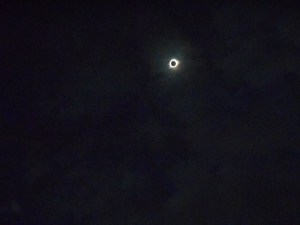
Photograph of total solar eclipse in Dillsboro, NC, August 21, 2017

When the partial eclipse transitioned into total eclipse at 2:35 pm, we could take off our viewing glasses and look at the sun unprotected for the minute and 50 seconds of totality. Nothing was visible of the sun during that time except its spectacular corona. I could see one star to the left of the sun. Everyone cheered and applauded when totality began and again when it ended. The birds started singing again as totality transitioned into partial eclipse.

The street lights came on during the twilight of total eclipse. If I had it to do again – which I don’t expect to – I would go to a place far away from any source of artificial light, and I would go the a place in the center of the total eclipse band. Even so, I have no regrets and feel fortunate to have had this opportunity. The last eclipse that could be seen in the Dillsboro area was July 20, 1506. The next one will be October 17, 2053. Since I’ll be 100 years old then, I don’t expect to see it.

When the eclipse was at about 50%, we could see what we thought to be a sunspot on the sun as we looked at the half-moon image on the paper under the telescope/binoculars setup. Unfortunately, the sunspot was too tiny to show up in the photograph I took.

Traffic!

It had taken less than an hour that morning to drive from Canton, North Carolina to Bryson City. After the steam train returned us to Bryson City after the eclipse, we enjoyed pizza at Nick and Nate’s Pizza across the street from the train station and headed back to Canton.

It wasn’t long before we caught up with bumper-to-bumper traffic. It took us three-and-a-half hours to drive back to Canton, so we were glad we’d taken time to eat supper in Bryson City.

A nice surprise

A nice surprise that morning in Bryson City was visiting O’Neil’s Shop on the Corner and finding a copy of my vintage postcard book, The Blue Ridge Mountains of North Carolina, prominently displayed near the bookstore’s entrance.

One of the shop’s owners, Tom O’Neill, asked me to autograph it and the other copy on another shelf. I was thrilled to find my book still available there! (I wrote about my first experience meeting Tom and Cynthia O’Neill in my December 30, 2014 blog post, O’Neill’s Shop on the Corner)

Solar Eclipse 8.21.2017 008
That’s me, proudly standing beside my vintage postcard book, The Blue Ridge Mountains of North Carolina, on display at O’Neill’s Shop on the Corner, Bryson City, NC.

It was a really nice day. We’d had such a good experience all day, the long drive back to Canton wasn’t so bad. We regretted that we were missing the NOVA program about the eclipse on PBS that night, but it turned out that we got to see it later in the week after we returned home.

Until my next blog post

I hope you have a good book to read. I’ve almost finished reading Hatteras Light, by Philip Gerard, for tonight’s meeting of Rocky River Readers Book Club.

If you’re a writer, I hope you have productive writing time.

Janet

Photo credits:  Marie Morrison


Race in America, and The Dry Grass of August

Today’s blog post highlights the first paragraph of The Dry Grass of August, Anna Jean Mayhew’s debut novel. That paragraph is a great hook, for it draws you in and conveys that there’s bound to be a good story in the coming pages. Here it is:

“In August of 1954, we took our first trip without Daddy, and Stell got to use the driver’s license she’d had such a fit about. It was just a little card saying she was Estelle Annette Watts, that she was white, with hazel eyes and brown hair. But her having a license made that trip different from any others, because if she hadn’t had it, we never would have been stuck in Sally’s Motel Park in Claxton, Georgia, where we went to buy fruitcakes and had a wreck instead. And Mary would still be with us.” ~ Anna Jean Mayhew in The Dry Grass of August

DryGrass
The Dry Grass of August, by Anna Jean Mayhew

The Dry Grass of August is a novel that takes you to the American South in the days of  lawfully-mandated racial segregation. It is written from the point-of-view of a 13-year-old white girl from Charlotte, North Carolina. It sheds light on how it was in the 1950s for a black maid, Mary Luther, traveling from North Carolina to Florida with her white employer, Mrs. Watts, and the four Watts children. Mary couldn’t eat in restaurants, couldn’t sleep in motels, and couldn’t use public bathrooms because they were the legal domain of white people.

Mary Luther is in constant but often subtle danger. She was, no doubt, apprehensive and in danger even when the members of the white family she was riding with were unaware. That unawareness is today referred to as “white privilege.” When one lives his entire life as a member of the predominant and ruling race, he enjoys privileges and advantages of which he isn’t even conscious.

The Watts children witness things along the way to Florida that open their eyes to how differently whites and blacks are treated in the United States. They cannot return home to Charlotte unchanged.

In light of the August 12, 2017 violence

I chose the opening paragraph of The Dry Grass of August as my blog topic for today many weeks ago. When I selected it and put it on my blog schedule, I had no idea I would be writing it in the aftermath of the tragedy in Virginia of last weekend. I did not anticipate writing a 1,000-word blog post around that paragraph.

Although published in 2011, The Dry Grass of August speaks to us today as, in light of the murder of Heather Heyer and other violence in Charlottesville, Virginia on August 12, 2017, Americans are having a conversation like never before about race relations. That conversation is long overdue and painful. It will not and cannot be a short conversation.

For all the progress that has been made between the races in my 64 years, it is abhorrent and repulsive to me that in 2017 there are Ku Klux Klan members, white supremacists, and Neo-Nazis not only living among us but being emboldened by the words, actions, and inactions of President Donald J. Trump. It is Mr. Trump’s lack of moral leadership that has added fuel to the fire and given bigots a green light to publicly spew their hate.

I had hoped to keep politics out of my blog, but I cannot remain silent. This is bigger than politics. This is morals and humanity and freedom. Freedom to live without fear. My blog is not a huge platform, but it does give me an avenue through which to speak. My blog has 1,300 followers from all over the world. I don’t want my blog followers in other countries to think Americans are vicious and at each other’s throats. That is not who we are.

Whereas the people who doggedly hung onto the myth that white people were a superior race used to cowardly hide their faces and identities under white hoods and robes, they now demonstrate and march with torches in regular street clothes. When they marched in Charlottesville last weekend, some of them were outfitted with helmets and shields, making it difficult for the anti-Nazi protesters to tell the difference between police officers and the white supremacists.

There is no room in the United States of America for Neo-Nazis and other hate mongers. The good citizens of this country cannot allow the current occupant of the White House to lead us down this destructive road by his lame condemnation of evil and his attempt to equate the people carrying Nazi flags with the people who were there to protest their hateful agenda.

Three of the founding pillars of the United States are freedom of speech, freedom of religion, and freedom to assemble. I’m glad I live in a country where people can voice their opinions; however, no American has the constitutional right to threaten, terrorize, or murder other people simply because of the color of their skin or the way they choose to worship God.

The United States is in a watershed moment. We will come out a better people on the other side of the current self-examination and soul searching because we are a good and decent people. We are not who Mr. Trump would try to make you think we are. We are so much better than that.

Until my next blog post

I hope you have a good book to read. If you’re a writer, I hope you have a good book to read while you write your next good book.

Janet


Anne Lamott’s Gems for Novelists

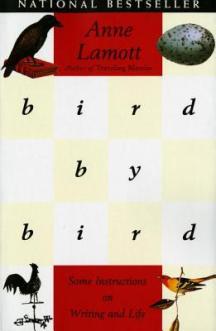
My blog post on August 7, 2017 (Late July Reading) was about the three books I read during the second half of July. I wanted to share more words of wisdom I gleaned from Anne Lamott’s book, Bird-by-Bird: Some Instructions on Writing and Life.

12543
Bird-by-Bird: Some Instructions on Writing and Life, by Anne Lamott

As I stated in that post, as someone learning the art and craft of writing, I enjoyed Bird-by-Bird, by Anne Lamott. The following quote from the book also sums up how I feel about good novelists.

“Ever since I was a little kid, I’ve thought that there was something noble and mysterious about writing, about the people who could do it well, who could create a world as if they were little gods or sorcerers. All my life I’ve felt that there was something magical about people who could get into other people’s minds and skin, who could take people like me out of ourselves and then take us back to ourselves. And you know what? I still do.”  ~  Anne Lamott

Ms. Lamott waxes poetic about what makes a book a good book. I cannot say it any better than she does in the first chapter. She writes about all the things books do for us.

She has some words of wisdom for people like me. One takeaway I took from the book was that I need to get over being a perfectionist.

Ms. Lamott talks about characters and gives tips about how to get acquainted with a character before you write about him or her. However, she cautions that you won’t really get to know your characters until “you’ve started working with them.”

My interpretation of one of her recommendations is for writers to focus on character and the plot will fall into place. You have to know what means the most to your protagonist so you’ll understand and can convey to the reader what is at stake in your novel. To quote her again:

“That’s what plot is:  what people up and do in spite of everything that tells them they shouldn’t,….” ~ Anne Lamott

Ms. Lamott writes about the parts of a novel and the importance of the writer paying attention to those details. If no one is changed in the course of the novel, it has no point. She writes about dialogue and how it must be written as real people talk. It’s essential to get voice right in order to get character right.

She writes, “We start out with stock characters, and our unconscious provides us with real, flesh-and-blood, believable people.” (I hope she’s right. I hope the unconscious part of my brain kicks in as I rewrite my manuscript for The Spanish Coin!)

All this is just the tip of the iceberg. She writes about a writer’s self-confidence and the importance of a novelist deeply knowing the setting for their novel. She says that a writer needs to recapture the intuition they had as a child and let that lead their opinions.

I could go on and on, but I’ll leave you with two more quotes from the book:

“Don’t look at your feet to see if you are doing it right. Just dance.” ~ Anne Lamott

“Risk being unliked. Tell the truth as you understand it. If you are a writer, you have a moral obligation to do this. And it is a revolutionary act –  truth is always subversive.” ~ Anne Lamott

Until my next blog post

I hope you have a good book to read. If you’re a writer, I hope you have productive writing time. I also recommend that you read Bird-by-Bird: Some Instructions on Writing and Life, by Anne Lamott.

Janet

Late July Reading

Another month has whizzed by and left me getting ever more behind in reading all the books I want to read, but July was another rewarding month of reading for me. I hope you’ll enjoy reading “my take” on the three books I read the last couple of weeks of July. On July 17 (Reading South Africa and South Carolina Novels) I blogged about the two books I read earlier in the month.

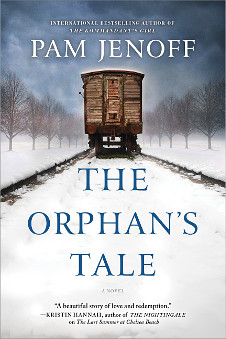
The Orphan’s Tale, by Pam Jenoff

I kept reading about The Orphan’s Tale, by Pam Jenoff and decided I wanted to read it. It was the first book I’d read by Ms. Jenoff, who has a fascinating background in government work. I look forward to reading her other books.

OTLarge
         The Orphan’s Tale,           by Pam Jenoff

The Orphan’s Tale revolves around a toddler who is rescued from the Nazis by a young woman who is no longer welcome in her parents’ home. She ends up being taken in by a circus and assigned to the trapeze, although she knows nothing about being an aerialist.

The woman assigned to train her resents her. Throughout this book of numerous twists and turns, the two women resent each other, support each other, and risk their lives for each other. It is a tale of humanity, forgiveness, trust, friendship, love, and loss set in Germany and France during World War II.

Bird-by-Bird:  Some Instructions on Writing and Life, by Anne Lamott

12543
Bird-by-Bird: Some Instructions on Writing and Life, by Anne Lamott

As someone learning the art and craft of writing, I enjoyed Bird-by-Bird, by Anne Lamott. In the book’s introduction she writes about learning to love books as a child. The following quote comes from the introduction:

“The act of writing turns out to be its own reward.” ~ Anne Lamott

I set out to write about the many things I liked about this book and the beautiful way Ms. Lamott writes about the many things a novelist needs to pay attention to in the writing process. It soon became obvious that today’s blog post would be longer than anyone wanted to read if I did that. Therefore, I will write about Bird-by-Bird in my August 14, 2017 blog post.

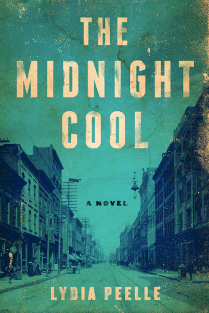
The Midnight Cool, by Lydia Peelle

I read this book because it was set in Tennessee during World War I. I haven’t read many novels set in that era and I wanted to learn more about it. I’m participating in the Read America Book Challenge from the Mint Hill Branch of the Public Library of Charlotte and Mecklenburg County. The object of that challenge is to read novels set in as many different US states as possible in 2017. Thirteen down and 37 to go. Seven months down and five to go. Hmmm. Not good.

static1.squarespace.com
      The Midnight Cool,         by Lydia Peelle

I was conflicted as I finished reading The Midnight Cool. Lydia Peelle has a way with words, but I found the book hard to follow since the dialogue was not enclosed within quotation marks. It was tedious to have to go back a couple of paragraphs at times in order to discern who was speaking.

I was interested in the subject matter, but the middle of the book did not hold my attention. I enjoyed the last 50 or so pages of the book, so I’m glad I didn’t give up on it. For all the hype of the book to be about mules for World War I and a killer horse, I found it to be more about the two men who traded in mules and the women they loved.

The book gave me some things to think about that I really hadn’t considered before, such as the massive number of mules the United States transported across the Atlantic in ships to pull artillery and do other hard labor in the Allies’ war effort in Europe.

I learned that horses have to be trained, but mules more readily reason things out. (Don’t hate me, horse lovers!) According to the book, the only thing the mules had to be trained in was being fitted with gas masks. Gas masks for mules was another thing that had never crossed my mind. This goes to show that you can learn things from reading well-researched historical novels.

The website, http://www.mountvernon.org/george-washington/farming/animals/father-of-the-american-mule/, confirms that George Washington was the “Father of the American Mule.” The site explains that there were advantages that mules had over horses in the Allies’ efforts in World War I in addition to their not needing much training. Mules eat one-third less than horses, they don’t need to drink as much water as horses, and mules are more surefooted than horses.

If Lydia Peelle writes another novel, I will check it out because she has a gift for turning a phrase and I believe she does her research.

Until my next blog post

I hope you have a good book to read. I’m reading Killers of the Flower Moon:  The Osage Murders and the Birth of the FBI by David Grann.

If you’re a writer, I hope you have productive writing time. I also recommend that you read Bird-by-Bird: Some Instructions on Writing and Life, by Anne Lamott.

Janet