I write southern historical fiction, local history, and I've written a devotional book. The two novels I'm writing are set in Virginia and the Carolinas in the 1760s. My weekly blog started out to follow my journey as a writer and a reader, but in 2025 it has been greatly expanded to include current events and politics in the United States as I see our democracy under attack from within. The political science major in me cannot sit idly by and remain silent.
Raise your hand if you are addicted to Pinterest. I am guilty.
I have boards on Pinterest about various aspects of writing, cooking, blogging, local history, the Blue Ridge Mountains of North Carolina (which just happens to also be the title of my vintage postcard book published by Arcadia Publishing), the North Carolina coast, quilting, Southernisms, hearing loss, and many of my other hobbies and interests.
If you follow my blog, you know that I generally write about books I’ve read, samples of my writing, or things I’ve learned about the art and craft of writing. I have a board on Pinterest called “Janet’s Writing Blog” where I pin each of my blog posts.
If you participate in Pinterest and have interest boards on the site, you probably get e-mails from Pinterest with suggested pins that might be of interest to you based on your boards. Those e-mails usually make sense; however, one I received a couple of weeks ago fell into the category of “sometimes I have to wonder.”
Considering the content I pin to my “Janet’s Writing Blog” interest board, why did Pinterest send me an e-mail titled, “A few new ideas for your board Janet’s Writing Blog” which included the following pins for me to visit?
“How much space do goats really need?”
“How to make homemade chicken feed – a simple formula.”
“Halloween Pumpkin Wall Clock A9 Nice for gift or home.”
“DIY Garden Fence.”
“Pinned for what they used to hinge the gate.”
“What to wear – frivolous Friday.”
Another one with a photo of a fence was titled, “So simple – inexpensive – would work for the dogs.”
And last but not least: “Small chicken coop and fenced area for egg laying.”
The Pinterest e-mail served a purpose, although not its intended one. It made me laugh. It loses some of its punch here since I can’t include the photos that accompanied each suggestion. As I scrolled down through the recommended pins for my Janet’s Writing Blog interest board, I laughed again and again.
I try to find something to laugh about every day. A good laugh, when not at the expense of another person, is good for the soul. Thanks, Pinterest!
I hope you have a good book to read. I’m reading The Quantum Spy, by David Ignatius; Last Christmas in Paris, by Hazel Gaynor and Heather Webb; A Gentleman in Moscow, by Amor Towles; and The Rooster Bar, by John Grisham. And, yes, sometimes I get the story lines and characters confused.
If you’re a writer, I hope you have productive writing time this week.
Sometimes a novel’s story summary sounds interesting but fails to deliver. Sometimes it’s a matter of it just not being the right time for you to read that particular book. Sometimes the opening “hook” does its job and pulls you into the story, but the following pages fall short and your interest wanes.
Life is short. There are too many good books out there to spend time reading one that does not measure up or appeal to you.
I used to think if I started reading a book, I owed it to the author to finish reading it. I no longer abide by that. When I joined a book club a few years ago at the Kannapolis branch of the Cabarrus County Library system, I was introduced to a “Reader’s Bill of Rights.” Perhaps you are familiar with it. It is attributed to Daniel Pennac in Better Than Life, published by Coach Press in 1996:
“Reader’s Bill of Rights
The right to not read
The right to skip pages
The right to not finish
The right to reread
The right to read anything
The right to escapism
The right to read anywhere
The right to browse
The right to read out loud
The right to not defend your tastes” – Daniel Pennac
If you do not live in the United States, “Bill of Rights” might be an unfamiliar term for you. That is what the first 10 amendments to the U.S. Constitution are collectively called. It is not coincidental that Mr. Pennac listed 10 items in his “Reader’s Bill of Rights.”
In the United States, we take for granted our access to books and other reading material. Millions of people in the world are not that fortunate. Americans tend to take free public libraries for granted until elected local government officials threaten to close libraries or radically curtail their hours of operation due to financial constraints. Many of them see libraries as an easy target. They see libraries as “fluff.” We suffered through this in the county in which I live during the downturn of the economy that started in 2008. What was taken from us in a proverbial “blink of an eye” took several years to reinstate.
We have wonderful public library systems in Cabarrus and Mecklenburg Counties in North Carolina. I utilize both systems most weeks. The Harrisburg branch of the Cabarrus County system is a very inviting hub of activity. When Harrisburg’s public library branch opened in 2001, our community started to feel like a real town.
I do not take my right to read lightly. I hope you have the right to read anything you want to read. As you can see from the table of flags on this blog page, people from at least 73 different countries have read my blog. When I write my blog posts, I try to be mindful of that.
Some of my readers live in countries where there is no free press and there are heavy prices to pay (such as prison life at hard labor or even execution) if you read something that is banned. Knowing that a few individuals in such countries are putting themselves at risk by reading one of my blog posts has put unexpected pressure on me.
Please don’t take your right to read for granted! This Thanksgiving season in America, I’m thankful for my right to read and for free public libraries.
Until my next blog post
I hope you have a nice Thanksgiving Day with family and friends.
I hope you have a good book to read. I’m reading Quantum Spy, by David Ignatius.
If you are a writer, I hope you have quality writing time.
I hope you live in a country where you have the freedom to write and read anything you want.
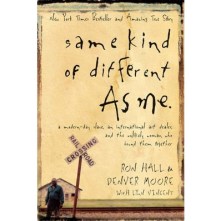
For today’s blog post I’m highlighting two sentences from Same Kind of Different As Me, by Ron Hall and Denver Moore with Lynn Vincent. You may recall that I read this nonfiction book in September and commented about it in my October 2, 2017 blog post, Some Great September Reads.
Same Kind of Different as Me, by Ron Hall and Denver Moore, with Lynn Vincent
“ʻEver man should have the courage to stand up and face the enemy,’ I said, “ʻcause ever person that looks like a enemy on the outside ain’t necessarily one on the inside. We all has more in common than we think.’” – Homeless man Denver Moore speaking in Same Kind of Different As Me, by Ron Hall and Denver Moore with Lynn Vincent.
Lessons to learn
We can all probably learn many lessons from Same Kind of Different As Me. I think the theme of the book is that under the pigment shade of our skin, we are all the same. When we judge others based on their outward appearance, we often rob ourselves of an opportunity for making a new friend, or at the very least, an opportunity to have cordial interaction with a stranger.
I’m not naïve enough to advocate that we just approach strangers willy-nilly and befriend them. There are people out there who are up to no good; however, that is not a good excuse for being afraid of everyone who does not look like we do.
Polarization in America
In our current polarized population in the United States, it seems we’re becoming more a nation of “they” and “us” than the “melting pot” I grew up learning about in history classes. We tend to fear the unknown. As long as our fellow citizens whose skin is a different shade from our own are seen as people to be feared or as an enemy, we will continue to be a divided people and none of us will be able to reach our potential. Our nation certainly won’t reach its potential until we learn how to get along with one another.
This applies to people of another racial or ethnic background, but it also applies to people who espouse political stances different from our own. I’m old enough to remember when Democrats and Republicans could agree to agreeably disagree. Now it seems that neither side has any desire to try to reach common ground on any issue.
Discovering the fun of compromise
As a political science major in college, one of the courses that still stands out in my memory is the one called The Legislative Process. Going into the course, I wasn’t very excited. I had never been a political person. I was studying political science to prepare myself for a career in city management (or so I thought.) Much to my surprise, The Legislative Process turned out to be an invigorating course.
Class members were arbitrarily divided into two groups. Each group was assigned a piece of legislation they had to fight to get passed. Of course, the two proposed laws were polar opposites of each other. The two groups had to work together and create a compromise bill.
I recall that one day when the bell rang and we were supposed to leave the classroom so another class could come in, the professor struggled to get us to stop debating and leave. Although we knew we could pick up where we left off at our next class meeting two days later, we were so wrapped up in the process – and HAVING SO MUCH FUN – that we didn’t want to stop. I have forgotten many of the intricacies of that political science course, but I accidentally learned that compromise can be fun.
The “takeaway”
Let’s stop being afraid of one another and start letting ourselves find the fun and joy that come from interacting with one another and finding common ground. And when we cannot readily find common ground, let’s remember how – or learn how – to compromise.
Find a place for compromise in your own life and work to get compromise back into the vocabulary and mindset of our local, state, national, and world leaders.
When I sat down to write about those two sentences from Same Kind of Different As Me, I thought I knew where I was going. I anticipated writing a short, maybe 300-word blog post. Like life and the legislative process, though, writing has many surprises. One of them is that this blog post is approaching 1,000 words.
Until my next blog post
I hope you have a good book to read. David Ignatius’s new thriller, The Quantum Spy is in transit to me at the public library. I have enjoyed his other novels, so I’m looking forward to reading this one.
After being overwhelmed this year with books I wanted to read, I plan to cut back somewhat on my reading for a while and spend more time on my writing. It is said that one has to read a lot in order to be a good writer.
I’ve learned a lot from the many good books I’ve read in 2017, and now I look forward to putting some of that new knowledge into practice by getting back to work on my historical novel manuscript with the working title, The Spanish Coin.
It’s been fun to work on my manuscript’s outline the last few days. There’s another surprise! I never thought I would use the words “outline” and “fun” in the same sentence. Outlining a work of fiction is hard work but, when I’m in the proper frame of mind, it can also be fun.
If you are a writer, I hope you have found the perfect balance between reading and writing. I hope you have productive writing time.
I’ve read some very good books this year, and it’s been a pleasure to share my thoughts about them on my blog. Today’s blog post highlights the five novels I read in October. Four of them (Love and Other Consolation Prizes, by Jamie Ford; The Deep Dark Descending, by Allen Eskens; The Last Ballad, by Wiley Cash; and The Stolen Marriage, by Diane Chamberlain) were published in October. The other book, News of the World, by Paulette Jiles, was published in October of 2016.
Love and Other Consolation Prizes, by Jamie Ford
Love and Other Consolation Prizes, by Jamie Ford
I eagerly awaited the release of Jamie Ford’s latest novel, Love and Other Consolation Prizes, and it did not disappoint. After hearing Mr. Ford speak at the Bookmarks Festival of Books and Authors in Winston-Salem, North Carolina in September, I really looked forward to reading this book. My September 18, 2017 blog post, Bookmarks Festival of Books and Authors, was about that festival and the seven authors I got to hear speak.
Historical fiction is near and dear to my heart, so it’s no wonder that I enjoyed reading Love and Other Consolation Prizes. Mr. Ford took a reference to an actual shocking event at the 1909 Alaska-Yukon-Pacific Exposition held in Seattle, Washington and created a powerful story about the young boy named Ernest who was raffled off at the Exposition. Yes. You read that correctly. Something different was raffled off each day of the fair, and one day it was an orphaned child!
The Chinese slave trade around the turn of the 20th century and the thriving red light district of Seattle in the early 1900s provided the perfect backdrop for this book. Mr. Ford gives us chapters set in 1909-1911 and chapters set in 1962 around the World’s Fair in Seattle so we can follow the amazing fictional life of Ernest – a mixed race boy from China.
The Deep Dark Descending is a dark story of just how deeply a person can descend when his anger, bitterness, and desire for revenge become an obsession.
In this novel, Minneapolis homicide detective Max Rupert sets out to find and punish the person or persons who murdered his wife. The case had been ruled an accident, but Rupert could not accept that.
The Deep Dark Descending takes the reader to the frigid Minnesota-Canada border and a frozen lake. Put this novel on your winter reading list.
The Last Ballad, by Wiley Cash
The Last Ballad, by Wiley Cash
The Last Ballad is author Wiley Cash’s newly-released novel. It is set in Gaston County, North Carolina and is based on the life of textile millworker Ella May Wiggins. Ms.Wiggins was murdered in Gastonia, North Carolina in 1929 during a riot that resulted from efforts to organize the millworkers into a union. Labor unions have never been popular in the state, and that was definitely the case in the textile industry in the early 20th century.
Although I grew up an hour from Gastonia, I had never heard about this incident. In fact, Wiley Cash is a native of Gastonia and he only recently learned of it.
The Last Ballad takes the reader into a world of poverty inhabited by both black and white millworkers in the 1920s. Ms. Wiggins was a white single mother who lived in an otherwise black neighborhood. She was instrumental in trying to get her black neighbors and co-workers the right to strike for better wages. The white workers didn’t have the right to strike either, but until Ms. Wiggins pushed the point, the possibility of black workers going on strike was unimaginable in that time and place.
This is a story of a woman’s courage as she fought for better working and living conditions for her children and her neighbors.
After having met Diane Chamberlain at the On the Same Page Book Festival in West Jefferson, North Carolina last year (Diane Chamberlain Author Event )and enjoying two of her other novels (Pretending to DanceA Novel’s First Line and The Secret Sister Books I’ve been reading), I got on the waitlist for The Stolen Marriage as soon as it was “on order” at the public library. The novel’s October 3, 2017 release date finally arrived!
I love it when I can read an expertly-written novel and learn something at the same time. Like Wiley Cash’s The Last Ballad, Diane Chamberlain’s The Stolen Marriage delivered in a big way. I regret that I cannot read The Stolen Marriage again for the first time. It was that good!
The Stolen Marriage was inspired by the true story of the citizens of Hickory, North Carolina building – and getting up and running – a hospital for polio patients in just 54 hours in 1944. Being a native of North Carolina, born in 1953, this is another piece of history that I didn’t know. It was an amazing feat in this small town in Catawba County, and it was covered by Life magazine. In historical literature, it is referred to as “The Miracle in Hickory.”
The fictional story Ms. Chamberlain created around this event is one of trust, love, and betrayal. There are numerous plot twists in this novel. It will keep you up at night turning pages.
News of the World, by Paulette Jiles
News of the World, by Paulette Jiles
The premise and title of News of the World, by Paulette Jiles, intrigued me when I read a blurb about it, so I borrowed it from the public library.
This is a tale of a fictional character known as Captain Kidd who traveled around Texas in the 1800s getting paid to have public readings of articles from various newspapers. Many people were illiterate and newspapers were rare in the region.
Captain Kidd agrees to return Johanna, a young white girl, to her family in southwest Texas. Years earlier, Johanna had been kidnapped by the Kiowa tribe of Native Americans. Being raised by the Native Americans, Johanna had no recollection of the habits and mores of her white family.
Johanna and Captain Kidd had a shaky and unpredictable relationship as Kidd tried his best to fulfill his promise to return Johanna to her family. Their journey across Texas is filled with misunderstandings, attacks by outsiders, challenging traveling conditions, and additional attempts to kidnap Johanna. The two of them gradually learn how to communicate and co-exist.
News of the World is the second novel I’ve read recently that did not use quotation marks in dialogue. I guess I’m just old-fashioned, but I don’t like this practice. When I have to stop and think or reread something in a novel to figure out what’s narration and what’s dialogue or who’s talking, it pulls me out of the story and reminds me I’m reading. I’m sure dropping all the quotation marks saved the publisher some money, but I hope this doesn’t become common practice.
Until my next blog post
I hope you have a good book to read. I seem to have trouble “getting into” a book at the moment. I’m more in the mood to write than to read, so I’m taking advantage of that. The last several days I’ve worked on the timeline and outline for my historical novel I’m calling The Spanish Coin. I’ll keep you posted.
If you are a writer, I hope you have quality writing time.






 Janet's Writing Blog