#FixYourNovel #4: Characterization, Part 1

Are the characters distinguishable, what are their motives, and are their arcs in the right places?

Photo by Kaitlyn Baker on Unsplash

I’ve been trying to get up the nerve to publish today’s blog post for months. Who am I to have the audacity to attack such a topic? I haven’t even published my first novel.

Perhaps I should have left #FixYourNovel #4:  Characterization on the back burner until I had more writing experience. However, to be perfectly honest with you, I got tired kicking the can down the road. I got tired revamping my blog’s editorial calendar and shifting this topic further into the future.

I hope readers and writers will find something of interest in today’s post.

In my journey as a fiction writer, I’ve read about all aspects of the craft of writing. New articles and how-to books are published every day. It’s impossible to keep up.

Today’s blog post is a combination of the things I’ve read about characterization by people who know more about that skill than I do. It’s my job as an aspiring fiction author to wade through all the advice, discern what’s worth keeping, and try to put those gems into practice.


Author Kristin Lamb’s take on characters

I read a September 23, 2019 article by author Kristin Lamb several weeks ago and immediately added it to my resources list for today’s blog post. I love the title of Ms. Lamb’s article: “Characters: Audiences Read Stories, but Great Stories Read the Audience.” It pulled me right in. Her article can be found at https://authorkristenlamb.com/2019/09/characters-story-audience/.

Of course, I had to keep reading to find out what she meant. In a nutshell, Ms. Lamb said that every reader reads a book through their unique perspective. The character in a novel has “baggage,” but so does the reader. The reader brings her “baggage” with her but so does the reader. The reader brings her “baggage” with her into the story and that completes how an individual reader sees a character.

If there are three main characters in a novel and three people read it, it’s possible that each reader will identify with a different character due to the readers’ backgrounds and life experiences.

Photo by Frank Holleman on Unsplash.com.
Photo by Etty Fidele on Unsplash.com.
Photo by Pablo Rebolledo on Unsplash.com.

Also, I think “Great Stories Read the Audience” is an excellent way of saying a writer must know her target audience. I could try to write a novel that would appeal to everyone, but the finished product would probably appeal to no one.


Proofreader Louise Harnby’s take on characters

In https://www.louiseharnbyproofreader.com/blog/unveiling-your-characters-physical-description-with-style­­­­, Louise Harnby addresses how a writer needs to make her characters distinguishable. Some writers tell the reader what a character looks like or gives hints.

One method is to do what Ms. Harnby suggests:  let the viewpoint character describe another character, but don’t let it sound like a description in a police report. The reader doesn’t need to know every detail of how a character looks. Tell what is different about a character. Give each character a distinguishing physical or personality trait.


Author, editor, and writing coach Lori Freeland’s take on characters

Something Lori Freeland says in her June 3, 2019 blog post, https://writersinthestormblog.com/2019/06/down-with-the-rules/, also addresses a method a writer can use when describing their characters. It’s a twist on bending or breaking the writing “rule” that says a character shouldn’t describe herself or himself.

Ms. Freeland writes, “Main characters can describe themselves if they do it right…. Go ahead. Put your character in front of a mirror. But make it a funhouse mirror that emphasizes her faults and grows them larger than life.”

In this blog post, Ms. Freeland also comments about motivation. A writer needs to tell the reader what motivates a character. This clarifies the story.

To quote Ms. Freeland, “The internal journey of your character is as crucial as the external journey.”


Australian Fantasy Author Douglas W.T. Smith’s take on characters

Douglas W.T. Smith wrote about characters, voice, and dialogue in his April 9, 2019 blog post, https://dwtsmith.wordpress.com/2019/04/09/five-ways-to-improve-your-characters-voice-and-dialogue/.  He states something important about characters and dialogue:  “Remember, if the dialogue doesn’t advance the plot, give insight into characters, or show relationships between characters, it should be deleted.”

Mr. Smith goes on to talk about how a writer can make characters distinguishable by giving each one a unique speech pattern or word choice. From there he reminds the aspiring writer that all dialogue in a novel should be necessary and should move the story forward; otherwise, it is unnecessary.

Some things are better told through narrative. Mr. Smith writes, “Use dialogue when it’s needed – when it will show relationships or reveal character or plot the way no other tool will.”


Back to Louise Harnby

Related to that last quote from Douglas W.T. Smith, is this comment Louise Harnby made in https://www.louiseharnbyproofreader.com/blog/writing-dialogue-and-thoughts-8-problems-and-how-to-fix-them­­­­­:  “Dialogue should be purposeful. If you’re using it to introduce information, have the characters seek answers to questions they don’t know the answers to. Unveil backstory that’s known to the speakers through the narrator, not the speech.”


Author and Writing Instructor Janice Hardy’s take on characters

Janice Hardy’s April 30, 2014 blog post, http://blog.janicehardy.com/2014/04/five-ways-to-create-likable-characters.html, is titled “Five Ways to Create Likable Characters.”  This brings up a whole other aspect of characterization. As if making each character look and sound different from every other character weren’t enough, a novelist needs to make most of their characters likeable.

Ms. Hardy prefaces her list of five ways to create likable characters by cautioning writers not make the characters perfect. She says, “There’s a fine–and often moving–line between likable and perfect, which can make it difficult to create a well-balanced likable character.”

Ms. Hardy’s blog post goes into detail about how to make a character likable and how to make each character distinguishable, so please click on the link above and read her entire post if you want to learn more.


Until my next blog post

At my own risk, I’m announcing that my blog post next Monday will be a continuation of today’s. If the topic doesn’t interest you, please check in again in two weeks when I’ll write about some of the books I’ve read in February.

I hope you have a good book to read. I’m listening to The Long Petal of the Sea, by Isabel Allende while I’m partially-incapacitated with my fractured leg.

If you’re a writer or other artist, I hope you have quality creative time.

Thank you for reading my blog post. You have many things vying for your attention and time, so I appreciate the fact that you took time to read my blog today. I hope you’ll visit it every week to see what I’m up to.


Let’s continue the conversation

Do you prefer to read plot-driven novels or character-driven novels? If you’re a writer, which do you prefer to write?

Janet

Three More Books I Read in January 2020

Today’s blog post is a follow up to last Monday’s. I read six books in January and I’ve split them up between last week’s blog and today’s. I hope you’ll find a book among the six that piques your interest.


The Sins of the Father, by Jeffrey Archer

Book Two in Jeffrey Archer's Clifton Series, The Sins of the Father.

I only have myself to blame. Why I thought it was a good idea to read the second book in Jeffrey Archer’s Clifton Chronicles Series before reading the first book, Only Time Will Tell, is a mystery. The Sins of the Father ended with a cliff hanger that compels me to read the third book in the series, Best Kept Secret; however, I feel even more compelled to read Only Time Will Tell next.

The Sins of the Father is based on the premise that Harry Clifton assumes the identity of another sailor during World War II. He lands in an American jail for this offense. Meanwhile, Giles Barrington is assumed to be the heir to the Barrington estate. Harry’s love, Emma Barrington, gives birth to a son whose parentage is a mystery. Harry’s parentage is also in question. Who will inherit the Barrington estate? Will the real Harry Clifton please stand up? Not in The Sins of the Father. The case of which man is the lawful inheritor of the estate goes to court, but court is adjourned in the last sentence of The Sins of the Father, without a verdict declared.

This was an enjoyable read for me. Working through my to-be-read list, I’ll eventually get to Only Time Will Tell and then to the remaining five books in the Clifton Chronicles.

Let this be a lesson for me:  Always start reading a fiction series by reading the first book in the series!


Keeping Lucy, by T. Greenwood

I must admit that I didn’t finish reading Keeping Lucy. It held much promise. The scenario is a woman gives birth in 1969 to a Down’s Syndrome infant girl. While she is recovering from a hard delivery, her husband and father-in-law secretly have the days old infant moved to a institution that “cares” for such children.

That secret arrangement goes over with the mother like a lead balloon. I enjoyed the book to that point and was eager to see what happened. Unfortunately, I stopped liking the mother. For starters, she didn’t try to see her daughter for two years. What mother would let her husband dictate that?

Spoiler alert:  when the mother finally goes to see the two-year-old daughter without telling her husband, she finds the toddler is a victim of horrendous neglect. I won’t go into the gory details, but things were really bad. The mother checks Lucy out of the institution for a long weekend but vows she will never take her back to the facility.

I was trying to forgive the mother for not visiting her daughter for two years, but instead of taking Lucy to a pediatrician or an emergency room and reporting the abuse to the authorities, she tries a home remedy to purge Lucy of the parasites with which she is infected. This is a mother who is financially very comfortable. She doesn’t take the action I think any mother would take because Lucy isn’t on the family’s health insurance policy.

That’s when I had to close the book. I was disappointed. I liked an earlier novel by T. Greenwood, Where I Lost Her. I wrote favorably about it in my May 2, 2017 blog post, “What I Read in April.” (I can’t seem to make a clickable link to that post today.) Maybe I was just in a bad mood when I read the first 14 chapters of Keeping Lucy. I really wanted to like it.


Twisted Twenty-Six, by Janet Evanovich

Years ago, I enjoyed reading the first 15 to 20 books of Janet Evanovich’s Stephanie Plum series. Either I’ve aged out or just become bored with Stephanie Plum’s escapades. The latest books in this series just haven’t made me chuckle, much less laugh out loud like her earlier books did. I’ll probably not read the 27th book in this series.


The Broker, by John Grisham

I’ve read only 18 of John Grisham’s novels, so I’m still playing catch-up. The Broker was published in 2005, so many of you read it a long time ago.

In this suspense novel, Joel Backman is “the broker.” He has ended up in prison for hacking into a spy satellite system the US didn’t know about. After six years of incarceration, the government decides he can do them more good on the outside than in prison.

The out-going US president grants Backman a pardon hours before leaving office. Backman is whisked out of the country, where he is to live out his life in something similar to the Witness Protection Program. Notice I said “similar.”

Spoiler alert: In truth, the whole thing is a CIA setup. The bad guys track Backman down. They are supposed to kill him.


Since my last blog post

I’ve spent the last two weeks either in bed or in a chair with my leg in an immobilizer. I’ve tried reading other blogs on my tablet and leaving a few comments, but our internet service isn’t the best. Sometimes it works better than other times. It’s frustrating after being used to using the desktop computer. That’s where I am for a few minutes, so I can finish writing this post and get it scheduled to go out.


Until my next blog post

I’ll have more x-rays and see what the orthopedic doctor has to say about my fractured leg. I’m not in pain, which is an encouraging blessing. I’m growing weary of the immobilizer and not being able to put any weight on that leg. I need some patience, and I need it NOW!

I have a good caregiver, and for the foreseeable future I don’t have to cook or wash dishes. There’s the silver lining! My planned blog posts the next two weeks is about characterization in fiction. I’ve worked on these posts off and on for a while. If I can get the material pulled together and edited to my satisfaction, that’s what I’ll post on February 17 and 24. If that doesn’t pan out, I’ll try to come up with something else that won’t bore you to tears.

I hope you have a good book to read. I’m reading Diane Chamberlain’s new novel, Big Lies in a Small Town.

If you’re an artist or writer, I hope you have quality work time this week.

Thank you for reading my blog. You have many demands on your time, so I appreciate your taking a few minutes to read my blog. If you like what you see, please share my blog with your friends.

Janet

Three Books I Read in January 2020

The first Monday of the month seems to come around faster and faster, and it’s time for me to blog about the books I read the previous month. As usually happens, I have to divide the books I read the month before into two blog posts. No one wants to read a 2,000-word blog post.

I read approximately 6.5 books in January. Today’s blog post is about three of them. I’ll write about the other 3.5 books next Monday.

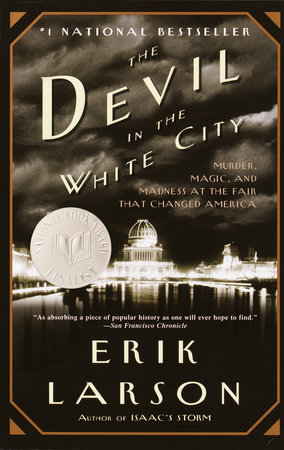
The Devil in the White City:  Murder, Magic and Madness and the Fair that Changed America, by Erik Larson

This book pleasantly surprised me. From the title, I wasn’t sure I’d like the book, but it’s an excellent piece of creative nonfiction.

The Devil in the White City: Murder, Magic, and Madness at the Fair that Changed America, by Erik Larson

I didn’t know the history of the World’s Fair:  Columbian Exposition except that it was held in Chicago to mark the 400th anniversary of the “discovery” of America by Christopher Columbus’s.

Chicago was a rough-and-tumble place at that time, known primarily for the slaughterhouses located there. The city was in competition with Washington, DC as the site of the fair.

When Chicago was selected, the depth of the bedrock immediately became a source of concern for the fair’s planners, architects, and construction engineers. The weight of the fair’s proposed buildings and the poor soil were difficult to overcome with the construction equipment of the day. I found that aspect of the book to be fascinating.

The fair was planned, built, and held with a backdrop of mysterious disappearances and murders in Chicago. As the title suggests, that comes into play. The murderer is a physician.

The mandate the Chicago fair had was to “out-Eiffel Eiffel.” The grand Eiffel Tower was built as part of the 1889 World’s Fair in Paris, so the Chicago fair authorities were under a lot of pressure to construct something more amazing at their fair. That turned out to be the Ferris wheel, although that first Ferris wheel was made up of “cars” that could hold 20 passengers. The construction details about the Ferris wheel were interesting to me. Being the daughter of a structural steel draftsman, I grew up being exposed to discussions and an appreciation of such things.

Mingled in with the details of the construction and operation of the fair itself are tidbits of the personal lives of the people involved such as landscape architect Frederick Law Olmstead, who was also working on the Biltmore Estate in Asheville, North Carolina at the same time.

Reference is also made to some of the new inventions that were introduced to the public at the Chicago fair, including zippers, Juicy Fruit chewing gum, Cracker Jacks snack, moving pictures, the vertical file, shredded wheat cereal, and Aunt Jemima’s pancake mix in a box.


A Minute to Midnight, by David Baldacci

A Minute to Midnight is David Baldacci’s latest novel and the second book in his Atlee Pine thriller series. I’ve only read five of Mr. Baldacci’s books, so I’ve missed a lot of his work. I missed the first book in this series, Long Road to Mercy. I’ll definitely read it before the third book in the series is published.

A Minute to Midnight, by David Baldacci

Atlee Pine is an FBI Special Agent. In A Minute to Midnight, she returns to her small hometown in Georgia to try to find answers to some nagging questions about her family. In the process of finding out some startling information about her parents, she is drawn into the investigation of several local murders. Who is the murderer? Are these murders – which are rare in this small town – somehow connected to Pine’s presence in the community?

Mr. Baldacci takes us on an eerie journey as he ties in the morbid history of the infamous Andersonville prisoner-of-war prison of American Civil War days. The prison’s cemetery plays a part in this novel, as that is where the murderer likes to leave his victims.


The Lies We Told, by Diane Chamberlain

In this novel, Diane Chamberlain takes us into a devastating hurricane on the North Carolina coast. There is massive flooding in the southeastern portion of the state, and we’re soon caught up in the lives of two sisters who just happen to be doctors. Each sister tries to do her part to help in the aftermath of the hurricane. Their duties take them to different directions and a breakdown of telephone communications results of their not being able to communicate for two long weeks.

The Lies We Told, by Diane Chamberlain

The sisters have a history of secrets that date back to the day their parents were murdered. One sister desperately wants children, while the other one is wrapped up in her career and doesn’t let herself have dreams of a family of her own.

There is a helicopter crash and one of the sisters cannot be located at the crash scene. She’s found by a local citizen and taken to his home for recovery. There are undertones of trouble within that home, though. Tensions rise because the small rural community is cut off from the mainland by the flooding, and the wife’s baby is due at any time.

I got a little weary of the part of the book that gave details of rescue efforts, but I’m glad a stuck with it. The ending was worth the wait.


Since my last blog post

Since my blog post last Monday, I had a freak accident and broke my right tibia. Therefore, you won’t see me as much on social media as usual.


Until my next blog post

I’ll be seeing an orthopedic surgeon to see what the plan of treatment will be for the next months. I hope I’ll get to blog about the other books I read in January next Monday.

I hope you have a good book to read. I’m listening to The Cold, Cold Ground, by Adrian McKinty, a novel set in Carrickfergus, Northern Ireland.

If you’re a writer or other artist, I hope you have productive creative time.

Thank you for reading my blog post. You have many things vying for your attention and time, so I appreciate the fact that you took time to read my blog today.

Janet