#Idiom: Reading the Riot Act

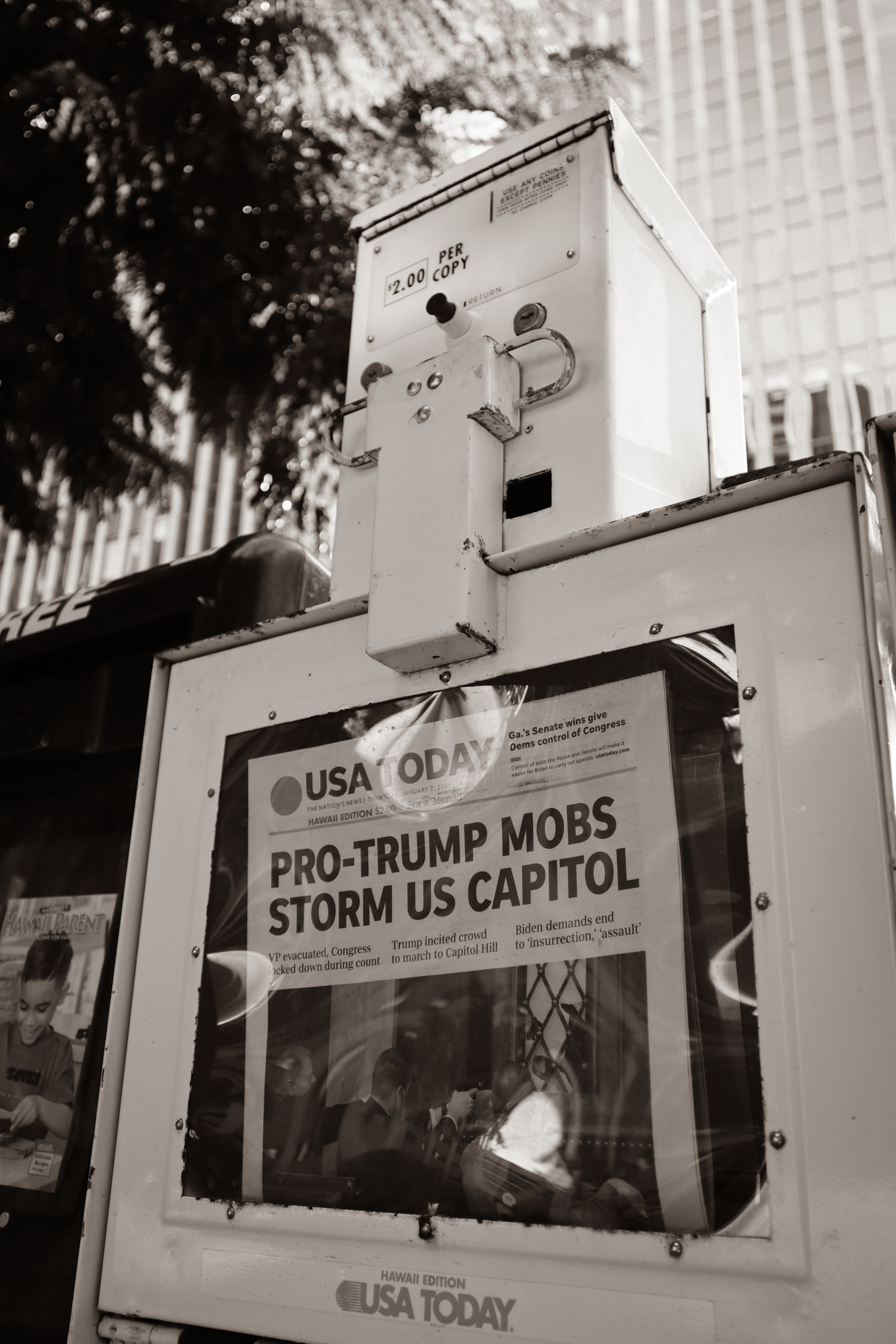
Just so you’ll know, I wrote this blog post, except for the “Since my last blog post” and “Until my next blog post” a month or more ago when I had no idea there would be an attempted coup at the US Capitol in Washington, DC on January 6, 2021. There had been rumors of political demonstrations in support of the man who lived in the White House until he moved to Florida on January 20, but I had no idea it would be a day of insurrection against the United States of America.
#Insurrection #FailedCoup
Photo Credit: Little Plant on Unsplash.com

The word “riot” does not adequately describe what happened on January 6, 2021. The word “riot” is far too tame to use in talking about that event. What happened that day outside and inside the US Capitol was not a riot; it was an act of domestic terrorism, an insurrection, and attempted coup incited by the man poorly-holding the office of president of the United States at the time.

Nevertheless, the following gives some of the background for the “Reading the Riot Act” idiom.

Reading the Riot Act

Have you ever wondered where the idiomatic expression, “reading the riot act” and its variations originated? I’ve heard the expression all my life, but I couldn’t have given a definitive answer if asked about its origins. As I’ve said before, the evolution of the English language fascinates me, so this will probably be the first of many blog posts I’ll write about idioms.

Another reason for my interest in idioms is, as a writer of historical fiction, I must be careful not to use a word or phrase in a story set at a time before that particular word or phrase came into usage. For many years, I’ve relied on English Through the Ages, by William Brohaugh, to guide me in the use of individual words and their meanings through time. Published by Writers Digest Books in 1997, this is an invaluable resource for writers of historical fiction.

However, I’ve recently come to know the book, The American Heritage Dictionary of Idioms: The Most Comprehensive Collection of Idiomatic Expressions and Phrases, by Christine Ammer. That collection of idioms and idiomatic expressions has opened my eyes to a whole new aspect of my need to be mindful of the use of words and phrases as I write fiction mostly set in America in the 18th and 19th centuries.

I’ve been surprised over and over again by the advent of some familiar idioms. And it’s made me feel old to find so many have only just come into general use during my lifetime. English is an ever-changing and evolving language.

What’s an Idiom or Idiomatic Expression?

An idiom or idiomatic expression is a group of words in usage whose meaning is not self-evident by considering the individual words.

If you’re familiar with the expression, “reading the riot act,” you probably know its meaning. According to The American Heritage Dictionary of Idioms: The Most Comprehensive Collection of Idiomatic Expressions and Phrases, by Christine Ammer, to read the riot act means to “warn or reprimand forcefully or severely.

It is thought that the first use of the figurative phrase “read the riot act” in print was in William Bradford’s Letters in 1819. This idiom has been in common use since the early 1800s, but exactly what was the riot act that inspired the expression?

The Riot Act of 1714

There was much unrest in Britain early in the eighteenth century. There were riots in 1710, 1714, and 1715, and the existing laws were inadequate to control the situation. The Riot Act of 1714 gave local officials a proclamation that was part of an Act of Parliament to read to a group of 12 or more people who were illegally assembled.

Here’s the wording of the proclamation that had to be read:

“Our Sovereign Lord the King chargeth and commandeth all persons, being assembled, immediately to disperse themselves, and peaceably to depart to their habitations, or to their lawful business, upon the pains contained in the act made in the first year of King George, for preventing tumults and riotous assemblies. God Save the King!”

You may recall the reading of Miranda Rights I blogged about on December 21, 2020 — Who said the world would end today? — . In like manner of police officers reading the Miranda Rights to a crime suspect in the United States today, a magistrate, mayor, bailiff, sheriff, or justice of the peace in Britain had to read the Riot Act in an effort to break up an unruly crowd. But that’s where the similarity ends.

The Riot Act of 1714 mandated that the people had an hour to disperse or otherwise be charged with a felony. The punishment for noncompliance was the death penalty! That was also the punishment for anyone interfering with the reading of the proclamation.

In actuality, if an assembled group’s rabble rousing escalated, the authorities didn’t have to wait an hour before making arrests.

What precipitated the Riot Act of 1714 ?

Parliament passed the Riot Act in 1714 – the same year George I became King of Britain – and it took effect in August 1715. The Crown feared that Jacobites (Scottish Roman Catholics – mostly Highlanders — who wanted to return James II of England and VII of Scotland and his descendants to the throne in London) would overthrow the government. In fact, the Jacobites invaded England in 1715 and again in 1745. They were eventually defeated at the Battle of Culloden. If the Jacobites had been successful, Roman Catholicism would have become the official religion throughout Britain. But I digress.

Was the Riot Act of 1714 always effective?

Of course not. I found the following two examples:

(1)        There’s conflicting information regarding the act’s effectiveness in 1839 at the Newport Rising. Some reports say the mayor was able to read the entire proclamation, while other reports say he was shot was attempting to read it from a hotel window; and

(2)        It is thought that the last time a sheriff tried to read the Riot Act was at the Battle of George Square in Glasgow, Scotland. People were protesting for shorter work hours on January 31, 1919. There was a confrontation with police. While the sheriff attempted to read the Riot Act, the piece of paper was grabbed out of his hands by protestors. That was apparently the proverbial last straw for the Riot Act of 1714.

According to the UK Parliament website, The Riot Act of 1714 was repealed in 1973, but it hadn’t been enforced in more than a half century. A version is still on the books in Canada.

Since my last blog post

I checked several weeks ago to see just how many blog posts I’d written. Much to my surprise, today’s post is my 500th. Yes, five hundredth! Thank you to those of you who have stuck with me through thick and thin since my first blog in 2010.

Joseph R. Biden has been sworn in as President of the United States, and Kamala Harris has been sworn in as the first female and the first person of African and Asian descent to the office of Vice President of the United States. I think the world took a collective sigh of relief at 11:49 a.m. Eastern Standard Time on January 20, 2021. I know I did!

I had a bit of a health scare last week, which prompted me to get an appointment on Saturday for a Covid-19 test at a local pharmacy. I’m feeling much better now, so I’m fairly confident that the results will come back “negative.” Better safe than sorry, though. I was pleased with how easy it was to schedule the test. Too bad it’s not as easy and timely to schedule an appointment to receive the vaccine. I believe that’s improving, though, here in the United States.

Until my next blog post

I hope you have a good book to read or a good book to write.

Find your passion and make time to pursue it in a creative way.

Wear a mask and get the Covid-19 vaccine as soon as you can.

Thank you for dropping by my blog today.

Janet

Fictional Characters Can Take on Lives of Their Own

In the aftermath of January 6, 2021, today’s topic seems frivolous; however, life goes on and I’m trying to stay true to the purpose of my blog. I want to write about the reading and the writing of books. I don’t want to dwell on politics in my blog postings even though it dominates my thinking.

Happy Birthday, A.A. Milne!

Today is Alan Alexander Milne’s birthday, or to put it more accurately, this is the 139th anniversary of the birth of British author A.A. Milne. He was, of course, the creator of Winnie the Pooh. A stuffed bear Milne named Winnie the Pooh has entertained children and adults since the book by that name was published October 14, 1926.

Photo Credit: Annie Spratt on Unsplash.com

Did you know that Milne originally called Christopher Robin’s stuffed bear Edward? There’s an interesting World War I story there, if you want to look it up. There’s a connection with a black bear from Canada named “Winnie” for Winnipeg.

In addition to Winnie the Pooh, there are numerous other fictional characters that have taken on lives of their own. Here’s a short list: Superman, Huck Finn, Tom Sawyer, Mother Goose, Little Orphan Annie, Friar Tuck, Robin Hood, Atticus Finch, Nancy Drew, Harry Potter, Darth Vader, Hawkeye Pierce, Mary Poppins, Gandalf, The Joker, Forrest Gump, Frankenstein, Sherlock Holmes, Spider-Man, Bugs Bunny, James Bond, Cinderella, Mickey Mouse, Goofy, Snow White, The Hulk, The Grinch, Indiana Jones, Paul Bunyan, Spock, Archie Bunker, King Kong, Popeye, Charlie Brown, Big Bird, Yoda, Kermit the Frog, Shrek, Porky Pig, Lassie, and even the GEICO Geiko.

The list could go on and on. I’m sure I’ve overlooked some of the characters from the last decade or two that someone from a younger generation would readily name.

My point is that it takes great care and imagination to create a fictional character that will strike such a chord with the general audience that their name and/or image becomes an icon. As a writer, I can’t imagine creating such a character.

Did Harper Lee know in her gut that Atticus Finch would go down in history as the iconic wise father and lawyer that he was? I doubt it.

I’ve read that Mickey Mouse went through several revisions before Walt Disney settled on the iconic figure we think of today. Charles Schulz adjusted Charlie Brown’s features before developing the Charlie Brown we all know and love. No doubt, the same is true for many of the other characters listed above.

And which came first? The image or the character in words? I imagine there’s a combination of both in the above list.

Since my last blog post

On January 13, I started participating via Zoom in a discussion of Janet Given’s book, LEAPFROG: How to have a civil conversation during an uncivil era. Janet is a blogger friend of mine, and she invited me to join this group sponsored by the Lorain Historical Society in Ohio. The timing couldn’t be better. Too bad the entire American citizenry aren’t participating. In conjunction with this discussion on Zoom, I’m re-reading Ms. Givens’ book, one chapter per month. I invite you to read it, too. Until the group’s next Zoom meeting, I’m practicing listening.

Now that anyone 65 years old or older in the US is eligible to receive the Covid-19 vaccine, I’ve been checking my county’s online scheduling tool numerous times every day. I haven’t been able to grab an appointment yet, but I’ll persevere. In the meantime, yesterday I was able to schedule my two doses in March through one of our local hospital systems.

Until my next blog post

I hope you have a good book to read or write. I’m listening to The Fix, by David Baldacci.

Make time to care for yourself during these stressful times.

Wear a mask out of respect for others.

Let’s all practice listening to each other. Really listening.

Janet

Other Books Read in December 2020

I saved two books I read in December for today’s blog post, not wanting to make last week’s post too long. One is a new novel and the other was from my to-be-read (TBR) list. I continue to add more books to my TBR than I check off. That’s just the way it is. My TBR hovers around 300, give or take 10-20 books. I need to ignore the number. Stressing over it isn’t beneficial.

The following two books transported me to England and Mississippi in December without leaving the Covid-19-free safety of my home.

Then She Was Gone, by Lisa Jewell

The first book I read by British author Lisa Jewell was The Family Upstairs in November 2019. I didn’t particularly enjoy listening to that book because one of the characters had a limited vocabulary. By that, I’m referring to the fact that the character used “the f-word” to such excess that I found it distracting. (Here’s the link to my blog post about the books I read in November 2019: Four Other Books I Read in November 2019.) Nevertheless, I decided to give Lisa Jewell another chance, so I listened to her new novel, And Then She Was Gone. I’m glad I did.

Then She Was Gone, by Lisa Jewell

Then She Was Gone is a cleverly-developed psychological thriller. A little girl disappears shortly after her tutor is let go. The little girl’s mother never gives up hope of finding her daughter. Many years later she is introduced to a young girl. She is the spitting image of her missing daughter. I was hooked by this story early on, and I wanted to see it through to the end. The longer I listened to this book, the more I was eager to see what would happen next.

Having a female predator made this novel different from the norm. We just don’t expect a woman to fill that role in real life or in fiction. Did the tutor have something to do with the little girl’s disappearance? If so, why did she do it? There are some surprises in the end that made me wish I had time to reread the book from the beginning to look for bits of foreshadowing I possibly missed the first time.

The Appeal, by John Grisham

This novel by John Grisham has been on my TBR for years. I finally got around to reading it. Actually, I listened to it. Michael Beck does such a good job recording John Grisham’s books, I’ve come to prefer to listen to his novels instead of reading the printed word.

The Appeal deals with a number of trials and appeals. The main one is an appeal filed after a jury in Mississippi finds a chemical company guilty of causing a cluster of cancer cases. The owner of the company decides to “purchase” a seat on the Mississippi State Supreme Court.

This book shines a bright light on the problems that can be created by making judgeships elected positions. When a judge is put in the position of needing to raise money for his or her campaign, it opens the door for all kinds of corruption. Mr. Grisham usually has a point he wants to get across, and I believe that was the one that stood out in The Appeal.

There is also a moral dilemma revealed near the end of the book.

Since my last blog post

Since my last blog post, insurrectionists and domestic terrorists stormed the US Capitol on January 6, 2021. I’m so angry and stunned that I’m still searching for words to attempt to describe how I feel. I’ve tried very hard the last four years not to make comments about politics in my blog posts; however, what happened last Wednesday, January 6, 2021, in Washington, DC was done at the direction and encouragement of Donald J. Trump, Sr., the sitting president of the United States of America.

It was a failed coup. There is no punishment for Trump and his enablers that is equal to their crimes.

The United States Capitol Photo credit: Ajay Parthasarathy on unsplash.com

I can almost forgive the people who voted for Trump in 2016. With time, maybe I’ll be able to completely forgive them. For the people who voted for him again in November 2020, you knew exactly what you were voting for and you got it on January 6. Unfortunately, we all got it on January 6—and we didn’t deserve it. As a Christian, I’m supposed to forgive you. Let’s just say I’m a work in progress. May God have mercy on my soul. May God have mercy on you.

Until my next blog post

I hope you have a good book to read or a good one to write – or both.

Make time to do something you’re really passionate about. For me, that’s writing.

Wear a mask, and get the Covid-19 vaccination as soon as you’re eligible. That’s still a few weeks or months away for me.

Thank you for taking the time to read my blog post today.

Janet

Three Books Read in December 2020

This is the first Monday of the month, so it’s time for me to blog about the books I read in December. Through the books I read in December, I traveled to Mississippi, Japan, Texas, Pennsylvania, and England. The beauty of reading is that you can see the world without ever leaving your easy chair. In December, I traveled the world without running the risk of catching Covid-19.

I don’t claim to be a book reviewer. Book reviewers have rules or guidelines they should follow. I don’t follow those guidelines; I just share my thoughts about the books I read. Below are my thoughts about the books that took me to Japan, Pennsylvania, and Texas in my easy chair in December.

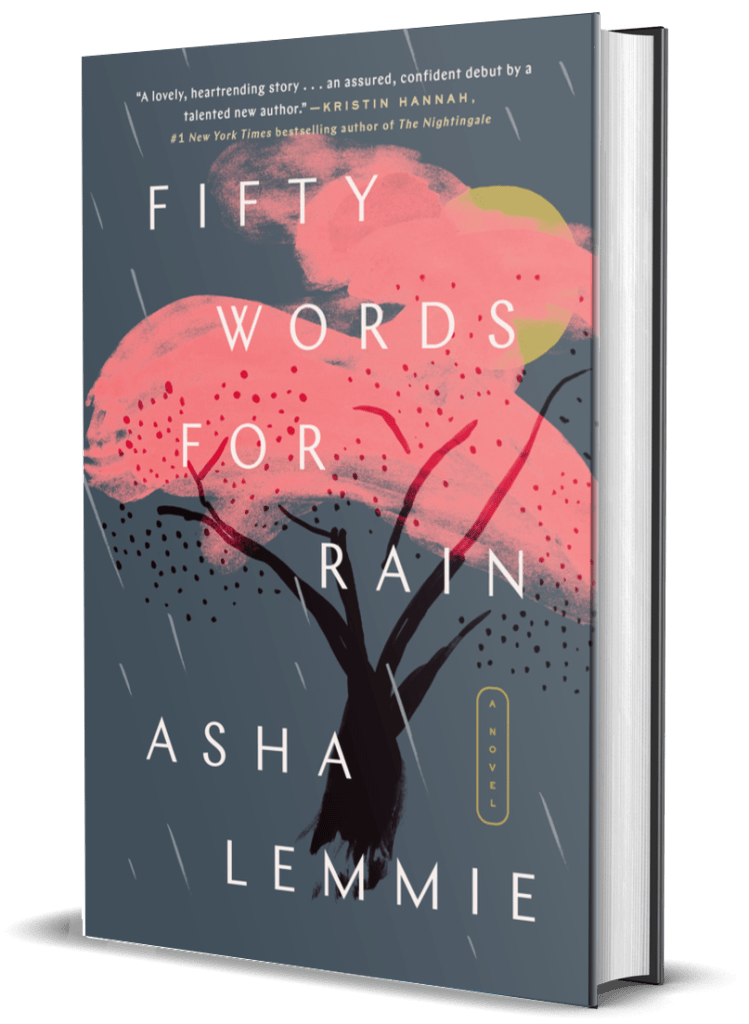
Fifty Words for Rain, by Asha Lemmie

As usual, I checked out too many books from the public library at one time and didn’t get this one finished before it disappeared from my tablet and returned to that public library in the sky! I immediately got back on the waitlist for it. It was two or three weeks before I got to check it out again. That isn’t the ideal way to read a book, but Fifty Words for Rain had enough of a hold on me that I definitely wanted to finish it.

Fifty Words for Rain,
by Asha Lemmie

The second time around, I got the MP3 audio version of the book. Since it had been several weeks since I’d read the first half of the book, I decided to listen to it from the beginning. Although familiar, listening to the novel made the story fresh and new for me, and I was soon hooked on it again.

The place is Japan. The time is 1948. The background for the novel is that a woman from a well-to-do family of pre-war royalty had a baby girl nick-named Nori that was fathered by an American GI. Considering the anti-American sentiments that the Japanese held immediately after World War II, that was bad enough; however, to make matters worse for Nori, her American soldier father was of African descent. In a country like Japan, where there has been little mixing of the races over the centuries, this mixed-race girl was an outcast.

Nori’s mother drops her off outside her parents’ estate, never to return. Nori has to introduce herself to her grandparents. To say they aren’t pleased with the situation would be a gross understatement. Being dropped off at the grandparents’ home is literally just the beginning of this story of abandonment, prejudice, concealment, physical abuse, freedom, prostitution, the human spirit, hope, obligation, and family ties.

This debut novel by Asha Lemmie is beautifully-written. I look forward to Asha Lemmie’s second novel – whatever it is or whenever it’s written and published.

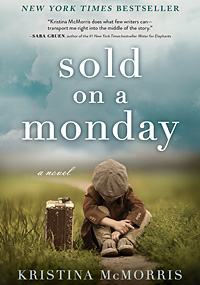
Sold on a Monday, by Kristina McMorris

The spark of inspiration behind this novel was a photograph that appeared in a 1948 magazine. It was a photograph of a sign that read: “Children for Sale.” That, the book’s title, and the book’s cover prompted me to add Sold on a Monday to my to-be-read list in 2018, the year it was published. In reviewing my TBR list last month, I decided it was time to read it. I checked out the MP3 of the book to listen to on my tablet.

Just like with Fifty Words for Rain, by Asha Lemmie, I knew Sold on a Monday, by Kristina McMorris deserved a second chance. I kept falling asleep while listening to Sold on a Monday – to the point that it made no sense. This is not a reflection on the book. It’s a reflection on what can happen when you have chronic fatigue syndrome and you want to sleep 24 hours-a-day.

Sold on a Monday,
by Kristina McMorris

The novel went back to the library, but the premise of the book wouldn’t let me go. I checked out the MP3 version again and gave it my full attention. It is a multi-layered book that takes you on a journey at break-neck speed. No wonder I couldn’t make sense of it the first time I slept through parts of it! If you skip a page or let your mind wonder for a few minutes, you’ll miss something important to the plot. There is not an unnecessary word in the whole book.

Ms. McMorris set the novel in Philadelphia early in the Great Depression. A newspaper reporter just can’t quite land that elusive story that will make his career. He takes a picture of a little boy and girl with a sign that reads, “Children for Sale.” The reporter makes a series of bad decisions, but he eventually becomes obsessed with tracking down the children. There are more twists and turns to this story than I could possibly comment on here – plus, that would spoil the book for you.

The crux of the novel is to show how a bad decision by an individual can have dire and tragic ramifications for other people.

The story that was the inspiration of this book reminded me of an incident that happened to a couple of friends of mine a decade or so ago. They went on a mission trip to a Native American reservation in the western part of the United States. A mother on the reservation offered to sell them her son. I was jarred by the story when my friends told me, and the thought of it still jars me today.

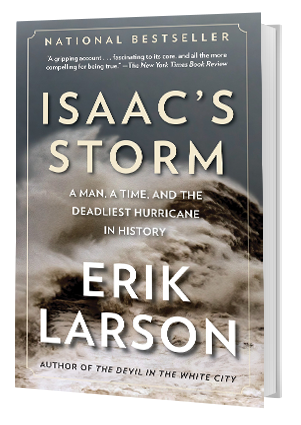
Isaac’s Storm: A Man, A Time, and the Deadliest Hurricane in History, by Erik Larson

This history of the deadly hurricane that all but wiped out Galveston, Texas in September 1900 was written in 1999, but the book just recently came to my attention. I’m becoming quite an admirer of writer Erik Larson. He writes history that reads like fiction. He gets into the nitty-gritty details that most history books skip over.

It was believed in meteorological circles at the turn of the 20th century that hurricanes were unlikely to hit the Texas coast. Combine that delusion with the lack of radar systems we depend on today, and you have the makings of a perfect storm.

Isaac’s Storm, by Erik Larson

Isaac Cline of Galveston thought he knew all there was to know about hurricanes. He didn’t think Galveston would ever be hit by a hurricane.

Cuba had warned the United States that a strong hurricane was heading into the Gulf of Mexico, but arrogance made US weather officials more than hesitant to take advice from Cuba. With black storm clouds approaching and huge waves crashing, many people went out to see what was happening along the oceanfront. Children delighted in playing the water as streets several blocks from the ocean filled with water. Businessmen went about their day as if nothing ominous was bearing down on their city.

The hurricane slammed into Galveston with virtually no warning, killing more than 6,000 and possibly as many as 10,000 people. Nearly a century before hurricanes were rated by intensity or named, the Galveston hurricane would easily be considered a Category 4 storm today.

It remained a ferocious storm all the way across the US, wreaking havoc in the Midwest. It brought hurricane force winds to cities such as Chicago and Buffalo. A steamship was almost sunk by the storm on Lake Michigan. Telegraph service across the Midwest and northeastern US was severely crippled with so many telegraph poles blown down. The storm continued on across Prince Edward Island and spun across the North Atlantic, sinking 16 ships. It was last witnessed as it made its way into Siberia.

Erik Larson researched newspaper accounts, letters written by Isaac Cline, telegrams, US Weather Bureau records, and the memories of the hurricane survivors.

To read about two of Erik Larson’s other books, follow this link to my February 3, 2020 blog post, Three Books I Read in January 2020 when I read The Devil in the White City: Murder, Magic and Madness and the Fair that Changed America and this link to my July 27, 2020 blog post, Three Other Books Read in June 2020 when I read The Splendid and the Vile. All three of his books that I’ve read are shining examples of creative nonfiction.

Since my last blog post

I started the new year by decluttering. It was time to go through file folders and discard, recycle, or shred a lot of paper. The biggest pile was for the shredder. It felt good to get rid of some papers in order to make room for, you guessed it, more papers. This is never going to end. In my dreams, I’m a minimalist, but only in my dreams.

And that new baby cousin arrived on January 2 – a healthy boy. It was great to hear some good news.

Until my next blog post

I hope you have a good book to read or write.

I hope you have lots of creative time to do the things you really enjoy.

Wear a mask.

Count your blessings.

Look for my blog post next Monday when I’ll tell you about the other books I read in December.

Janet