#OnThisDay: The Florida Purchase Treaty, 1819. Consider the US without it!

Here I am, with another little history lesson. I hope I’m not losing my audience. My blog is about my journey as a writer. I write history and historical fiction, so continuing to study history and sharing some of what I learn is an integral part of my blog.

Last week I admitted how little I knew about the Spanish-American War. In today’s blog, I’ll admit how little I knew, or at least remembered, about the Florida Purchase. If history could be taught in story form instead of lists of battles and dates, I think we’d all retain more of it later in life.

As you read my post, I want you to think about what the map of the United States would look like today if not for this 1819 treaty.

In case you’re ever on “Jeopardy!”

The Adams-Onis Treaty was negotiated and signed by U.S. Secretary of State John Quincy Adams on February 22, 1819. That’s 202 years ago today. Luis de Onis, the 1809-1819 Spanish Envoy to the United States, negotiated and signed for Spain; hence, the name Adams-Onis Treaty. It’s also known as the Florida Purchase Treaty, the Treaty of 1819, and the Trans-Continental Treaty.

What the treaty accomplished

The United States was still in its infancy as a nation in 1819. It had won two major wars against Great Britain, but it was just 40 years old. The map of the United States was still in flux. In fact, it still is with the possibility of the District of Columbia and Puerto Rico possibly gaining statehood status. In 1819, the vast West was still occupied by native peoples and enormous herds of bison and other native animals.

Under this treaty, Spain gave up its claim to the Florida peninsula as well as the panhandle of Florida, the coastal lands of Alabama and Mississippi, and part of Louisiana. The United States temporarily gave up Texas. The boundaries of the Louisiana Purchase were more accurately defined, and the boundary between Spanish Mexico and the United States was settled. Spain relinquished its claim to the lands north of the 42nd parallel known as the Oregon Territory. (The 42nd parallel later formed the northern boundaries of California, Nevada, and Utah.)

What if…?

When I’m writing fiction, I often ask myself, “What if…?” Asking myself that questions leads to plot twists in my fiction, but it can lead to some fascinating theories of how history could have turned out differently if certain events had not happened. I touched on this question in last week’s blog post, #OnThisDay: Remember the Maine! What you might not know, when I asked how history would have unfolded if the Americans had known that the sinking of the Maine was an internal accident and not an act of war by Spain.

Imagine how the United States would look today if the Adams-Onis Florida Purchase Treaty hadn’t been signed and ratified.

There would be no Disney World or Cape Canaveral. Or, if there were, they’d be in Spanish Florida.

Photo credit: Justin Novello on unsplash.com

There would be no white sandy Gulf of Mexico beaches in the United States.

There would be nowhere in the southeast for people from the cold northern states to retire to or spend their winters.

The 55th Super Bowl wouldn’t have been held in Tampa, Florida earlier this month.

There would be no American Floridians creeping along at a snail’s pace on the curvy mountain roads in western North Carolina because they’re terrified of curves and hills. They’d be Spanish Floridians.

All jokes aside, we’d be importing lots of vegetables and citrus fruits from Spain because that’s who would still own what we know now as the state of Florida. And perhaps Spain would still control the Oregon Territory. The map of the United States would look quite different than it does today. Our history would be quite different, and we would lack many of the natural and cultural resources we enjoy today that make our country what it is.

I have given a simplified description of the Adams-Onis Florida Purchase Treaty in this blog post, but on this 202nd anniversary of its signing, I believe we Americans can be glad it was negotiated and signed.

Since my last blog post

I’ve been reading, writing, and enjoying both. The part of North Carolina I live in, dodged the snow and ice that much of the U.S. has been dealing with. The people of Texas and other areas without electricity and safe drinking water are in my prayers. Mississippi was hit hard, too, but hasn’t received much national publicity.

The first crocus of the year opened near our side porch and the daffodils are coming up. I look forward to spring with great anticipation.

Until my next blog post

I hope you have a good book to read. I’m reading Soroosh, a new novel by Laleh Chini, and listening to The Unwilling, by John Hart.

Find time for your favorite pastime.

Even if you won’t wear a mask to protect yourself, please wear one out of respect for others. We’re all in this Covid-19 pandemic together and it will take all of us working together to get out of it faster.

Note to my neighbors and friends in Canada (including author Laleh Chini): This is “Freedom to Read Week” in your country.

Thank you for dropping by my blog.

Janet

#OnThisDay: “Remember the Maine!” What you might not know.

If asked what the slogan, “Remember the Maine!” was about, I could have told you it referred to a ship that was sunk and caused the Spanish-American War. I minored in history in college, but some of the details are a little blurry now. Today is the 123rd anniversary of the sinking of the U.S.S. Maine in the Havana, Cuba harbor.

USS Maine three weeks before it sank in Havana harbor.
The USS Maine passing Morro Castle as she entered the harbor of Havana, Cuba 25 January 1898. Photo credit: US Naval History & Heritage Command photograph. Catalog#: NH 48619. 

Manned with a crew of 350 men, the Maine was a 393-foot-long battleship. It had been sent to Havana to protect Americans living there in the event that Cuba’s struggle for independence from Spain spun into a full-scale war. At 9:40 p.m. on Tuesday, February 15, 1898, there was an explosion and the ship sank. Only 84 crew members survived. It was quickly concluded that the ship had been hit by a Spanish torpedo or that it had hit a Spanish mine.

“Remember the Maine!” became the battle cry in the United States, and the US Congress declared war on Spain ten weeks later on April 25, 1898.

U.S. Navy diving crew with wreckage of USS Maine in 1898, from aft looking forward. U.S. Naval History and Heritage Command photograph. Catalog#: NH 46774.

Fast forward to 1976

In 1976, U.S. Navy Admiral Hyman Rickover investigated the sinking of the U.S.S. Maine and concluded that the ship sank due to a probable coal bunker fire. That deflates the rallying cry, “Remember the Maine!” in a heartbeat.

Some historians have disputed Adm. Rickover’s conclusions, so we maybe haven’t heard the end of this story.

One has to wonder how differently the course of Cuban and American history would have gone if everyone had known at the time that the sinking of the U.S.S, Maine was a self-inflicted accident and not an act of war. The next time you read or hear, “Remember the Maine!” remember what can happen when a nation’s government jumps to the wrong conclusion.

How the US got Puerto Rico, Guam, and the Philippines

The first battle of the Spanish-American War took place on May 1, 1898. The war lasted only several months, ending on August 12, 1898. Through the peace treaty, which was worked out in Paris the following December, Spain gave Cuba its independence and gave Puerto Rico, Guam, and the Philippines to the United States. Let that sink in for a minute. What a turn of events!

When I was in school, we never studied the details of the Spanish-American War. Every year we studied U.S. history from colonial times through the Civil War. It was just through living, watching TV, and having an early interest in history that I absorbed through osmosis the stories of the Battle of Bunker Hill, and Teddy Roosevelt and “The Rough Riders.”

In other words, I couldn’t give you a definitive summary of the Spanish-American War. I couldn’t have told you that Puerto Rico, Guam, or the Philippines had anything to do with that war. If I ever knew they did, those facts were lost to me over time. It was only in researching “Remember the Maine!” for today’s blog post that I learned of those connections.

Through my interest in genealogy, I’ve just in recent years learned that one of my great-uncles fought in the Spanish-American War. This made me realize that it’s not ancient history. It makes me realize today that I should have known more about it. I’m not as far-removed from it as I thought.

In the big scheme of things, United States history covers but a tiny fraction of world history. So how is it that we do such a poor job of teaching our citizens U.S. history?

Since my last blog post

I was able to get my first Covid-19 vaccine shot on Saturday. I thought I’d have to wait until March, but some more appointments opened up in my county. It is encouraging to get that first shot. I got the Moderna shot. My arm is sore, but that’s the only side effect I’ve had.

Until my next blog post

I hope you have a good book to read. I’m listening to Dead Wake: The Last Crossing of the Lusitania, by Erik Larson. Having it on CD from the public library was a blessing the 48 hours I had a sick headache last week and couldn’t stand any light. I highly recommend this nonfiction book. Mr. Larson has a talent for bringing history alive in his writing.

I hope you have time to enjoy a hobby or favorite pastime this week.

Note: Next Sunday, February 20, is World Storytelling Day. Are you a good storyteller?

Janet

4 Other Books I Read in January 2021

My custom is to share with you my thoughts about the books I read during one calendar month in my first blog of the following month. Last Monday’s post, My thoughts on Stones from the River, by Ursula Hegi, was about the novel Stones from the River, by Ursula Hegi. In today’s post, I’ll tell you what I thought about the other four books I read in January. It’s a nice mix of fiction and nonfiction books.

After the attempted coup at the US Capitol on January 6, it was difficult to concentrate. My reading suffered, but my writing time suffered even more. I was surprised at the end of the month to discover I’d read five books.

I ran into some problems while trying to insert images of the books I’m blogging about today. Ironically, (or not?) the message I got when I tried to copy the publisher’s image of The Spy and the Traitor said “for security reasons” I was not allowed to use it. I had to laugh. I could download it to my computer, but I couldn’t insert it in today’s blog post. It’s recommended that all blog posts have images, so I’m disappointed to present a post today that has no illustrations.


The Spy and the Traitor: The Greatest Espionage Story of the Cold War, by Ben MacIntyre

On a scale of one-to-five stars, I give this nonfiction book six stars. The research that backs up this detailed account of the life of double-agent Oleg Gordievsky is stunning. The book reads like a spy novel but is all the more riveting because the reader knows it is true.

I learned about this book when I saw a list of the top five books of 2020 that Bill Gates recommended. This one sounded intriguing, and it didn’t disappoint.

Oleg Gordievsky started out as a KGB agent. Fascinated by the West, though, he read and learned all he could about Great Britain. He also read works of such Soviet dissidents as Aleksandr Solzhenitsyn, even though reading those works or having them in your possession was against the law in the Soviet Union. Gordievsky’s world opened up when he landed an assignment in England. It is there that he became a double agent and became the crown jewel in Great Britain’s MI6 spy network.

I learned how close we came to nuclear war in 1983 when the Soviet Union misinterpreted a NATO war game with the code name ABLE ARCHER 83. The book says on page 181, “Both Reagan and Thatcher understood the Cold War in terms of a Communist threat to peaceful Western democracy; thanks to Gordievsky, they were now aware that Soviet anxiety might represent a greater danger to the world than Soviet aggression.”

It is not common for an individual spy to have a profound impact on world history, but Oleg Gordievsky falls into that category. As the book says of Gordievsky on page 183, “…he opened up the inner workings of the KGB at a pivotal juncture in history, revealing not just what Soviet intelligence was doing (and not doing), but what the Kremlin was thinking and planning, and in so doing transformed the way the West thought about the Soviet Union. He risked his life to betray his country, and made the world a little safer.”

The story is far from over at that point, and the book takes the reader on an edge-of-your-seat nail-biting ride. Will Gordievsky be outed? Will Great Britain succeed in smuggling him out of the Soviet Union? What happens to his wife and daughters? Who turns out to be an American double agent? Is that spy still alive and, if so, where is he? Is Gordievsky still alive and, if so,  where is he?

All these questions and more are answered in the book, but I don’t want to spoil the fun for you. I highly recommend The Spy and the Traitor: The Greatest Espionage Story of the Cold War, by Ben MacIntyre. I listened to the book on CD while keeping a print copy in front of me. That made it easier for me to keep up with the unpronounceable Russian names.


My Grandmother Asked Me to Tell You She’s Sorry, by Fredrik Backman

Told from the point-of-view of seven-year-old Elsa, this is another somewhat quirky novel from Fredrik Backman. I think it was clever for Mr. Backman to give us a novel told from a child’s viewpoint. It was an interesting read, but not one of my favorite novels.

I listened to this book on CD. My favorite part of the book turned out to be the first disc, as it included Elsa’s feisty grandmother before she died. It was funny. Elsa’s grandmother wasn’t a typical grandmother or a typical old woman. She delighted in upsetting the powers that be. She thrilled at dragging Elsa into her various escapades.

Since both of my grandmothers died before I was born, I had trouble identifying with Elsa. I don’t have a firm grasp of the personalities of either of my grandmothers; however, since they were farm wives and were born in the second half of the 19th century, they probably didn’t resemble Elsa’s grandmother in any way, shape, or form.

Of course, the reason for this novel was not to entertain the reader with the antics of an old lady. It was to show the ramifications of a life lived as this woman lived it. This woman lived her entire life insulting people, but somewhere deep down inside she wanted to apologize. The burden of making those apologies fell on her granddaughter.


Step into the Circle: Writers in Modern Appalachia, edited by Amy Greene and Trent Thomson

This is a book of profiles about nine writers of present-day Appalachia written by writers of present-day Appalachia. It is beautifully illustrated with photographs of the writers and the mountains from which they came. The writers highlighted are Wendell Berry, Crystal Wilkinson, Ron Rash, Adriana Trigiani, Silas House, George Ella Lyon, Frank X. Walker, Marie Junaluska, and Lee Smith.

Some of these writers were familiar to me, while others were not. I was glad to learn about each of them; however, the book did not live up to its promise as far as I was concerned. At least one of the “profiles” turned out to be more about the profiler than the writer being profiled. Therefore, the book ended on a sour note for me. Nevertheless, it’s worth checking out of the public library and giving it your attention.

The book addresses the influence of an author’s geographic upbringing and the importance of writing the truth that one knows. The importance of Appalachian writers to write the truth in order to dispel the myths about the people of Appalachia is an overriding theme.

The most interesting profile for me was that of Marie Junaluska, a Cherokee language teacher and translator.


The Fix, by David Baldacci

I’m attempting to whittle away at the 300 books on my To Be Read list (TBR.) I thought it might be a good idea to try to read one book from my TBR each month. But then I did the math and discovered that, at that rate, it will take me 25 years to read those 300 books. That doesn’t sound doable because I would be 103 years old by then. Also, I tend to add more than one book to my TBR each month, so the list is literally never-ending.

The Fix has been on my TBR for several years. It is the third in David Baldacci’s Amos Decker series. Labeled a thriller, I found The Fix to be more of a spy mystery. It did not keep me on the edge of my chair anxious to see what happened next. Perhaps it just wasn’t the right time for me to read this book, since I had trouble concentrating all month.

I’ve listened to many novels in the last year or two, which is quite a change for me. A lot depends on the professional recording reader. In addition to that, something that jumped out at me in listening to The Fix was how the “he said/she said” tags can distract. When reading a print book, our eyes often leap over those tags. In listening to The Fix, I was very distracted by them. There were several readers – male and female. When I female voice read a line, it was terribly jarring to have the male reader follow it by saying, “she said.” It reminded me that I was listening to a book – and that’s not a good thing. I’m not sure what the remedy is for this, but it continually took me out of the story in this novel.


National Grammar Day in the USA

No, that’s not the name of a book. Today is National Grammar Day in the United States It gives me an opportunity to share with you something I learned recently from a blog post.

I took courage from reading Melissa Donovan’s December 15, 2020 blog post. She opened my eyes to the difference between grammar rules and grammar guidelines. Here’s a link to her blog post: Grammar Guidelines Versus Grammar Rules | Writing Forward.

If grammar grabs your attention, please take time to read Ms. Donovan’s blog post. Like me, you might be surprised to learn that some things you think are grammar rules are just guidelines. You must follow the rules, but you don’t have to follow the guidelines. I wish someone had told me that years ago.

I have stressed over some guidelines because I thought they were rules. One of my favorites is that you should never end a sentence with a preposition. It turns out that rule of earlier centuries is now a guideline. Hurrah! I’ve twisted myself into a pretzel on occasion trying not to break that guideline because I thought it was a rule. What I’ve ended up with are awkward sentences. From now on, I’ll end sentences with a preposition when it makes better sense to do so.

And, by the way, you probably noticed that I used the numeral “4” in my blog post title today instead of “four.” I was taught to write out numbers one through nine in a written document – and always when it is the first word in a title or sentence — and to use numerals for 10 and higher.

I learned recently though, that when writing the title of a blog post, I should always use numerals because they make a bigger impact. They help my SEO (Search Engine Optimization). In those mysterious algorithms of cyberspace, they help my blog posts move up and get seen. They grab a person’s attention. That’s what “they” say.

Bear with me, folks. I’m in my 60s (or sixties?) and I’m trying to learn new things and adapt to the world of technology. When I was born, black and white television, black and white photography, and manual typewriters were cutting edge. And Caribbean was pronounced Ca-rah-be-in.


Since my last blog post

I’ve continued to read and I have some excellent books to share with you in March when I blog about the books I read in February. I have been entertained and educated by these books, and the month is just one-week old. I’ve read two historical novels this week that I can’t wait to tell you about.

I tried my hand at a new recipe for no-knead whole wheat sandwich bread. It held much promise in the beginning, but it turned out the size of half-of-a-sandwich bread. It tastes okay, but looks pitiful. I was disappointed but had to laugh.

We came within a few miles of having snow on Saturday night but only got rain. That’s the way it often is in the piedmont of North Carolina.


Until my next blog post

I hope you have at least one good book to read this week – one that will not only entertain you but also educate you. Our learning should never end.

Wear a mask and get the Covid-19 vaccination as soon as it’s your turn and you can get an appointment.

Stay safe, and be respectful of others’ desire to stay safe and well.

Janet

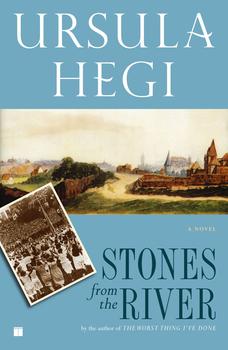
My thoughts on Stones from the River, by Ursula Hegi

I finished reading Stones from the River, by Ursula Hegi a few days ago. It made such an impression on me that I decided to write about it today and share my thoughts on the other books I read in January in next Monday’s blog post.

I enjoy following the blogs of book reviewers. Their reviews often pique my interest in books I might have otherwise overlooked. From a review, I can be fairly sure a particular book is or isn’t for me. My fellow blogger, Stella Maud Maurer (https://stellamaudmaurer.wordpress.com/,) wrote about author Ursula Hegi a couple of months ago. It was that blog post that nudged me to read Stones from the River.

I don’t consider myself a book reviewer. I just enjoy sharing my impressions of the books I read. I don’t abide by the rules that book reviewers adhere to. (And if you think I shouldn’t have ended that sentence with a preposition, I’m excited to tell you that I recently learned that “rule” is now just a “guideline.” Look for more on that in a future blog post.)

Stones from the River, by Ursula Hegi

Stones from the River, by Ursula Hegi

After reading Stella’s blog post, I wanted to read something by Ursula Hegi. I decided to start with the first novel in her Borgdorf Cycle series, Stones from the River. It wasn’t long before I was captivated by her prose.

Oh, to be able to write descriptions like Ms. Hegi does! She deftly weaves phrases of description into sentences in a way that you hardly notice. I admit, I was reading the book as a writer and not as a reader. The writing really isn’t supposed to pull the reader out of the story, but I just couldn’t help myself.

Trudi, the main character, is a little person. Her mother had what sounds like post-partem depression after Trudi’s birth. Her father, Leo, never gave up on bringing his wife and their daughter into a loving relationship. As a young girl in the late 1910s in Germany, Trudi yearns to grow tall. Her childhood isn’t an easy one, not only because she is different but because her mother is different, too. Her mother’s depression spirals out of control and she takes to hiding under the house, sometimes taking Trudi with her.

And then there’s the neighbor boy, Georg, whose mother wants him to be a girl. She dresses him like a girl and doesn’t cut his hair. Trudi starts to realize that she’s different, her mother’s different, and Georg is also different.

Through it all, Trudi has a priceless sense of humor that comes through especially in her dealings with her friend, Ingrid. Ingrid is tall and beautiful. Trudi would give anything to look like Ingrid; however, Ingrid thinks Trudi is the lucky one.

Trudi works in her father’s “pay library.” 1933 brings Hitler’s orders to destroy all books written by the great authors and thinkers of the day. She and her father hide some of his prized books under rental books in boxes. After all, what better place to hide books than in a library?

One day, Trudi discovers a woman and her little boy hiding under the house that she and her father still share along with the pay-library. They start hiding Jews in their cellar.

Due to her small stature, Trudi never expected to find romantic love. That yearning for love and a family of her own is a thread throughout the novel. I’ll just leave it at that and not spoil the story for you if you wish to read it.

This is a story of the unpredictability of life. It’s a story of thinking you know someone, but then realizing you don’t really know them. The constant backdrop was Nazi Germany. Step-by-step, day-by-day, year-by-year life became more precarious not only for the Jews but for everyone living in Germany in the 1930s and 1940s. Every word and action was suspect, and you never knew who was listening and watching.

What struck me, though, about this novel was the parallels I saw between Germany in the 1930s until the end of World War II and the United States in 2020 and 2021. If I’d read it when it was published in 1994, it wouldn’t have affected me like it did as I read it in December 2020 and January 2021. Over and over, sentences and paragraphs jumped out at me as if to say, “Wake up, America!”

It’s almost as if Ursula Hegi wrote pointed phrases and sentences in Stones from the River to serve as a cautionary tale for Americans living in the last five years.

The following sentence from Stones from the River stopped me in my tracks, since it rang so true for the United States in 2020: “She fought him by reminding herself what her father had said to Emil Hesping – that they lived in a country where believing had taken the place of knowing.” It seemed in 2020 and still today that nearly half of Americans believed what they were being told by the right-wing media and the Trump Administration instead of believing what they should have known to be true – what they saw and heard with their own eyes and ears. I’m not sure how that gets corrected, but I pray it will be.

There were several other quotes from the book that caught my attention. These three, in light of January 6, 2021: (1) “…breaking of windows….”  (2) “Maybe now, she thought, now in the blaze of fire, they surely would have to see. But it was as if they’d come to take the horrible for granted, mistaking it for the ordinary.” And (3) “Their allegiance to one powerful leader now became their excuse: since they had not made decisions but merely obeyed orders, they were not to blame.”

And this quote from the book parallels the fear some members of Congress now live with because they know that some other members of Congress wish them dead: “‘The Jews in this country,’ she corrected him one Saturday afternoon when he followed her into the garden, lecturing her, ‘are Germans and far more decent than those – those friends of yours who terrorize them –.’”

Since my last blog post

I almost finished the research necessary for the writing of one of my historical short stories. A little more research is needed in order to fill in some blanks. The story morphed into an essay. I had a lot of fun writing the 2,800-word piece on Saturday. The point-of-view “character” is a house. No more clues. I hope before the year is out, I’ll get to turn my stories and essays into a book. You’ll learn it here first, so don’t miss any of my blog posts!

Until my next blog post

Note: Tomorrow through February 8 is “Read an E-Book Week”.  If you’ve been wanting to take the plunge and try reading a book on your electronic device, this is the perfect week to do it. Don’t be an “I only read printed books” snob.

Note: Next Saturday, February 6 is “Take Your Child to the Library Day”. If your local public library is open and you feel safe to take your child there, perhaps you can do so. But if the Covid-19 pandemic has closed your library to in-person service – or you don’t feel safe going there yet – take next Saturday as an opportunity to explore the online resources your local public library system offers. Get your child excited about using the library online now and in-person as soon as that is safe. It will be a gift that keeps on giving for the rest of their lives.

I hope you have a good book to read (in print or on an electronic device) or a good one to write.

Wear a mask and get the Covid-19 vaccination as soon as it’s your turn and you can get an appointment.

Stay safe, and be respectful of others’ desire to stay safe and well.

Janet