You should know who Julian Francis Abele was

Everyone reading my blog has probably heard of Duke University. It’s a world-renowned university located in Durham, North Carolina. You might not know of its meager beginnings, and you might not know that the architect responsible for its magnificent West Campus was a black man.

I’ve lived in North Carolina my entire life, and I only recently learned who Julian Francis Abele was.

First, here’s a very brief early history of the university.

In 1838, a subscription-supported school called Brown’s Schoolhouse was established in the Randolph County community of Trinity. The school’s name changed a couple of times over the years but was settled as Trinity College in 1859.

In 1892, Trinity College moved to Durham, North Carolina. With heavy financial support from Washington Duke and Julian S. Carr – both Methodists – the name was changed to Duke in December 1924. That was then James B. Duke, son of Washington Duke, established The Duke Endowment. It was a $40 million trust fund set up for its interest to be divided between various hospitals, orphanages, the Methodist Church, three colleges, and the university to be built around Trinity College. In today’s dollars, the $40 million endowment would be equivalent to more than $630 million.

But what did Julian Francis Abele have to do with this?

Julian Francis Abele was born April 30, 1881 in Philadelphia, Pennsylvania – so this Saturday will be the 141st anniversary of his birth. In 1902, Abele was the first black graduate of the University of Pennsylvania School of Design. All four years of undergraduate school there, Abele worked in the mornings as a designer at the Louis Hickman Architectural Firm and took afternoon and evening classes at the university.

Horace Trumbauer, a nationally-recognized Philadelphia architect, hired Abele. He sent Abele to study abroad for three years. Upon returning from Europe in 1906, Abele joined Trumbauer’s firm and by 1909 had become the company’s chief designer. When Trumbauer died in 1938, Abele became head of the company.

The company designed numerous buildings in Philadelphia, a number of mansions in Newport and New York, and the Widener Memorial Library at Harvard University.

But my interest in writing about Julian Francis Abele today is his contributions to the gorgeous English Gothic and Georgian buildings at Duke University. Over the 30-year period of 1924 to 1954, he was the primary designer of the university’s West Campus.
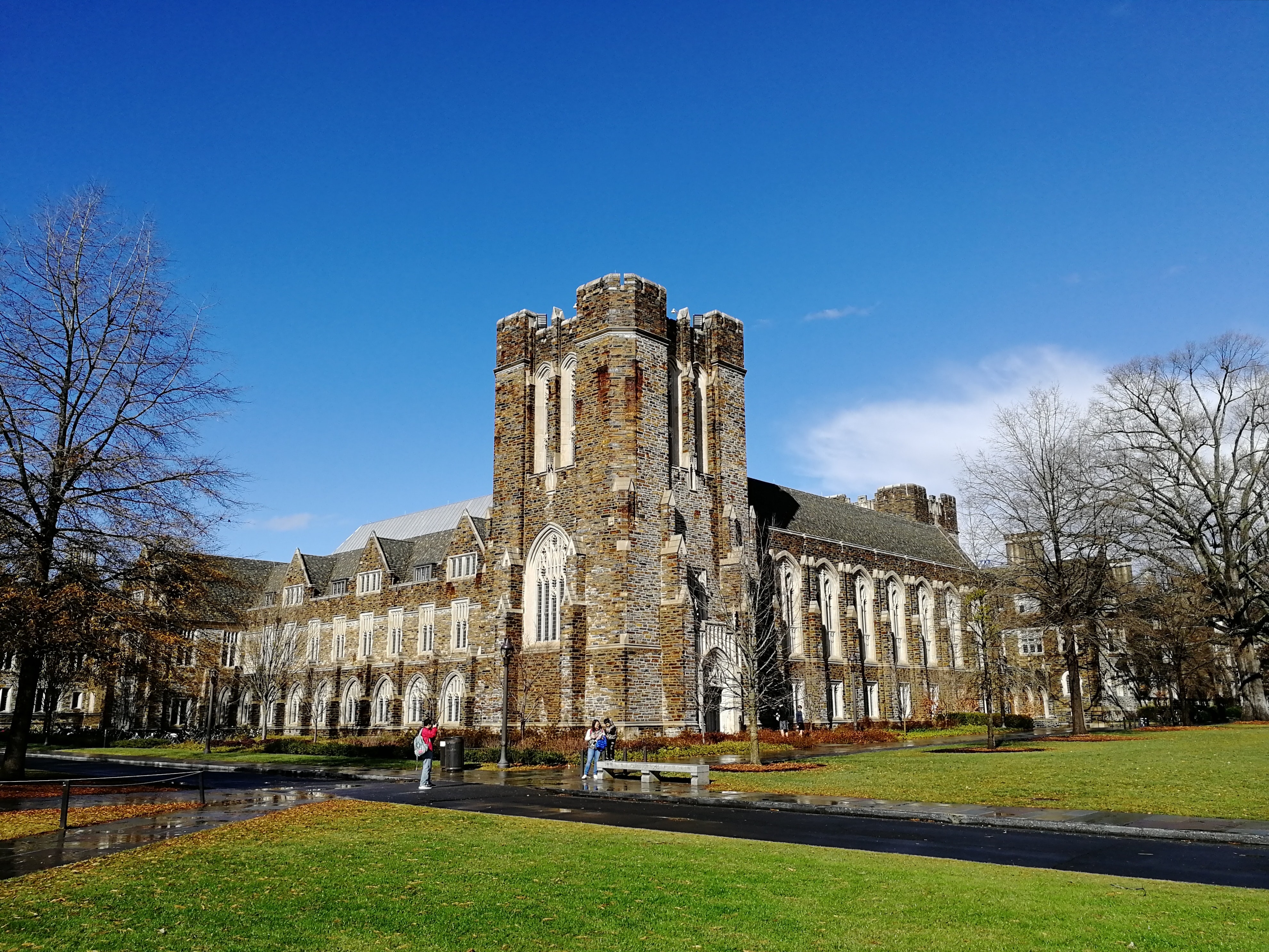
Photo credit: Pattern on unsplash.com

If you’ve not had the pleasure of visiting Duke University…

Photographs of the buildings on the Duke University campus don’t do justice to the beauty of the architecture. The centerpiece of the campus and grandest example of Julian Francis Abele’s work is Duke Chapel.

Exterior of Duke Chapel. Photo credit: Chuck Givens on unsplash.com

“Chapel” in this case is an understatement, for the chapel is more of a cathedral than a chapel in the common sense of the word. The chapel interior is 63 feet wide, 291 feet long, and the nave proper is 73 feet tall.
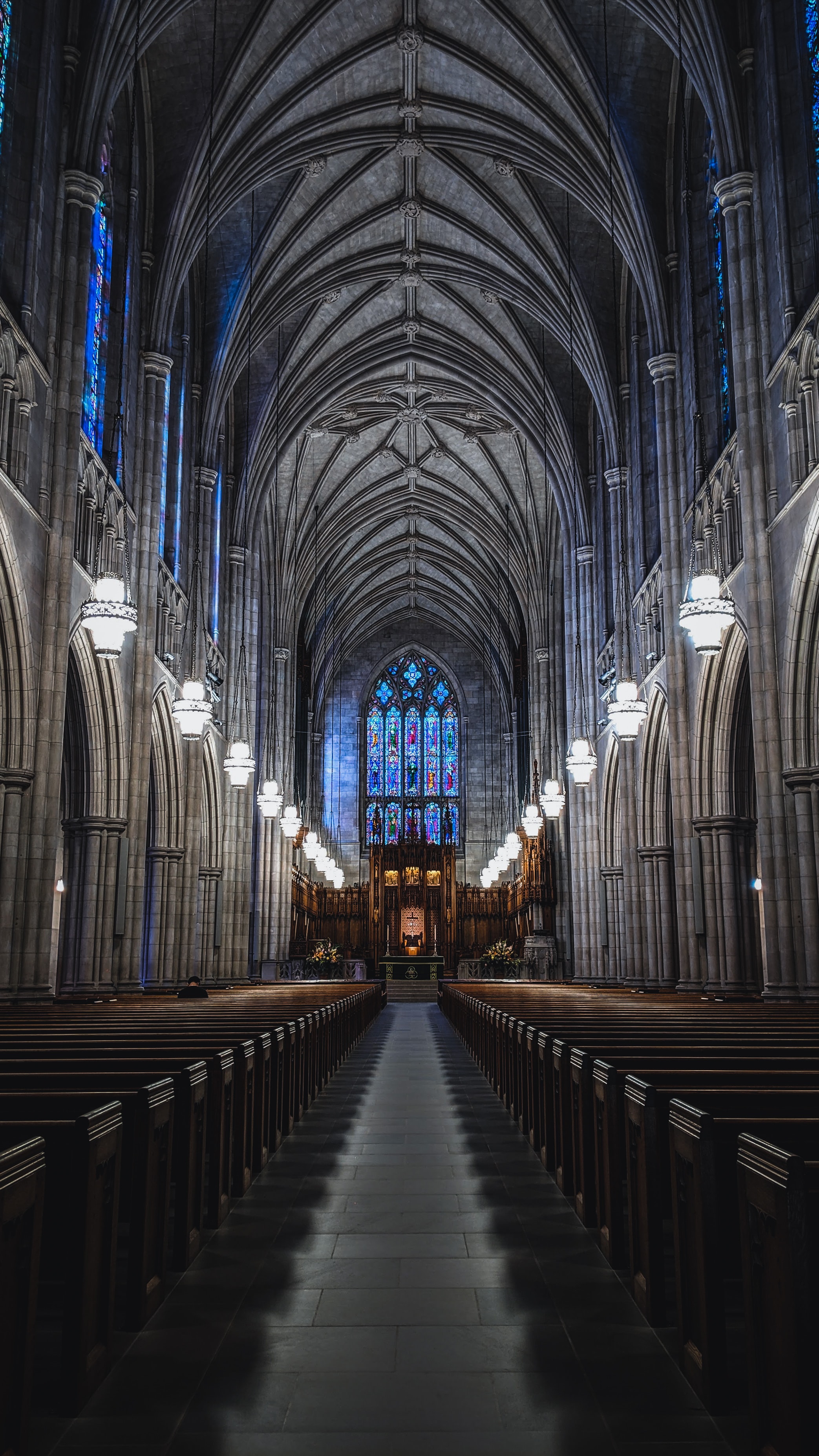
Inside Duke Chapel. Photo credit: Chuck Givens on unsplash.com

Standing on the highest point on the planned campus in 1925, James B. Duke said that it was on that place that the chapel should be built. It would be the highest point and the center of the campus. The cornerstone was laid in 1930, and it is said that students enjoyed watching the stone cutters and the progression of construction of the chapel over the next two years. Little did those white students know that the chief designer of the edifice was a black man.

In fact, it wasn’t until Julian Francis Abele’s granddaughter, Susan Cook, brought to public light in 1986 that a person of color had designed the magnificent focal point of the Duke campus. While students protested apartheid in South Africa, Susan Cook wrote a letter to the student newspaper to make it known that her grandfather had designed their beloved West Campus.

Portraits of Abele now hang in the main administration building on campus and in the Gothic Reading Room in Rubenstein Library alongside those of former Duke presidents and board chairs. In 2016, and the main quadrangle on campus, which stretches from the Clocktower Quad to the Davison Quad – and to the Chapel Quad – was named the Abele Quad.

As quoted from https://today.duke.edu/2016/03/abele, upon the naming of the Abele Quad in 2016, Duke University President Richard H. Brodhead said, “Julian Abele brought the idea of Duke University to life. It is an astonishing face that, in the deepest days of racial segregation, a black architect designed the beauty of this campus. Now, everyone who lives, works, studies and visits the heart of Duke’s campus will be reminded of Abele’s role in its creation.”

Shocking to our 21st century minds, is the fact that the racial prejudices of the early- and mid-20th century deterred Mr. Abele from visiting the Duke University campus to see his designs come to fruition and caused him not to be admitted to the American Institute of Architects until 1942.

Mr. Abele died in Philadelphia on April 23, 1950, which was 72 years ago this past Saturday.

Visit Duke University in person or virtually

If you’re ever zipping along on Interstates 40 or 85 in Durham, take several hours to leave the hustle and bustle behind and visit the Duke University campus. Duke Chapel is open every day from 10:00 a.m. until 6:00 p.m. Stroll around the campus and be sure to visit the Sarah P. Duke Gardens. (Visit https://gardens.duke.edu/ for information about parking and what’s in bloom.)

Visit https://chapel.duke.edu/about-chapel/history-architecture to take a virtual tour of the Duke University campus and to watch a tour of Duke Chapel. Scroll down to the bottom of the page and click on the links to various aspects of the chapel to learn more about the 77 stained-glass windows, the portal, the carillon, and the four pipe organs (including the diminutive 2014 153-wooden pipe positive organ that can be moved about within the chapel for small concerts.

Since my last blog post

I continue not to be at my best, but as energy allows I work on my novel, read, or do online research.

Until my next blog post

I hope you have a good book to read.

Remember the people of Ukraine and count your blessings.

Janet

#OnThisDay: San Francisco Earthquake, 1906

Before daylight on Wednesday, April 18, 1906, the northern coast of California, including the city of San Francisco, was rocked by an earthquake of historic proportions. In retrospect, it was estimated to have been on the magnitude of 7.9.

The earthquake and its resulting fires destroyed 500 city blocks – approximately 28,000 buildings. The fires burned for three days and intensified the citizens’ fears and anxiety.

Photo credit: Christopher Burns on unsplash.com

Some 200,000 people – half of the city’s population at the time – were left homeless. Although usually referred to as “the Great San Francisco Earthquake,” it also resulted in widespread damage in northern California, including San Jose and Oakland.

Cooking food inside standing houses was outlawed immediately after the earthquake in the government’s efforts to minimize additional fires. “Bread lines” were established to distribute food to the homeless and whatever food preparation that was possible was done in the streets.

According to the United States Geological Survey website, (https://earthquake.usgs.gov/earthquakes/events/1906calif/18april/) 296 miles (477 kilometers) of the San Andreas fault ruptured. The quake was felt from southern Oregon to south of Los Angeles and as far east as central Nevada. Much was learned from this earthquake, but it would be a half-century later before plate tectonics as a field of study would shed more light on exactly what processes were at play to produce the event.

The USGS website contains a drop-down menu through which you can access many more details about this earthquake, including comparisons with the October 17, 1989 quake that struck the San Francisco area just 26 minutes before Game 3 of the World Series was set to begin at Candlestick Park. It was measured at 6.9 on the Richter Scale.

Earth tremors and earthquakes of low magnitude are a daily occurrence in San Francisco. That is something I can’t imagine, since I’ve only felt two earthquakes in my life.

While doing the research for today’s blog post, I remembered reading The Nature of Fragile Things, by Susan Meissner in April 2021. It’s a novel based on the 1906 San Francisco Earthquake. You might like to read what I had to say about that book in my May 3, 2021 blog post, 5 Historical Novels I Read in April 2021.

Since my last blog post

Jennie Nash’s book, Blueprint for a Book: Build You Novel from the Inside Out, is helping me outline The Heirloom. Ms. Nash’s “inside outline” helps me remember there must be a reaction to every event and internal reactions are what pull readers into a story.

I continue not to be at my best physically, but I’m constantly thinking about the plotline for The Heirloom and how I can make it better.

Until my next blog post

I hope you have a good book to read.

Remember the people of Ukraine.

Janet

Where do you stand on cursive writing?

As promised last week, today my blog is about the third book I read in March. It’s about the history of handwriting and the debate over whether children today should be taught cursive writing. I say, “Yes!” and I’ll explain why later.

Photo credit: Aaron Burden on unsplash.com

The History and Uncertain Future of Handwriting, by Anne Trubek

“Put your John Hancock here.” How many times have we of a certain age heard that? We, of course, immediately know that is a euphemism for our signature. But does a child of the 21st century know that? I understand that children today don’t have a clue what “clockwise” or “counterclockwise” mean. Yikes!

I discovered The History and Uncertain Future of Handwriting, by Anne Trubek while looking for a different book. I found this 154-page book fascinating and thought-provoking.

Trubek meticulously takes the reader on a journey through history. She shares facts about cuneiform and hieroglyphics. (Did you know that most cuneiform clay tablets can fit in your hand? In photographs, they look huge.) She explains how tedious and time-consuming it was for Sumerians to learn how to write and the hours people in ancient oral-based civilizations spent on memorization.

Egyptians invented writing on papyrus. When the Greeks adopted that practice, though, their papyrus was inferior and their scrolls were smaller. (Did you know that the size of ancient Greek scrolls has a bearing on literature today? For instance, the size of a scroll dictated the length of a play. Who knew?)

Socrates was anti-writing. He maintained that if people learned how to write, they’d lose their skill for remembering the spoken word. There’s probably some truth to that.

People in oral civilizations couldn’t look things up like we can today, so they developed elaborate mnemonics and also used additive structure (and… and… and) to help them remember important things. An example of this can be found in the Book of Genesis in The Bible: “In the beginning God created… and… and….”

It was the Romans who stopped using papyrus and started using parchment. Parchment made it easier to make books. Trubek says that bookstores had been established in Rome by the first century B.C.E. Take a moment to visualize that. It makes me smile.

Trubek talks about the development of the various scripts and the high-esteem held for scribes back in the day. She points out that the invention of the printing press put scribes out of business; however, the ones with good penmanship reinvented themselves and traveled around offering handwriting schools.

I’ve spent a lot of time reading handwritten documents from the 1700s and 1800s. I admire the elaborate and visually beautiful handwriting of the 1800s; however, it is sometimes difficult to decipher. One of the most interesting parts of Trubek’s book was about the evolution of handwriting in America in the 19th and early 20th centuries. Although I’ve admired the lovely handwriting of the 1800s, I’d never researched why and how it was replaced with our contemporary handwriting.

Briefly, Platt Rogers Spencer developed that flowing, fancy script we associate with the 1800s. (If you don’t know what I’m referring to, think about the Coca-Cola logo. That’s an example of Spencerian script.) Spencer proclaimed that having good penmanship was a sign that you were a Christian, educated, and a proper person. His students were advised to practice their penmanship six to twelve hours a day. (I’m sorry, Mr. Spencer, but life’s too short!)

Part of a page from my great-grandfather’s 1912 daybook

I’m reminded that in my great-grandfather’s daybooks from the 1890s and first decade of the 1900s, he occasionally mentioned that his children or grandchildren had gone to writing school that evening. That writing school was conducted at night in the Pine Hill one-room schoolhouse in Mecklenburg County, North Carolina. Notice the curly-ques Great-Grandpa made in his capital F and capital W. Also, he randomly capitalized words. I learned from Trubek’s book that such practice was part of the Spencerian script.

A.N. Palmer came along and made modifications to Spencerian script after he went to work for the Iowa Railroad and saw how time-consuming it was for the employees to record all the details required by industrialization. He removed all the curly-ques required by Spencerian script and made handwriting much easier after 1920.

Trubek’s book also covers such things as the collecting of autographs, which started in the mid-1800s, and graphology, which was started by a French priest in the 1800s.

The science of analyzing handwriting for evidentiary purposes in a court of law has had to evolve over the years. One used to be able to use the force one’s fingers used to press typewriter keys to prove who typed a document. The wear and tear on the parts of a typewriter could prove on which typewriter a document was created.

Photo credit: Csabi Elter

Consider that for a moment. I’m showing my age, but I learned to type on a manual typewriter. Now, the justice system is faced with determining the true identity of a person who electronically “signs” his or her name. How things have changed in the last 50 years!

When I think about handwriting and how people rarely hand write letters today, it makes me sad. Last year, my sister and I assisted a 97-year-old friend who wanted to preserve the letters he and his wife wrote to one another during the Korean War. What a treasure those letters are! We organized the letters in chronological order and placed them in archival binders. Hopefully, some of his descendants will see the value in those letters. When people go off to war now, they can telephone and text their loved ones. Few of those communications are saved for posterity.

In her book, Trubek points out that if a child isn’t taught cursive writing by the fourth grade, an important window of opportunity will close. She says that it is by that age that a typical child needs to master cursive in order for him or her to achieve cognitive automaticity.

Photo credit: Kelly Sikkema

Trubeck says if cursive isn’t mastered by then, the child will continue to struggle with handwriting. It will forever be a skill the person has trouble with because they didn’t learn it early enough for it to become something they can do without thinking about it. She says the “up” side of this is that this child might be able to type faster than someone who is better at handwriting.

To that, I would say it’s a big price to pay. This person might be able to get a higher-paying job later on, but what if he or she grows up and wants to do historical research for pay or for fun?

Photo credit: Alessio Fiorentino

Not being able to read handwritten primary sources will definitely be a drawback. There’s no substitute for primary sources in historical or genealogical research. In my own genealogical research I’ve found many instances where names in census and other records have been misread when they’ve been converted to typed records. When the typed copies are taken for fact, misinformation is perpetuated.

In the arena of the debate over teaching cursive or not, I still come down on the side of teaching it for the very reason I just gave.

Do you think children should be taught cursive?

I’d love to hear your thoughts on this and why you come down on one side or the other. Or, perhaps you don’t have an opinion.

For my readers in other English-speaking countries

Is there a debate about continuing to teach children cursive writing in other English-speaking countries aside from the United States?

Since my last blog post

I borrowed another book about handwriting from the public library. Power Penmanship: An Illustrated Guide to Enhancing Your Image Through the Art of Handwriting Style, by Janet Ernst, helped me address several (well, actually, six letters I’d gotten a bit sloppy in writing.)

I blame taking shorthand in high school for ruining my handwriting. Since that was 50 years ago, I decided it was time to stop making excuses and start making corrections. After spending just 10 minutes a day for six consecutive days, I was able to see some improvement. I think we never get too old to try to improve something about ourselves.

After much brainstorming about the opening scenes in the historical novel I’m writing, The Heirloom (working title), I have started working on a new plot angle. I’d hoped to switch gears from brainstorming to rewriting those opening scenes last week, but my Chronic Fatigue Syndrome (known as Myalgic Encephalomyelitis in the UK) relapse continued to drastically limit my work. When my energy level is this low, it’s tempting to stop trying to write; however, I was feeling a little better by the time the weekend rolled around. I’m back to work on The Heirloom as of Saturday. My journey as a writer surely is bumpy!

Until my next blog post

I hope you have the energy to do all the things you need or want to do.

Remember the people of Ukraine.

Janet

Two Books Read in March 2022

I finished reading three books last month. Each of them gave me a lot to think about, and I hope my comments will prompt you to read one of them.

I had so much I wanted to write about two of the books, that I thought everyone would get tired reading about them; therefore, I’ll save one of them for next week’s blog post.


And Every Morning the Way Home Gets Longer and Longer: A Novella, by Fredrik Backman

Most people will think of A Man Called Ove, when they hear the name Fredrik Backman. The novella by him that I read in March is quite different from that full-length novel.

And Every Morning the Way Home Gets Longer and Longer, by Fredrik Backman

And Every Morning the Way Home Gets Longer and Longer takes you on a journey with a boy and his grandfather. The grandfather has dementia or Alzheimer’s Disease, and he knows he’s losing his memories. The older man and the boy have an appreciation of math in common. They go out in a boat for fun and the boy knows his grandfather is depending on him to figure out how to get them home.

The book shows how memories get passed down from generation to generation and a boy becomes a man with children of his own. When the book ends, you’re not sure whose mind you’re in because the memories of one generation become the stories of the next generation, and so on.

Something I took away from this novella is the importance of sharing one’s memories with the people close to them and the importance of those people close to them taking the time to listen and remember. The day will come when you’ll wish you had paid attention and asked questions.

Most of us have been touched by Alzheimer’s Disease within our families and circle of friends. It’s a sad disease with no known cure. It’s a disease that ravages the caregivers as much as it does the person who actually has the disease.


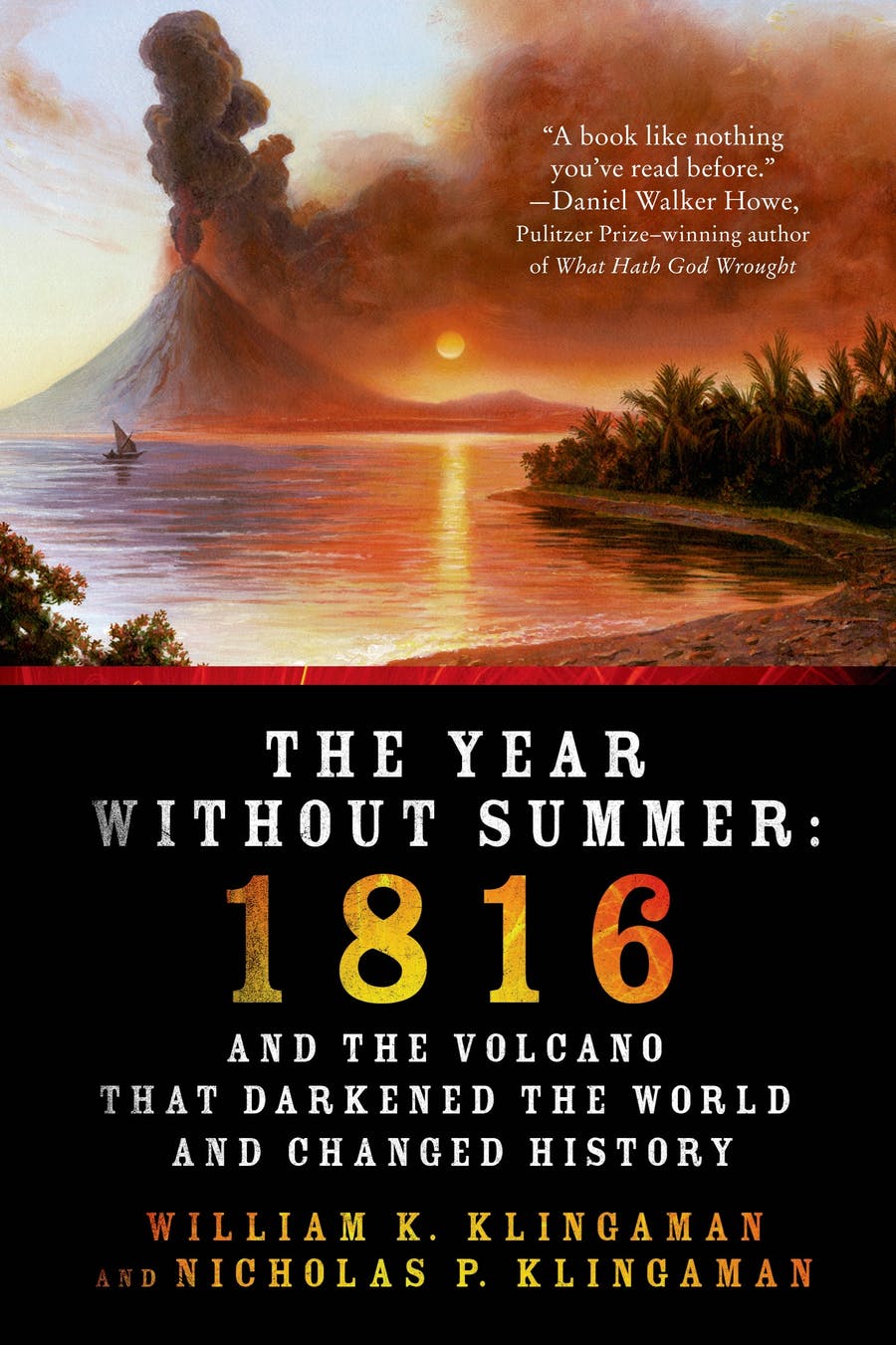
The Year Without Summer: 1816 and the Volcano that Darkened the World and Changed History, by William K. Klingaman and Nicholas P. Klingaman

Volcanoes have always fascinated me, so this book was “right down my alley.” I first heard about 1816 being called “the year without a summer” about 20 years ago. The premise of it stuck with me all these years, so I was pleased to discover William and Nicholas Klingaman’s book at the public library a few weeks ago.

The Year Without Summer: 1816 and the Volcano the Darkened the World and Changed History, by William K Klingaman and Nicholas P. Klingaman

On April 5, 1815, Mount Tambora – thought to be an extinct volcano — on the island of Sumbawa in the Indonesian archipelago erupted. The blast was heard more than 800 miles away on Java. It’s subsequent eruption on April 10 was even more violent.

That second eruption was heard on Sumatra, which is more than 1,000 miles from Mount Tambora. The top 3,000 feet of the volcano was blown off, leaving a three-mile-wide crater one-half mile deep. It is thought that ash rose 25 miles high where the wind spread it in all directions. A tsunami reached eastern Java around midnight and earth tremors were felt there 18 hours after the eruption.

It is thought that Mount Tambora was the largest volcanic eruption in the last 2,000 years. Volcanoes are measured by the Volcanic Explosivity Index (VEI), which works much like the Richter Scale we’re all familiar with for measuring earthquakes. Each step on the VEI equals 10 times the magnitude of the preceding step. Tambora gets a 7 on the VEI, making it 100 times stronger than the 1980 eruption of Mount St. Helens.

As one might suspect from the name of the book, the eruption of Mount Tambora affected weather worldwide, although contemporary documentation is more readily available from North America and Europe than other continents.

Not only were record snowfalls reported in Europe, but the snow was red and yellow. Imagine how unsettling that was! Brilliant red, purple, and orange sunsets were much written about in London.

Quoting from the book: “In fact, scientists have taken advantage of this effect by using the amount of red in contemporary paintings of sunsets to estimate the intensity of volcanic eruptions. Several Greek scientists, led by C.S. Zerefos, digitally measured the amount of red – relative to the other primary colors – in more than 550 samples of landscape art by 181 artists from the sixteenth through the nineteenth centuries to produce estimates of the amount of volcanic ash in the air at various times. Paintings from the years following the Tambora eruption used the most red paint; those after Krakatoa came in a close second.” (Krakatoa in Indonesia erupted in 1883.)

I’ll share a few specific examples from the book to illustrate how the weather was affected by Tambora.

May 1816: 6 inches of snow in parts of New York; frost in Tennessee and Richmond, VA. Snow in Vermont in late May.

June 6-9, 1816: Snow in Quebec, Vermont, New York, and Massachusetts; Arctic air plunged into the Carolinas. Snow in Lancashire in England. Erratic temperatures in New England, with snow one week, 100 degrees F. the next, and frost the following week.

July 6, 1816: Snow in Montreal. Frost from Maine to Virginia on July 8.

August 29, 1816: Heavy frost in South Carolina. A man in Danville, North Carolina wrote that his fields were white with frost and he had recently visited Mecklenburg County, NC and the cold and drought had left fields from there to the Savannah River bare.

Feb. 14, 1817: It was 30 degrees F. below zero at Dartmouth College and ice was 25 inches thick on the Potomac River at Alexandria, Virginia.

As one would expect, crops failed in Canada, the United States, and throughout Europe. Hundreds of thousands of people starved to death in Europe. Prices for food and grain for human and livestock consumption skyrocketed.

Various theories arose as people tried to figure out the cause of the cold weather. Self-appointed prophets predicted that the world would end on July 18, 1816.

Many families moved from New England to Ohio and Indiana in hopes of better farming conditions. Joseph Smith, father of Joseph Smith, Jr. who founded the Church of Jesus Christ of Latter-Day Saints, moved his family from Vermont to Palmyra, New York. It was there that Joseph Smith, Jr. had his visions. An interesting aside to the story is that after referencing the Messrs. Klingaman’s book in passing in my blog post two or three weeks ago, I was contacted by a descendant of Mr. Smith who inquired if the Smiths were mentioned in the book. Indeed, they are, on pages 119 and again in some detail on page 280.

In addition to the way global weather was affected by the eruption of Mount Tambora, the thing that really caught my attention was how the eruption was heard hundreds of miles away. In the Epilogue, Messrs. Klingaman say that when Krakatoa erupted in 1883, the explosion was heard in Perth in southwest Australia, which is more than 2,200 miles away!

By the way, Tambora is still active. It has erupted several times since 1815 – and as recently as 1967.

I wish I’d been told about Mount Tambora in history class.


Since my last blog post

I’ve been reading and also watching a lot of basketball. The North Carolina State University women’s basketball team gave the University of Connecticut a run for their money on Monday night in a game that went into double overtime. UCONN came out of top in the end and advanced to the “Final Four.”

And only in a North Carolinian’s dreams could the men’s “Final Four” pit the University of North Carolina at Chapel Hill against Duke University. That much-anticipated game was played on Saturday night. It was a typical UNC-Duke game, and it was a shame that one of the teams had to lose.

If you aren’t a college basketball fan, please overlook my going on and on about this, but I’m a North Carolinian and we take our college basketball very seriously.

I continue to work my way through Blueprint for a Book: Build Your Novel from the Inside Out, by Jennie Nash as I tweak the plot for The Heirloom.


Until my next blog post

I hope you have a good book to read. At the recommendation of author A.J. Mayhew, I’m reading Writing the Blockbuster Novel, by Albert Zuckerman, and at the recommendation of Mr. Zuckerman, I’m reading The Man from St. Petersburg, by Ken Follett.

Make time to enjoy a hobby.

Don’t forget the people of Ukraine.

Janet