This Writer Needed a Change of Scenery – Part I

Not wanting to publicize online that I was going out-of-town, you probably did not know that I spent much of the second full week of May on the Outer Banks of North Carolina. Having been there some 25 years ago, a return trip was on my and my sister’s “bucket lists.”

Along Cape Hatteras, NC

We packed so much into our trip that I decided to divide this “travelogue” into two parts. I will share Part II with you on Monday, June 3 and shift my usual “what I read last month” post to Monday, June 10.

Our departure was delayed by 24 hours by a storm that knocked out our electricity for 21 hours and took down literally hundreds of tree limbs in our yard. Yard clean up and some adjustments in our itinerary and reservations meant that we were exhausted when we finally left home, but the trip was salvaged. (And yard clean-up has continued since we returned home. Such is life when you live out in the country and have a yard full of large, old trees.)


The Outer Banks of North Carolina

The Outer Banks of North Carolina (often abbreviated as “OBX” these days) are truly a national natural treasure. They are a 120-mile-long string of barrier islands known as “The Graveyard of the Atlantic.”

Map showing locations of hundreds of shipwrecks along the Outer Banks – “Graveyard of the Atlantic”

Off Cape Hatteras is where the cold waters of the Labrador Stream collide with the warm water of the Gulf Stream. The clashing water and wind there constantly change to shape of the islands. It is said that the only constant on the Outer Banks is that they are constantly changing.

The massive sand dunes at Jockey’s Ridge are in a constant state of flux and shifts in height due to the wind. There’s a reason why the Wright Brothers decided to try out their “flying machine” there at Kitty Hawk in 1903. It seems like the wind never stops blowing.

To give you an example of the changes Mother Nature makes in the islands, the third (and present) Bodie (pronounced “body”) Island Lighthouse was completed in 1872 near the tip of Oregon Inlet. The lighthouse has never moved, but it is now two miles from the inlet! (https://www.nps.gov/caha/planyourvisit/bils.htm)

Bodie Island Lighthouse at dusk

The northern end of the Outer Banks

We knew the northern end of the Outer Banks had been highly developed since we were last there, but it was worse than we anticipated. It’s unfortunate that vacationers and summer-only residents wanted all the conveniences of home. Whether they wanted that or not, that’s what they got.

North from Whalebone Junction to Corolla is wall-to-wall development. It’s a shame what has been built on such a fragile sliver of the coast. The Nags Head Woods Preserve (https://www.nature.org/en-us/get-involved/how-to-help/places-we-protect/nags-head-woods-ecological-preserve/

Nags Head Woods Preserve

is still there protecting Jockey’s Ridge – the tallest living sand dunes in eastern United States. You can try your hand at learning to hang glide at Jockey’s Ridge State Park. (https://www.ncparks.gov/state-parks/jockeys-ridge-state-park)

There used to be miles of vacant land between Kitty Hawk and Duck and Corolla with the Spanish now-wild horses roaming freely. Now there’s a town called Southern Shores which runs into Duck which runs into Corolla. Multimillion dollar homes line NC Highway 12 and leave no vacant land.

The wild horses that have lived there for 400 years have now been corralled and fenced just north of Corolla for their own safety and one must pay a tour company big bucks to ride in a Hummer or a Jeep for a couple of hours in hopes of catching a glimpse of a few of those magnificent animals. We chose not to do that. We choose to remember them the way they used to be. Be sure and visit the gift shop of the Corolla Wild Horse Fund, Inc. (https://www.corollawildhorses.com/) where all proceeds support the maintenance and health of the wild horses.

At the north end of NC-12 there is a tiny parking lot. From there, one can hike and perhaps see some wild horses, but the lot was full when we were there.

We wanted to see the Currituck Beach Lighthouse again. (We love lighthouses!) Due to the growth of surrounding trees and the residential and commercial development in the last 25 years, the lighthouse at Corolla was more difficult to find than it was in the past. Nevertheless, we enjoyed seeing it one last time. (https://obcinc.org/currituck-beach-lighthouse/)

Currituck Beach Lighthouse

Meanwhile, traveling back south to Nags Head and Manteo…

Even if you aren’t interested in fishing, you might enjoy a stroll on Jennette’s Pier https://www.ncaquariums.com/jennettes-pier) at Nags Head. Associated with North Carolina Aquariums, this 1,000-foot-long concrete pier is a nice way to spend a few minutes or more. Fees are charged for fishing, but for $2.00 you can walk the pier and spend as much time as you like enjoying the views of the ocean and beach. The pier and its wooden predecessors have an interesting history.

We also enjoyed the North Carolina Aquarium (https://www.ncaquariums.com/roanoke-island) at Manteo on Roanoke Island. In the summer months there is a famous outdoor drama, “The Lost Colony” on Roanoke Island. That’s where North Carolina native Andy Griffith got his start in acting.

If you plan to visit the Outer Banks to see their stark beauty and leave some of the conveniences of home … well, at home, I recommend you spend two or three days on the northern banks if you must so you can visit the Wright Brothers National Memorial (https://www.nps.gov/wrbr/index.htm)

Wright Brothers Memorial, Kitty Hawk, NC

and the natural grandeur of Jockey’s Ridge,

Small portion of Jockey’s Ridge

the NC Aquarium,

One of the sea turtles at the NC Aquarium on Roanoke Island

and Jennette’s Pier,

Jennette’s Pier at Nags Head, NC

but then leave the traffic and hubbub behind and drive south from Whalebone Junction into the Cape Hatteras National Seashore.

Welcome sign at Cape Hatteras National Seashore

Please read my June 3, 2024 blog post to learn about my favorite part of the Outer Banks – the peaceful, wild, and beautiful southern end.


Until my next blog post

I hope you have a good book to read.

Remember the people of Ukraine.

Thank you for taking the time to read my blog! When you have a couple of minutes, I invite you to visit my website to see what I was doing prior to my trip and the types of writing I plan to continue to do:  https://www.janetmorrisonbooks.com.

Janet

#OnThisDay: Mecklenburg Declaration of Independence, 1775

I have blogged about today’s topic before. I try to always mention it near the anniversary date of the event because it is a little-known fact in US history. Indeed, it rarely gets mentioned even by the local journalists and reporters in the Mecklenburg County, North Carolina area today. (Of course, most of them moved here from other parts of the country and they are not aware of our local history.)

I don’t know that I can improve upon my Mecklenburg Declaration of Independence blog from 2022, so I am taking the liberty to quote from it today.

From my May 23, 2022 blog post, “Mecklenburg Declaration of Independence, 1775”:

Today, my blog is about the Mecklenburg Declaration of Independence in 1775 while present-day Cabarrus County was part of Mecklenburg County and its citizens played just as important a role in the declaration as anyone living in what is present-day Mecklenburg County, North Carolina.

Friday, May 20, 2022 was the 247th anniversary of the signing of the Mecklenburg Declaration of Independence.

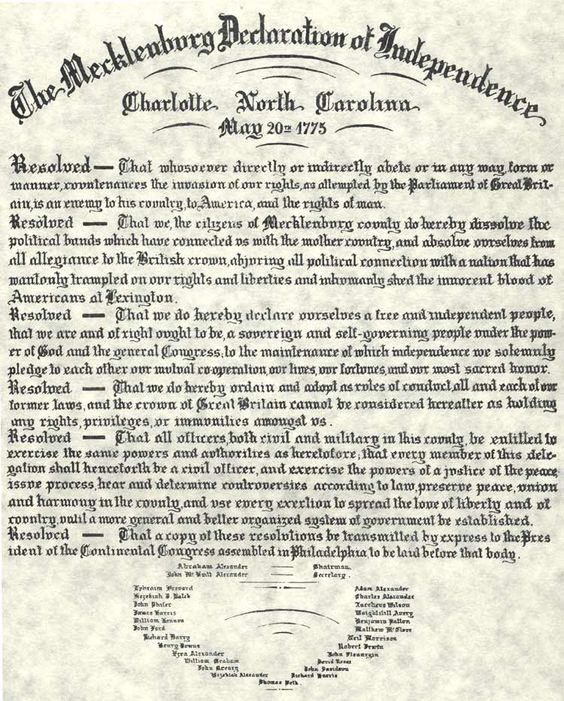
A recreation of the Mecklenburg Declaration of Independence

But what about the 1775 Mecklenburg Declaration of Independence?

I blogged about the Mecklenburg Declaration of Independence on May 21, 2018. To refresh your memory, or to introduce you to the topic if you aren’t aware of it, the following nine paragraphs are reblogged from that post:

My immigrant ancestors were among the Scottish Presbyterian pioneers who settled old Mecklenburg County, North Carolina. Years of discontent in the American colonies were piled on top of the anti-British Crown feelings they brought with them across the Atlantic.

Weary of unfair taxes imposed by the Crown and the discrimination they were subjected to as Presbyterians slowly brought the settlers to the boiling point. An example of the persecution these Presbyterians felt were the Vestry and Marriage Acts of 1769. Those acts fined Presbyterian ministers who dared to conduct marriage ceremonies. Only Anglican marriages were recognized by the government.

In May of 1771 a group of young men from the Rocky River Presbyterian Church congregation in the part of Mecklenburg County that later became Cabarrus County, disguised themselves by blackening their faces and under the cover of darkness ambushed a shipment of Royal munitions traveling north on the Great Wagon Road. The supplies were destined for Rowan County to put down the Regulator Movement.

Blowing up three wagons loaded with gunpowder and other supplies, the teens and young men who perpetrated the deed were declared outlaws by the Royal Governor and had to go into hiding until May 20, 1775 when all the citizens of Mecklenburg County were declared to be rebels against the British Crown.

On May 20, 1775, the citizens of Mecklenburg County, North Carolina declared themselves to be free and independent of the rule of Great Britain. It was a sober and sobering declaration not entered into lightly. Those American patriots meant business, and they knew the risks they were taking.

Archibald McCurdy, an Elder in Rocky River Presbyterian Church, heard the document read from the steps of the log courthouse in Charlotte. When he got home, he and his wife, Maggie, listed everyone they knew of who could be trusted in the coming fight for American independence.

No original copies of the Mecklenburg Declaration of Independence survive today. The local copy was lost in a house fire at the home of one of the signers. The copy taken to the Continental Congress in Philadelphia by Captain James Jack on horseback was also lost. Later, signers of the document recreated it from memory.

Nevertheless, those of us who were raised on stories of the Mecklenburg Declaration of Independence and the brave souls who risked their lives to sign it know that the document was real. The blood of the American patriots still flows in our veins and their spirit of freedom still beats in our hearts.

Don’t mess with our freedom of the press, freedom of speech, freedom of religion, or our freedom of assembly!

Until my next blog post

Just for the pleasure of it, read a good book.

Take time for friends and family.

Don’t forget the people of Ukraine.

Janet

Spring Sightings in North Carolina

I considered writing about the Jamestown, Virginia Colony today on the 417th anniversary of its establishment, but I just could not muster enough interest in it this week to do the research necessary to blog about it. (You can thank me now or you can thank me later.)

I am taking the easy way out with my blog this week. Instead of researching the Jamestown Colony or waxing poetic about a book I’ve read, I have chosen to share with you some of the beauty of spring in my own yard.

Spring is by far my favorite season of the year because it follows the “dreaded winter.”

Camellia
Camellia and Honey Bee
Daffodils
George Tabor Azalea
Bearded Iris
Dutch Iris
Rhododendron

What’s not to love?


Until my next blog post

I hope you enjoy the gifts of spring or whatever season it is where you live. (I am well-aware that several of my readers live in Australia, and I don’t envy you of your transition into cold weather.)

I hope you have at least one good book to read this week.

Remember the people of Ukraine.

Janet

Books I Read in April 2024

As you will see from three of the four books I read last month, I chose to concentrate on my writing and historical research in April. Some of the following books might not pique your interest as a reader, but… you never know. I’ll start with the book that falls in a different category.


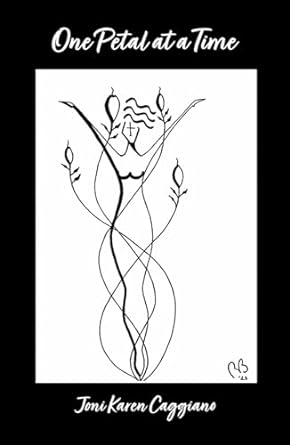
One Petal at a Time, by Joni Karen Caggiano

One Petal at a Time, by Joni Karen Caggiano

This is a book of poetry and prose written from the depths of pain and abuse. The writer bares her soul in her words earned from years of abuse by two alcoholic parents and further abuse from a male relative. It is difficult to read. I cannot identify with the horrors she writes about. I had a good life as a child and teen, and naively assumed everyone else lived in a calm, comfortable home with loving parents.

The silver lining in Ms. Caggiano’s book is that she eventually found love and has, as an adult, established a loving home for her own family. Others who have or are living in an abusive situation should find hope in Part 3 of this book and be inspired by her example, her statement of faith in God, and the fear that is no longer in her life. She is a retired nurse, a survivor, and an environmental advocate.

 The book cover and interior are masterfully illustrated with the exquisite art of Francisco Bravo Cabrera, who is also known as Bodo Vespaciano. Through black line art he captures the essence of Ms. Caggiano’s words.


Historic Shallow Ford in Yadkin Valley: Crossroads Between East and West, by Marcia D. Phillips

Historic Shallow Ford in Yadkin Valley: Crossroads Between East and West,
by Marcia D. Phillips

The Shallow Ford on the Yadkin River in North Carolina plays a role in the historical novel I’m writing, so imagine my excitement when I discovered this book. It was published in 2022 by The History Press.

The Shallow Ford was a natural crossing of the river and was used by thousands of pioneers traveling on the Great Wagon Road and by armies during the American Revolution and the American Civil War. It was, no doubt, used by native Americans for thousands of years before the era of European settlement.

If you are interested in how the piedmont section of North Carolina was settled, then this book is for you. It mentions the various roads and how roads sprang up from the Great Wagon Road to lead to other parts of the state and adjoining states for commerce.

I was most interested in the first sixty percent of the book for its research value for my writing; however, the entire book gives a detailed look at the settlement, cultural development, and industrial development of the Yadkin Valley, which is more of less the area of present-day Davie, Yadkin, and Rowan counties for the purposes of this book.

The Yadkin River is one of the major rivers in North Carolina. It drains the area from the Blue Ridge Mountains in the northwestern part of the state, through the lower piedmont – including where I live. At its confluence with the Uwharrie River it becomes the Pee Dee River, which is fed by the Rocky River and the Lumber River as it eventually flows into the Atlantic Ocean at Georgetown, South Carolina.

Written by “the keeper of the treasures in the Martin-Wall History Room at the Davie County Public Library,” the book is well-documented. In her work, Marcia D. Phillips had access to a wealth of local history sources as well as having the advantages of living in the area about which she wrote.

This book was a God-send for my research of the Shallow Ford of the Yadkin River.


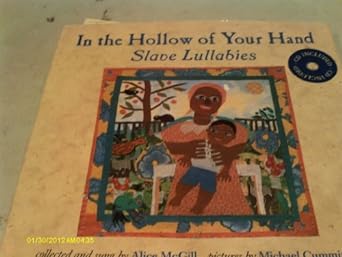
 In the Hollow of Your Hand: Slave Lullabies, collected and sung by Alice McGill, pictures by Michael Cummings; musical accompaniment on enclosed CD by Nancy Krebs

In the Hollow of Your Hand: Slave Lullabies,
collected by Alice McGill

This is a juvenile picture book that I happened upon at the public library in Charlotte while looking for documented American slavery songs as a part of my research for the historical novels I am writing.

Although it is classified as a Juvenile book, I thoroughly enjoyed it.

The fact that it includes a musical CD with the author giving some narrative and singing the songs that have been passed down through the generations of her North Carolina family is the icing on the cake!

The book and CD include thirteen lullabies endemic to the families of slaves. Each lullaby is beautifully illustrated in the African-American tradition by the artwork of Michael Cummings. The banjo having its roots in the Africans who were brought to the American colonies and states as slaves, it is fitting that Nancy Krebs accompanies Alice McGill’s singing by playing the banjo.

There is pain, sorrow, familial separation, the threat of being sold to another slaveholder, and even death in these lullabies. If not for writers like Alice McGill, these wonderful nuggets from American history would be lost forever.


Painting the Past: A Guide for Writing Historical Fiction, by Meredith Allard.

Painting the Past: A Guide for Writing Historical Fiction,
by Meredith Allard

My sister happened upon this book at the public library and brought it to my attention. It is a good book for someone beginning their journey as a writer of historical fiction and, at the same time, is a good book to remind a veteran historical fiction writer of why they do what they do.

Each chapter is introduced by a quote from a writer. I copied most of those quotes so I’ll have them as reminders when I question what I’m attempting to do as a writer.

The book talks about the joys and challenges faced by historical fiction writers, as well as our responsibilities. It addresses what constitutes historical fiction and how much leeway a writer has in sticking to the truth. A writer of historical fiction should always disclose what is fiction and what is fact.

The author talks about the importance of using trusted sources and how just because something is presented as a fact in a nonfiction book does not mean it is true. (That reminded me of something Sharyn McCrumb said in a speech I heard her make in Wilkes County, North Carolina many years ago. She said something like – and I must paraphrase here — some historical fiction is better-researched than some history books.)

The book addresses what historical fiction has in common with general fiction and how it differs. Lovers of historical fiction expect certain things in the novels they read, and it is incumbent upon the author to meet those expectations. If they don’t deliver, they lose all credibility.

I’ll close with a couple of quotes the author shared in her book. She quotes Guy Vanderhaeghe as follows: “History tells us what people do; historical fiction helps us imagine how they felt.”

And she quotes Isabel Allende as follows: “People have this nostalgic idea that the past was better, but the truth is most folks had very hard lives.”

Until my next blog post

I hope you always have a book that you can’t wait to get back to reading.

Appreciate friends and family.

Remember the people of Ukraine.

Janet