A Recent Attack on an Historical Novel

Here I go again, blogging about book banning. It’s too important to sweep under the rug.

Today’s blog post is longer than most of mine, but this is a topic that is near and dear to my heart. It is a topic that is indicative of the trouble our world is in today.

A small but vocal segment of our society believes it is wrong to teach young people about slavery, the Holocaust, or any part of history that makes them uneasy. They start by asking that books be removed from public school libraries and classrooms. They complain if certain books and plays written by Shakespeare are read in the classroom or assigned as required reading. Then they move on to public libraries. Then they start attacking authors and book publishers.

They believe that their freedom of speech trumps my freedom to read. They believe they have the right to deny you and me the right to read anything we want. Some of them don’t mind using violence to get their point across.

Photo by Kristina V on Unsplash

As I stated in an earlier blog post, they have the right to regulate what their own children read, but they don’t have the right to deny my great-nieces the right to read what they want and need to read.

Where does it end? Just look at 1930s Germany, if you want to know. Just look at countries where groups like the Taliban have gained political control.

It’s time for reasonable people to pay attention

I hear too many people say, “I never use the public library. I buy the books I want to read.” As a writer, I want people to purchase my books. I also want public libraries to purchase my books. But that’s not the point.

The point is that public libraries are integral to the very foundation of our country and our society. I read an article last week that quoted the American Library Association (ALA) as reporting that book challenging at public libraries in 2022 amounted to 16% of all book challenges in the United States, but in 2023 public libraries are receiving approximately 50% of the book challenges in the US.

Let that sink in. Also, let it sink in that the Proud Boys have disrupted reading hours at public libraries and librarians have received death threats. Is that what you want at your local public library?

Well-meaning, misguided people are taking away your right to read. Many of them are even doing it in the name of God. It makes them feel good to say that. It makes them feel good to say they’re doing it “to protect the children.”

I understand the need for age-appropriate books; however, today’s right-wing activists are hiding behind that political campaign sound bite and are using it to nitpick and challenge every book that comes down the pike. Their “holier than thou” attitude is wearing thin with me.

They’re on a mission to dumb us down, to dictate what we can and cannot have access to, to limit our intellectual potential. They are on a mission to erase the ugly and uncomfortable parts of our nation’s history.

Many historical novels have been challenged and banned in various places over the years, and it seems like all fiction is fair game for the book banners today. In my blog post today I highlight three historical novels that have been challenged and banned in various locations.

These three immediately came to mind

To Kill a Mockingbird, by Harper Lee
Beloved, by Toni Morrison
The Grapes of Wrath, by John Steinbeck

I have read each of those novels and not one of them warped my mind. Were you damaged by reading any of these novels? I doubt it. Were you moved to understand and see the world differently by reading these novels? Probably.

To Kill a Mockingbird teaches us about racial discrimination and injustice while also teaching us that Atticus Finch had integrity and maybe we should, too.

Beloved teaches us about the horrors of slavery and that the horrors did not end with the Civil War. It teaches us the lengths desperate people will go to prevent their children from being enslaved and living in horrible circumstances. That’s being demonstrated daily at the US-Mexican border.

The Grapes of Wrath teaches us what can happen after a decade of affluence and decadence and a time of drought as it illustrates a side of life during The Great Depression.

It’s one thing to read that thousands of people lost their farms and everything they had during the “Dust Bowl,” but it’s altogether different to read The Grapes of Wrath and live with the novel’s characters.

The Snow Forest, by Elizabeth Gilbert

In July of this year, an historical novel scheduled to be released in February 2024 was attacked on the author’s Goodreads account to the point that she chose to cancel its publication.

Elizabeth Gilbert, who wrote Eat, Pray, Love had written a novel set in Russia in the 1930s. With all the current interest in the war in Ukraine today, it would seem an opportune time to release a book set in 1930s Russia.

But author Elizabeth Gilbert learned that was not the case. She got so much blowback from her fans, that she pulled The Snow Forest even after some of her readers had pre-ordered the book. Her fans in Ukraine (or at least enough of them) said it was not the right time to release a book set in Russia. In response, the author suspended the publication of the book.

Author Alina Adams’s Thought on this

I read a blog post by author Alina Adams who was born in Odessa, Ukraine. Ms. Adams’ post maintains that historical fiction can make an important statement about the world and not just be a source of entertainment.

Ms. Adams wrote, “And as someone who loves to read historical fiction taking place all over the world in all sorts of different time periods, I am wary of a mindset which might lead to authors and publishers censoring themselves, shying away from setting stories in regions where there is ongoing political strife.”

In addition to specific examples of historical novels that have been challenged and banned, Ms. Adams’ blog post contained several succinct statements about the potential historical fiction holds, including the following: “Sometimes, historical fiction can tell a truth non-fiction isn’t equipped to deliver.” Also, “It doesn’t just make you think, it makes you feel. And it makes you empathize.”

My thoughts on this

Reading an historical novel might not change your political stance or religious beliefs but, if you give it a chance, it just might help you see the other side of an issue.

It might at least help you realize that people with views that oppose yours are not necessarily your enemies. They just might be human beings with a different perspective and life experience.

Please take a couple of minutes to read Alina Adams’ complete blog post from July 27, 2023 on M.K. Tod’s blog, A Writer of History: Why Historical Fiction Must Keep Tackling Controversial Topics | A Writer of History.

A quote from author Barbara Kyle

I printed this quote from Barbara Kyle and have it taped to my computer:

“The move to self-censorship for fear of ‘cultural appropriation’ is a sad state of affairs. Author Morgan Jones eloquently champions the opposite position: ‘Fiction remains the best means we have of finding connection where there seems to be none; and the novel, of all forms, encourages a search that’s deep and sustained. By reading (or writing) one, you’ve travelled somewhere else. You’ve moved, if only slightly, toward others. In a world that finds and increasingly exploits division and difference, this is an invaluable, precious exercise.”

Since my last blog post

Marie and I finished proofreading and creating the cover for our upcoming cookbook, The Aunts in the Kitchen: Southern Family Recipes. We submitted it to Amazon on Friday and requested a proof copy. It should arrive this week and, if we are pleased with it, we’ll give Amazon the go ahead to publish it. Look for an update and perhaps a cover reveal in next Monday’s blog post.

Until my next blog post

Be aware of what is going on in your community and state related to book challenges and book bannings. Speak up for books. Speak up for the freedom to read. Speak up for public libraries and librarians.

Have you ordered my American Revolution e-ghost story?  “Ghost of the Battle of Guilford Courthouse: An American Revolutionary War Ghost Story” is available from Amazon, along with my other books: https://www.amazon.com/dp/B0CH7JCP11/. It’s only available as an e-Booklet.

“Ghost of the Battle of Guilford Courthouse: An American Revolutionary War Ghost Story,” by Janet Morrison

If you don’t have a good book to read, visit your local public library. Or, from the comfort of your home, go to its website and search for books you would like to read or subjects you want to learn more about. You will be amazed at what is available at your fingertips!

Take time for friends and family.

Thank you for taking time to read this long blog post.

Remember the people of Ukraine, Maui, Libya,….

Janet

How much Regional Accent and Dialect is Too Much in Historical Fiction?

When it comes to using dialect or regional accents in a novel, there are no definitive rules. It depends on the writer’s voice, the genre, and personal taste. Personal taste is where the rubber meets the road.

Too much of something like dialect in a novel sort of falls into the “I know it when I see it” category.

The rule of thumb

The rule of thumb is to avoid using it to the point of making the novel difficult to read. If the reader finds it exhausting to decipher the words, it means you have crossed that imaginary line. If the reader must wade through so much dialect that they are yanked out of the story, it means there is too much dialect.

Photo by Tim Mossholder on Unsplash

My experience with “y’all” in “Slip Sliding Away”

In my early drafts of my historical short story, “Slip Sliding Away,” I set the plot in the late 1700s. Something kept nagging at me, though. I wanted to use “y’all” in the story.

If you have read the story and you are from the southern part of the United States, you know the funeral scene with the intoxicated pallbearers struggling to get up the hill to the cemetery just screams out for the use of “y’all.”

There was a problem, though. My trusty resource for determining when a word came into common usage, English Through the Ages, by William Brohaugh, failed me! I did not find ‘y’all” in the book.

My second resource for such dilemmas is Merriam-Webster’s Collegiate Dictionary, Tenth Edition, for it tells when words came into common use. I looked up “y’all” and to my great disappointment, the dictionary just said, “var [variation] of you-all.”

I cringed. Why would anyone say, “You all” when there is a perfectly good contraction that just rolls off the southern tongue?

While I’m airing my grievances about the use and misuse of “y’all,” let me just say that if one is going to write the contraction, please put the apostrophe in the correct place. Don’t make me cringe by writing, “ya’ll.” I see it on all kinds of southern merch and it’s just not right. But I digress.

I turned several pages beyond “y’all” in the dictionary and looked up “you all.” First, I discovered it is hyphenated. Who knew? Then I learned that “you-all” was in common use in 1824. That information was helpful. It told me that I had to move my late-1700s story to 1824 or later.

I never did find anything definitive telling me when southerners started taking the easy way out by addressing two or more people as “y’all.” I figure that surely by the 1870s the word was in use, so I set the final draft of “Slip Sliding Away” in that decade.

Did you have any idea about the minutiae writers of historical fiction have to deal with? (Yes, I know. I’m not supposed to end a sentence with a preposition; however, it just seems awkward to write – or read – “Did you have any idea about the minutiae with which writers of historical fiction have to deal?” My mother was an English teacher, and I think she would agree with me on this one.)

What about the dialect in Where the Crawdads Sing, by Delia Owens?

After reading Where the Crawdads Sing, I found myself alone in the world in saying that novel contained too much dialect. Everyone else who read it absolutely loved it. I liked it, too, but I was distracted by the amount of dialect used. Maybe I had read too many articles and books about the craft of writing and I was just hyper aware of the dialect.

With more than 617,000 reviews with an average of 4.7 out of 5 stars on Amazon and 18 million copies sold worldwide, Where the Crawdads Sing is obviously an amazing novel. Apparently, Delia Owens knew exactly how much dialect to include in it to please millions of readers. I wish I were talented enough to have written it!

Since my last blog post

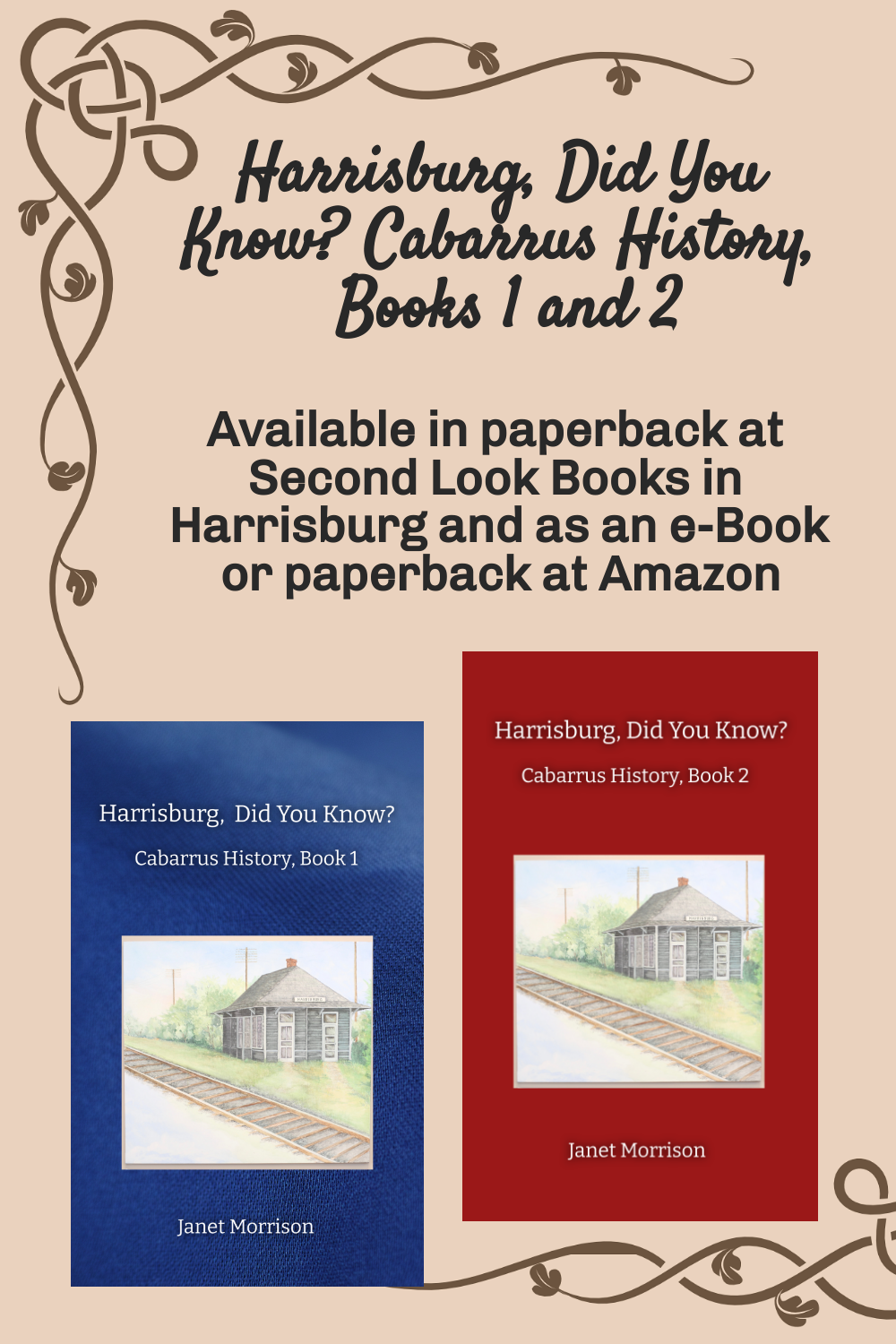
It was a busy week and I got to check off one big task that has been on my to-do list for months. On Friday, my church friend who took the cover photograph for my two local history books, Harrisburg, Did You Know? Cabarrus History, Book 1 and Harrisburg, Did You Know? Cabarrus History, Book 2, took photographs for the cover of the family cookbook my sister and I have been compiling for a couple of years. With the formatting finally completed, I felt safe in getting the cover designed. Look for an announcement regarding the publication of The Aunts in the Kitchen: Southern Family Recipes in a future blog post and in my November newsletter.

My sister and I took a day trip that was a combination Revolutionary War/genealogy trip. It was a wonderful day. I’ll tell you about in my November newsletter.

Speaking of my newsletter, you can find out about the cookbook, my various other writing projects, and the historical “field trips” I take if you simply go to https://www.janetmorrisonbooks.com and click on the “Subscribe” button. You will immediately receive a free downloadable copy of “Slip Sliding Away” as well as my future every-other-month newsletters. Thank you to all 42 of you who have taken the time to subscribe.

Until my next blog post

What do you have to say about the amount of regional accent or dialect in a novel? I would like to hear your thoughts on the topic.

Have you ordered my American Revolution e-ghost story?  “Ghost of the Battle of Guilford Courthouse: An American Revolutionary War Ghost Story” is available from Amazon, along with my other books: https://www.amazon.com/dp/B0CH7JCP11/.

Take time for friends and family.

Thank you for taking time to read my blog post. Y’all come back now, ya hear?

Remember the people of Ukraine, Maui, Libya,….

Janet

#OnThisDay: September 11, 2001

In memory of the 2,977 innocent victims who died 22 years ago today in the Twin Towers in New York, the crash of hijacked United Airlines Flight 93 in Shanksville, Pennsylvania, and The Pentagon in Washington, DC.

Photo by Jametlene Reskp on Unsplash
Photo by Aidan Bartos on Unsplash
Photo by Fiona Murray on Unsplash

A day that all of us who were alive on that day will forever remember with unspeakable sadness.

Until my next blog post

Hold all those you love a little closer.

Janet

Four Books I Read in August 2023

Here it is, the first Monday in September. Where did the summer go? We still have some warm – probably even hot – days ahead, but school is back in session, today is Labor Day in the United States, and for all practical purposes, today marks the unofficial end of summer. I always hate to see it go, but that’s just me.

I read an assortment of books in August, and today I’ll tell you about them. I hope at least one of them will pique your interest. If you’ve read any of them, I’d like to know how you liked them.

The Paris Agent, by Kelly Rimmer

The Paris Agent, by Kelly Rimmer

I get excited when Kelly Rimmer writes a new book. She’s one of my go-to authors when it comes to historical fiction. The first novel of hers that I read was The Things We Cannot Say. I blogged about that novel September 9, 2019 (#BringBackOurGirls.) The next month I read Before I Let You Go (see my October 7, 2019 blog post: Thrillers and a Dark Novel I Read Last Month.)

I listened to Rimmer’s novel, Truths I Never Told You in March 2021, but I failed to blog about it after I finished it. I blogged about The Warsaw Orphan in my July 12, 2021 post, 4 Other Books I Read in June 2021. I read The German Wife by her last August and blogged about it on September 5, 2022 (Four of Eight Books Read in August 2022).

I didn’t realize I’d read six of Kelly Rimmer’s novels until I did a search of my blog posts. I guess you could say I like her writing.

I listened to The Paris Agent on CD from the public library. In her latest historical novel, Kelly Rimmer weaves a story involving two timelines. I usually don’t care for books that yank me back and forth between two different eras, but The Paris Agent was masterfully written and the format worked for me.

Noah Ainsworth was a British spy in France during World War II. In 1970, he is still struggling to make sense of his memories and the gaps in his memories caused by a head injury in the line of duty. His daughter, Charlotte, is determined to unravel the bits and pieces of his memory, official records, and memories of her father’s contemporaries.

The book takes the reader on a journey of questions, hope, love, misunderstandings, dead ends, and answers. As with Rimmer’s other novels, I recommend this one.

Darkness Visible: A Memoir of Madness, by William Styron

Darkness Visible: A Memoir of Madness, by William Styron

You might be familiar with the author William Styron. He wrote Sophie’s Choice, which was made into a movie. What you might not know is that he had a life-altering battle with severe depression.

Darkness Visible: A Memoir of Madness is the story of his depression. I have relatives who have and still are battling depression. It is a serious illness and deserves a more serious-sounding name. I have heard depression described by the people in the throes of their battles and I have read about it, but nothing has brought the wide scope of symptoms the disease can cast on a person’s mind and body like this book did.

Being a professional writer, Mr. Styron was able to express some of the things he endured with style and grace and carefully-chosen words. It is not a pleasant subject, but it is an illness that affects more people than we probably realize.

I encourage you to read this book, especially if someone you love is suffering with depression. Each case is unique, so the symptoms Mr. Styron had are not necessarily the symptoms your loved one has. But maybe reading this memoir will enlighten you and help you understand just a little of what your friend, co-worker, or relative faces every day as they try to put on a happy face and act like nothing is wrong.

Don’t ever belittle anyone who is depressed. Don’t ever say, “He is just depressed.” Don’t tell a depressed person to “just snap out of it.” Don’t ever minimize their suffering. Mr. Styron gives hope in the end. He got the professional help and medication he needed, and now he can look back on that horrible time and write about it.

Blowback: A Warning to Save Democracy From the Next Trump, by Miles Taylor

Blowback: A Warning to Save Democracy From the Next Trump, by Miles Taylor

I was reading this book on August 14, 2023 – the day the indictments came down from Fulton County, Georgia against Donald Trump and 18 others. The author, Miles Taylor, worked in the Department of Homeland Security in the Trump Administration. He hoped from the beginning that Donald Trump would “rise to the occasion” or that some adults would influence him. Neither happened.

Taylor thought by staying in the administration but publishing warnings under the pseudonym “Anonymous” he could bring enough exposure to the corruption in the Trump White House to prompt Congress and others in high positions of authority in the government to reign in the extremist radical ideas Trump espoused. It didn’t work out that way, and in October of 2020, Taylor went public and Trump was openly out for revenge.

Among other things, as “Anonymous,” Taylor had made it known that behind Trump’s back various Cabinet members were saying how incompetent he was.

Taylor explains in the prologue that “blowback” is the term used in national security circles “to describe unintended consequences, the failure to anticipate the repercussions when we make a choice.” Hence, the title of his book.

He says our generation of Americans will be known by future generations by the words, “They did not listen.”

He wrote the book to warn the American public about what is at stake if Trump is elected in 2024 or a more competent Trump-wannabe is ever elected. He addresses the various “guardrails” in place to safeguard our democracy and how they were weakened by the actions of Trump and his supporters.

I know what I write here won’t change any minds. Mr. Taylor probably knows his book won’t change any minds. The people who still support Trump apparently aren’t going to change their minds no matter what he says, does, or is convicted of. And they will go to the polls in 2024 and vote for him again even as they must hold their noses to shield themselves from the stench of his behavior – behavior they would not tolerate from their own family members or an employee.

If you want an inside look at what went on in the White House during the Trump Administration, you might be interested in this book. It is incumbent upon every American to pay attention to what has happened, what is happening, and what will continue to happen in the political arena. It is our responsibility. After all, ours is, to quote the Gettysburg Address, “…government of the people, by the people, and for the people….” We are the government.

Educate yourself before you vote. The depth of Trump’s incompetence illustrated by example after example in this book is mind blowing. From asking if hurricanes really spin to wanting to tell people in the path of a Category 4 hurricane to stay home and ride it out, to suggesting that fire trucks could be parked near the border with Mexico so cows could climb the ladders on the trucks to get over the border wall and graze along the Rio Grande…. You can’t make this stuff up.

Mastering Suspense, Structure & Plot: How to Write Gripping Stories That Keep Readers on the Edge of Their Seats, by Jane K. Cleland

Mastering Suspense Structure & Plot, by Jane K, Cleland

In this book about the craft of writing, Ms. Cleland starts out by remind writers to know their readers and give them what they want. She suggests that a writer look at six or more bestsellers in their genre and then analyze them based on such things as sexual content, violence, setting, and pace. She writes about the overarching thematic question posed at the beginning of a novel that must be answered by the end of the book. In terms of structure, she writes about linear and nonlinear structure, and she recommends that a writer select the best structure for the story they’re telling.

In the section of her book about creating suspense, she gives numerous examples of how that can be done. She says “The most common way to create suspense is to let your reader share a character’s anxiety.” It’s easier said than done, but she offers a lot of pointers.

In talking about settings, Ms. Cleland encourages writers to only include the things your point-of-view character sees, hears, touches, smells and only the kinds of places that character would go.

In the fifth chapter, Ms. Cleland writes about how to layer in two subplots. This was a helpful chapter for me, as I have a couple of subplots in one of the novels I’ve drafted. I hope I’ve woven them in appropriately.

She writes about isolating your characters. Each person reacts differently to be physically or socially isolated. She touches on red herrings and how to use them.

You get the picture. If you’re still learning the art and craft of writing fiction, I recommend Jane K. Cleland’s book.

Since my last blog post

I edited one of my short stories, created the cover for it on Bookbrush.com, finished formatting it on Atticus.io, and submitted it to Amazon for publication as an e-book only. It should be available today for $2.99. The name is “Ghost of the Battle of Guilford Courthouse: An American Revolutionary War Ghost Story.” I’m not a believer in ghosts, but please read the Author’s Note at the end of the story to find out what prompted me to write a ghost story.

Ghost of the Battle of Guilford Courthouse: An American Revolutionary War Ghost Story, by Janet Morrison

My sister and I finished proofreading the recipes in and wrote the introduction for The Aunts in the Kitchen: Southern Family Recipes. Getting the photography done for the front and back covers is next on our list. We hope to have the paperback and e-book available on Amazon by November.

I finished writing my September newsletter. I hope you’ve subscribed. It comes out every other month. When you visit my website, https://www.janetmorrisonbooks.com, you can click on the subscribe button and receive a free downloadable copy of my short story, “Slip Sliding Away.”

Until my next blog post

I hope you’re reading a book that is so engrossing you didn’t want to put it down to read my blog.

Don’t forget to order “Ghost of the Battle of Guilford Courthouse: An American Revolutionary War Ghost Story” on Amazon!

Make time for friends and family. They won’t always be here.

Remember the people of Ukraine, Maui, and Florida.

Janet

As a reader, what do you think of flash fiction?

The novels I’ve drafted or at least outlined are not going to be short. They aren’t going to be 1,000-page tomes (300,000 words!) like the Outlander series by Diana Gabaldon either. A sweet spot for historical novels falls somewhere between 90,000 and 120,000 words. I’m aiming for the low 90,000s.

At the other extreme is the genre called flash fiction or minimalist fiction. By definition, flash fiction falls somewhere between six words and usually 1,000 words. There are some 1,500-word exceptions.

For me, it’s easier to write a story of thousands of words than one of a thousand words. It’s a challenge to develop characters and a plot in 1,000 words.

But I mentioned a starting point of six words. The example of such a concise story is attributed to Ernest Hemingway, although, the efficacy of that attribution is not proven. Nevertheless, here is that six-word piece of flash fiction:

“For sale: baby shoes, never worn.”

Wow! You would be hard pressed to find six words that pack more of a punch! The author could have gone on to explain why the baby shoes had never been worn, but isn’t it more effective to let the reader’s mind fill in the blanks?

Photo by Drew Hays on Unsplash

In fact, it would have been easier for the writer to elaborate. Boiling down an entire story into six words is nearly impossible. I can’t imagine that I’d ever be able to do it, but fiction writers today are encouraged to delete all unnecessary words – to make every word count.

That’s the lesson flash fiction teaches a writer, so I think it’s a good exercise for aspiring novelists to practice.

I submitted a 28-word story to an “On the Premises” mini-contest in May. The guidelines were to write in any genre a story of 25 to 50 words in which two opposing points of view were shown. It was an interesting exercise. My first two versions were exactly 50 words. I continued to pare down the unnecessary words. Satisfied with my eighth version of the story, I hit the “submit” button.

Here’s the story I submitted:

This house has stories to tell. Close your eyes. Just listen. You hear that? Children laughing and playing.

Yeah, then going off to war and not coming home.

Photo by Anne Nygård on Unsplash

The winner out of the 212 entries was announced on May 10. My story wasn’t the winner. Perhaps I edited out too many words. I’ll keep trying.

If you’ve never read any flash fiction but are curious about it, here’s the link to an April 23, 2023 blog post on Reedsy: https://reedsy.com/discovery/blog/best-flash-fiction. The 25 stories are clickable. One of them, “Where Are You?“ by Joyce Carol Oates, was published in The New Yorker in 2018. Here’s the link: https://www.newyorker.com/books/flash-fiction/where-are-you. Take a minute (or maybe two) to read it.

Or, you can go to your public library system’s online catalog and do a search for it – or ask a librarian for suggestions. If you prefer, you can do a search on Amazon or a general search in your favorite search engine.

Since my last blog post

I finished writing the first draft of a devotional book designed especially for people who have Seasonal Affective Disorder in the colder months of the year.

With the family cookbook my sister and I have compiled finally formatted, we started the tedious proofreading phase.

I started proofreading the historical short stories I’ve finished writing.

Until my next blog post

I hope you’re reading a book that is so engrossing you didn’t want to put it down to read my blog.

Don’t forget to subscribe to my newsletter by visiting https://www.janetmorrisonbooks.com. Thank you! I plan to send out my September newsletter the first week of the month. Remember, subscribers to my newsletter receive a free downloadable short story I wrote:  “Slip Sliding Away”, which takes place in the Appalachian Mountains in the 1870s.

Make time for friends and family. They won’t always be here.

Remember the people of Ukraine, Maui, and Jacksonville, Florida.

Janet

#OnThisDay: Anniversary of Hawaii Statehood, 1959

When I was planning my blog post topics for August, I considered writing about today being the 64th anniversary of the statehood of Hawaii. I thought the 64th anniversary was a ho-hum time to draw attention to it, so I planned to write about a different subject today.

Then the wildfires erupted on Maui. Fanned by hurricane-force winds, the fires became a raging inferno and in the blink of an eye, at least 1,100 human lives were lost (as 114 deaths have been documented and more then 1,000 people are still unaccounted for as I write this.) Thousands of homes and businesses were destroyed and thousands of people were left not only homeless but with nowhere to work.

A 200-year-old church sanctuary was destroyed, as well as the local public library – along with everything else in the town of Lahaina.

There is speculation that the fire was sparked by a tree connecting with a power line. However it started, it was fed by low level winds created by Hurricane Dora some 300 miles away and another weather system thousands of miles to the north. The converging wind circulations of the two weather systems created a recipe for disaster.

Should someone or a government agency have seen it coming and issued warnings? That’s not for me to say. This isn’t the time to place blame. The wounds are still too raw. I’m sure the situation is being carefully investigated. I hope the result will be improvements that will give residents and tourists in the future a better chance to evacuate.

Hawaiians should be celebrating the islands’ statehood today, but instead they are in mourning for the lives, beautiful landscape, jobs, history, and property lost in the wildfire.

It’s too early to tell the prognosis of the massive 150-year-old banyan tree on Front Street in Lahaina. I understand it was quite a local landmark.

Lahaina was the ancient capital of the Kingdom of Hawaii, which makes the total destruction of the town even more painful and significant.

I’m old enough that I remember when Hawaii became the 50th state in the United States. We heard about it at home and we talked about it at school. It happened during the first week when I was in the first grade. It was a big deal.

Hawaii is 5,000 miles (or 8,000 kilometers) from North Carolina. I didn’t know anyone who had been there on vacation and couldn’t dream in 1959 that I would ever know anyone to do so. Even by the black-and-white photographs we saw, we could tell it was an exotic place of incredible beauty.

Photo by Neora Aylon on Unsplash

Hawaii still holds a mystique for me and probably most Americans in the other 49 states. I don’t expect to ever visit the state, but the photographs of the lush green of the land and azure Pacific Ocean waters on all sides bring the word “paradise” to mind.

A sizeable portion of paradise on Maui got burned beyond recognition just over a week ago. The landscape is changed forever. I’m sure people will rebuild most of the structures that were destroyed, but lives and artefacts cannot be replaced. The history of the place will only live in the hearts and minds of the people who knew the area before the sudden fire.

Since my last blog post

I finally finished formatting The Aunts in the Kitchen: Southern Family Recipes except for the introduction through the help of Atticus.io. It was beginning to look like it was only going to be an e-book, but technical difficulties caused by my ignorance were eventually ironed out. My sister and I hope to publish the cookbook on Amazon in paperback as well as for Kindle in November. I’ll let you know when it is available.

Until my next blog post

I hope you have a good book to hold your interest this week. I hope it inspires, educates, and entertains you.

Appreciate your friends and relatives, even if they disagree with you politically.

Remember the people of Ukraine and the Island of Maui in Hawaii.

Janet

My Take on AI

I receive spam emails almost daily from people wanting to tell me how I can greatly improve my website by using Artificial Intelligence. Trust me. I will never let Artificial Intelligence write content on my website or write my blog posts. Furthermore, I will never let artificial intelligence write a short story or novel and then put my name on it as the author. 

Photo by Andrea De Santis on Unsplash

Here’s an example of the emails I receive offering to help me write: “I have just took an in depth look on your  janetmorrisonbooks.com for the current search visibility and saw that your website could use a boost. We will improve your ranks organically and safely, using state of the art AI and whitehat methods, while providing monthly reports and outstanding support.”

Yikes!

It took me a minute or two to get past, “I have just took…” so I could glance over the rest of the email. I continued to read out of curiosity to see if there were additional grammatical errors. The only thing that would have made this email worse would have been if it had gone on to say, “I had saw….”

Thank you, but I think I’ll just keep plodding along and doing my own writing.

Fortunately, almost 100% of such emails are identified as spam. They don’t clutter up my inbox, but I have to skim over the subject lines before I delete them from the spam box.

Writers Guild of America Strike

On April 18, 2023, the vast majority of members of the Writers Guild of America (WGA) voted to go on strike. Yay for them! They’re striking to get higher pay and guaranteed residuals from the streaming of the TV shows and movies they wrote. I applaud their courage in drawing attention to the way their work is undervalued. They’re being taken advantage of and this was their only choice after negotiations broke down.

Writers never have gotten the respect they deserve because their faces are what people see when they watch a TV show or movie. But make the actors ad lib and see how entertaining that is.

WGA members also don’t want their writing talents replaced by narrative and scripts being written by AI.

Granted, some shows I see advertised don’t appear to have any substance. Maybe the writers of such pitiful TV programming will find another way to make a living during the strike. They should.

Screen Actors Guild Strike

On July 13, 2023, members of the Screen Actors Guild in the United States voted to go on strike for several reasons. One of the reasons was they wanted better protection against AI. They don’t want their images to be hijacked and used in movies or videos without their permission. I’m glad to see the actors standing up against AI.

Another example of AI

I have a new email account with another company since the Windstream data breach fiasco around June 1. One thing I’ve noticed is that it tries to write email content for me. It’s very irritating. It starts throwing out the next three or four words it thinks I want to say. It’s worse than the words my iPhone thinks I want to say next when I’m texting.

The good things about AI

I would be remiss if I didn’t include the other side of the debate. The most promising thing about AI is the ability it will give researchers and medical professionals the ability to access information instantaneously that will potentially lead to new drugs and cures. Of course, how they will keep (or already are keeping) the hackers out of that process remains to be seen.

We all know there are unscrupulous people jumping on the bandwagon to perpetrate harm in other areas of our lives. The MOVEit and Windstream data breaches this summer are proof of that.

AI and the future of writing

Artificial Intelligence writing doctoral theses. Artificial Intelligence writing textbooks. Artificial Intelligence writing term papers. Artificial Intelligence writing essays for university applicants. Artificial Intelligence writing a novel.

Where will it end?

Worse than that, though

These are uncertain times and we haven’t even seen the tip of the iceberg. Just wait until the 2024 US Presidential Election campaign ads are running 24/7 on your TV and you will not be able to tell truth from fiction. You will see and hear candidates for political office doing and saying things they didn’t do and never said. It will all be smoke and mirrors and our very democracy will be at stake. That’s much more serious and dangerous than AI writing novels. It is our democracy being overcome by AI that should have every American’s attention.

Until my next blog post

I hope you’re reading a book that’s so good you didn’t want to put it down to read my blog post! But you did – so thank you! That book, no doubt, was written by a real human being who worked many years to learn and hone their craft so you could hold that book in your hand and be transported to another place and time.

Enjoy your friends and family, even if they don’t agree with you when it comes to politics.

Remember the people of Ukraine and the people on the island of Maui in Hawaii.

Janet

Books I Read in July 2023

Although it’s already the seventh day of the month, it’s the first Monday of August. Therefore, it’s time for me to tell you about some of the books I read in July. I didn’t read as many books as I do some months, but I read one by Jennifer Coburn that I’m eager to tell you about.


Cradles of the Reich, by Jennifer Coburn

Cradles of the Reich, by Jennifer Coburn

If you follow my blog, you know my favorite genre is historical fiction. I happened upon the title of this book quite by chance and was prompted to investigate it. I checked it out of the public library and read it on my Kindle.

Cradles of the Reich, by Jennifer Coburn is a wonderful piece of historical fiction research and writing. It brought to my attention a secret baby breeding scheme conducted in Nazi Germany in the 1930s and 1940s. It started in 1935 and was called Lebensborn, which translates in English as Spring of Life.

In an effort to bring about the master white race Hitler dreamed of, young German girls and women were put in maternity homes where they had sex with German Army officers and other officials of the Third Reich.

There were at least 10 such Lebensborn homes were also where pregnant girls and young women who were not married were taken to be cared for and indoctrinated about the Reich, to be wined and dined, to be trained to be perfect German women, and to deliver their babies to be put up for adoption.

Cradles of the Reich follows the lives of three diverse girls and women whose paths cross in one of those maternity homes. The chapters move from one character to another, which at times pulled me out of the story.

A statement the author makes in her “Author’s Note” in the back of the book sent a chill down my spine as I immediately thought of the loss of autonomy women in the United States have experienced in 2023: “It is my hope that this novel about three German women provides fodder for discussions about the social environments that allow women’s bodies to be politicized and commoditized.”

Along those same lines, I found the following words in her “Dear Reader” section in the back of the book where she addressed questions early readers of the novel had asked her to be a chilling reminder of how it is incumbent upon us to stay vigilant: “Writing about man’s inhumanity to man was sobering…. But once I learned about this horrific program, I felt compelled to write about it because the most effective way to prevent the rise of fascism is to recognize its early warning signs. A key move in every dictator’s playbook is to control women’s reproductivity either by mandatory abortion or forced childbirth.”

I would add that it doesn’t have to be a dictator; it can be the US Supreme Court or a state legislature. Such government actions are insidious and usually presented under the guise of being for your own protection or for the protection of someone else.


Silver Alert, by Lee Smith

Silver Alert, by Lee Smith

I heard Lee Smith interviewed about her new novel on “Friends and Fiction” on Facebook on May 24, 2023. I love to hear Lee Smith’s buttery southern accent. It was hilarious to hear her tell what inspired the novel and the fun she had writing it.

The book is about a senior citizen in Florida taking a road trip with a much younger woman.

It hurts me to write my honest reaction to Silver Alert. There were so many “F-bombs” in the first two chapters that I decided to just return it to the library. The language distracted from the story and was excessive. I was very disappointed in Lee Smith’s latest novel. She is a better writer than this book demonstrates.

Granted, there are people out there who have such a limited vocabulary that they depend on expletives and F-bombs to communicate with others. Lee Smith is not one of those people.


52 Small Changes for the Mind, by Brett Blumenthal

52 Small Changes for the Mind, by Brett Blumenthal

I must be losing it! I read this book. It all sounded new to me. I took some notes. Last week I found I’ve read the book and taken notes not once but twice before. Perhaps three times will be the charm.

The book contains a lot of sound advice that ideally the reader will put into practice one small change every week for a year. I keep reading the entire book in a few days. That must be why it’s not sticking with me.

Books I read to help my writing:

The Idea: The Seven Elements of a Viable Story for Screen, Stage, or Fiction, by Erik Bork. This book is about how the idea is at the core of all writing.

The Idea: The Seven Elements of a Viable Story for Screen, Stage, or Fiction, by Erik Bork

Blog2Book, by Cathy Fyock. This book tells a blogger how to take their blog posts and turn them into a book. I’m not sure that will be the case for me. I write about too many different topics.

Blog2Book: Repurposing Content to Discover the Book You’ve Already Written, by Cathy Fyock

Since my last blog post

I enjoyed the discussions my blog post sparked last week.  I’ll get off my soapbox now and let everyone calm down. Just don’t forget to keep you eyes and ears open for future developments as we try to keep our right to read.

I’ve also gotten back to work on a Christian devotional book I’m writing. The tentative title is I Need The Light: 26 Devotionals to Help You Through Winter. I hope to have it out by the fall of 2024.

Just when I thought I was getting the ramifications from Windstream’s data breach sorted out, last week I received a letter telling me that all my personal and medical data had potentially been compromised in a data breach at MOVEit and Maximus, a company that stores Medicare records. It took them two months to let the specific Medicare patients know. I guess I need to just accept it as part of life in the 21st century.


Until my next blog post

Keep reading everything you want to read. I hope you hurried through my blog post today because you have a book you’re eager to return to. I’m listening to The Paris Agent, by Kelly Rimmer.

The Paris Agent, by Kelly Rimmer

Don’t forget to subscribe to my newsletter by visiting https://www.janetmorrisonbooks.com. Thank you!

Make time for friends and family. They won’t always be here.

Remember the people of Ukraine.

Janet

Who decides what you have access to at the library?

A few weeks ago I blogged about book banning. (See Book Banning is Democracy Banning! June 19, 2023.) I planned to blog about “How do you decide what to read next?” on July 14, but my computer had other ideas. I’m saving that post for August because I felt compelled to take a different approach today.


Book challenges and book banning

I didn’t plan to bash anyone in this post; however, I keep reading about more and more cases of book challenges and book banning across the United States and how various state legislatures (Arkansas, to name one) are passing laws that are putting our society on the slippery slope of censorship.

Fortunately, on Saturday, in response to a lawsuit filed by libraries, librarians, bookstore, and publishing companies,  a federal judge temporarily blocked portions of Act 372 in Arkansas, which would criminalize librarians who knowingly let a minor see objectionable sexual content.

Senate Bill 90 in North Carolina is tame by comparison to Arkansas’s Act 372, which had been scheduled to become law tomorrow. NC Senate Bill 90 is still under review and, if signed into law, will add new constraints on public libraries and public school libraries, and will add additional hoops through which librarians, school superintendents, and local school boards must jump. As if their jobs weren’t challenging enough!

Warren County, Virginia and the Houston Independent School District in Texas have been in the news recently, too, on this topic.

This terrifies me! This is the United States of America, and a vocal narrow-minded group of people are yanking local and state governing bodies around as if they have rings in their noses.


Book by book…

Book by book, library by library, school system by school system, the whittling away of our right to read is eating away the foundations on which our country was founded. If not for public education in the United States, how many of our citizens would know how to read?

Public education is under attack by many state legislatures, including the one here in North Carolina. Vouchers to give parents money to send their children to private school? Give me a break! Why would a state legislature give money for private education when one of its responsibilities is to fund and support public education?

The ignorant few will soon decide what we can read and cannot read. Politicians are usurping the roll of professional librarians in deciding which books can go on library shelves.

Pay attention! What’s happening in your state and in your county? The state legislature in North Carolina has a history of voting in the dead of the night. You just never know what you’re going to wake up to in the morning.

This leads me to the question I ask in the blog post title today: Who decides what you can and cannot read?

There’s a connection between today’s question and the current trend toward banning books in the United States.

Do you want politicians deciding what you can and cannot read? Do you want local politicians deciding what your child can or cannot read?


Since my last blog post

I didn’t intend to take a three-week break from blogging this month, but my computer had other ideas. I won’t bore you with the details. I’ll just say, it was unsettling and frustrating being unable to log into my WordPress account for 18 days.

I hope you missed me. I missed y’all!


Until my next blog post

If you haven’t subscribed to my newsletter through my website, https://www.janetmorrisonbooks.com, please do so before you miss any more newsletters. For subscribing, you’ll receive a free downloadable copy of “Slip Sliding Away: A Southern Historical Short Story,” so you can get a feel for my historical fiction writing.

I hope you have a good book to read and time to read it. Read! Read! Read! And please support your local public library!

Make time for friends and relatives, even if you don’t agree with them about politics.

Remember the brave people of Ukraine.

Janet

The Other Books I Read (or Meant to Read) in June 2023

June turned out to be a strange month of reading for me. If my blog post last week didn’t convince you of that, just wait until you read today’s post.


Yellowface, by R.F. Kuang

Yellowface, by R.F. Kuang

I heard R.F. Kuang interviewed about her new novel on “Friends and Fiction” on Facebook on May 24, 2023 – the same night Lee Smith was a guest. The New York Times called it, “a blistering satire about publishing.”

This novel might appeal more to writers than “normal” readers. It’s about two young women who barely know one another. One is an outrageously successful author, while the other on is living hand to mouth. When the successful writer chokes to death, the other writer steals her unfinished manuscript and gets it published under her name. No one will be the wiser… or will they?

One of the threads throughout the book is racism. Not the usual way we tend to think of racism: white versus black. The racism running through this book is white versus Asian.

There was an unexpected twist at the end of the book.

I Will Find You, by Harlan Coben

I Will Find You, by Harlan Coben

It had been a while since I’d read a Harlan Coben novel, so I decided to give his new one a try. I listened to it on CD. The nine discs last just a little more than 10 hours, so I was able to set aside time to listen to one disc per day.

In this novel, David Burroughs is wrongly imprisoned for killing his three-year-old son. But did his son really die? After five years in prison, David is determined to find his son.

Time Management for Writers, by Sandra Gerth

Time Management for Writers, by Sandra Gerth

I needed this! I have all the time in the world, and yet I don’t seem to get anything accomplished. This little gem of a book gave me some practical suggestions and a systematic way to organize my time. I read it the first week in June, so I’ve had almost month to work out some new scheduling ideas. I say “almost a month” because I spent five days in Georgia to attend the wedding of one of my great-nieces.

The book addresses such time killers as email and social media and recommended that those things only be checked twice a day. It suggested “bundling” similar tasks such as working on the content for several blogs on the same day, selecting the photographs to illustrate those posts another time or day, and scheduling the blogs another time.

I’ve always given myself goals for when to complete certain tasks involved in writing a book or short story, but this book was a strong reminder that I need to be serious about those “deadlines” and be accountable to someone else for meeting those goals.

If you feel overwhelmed, this book might help you even if you aren’t a writer.

Grow Your Own Herbs: The 40 Best Culinary Varieties for Home Gardens, by Susan Belsinger and Arthur O. Tucker

This is a book I checked out from the public library to look for some specific information I need for the historical novel I’m writing. I decided to include it in today’s blog post because some of my readers might be interested in the book.

I you have any interest in growing herbs and using them in your kitchen, I recommend this book. It contains detailed information for growing, harvesting, and using 40 herbs. It includes recipes for herb butters, pastes, oils, and vinegar infusions.

The 180-page section about those 40 herbs is beautifully illustrated and organized in a way that makes it easy to find specific information you’re looking for. It made me wish I could grow all 40 of them! Unfortunately, I don’t have much of a green thumb when it comes to growing herbs.

Three books I won’t elaborate on because I read them for research purposes:

The Ultimate Guide to Old-Fashioned Country Skills, edited by Abigail R. Gehring

Edible Paradise: How to Grow Herbs, Flowers, Veggies and Fruit in Any Space, by Vera Greutink

How to Write a Series: A Guide to Series Types and Structure plus Troubleshooting Tips and Marketing Tactics, by       Sara Rosett (Kindle) – This was a second reading of this book. I read it the first time in December 2021 and wrote about it in my January 3, 2022 blog post, Books Read in December 2021.

Books I didn’t finish reading in June and why:

Loyalty, by Jodi Picoult

I made the mistake of requesting this novel on CD from the public library. I eagerly popped the first disc into my CD player and settled back to enjoy another Jodi Picoult novel. Unfortunately, right off the bat, the narrator in his Italian accent (which should have been – and maybe was – a good match for a story set in Sicily) immediately read a list of the characters in the book along with their occupations or how they were related to the other characters.

After listening to a seemingly endless cast of characters whose names I’d never be able to understand or remember, I stopped the CD before getting to the first chapter.

I should have counted the characters. I’m guessing there must have been 20 or so.

Reading the novel might be easier than listening to it, but I don’t plan to try.

The Castle Keepers, by Aimie K. Runyan, J’nell Ciesielski, and Rachel McMillan

This book is a collection of three novellas written by Aimie K. Runyan, J’nell Ciesielski, and Rachel McMillan. When I first read about the book, I was under the conception that each author wrote one novella, and perhaps that’s true. My surprise, upon getting the book from the public library was to learn that it is not revealed which author wrote which novella in the collection.

The book follows one family. The first novella takes place in 1870. The second novella is set in 1917, and the last one is set in 1945. Most of the reviews I read mentioned that the first two novellas were better than the third one.

Due to the small print and my attention being pulled to historical research, I ended up returning this book to the public library unread. Maybe I can give it another try at a later date.

The Lost English Girl, by Julia Kelly and The Midwife of Auschwitz, by Anna Stuart

I returned these two historical novels to the public library after realizing I wasn’t going to have time to read them, even though the Julia Kelly book was large print. Maybe another time will work for me to read and enjoy them.

Since my last blog post

I was able to send out my Janet Morrison Books July 2023 Newsletter after overcoming some technical issues. I hope you received your issue via email. If you have subscribed, please visit http://www.janetmorrisonbooks.com and click on the “subscribe” button. As a bonus, you’ll receive a downloadable copy of “Slip Sliding Away: A Southern Historical Short Story” I enjoyed writing.

Yardwork keeps calling my name, but with the heat index of around 100 to 106 degrees F. nearly every day, I have to pick and choose the time of day and length of time I work. Progress has been at a snail’s pace.

I’ve been working on several historical short stories.

Until my next blog post

I hope you have a good book to read – one that will whisk you away from the stresses in your life, entertain you, educate you, and give you a new perspective. I’m reading Cradles of the Reich, an historical novel about part of Hitler’s plan for creating a master race, by Jennifer Coburn.

Cradles of the Reich, by Jennifer Coburn

Spend time with friends and family. Remember the treasure they are, even if they don’t agree with you about politics.

Remember the people of Ukraine.

Janet