I write southern historical fiction, local history, and I've written a devotional book. The two novels I'm writing are set in Virginia and the Carolinas in the 1760s. My weekly blog started out to follow my journey as a writer and a reader, but in 2025 it has been greatly expanded to include current events and politics in the United States as I see our democracy under attack from within. The political science major in me cannot sit idly by and remain silent.
Author: janetsm
In November 2025, I published Traveling Through History: A Collection of Historical Short Stories. In the fall of 2025, I published a devotional book: I Need The Light! 26 Weekly Devotionals to Help You Through Winter AND I Need The Light! Companion Journal and Diary. I write North Carolina local history and Southern American colonial historical fiction. I enjoy doing extensive research as well as the writing that research supports. My stories and novels-in-progress are about the common people. I'm the author of Harrisburg, Did You Know? Cabarrus History, Books 1 and 2 and a vintage postcard book titled The Blue Ridge Mountains of North Carolina.
I’m going to do something on my writing blog today that I haven’t done before. Come to think of it, I’m doing two things I haven’t done before. (1) I’m blogging twice in one day, and (2) I’m going to share with you just a bit of the talent of music composer James Revels. (James doesn’t know I’m doing this!) We follow each other’s blogs although I try to write books and he writes music. I am never disappointed by the compositions he shares on his blog and on YouTube. His music is upbeat and fresh. When I’m checking in on the blogs I follow, it’s always nice to take a bring from reading and listen to James’ latest compositionn
Make sure the volume is turned on, click on the start button, close your eyes, and enjoy the music of James Revels.
Until my next blog on Monday (unless I stumble upon something else I want to share)
I hope you have a good book to read. (I’m reading Bittersweet, by Colleen McCullough and The Source, by James A. Michener.) If you’re a writer, I hope you have productive writing time.
This is the seventh day of the 2017 A to Z Blog Challenge, so I am featuring the letter “G” in today’s post.
I no longer remember how I found out about GOODREADS.COM, but it has become one of my favorite websites. I have a reader’s page and an author’s page on the site. Since I’ve only published one nonfiction book, my author page is not very extensive.
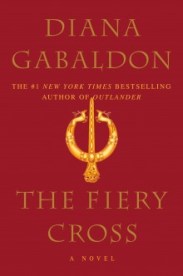
This is the sixth day of the 2017 A to Z Blog Challenge, so I am featuring the letter “F” in today’s post. Every month I blog about a favorite line from a novel. Today I shine a light on a FAVORITE line from the novel THEFIERY CROSS, by Diana Gabaldon.
It is the last line in the book, and it is spoken by the heart throb of Ms. Gabaldon’s Outlander Series, JAMIE FRASER.
“’When the day shall come, that we do part,’ he said softly, and turned to look at me, ‘if my last words are not ‘I love you’ – ye’ll ken it was because I didna have time.’”
Whew!
I wish I’d written that!
Until my next blog post tomorrow
I hope you have a good book to read. If you’re a writer, I hope you have productive writing time.
On the fifth day of the 2017 A to Z Blog Challenge I considered blogging about the dreaded editing process that strikes fear in the heart of the writer. (There should be sound effects here. Think “dadadadah dadadadahhhhh” from Beethoven’s 5th Symphony.)
However, I am so far from being an expert on editing that I concluded that I shouldn’t attempt to write about the process. That left me scrambling for another “E” word to blog about today.
As I bounced around on the internet looking for inspiration, I happened upon an interesting article about E-BOOKS. Written in 1998, this serious article comes across as humorous to the 2017 reader. If you don’t think the world of publishing has changed in 20 years, I direct your attention to “Electronic Books – A Bad Idea,” by Jakob Nielsen as published on July 26, 1998, on https://www.nngroup.com/articles/electronic-books-a-bad-idea/.
The title of the article alone gives the 2017 reader a chuckle. Before I start throwing rocks at this 1998 article, though, I thought I should do a little research on its author, Jakob Nielsen. The name meant nothing to me, since I’m not a computer nerd.
Who is Jakob Nielsen?
Jakob Nielsen is a Danish web usability consultant born in 1957. He holds a Ph.D. in human-computer interaction from the Technical University of Denmark in Copenhagen. I don’t even understand what that means except that Dr. Nielsen is far better qualified to write about electronic books than I will ever be. In 1998, I’m not sure I’d ever heard of electronic books.
According to https://www.nngroup.com/people/jakob-nielsen/, Dr. Nielsen is a principal of the Nielsen Norman Group. He co-founded the organization with Dr. Donald A. Norman, a former Vice President of Research at Apple Computer. His biographical information on the Nielsen Norman Group website states that Dr. Nielsen “holds 79 United States patents, mainly on ways of making the Internet easier to use.”
Dr. Nielsen’s accomplishments are far too numerous for me to include here. Suffice it to say, he knows what he’s talking about and he was a respected authority in 1998 as well. I cite his 1998 article today merely to illustrate how far we’ve come in the last two decades.
His article talks about his hope that “The Last Book” Project at the MIT Media Lab would produce a computer on which the reader could flip pages like one does when reading a printed book. Dr. Nielsen argued that “digital ink” needed to be invented that would give higher resolution, and hence, “gain the same reading speed as print.”
Dr. Nielsen stated the following two paragraphs in his 1998 article:
“Even when e-books gain the same reading speed as print, they will still be a bad idea. Electronic text should not mimic the old medium and its linear ways. Page turning remains a bad interface, even when it can be done more conveniently than by clicking the mouse on a ‘next page’ button. It is an insufficient goal to make computerized text as fast as print: we need to improve on the past, not simply match it.
”The basic problem is that the book is too strong a metaphor: it tends to lead designers and writers astray. Electronic text should be based on interaction, hypertext linking, navigation, search, and connections to online services and continuous updates. These new-media capabilities allow for much more powerful user experiences than a linear flow of text. Linear text may have ruled the world since the Egyptians learned to produce arbitrarily long scrolls of papyrus, but it’s time to end this tradition. Nobody has time to read long reports any more: information must be dynamic and under direct control of the reader, not the author.”
“When Peter James published his novel Host on two floppy disks in 1993, he was ill-prepared for the ‘venomous backlash’ that would follow. Journalists and fellow writers berated and condemned him; one reporter even dragged a PC and a generator out to the beach to demonstrate the ridiculousness of this new form of reading.”
Jump forward to 2017
We’re still debating in the public arena the fate of printed books. In the 1990s, Peter James predicted that electronic books would someday threaten print books with extinction. He was probably laughed at for saying that; however, that very issue is up for much debate today.
Print versus e-books
People seem to fall into two camps. There are people who have dug in their heels and refuse to read an e-book. At the other end of the spectrum are people who only read e-books. If they can’t get an electronic copy, they simply don’t read the book. I fall somewhere in the middle.
I like the ease of holding my Kindle Fire in my hand and having immediate access to hundreds of books. (If money were no object, I would have immediate access to thousands or possibly millions of books. That’s not my reality, though.)
I like being able to borrow e-books from the public library and change the font to better suit my aging eyes.
I like being able to pause when I come to a word I don’t know, highlight it with my finger, and instantaneously pull up the word’s definition. In fact, I have used that feature so much that occasionally while reading a print book I catch myself holding my finger on an unknown word and waiting for the definition to magically appear!
I also like the feel of a printed book. The smell of a new book. The clean, crisp pages of a new book.
I like the pliability of a well-worn old book – for instance, an old family Bible. I like the feel of my great-grandmother’s tiny leather-bound Psalter. I like holding a book in my hands that an ancestor held in her hands 150 years ago.
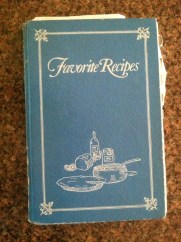
I like holding a cookbook that my mother hand wrote. There’s something comforting in reading her favorite recipes written in her own handwriting. As her death in 1993 becomes more distant, this book that she wrote just for me becomes more and more valuable to me. An electronic copy of my mother’s favorite recipes would also be valued, but it wouldn’t have the same effect on me as the paper pages bearing her handwriting.
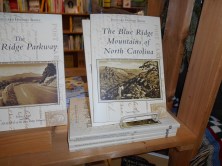
The day that the boxes of my paperback vintage postcard book, The Blue Ridge Mountains of North Carolina, arrived at my door was a day I’ll never forget. Although discovering my book in electronic form some weeks later was a thrill of a whole other kind, nothing equals the thrill I feel when I walk into a bookstore and see the paperback edition of my book on the shelf.
Janet’s book on display at Books Unlimited in Franklin, NC.
Destiny of printed books
Rachel Nuwer asked a question early in 2016 in her BBC article that is still waiting for an answer:
“Are printed books destined to eventually join the ranks of clay tablets, scrolls and typewritten pages, to be displayed in collectors’ glass cases with other curious items of the distant past?”
Then, she asked a follow up question: “And if all of this is so, should we be concerned?”
I ask, “Does it have to be either/or?”
The advent of e-books has revolutionized book publishing, but surveys indicate that most people still prefer print books. The advent of print-on-demand books and e-books struck fear in the hearts of writers, be they established, or newly-published, or the not-yet-published.
E-books – a two-sided coin.
On the one hand, e-books are less expensive to publish than print books, which prompted a fear that they would completely replace print books. As long as there is a demand for traditional print books, I believe they will continue to be printed. E-book technology has made it possible for anyone to publish a book. The other side of that coin, though, is that e-book technology has made it possible for anyone to publish a book.
You read that right. The good thing about e-books is the same as the bad thing about them. Do we want anyone publishing anything they want to? It used to be that having a novel published by a large publishing house gave the author credence. The way large publishing houses used to operate, an author was assigned an editor. The editor worked closely with the author to polish the novel before it was published. Budget crunches gradually squeezed in-house editors out of the equation. Now a person can self-publish an e-book without the aid of an editor. In fact, a person can self-publish an e-book without the benefit of even a self-edit.
My plan
It remains to be seen how or if I will get The Spanish Coin published. My original dream was that I would get a literary agent who would get me a contract with a large publishing house. That would still be fantastic and would stamp me as a legitimate writer; however, realistically, I know that I might have to self-publish a print-on-demand book or an e-book only. Doing so does not carry the stigma it did just a few years ago. The assumption used to be that a self-published novel was not professionally edited, but that is no longer necessarily the case. If I choose to self-publish The Spanish Coin, it will only be after it has been professionally-edited at my own expense, of course.
I hope within a year, I’ll know which path to publication The Spanish Coin is taking.
Until my next blog post tomorrow
I hope you have a good book to read. If you’re a writer, I hope you have productive writing time.
On this fourth day of the 2017 A to Z Blog Challenge, I’m supposed to write about something related to the letter “D.” Staying in my usual theme of writing, I chose the word, DIALECT.
18th century African slave dialect
Dialect is something I’ve had to address in my The Spanish Coin manuscript. One of the main characters and one of the minor characters are slaves in South Carolina in 1771. Another character is a free woman of color living in the community.
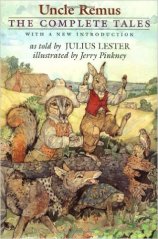
Dialect can be overdone. As a novice writer, that’s a fair assessment of where I was. I had those two slaves dropping the “g” at the end of every gerund. I gradually realized that they sounded like Uncle Remus or worse.
I grew up in the 1950s loving Uncle Remus stories, but writing a novel in the 21st century and assigning a speech pattern to that extreme is just wrong on so many levels.
Being a beginning writer, though, perhaps I had to go through many stages with the slaves’ dialect. I gradually changed dialectal words to today’s language – or to the standard language of the time and place. (The “find and replace” feature on the computer became my best friend.)
Beowulf
Even if it weren’t offensive to overuse dialect in a novel, it would be exhausting to the writer and the reader. It would be something akin to having to read Beowulf as it was originally written in Old English. I had to read Beowulf in high school, and I think I’d rather have a root canal than have to read it again. (My apologies to the late Mrs. Estelle Cline, my senior English teacher.)
Foreign accents
A consideration related to having a character speaking in dialect is having one speaking with a foreign accent. Since most of the characters in The Spanish Coin are Scottish or Irish immigrants, they use some words that we no longer use in America or they have ways of pronouncing words that differ from my 2017 pronunciation in North Carolina. For instance, the word “wee” is still very much used in Scotland and would have been used by Scottish immigrants and probably by one or two more generations, whereas today in America we use the word “little.” Having a character in The Spanish Coin say “wee” is a way I chose to remind the reader that a particular character is a native of Scotland.
Another character in The Spanish Coin is a French immigrant. There are a few French words he says when he cannot think of or doesn’t know the English word he needs to use. Perhaps I watch too many cooking shows on TV, but in my mind the Frenchman is my book sounds just like Jacques Pepin.
Until my next blog post tomorrow
I hope you have a good book to read. If you’re a writer, I hope you have productive writing time.
This is the third day of the 2017 A to Z Blog Challenge, so today’s post must have something to do with the letter “C.” Thinking in the realm of writing fiction, I settled on the word CHARACTERIZATION.
Characterization can be shown through narrative, dialogue, action, and reaction. All four should be used by a writer.
There are many things for a fiction writer to keep in mind in creating and fleshing out characters. My writing mentor from Queens University of Charlotte, Judy Simpson, said, “Don’t begin writing your story until you know all of the major characters.” I can’t remember if I followed that advice when I started writing The Spanish Coin manuscript 10 or more years ago. (There! I’ve said it! This has been a labor of love that I have worked on in spurts and fits, sometimes not touching it for more than a year at a time.) But I digress.
The famous mantra of writing instructors comes into play in characterization: Show, don’t tell. Don’t tell the reader about a character. Reveal character details through what they say, how they say it, and what they do or don’t do.
Even though the writer might have in her notes a driver’s license description of each character (e.g., black male, brown eyes, black hair, six feet tall, 180 pounds) that is usually not the best way to introduce a character to your reader. Let those details (or just the ones that are pertinent) come out gradually and in subtle ways.
Every character has strengths and weaknesses. A “goody-two-shoes” character is boring and, let’s face it, offensive and irritating. Likewise, even the most heinous villain probably has some redeeming value.
Characters unnecessary to the story should be omitted. Related to that, a writer should not include minor characters early on in a novel because the reader might be misled and lose interest.
There is also the matter of choosing names for all the characters. Writing instructors caution beginning writers not to give two characters in the same short story or novel names that are similar. For instance, you might not want a Phil and a Phyllis in the same book.
I have struggled over the name of a free woman of color in The Spanish Coin. She was Rachel for a long time because I think Rachel is a beautiful name and it conjures up an image of a strong and elegant woman in my mind. I changed her name to Clarissa in honor of a woman of color who made a great impression on me while I was writing local history articles for a newspaper a decade ago. It will be interesting to see what the character’s name turns out to be in the final product.
Another consideration that must be taken into account, especially when writing historical fiction, is that the writer must make sure to give characters names appropriate to the time and place. For instance, you won’t find a Tammy or a Kevin in The Spanish Coin because those names were not used in 1771 in the Carolina backcountry.
Each character should have at least one distinguishing characteristic in order to help set an image in the reader’s mind. A character could have a foreign accent, a disfiguring physical feature, a hearing problem, a lisp, a limp, an annoying laugh, a mental illness, or a word or phrase that no one else says.
Who knew there were so many things to think about when giving a fictitious character a name?
Until my next blog post tomorrow
I hope you have a good book to read. (I seem to always have too many on my bedside table! One night they’re going to topple over and give me a concussion.) If you’re a writer, I hope you have quality writing time.
On this second day of the 2017 A to Z Blog Challenge, my blog post is supposed to have something to do with the letter, “B.” I was tempted to write about blogging, but I’ve had that as my topic several times lately. I decided to write about BACKGROUND and what it means in fiction.
Foundations in Fiction
My first thought was to see what my fiction writing instructor in the Continuing Education Department at Queens University of Charlotte, Judith H. Simpson, had to say about background in her book, Foundations in Fiction.
Although background and setting are often used interchangeably, Judy chose to address them separately. Whereas setting is physical location, background is the story’s environment. Of background, Judy wrote in her book, “It is not the physical place but something more than that. It can be the hero’s job.”
Examples of background
Many popular authors use a background for their novels that becomes part of their brand. Janet Evanovich’s Stephanie Plum novels are set in New Jersey, but the background is bounty hunting — albeit of the bumbling variety. Tony Hillerman used Indian reservations for background in his Leaphorn and Chee series. Margaret Truman used iconic locations in Washington, DC in her murder mysteries, and Amy Clipston uses the Amish culture as the background in her fiction.
I enjoy reading and writing historical fiction. The historical fiction writer must create physical setting, create story background, and recreate a past culture, according to Judy Simpson. That last aspect — recreation of a past culture — is what gives historical fiction authenticity.
The writer of historical fiction must do extensive research in order to write believable characters. The novel manuscript I’m writing is set in the Carolina backcountry in 1771. People dressed and lived differently in 1771 than how we dress and live in that same geographical location in 2017. The culture, values, and accepted societal mores were different in 1771 than they are in 2017.
The writer of good historical fiction “must know the history of the period you are using; you must understand the social structure of this society; you must know how they lived, what they wore, what they ate, their monetary system, their transportation system, their social events, their daily lives,” according to Judy’s book. If you make an error, one or more readers will delight in bringing that mistake to your attention.
In writing my The Spanish Coin manuscript, I have done extensive research. The fear of making a mistake has paralyzed me sometimes. If I wait until my research is complete and my writing is perfect, though, my novel will never be published. At some point in the next 12 months, I need to conclude that it is as good as I can make it, push to get it published, and get back to writing the sequel.
The Flavor of Historical Fiction
Judy Simpson wrote the following in Foundations in Fiction and I try to keep her words in mind as I work on my book:
“Remember that what makes a historical novel different is the flavor, the sense of time and place of a long ago era. When the reader finishes the book, they should feel as if they were there, as if they really know what it would be like to live then. You have to capture the essence of that time and each period has its own flavor. Only you, the writer, can open the gate to that era for the reader.”
Until my next blog post tomorrow
I hope you have a good book to read. (As I was writing this last night, I was still reading The Heavens May Fall, by Allen Eskens.) If you’re a writer, I hope you have quality writing time.
Today is the first day of the 2017 A to Z Blog Challenge. The challenge is for a blogger to blog on 26 specific days in the month of April. If that weren’t enough, there is a big caveat: Each day’s blog must be based on the next letter of the English alphabet in chronological order. Therefore, today’s blog has to have something to do with the letter “A.”
Blogging from A to Z Challenge Badge 2017
Since my first blog each month is about the books I read in the preceding month, I’ve tweaked my usual post title to read, “The Authors I Read in March” instead of the usual, “What I Read in March.” Without further ado, let’s get to those authors and their books. I had a rewarding month of reading in March!
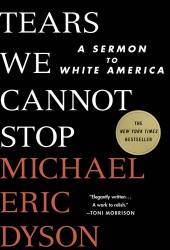
Tears We Cannot Stop: A Sermon to White America
One of the categories I included in my 2017 Reading Challenge was to read a book that might change my mind. Tears We Cannot Stop: A Sermon to White America, by Michael Eric Dyson definitely fit the bill. Reading this nonfiction book still haunts me four weeks later. Page after page, it drove home to me how those of us who are white in America take for granted our white privilege. It even goes farther than that. For the most part, we aren’t even aware of our white privilege.
An example is that, as a small child, I was told by my parents that if I ever got separated from them out in public to look for a police officer. I was told that police officers were my friend. A police officer would always help me. It has taken me to middle age to recognize that children of color in America are not told that. Their parents and grandparents have not been able to trust law enforcement officers, so they cannot be told to automatically trust such people in authority.
If I am driving and see a police car in my rear view mirror, my eyes immediately drop to the speedometer even if I’m fairly certain I’m not speeding. For a split second, I’m afraid I might be doing something wrong. “Afraid” is probably too strong a word. It’s just a fraction of a second when I think I might get a speeding ticket, but with a glance at the dial on the dashboard I’m reassured that I’m not breaking any laws and I am perfectly safe. It is impossible for me to put myself in skin of a darker shade than my Scots-Irish heritage gave me. The emotions a person of color must feel when being approached by a police officer is something I cannot identify with because I am Caucasian.
These are just two examples. The roots of this problem run deep into the foundations of our country. Tears We Cannot Stop: A Sermon to White America, by Michael Eric Dyson made me think about these issues in more depth than I had otherwise been forced to think about them. Just by being born with white skin in America has given me privileges that I have been oblivious to all my life. It is that white privilege itself that has made my oblivion possible.
It’s not enough for me to be aware of my white privilege. It is my responsibility to work for social justice.
Michael Eric Dyson is a sociology professor at Georgetown University in Washington, DC. This is the first one of his books that I’ve read. I wanted to read it after seeing him interviewed by Tavis Smiley on PBS.
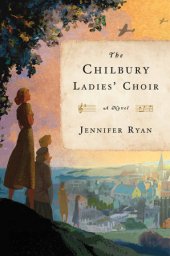
The Chilbury Ladies’ Choir
The Chilbury Ladies’ Choir, by Jennifer Ryan is a 2017 novel that is getting much-deserved praise. I gravitated to it because it is a work of historical fiction. Set in the early days of World War II in England, it is a story of how a group of women found their voices and their strengths after all the able-bodied men in the village were called away to fight the Nazis. Each of the women came about this epiphany in her own way and at her own pace. Subjects such as abortion, black market dealings, and the British class system are among the topics woven into this novel.
A native of Kent, England, author Jennifer Ryan lives in the United States. Her earlier career was as a nonfiction book editor. She wrote The Chilbury Ladies’ Choir in the form of letters and documents, much in the vein of The Guernsey Literary and Potato Peel Pie Society, by Annie Barrows and Mary Ann Shaffer. Like that 2008 novel, the characters I met in this debut novel by Jennifer Ryan will stay with me for a long time.
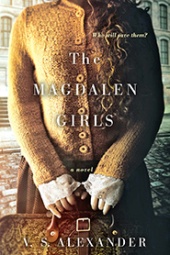
The Magdalen Girls
The next book I read in March was The Magdalen Girls, by V.S. Alexander. It is not the kind of book I would say I enjoyed; however, the story was compelling and I had trouble putting it down. I will be haunted by the characters in this novel. It is a dark tale based on the homes for “wayward girls” in Great Britain in the 1960s and beyond. This story is based specifically in 1964.
The Magdalen Girls paints a painful picture of the nuns who ran this particular convent and “home” (“prison” would be more accurate!) for girls and women deemed too much of a temptation for boys and men. As with any good work of fiction, just when the reader thinks things can’t possibly get worse for 16-year-old Teagan and her fellow “Magdalens,” things get progressively worse until this reader can scarcely stand to turn to the next page. The Mother Superior/Sister Anne is hiding a secret that is tearing her to pieces. Unfortunately, her way of coping with her own demons is to heap abuse upon the girls and young women under her care.
Upon entering the confines of the convent, the girls are stripped of their dignity and their identities. They are assigned new names and are never to refer to themselves or others again by their birth names. The book shines a bright light on the double standard held worldwide that girls and women must always live to a higher standard than boys and men and bear the punishment even when the male is an adult and the female is a minor.
V.S. Alexander’s next novel, The Taster, due out in January, 2018, is about one of the women who had to taste Adolf Hitler’s food in order to ensure that he wasn’t being poisoned. I’ll be on the wait list for it as soon as it shows up in the public library’s catalog. That’s just how good Ms. Alexander’s writing was in The Magdalen Girls. It wasn’t a pleasant read for its subject matter, but the writing was so vivid that I felt like I was imprisoned at the convent along with Teagan, Nora, Lea, and all the others.
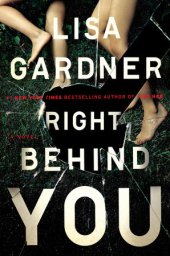
Right Behind You
The next book that rose to the top of my wait list at the public library was Right Behind You, by Lisa Gardner. Although this is her seventh and latest (2017) installment in her Quincy and Rainie FBI profiler thrillers series, it is the first book I’ve read by Ms. Gardner. This novel made me want to read more of her books. Perhaps I should go back and read the first book in this series, The Perfect Husband, which was published in 2004.
Right Behind You is the frightening tale of a brother and sister who are separated from each other into numerous foster homes after the murder of their father. The girl is nurtured by loving foster parents, while the boy is not so fortunate. He never receives the psychological care and support he needs as a result of his father’s gruesome death. That propels him onto a path of trouble, violence, and the over-riding guilt of not being able to protect his little sister.
I don’t want to reveal other details of the book, in case you haven’t read it yet but wish to do so.
One of my objectives when I created my 2017 Reading Challenge was to read many authors I had not read before. That’s what prompted me to look for a book by Lisa Gardner. I can recommend her to other readers now. I’ll read more of her novels as time allows. “So many books! So little time!”
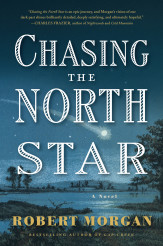
Chasing the North Star
For the March meeting of Rocky River Readers Book Club, each member of the group was asked to read any book of their choice written by Robert Morgan. I’ve read a number of novels by this North Carolina author, in addition to Boone: A Biography, which is a biography of Daniel Boone. For book club, I read Morgan’s latest novel, Chasing the North Star.
A slave on a plantation in South Carolina, Jonah runs away on his 18th birthday. The book follows Jonah and a female runaway slave, Angel, on their dangerous trek north to freedom. At times, the story got slowed down with details of the tree branches encountered as one runs through the woods. That aside, I soon became invested in both Jonah and Angel as I cheered them on and tried to will them to reach Pennsylvania, New York, and Canada.
Robert Morgan will be the guest speaker at the public library in Concord, North Carolina on Saturday, April 22, 2017. It was in preparation for that author event that Rocky River Readers chose to read books by him in March. I look forward to hearing Mr. Morgan talk about his writing.
My next blog post
My next blog post is scheduled for Monday, April 3, and it must have something to do with the letter, “B.”
Until my next blog post
I hope you have a good book to read. (I’m reading The Heavens May Fall, by Allen Eskens.) If you’re a writer, I hope you have quality writing time.
My last blog post of each month is usually a progress report on the novel I’m writing. The Spanish Coin is its working title. A month or so ago a writing coach evaluated the first 2,000 words of my manuscript. I set about to take her recommendations and edit the remaining 94,000 words.
Speedbump
Due to one thing and another, I’ve made very little progress on that project. Life got in the way. I’ve come to call such things speedbumps.
Another speedbump?
Then, I read an online article by a literary agent. Her comments were directed toward writers and their blogs.
The article was quite helpful until
I got to the part where she said a writer needs to have 50,000 engaged blog followers in order to get a book published. Whoa! I guess that’s what I get for getting all puffed up about having 1,000 blog followers just a week ago. This literary agent really knows how to burst someone’s bubble!
I would like to think that all 1,008 of my current followers are engaged (meaning they are truly interested in my writing and didn’t just hit the “follow” button out of curiosity or a sense of obligation) and that every one of them would purchase a novel I wrote. I know that’s not necessarily the case, though.
Looking forward to better (and healthier) days ahead,
I hope to report to you sometime in April that I’ve completed that work and have turned at least half of the manuscript over to the writing coach. I look forward to taking that next step toward publication and making my novel better and better. I realize that you might be growing weary of my progress reports that don’t reflect any progress.
A reminder
I plan to embark upon the 2017 A to Z Blog Challenge on April 1. The first day is “A.” I will write about the authors and books I read in March. I think you’ll enjoy that post. I read some very good books this month! (I hope my April 1 blog post will make up for this one because this is definitely not my best work.)
Blogging from A to Z Challenge Badge 2017
Until my next blog post
I hope you have a good book to read. (I’m reading The Heavens May Fall, by Allen Eskens.) If you’re a writer, I hope you have productive writing time.
Jonathan Stinson is the publisher of The Sand Mountain Reporter newspaper in Albertville, Alabama. I recently discovered him on Twitter and was immediately impressed with his level of professionalism.
I have no personal experience with the University of Alabama, but I’m beginning to think it must have a top-notch journalism school. Back in the 1980s and 1990s, one of the most-respected TV journalists in Charlotte was Bob Inman of WBTV. A native of Elba, Alabama, Robert Inman is a successful novelist today. He is a product of the University of Alabama.
Lee Perryman, one of my far-flung Morrison cousins is another graduate of the University of Alabama. Lee recently retired after a celebrated career with the Associated Press in Washington, DC. In retirement, Lee continues to champion the field of journalism in his hometown of Sylacauga, Alabama.
Many years later to happen upon another Alabama native and alumnus of that university’s Department of Journalism — Jonathan Stinson — cannot be merely coincidental. I did not major in journalism in college but, if I were looking for a good journalism school to invest my time and money in as a student, I would certainly give the University of Alabama my serious consideration.
Here’s the quote from Jonathan Stinson that first grabbed my attention:
“Everything you write is about the reader. The sooner you accept this truth as a writer, the better off you’ll be because you’ll have a clear understanding of what it is you’re trying to do.” – quote from Jonathan Stinson’s blog, at http://JstinsonINK.com.
I typed the quote and keep it by my computer monitor so I can read it every day.
Jonathan Stinson can be followed on Twitter as @JstinsonINK and on his blog as referenced above.
In this day in America when reporters and journalists are being recklessly maligned almost daily by the US President and his staff and surrogates, it is reassuring to know that there are countless journalists in this country who are dedicated to reporting the facts. Not “alternative facts,” but facts.
Lest we forget
The First Amendment to the Constitution of the United States of America reads as follows:
“Congress shall make no law respecting an establishment of religion, or prohibiting the free exercise thereof; or abridging the freedom of speech, or of the press; or the right of the people peaceably to assemble, and to petition the Government for a redress of grievances.”
Until my next blog post
I hope you have a good book to read. (I’m reading The Second Mrs. Hockaday, by Susan Rivers.) If you’re a writer, I hope you have quality writing time.












 Janet's Writing Blog