N is for Newspaper Column

Today is the 14th day of the 2017 A to Z Blog Challenge, so the featured letter is “N.” I wrote a local history column for a weekly newspaper, Harrisburg Horizons, in Harrisburg, North Carolina for six and a half years.

My freelance “job” with the newspaper took me in many unexpected directions. One of my first columns (July 12, 2006) was titled, “Native American Projectile Points.” The following is a slightly revised version of that column. Some of the wording has been changed and all the photographs have been added to this blog post.

Do you think Harrisburg’s history began with the earliest European settlers, or even with the coming of the railroad in the 1850s? Today, I invite you to join me on a journey into prehistoric Harrisburg in the southern piedmont section of North Carolina.

Schiele Museum, Gastonia, NC

I recently made an appointment to take my collection of Indian arrowheads to Dr. Alan May, staff archaeologist at the Schiele Museum in Gastonia, NC. The first thing I learned was that I didn’t have a collection of Indian arrowheads!  The proper term is “projectile point,” which includes spear points and arrowheads.

I proudly opened the box containing my small collection. Dr. May examined each piece. I held my breath and waited for him to gasp upon spying a rare and valuable piece. He did not gasp.

My collection turned out to be mundane and of no particular interest to an archaeologist; however, the insight Dr. May shared that day gave me much to think about and opened a window on prehistoric Harrisburg.

I expected Dr. May to tell me that my projectile points dated back to the 1600s or possibly a little earlier than that. I expected him to tell me that the points were typical of the Catawba or perhaps even the Cherokee. That’s not what he said.

Middle Archaic – Morrow Mountain

Two of my projectile points are called “Morrow Mountain” pieces. They are from the Middle Archaic period which ended around 3000 B.C. (or B.C.E., if you prefer.)

Base of a projectile, Morrow Mtn., Middle Archaic
Base of projectile, Middle Archaic, Morrow Mountain.
Arrowheads, Tools, & Rocks 012
Middle Archaic (2,000 to 3,000 B.C.E.) Morrow Mountain Projectile Point

Middle Archaic Guilford

Two other pieces are of the “Guilford” style and also date to the Middle Archaic period when Native Americans hunted bison in North Carolina.

Broken example of Middle Archaic - Guilford
Broken example of Middle Archaic – Guilford projectile point.
Middle Archaic - Guilford
Middle Archaic, Guilford projectile point.

Late Archaic

Several of the projectile points in my collection are “Savannah River Stemmed “ points from the Late Archaic period, 1000 to 3000 B.C. This period was cooler than Middle Archaic. Deer, rabbits, and raccoons were hunted for food.

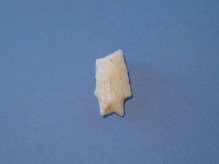
Late Archaic. Flagstone or field stone argilite, probably like what's coming out of the quarry nearby.
Late Archaic. Flagstone or field stone, probably like rock that is currently being mined from a nearby quarry.
Late Archaic. Thin bioface straight-sided projectile broken in use or when re-sharpened. Good material.
Thin biface straight-sided Late Archaic projectile point. Broken either by use or when re-sharpened.

Ancient Tool:  Anvil

I was certain that Dr. May would identify one of the smooth rocks I took him as an early Native American tool. He said it was just a rock that had been smoothed by water. Another rock, which hadn’t seemed as interesting to me, turned out to be an anvil.

This is an anvil. Notice the slight depression in roughness in middle on one side.
This is a stone anvil.

Some rocks I took to the museum were magnetic, which wasn’t a surprise; our red clay soil is rich in iron. One piece that appeared to be a rock was identified as slag hammered by a blacksmith. That made sense, because my father told me that there used to be a blacksmith’s shop in what is now my front yard.

Gold?

The rock I hoped he would say held flecks of gold, held flecks of worthless pyrite instead. I can see why it’s called “fool’s gold.”
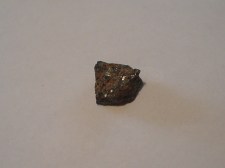
pyrite and flecks of gold and lead. Dr. Alan May at Schiele thought this was a neat piece.
Lead with pyrite and flecks of gold. Dr. May thought this was an interesting piece.

Dr. May recommended that I send a detailed report about my collection to the Office of State Archaeology in Raleigh. The State has a form called “North Carolina Amateur Archaeological Site Form.” Dr. May said they will pinpoint my yard on a map and keep a record of my findings.

My visit with Dr. May brought surprises, both good ones and disappointing ones. I came home knowing that 5,000 years ago as the Egyptians developed hieroglyphic writing and the darkness was first lighted by candles, Native Americans were hunting deer and bison in my yard. Wow!

That was the end of my July 12, 2006 newspaper column. For now, it’s the end of the story. When I read the column last night for the first time in many years, I realized that I never followed through with Dr. May’s recommendation that I send a detailed report to the Office of State Archaeology in Raleigh. I’ve added that report to my “to-do” list, but writing must still come first.

Until my next blog post

I hope you have a good book to read. (I’m reading a nonfiction book, In Order to Live:  A North Korean Girl’s Journey to Freedom, by Yeonmi Park with Maryanne Vollers. It was published in 2015, but I’m finding it particularly interesting as I read it during rising tension between North Korea and the United States. I highly recommend it!)

If you are a writer, I hope you have productive writing time.

Janet

The Sauline Players

One of the rewards for writing the “Did You Know?” local history column for Harrisburg Horizons newspaper from 2006 through 2012 is that people still tell me they miss it since the newspaper ceased publication. Another reward is that I occasionally receive an e-mail from a stranger asking a question or making a comment about one of my local history column topics.

My most recent such communication came from a woman who was looking for information about the Sauline Players and discovered that I had written about them for the newspaper. I shared my two-part series on the acting troupe with her and we corresponded for a couple of days to compare our memories. She recalled seeing them perform at Marion Junior High School and Glenwood High School in McDowell County, North Carolina in the 1950s, and I have fond memories of seeing them perform in the auditorium of Harrisburg High School in the 1960s.

It is gratifying when someone expresses that a newspaper column or short story I wrote has enlightened them or brought them joy. One of the beauties of the internet is that it makes serendipitous connections possible.

A local history talk

Yesterday my sister and I conducted our fourth (and last) Local and Rocky River Presbyterian Church History Talk and Tour. We had these monthly, September through November, skipped December, and then started again in January. Response has fluctuated. It was worth a try. I spent hours planning the topics. I had enough topics to last two or three years. No doubt, someone who has not attended any of the four talks so far will complain that we are discontinuing the programs. That’s human nature.

Yesterday’s topics were the Rev. Dr. John Makemie Wilson and the Rocky River Academy. Dr. Wilson was the pastor of Rocky River and Philadelphia Presbyterian Churches in Cabarrus and Mecklenburg Counties for 30 years in the early decades of the 19th century. He served as teacher at Rocky River Academy for much of that time. Completing their studies at Rocky River Academy prepared the students for entrance in the University of North Carolina at Chapel Hill. Twenty-five of the academy’s students went on to become Presbyterian ministers. One of them, the Rev. Dr. Robert Hall Morrison, was a founder and the first president of Davidson College.

The three-part series of local history columns I wrote about the Rocky River Academy for Harrisburg Horizons newspaper came in handy as I prepared for yesterday’s program.

Last night I spent some time editing the manuscript of my historical novel, The Spanish Coin, in preparation to submit it in a writing competition. More on that later.

A Tribute to Mr. Ira Lee Taylor

When I started writing a local history column for Harrisburg Horizons newspaper in 2006, I visited 88-year-old Mr. Ira Lee Taylor. Mr. Taylor lived in Harrisburg his entire life and had an incredible memory. He had been my mail carrier all my growing-up years and I was in school with his daughter. Aside from that, I never really knew him. I expected to visit him once and get the answers to my questions about Harrisburg in the early 20th century. I found Mr. Taylor to be so knowledgeable and eager to talk that I went back to see him numerous times over the next eight years. His memory and eagerness to share stories enabled me to write more newspaper articles — and write with more detail — than I would have otherwise been able to write.

I not only learned a lot about the Harrisburg of Mr. Taylor’s youth, but I heard his personal recollections of the D-Day invasion of Normandy and subsequent battles in the European Theatre of World War II. He recalled the sights, sounds, and smells of war. As a former North Carolina State University student of forestry, he remembered how heartbreaking it had been to see the Hurtgen Forest ravaged by artillery. When he delivered mail to our house all those years, I had no idea about his war experience. Hearing this elderly veteran talk about the war gave me a whole new appreciation for the sacrifices “the greatest generation” made.

The last times I visited Mr. Taylor were at a nursing home. It was sad to see him in a wheelchair in his room instead of in his comfortable living room in his home on Stallings Road. The lives of the residents of several blocks of Stallings Road have been disrupted by construction associated with the high-speed rail. I am glad Mr. Taylor did not have to witness what the government is doing to the neighborhood in which he lived his entire life.

Mr. Taylor died last Wednesday, just 13 days shy of his 96th birthday. Sadly for me, I did not hear about his death until this evening after his funeral had been held. I regret that I did not get to pay my last respects to this gentleman who helped me in my writing and added so much local interest to the last eight years.

Trying the magazine market again

I revisited my 2009 newspaper series about the 1849 Monroe Meteorite today and worked on turning those seven columns into a magazine article.

I’ll let you know if that goes anywhere. It’s not easy getting published.

Ending a chapter

I’m ending a chapter in my writing life this week. On Christmas Eve, I received an e-mail informing me that as of December 30, 2012, Harrisburg Horizons weekly newspaper will cease publication. I have written a local history column for the paper every other week since its second issue in May of 2006. I have learned far more about the history of Cabarrus County’s Township #1 than I could have anticipated when I set out on this journey. I enjoyed doing most of the research and loved doing the writing. The little bit of income this freelancing job gave me was icing on the cake.

It is time to start a new chapter, or perhaps return to an unfinished chapter as a writer. The manuscript for The Spanish Coin, my first attempt at writing an historical novel, has been on the back burner far too long. It is time to look at it with fresh eyes and get it published. It is time to look at other avenues of writing and see where that road takes me.

As I count down to my birthday in January… one of those dreaded birthdays that ends in a “0,” it seems fitting to take stock of what I have and have not accomplished and step into the next chapter of my life with boldness and enthusiasm!

Getting back to research

For those of you who follow my local history column in Harrisburg Horizons newspaper every other week, my article was omitted last Sunday. It should be in the paper on October 7.

I neglected research for my local history column for a few weeks while I spent time making items to sell on Saturday, October 6 at the Harvest Fest at Harrisburg United Methodist Church. This is my first craft fair, so I’m eager to see how it goes. Variety is the spice of life, so I have enjoyed this recent diversion.

Monday will find me concentrating on my local history research and putting my fingers to the keyboard. Reading microfilmed records is tedious but full of surprises. I must psyche myself up to do more of that this winter.

Writing the newspaper column since May of 2006 has been a blessing to me, and I’m thrilled when people tell me how much they enjoy and look forward to my articles. I have enjoyed writing my “Did You Know?” column more than any other job I’ve ever had.

I plan to start blogging a couple of times a week to let you know what I’m working on and what I’m reading. Stay tuned.

Learning to Quilt, too?

Learning to play the mountain dulcimer at the age 57 apparently wasn’t enough of a challenge for me. Or perhaps I’m having a midlife crisis. For whatever reason, this seemed like the right time in my life to do some of the things I’ve always wanted to do.

My new endeavor is quilting. I’ve joined a small quilters group in my community.  We meet monthly. Individually and collectively they have welcomed me with open arms and much encouragement.

I literally had to blow the dust off the old Singer sewing machine. It’s one of those old “thread-it-yourself” models from the 1960s. It took a while for the machine and me to get reacquainted. Thread tension is still a bit of an issue, but I’m confident that the end result will be something of which I can be proud.  Project #1:  a sample quilt made up of a dozen 12-inch square blocks, each block a different quilt pattern.

With Block #1: Roman Square successfully completed, this week I will tackle Block #2: Log Cabin. It is fun to see the various fabrics I purchased for my quilt coming together in blocks. I had not sewn since the early 1980s and had forgotten how exciting it can be to shop for fabrics.

My assignment before the February quilting group’s (Friendship Quilters) meeting is to sew sash pieces of fabric between quilt blocks sewn earlier by other members of the group. With some luck, this piece will turn out to be a table runner to be sold at our sponsoring church’s fall bazaar. Imagine something I helped sew being sold at a bazaar!

My blog continues to be all over the map when it comes to topics. It started out to be a way for me to put out the word about my writing. Life is too short and precious to be lived enjoying only one thing, though. I continue to write a local history column for Harrisburg (NC) Horizons newspaper every other week, but playing the mountain dulcimer and sewing also beg for my time and attention. It is said that a writer writes because he or she has to. I feel the same way about playing the dulcimer. If a day passes and I don’t play this beautiful Appalachian mountain instrument, I feel cheated and my day is incomplete. I play for my own enjoyment. It is one of the most relaxing hobbies I’ve ever had.

I wish for you the same desire to learn new things. Writing, music, and sewing continue to bring new friends and pleasures into my life.

What have you always wanted to do that you have never pursued?

Too much of a good thing

Our drought and heatwave broke around midnight last night.  After 18 consecutive days of 90 degrees or higher, it was in the pleasant 80s today.

With no rain in weeks, everything in the garden that the deer hadn’t eaten was burned up.  This is the first total garden failure I’ve had.  We caught up on rain today, though.  We had 2.25 inches between 12:15 and 3:00 a.m. and another 2.5 inches between 2:00 and 2:45 p.m. this afternoon.

I got the 2,500-word 1849 meteorite article drafted for The Old Farmer’s Almanac, but I need to do some editing before I pitch the idea to the almanac.

Tonight I proofread and submitted my seven-part “Did You Know?” newspaper series to the editor of Harrisburg Horizons weekly newspaper. 

I didn’t finish reading The Testament, by John Grisham for the Rocky River Readers Book Club, but I went to the discussion on Monday night. I want to finish it, even though I know the ending. I hate to leave a book unfinished.

I’m reading Life of Pi by Yann Martel for the Bookends Book Club.  I’m also reading Words That Hurt, Words That Heal:  How to Choose Words Wisely and Well, by Rabbi Joseph Telushkin.