I write southern historical fiction, local history, and I've written a devotional book. The two novels I'm writing are set in Virginia and the Carolinas in the 1760s. My weekly blog started out to follow my journey as a writer and a reader, but in 2025 it has been greatly expanded to include current events and politics in the United States as I see our democracy under attack from within. The political science major in me cannot sit idly by and remain silent.
I am thrilled to announce that my book, I Need The Light! 26 Weekly Devotionals to Help You Through Winter is now available!
I Need The Light! 26 Weekly Devotionals to Help You Through Winter, by Janet Morrison
Even if you love the fall and winter, I think you will benefit from reading this book.
Why I Wrote I Need The Light!
I wrote it from a place of physical challenges in cold weather, so I think people who have such illnesses and conditions as Seasonal Affective Disorder, Fibromyalgia, and Chronic Fatigue Syndrome/Myalgic Encephalomyelitis will be able to identify.
I settled on writing 26 weekly devotionals because with the onset of fall, I start dreading winter. Seasonal Affective Disorder affects me half the year.
What Does the Title I Need The Light! Mean?
To help me combat the symptoms of Seasonal Affective Disorder and sleep problems, my former physician’s assistant told me that I needed to get out in the natural light early every morning. I needed natural sunlight.
I’m not a morning person, so I had to force myself out of bed and outdoors in the morning – even in cold weather. As I walked, I repeated in my head the words, “I need the light. I need the light. I need the light. I need the light.” On about the fifth repetition, I had an epiphany: I realized I also needed The Light – Jesus Christ – “The Light of the World.”
I’ve been a Christian all my life, so it wasn’t a new concept for me that I needed Jesus Christ in all aspects of my life, but the sudden connection between “the light” and “The Light” was startling! It was then and there that God planted the idea in my mind and heart to write a book about the light and The Light.
That day, I started looking for all the references to light and The Light in the Bible.
Format of I Need The Light!’
Each week’s devotional follows this basic pattern:
The week’s Scripture reference is stated.
“Setting the Stage” in which I give a little background for that Scripture.
The week’s Scripture is then presented from The Message, The Good News Bible, The Living Bible, The New Oxford Annotated Bible (New Revised Standard Version), and TouchPoint Bible. The second week has the bonus of including the Bible verse from my great-great-grandmother’s 1849 The Psalms of David in Metre.
Insight from a Bible commentary, such as the series by Rev. William Barclay.
“My Thoughts” – Then, I usually share my thoughts about the Scripture.
“Remember” – one sentence of encouragement to ponder.
“Thought Pattern Interrupter” – One sentence to help you put a positive spin on that week.
“Activity Suggestion” – An activity you might choose to do that week to get you out of your own head/situation.
“Comfort Recipe” – A recipe that I consider a fall or winter “comfort food” from my own experience.
How to Use I Need The Light!
Readers are encouraged to read the devotional book as they choose. You don’t have to read it over a 26-week period. And each week, you can read the entire chapter in one sitting, or you can string it out over the week. It’s totally up to you to read the book in the way that best helps you.
Where to Find I Need the Light!
If you think I Need The Light! 26 Weekly Devotionals to Help You Through Winter would help you, or if you know someone who might benefit from the book, it can be purchased at your favorite independent bookstore. If you don’t find it there, please ask them to order the book from IngramSpark.
The book is available in paperback and as an e-book.
Click on “Read more” under the photo of the book cover.
At the end of the book’s description there, click on the BookShop.org buy button, which takes you to BookShop.org (a site that supports independent bookstores throughout the U.S.)
Put my book in your basket.
Select the independent bookstore you wish to support.
Place your order and have the satisfaction of knowing you are supporting an independent bookstore!
So far, Second Look Books in Harrisburg, NC; Blue Ridge Books in Waynesville, NC; and Highland Books in Brevard, NC have been very supportive of my book so I’ll give them a shout-out.
Available for your cell!
The book is also available on Amazon and from Barnes & Noble.
Here’s a Sneak Peek at I Need The Light!
From Week 12, here’s the “Setting the stage” introduction to that week’s devotional about the Parable of the Lost Coin:
“In Halley’s Bible Handbook, Henry H. Halley describes the fifteenth chapter of Luke as ‘the calm before the storm’ in Luke 14. In the fourteenth chapter of Luke, Jesus doesn’t beat around the bush as He talks about the price people will pay for following Him. He goes on to explain that He must be first in our lives. We must love Him more than we love anyone else. It’s enough to make a person question the wisdom of following Jesus!
“But then we come to Luke 15. It is a beautiful chapter about the tender, forgiving grace of Jesus. The chapter includes the Parable of the Lost Sheep, the Parable of the Prodigal Son, and the passage we’re looking at this week: The Parable of the Lost Coin.”
Does this sound like something you or a friend would like to read?
I wrote I Need The Light! 26 Weekly Devotionals to Help You Through Winter in a conversational tone as I imagined I was talking one-on-one with a good friend. If this approach to the Bible appeals to you, I hope you will look for my book.
I’m not an “in your face” kind of Christian. I’m a lifelong Presbyterian, so I’m not going to scare you into being a Christian. That’s not the Presbyterian way!
Even if fall and winter are your favorite seasons of the year, I believe you will find something of benefit in my 188-page devotional book.
I invite you to look for it!
If you read it and like it, your rating and/or brief review on such sites as Goodreads.com and Amazon will be greatly appreciated.
I considered saving today’s topic for my July 7 planned blog post about the books I am reading in June, but I decided it deserved its own post.
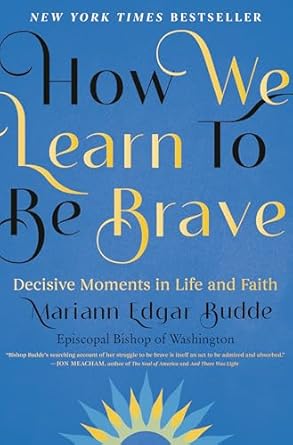
Last week, I read the fourth chapter in How We Learn to Be Brave: Decisive Moments in Life and Faith, by Mariann Edgar Budde.
How We Learn To Be Brave, by Mariann Edgar Budde
If the author’s name sounds familiar, it is because she is the Bishop of the Episcopal Diocese of Washington, D.C. and the Washington National Cathedral. She spoke boldly in the worship service on President Trump’s Inauguration Day in January 2025, and was sharply criticized by Trump for her courage.
My sister read this book and encouraged me to at least read the fourth chapter before she returned it to the public library. She said it reminded her of me and some of my life experiences. I took time to read that 34-page chapter titled, “Accepting What You Do Not Choose.”
My story (well, part of it)
At the age of 25 I accepted the fact that I had a medical problem that was incurable but could be treated with a series of surgeries. It meant that I would never have a chance to have children. Less than ten years later I accepted the fact that I had chronic fatigue syndrome and fibromyalgia, neither of which can be cured and treatment of the symptoms is poor at best.
What I was able to accept has astounded my sister. She knows better than anyone else how much physical pain I tolerate and the fatigue that makes it difficult for me to get up and face each day. She says she has asked God, “Why Janet?” but I just find that odd because I have never asked God, “Why me?”
I admit that when I get frustrated over the memory problems that accompany chronic fatigue syndrome that cause me to make mistakes and have to repeat various tasks, I do sometimes ask God why life has to be so hard.
But I’ve never asked God why I had endometriosis, a ten-pound ovarian cyst, fibroid tumors, chronic fatigue syndrome, fibromyalgia, chronic corneal erosion, and so forth. Why would I do that? Stuff happens. God never promised us that life would be a bed of roses. He promised He would always be with us. Diseases happen. Accidents happen. No one has a perfect life, so why would I expect my life to be perfect?
My father was my example
My example was my father. He was just 61 years old when he was diagnosed with multiple myeloma. I had just started my sophomore year in college. He lived for almost five more years. The chemotherapy acted like fertilizer on his cataracts and he went blind. Blindness was harder for him to accept than his cancer because there was nothing he could do to fight blindness.
He insisted on having cataract surgery against his doctors’ recommendations, but it was unsuccessful. But in those five years of sickness and eventual legal blindness, I never once heard my father ask, “Why me?” That just was not the way he approached his medical diagnoses. He continued to work every day until his eyesight made it impossible for him to drive.
What Bishop Budd’s 4th chapter had to say
I read the fourth chapter in Bishop Budde’s book, and it was comforting. She writes from a place of physical pain that I did not know she had. The book gave me some things to think about. It is always helpful to listen to another person’s perspective.
Budde writes several pages about the Rev. Dr. Martin Luther King and how he accepted the life he was dealt. She writes about acting from a place of love and putting the other person ahead of ourselves. Instead of being like the Levite and the priest in the story of the Good Samaritan, we should strive to be like the Good Samaritan.
The Levite and the priest in the story saw the man who needed help, but they were afraid of what could happen to them if they stopped to help the man. But if we try to adopt the mindset of the Good Samaritan, when we see someone who needs help or an injustice, we should ask ourselves, “What will happen to them if I don’t act?”
That is the question I have asked myself daily since January 20, 2025. What will happen to my country, to my great-nieces, to their future children, if I don’t act?
With Episcopal Bishop Michael Curry’s words in mind from Prince Harry and Meghan Markle’s wedding ceremony, Budde writes, “When we choose love in response to what we wish we could change but can’t; when we choose love as our response to the world as it is, not as what we wish it were; when we choose love over denial, or anger, or cynicism and withdrawal, we share in God’s redeeming of our world. It doesn’t make the work any easier, but it gives our efforts a sense of purpose that can carry us through. Through our imperfect efforts, God’s grace shines through us in ways we may never know or fully understand.”
Budde closes the fourth chapter with the following words:
“Our lives are full of unforeseen choices, struggles, and callings. Sometimes we can overcome these obstacles, and sometimes we must make peace with them…. Accepting what we did not choose involves a leap of faith that God is present and at work in ways that we cannot comprehend…. This kind of acceptance is not passive or fatalistic, but rather a courageous choice at a decisive moment to embrace the places we are broken as an integral part of a courageous life.”
I didn’t feel courageous at age 24 but maybe I am at 72
I don’t consider that I was courageous in accepting my physical limitations. It never occurred to me that I had a choice, so what would have been the point of fighting or lashing out at God about them?
Another participant in a Chronic Fatigue Syndrome support group in the 1980s who every month angrily said, “I refuse to be sick! I’m not going to put up with this. The rest of you can be sick if you want to, but I refuse.” I don’t know what became of her. I hope she was able to find a place of acceptance and contentment.
There was another participant in the support group who presented herself as a wealthy middle-age woman who enjoyed playing tennis every day. She could no longer play tennis and it crushed her spirit. She committed suicide.
I did not choose to have Chronic Fatigue Syndrome since April 26, 1987, but here I am.
On the other hand, I did not choose to have Donald Trump as my President, and it is taking a degree of courage for me to express my concerns in my blog. I don’t personally know but a few of the people who read my blog. WordPress tells me that people in 81 countries have read my blog just in 2025. People who may wish me harm for my opinions might read my blog. A few trolls have read it and left unpleasant comments.
I’m happy to engage in a “conversation” about the topics in my blog, but when a comment turns into a personal attack or accusations about my credibility or motives, I draw the line and I delete them. I do not owe my time and limited energy to someone who merely wants to pick a fight.
The bottom line
“The bottom line” is that we do not choose many of the things that happen to us, but we can always choose how we react to them. Our experiences make us who we are. If I had not had some medical problems, I would not be the person I am today.
We can look for constructive and creative things to do when we have physical or career setbacks. If I had not been forced to give up my chosen career due to my health at the age of 34, I might not have taken a writing course at the age of 48.
If I had not taken that writing course, I would not have had the confidence to write a local history column for the newspaper at the age of 53 to 59. If I had not taken that writing course, I would not have started a blog at the age of 60.
If I had not written 175 local history articles for the newspaper, I wouldn’t have been able to self-publish them in two books (Harrisburg, Did You Know? Cabarrus History, Books 1 and 2). If I hadn’t wanted to publish those articles in book form, I wouldn’t have learned how to format a book on the computer so I could self-publish on Kindle Direct Publishing.
If I had not taken that writing course or published those two history books, I would not have published two short stories on Amazon… or a cookbook with my sister in 2023.
If I had not taken that writing course, I would not be writing an historical novel now at the age of 72.
If I had not had Chronic Fatigue Syndrome, Fibromyalgia, and Seasonal Affective Disorder and learned how to write and self-publish, I would not have just finished writing a devotional book. I hope to publish I Need The Light in August, so stay tuned!
God did not wish for me to have any of my physical maladies, but he gave me the Holy Spirit. The Holy Spirit gives me the gumption to get up every day (although some days I don’t get up until the afternoon) and to seek God’s will in my life.
It is through The Trinity — God, Jesus Christ, and the Holy Spirit — that I have the energy and creative motivation many days to read, write, interact with the friends I’ve made around the world through my blog, sometimes dabble in genealogy, and occasionally keep learning to play the dulcimer – a musical instrument I took up in middle age.
It is through The Trinity that I was given an interest in history and political science. It is those lifelong interests that compel me to pay attention to current events. The current events in my country are sources of much stress and concern.
I see the democracy in which I have thrived all my life under attack now from within. My government is turning against its citizens and the things we value. I did not vote for any of this, but the situation is the one I’ve been dealt.
It is up to me how I react.
Some days I wish I could just turn off the news. Some days I wish I could listen to the news and then just go about my business and not be concerned. Lots of people seem to be able to do that. I am not one of them. (I am simultaneously envious of them and frustrated with them!)
The reelection of Donald Trump has upended my little weekly blog (and, therefore, my life) into an almost daily report (some say “rant”) about the dismantling of our democracy. Nothing about 2025 is what I had planned for myself, but life happens.
Now you see
So now, 1,900 words later, you see why I decided to give the fourth chapter of Bishop Mariann Edgar Budde’s book, How We Learn to Be Brave: Decisive Moments in Life and Faith, its own blog post.
Some of you might think my life is too much of an open book. I get it. Some people don’t want anyone to know they have medical problems. I don’t share that information about myself to get your sympathy. That’s not what this is about. But perhaps someone else with health problems at a young age (or at any age) can take some measure of encouragement from my blog today or from the devotional book I will blog more about later.
It’s all about faith and where we get out courage to keep putting one foot in front the other. It’s about how we react to whatever comes our way.
What are your priorities?
What creative and constructive ways have you found to express yourself and react to the life you have been given?
It’s never too late to find your voice.
It has been my experience that when life circumstances close a door, God always opens a window… or even a bigger door.
Until my next blog post
Keep reading and paying attention to what’s happening in your country and the world. Being a citizen is not a spectator sport!
Remember the brave people of Ukraine, and don’t forget the people in western North Carolina who are still recovering from last September’s hurricane and record-setting flooding and landslides… as well as a new flood and landslide two days ago just over in Tennessee which has closed I-40 to all traffic (again) for a couple of weeks.
I tried reading several novels in November that just didn’t grab my attention. I will not name them here. It’s disappointing to sit down to read a book and just not get “into it” even after 10 or 20 pages.
Still Life, by Louise Penny
The only book I read in November was Still Life, by Louise Penny. It was the book read by the Rocky River Readers Book Club last month. I really tried to like it, but I just couldn’t stay interested in it. Don’t blame the author or the book. Louise Penny is a popular author. I believe it wasn’t the right time for me to try to read her first book.
One of the items in the Reader’s Bill of Rights (my blog post two weeks ago: Reader’s Bill of Rights) is the right to skip pages. I did too much of that while reading Still Life, so when I got to the last page I still didn’t know “who dunnit.” I enjoyed the book club discussion of the book last Monday night and found out how much I’d missed by not giving it my full attention.
After reading four to six books every month in 2017, suddenly in November I lost my motivation to read. I wanted to read. At first, I thought I was distracted by my desire to get back to work on my historical novel manuscript. It just didn’t work out very well.
Seasonal Affective Disorder
As I wrote today’s blog post, I concluded that the culprit in my recent inability to concentrate enough to read is Seasonal Affective Disorder. In case you aren’t familiar with this disorder, there is reliable information about it at the Mayo Clinic’s website: https://www.mayoclinic.org/diseases-conditions/seasonal-affective-disorder/symptoms-causes/syc-20364651. I think I’ve had it all my life but just got a diagnosis several years ago.
As November came to a close, I was halfway through The Quantum Spy, by David Ignatius. I’m eager to find out who the “mole” is, but Seasonal Affective Disorder is restricting my reading time and messing with my ability to concentrate.
I’ve checked out A Gentleman in Moscow twice. This time, I hope to finish reading it. Last Christmas in Paris, by Hazel Gaynor and Heather Webb. It is the December book choice for an online book club I joined earlier this fall. It’s a book reminiscent of The Guernsey Literary and Potato Peel Pie Society, by Annie Barrows.
I also continue to listen to The Rooster Bar, by John Grisham, but you know I’m not a fan of books on CD. I’m on the waitlist for the electronic copy of it at the public library. One way or the other, I will finish it.
The Spanish Coin
I’ve worked on my scenic plot outline for the rewrite of The Spanish Coin several days in the last week in an effort to get it off “the back burner.” The outline kept calling my name in November and I was excited to get back to it. I hadn’t worked on it in several months, so I had to reacquaint myself with the new plot line.
My blog is about my journey as a writer, and that includes my reading. That journey was bumpy in November. Better days lie ahead as my Seasonal Affective Disorder symptoms abate in the coming months. Too bad I can’t live in the northern hemisphere from April until mid-September and then live in the southern hemisphere for the remainder of the year!
Until my next blog post
I hope you have a good book to read. I’ll try to finish the books I’ve started.
If you’re a writer, I hope you have quality writing time.




 Janet's Writing Blog