Holocaust Survivors and Osage Murders

August brought with it a host of good reading. The problem is, when I’m distracted by lots of good books to read, I don’t spend as much time as I should spend writing. The two go hand-in-hand. I’ve read from many sources that you can’t be a good writer if you don’t read a lot. Of course, you can’t be a good writer if you don’t spend time writing. Maybe this month I’ll strike a good balance.


Among the Living, by Jonathan Rabb

Rabb_AmongtheLiving_final-255x390
Among the Living, by Jonathan Rabb

Among the Living is a novel about a 31-year-old Jewish man, Yitzhak Goldah, who survived The Holocaust and came to live with his cousin, Abe Jesler and Jesler’s wife, Pearl, in Savannah, Georgia in 1947.

The tone of the book is set early on as the author reveals Mr. Goldah’s sense of humor and ability to take life in stride. For instance, on the way home from the train station, Goldah’s cousin and his wife inform him that they are changing his name to “Ike.” Yitzhak doesn’t like the idea, but he accepts this in an effort to not cause a rift with these generous cousins.

It quickly become obvious that Pearl Jesler is going to treat “Ike” like he’s a child. As if that’s not enough, she smothers him with kindness. And she talks all the time – many times saying the wrong thing.

This is by no means a humorous book, but there are constant undertones of “Ike” knowing exactly what the Jeslers are doing but choosing not to confront them about his treatment.

Abe Jesler is in the retail shoe business and is well-connected in Jewish circles in Savannah. Much to Pearl’s chagrin, though, they are not in the uppermost crust of Jewish society. The book does a good job of depicting the social and business lives of Jews in post-World War II Savannah.

There is intrigue as Abe gets involves in some shady business dealings at Savannah’s port. Ike’s profession before the war was that of a journalist, so he gets acquainted with the local newspaper editor and starts writing for the paper. This had the two-fold benefit getting Ike into the profession he loved and out of Abe’s retail shoe business.

Ike also became involved with the newspaper editor’s daughter, which lends a bit of romance to the book. When Ike’s pre-war thought-to-be-dead fiancée suddenly appears in Savannah, Ike’s life gets quite complicated.

The book also addresses the feelings of guilt held by American Jews because they weren’t directly faced with the horrors of The Holocaust and the guilty experienced by the survivors of the concentration camps because they survived.

After reading an article by Jonathan Rabb, “Trigger Warnings in Historical Fiction,” (http://www.readitforward.com/authors/trigger-warnings/) I sought out his latest book, Among the Living. I’ll definitely read some of his other books.

One of my takeaways from Mr. Rabb’s online article about history and writing about history is the following:

“But history is offensive. The past is filled with oppression and murder, rape and slavery, torture and madness, often celebrating each within its own context. And, as painful as it might be, there is something valuable to be learned when we confront who we have been, and who we continue to be. We cannot be so arrogant or naïve as to think that we have somehow stepped beyond our baser instincts or that by avoiding them we prove they no longer exist.” ~ Jonathan Rabb


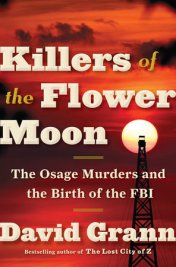
Killers of the Flower Moon:  The Osage Murders and the Birth of the FBI, by David Grann
9780385534246
Killers of the Flower Moon: The Osage Murders and the Birth of the FBI, by David Grann

This nonfiction book was a real eye opener for me. I knew that Native Americans have always gotten the short end of the stick from the US Government, but I knew nothing about the history of the Osage Tribe in Oklahoma until I saw the author, David Grann, interviewed about his book on TV. The story was fascinating, so I immediately got on the waitlist for the book at the library.

In a nutshell, this book is the story of how the lives of the Osage were turned upside down in the early 1900s when oil was discovered on their land. They had wisely purchased land and acquired all mineral rights. Unfortunately, their wise decisions became their undoing when they became wealthy. The government deemed them incapable of handling their own finances and assigned each headright holder a white guardian to oversee their spending even for the most mundane personal hygiene items.

This had trouble written all over it from the beginning. Unscrupulous guardians not only stole their ward’s wealth, but in many cases killed them or had them murdered. Most local government authorities in Osage County were either complicit in these murders or turned a blind eye to them. Two local physicians were even involved in the poisoning of some of the Osage. Cause of death records were falsified, and most of the deaths were not investigated.

This is a sordid tale of a horrible and little-known chapter in American history. Integral to the story is the fact that the US Bureau of Indian Affairs investigations arm came in to try to get to the bottom of the matter. It became such a big deal that the Bureau of Investigation grew in stature to become the Federal Bureau of Investigation.

Killers of the Flower Moon:  The Osage Murders and the Birth of the FBI is incredibly well researched and is written in such a flowing way that it reads more like a novel than a history book. In case you haven’t guessed it already, I highly recommend this book.


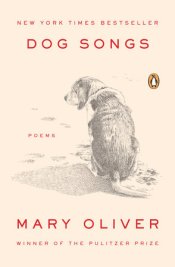
Dog Songs:  Poems, by Mary Oliver
9780143125839
Dog Songs: Poems, by Mary Oliver

My sister found this book at the public library and recommended it to me. If you’re a dog lover, like I am, you need to look for this little book. It’s a quick read but chock-full of delightful poems and memories of dogs and how they bless our lives.

What’s next?

I will blog about the other three books I read in August in next week’s post. No one wants to read in one sitting thousands of words about the books I read, so check out my blog next Monday to find out what else I read in August.

Until my next blog post

I hope you have a good book to read. I’ve just finished reading State of Wonder, by Ann Patchett, and I’ve started If the Creek Don’t Rise, by Leah Weiss.

If you’re a writer, I hope you have productive writing time.

Janet

Total Solar Eclipse!

Last Monday, August 21, 2017, I had a once-in-a-lifetime experience. I saw a total solar eclipse! My sister and I traveled several hours from our home to the mountains in southwestern North Carolina in order to see the eclipse in the band of totality.

Anticipating heavy traffic later in the morning, we left Canton, North Carolina (just west of Asheville) at 6:45 a.m. It was a scenic and pleasant hour’s drive to Bryson City, North Carolina where we had reservations on a steam train to Dillsboro at noon.

After a hearty breakfast at The Iron Skillet and a tour of the Smoky Mountain Trains Museum in Bryson City, and armed with NASA-approved solar eclipse viewing glasses, we boarded a train for the 75-minute ride to Dillsboro, North Carolina. Pulled by a diesel locomotive for the trip to Dillsboro, the train was pulled by a steam locomotive on the return trip to Bryson City that afternoon.

2-8-0 Class Steam Locomotive No. 1702

The 2-8-0 steam locomotive No. 1702 was built by The Baldwin Locomotive Works in Eddystone, Pennsylvania in August, 1942. Intended for military service in Europe during World War II, it was sent instead to Fort Bragg, North Carolina to perform domestic wartime service. According to the information on the back of my souvenir ticket, “The engine is one of two remaining in the U.S. 120 2-8-0 class oil burning engines built.”

Solar Eclipse 8.21.2017 046
2-8-0 Steam Locomotive No. 1702, owned and operated by Great Smoky Mountains Railroad

After being owned by various railroad lines, in 1992 the locomotive was purchased by Great Smoky Mountains Railroad. It gave passenger service in western North Carolina until 2004 when mechanical problems took it out of service. Restoration work began in 2014 and today the steam engine is a thing of beauty in great working order.

During the two-and-a-half-hour layover in Dillsboro, we were able to sit and watch the progression of the eclipse.

Solar Eclipse 8.21.2017 058
That’s me, watching the solar eclipse in Dillsboro, NC, August 21, 2017.

The people on the train and in Dillsboro were all in a jovial mood and excited about the experience. There were people there from many US states, India, and Japan. The ladies from Japan had traveled to China to see a total eclipse. They brought with them solar eclipse viewing fans. They reminded me of the cardboard fans on a wooden stick that we used in our church before the days of air-conditioning.

The fans from China had a strip across so one could hold the fan in front of the face and look at the eclipse through the strip. One of the women let me try it out. I thought it was more convenient and sturdy than the flimsy eclipse glasses we have in the US. Afraid my glasses would slip and expose my eyes, I found myself holding them in place.

Eclipse projected on the ground

Solar Eclipse 8.21.2017 068
Image of sun just minutes before total eclipse as projected on paper through a telescope and binoculars

An engineer from Conyers, Georgia set up a telescope rigged with binoculars just a few feet from where we sat. It was fascinating to watch the progression of the eclipse, which started at 1:06 pm and ended at 4:00 pm, as his setup projected the image of the sun onto a piece of paper on the ground.

Solar Eclipse 8.21.2017 056
Tiny solar crescents being project through a round disk with tiny round holes in it.

He had a round disk containing a myriad of tiny holes. Everywhere the eclipsed sun shone through the holes, we could see tiny crescents of light on the paper underneath. He also showed the women from Japan how to hold they hands palms down, crossways of each other at a 90-degree angle and somehow the tiny crescents of light appeared on the ground beneath his hands. I never got the hang of that.

Total Solar Eclipse!

Solar Eclipse 8.21.2017 070
Photograph of total solar eclipse in Dillsboro, NC, August 21, 2017

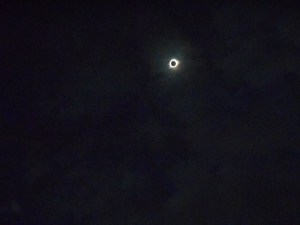
When the partial eclipse transitioned into total eclipse at 2:35 pm, we could take off our viewing glasses and look at the sun unprotected for the minute and 50 seconds of totality. Nothing was visible of the sun during that time except its spectacular corona. I could see one star to the left of the sun. Everyone cheered and applauded when totality began and again when it ended. The birds started singing again as totality transitioned into partial eclipse.

The street lights came on during the twilight of total eclipse. If I had it to do again – which I don’t expect to – I would go to a place far away from any source of artificial light, and I would go the a place in the center of the total eclipse band. Even so, I have no regrets and feel fortunate to have had this opportunity. The last eclipse that could be seen in the Dillsboro area was July 20, 1506. The next one will be October 17, 2053. Since I’ll be 100 years old then, I don’t expect to see it.

When the eclipse was at about 50%, we could see what we thought to be a sunspot on the sun as we looked at the half-moon image on the paper under the telescope/binoculars setup. Unfortunately, the sunspot was too tiny to show up in the photograph I took.

Traffic!

It had taken less than an hour that morning to drive from Canton, North Carolina to Bryson City. After the steam train returned us to Bryson City after the eclipse, we enjoyed pizza at Nick and Nate’s Pizza across the street from the train station and headed back to Canton.

It wasn’t long before we caught up with bumper-to-bumper traffic. It took us three-and-a-half hours to drive back to Canton, so we were glad we’d taken time to eat supper in Bryson City.

A nice surprise

A nice surprise that morning in Bryson City was visiting O’Neil’s Shop on the Corner and finding a copy of my vintage postcard book, The Blue Ridge Mountains of North Carolina, prominently displayed near the bookstore’s entrance.

One of the shop’s owners, Tom O’Neill, asked me to autograph it and the other copy on another shelf. I was thrilled to find my book still available there! (I wrote about my first experience meeting Tom and Cynthia O’Neill in my December 30, 2014 blog post, O’Neill’s Shop on the Corner)

Solar Eclipse 8.21.2017 008
That’s me, proudly standing beside my vintage postcard book, The Blue Ridge Mountains of North Carolina, on display at O’Neill’s Shop on the Corner, Bryson City, NC.

It was a really nice day. We’d had such a good experience all day, the long drive back to Canton wasn’t so bad. We regretted that we were missing the NOVA program about the eclipse on PBS that night, but it turned out that we got to see it later in the week after we returned home.

Until my next blog post

I hope you have a good book to read. I’ve almost finished reading Hatteras Light, by Philip Gerard, for tonight’s meeting of Rocky River Readers Book Club.

If you’re a writer, I hope you have productive writing time.

Janet

Photo credits:  Marie Morrison


Race in America, and The Dry Grass of August

Today’s blog post highlights the first paragraph of The Dry Grass of August, Anna Jean Mayhew’s debut novel. That paragraph is a great hook, for it draws you in and conveys that there’s bound to be a good story in the coming pages. Here it is:

“In August of 1954, we took our first trip without Daddy, and Stell got to use the driver’s license she’d had such a fit about. It was just a little card saying she was Estelle Annette Watts, that she was white, with hazel eyes and brown hair. But her having a license made that trip different from any others, because if she hadn’t had it, we never would have been stuck in Sally’s Motel Park in Claxton, Georgia, where we went to buy fruitcakes and had a wreck instead. And Mary would still be with us.” ~ Anna Jean Mayhew in The Dry Grass of August

DryGrass
The Dry Grass of August, by Anna Jean Mayhew

The Dry Grass of August is a novel that takes you to the American South in the days of  lawfully-mandated racial segregation. It is written from the point-of-view of a 13-year-old white girl from Charlotte, North Carolina. It sheds light on how it was in the 1950s for a black maid, Mary Luther, traveling from North Carolina to Florida with her white employer, Mrs. Watts, and the four Watts children. Mary couldn’t eat in restaurants, couldn’t sleep in motels, and couldn’t use public bathrooms because they were the legal domain of white people.

Mary Luther is in constant but often subtle danger. She was, no doubt, apprehensive and in danger even when the members of the white family she was riding with were unaware. That unawareness is today referred to as “white privilege.” When one lives his entire life as a member of the predominant and ruling race, he enjoys privileges and advantages of which he isn’t even conscious.

The Watts children witness things along the way to Florida that open their eyes to how differently whites and blacks are treated in the United States. They cannot return home to Charlotte unchanged.

In light of the August 12, 2017 violence

I chose the opening paragraph of The Dry Grass of August as my blog topic for today many weeks ago. When I selected it and put it on my blog schedule, I had no idea I would be writing it in the aftermath of the tragedy in Virginia of last weekend. I did not anticipate writing a 1,000-word blog post around that paragraph.

Although published in 2011, The Dry Grass of August speaks to us today as, in light of the murder of Heather Heyer and other violence in Charlottesville, Virginia on August 12, 2017, Americans are having a conversation like never before about race relations. That conversation is long overdue and painful. It will not and cannot be a short conversation.

For all the progress that has been made between the races in my 64 years, it is abhorrent and repulsive to me that in 2017 there are Ku Klux Klan members, white supremacists, and Neo-Nazis not only living among us but being emboldened by the words, actions, and inactions of President Donald J. Trump. It is Mr. Trump’s lack of moral leadership that has added fuel to the fire and given bigots a green light to publicly spew their hate.

I had hoped to keep politics out of my blog, but I cannot remain silent. This is bigger than politics. This is morals and humanity and freedom. Freedom to live without fear. My blog is not a huge platform, but it does give me an avenue through which to speak. My blog has 1,300 followers from all over the world. I don’t want my blog followers in other countries to think Americans are vicious and at each other’s throats. That is not who we are.

Whereas the people who doggedly hung onto the myth that white people were a superior race used to cowardly hide their faces and identities under white hoods and robes, they now demonstrate and march with torches in regular street clothes. When they marched in Charlottesville last weekend, some of them were outfitted with helmets and shields, making it difficult for the anti-Nazi protesters to tell the difference between police officers and the white supremacists.

There is no room in the United States of America for Neo-Nazis and other hate mongers. The good citizens of this country cannot allow the current occupant of the White House to lead us down this destructive road by his lame condemnation of evil and his attempt to equate the people carrying Nazi flags with the people who were there to protest their hateful agenda.

Three of the founding pillars of the United States are freedom of speech, freedom of religion, and freedom to assemble. I’m glad I live in a country where people can voice their opinions; however, no American has the constitutional right to threaten, terrorize, or murder other people simply because of the color of their skin or the way they choose to worship God.

The United States is in a watershed moment. We will come out a better people on the other side of the current self-examination and soul searching because we are a good and decent people. We are not who Mr. Trump would try to make you think we are. We are so much better than that.

Until my next blog post

I hope you have a good book to read. If you’re a writer, I hope you have a good book to read while you write your next good book.

Janet


Anne Lamott’s Gems for Novelists

My blog post on August 7, 2017 (Late July Reading) was about the three books I read during the second half of July. I wanted to share more words of wisdom I gleaned from Anne Lamott’s book, Bird-by-Bird: Some Instructions on Writing and Life.

12543
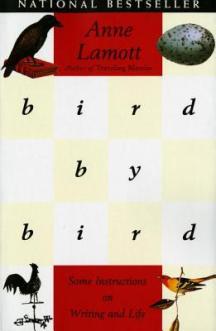
Bird-by-Bird: Some Instructions on Writing and Life, by Anne Lamott

As I stated in that post, as someone learning the art and craft of writing, I enjoyed Bird-by-Bird, by Anne Lamott. The following quote from the book also sums up how I feel about good novelists.

“Ever since I was a little kid, I’ve thought that there was something noble and mysterious about writing, about the people who could do it well, who could create a world as if they were little gods or sorcerers. All my life I’ve felt that there was something magical about people who could get into other people’s minds and skin, who could take people like me out of ourselves and then take us back to ourselves. And you know what? I still do.”  ~  Anne Lamott

Ms. Lamott waxes poetic about what makes a book a good book. I cannot say it any better than she does in the first chapter. She writes about all the things books do for us.

She has some words of wisdom for people like me. One takeaway I took from the book was that I need to get over being a perfectionist.

Ms. Lamott talks about characters and gives tips about how to get acquainted with a character before you write about him or her. However, she cautions that you won’t really get to know your characters until “you’ve started working with them.”

My interpretation of one of her recommendations is for writers to focus on character and the plot will fall into place. You have to know what means the most to your protagonist so you’ll understand and can convey to the reader what is at stake in your novel. To quote her again:

“That’s what plot is:  what people up and do in spite of everything that tells them they shouldn’t,….” ~ Anne Lamott

Ms. Lamott writes about the parts of a novel and the importance of the writer paying attention to those details. If no one is changed in the course of the novel, it has no point. She writes about dialogue and how it must be written as real people talk. It’s essential to get voice right in order to get character right.

She writes, “We start out with stock characters, and our unconscious provides us with real, flesh-and-blood, believable people.” (I hope she’s right. I hope the unconscious part of my brain kicks in as I rewrite my manuscript for The Spanish Coin!)

All this is just the tip of the iceberg. She writes about a writer’s self-confidence and the importance of a novelist deeply knowing the setting for their novel. She says that a writer needs to recapture the intuition they had as a child and let that lead their opinions.

I could go on and on, but I’ll leave you with two more quotes from the book:

“Don’t look at your feet to see if you are doing it right. Just dance.” ~ Anne Lamott

“Risk being unliked. Tell the truth as you understand it. If you are a writer, you have a moral obligation to do this. And it is a revolutionary act –  truth is always subversive.” ~ Anne Lamott

Until my next blog post

I hope you have a good book to read. If you’re a writer, I hope you have productive writing time. I also recommend that you read Bird-by-Bird: Some Instructions on Writing and Life, by Anne Lamott.

Janet

Late July Reading

Another month has whizzed by and left me getting ever more behind in reading all the books I want to read, but July was another rewarding month of reading for me. I hope you’ll enjoy reading “my take” on the three books I read the last couple of weeks of July. On July 17 (Reading South Africa and South Carolina Novels) I blogged about the two books I read earlier in the month.

The Orphan’s Tale, by Pam Jenoff

I kept reading about The Orphan’s Tale, by Pam Jenoff and decided I wanted to read it. It was the first book I’d read by Ms. Jenoff, who has a fascinating background in government work. I look forward to reading her other books.

OTLarge
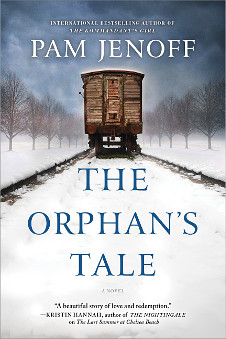
         The Orphan’s Tale,           by Pam Jenoff

The Orphan’s Tale revolves around a toddler who is rescued from the Nazis by a young woman who is no longer welcome in her parents’ home. She ends up being taken in by a circus and assigned to the trapeze, although she knows nothing about being an aerialist.

The woman assigned to train her resents her. Throughout this book of numerous twists and turns, the two women resent each other, support each other, and risk their lives for each other. It is a tale of humanity, forgiveness, trust, friendship, love, and loss set in Germany and France during World War II.

Bird-by-Bird:  Some Instructions on Writing and Life, by Anne Lamott

12543
Bird-by-Bird: Some Instructions on Writing and Life, by Anne Lamott

As someone learning the art and craft of writing, I enjoyed Bird-by-Bird, by Anne Lamott. In the book’s introduction she writes about learning to love books as a child. The following quote comes from the introduction:

“The act of writing turns out to be its own reward.” ~ Anne Lamott

I set out to write about the many things I liked about this book and the beautiful way Ms. Lamott writes about the many things a novelist needs to pay attention to in the writing process. It soon became obvious that today’s blog post would be longer than anyone wanted to read if I did that. Therefore, I will write about Bird-by-Bird in my August 14, 2017 blog post.

The Midnight Cool, by Lydia Peelle

I read this book because it was set in Tennessee during World War I. I haven’t read many novels set in that era and I wanted to learn more about it. I’m participating in the Read America Book Challenge from the Mint Hill Branch of the Public Library of Charlotte and Mecklenburg County. The object of that challenge is to read novels set in as many different US states as possible in 2017. Thirteen down and 37 to go. Seven months down and five to go. Hmmm. Not good.

static1.squarespace.com
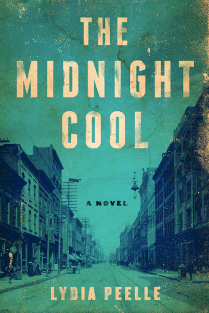
      The Midnight Cool,         by Lydia Peelle

I was conflicted as I finished reading The Midnight Cool. Lydia Peelle has a way with words, but I found the book hard to follow since the dialogue was not enclosed within quotation marks. It was tedious to have to go back a couple of paragraphs at times in order to discern who was speaking.

I was interested in the subject matter, but the middle of the book did not hold my attention. I enjoyed the last 50 or so pages of the book, so I’m glad I didn’t give up on it. For all the hype of the book to be about mules for World War I and a killer horse, I found it to be more about the two men who traded in mules and the women they loved.

The book gave me some things to think about that I really hadn’t considered before, such as the massive number of mules the United States transported across the Atlantic in ships to pull artillery and do other hard labor in the Allies’ war effort in Europe.

I learned that horses have to be trained, but mules more readily reason things out. (Don’t hate me, horse lovers!) According to the book, the only thing the mules had to be trained in was being fitted with gas masks. Gas masks for mules was another thing that had never crossed my mind. This goes to show that you can learn things from reading well-researched historical novels.

The website, http://www.mountvernon.org/george-washington/farming/animals/father-of-the-american-mule/, confirms that George Washington was the “Father of the American Mule.” The site explains that there were advantages that mules had over horses in the Allies’ efforts in World War I in addition to their not needing much training. Mules eat one-third less than horses, they don’t need to drink as much water as horses, and mules are more surefooted than horses.

If Lydia Peelle writes another novel, I will check it out because she has a gift for turning a phrase and I believe she does her research.

Until my next blog post

I hope you have a good book to read. I’m reading Killers of the Flower Moon:  The Osage Murders and the Birth of the FBI by David Grann.

If you’re a writer, I hope you have productive writing time. I also recommend that you read Bird-by-Bird: Some Instructions on Writing and Life, by Anne Lamott.

Janet

They’re All Uncertain Times

Events of the last week prompted me to write about uncertain times for today’s blog post. It soon occurred to me that all times are uncertain because we cannot see into the future.

We tend to think the time we’re living in is more unpredictable than any other time, but if you’ll stop and think about it, you might see that life is and always has been full of doubts, worries, and stress. The unknown can do that to you.

I think about the uncertain times my known ancestors lived through:

English-speaking Lowland Scots being taken into the Gaelic-speaking Kintyre Peninsula in the southwest of Scotland to be tenant farmers in the 1600s and being required to attend a church where only Gaelic was spoken;

Scottish immigrants crossing the Atlantic and settling in the Carolina backcountry/wilderness in the 1760s; and

Those Scottish immigrants facing the American Revolution and not knowing what the outcome would be.

On December 23, 1776, in “The Crisis,” Thomas Paine wrote the following:

“THESE are the times that try men’s souls. The summer soldier and the sunshine patriot will, in this crisis, shrink from the service of their country; but he that stands by it now, deserves the love and thanks of man and woman. Tyranny, like hell, is not easily conquered; yet we have this consolation with us, that the harder the conflict, the more glorious the triumph. What we obtain too cheap, we esteem too lightly: it is dearness only that gives every thing its value.”

My ancestors lived through those times. The deaths of my Morrison great-great-great-great-grandparents during the American Revolutionary War left my great-great-great-grandfather orphaned at the age of nine. He and his siblings were cared for thereafter by his uncles and their wives, but it must have been more than frightening.

Then came the following trying times:

War of 1812;

American Civil War;

Reconstruction Era in The American South;

My maternal great-grandmother’s death in childbirth in 1881;

My paternal great-grandfather’s accidental death while felling a tree for lumber to build a kitchen in 1886;

Spanish-American War;

World War I;

The Great Depression;

My paternal grandmother and maternal grandfather both dying as young adults;

World War II;

Korean War; and

Illnesses and epidemics.

Living in the age of modern medicine and miracle drugs, it’s difficult for most of us to empathize with our ancestors who lived with the possibility of dying or watching their children die of typhoid fever, tetanus, flux, or polio.

When the Salk polio vaccine became available in the late 1950s, I did not fully appreciate what it meant to my parents. For me, as a child, I just remember our family going to the gymnasium lobby at Harrisburg High School on three Sunday afternoon after church to get an oral vaccine on a sugar cube.

The 1960s and years since have brought the following times of uncertainty:

Vietnam War;

Civil Rights Movement in the United States;

Numerous wars in the Middle East;

Rumors of more wars;

Terrorism; and

Incompetency and recklessness in The White House. (Don’t blame me; I didn’t vote for him!)

All of my ancestors down through my grandparents were farmers. I can’t imagine a life full of more uncertainties than one in which one’s livelihood is at the mercy of the weather.

I believe that God created the world with everything we need to not only survive but thrive. Human beings have brought on many uncertainties by not being good stewards of the world that God has entrusted to us – its animals and natural resources. Come to think of it, we have created most of the uncertainties ourselves – war, poor planning, poor agricultural practices, greed, and envy.

Earthquakes, hurricanes, tornadoes, floods, volcanoes, and wildfires happen, but even many floods and wildfires are caused by man’s carelessness.

I attended two funerals in less than 48 hours last week. One was expected after a long battle with cancer, but the other one was quite sudden. Life is full of uncertainties.

Reviewing some of the events and hardships my ancestors faced, and the things I’ve witnessed in my 64 years has helped me put recent events and concerns in perspective.

The sun comes up. The sun goes down. The world keeps spinning around and revolving around the sun. What an amazing world!

simon-hesthaven-216108 (2)
Photo by Simon Hesthaven on Unsplash


Until my next blog post

I hope you have a good book to read. I’m reading Killers of the Flower Moon:  The Osage Murders and the Birth of the FBI by David Grann and Among the Living by Jonathan Rabb.

If you’re a writer, I hope you have lots of productive writing time.

Janet

Things I Miss and Things I Don’t

I am fortunate to once again live where I grew up. Literally. I live in the house that my parents built when I was six years old. The site is not as rural as it was in 1959, but it’s still considered “country.” I can see two other houses from my house, but I don’t exactly live in a neighborhood as most people define that today. The local landscape is rapidly changing, and there are things from my growing up years that I miss.

I invite you to come with me as I take a walk down memory lane. All the photographs in today’s blog post were taken by me.

Cars

I used to know almost everyone who passed by the house. There was less traffic then, and each make and model of car was more distinctive than today. It was easy to tell a Ford from a Chevrolet.

Bobwhites

For a good part of my life, a covey of quail (also known as Bobwhites because that was their wonderfully-distinctive call:  Bob-White!) nested on the ground near a bed of daffodils and a pale pink rose bush in the front yard. I haven’t seen or heard a quail in probably 10 years. Those daffodils still bloom around the first week in February. The climbing rose bush is no longer there, but my brain can still call up the delicious scent of those roses!

Woodpeckers and Flying Squirrels

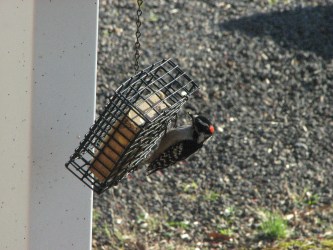
I haven’t seen a Red-Headed Woodpecker since I was a teenager. We have Downy Woodpeckers but no Red-Headed ones. I miss them.

IMG_0795
Male Downy Woodpecker on a suet feeder

We’ve seen flying squirrels in the huge old red cedar tree at the south end of the house some years, but not in a long time. I’m afraid they are no longer in our area. One summer our nightly entertainment was sitting on the porch and watching the flying squirrels fly in and out of the feeder in the cedar tree where we put dried ears of corn.

Eastern Bluebirds

Eastern Bluebirds almost became extinct due to chemicals that were being used for agricultural purposes. After the problem was figured out and stopped, the bluebirds made a comeback. They nest in bluebird boxes in our yard every spring and are a joy to see!

Crimson Clover, Daisies, and Queen Anne’s Lace

IMG_6092
Wild Daisy on May 9, 2015.

My uncle used to plant red clover in the field across the road from our house to enrich the soil for other crops planted other years. I loved the way a breeze would gently blow through the crimson clover blossoms in waves. That memory calls to mind “amber waves of grain” from the song, “America the Beautiful.” That field is beautiful today with wild daisies and Queen Anne’s Lace. No doubt, someday, the wild flowers will be replaced with houses.

IMG_5926
Queen Anne’s Lace blossom

Tractors and Cattle

There are several farmers on the road I live on who still grow crops such as winter wheat. They raise beef cattle and goats. Some of the cattle have won blue ribbons at the North Caroline State Fair. These are serious farmers. I like that their tractors pulling various farm implements pass my house daily. I dread the day that I will have to add farm tractors to the list of things I miss.

Air-Conditioning

Lest I become too nostalgic about the 1950s and 1960s, I will also admit that I do not miss the days before air-conditioning. I do not miss those nights when it was so hot, humid, and still that I just lay in bed watching the clock because it was too hot to sleep.

Hoppy Toads and Mollypops


Flowers & Green Spider in Garden 9-5-08 022
Passion Flower in our garden

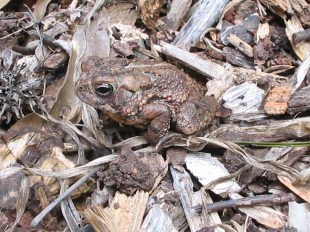
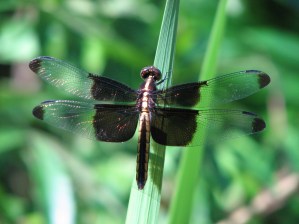
I enjoyed having a vegetable garden for many years. Along with a lot of hard (and hot!) work, came brown and bumpy toads we called “hoppy toads,” box turtles, writing spiders, gossamer-winged dragonflies, and wild passion flowers that produced a fruit we call “mollypops.”

August 2005 167
A “Hoppy Toad”
Box Turtle 002
Eastern Box Turtle in our yard
Flowers, Snail & Spiders in Garden 9-6-08 031
A writing spider in our garden
Flowers and Garden 6-25-09 055
Dragonfly in our garden

Not having a garden any more means I rarely see a toad, a box turtle, or a writing spider. I haven’t seen a passion flower since the last year I had a garden, but now we’re overrun with white-tailed deer, raccoons, skunks, gray squirrels, and rabbits. As their habitats get bulldozed down to make way for more and more houses, animals such as deer are being pushed into our yard.

A raccoon in our yard April 28, 2014.
Raccoon in our yard

Hungry White-Tailed Deer

Squirrel 4
Gray Squirrel (with a slightly red tail)


Deer in backyard 9-19-10 001
White-Tailed Deer Fawn

One interesting bit of information is that I never saw a deer in our area until I was an adult. Now it’s common to see several grazing in the yard. The deer were the reason we stopped planting a vegetable garden a few years ago. We planted tomatoes, green beans, summer squash, corn, bell peppers, okra, and radishes. The deer ate everything. Well, almost everything. We did get six radishes for all our hard work! Needless to say, that was the last year we tried to have a vegetable garden.

I have truly been blessed to have lived here as a child and now again as an adult. I can’t imagine growing up in a better place! A part of me bemoans the fact that this area’s population is growing so fast, but I’d rather live in a vibrant, growing area than in one that is losing people and becoming a ghost town.

Until my next blog post

I hope you have a good book to read. I’m reading The Midnight Cool, by Lydia Peelle and Killers of the Flower Moon:  The Osage Murders and the Birth of the FBI by David Grann.

I’m still working my way through Barbara Kyle’s “Your Path to a Page-Turner Program.” I’ve learned a lot about the art and craft of writing from the first 16 videos and look forward to the remaining seven lessons.

If you’re a writer, I hope you have lots of productive writing time.

Janet


Reading South Africa and South Carolina Novels

Since I had a lot to say about both of the novels I’ve finished reading so far in July, I decided not to wait until my August 7 blog post to tell you about them. One was set in South Africa during the Second Boer War. The other was set on an island in South Carolina in beginning in 2004. Quite a contrast in location and time!

The Lost History of Stars, by Dave Boling

Boling_History_FLAT_rgb_HR-210
The History of Stars, by Dave Boling

One of the categories I chose for my 2017 Reading Challenge was to be sure to read a book that takes place on each of the seven continents. Without that being part of my personal challenge, chances are I would not have read The Lost History of Stars, by Dave Boling.

I’m amused at people who brag that they only read nonfiction. They think there is nothing to be learned from fiction. I used to fall into that category. I was a nonfiction snob, so my sister couldn’t believe it when I told her in 2001 that I was taking a fiction writing course.

I minored in history in college, but what little I learned about the Second Boer War has long since been forgotten. The Lost History of Stars is a novel about that 1899-1902 war in South Africa. It follows an Afrikaner family throughout the war. It is not a history of that war, and I admit that I still know few details of it; however, from reading this book I learned that the British burned the homes and farms of many Afrikaners and rounded up the women and children and put them in concentration camps. Disease and malnutrition were rampant in those camps.

From the inside flap of the book’s cover, I learned that “some 3,500 Afrikaner farmer-soldiers lost their lives. However, in the concentration camps, hastily assembled by the British forces to limit resistance among the general populace, the human toll was much higher:  it was there, while their husbands and fathers were away fighting, that more than 26,000 women and children died.” Take time to reread this paragraph and let the injustice set in.

It is interesting to me that the author, Dave Boling, was inspired to write this novel after learning that one of his grandfathers was a British soldier in South Africa during the Second Boer War. That must be the reason he wrote about a camp guard who did not wish to be there, finding it distasteful to be guarding women and children in a concentration camp.

The book is written with chapters alternating between the farm and the concentration camp. Some chapters took place in the concentration camp, and then the next chapter took place a year earlier on the farm. I would have preferred the book being written in chronological order, but that’s just my personal preference.

This is a story of family loyalty and the sheer strength of will to survive.


Grief Cottage, by Gail Godwin

9781632867049
Grief Cottage, by Gail Godwin

Author Wiley Cash recommended the writings of Gail Godwin. She has had two novels published – Flora and Grief Cottage. I decided to read Grief Cottage first. It’s her new book.

Grief Cottage is set on an island in South Carolina in 2004 and partially in North Carolina in 2018. Eleven-year-old Marcus is an orphan who has been sent to South Carolina to live with his Aunt Charlotte. Charlotte is an artist and is used to living alone.

Marcus takes on the project of finding out the names of the couple and son who were lost when Hurricane Hazel hit 50 years ago in 1954. They were vacationing on the island and staying in what later became known as Grief Cottage when Hurricane Hazel hit. I thought the climax of the book would be when Marcus learned the names of those three people, but that happened less than halfway through the book.

Maybe it was just me, but I thought the story dragged in places and some information was repeated two or three times. That aside, I did enjoy the book.

Marcus’s mother had given him a picture of his father and promised to tell him his father’s name when he got older. She was killed in an automobile accident before that happened. It wasn’t until the last page of the epilogue (set in 2018) that Marcus learns the name of his father.

There are subplots that include such things as loggerhead turtle eggs and hatchlings, Charlotte’s paintings, alcoholism, and bullying. The plot takes a huge turn in the second half that I didn’t see coming. In case you haven’t read the book, I won’t say more.

I’ll probably read Gail Godwin’s other novel, Flora, after I check off a few more items on my 2017 Reading Challenge.

Until my next blog post

If you’re a writer, I hope you have quality writing time.

I hope each of you has a good book to read. I’m reading The Girl on the Train, by Paula Hawkins for Rocky River Readers Book Club this month; The Midnight Cool, by Lydia Peelle; The Orphan’s Tale, by Pam Jenoff; and Bird  by Bird:  On Writing and Life, by Anne Lamont. (This is what happens when all the books you’ve been on the waitlist for at the public library come in at the same time!)

Excuse me while I get back to my reading.

Janet

A Line from Child 44, by Tom Rob Smith

Child44cover
Child 44, by Tom Rob Smith

Today’s blog post features a line I liked in Tom Rob Smith’s novel, Child 44.

“Their mother, a stout, tough-looking woman who looked like she could swallow bullets and spit them back out, was in front of them, shielding them with one hand on each of their chests.” From Child 44, by Tom Rob Smith

Don’t you just love the way Tom Rob Smith described this woman in Child 44, the first book in his Child 44 Trilogy? I aspire to write descriptions like that – descriptions that conjure up an image in your mind.

What a writer shouldn’t do

As I continue to learn the craft of writing, I make a note of sentences that grab my attention in books I read. Yes, it sometimes takes me out of the story, but I read now as someone who is learning to write fiction. Writers are told not to write anything that will pull the reader out of the story, but I take an exception to that for myself at this stage in my journey as a writer.

A few words about Child 44

As I stated in my February 14, 2017 blog post (The First Line from a Novel by Tom Rob Smith), Child 44, is about a serial child killer in Stalinist Russia. It is the first book in Mr. Smith’s Child 44 Trilogy. I haven’t had a chance to read the other books in the trilogy. My February 14, 2017 blog post was about the first line in Child 44 and its being a good literary “hook.”

Until my next blog post

I hope you have a good book to read. I just finished reading Grief Cottage, by Gail Godwin. Now I have the joy of deciding which library book in that stack on my desk I will start reading next. Due dates will influence my decision.

If you’re a writer, I hope you have productive writing time.

I invite you to share my blog by word-of-mouth and by clicking on the social media icons below.

Janet
You Must Read (Some of) These Books!

First, I wish all my fellow Americans a Happy Independence Day or Happy 4th of July tomorrow!

ben-white-197668(1)

Photo by Ben White on Unsplash

I read some good books in June, so I will share my thoughts about them in today’s blog post. You might want to read one or more of them.

The Stars Are Fire, by Anita Shreve

I was drawn to this novel by the title. I got on the waitlist for it at the library as soon as it was on order. The book was inspired by the wildfires in Maine in October, 1947. I didn’t know about those fires, so I learned something.

The book is suspenseful as it follows Grace, a young mother whose husband has gone to fight the fire. Suddenly, the fire is upon the small coastal town where they live and Grace is forced to run for her life with a child in tow. I don’t want to spoil the book, in case you haven’t read it. If you prefer to read “happy books,” this is not the book for you. Much of the story is dark, yet the reader can’t help but cheer for Grace as she overcomes tragedy. It was a page-turner for me.

The Things We Keep, by Sally Hepworth

As with The Stars Are Fire, by Anita Shreve, The Things We Keep, by Sally Hepworth, is not what I would call a “happy book.” Ms. Hepworth follows a 38-year-old woman, Anna, who is diagnosed with Alzheimer’s Disease. The book chronicles Anna journey from diagnosis, through the months that she is very much aware of her diagnosis and the mental and physical deterioration that will be her future. Anna accepts her illness with humor as she adjusts to living in a residential facility where most of the other residents are decades older than she. The other young resident, Luke, befriends Anna, and the main plot of the book is their friendship, which grows into romantic love and how their relatives and the facility’s staff deal with that.

A subplot is about the widow of a businessman who loses everything and has to create a new life for herself and her young daughter. She takes a job at the facility where Anna and Luke live and gets more involved in their lives than the administrator wishes.

Although the subject matter of dementia is a frightening diagnosis, I found the book to be almost delightful due to Ms. Hepworth’s writing style. Each chapter was written from a different character’s point-of-view, which allows the reader to get into the head of Anna and to get a better understanding of what a person in the early stages of Alzheimer’s Disease thinks – their feelings and emotions.

As someone with Chronic Fatigue Syndrome/Myalgic Encephalomyelitis (CFS/ME), I could identify with some of the issues Anna faced. I have memory problems and, when put on the spot, I have trouble formulating a comment or an answer to an unexpected question. When Anna talked about not being able to think fast enough to join in a conversation, I immediately identified with that. Ms. Hepworth let Anna articulate so well how it feels when by the time you formulate a comment, the conversation has moved on to something else. That was a paragraph that made my mouth drop open because I felt like the book was describing me. It was eerie to realize that some of my CFS/ME symptoms overlap some early Alzheimer’s Disease symptoms.

The Things We Keep, by Sally Hepworth, was June’s selection for Rocky River Readers Book Club. We had a good discussion about the book on June 26.

The Sound of a Wild Snail Eating, by Elisabeth Tova Bailey

By the time I remembered to check this out from the public library, I’d forgotten how I’d heard about the book or why I wanted to read it. It had a catchy title, so I dived in. Lo and behold, the author, among other ailments, has Chronic Fatigue Syndrome.

This is a unique book. It probably wouldn’t appeal to everyone, but I enjoyed it. It is the true story of the author’s months of being bedridden. One of her friends comes to visit one day and brings wild violets and a snail. The snail started out living in a flowerpot with the violets. Much to Ms. Bailey’s surprise, she developed quite an attachment to the snail.

She realized one day that she could hear the snail eating. One thing led to another, and the author was soon reading everything she could get her hands on about snails. She studied the habits of the snail and by so doing, along with her readings, learned a great deal about the species. In the course of reading the book, so did I! I had no idea there was so much to learn about snails.

Being a “country girl” for most of my life since birth, I have encountered many snails, but until reading this book I did not know that they have row-upon-row of teeth, their eyes are on the tips of their tentacles, they cannot hear, they have an acute sense of smell, and their one foot is called a gastropod. That’s just the tip of the iceberg so, if you’d like to know more about snails – and what it’s like to be bedridden with Chronic Fatigue Syndrome, I recommend The Sound of a Wild Snail Eating, by Elisabeth Tova Bailey.

Although I’ve been ill for 30 years, Ms. Bailey was able to articulate some of my feelings better than I have ever been able to in writing or verbally.

Camino Island, by John Grisham

John Grisham’s latest novel, Camino Island, is a little different from most of his novels. There’s still suspense and there are still bad guys, but the hero isn’t a lawyer this time. The story is about the underworld of those who deal in buying, selling – and sometimes stealing – rare books. The book takes place in New Jersey, Pennsylvania, North Carolina, Florida, and France. The book held my interest, as all John Grisham books do. If John Grisham’s legal thrillers aren’t your “cup of tea,” you might want to give Camino Island a try. I think anyone interested in books will enjoy it.

And Every Morning the Way Home Gets Longer and Longer: A Novella, by Fredrik Backman

After liking A Man Called Ove, by Fredrik Backman in May, I was eager to read another of his books. In June I read And Every Morning the Way Home Gets Longer and Longer: A Novella, by him. It is about a man with dementia, his son, and his grandson and how the man’s dementia affects his relationships with his son and grandson.

Perhaps it was just me, but I had some confusion keeping up with when we were in real life and when we were in the thoughts inside the man’s brain. For that reason, I had trouble getting into the book. The longer I read, though, the more I got out of it.

Detective Cross (a BookShot), by James Patterson

I wrote about a BookShot by James Patterson, Detective Cross, in my June 16, 2017 blog post, “What’s the Verdict on BookShots?” (What’s the Verdict on BookShots?) I read it out of curiosity. I wanted to know what a BookShot was like, and I’m one of the last people in the world to read a book by James Patterson. His books are known for their fast pace, and this BookShot was no different.

Mr. Patterson’s BookShots are designed to be read in one sitting. It took me longer than that because, as I’ve mentioned before, I am a slow reader. I guess you could say that a BookShot is longer than a short story and shorter than a novella, but don’t quote me on that. I’m no expert.

As I pointed out in my June 16 blog post, Mr. Patterson has long been a champion of children’s literacy, and his BookShots are an attempt to put short books in the hands of adults who might not otherwise pick up a book to read. I hope they accomplish that!

Put the Cat in the Oven Before You Describe the Kitchen:  A Concise No-Bull Guide to Writing Fiction, by Jake Vander Ark

I must admit that I was drawn to this book by its title. I would never put a cat in an oven, but I just had to see what the author had to say about writing fiction. It was a humorous book, and it held my attention. The jest of it was that you need to get your reader’s attention before you start giving a lot of description.

Among other points, the author said if a minor character doesn’t have an effect on the main character, take them out of the story. I’m trying to keep that in mind as I rewrite the manuscript for The Spanish Coin. Another thing he said was, “You need to scare your protagonist and shock your audience.”

He also said that a writer should let the “protagonist determine the placement of the #$%! Moment.” (This is usually called the “inciting incident.”) He suggests to hit the reader with the inciting incident the moment the reader grasps what “normal” is for the protagonist. I picked up a few other tips from the book, but I don’t want to bore non-writers with the details. If you’re a beginning writer, you might look for this e-book yourself.

Until my next blog post

I hope you have a good book to read. If you’re a writer, I hope you have productive writing time.

Janet