Early X-ray and a Thimble

Did you know that a girl from the Rocky River community in Cabarrus County, North Carolina was the first person whose life was saved in the United States with the aid of the X-ray? Today’s blog post is an edited version of a local history newspaper column I wrote in 2006 for Harrisburg Horizons, a short-lived weekly newspaper. I usually blog about writing fiction, but this is an example of my nonfiction writing.

Discovery of the X-ray

Just three months after Wilhelm Conrad Roentgen of Bavaria discovered the X-ray, a scientist from Davidson, North Carolina used it in a Rocky River home to help save Ellen Harris’ life. It was a February day in 1896.

Dr. Henry Louis Smith of Davidson read about Roentgen’s discovery of the X-ray. He went to Dr. J.P. Munroe’s laboratory in the small medical school on the campus of Davidson College. The laboratory had the same equipment as that used by Mr. Roentgen.

Dr. Smith fired a bullet into the palm of a corpse’s hand. He then made a successful X-ray of the hand.

Ellen Harris Swallows Thimble

Soon thereafter, Mr. and Mrs. William Edwin Harris’ twelve-year-old daughter, Ellen, swallowed a tailor’s thimble. The open-ended thimble lodged in her throat and made it increasingly difficult for her to breathe or eat over the following days.

Tailor's Thimble
Tailor’s Thimble

Area physicians did not agree on a diagnosis. Three doctors thought she coughed up the thimble and damaged her throat in the process. One doctor speculated that the thimble hurt her throat as it passed to her stomach. Only one of the five doctors consulted thought the thimble was still in Ellen’s throat.

A man in Charlotte, the largest town in the area, told Dr. Smith about Ellen’s predicament. Dr. Smith asked the man to convey to Ellen’s parents his willingness to help them.

Ellen’s frantic father and mother believed that Dr. Smith could help their daughter. Mr. Harris traveled to Davidson in a wagon (a distance of about 30 miles — perhaps more in those days) and brought Dr. Smith and his X-ray equipment to his home near Rocky River Presbyterian Church on Rocky River Road.

Mr. and Mrs. Harris placed Ellen on a sheet fashioned into a hammock. Dr. Smith set up his crude X-ray apparatus. A large and heavy battery and induction coil powered the equipment.

According to a letter that Dr. Smith wrote to Dr. Robert M. Lafferty, he crouched on the floor under the girl. After an hour’s work with a fluoroscope, he got a fleeting glimpse of the thimble in the child’s windpipe. There was no lasting image on film like in X-rays today.

Dr. Smith returned to Davidson and the Harris family set out for a hospital in Charlotte. The doctors there refused to operate on Ellen. They wanted to see exactly where the thimble rested before they made an incision.

The Charlotte surgeons wired Dr. Smith their concerns. Surgery was Ellen’s only hope for survival. Without knowing the exact location of the thimble, though, the surgeons feared they would lose their patient on the operating table.

Dr. Smith immediately brought his X-ray equipment from Davidson to the hospital. Once more, the apparatus pinpointed the location of the thimble in Ellen’s trachea. The image paved the way for the operation.

The surgeons soon discovered that Ellen’s flesh partially grew over the rusting thimble. This made the thimble’s removal difficult and challenging. The arduous two-hour surgery saved Ellen’s life and put the Rocky River community on the medical history map!

My sources:

Early Medicine in Cabarrus, primary data collected by Eugenia W. Lore and edited by Jane Harris Nierenberg, 1990.  (Includes newspaper articles from The Concord Tribune, November 9, 1945, and December 10, 1945.)

Open the Gate and Roam Cabarrus With Us, by Adelaide and Eugenia Lore, 1971.

The Historic Architecture of Cabarrus County, North Carolina, by Peter R. Kaplan, 1981.

Hornets’ Nest:  The Story of Charlotte and Mecklenburg County, by LeGette Blythe and Charles R. Brockmann, 1961.

Until my next blog post

I hope you have a good book to read. (I finished Right Behind You, by Lisa Gardner and have started reading Chasing the North Star, by Robert Morgan.) If you are a writer, I hope you have quality writing time.

Janet

Save

Blogging from A to Z Challenge 2017 Theme Reveal

What is the Blogging from A to Z Challenge?

The Blogging from A to Z Challenge is an annual challenge open to all bloggers during the month of April. The first challenge was issued in 2010 and has steadily grown in participants each year. It is open to bloggers who write about any topic. I just learned about the challenge a couple of week ago.

Theme Reveal Day: March 20, 2017

My Blogging from A to Z Challenge Theme Reveal

Each participating blogger selects a theme for the challenge. My theme is Janet’s Writing Journey. That’s the theme of my blog already, but this challenge will force me to delve into some aspects of reading and writing that I maybe wouldn’t have written about otherwise.

How does the Challenge Work?

The challenge is to blog 26 days during April. This is based on the fact that there are 26 letters in the English alphabet. Each blog post must have a connection to a letter in the alphabet in chronological order. Posts are made on Saturday, April 1, then Monday through Saturday of each week through the end of the month plus a post on Sunday, April 30.

Blogging from A to Z Challenge Badge 2017

My Thoughts about the Challenge

This will be a challenge for me in more than one way. As you know, I usually only blog on Tuesdays and Fridays, so blogging 26 times in April will be a stretch for me. Add to that the requirement to connect with a specific letter each day, and it will definitely be a challenge!

In case you don’t want to receive a blog post from me every day, I ask you to please bear with me in April. I plan to go back to my usual blogging routine in May.

Until my next blog tomorrow

I hope you have a good book to read. (I’m reading Right Behind You, by Lisa Gardner.) If you’re a writer, I hope you have quality writing time. If you’re a blogger, I invite you to consider committing to the Blogging from A to Z Challenge 2017. Information about the challenge can be found at http://www.a-to-zchallenge.com/p/what-is-blogging-from-to-z.html.

Janet

Save

First Line from a Novel by Flannery O’Connor

The first line of Flannery O’Connor’s 1960 novel, The Violent Bear It Away, has to be my favorite first line.  “Francis Marion Tarwater’s uncle had been dead for only half a day when the boy got too drunk to finish digging his grave and a Negro named Buford Munson, who had come to get a jug filled, had to finish it and drag the body from the breakfast table when it was still sitting and bury it in a decent and Christian way, with the sign of its Saviour at the head of the grave and enough dirt on top to keep the dogs from digging it up,” says it all.

The Violent Bear It Away book cover
Book cover of The Violent Bear It Away, by Flannery O’Connor

What do we learn from the sentence?

From that one sentence, we know that Francis Marion Tarwater was, no doubt, named for that famous South Carolina “Swamp Fox” of the American Revolution, Francis Marion. We know that Tarwater is white, because Buford Munson is described as being a Negro. We can guess that there is an illegal still involved, although Munson could have come to fill his jug with water. The sentence tells us that Tarwater’s uncle died at the breakfast table and half a day later Tarwater was too drunk to bury him. It also tells us that Tarwater’s uncle was a Christian, and that Munson puts a cross at the head of the grave when he finishes burying Tarwater’s uncle.

The opening sentence also paints a picture of the grave of Tarwater’s uncle piled high with fresh dirt in order to prevent dogs from smelling and digging up the body. From this, we can assume there was no casket, no vault, no fence around the gravesite, and no leash laws in the area.

Tarwater is described as a boy in the opening sentence. This tells us that he was under the age of 21 (the age of majority when the novel was written) and more than likely younger than that. (We learn later that he is 14 years old.) For him to be too drunk to finish digging the grave tells us that Tarwater is either celebrating his uncle’s death or distraught with grief. Either way, it is not a desirable situation.

The young Tarwater apparently felt total responsibility to bury his uncle which insinuates that there are no relatives or good friends close by. Or, perhaps Tarwater murdered his unsuspecting uncle by putting poisonous material in his food, then got scared or felt guilty, which caused him to get drunk and  attempt to hide the evidence by burying him.

Just when we think that opening sentence with all its nooks and crannies has said it all, we realize that it has led us to an incredible number of questions. Although the novel’s opening sentence is outrageously long at 88 words and complicated with only two commas allowing us to take a breath, it accomplishes what every fiction writing textbook says a novel’s opening sentence should do:  It hooks us. It draws us in. It compels us to keep reading in order to find out what is going on and to find the answers to the many questions it raises.  What more could you ask of an opening line?

Until my next blog post

I hope you have a good book to read. If you’re a writer, I hope you have quality writing time.

Want a reading challenge for 2017?

Throughout 2016 I’ve enjoyed participating in the reading challenge issued by the Mint Hill Branch of the Charlotte-Mecklenburg Public Library. The year is quickly drawing to a close. I have not yet fully met the challenge, but I have four days left.

img086

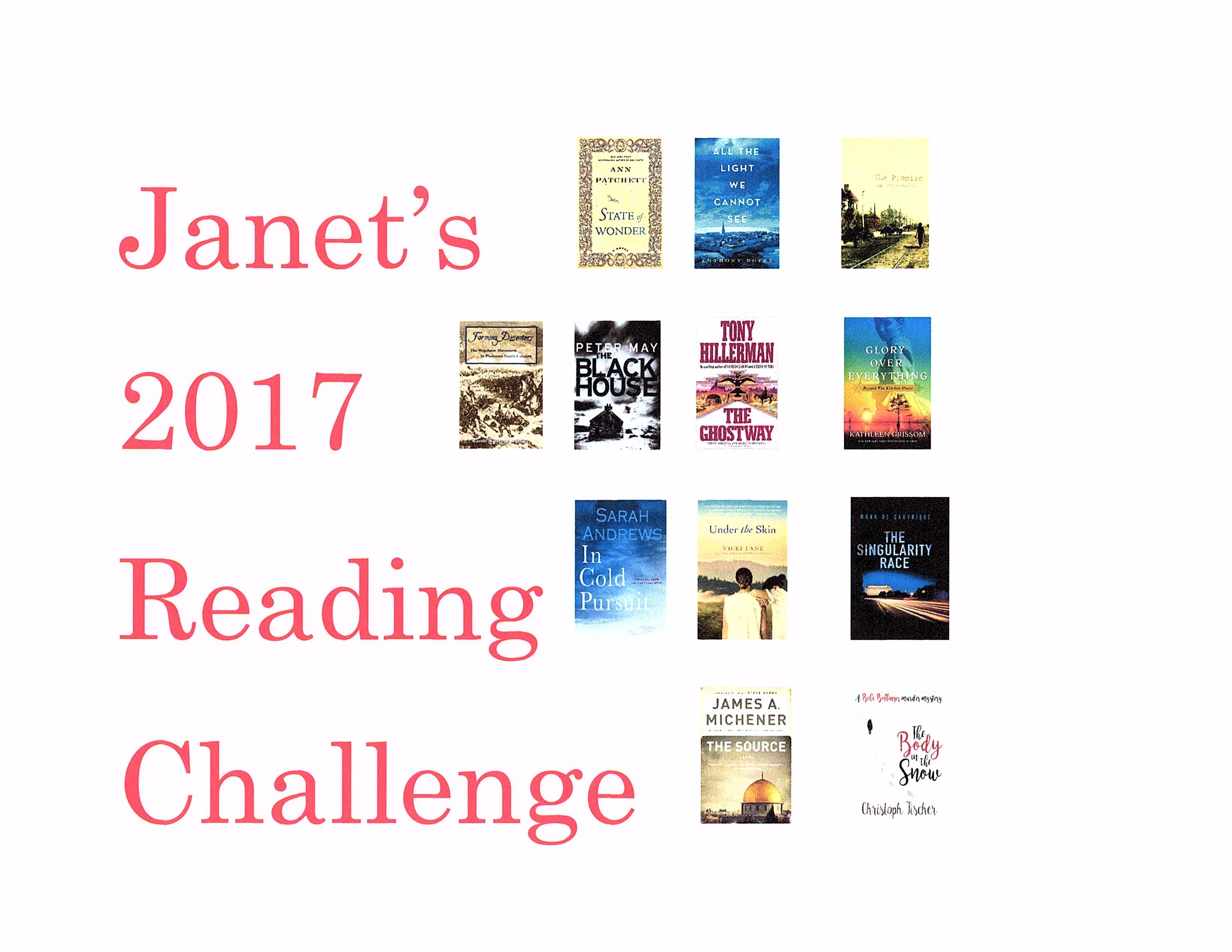
I designed the following reading challenge for 2017:

  1. A book of poetry
  2. A Sci-Fi book
  3. A nonfiction book
  4. Books by 12 authors I’ve never read
  5. A novel set in each of the seven continents
  6. A novel by a North Carolina author
  7. A novel set in North Carolina
  8. Re-read a favorite book
  9. A book written in the 1700s
  10. A book written in the 1800s
  11. A book written in the 1900s
  12. A biography, autobiography, or memoir
  13. A book about a religion other than my own
  14. A book that might change my mind
  15. A book just for fun
  16. A book that will teach me a new skill
  17. A book that was originally written in a language other than English
  18. A book written in Spanish (a language I haven’t studied since 1973)
  19. A book published in 1953 (the year I was born)
  20. A book that is the first in a series I haven’t read any of before
  21. The second book in a series of which I’ve read the first book
  22. A book written by an author I’ve met
  23. A book of short stories
  24. A book published in 2017
  25. A book about the craft of writing historical fiction
  26. A Nobel Prize winner
  27. A political thriller
  28. A sequel to a book I’ve read

 2017 – My Goal and Objective

I used to set a goal of reading a book every week, but in 2017 I’m going for quality and variety instead of volume. My goal isn’t to check off every category. My reading goal is to expand into areas and subjects I might not normally consider. My personal objective in 2017 is to become less judgmental. I think reaching my reading challenge goal will enable me to accomplish my objective. It will, no doubt, be an objective I will never fully attain. I am a work in progress.

Join me for the 2017 reading challenge I’ve planned or design one of your own.  Tell your friends about my blog and my reading challenge. Let’s get some conversations going about the books we’re all reading!

Everyone in the world does not have equal access to books so, now more than ever, it is incumbent upon those of us blessed to live in free societies and those of us blessed to live in countries with free public libraries and/or the financial means to have access to books to make the most of that privilege.

Until my next blog post, I hope you have a good book to read. If you’re a writer, I hope you have productive writing time.

Janet

Save

Save

11 More Things I’ve Learned about Twitter

Tweet!
Tweet! @JanetMorrisonbk.com

On July 22, 2016 I blogged “10 Things I’ve Learned about Twitter.” Since then, I’ve learned 11 more things.

  1. Twitter should come with an owner’s manual or a teenager to teach those of us in our 60s how to use it.
  2. I’d still rather be working on my southern historical novel than writing Tweets.
  3. Twitter continues to be maddening and takes more of my time than I want to give it.
  4. Some days it seems like Twitter is really just a contest to see who can accumulate the most followers.
  5. I grow weary of trying to improve my follower : follow ratio.
  6. There are some things I’d like to Tweet about but I have to be conscious of my author brand.
  7. The older I get, the more I believe I must show my authentic self if I’m going to project my true brand. (Yes, #7 conflicts with #6.)
  8. It’s amazing how many followers from Australia I can pick up by Tweeting in the middle of the night in the USA.
  9. I recently read that you have to manually cut and paste another person’s Tweet in order to retweet it – as well as adding “RT” and the original Tweet author’s username. Who knew? I thought that’s what the “ReTweet” button was for. Hence, the importance of #1 above.
  10. I’d been on Twitter for months when I learned that you need a “header image” as well as a profile picture. How are you supposed to know that since. . . well, please refer to #1 above.
  11. Any link you paste into the Tweet box is automatically shortened to 19 characters. I would have known this months ago if. . . well, please refer to #1 above.

Thank you for taking time to read my blog. If you like it, please share it by clicking on the social media buttons below. I invite you to follow me on social media by clicking on the icons to the right.

Until my next blog post in a few days, I hope you have a good book to read. If you are a writer, I hope you have productive writing time.

Janet

Save

Save

Save

Save

Crafting An Authentic Beginning

This blog post by a book reviewer is enlightening, and it gives me something new to think about regarding the writing of a novel’s hook. I’ve been taught in classes and in reading how-to books about writing that the opening sentence/paragraph/page should grab the reader’s attention. This is the first article I’ve read that addresses the importance of a novel’s opening matching the rest of the book in tone.

What I read in September

My first blog post each month is about the books I read during the previous month. Maybe my comments about those books will prompt you to read (or not read) one of my choices.

The Woman in Cabin 10

The first book I finished reading in September was the psychological crime thriller, The Woman in Cabin 10, by Ruth Ware. This novel took me out of my reading comfort zone. Early on lots of characters were introduced and it was a little daunting to keep them straight; however, each one’s personality soon came through and prevented confusion. The author is British, so occasionally there was a word that prompted me to use the definition feature on my e-reader. Reading The Woman in Cabin 10 makes me want to read Ruth Ware’s first novel, In a Dark, Dark Wood, even though its review are all over the place.

Prayers the Devil Answers

The second book I read in September was Prayers the Devil Answers, by Sharyn McCrumb. Inspired by on event that took place in Kentucky in 1936, this novel is the story of a woman who became a county sheriff in Tennessee after her husband’s death. Albert, her husband, had only been the county sheriff for a short time when it became ill and died in a few days. His widow, Ellie, quickly figured out that she needed to find a way to support herself and their two children.

As only Sharyn McCrumb can do, she spins a story about a strong female protagonist and backs up the tale with numerous threads that made up the fiber of the fearlessly independent residents of the southern Appalachian Mountains in the days of the Great Depression. The story includes murder and betrayal and, all the while, Ellie faces a task that will test her mettle. To tell you more would spoil the book for you.

Child 44

The other book I read in September was Child 44, by Tom Rob Smith. It is a murder mystery/historical thriller set in the former Soviet Union in the 1950s. I discovered Child 44 in a roundabout way. I started reading The Secret Speech, by Tom Rob Smith only to find out I had started reading the second book of the Child 44 Trilogy. I stopped reading The Secret Speech and checked out Child 44. Mr. Smith paints a picture of what Stalin’s Russia must have been like. No one trusted anyone and members of the secret police were everywhere.

The main plot is the story of Leo Demidov taking it upon himself to track down a serial killer. The State denied that any of the murders could be connected and, in fact, denied that most of them had occurred. Although some details were unpleasant to read, I found this novel to be a page-turner.

Child 44 was Tom Rob Smith’s debut novel. All quotes are in italics, which sometimes pulled me out of the story; however, from a writer’s point of view, I recognize that eliminated the necessity for quotation marks. That format distracted me. It also made it difficult at times to remember who was speaking.

Until my next blog post in a few days, I hope you have a good book to read and, if you are a writer, I hope you have quality writing time.

Janet

Writing talents from my mother

I’d like to think I inherited my writing talent from my mother, but she set the bar high. Today would have been her 104th birthday.

My mother was one of 10 children. She was the third youngest. She grew up on a farm in Mecklenburg County, North Carolina, attended first grade a one-room school where all 11 grades were taught in one room.  When she graduated valedictorian of a consolidated high school in Charlotte, some of her city classmates were displeased. How dare a farm girl make the highest grades in the class! She went on to major in French and English at what is now the University of North Carolina at Greensboro during the Great Depression. After graduating, she taught French and English on the high school level for five years (also during the Great Depression, being paid $70.00 per month) until her marriage and second career as a homemaker and mother.

Growing up with an English teacher for a mother can be frustrating at times. Such a child is not allowed to make grammatical errors, even in jest. Such a child is taught from birth to use the correct verb tense. You might say the use of an incorrect verb tense was my mother’s pet peeve. By her example, I grew up ever-vigilant in catching grammatical errors I heard on TV or read in a newspaper. Although my mother died more than two decades ago, I still think of her and cringe  every time I hear an error by someone on TV who “should know better” or read a mistake in a news article written by someone who “should know better.” It wasn’t until I became an adult that I appreciated what my mother did for me. It wasn’t until I tried to become a writer that I became painfully aware that I should have paid more attention to punctuation in English class.

My mother loved teaching and late in her life she wrote and self-published a history of the first 100 years of organized women’s work in our church congregation. She even wrote a little play to accompany that 100-year milestone.

I was a young adult when she wrote that book, and I did not fully appreciate her accomplishments. For one thing, I just always took for granted what my mother did. I assumed all mothers could make doll clothes and some of their children’s clothing, even if they’d never had a sewing class. I assumed all mothers taught their toddlers to sing “Row, Row, Row Your Boat” in two languages. I assumed all mothers knew how to make doll cakes for their daughters’ birthdays. I assumed all mothers could teach themselves how to knit and crochet. I assumed any mother could write a book. Wasn’t that just what all mothers did?

It wasn’t until I reached my 40s and she was gone that I realized just how gifted my mother was. I’ve had sewing and quilting lessons, but I still struggle to darn a sock or sew on a button — things she did with ease. I can make a cake and ice it, but it would take me all day to make a doll cake and it wouldn’t be as elaborate and pretty as the ones she made. It wasn’t until I took a fiction writing course at Queens University of Charlotte in 2001 and started writing short stories and longer fiction that I realized that writing is hard work. My mother made all these and a host of other things look simple. I’m 63 years old and I still can’t get all the components of a meal ready on time or at the same time.

Mama, how in the world did you do it?

Thoughts on the US Constitution

As a political science major in college, I was required to take at least one Constitutional Law course. Intimidated by the prospect of taking a law class, I put off taking Constitutional Law until my last quarter before graduation. Much to my surprise, I thoroughly enjoyed the class (except for the copious amount of reading it required) and 41 years later I still remember some of the Supreme Court cases we studied. That class, more than any other, opened my eyes to the nuances of how the US Constitution governs everything from voting rights to the classification of tomatoes as a fruit or as a vegetable in light of the Tariff Act of 1883.The current US election season and, more specifically, the present civil unrest here in Charlotte have brought the Constitution and certain our constitutional rights to mind.

constitution_pg1of4_ac
First page of the US Constitution

2016 US Presidential Election

The US Presidential campaigns this year have made me uneasy about the interpretation of the US Constitution. One political party has taken fear mongering to a new level. We in “battleground states” are bombarded by endless TV ads telling us if the other major party’s candidate is elected, she will abolish the Second Amendment. In a nutshell, that amendment assures our right to “keep and bear arms.”

US Constitution,  First Amendment

The same political party dealing in the fear mongering over the Second Amendment holds the First Amendment in contempt. The First Amendment is near and dear to my heart. It guarantees freedom of religion, freedom of speech, freedom to peaceably assemble, and freedom to  redress of grievances. The 19th Amendment, which gave women the right to vote in 1919, runs a very close second!)

US Constitution, Second Amendment

The Second Amendment gives the US Government the right to establish a military and confirms the right of a citizen to “bear arms.” I understand and appreciate the thinking behind the Second Amendment, but I believe one side of the 2016 Presidential campaign has championed it to the exclusion of the other amendments. The baseless fear mongering that, if elected, the other major party’s candidate will “take away all your guns” has reached a fever pitch. Personally, I’m more concerned that the candidate championing the Second Amendment does not see the value of the First Amendment. I believe it is the First Amendment that makes America, America. It is our rights guaranteed by the First Amendment for which citizens of many other countries envy Americans.

Protests this week in Charlotte

The riots that took place in Charlotte on Tuesday and Wednesday nights and the peaceful protests last night prompt me to reflect on the First Amendment. Rioting and destruction of property cannot be tolerated, but the right of citizens to peacefully assemble and protest must be protected. Peaceful protests can shine a spotlight on an issue and bring it to the forefront of public discussion. The prime example that comes to mind is the Civil Rights Movement of the 1960s led by the late Rev. Dr. Martin Luther King.

The protests this week in Charlotte were the result of the death of a man at the hands of the police. The protests in Charlotte have resulted in a national discussion of race relations, the inordinate number of African-American men who have been shot by police in our country, and the distrust of police held by people of color. If any good can come out of what has transpired in Charlotte this week, perhaps it will be a more open and honest conversation in America about the racial prejudices and biases most people in our country hold to varying degrees. It is through frank public discourse that we will better understand and respect one another. I pray that something good will come out of this violent, angry, and sad week. In the meantime, I anxiously await what the darkness of tonight will bring to the streets of Charlotte.

In conclusion

The US Constitution is a living, breathing document. It has been amended 27 times as our society continually reinvents itself. It is the bedrock of our government and is constantly up for debate by citizens and, ultimately, by the US Supreme Court.

The primary purpose of my blog is to shed light on my life as a writer, and I have avoided political content until today. Inasmuch as the 2016 federal and state elections just might be the most important elections of my life, I felt compelled today to post my thoughts about certain aspects of the US Constitution.

Until my next blog post in a few days, I hope you have a good book to read and productive writing time.

Janet

Losing The Ability To Be Lost

This blog post by Elan Mudrow made me look at something in a new way. With all the technology, we are perhaps approaching a time when it will be impossible to get lost. I say “perhaps” because my faith is not in electronics. I know too many people who have horror stories to tell after relying on GPS. I’ve been in the car with some of them when things went haywire and no amount of, “But I’ve been there before and this isn’t where it is!” could convince them that GPS was steering us in the wrong direction. At some point, one must stop and say, “This doesn’t feel right. I need to turn back.”

This blog post prompted me to think about the joys of taking a wrong turn and then figuring out all by myself where I went wrong. Sometimes taking a wrong turn will lead you to a waterfall you didn’t know existed. Sometimes a wrong turn will give you a glimpse of wildlife. Sometimes a wrong turn will lead you to a story idea for a short story or a novel.

I love maps and globes. I always have. Discovering that geography was something to be studied in the fourth grade opened up a whole new world (literally!) to me. Will today’s children even know what a map is? Will they be able to read it if they ever see one? If they take a wrong turn, will they be able to find their way?

With the literal interpretation out of the way, let’s think of it in the metaphorical sense. What things in life serve as signposts for you? You weren’t born with an owner’s manual or a map to your life’s journey, but wasn’t that what made your life unique and challenging? I don’t know anyone who hasn’t taken some wrong turns in life. Sometimes it’s a good choice to “take the road less traveled.” Sometimes you find yourself going down the wrong path in life, and it’s time to stop and say, “This doesn’t feel right. I need to turn back.”

Someday I might have a car with GPS, but you can be sure I’ll never leave home without a map. It’s wise to always have a back up plan.

Janet