More Great September Reads

Last Monday I blogged (Some Great September Reads) about five of the nine books I read in September. Today I’ll tell you about the other four books I read.

The Light Between Oceans, by M.L. Stedman

the-light-between-oceans-9781451681758_lg
The Light Between Oceans, by M.L. Stedman

I thoroughly enjoyed reading this novel. I chose it to fulfill an item on my 2017 Reading Challenge – a book set in Australia in the 1920s. It was published in 2012, so I’m a little slow getting around to it.

The Light Between Oceans is a story about good people making bad decisions for all the right reasons. Tom and Isabel Sherbourne live alone on a remote Australian island where Tom is the lighthouse keeper. Their world is turned upside down the day a boat washes up on the shore. In the boat are a man’s body and a wee baby.

Isabel has been unable to carry a baby to full-term, and her multiple miscarriages have taken an emotional toll on her and on tom. Do they keep the baby and claim it is their own, or do they report the incident and risk having to return the baby girl to her biological mother?

The Gifts of Imperfection, by Dr. Brené Brown

the-gifts-of-imperfection-9781592858491_lg
The Gifts of Imperfection, by Brene Brown, Ph.D., L.M.S.W.

My niece recently introduced me to the writings of Dr. Brené Brown. In September I read her book, The Gifts of Imperfection. Dr. Brown is a research professor at the University of Houston. She has studied courage, vulnerability, empathy, and shame for 16 years.

I had the privilege of hearing Dr. Brown speak in Charlotte on September 14, thanks to my niece. It was a wonderful evening. Dr. Brown “tells it like it is,” as the saying goes.

Here’s a quote from the book I read:

“The greatest challenge for most of us is believing that we are worthy now, right this minute. Worthiness doesn’t have prerequisites.” – Dr. Brené Brown in The Gifts of Imperfection

I look forward to reading other books by Dr. Brown.

The Saboteur, by Andrew Gross

9781250079510
The Saboteur, by Andrew Gross

I rarely listen to a book on CD but, as I mentioned in my blog last week, I listened to The Saboteur, by Andrew Gross. It is a thriller based on a true story about a mission by The Allies in 1943 to destroy a “heavy water” laboratory the Germans had built in Norway. “Heavy water” is another name for a hydrogen isotope called deuterium oxide. Germany needed to produce just a small additional amount of heavy water in order to have enough to make an atomic bomb.

The Allies and the Germans were both trying to create an atomic bomb. If this German plant in Norway was not destroyed, the Germans could have developed the atomic bomb first and won World War II. To say that would have changed the course of history would be a vast understatement.

The descriptions of the training and experiences this team of Allies had – which included traversing on skis and surviving in dangerously cold conditions – reminded me of a 91-year-old friend of mine. He served in the United States Army, 10th Mountain Division in Europe in World War II.

The Saboteur is the second of Andrew Gross’s historical thrillers I’ve read. Having read The One Man, I expected to enjoy The Saboteur. I was not disappointed.

Gone Without a Trace, by Mary Torjussen

9780399585012
Gone Without a Trace, by Mary Torjussen

Gone Without a Trace is Mary Torjusussen’s debut novel. From the blurb on the back of the book, I thought I knew what I was getting into by checking it out from the public library; however, this book was full of surprises.

This is a psychological thriller that turned out to be about domestic abuse, but it takes an unexpected slant on the subject. Is one of the main characters suffering from mental illness or is someone trying to make her think she or he is? I’ll just leave it at that. If you like psychological thrillers, I think you’ll like this one.

Until my next blog post

I hope you have a good book to read. I’m still reading Love and Other Consolation Prizes, by Jamie Ford and listening to A Gentleman in Moscow, by Amor Towles on CD.­­­­­­­

If you’re a writer, I hope you have productive writing time.

Janet

Some Great September Reads

Just about the time I think I will cut back on my reading time so I can increase my writing time, a bunch of books become available to me and I’m compelled to keep reading. September was one of those months. I read seven novels and two nonfiction books.

Once again, I find to write about all nine books makes a blog post that is longer than anyone wants to read. Therefore, I’ll write about five of the books today and the other four books next Monday. I tried to insert photos of each of the five books I wrote about today, but I had technical problems with all except one of them.

State of Wonder, by Ann Patchett

I was drawn to State of Wonder, by Ann Patchett because it is set in Brazil. One of my goals in 2017 was to read a book set on each of the seven continents.

The premise of the book is that a pharmaceutical firm in Minnesota has sent an employee, Anders Eckman, to Brazil to report back on a drug they are developing in the jungle there. Anders fails to report back and word is sent that he died of a fever.

The pharmaceutical company then sends a female employee, Marina Singh, to Brazil to learn what happened to Anders and to determine the status of the drug being developed.

Marina embarks on quite an adventure along the Amazon River and its surrounding jungle. There are numerous twists and turns in the story and I believe some of them will surprise you. I highly recommend the book. The description of the jungle and the river put the reader right there!

If the Creek Don’t Rise, by Leah Weiss

If the Creek Don’t Rise is Leah Weiss’s debut novel, and I hope it won’t be her only one. Set in the Appalachian Mountains in western North Carolina in the 1970s, it is the story of Sadie Blue, who gets pregnant as a teenager and marries the baby’s father, Roy Tupkin. Roy is a ne’er do well, if there ever was one, but his worst character flaw is that he is a wife beater.

Sadie’s story is told from the viewpoints of herself, and nine other people including the local preacher, the new one-room school teacher, and Sadie’s good-for-nothing husband.

I was in college at Appalachian State University in the early 1970s, so I found the time in which If the Creek Don’t Rise was set to be hard to believe. It felt more like the 1930s to me. As a college student in Boone I just wasn’t exposed to people living the way the book’s characters live.

However, Ms. Weiss did a wonderful job developing her characters! I can only hope to come close to her when I write my characters. It was truly a pleasure to read about these fictitious people and be able to picture them and hear them so vividly in my mind.

The plot kept me turning pages to see what would happen next to Sadie Blue and to see if Roy Tupkin would get his comeuppance.

The Silent Sister, by Diane Chamberlain

The Silent Sister is the second of Diane Chamberlain’s novels that I’ve read. I got to hear her speak and meet her last September at the One the Same Page book festival in West Jefferson, North Carolina.

The Silent Sister is about a family that held many secrets. Riley MacPherson grew up thinking that her older sister Lisa had committed suicide when Riley was just a toddler. Riley returns to New Bern, North Carolina to clean out her deceased father’s house. She finds evidence that Lisa might still be alive and sets out on a mission to find Lisa. Her search takes her all the way to California.

There are many twists, turns, and surprises in this 2014 novel, so I will say no more about the plot in case you haven’t read it yet. It will keep you guessing!

What We Lose, by Zinzi Clemmons

This debut novel by Zinzi Clemmons reads like a memoir. Written in the form of short vignettes, the book takes us on a journey of losses.

Though not morbid, at the root of the book is the death of Thandi’s South African mother. Her American father distances himself from Thandi after her mother’s death. He is able to move on to future happiness much more easily than Thandi.

The novel takes us through Thandi’s growing up years and her young adult years with her various friendship, marriage, and motherhood. All the while, she is haunted by memories of her mother. Thandi never fits in.

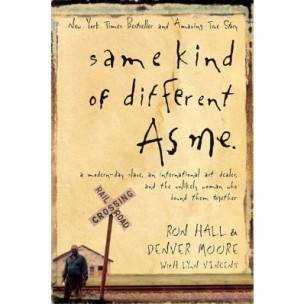
Same Kind of Different as Me, by Ron Hall and Denver Moore with Lynn Vincent

0849900417.jpg.1458336228
Same Kind of Different as Me, by Ron Hall and Denver Moore, with Lynn Vincent

Ron Hall and Denver Moore with Lynn Vincent couldn’t have been less alike. Ron was a wealthy white art dealer. Denver was a homeless black man. At Ron’s wife’s insistence, he accompanied Debbie to serve a meal at the homeless shelter. Debbie kept trying to “break the ice” with Denver, to no avail. He wondered why this white woman was harassing him. Debbie told Ron that he had to make friends with Denver. It was a slow process, but Ron and Debbie finally broke through and Denver became a close friend.

This book will teach you some things you probably don’t know about being homeless unless you’ve been in that situation. Based on a true story, it will break your heart and make you cheer. It was the September book choice for Rocky River Readers Book Club.

Until my next blog post

I hope you have a good book to read. I’ve started off October with Love and Other Consolation Prizes, by Jamie Ford. If you’re a writer, I hope you have productive writing time.

Janet

A Thriller, Hatteras in WWI, and Appalachian Memories

I had more to say about the six books I read in August than reasonably fit into last week’s blog post, so today’s post is about the three I didn’t get to last week. I’m a bit put off by long blog posts, and I doubt I’m alone in that. Without further ado, I offer my thoughts about the other books I read in August.

Here and Gone, by Haylen Beck

9780451499578
Here and Gone, by Haylen Beck

If books have a demeanor, Running on Red Dog Road and Other Perils of an Appalachian Childhood, by Drema Hall Berkheimer is at one end of that spectrum, in many ways Here and Gone, by Haylen Beck is at the other end of that spectrum. While Ms. Berkheimer’s book was a relaxing read, Mr. Beck’s thriller grabbed me by the throat immediately and never let me relax.

I thought I’d done well to read Ms. Berkheimer’s memoir in three days, but I read Here and Gone in 48 hours.

Wow! What a book! I made the mistake of starting to read the book late one night. I read until my vision blurred to the point that I could literally read no more without getting some sleep.

Audra Kinney fled New York with her young son and daughter to avoid her children being taken away by Children’s Services. Her husband had tried to prove she was an unfit mother.

The book begins in Arizona where Audra thought things couldn’t get any worse when the Elder County Sheriff pulled her over and discovered a bag of marijuana in the trunk of her car. Audra and the reader could not imagine all that would transpire over the next four days. What a thriller!

By the way, I thought I had picked up a debut novel by Haylen Beck, but it turns out that is the pen name of Stuart Neville! You may recall that I wrote about one of Mr. Neville’s Northern Ireland thrillers, The Ghosts of Belfast in my January 3, 2017 blog post (What I read in December.)

According to the author bio on the back inside flap of the book jacket, Haylen Beck’s books are set in the United States whereas Stuart Neville’s books are set in Northern Ireland. That tells me there will be more Haylen Beck books in the future. I can’t wait!

Hatteras Light by Philip Gerard

w204
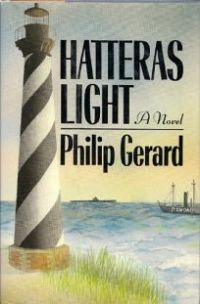
Hatteras Light: A Novel, by Philip Gerard

Hatteras Light, by Philip Gerard, took me to the beautiful Hatteras Lighthouse on the Outer Banks of North Carolina during the tense days of World War I when German U-boats and submarines trolled the Atlantic coast of the United States. This book was the August selection for the Rocky River Readers Book Club.

Hatteras Light follows the lives of the few residents of Hatteras Island in the early 1910s, particularly the people associated with the maintenance of the Hatteras Lighthouse and their efforts to rescue people in peril on the sea.

This was hard and lonely work. It took a special kind of person to acclimate to the demands of the job. The waters off Cape Hatteras are known worldwide as “the graveyard of the Atlantic” because the treacherous clashing of the cold waters of the Atlantic Ocean and the warm Gulf Stream (from the Gulf of Mexico) cause constantly changing conditions that have resulted in the sinking of hundreds of ships.

The Germans had already torpedoed an oil tanker, the resulting blaze literally getting the attention of everyone on Hatteras Island. The US Navy was too busy protecting the more densely populated Mid-Atlantic coast to come to the aid of the keepers of the Hatteras Lighthouse who did double duty of going out to sea to try to rescue anyone in peril.

Tensions were coming to a head at a community meeting when Ham Fetterman said the following:

“ ‘ I have lived longer than ever I hoped or wanted,’ Fetterman said. ‘I have seen Yankees and pirates and bootleggers and a good deal worse. And now I’ve seen this, too. And I tell you:  this is different. This murderous lurking Teutonic bastard is hunting by the Light – our Light! He navigates by it, he ambushes by it, he kills by it…. With that Light, he is damn near invincible.’ ”

Fetterman was a true Hatterasman, meaning he was born and had lived on Hatteras Island all his life. He was someone others listened to because of his age and his experience as a Hatteras Islander.

Someone else in the meeting spoke up and suggested they rig up a false light like had been done at Nags Head years before. Then, Fetterman said their only choice was to turn off the Hatteras Lighthouse Light.

Did they? I suggest you read Hatteras Light, by Philip Gerard, to find out.

Running on Red Dog Road and Other Perils of an Appalachian Childhood, by Drema Hall Berkheimer

9780310344964.jpg.1442560708
Running on Red Dog Road, by Drema Hall Berkheimer

I need to start jotting down where or how I hear about a book I want to read. I can’t recall how I learned about this one, but I’m glad I did. I found it at the public library and devoured it in three days. It is just 200 pages, but I’m a slow reader. Any time I read a book in three days, take it as a compliment.

The author grew up in West Virginia and writes humorously but lovingly and respectfully about her childhood there in the 1940s. Although I grew up in the piedmont (not the mountains) of North Carolina in the 1950s, I could identify with many of the things she wrote.

I never had a grandmother, though, and Ms. Berkheimer writes a lot about the grandmother who pretty much raised her while her mother was off in New York helping to build airplanes for the World War II effort.

Ms. Berkheimer and I grew up in a simpler time than the one we’re living in now. Home-canned produce from the garden, lightning bugs, playing Red Rover, church being the center of one’s social life, and many old sayings used in the book – all these rang true with me and brought to mind fond memories of my childhood.

I loved her memory of church fans:

“Paper fans always stood ready in the wooden rack on the back of each pew, along with the hymnals. Each fan was the size of a small paper plate and had a flat stick attached as a handle. Sometimes you got a fan with a picture of Jesus on one side and Scripture verses on the other, while another time your fan might advertise a bank or a furniture store.” ~ Drema Hall Berkheimer

The church where I grew up always had those same fans, but the back side advertised one of the two funeral homes in the county. Hence, they were always referred to as “funeral home fans” at Rocky River Presbyterian.

If you’re looking for a book that harkens back to rural and small town American life a few decades ago, this is the book for you.

Until my next blog post

I hope you have a good book to read. If you’re a writer, I hope you have quality writing time.

Janet

Holocaust Survivors and Osage Murders

August brought with it a host of good reading. The problem is, when I’m distracted by lots of good books to read, I don’t spend as much time as I should spend writing. The two go hand-in-hand. I’ve read from many sources that you can’t be a good writer if you don’t read a lot. Of course, you can’t be a good writer if you don’t spend time writing. Maybe this month I’ll strike a good balance.


Among the Living, by Jonathan Rabb

Rabb_AmongtheLiving_final-255x390
Among the Living, by Jonathan Rabb

Among the Living is a novel about a 31-year-old Jewish man, Yitzhak Goldah, who survived The Holocaust and came to live with his cousin, Abe Jesler and Jesler’s wife, Pearl, in Savannah, Georgia in 1947.

The tone of the book is set early on as the author reveals Mr. Goldah’s sense of humor and ability to take life in stride. For instance, on the way home from the train station, Goldah’s cousin and his wife inform him that they are changing his name to “Ike.” Yitzhak doesn’t like the idea, but he accepts this in an effort to not cause a rift with these generous cousins.

It quickly become obvious that Pearl Jesler is going to treat “Ike” like he’s a child. As if that’s not enough, she smothers him with kindness. And she talks all the time – many times saying the wrong thing.

This is by no means a humorous book, but there are constant undertones of “Ike” knowing exactly what the Jeslers are doing but choosing not to confront them about his treatment.

Abe Jesler is in the retail shoe business and is well-connected in Jewish circles in Savannah. Much to Pearl’s chagrin, though, they are not in the uppermost crust of Jewish society. The book does a good job of depicting the social and business lives of Jews in post-World War II Savannah.

There is intrigue as Abe gets involves in some shady business dealings at Savannah’s port. Ike’s profession before the war was that of a journalist, so he gets acquainted with the local newspaper editor and starts writing for the paper. This had the two-fold benefit getting Ike into the profession he loved and out of Abe’s retail shoe business.

Ike also became involved with the newspaper editor’s daughter, which lends a bit of romance to the book. When Ike’s pre-war thought-to-be-dead fiancée suddenly appears in Savannah, Ike’s life gets quite complicated.

The book also addresses the feelings of guilt held by American Jews because they weren’t directly faced with the horrors of The Holocaust and the guilty experienced by the survivors of the concentration camps because they survived.

After reading an article by Jonathan Rabb, “Trigger Warnings in Historical Fiction,” (http://www.readitforward.com/authors/trigger-warnings/) I sought out his latest book, Among the Living. I’ll definitely read some of his other books.

One of my takeaways from Mr. Rabb’s online article about history and writing about history is the following:

“But history is offensive. The past is filled with oppression and murder, rape and slavery, torture and madness, often celebrating each within its own context. And, as painful as it might be, there is something valuable to be learned when we confront who we have been, and who we continue to be. We cannot be so arrogant or naïve as to think that we have somehow stepped beyond our baser instincts or that by avoiding them we prove they no longer exist.” ~ Jonathan Rabb


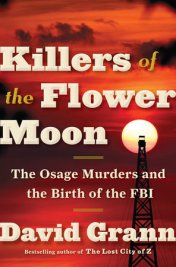
Killers of the Flower Moon:  The Osage Murders and the Birth of the FBI, by David Grann

9780385534246
Killers of the Flower Moon: The Osage Murders and the Birth of the FBI, by David Grann

This nonfiction book was a real eye opener for me. I knew that Native Americans have always gotten the short end of the stick from the US Government, but I knew nothing about the history of the Osage Tribe in Oklahoma until I saw the author, David Grann, interviewed about his book on TV. The story was fascinating, so I immediately got on the waitlist for the book at the library.

In a nutshell, this book is the story of how the lives of the Osage were turned upside down in the early 1900s when oil was discovered on their land. They had wisely purchased land and acquired all mineral rights. Unfortunately, their wise decisions became their undoing when they became wealthy. The government deemed them incapable of handling their own finances and assigned each headright holder a white guardian to oversee their spending even for the most mundane personal hygiene items.

This had trouble written all over it from the beginning. Unscrupulous guardians not only stole their ward’s wealth, but in many cases killed them or had them murdered. Most local government authorities in Osage County were either complicit in these murders or turned a blind eye to them. Two local physicians were even involved in the poisoning of some of the Osage. Cause of death records were falsified, and most of the deaths were not investigated.

This is a sordid tale of a horrible and little-known chapter in American history. Integral to the story is the fact that the US Bureau of Indian Affairs investigations arm came in to try to get to the bottom of the matter. It became such a big deal that the Bureau of Investigation grew in stature to become the Federal Bureau of Investigation.

Killers of the Flower Moon:  The Osage Murders and the Birth of the FBI is incredibly well researched and is written in such a flowing way that it reads more like a novel than a history book. In case you haven’t guessed it already, I highly recommend this book.


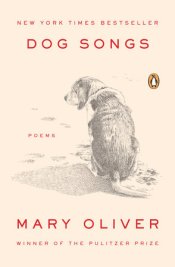
Dog Songs:  Poems, by Mary Oliver

9780143125839
Dog Songs: Poems, by Mary Oliver

My sister found this book at the public library and recommended it to me. If you’re a dog lover, like I am, you need to look for this little book. It’s a quick read but chock-full of delightful poems and memories of dogs and how they bless our lives.

What’s next?

I will blog about the other three books I read in August in next week’s post. No one wants to read in one sitting thousands of words about the books I read, so check out my blog next Monday to find out what else I read in August.

Until my next blog post

I hope you have a good book to read. I’ve just finished reading State of Wonder, by Ann Patchett, and I’ve started If the Creek Don’t Rise, by Leah Weiss.

If you’re a writer, I hope you have productive writing time.

Janet

Late July Reading

Another month has whizzed by and left me getting ever more behind in reading all the books I want to read, but July was another rewarding month of reading for me. I hope you’ll enjoy reading “my take” on the three books I read the last couple of weeks of July. On July 17 (Reading South Africa and South Carolina Novels) I blogged about the two books I read earlier in the month.

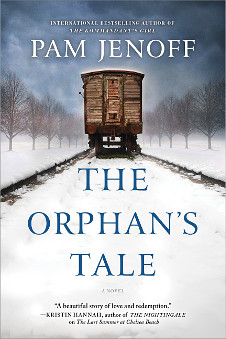
The Orphan’s Tale, by Pam Jenoff

I kept reading about The Orphan’s Tale, by Pam Jenoff and decided I wanted to read it. It was the first book I’d read by Ms. Jenoff, who has a fascinating background in government work. I look forward to reading her other books.

OTLarge
         The Orphan’s Tale,           by Pam Jenoff

The Orphan’s Tale revolves around a toddler who is rescued from the Nazis by a young woman who is no longer welcome in her parents’ home. She ends up being taken in by a circus and assigned to the trapeze, although she knows nothing about being an aerialist.

The woman assigned to train her resents her. Throughout this book of numerous twists and turns, the two women resent each other, support each other, and risk their lives for each other. It is a tale of humanity, forgiveness, trust, friendship, love, and loss set in Germany and France during World War II.

Bird-by-Bird:  Some Instructions on Writing and Life, by Anne Lamott

12543
Bird-by-Bird: Some Instructions on Writing and Life, by Anne Lamott

As someone learning the art and craft of writing, I enjoyed Bird-by-Bird, by Anne Lamott. In the book’s introduction she writes about learning to love books as a child. The following quote comes from the introduction:

“The act of writing turns out to be its own reward.” ~ Anne Lamott

I set out to write about the many things I liked about this book and the beautiful way Ms. Lamott writes about the many things a novelist needs to pay attention to in the writing process. It soon became obvious that today’s blog post would be longer than anyone wanted to read if I did that. Therefore, I will write about Bird-by-Bird in my August 14, 2017 blog post.

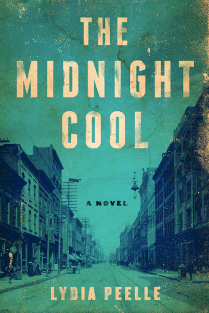
The Midnight Cool, by Lydia Peelle

I read this book because it was set in Tennessee during World War I. I haven’t read many novels set in that era and I wanted to learn more about it. I’m participating in the Read America Book Challenge from the Mint Hill Branch of the Public Library of Charlotte and Mecklenburg County. The object of that challenge is to read novels set in as many different US states as possible in 2017. Thirteen down and 37 to go. Seven months down and five to go. Hmmm. Not good.

static1.squarespace.com
      The Midnight Cool,         by Lydia Peelle

I was conflicted as I finished reading The Midnight Cool. Lydia Peelle has a way with words, but I found the book hard to follow since the dialogue was not enclosed within quotation marks. It was tedious to have to go back a couple of paragraphs at times in order to discern who was speaking.

I was interested in the subject matter, but the middle of the book did not hold my attention. I enjoyed the last 50 or so pages of the book, so I’m glad I didn’t give up on it. For all the hype of the book to be about mules for World War I and a killer horse, I found it to be more about the two men who traded in mules and the women they loved.

The book gave me some things to think about that I really hadn’t considered before, such as the massive number of mules the United States transported across the Atlantic in ships to pull artillery and do other hard labor in the Allies’ war effort in Europe.

I learned that horses have to be trained, but mules more readily reason things out. (Don’t hate me, horse lovers!) According to the book, the only thing the mules had to be trained in was being fitted with gas masks. Gas masks for mules was another thing that had never crossed my mind. This goes to show that you can learn things from reading well-researched historical novels.

The website, http://www.mountvernon.org/george-washington/farming/animals/father-of-the-american-mule/, confirms that George Washington was the “Father of the American Mule.” The site explains that there were advantages that mules had over horses in the Allies’ efforts in World War I in addition to their not needing much training. Mules eat one-third less than horses, they don’t need to drink as much water as horses, and mules are more surefooted than horses.

If Lydia Peelle writes another novel, I will check it out because she has a gift for turning a phrase and I believe she does her research.

Until my next blog post

I hope you have a good book to read. I’m reading Killers of the Flower Moon:  The Osage Murders and the Birth of the FBI by David Grann.

If you’re a writer, I hope you have productive writing time. I also recommend that you read Bird-by-Bird: Some Instructions on Writing and Life, by Anne Lamott.

Janet

Reading South Africa and South Carolina Novels

Since I had a lot to say about both of the novels I’ve finished reading so far in July, I decided not to wait until my August 7 blog post to tell you about them. One was set in South Africa during the Second Boer War. The other was set on an island in South Carolina in beginning in 2004. Quite a contrast in location and time!

The Lost History of Stars, by Dave Boling

Boling_History_FLAT_rgb_HR-210
The History of Stars, by Dave Boling

One of the categories I chose for my 2017 Reading Challenge was to be sure to read a book that takes place on each of the seven continents. Without that being part of my personal challenge, chances are I would not have read The Lost History of Stars, by Dave Boling.

I’m amused at people who brag that they only read nonfiction. They think there is nothing to be learned from fiction. I used to fall into that category. I was a nonfiction snob, so my sister couldn’t believe it when I told her in 2001 that I was taking a fiction writing course.

I minored in history in college, but what little I learned about the Second Boer War has long since been forgotten. The Lost History of Stars is a novel about that 1899-1902 war in South Africa. It follows an Afrikaner family throughout the war. It is not a history of that war, and I admit that I still know few details of it; however, from reading this book I learned that the British burned the homes and farms of many Afrikaners and rounded up the women and children and put them in concentration camps. Disease and malnutrition were rampant in those camps.

From the inside flap of the book’s cover, I learned that “some 3,500 Afrikaner farmer-soldiers lost their lives. However, in the concentration camps, hastily assembled by the British forces to limit resistance among the general populace, the human toll was much higher:  it was there, while their husbands and fathers were away fighting, that more than 26,000 women and children died.” Take time to reread this paragraph and let the injustice set in.

It is interesting to me that the author, Dave Boling, was inspired to write this novel after learning that one of his grandfathers was a British soldier in South Africa during the Second Boer War. That must be the reason he wrote about a camp guard who did not wish to be there, finding it distasteful to be guarding women and children in a concentration camp.

The book is written with chapters alternating between the farm and the concentration camp. Some chapters took place in the concentration camp, and then the next chapter took place a year earlier on the farm. I would have preferred the book being written in chronological order, but that’s just my personal preference.

This is a story of family loyalty and the sheer strength of will to survive.


Grief Cottage, by Gail Godwin

9781632867049
Grief Cottage, by Gail Godwin

Author Wiley Cash recommended the writings of Gail Godwin. She has had two novels published – Flora and Grief Cottage. I decided to read Grief Cottage first. It’s her new book.

Grief Cottage is set on an island in South Carolina in 2004 and partially in North Carolina in 2018. Eleven-year-old Marcus is an orphan who has been sent to South Carolina to live with his Aunt Charlotte. Charlotte is an artist and is used to living alone.

Marcus takes on the project of finding out the names of the couple and son who were lost when Hurricane Hazel hit 50 years ago in 1954. They were vacationing on the island and staying in what later became known as Grief Cottage when Hurricane Hazel hit. I thought the climax of the book would be when Marcus learned the names of those three people, but that happened less than halfway through the book.

Maybe it was just me, but I thought the story dragged in places and some information was repeated two or three times. That aside, I did enjoy the book.

Marcus’s mother had given him a picture of his father and promised to tell him his father’s name when he got older. She was killed in an automobile accident before that happened. It wasn’t until the last page of the epilogue (set in 2018) that Marcus learns the name of his father.

There are subplots that include such things as loggerhead turtle eggs and hatchlings, Charlotte’s paintings, alcoholism, and bullying. The plot takes a huge turn in the second half that I didn’t see coming. In case you haven’t read the book, I won’t say more.

I’ll probably read Gail Godwin’s other novel, Flora, after I check off a few more items on my 2017 Reading Challenge.

Until my next blog post

If you’re a writer, I hope you have quality writing time.

I hope each of you has a good book to read. I’m reading The Girl on the Train, by Paula Hawkins for Rocky River Readers Book Club this month; The Midnight Cool, by Lydia Peelle; The Orphan’s Tale, by Pam Jenoff; and Bird  by Bird:  On Writing and Life, by Anne Lamont. (This is what happens when all the books you’ve been on the waitlist for at the public library come in at the same time!)

Excuse me while I get back to my reading.

Janet

You Must Read (Some of) These Books!

First, I wish all my fellow Americans a Happy Independence Day or Happy 4th of July tomorrow!

ben-white-197668(1)

Photo by Ben White on Unsplash

I read some good books in June, so I will share my thoughts about them in today’s blog post. You might want to read one or more of them.

The Stars Are Fire, by Anita Shreve

I was drawn to this novel by the title. I got on the waitlist for it at the library as soon as it was on order. The book was inspired by the wildfires in Maine in October, 1947. I didn’t know about those fires, so I learned something.

The book is suspenseful as it follows Grace, a young mother whose husband has gone to fight the fire. Suddenly, the fire is upon the small coastal town where they live and Grace is forced to run for her life with a child in tow. I don’t want to spoil the book, in case you haven’t read it. If you prefer to read “happy books,” this is not the book for you. Much of the story is dark, yet the reader can’t help but cheer for Grace as she overcomes tragedy. It was a page-turner for me.

The Things We Keep, by Sally Hepworth

As with The Stars Are Fire, by Anita Shreve, The Things We Keep, by Sally Hepworth, is not what I would call a “happy book.” Ms. Hepworth follows a 38-year-old woman, Anna, who is diagnosed with Alzheimer’s Disease. The book chronicles Anna journey from diagnosis, through the months that she is very much aware of her diagnosis and the mental and physical deterioration that will be her future. Anna accepts her illness with humor as she adjusts to living in a residential facility where most of the other residents are decades older than she. The other young resident, Luke, befriends Anna, and the main plot of the book is their friendship, which grows into romantic love and how their relatives and the facility’s staff deal with that.

A subplot is about the widow of a businessman who loses everything and has to create a new life for herself and her young daughter. She takes a job at the facility where Anna and Luke live and gets more involved in their lives than the administrator wishes.

Although the subject matter of dementia is a frightening diagnosis, I found the book to be almost delightful due to Ms. Hepworth’s writing style. Each chapter was written from a different character’s point-of-view, which allows the reader to get into the head of Anna and to get a better understanding of what a person in the early stages of Alzheimer’s Disease thinks – their feelings and emotions.

As someone with Chronic Fatigue Syndrome/Myalgic Encephalomyelitis (CFS/ME), I could identify with some of the issues Anna faced. I have memory problems and, when put on the spot, I have trouble formulating a comment or an answer to an unexpected question. When Anna talked about not being able to think fast enough to join in a conversation, I immediately identified with that. Ms. Hepworth let Anna articulate so well how it feels when by the time you formulate a comment, the conversation has moved on to something else. That was a paragraph that made my mouth drop open because I felt like the book was describing me. It was eerie to realize that some of my CFS/ME symptoms overlap some early Alzheimer’s Disease symptoms.

The Things We Keep, by Sally Hepworth, was June’s selection for Rocky River Readers Book Club. We had a good discussion about the book on June 26.

The Sound of a Wild Snail Eating, by Elisabeth Tova Bailey

By the time I remembered to check this out from the public library, I’d forgotten how I’d heard about the book or why I wanted to read it. It had a catchy title, so I dived in. Lo and behold, the author, among other ailments, has Chronic Fatigue Syndrome.

This is a unique book. It probably wouldn’t appeal to everyone, but I enjoyed it. It is the true story of the author’s months of being bedridden. One of her friends comes to visit one day and brings wild violets and a snail. The snail started out living in a flowerpot with the violets. Much to Ms. Bailey’s surprise, she developed quite an attachment to the snail.

She realized one day that she could hear the snail eating. One thing led to another, and the author was soon reading everything she could get her hands on about snails. She studied the habits of the snail and by so doing, along with her readings, learned a great deal about the species. In the course of reading the book, so did I! I had no idea there was so much to learn about snails.

Being a “country girl” for most of my life since birth, I have encountered many snails, but until reading this book I did not know that they have row-upon-row of teeth, their eyes are on the tips of their tentacles, they cannot hear, they have an acute sense of smell, and their one foot is called a gastropod. That’s just the tip of the iceberg so, if you’d like to know more about snails – and what it’s like to be bedridden with Chronic Fatigue Syndrome, I recommend The Sound of a Wild Snail Eating, by Elisabeth Tova Bailey.

Although I’ve been ill for 30 years, Ms. Bailey was able to articulate some of my feelings better than I have ever been able to in writing or verbally.

Camino Island, by John Grisham

John Grisham’s latest novel, Camino Island, is a little different from most of his novels. There’s still suspense and there are still bad guys, but the hero isn’t a lawyer this time. The story is about the underworld of those who deal in buying, selling – and sometimes stealing – rare books. The book takes place in New Jersey, Pennsylvania, North Carolina, Florida, and France. The book held my interest, as all John Grisham books do. If John Grisham’s legal thrillers aren’t your “cup of tea,” you might want to give Camino Island a try. I think anyone interested in books will enjoy it.

And Every Morning the Way Home Gets Longer and Longer: A Novella, by Fredrik Backman

After liking A Man Called Ove, by Fredrik Backman in May, I was eager to read another of his books. In June I read And Every Morning the Way Home Gets Longer and Longer: A Novella, by him. It is about a man with dementia, his son, and his grandson and how the man’s dementia affects his relationships with his son and grandson.

Perhaps it was just me, but I had some confusion keeping up with when we were in real life and when we were in the thoughts inside the man’s brain. For that reason, I had trouble getting into the book. The longer I read, though, the more I got out of it.

Detective Cross (a BookShot), by James Patterson

I wrote about a BookShot by James Patterson, Detective Cross, in my June 16, 2017 blog post, “What’s the Verdict on BookShots?” (What’s the Verdict on BookShots?) I read it out of curiosity. I wanted to know what a BookShot was like, and I’m one of the last people in the world to read a book by James Patterson. His books are known for their fast pace, and this BookShot was no different.

Mr. Patterson’s BookShots are designed to be read in one sitting. It took me longer than that because, as I’ve mentioned before, I am a slow reader. I guess you could say that a BookShot is longer than a short story and shorter than a novella, but don’t quote me on that. I’m no expert.

As I pointed out in my June 16 blog post, Mr. Patterson has long been a champion of children’s literacy, and his BookShots are an attempt to put short books in the hands of adults who might not otherwise pick up a book to read. I hope they accomplish that!

Put the Cat in the Oven Before You Describe the Kitchen:  A Concise No-Bull Guide to Writing Fiction, by Jake Vander Ark

I must admit that I was drawn to this book by its title. I would never put a cat in an oven, but I just had to see what the author had to say about writing fiction. It was a humorous book, and it held my attention. The jest of it was that you need to get your reader’s attention before you start giving a lot of description.

Among other points, the author said if a minor character doesn’t have an effect on the main character, take them out of the story. I’m trying to keep that in mind as I rewrite the manuscript for The Spanish Coin. Another thing he said was, “You need to scare your protagonist and shock your audience.”

He also said that a writer should let the “protagonist determine the placement of the #$%! Moment.” (This is usually called the “inciting incident.”) He suggests to hit the reader with the inciting incident the moment the reader grasps what “normal” is for the protagonist. I picked up a few other tips from the book, but I don’t want to bore non-writers with the details. If you’re a beginning writer, you might look for this e-book yourself.

Until my next blog post

I hope you have a good book to read. If you’re a writer, I hope you have productive writing time.

Janet

You Need to Read These Books!

I had another good month of reading in May. I’m on a roll for 2017! If I were a faster reader, I could devour more books. In the meantime, though, I’ll enjoy as many as I can.

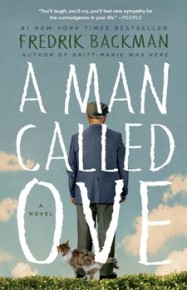
A Man Called Ove, by Fredrik Backman

I’m running out of superlatives for the books I’ve read this year. I kept hearing about A Man Called Ove, by Fredrik Backman, so I got on the waitlist for it at the public library. It’s a popular book, so it took a while for my name to gravitate to the top of the list.

a-man-called-ove-9781476738024_lg

I thoroughly enjoyed this book. At times outrageously funny and at times heartwarming and touching, it held my interest from start to finish. Ove is a 59-year-old man. I could see my father, my brother, and even myself in him. I could see myself in his late wife when he recalled how it drove him up the wall because she delighted in planning the details of a trip to the extreme. That’s me! Thank goodness I have a sense of humor! Poor Ove is at odds with the world and having trouble keeping up with the modern world. For the most part, he’s not even trying to keep up.

The author, Fredrik Backman, is from Sweden, where his books have gained much acclaim. I am amazed at how well the humor in this book translated so well from Swedish into English. Although I don’t speak or read Swedish, I don’t believe the book lost anything in the translation. I look forward to reading Mr. Backman’s other books.

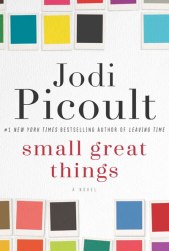
Small Great Things, by Jodi Picoult

Maybe it’s because Mother’s Day was approaching when I was reading this book, or maybe the sentence would have struck me like a ton of bricks any time of the year. Ms. Picoult has an uncommon gift when it comes to writing. Her books tackle some of the most heart-wrenching issues of our day, and she has a wonderful way with words.

small-great-things-hc-400w

I featured the following sentence in my Being the Balloon blog post on May 5, 2017:

“What it’s like to be the balloon, when someone lets go of the string.”   – from Small Great Things, by Jodi Picoult

The context of that sentence is that Ruth, the protagonist who is a seasoned labor and delivery nurse, a mother, and the widow of an American soldier killed in Afghanistan, reacts to the death of her mother with, “What it’s like to be the balloon, when someone lets go of the string.”

I highly recommend Small Great Things. In it, Ms. Picoult takes on the issue of race in America, and she has an uncanny talent for getting inside the skin of individuals from one end of that spectrum to the other in Small Great Things. The line that I focused on from the book in my blog on May 5 speaks to the humanity of us all.

In a nutshell, Small Great Things is about an African-American nurse in Connecticut who is barred from caring for the newborn infant of a white supremacist couple. Author Jodi Picoult masterfully writes from the point-of-view of the nurse, the white-supremacist father, and the white lawyer who defends the nurse. There is an explosive trial during which all kinds of raw emotions erupt. I think we all can learn some life lessons by reading and pondering Small Great Things, by Jodi Picoult!

The Hidden Life of Trees, by Peter Wohlleben

I kept hearing good things about this book, which had been translated into English from its original German. I finally got it from the public library, but with too many other books to read and a lot I was trying to learn about the craft or writing. Therefore, I only got 40% of the book read before I had to return it to the library for the next person on the wait list. I will definitely check it out again so I can finish it.

index

The Hidden Life of Trees:  How They Feel, How They Communicate – Discoveries from a Secret World might not appeal to everyone, but I thought it was very interesting. That might be because I grew up and again live out in the country. My parents instilled an appreciation and respect for trees in us. We have a variety of trees in our yard – dogwood, pine, ash, poplar, cedar, several varieties of oak, mulberry, sycamore, black walnut, sweet gum, holly, persimmon, and maple.

I thought I knew a lot about trees until I started reading Peter Wohlleben’s book. I now know that there’s a whole world out there I can’t see or hear. The book explains how certain tree species work together and how other tree species work against one another. It talks about how trees pump water out of the ground. It talks a lot about fungi and how fungal networks underground help trees in numerous ways. It really is quite fascinating!

The Nightingale, by Kristin Hannah

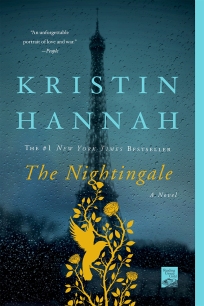
I highly recommend The Nightingale, by Kristin Hannah. It is a historical novel about two sisters in France during the German occupation in World War II. The sisters cope with the occupation and resulting cruelties of war very differently.

Nightingale-PB-658

One sister joins the French Resistance and risks her life helping shot down Allied airmen across the Pyrennes and into Spain. The other sister’s nerves and wits are pushed to the limits as two German officers are billeted in her home. The book was inspired by a 19-year-old Belgian woman, Andrée De Jongh, who created an escape route out of Nazi-occupied France.

This book will pull on all your emotions. When the characters are cold and hungry – which was most of the time – you will feel cold and hungry, although I’m certain that I truly can’t imagine the level of hunger or fear the people who lived through the ordeal actually endured.

When we study World War II or hear stories about it, the emphasis is almost always on the battles. The Nightingale gives a paints a picture of life on the home front in France. It was this month’s book for discussion by Rocky River Readers Book Club. Everyone at our meeting had only praise for the book – how much it taught us and how well-written it was.

Homegoing, by Yaa Gyasi

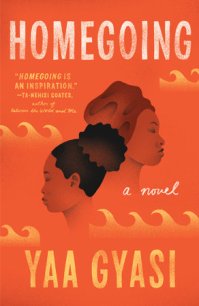
This historical novel is Yaa Gyasi’s debut as a fiction writer. It is different from any novel I’ve ever read. It is set in Africa. As part of my 2017 Reading Challenge I wanted to read a book set on each of the continents this year, so I was drawn to this novel. Unfortunately, I couldn’t finish reading it before it was due at the public library.

9781101971062

Each chapter is about a different member of this family. It is about family ties and the horrible conditions in the slave trade. It puts a human face on slavery – a subject we tend to think of in terms of numbers and not the families that were torn apart in Africa. If I get a chance, I’d like to check this book out again.

The Tea Girl of Hummingbird Lane, by Lisa See

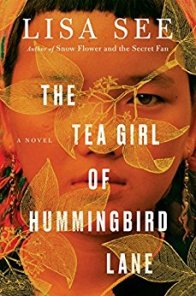
Like Homegoing and The Hidden Life of Trees, I didn’t get to finish reading The Tea Girl of Hummingbird Lane before it had to be returned to the library. I couldn’t renew any of the three books because there were people on the wait list. The part of The Tea Girl of Hummingbird Lane that I got read was fascinating in how it shed light on some of the superstitions held by the Chinese. I had no idea!

51nbXr3ZbXL._SY346_

The novel follows a young Chinese girl who is painfully aware from birth that she is not valued because she is female. Her family has to walk for hours to pick tea leaves for a meager amount of income. It is a difficult life. Her mother is the local midwife and she tells her daughter that she must follow in her footsteps in that occupation.

There is a ray of hope, though, because the girl’s teacher tells her that she can leave the harsh mountain environment and make something of herself. I look forward to checking the book out again in order to see how her life turns out!

Until my next blog post

I hope you have a good book to read. I have come to the conclusion this week that I am trying to read too many books and not spending enough time on my writing. My goal in June is to strike a happy medium.

If you’re a writer, I hope you have productive writing time. I’m writing bios of my characters in the “new and improved” The Spanish Coin.

Janet

What I Read in April

The Heavens May Fall

I had missed knowing that Allen Eskens’ third book, The Heavens May Fall, was released in October. When I found out about it, I immediately got on the wait list for it at the public library. Mr. Eskens writes legal thrillers. This one did not disappoint, as it kept me guessing who the killer was.

Last week I learned that Mr. Eskens’ fourth book, The Deep Dark Descending, will be released on October 3, 2017. It continues the story of homicide detective Max Rupert. I look forward to it!

Where I Lost Her

T. Greenwood was a new author for me. I read her 2016 novel, Where I Lost Her. It is about a woman, Tess, and her husband from New York who go to rural Vermont to visit friends. One night, while driving alone, Tess sees a little girl standing in the road. She stops to help, but the girl runs away into the woods.

When a search turned up nothing and there are no reports of a missing child, local officials begin to doubt Tess. Added to the lack of evidence is the fact that Tess and her husband have gone through unsuccessful fertility treatments and Tess is desperate to have a child. Locals label her a trouble maker from outside.

Tess knows what she saw, though, and she continues to search for the little girl even though that search puts her in incredible physical danger. I’ll probably read other books written by Ms. Greenwood.

The Mother’s Promise

Sally Hepworth was another new author for me in April. I read her 2017-released novel, The Mother’s Promise. The book follows a single mother, Alice, and her teenage daughter, Zoe, who has no social graces or self-confidence. Alice has promised to always be there for Zoe, but a diagnosis of ovarian cancer tears their world apart.

As Alice’s illness progresses, Zoe gradually gains confidence and begins to take a more active part in her classes. A cast of minor characters move this story through some surprising twists and turns. I found myself really caring about Alice and Zoe.

In Order to Live:  A North Korean Girl’s Journey to Freedom

In spite of my memory problems, a book that will stay with me for a long time is In Order to Live:  A North Korean Girl’s Journey to Freedom, by Yeonmi Park. Written in 2015, this nonfiction book is a memoir of a young woman who was born in and grew up in North Korea. Reading the harrowing story of Ms. Park’s childhood of hunger, governmental brainwashing, escape to China, and eventual escape to South Korea will have you turning the pages to find out what happens next.

This is a story of personal strength, the love of a family, and the will to live. Ms. Park’s story is one that is so far removed from my own experience, I had to keep reminding myself that it wasn’t fiction. I highly recommend this book to everyone, especially during this time of high tension between the United States and North Korea.

Until my next blog post

I hope you have a good book to read. If you’re a writer, I hope you have quality writing time.

Janet

R is for Reading Challenge

img086

My 2017 Reading Challenge

This is the 18th day of the A to Z Blog Challenge, so I decided to give a status report on my 2017 Reading Challenge. I have completed the following 12 of the 28 categories in my challenge, which I announced on my blog on December 27, 2016 [https://janetswritingblog.com/2016/12/27/reading-challenge-for-2017/.]

  1. A nonfiction book
  2. A novel by a North Carolina author
  3. A biography, autobiography, or memoir
  4. A book that might change my mind
  5. A book just for fun
  6. The second book in a series of which I’ve read the first book
  7. A book of short stories
  8. A book published in 2017
  9. A book about the craft of writing historical fiction
  10. A Nobel Prize winner
  11. A political thriller, and
  12. A sequel to a book I’ve read

In addition, I’ve made good progress toward completing #4 on my challenge – “Books by 12 authors I’ve never read.” I’ve read nine already.

Number 5 on my challenge is “A novel set in each of the seven continents.” I’ve read eight books set in North America and four set in Europe. I’m currently reading a novel set in Australia.

With the year almost one-third behind us, I feel like I’m on track to meet my 2017 Reading Challenge. It’s been fun, and I look forward to more good books in the coming months.

Read the USA Reading Challenge

I’m also hoping to meet the “Read the USA” reading challenge sponsored by the Mint Hill Branch of the Public Library of Charlotte and Mecklenburg County. I’ve read novels set in New Jersey, Minnesota, Oregon, and Vermont.

Friends of the Harrisburg Library Reading Challenge

I’ve completed only two of the 12 categories in Friends of the Harrisburg Library Reading Challenge.  There’s a lot of duplication between it and my own reading challenge, so I think I might meet that challenge by the end of the year, too.

Are you participating in a reading challenge this year? How are you doing? Are you enjoying your challenge or do you find it too confining?

Until my next blog post

I hope you have a good book to read. If you’re a writer, I hope you have productive writing time.

Janet