Mt. Pleasant Literary Festival – Cathy Pickens’ Writer’s Workshop

I had two delightful experiences last Thursday at the first day of the second annual Mt. Pleasant Literary Festival in Mt. Pleasant, North Carolina. The public library staff and The Friends of the Mt. Pleasant Library are real go-getters!
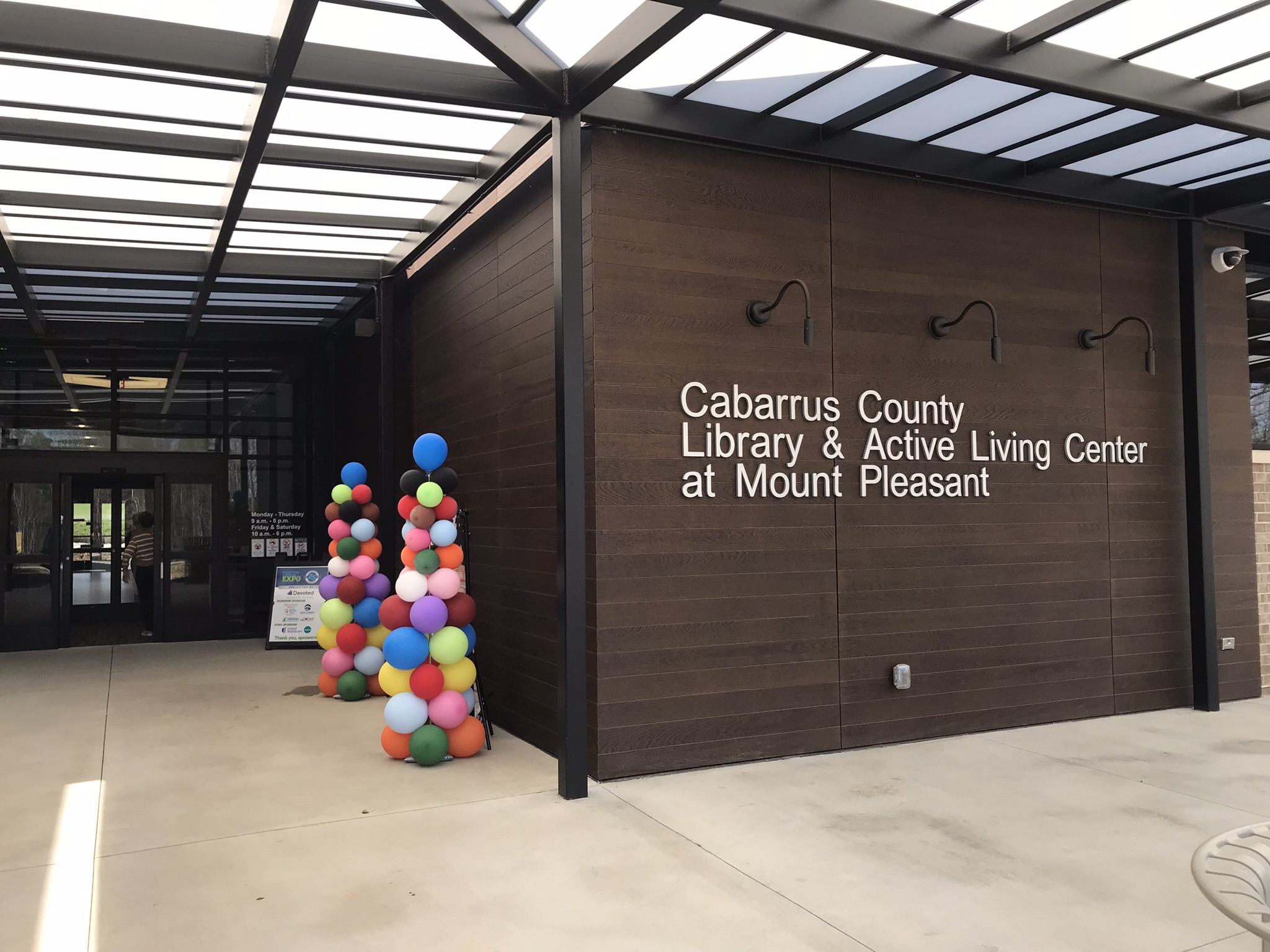
Mt. Pleasant is a quiet little town, more of a village than a town originally settled by German immigrants in the mid-1700s. It is in eastern Cabarrus County.

The Bernheim Literary Society (named for the literary society for the students of Mont Amoena Female Academy, located in Mt. Pleasant from 1859 until 1927), The Friends of the Mt. Pleasant Library, the Cabarrus Arts Council, and individual and commercial sponsors make this annual literary festival possible for the public – free of charge.
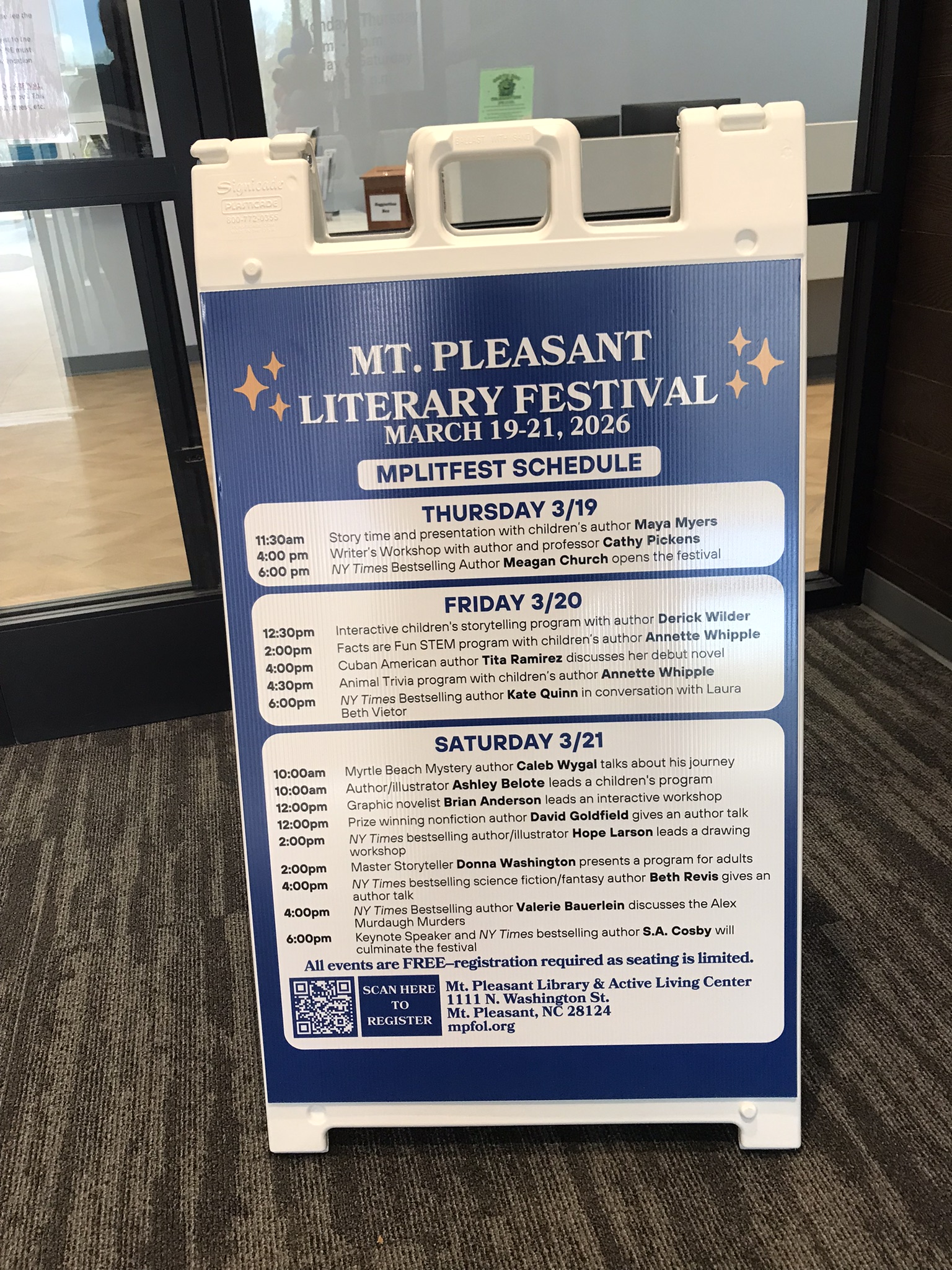
Schedule for the 3-Day event

This second annual event attracted such authors as Kate Quinn and Meagan Church! I understand some authors have already been signed on for next year’s festival. I can’t wait to find out who’s coming!

I was too late registering for Kate Quinn’s presentation. Lesson learned for future festivals!

The first event I attended on Thursday was a 90-minute Writer’s Workshop with author and professor Cathy Pickens. She has an impressive history as a lawyer, a professor, and a writer, so I was privileged to have the opportunity to finally attend one of her workshops.
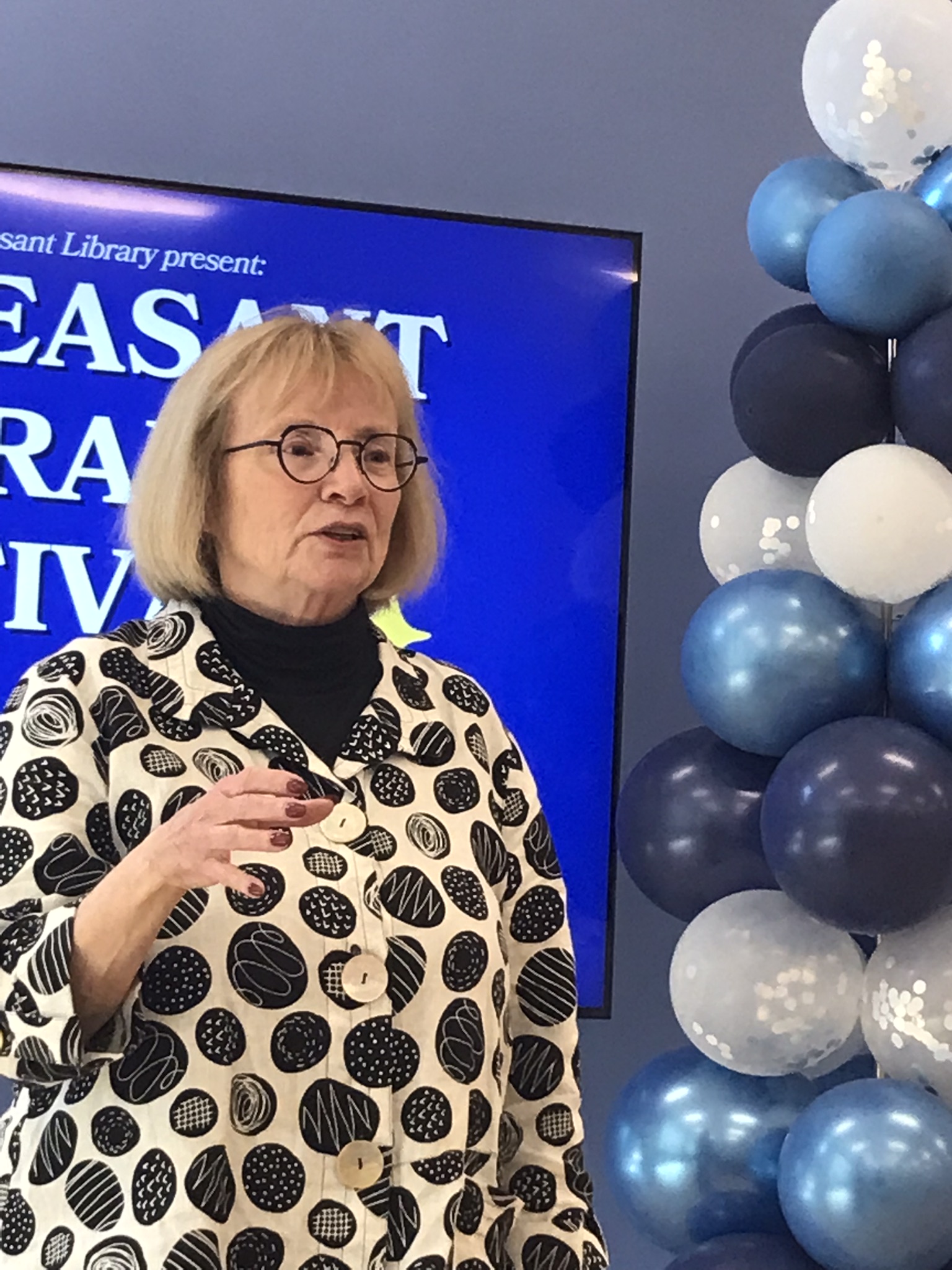
Cathy Pickens, teaching a Writer’s Workshop at the Mt. Pleasant Literary Festival, March 19, 2026

She led us through a systematic series of writing prompts to help us clarify the roots of our creativity and why we want to write what we want to write.

Workshop attendees were in various stages along our writing journeys. The first thing she had us write about was our “pinprick.” What was the pinprick that set in motion my desire to write the story I want to write? I knew immediately what the pinprick was for the series of historical novels I’m writing. It was a banjo from Africa.

(That’s all I will tell you about that banjo for now. You will need to continue to read my blog posts and subscribe to my e-newsletter if you want to find out later just how that came about. It seemingly came “out of the blue,” but maybe it is deeply connected to the historical fiction I want to write.)

Back to the workshop… I was able to quickly write an entire page about that banjo as my inspiration or “pinprick” as she called it.

Ms. Pickens talked about how it was sometime between the ages of eight and eleven that something happened that influenced the paths our lives take. Whether or not we are aware of it at the time, something happened that set us on a path to writing.  Our worldview begins to shift, and you start to try to figure out what you want to be when you grow up. She asked us to write down everything we could remember from those years of our life.

I was surprised at how many things I remember and in minute detail and how each of those incidents made me feel. As I wrote, it became clear to me that my lifelong interest in the colonial era of United States history and what unbeknownst to me put me on the path to majoring in political science and minoring in history in college started when I was in Miss Judy Ford’s fourth grade class at Harrisburg School in Harrisburg, North Carolina.

Miss Ford made Jamestown and Colonial Williamsburg come alive to us, although we lived a long way from those places and had no hopes of visiting them in the foreseeable future. I’ll never forget that Colby Cochran’s father, Dan, built a pillory for the class so we could in some small way experience what that public form of punishment and humiliation was like for our nation’s colonial ancestors.

As you can see, Ms. Pickens’ questions and writing prompts triggered a flood of memories for me and helped me piece together why in later life I want to write historical fiction.

She talked about how creative young children are, but usually when we are in our teens peer pressure kicks in and most of us begin to stifle our creativity. We’re told to pursue occupations or fields of study to lead us to a way to make a living.

Being a writer is not the occupation one should choose in order to make a living!
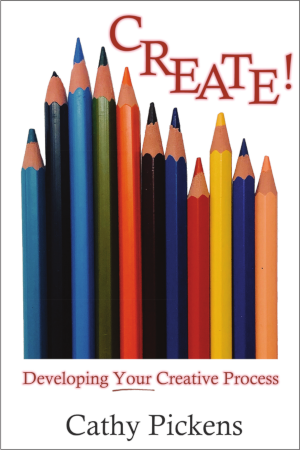
CREATE! by Cathy Pickens

Ms. Pickens talked about the writing process. Different participants in the workshop shared what their process is. She asked us what holds us back in our writing. (No one was pressured to voice their answers to any of her questions; it was a very relaxed and welcoming atmosphere.)

Ms. Pickens recommended that we set a goal to write a certain length of time or a certain number of words each day. Even if it’s only 15 minutes, slow and steady seemed to be her advice.

I recently revealed in my February 27, 2026 blog post (My new discovery: I’m a binge writer!) that I’d had the epiphany that I am a binge writer when it comes to my novel(s). I find it easy to work on a blog post or two each day, but when it comes to writing fiction I have not been able to discipline myself to write every day of the week.

Ms. Pickens advised us to be very specific in categorizing what we are writing. She pointed out that the Library of Congress categorizes books in more specific details than the Dewey Decimal System. She suggested that we look inside the front covers of books in the genre in which we write to familiarize ourselves with how the Library of Congress labels books.

She suggested that instead of asking a writer, “How long did it take you to get your book published?” a better question is, “How long did it take you to get your book publishable?”

The road to traditional publishing is typically years and years long.

Ms. Pickens ended by saying that the secret to success is discipline – time, place, and goal. To read more about Cathy Pickens, visit her website, https://cathypickens.com/. She has written a Blue Ridge Mountains series of cosy mysteries, a book of Charleston mysteries, nine true crime books, and CREATE! — a book for writers.

Tune in tomorrow for my blog post about author Meagan Church’s presentation.

Janet

The government should be afraid of its citizens, not the other way around.

Two for Tuesday — Two Books that Taught Me Something

In “Rae’s Reads and Reviews blog post on January 8, 2019 (https://educatednegra.blog/2019/01/08/two-for-tuesday-prompts/comment-page-1/#comment-1646), Rae mentioned her idea of starting a “Two for Tuesday” tag.

I thought she was launching the idea, but I found a link (https://educatednegra.blog/2018/07/19/what-is-two-for-tuesday/) to her July 17, 2018 blog post in which she talked about it. She invited other bloggers to participate, and I took the bait. She supplies the writing prompts. All I have to do is share my thoughts. How hard can that be, right?

Today is the first day of this #TwoForTuesday adventure for me. The prompt is:  Two Books that Taught Me Something.” That sounded easy until I tried to narrow it down to two books.

The first 11 books that came to mind

I made a list of books that taught me something. I thought of the following 11 books right off the bat (in no particular order):

Whose Gospel?  A Concise Guide to Progressive Protestantism, by James A. Forbes, Jr.

Still Alice, by Lisa Genova

Killers of the Flower Moon:  The Osage Murders and the Birth of the F.B.I., by David Grann

Lessons from a Sheep Dog, by Phillip Keller

Unthinkable Choice, by Sampson and Lee Ann Parker

Picking Cotton, by Jennifer Thompson-Cannino and Ron Cotton

Left to Tell:  Discovering God Amidst the Rwandan Holocaust, by Immaculee Ilibagiza

The Third Reconstruction, by The Rev. Dr. William J. Barber

The Story of the Covenant:  Fifty Years of Fighting Faith, by T. Ratcliff Barnett

The Gift of Fear, by Gavin de Becker

Tears We Cannot Stop:  A Sermon to White America, by Michael Eric Dyson

Then, I narrowed it down to two books

Both books are nonfiction. Both books taught me that, with God’s help, people can withstand much more than seems possible and then come out stronger than they thought they could ever be.

Unthinkable Choice, by Sampson and Lee Ann Parker

Left to Tell:  Discovering God Amidst the Rwandan Holocaust, by Immaculee Ilibagiza

Unthinkable Choice, by Sampson and Lee Ann Parker

I personally know the authors of Unthinkable Choice. If you want to read a book by a couple who overcome the impossible and the unthinkable, this is the book for you. Sampson and Lee Ann take turns by chapter telling their story.

Sampson made an unthinkable choice and had Lee Ann’s support throughout his battle to survive the consequences of that choice. Sampson’s story begins with a horrendous farm accident. Lee Ann’s story begins the moment she is notified of Sampson’s accident. After reading this book, I think you’ll agree that Sampson has the right name.

Please read this book of true courage.

Left to Tell:  Discovering God Amidst the Rwandan Holocaust, by Immaculee Ilibagiza with Steve Erwin

I’ve seen Immaculee Ilibagiza interviewed on television. Hers is another jaw-dropping true story of courage and beating the odds. She survived the 1994 Rwandan Holocaust by hiding with seven others in the tiny bathroom of a Hutu pastor’s house for an astounding 91 days. She lost most of her relatives during the three-month slaughter of nearly 1 million Tutsis.

If you haven’t read Left to Tell:  Discovering God Amidst the Rwandan Holocaust, I highly recommend that you do so.

Until my next blog post

I hope you have at least one good book to read. Please consider Unthinkable Choice and Left to Tell. They are both true stories that will stay with you forever and, hopefully, inspire you to get through the hardest times in your life.

If you’re new to my blog, thank you for finding it. I blog on Mondays and, at least through the month of February, also on Tuesdays. Thanks for stopping by for #TwoForTuesday!

Let’s continue the conversation

What are two books that taught you something?

Janet

The Daily Prompt – Record

I’m trying something new today. Monday is the day that I get weekly digests of the blogs I follow. I tend not to be very productive on Mondays, so it is a good day for me to read what other bloggers have to say. I follow a variety of bloggers from around the world – USA, Scotland, France, Australia, Egypt, England, Canada, India, Norway, and South Africa. I follow the blogs of other writers, as well as a young man who is a music composer, photographers, historians, pastors, stay-at-home mothers, a father whose daughter died of cancer at the age of 19, and an autistic man in the United Kingdom.

This afternoon I found a blog that was new to me: https://dailypost.wordpress.com/challenge-instructions/. The site offers a writing prompt every day. I’ve never done much with writing prompts, but this might be a way for me to blog more often than my usual Tuesdays and Fridays. It has already prompted me to do a little writing on a Monday, which is an accomplishment in itself. Today’s prompt is the word record.

Right off the bat, I’m faced with the decision of whether to use record as a noun or a verb. I chose to use it both ways.

I immediately thought about the daybooks one of my great-grandfathers kept in which he wrote daily from 1891 until his death in 1914. His daybooks (or journals) are a RECORD of life on his farm in Mecklenburg County, North Carolina. What a gem for his descendants! I wish he had RECORDED more current events. He had fought in the American Civil War, so on the anniversary dates of the battles in Richmond, Virginia, and New Bern, North Carolina were always noted.

In April, 1896 he wrote the following note in the margin:  “We Built this house in 1886 and moved in it   Earth Quake Aug the 28 the Same year.”

On May 31, 1897, after commenting on the weather, that he didn’t feel well (“I am on the Sick list.”), and what was being done on the farm, he ended the day’s daybook entry with, “a Earth Quake this Eavning 12 m to 2 o clock.”

Lee Dulin kept a daily RECORD of the weather and that day’s activities on the farm. He was a widower raising six children, his wife having died in childbirth in 1881. Trips into Charlotte for supplies were duly noted, as was his trip by train to the 1895 Cotton States and International Exposition in Atlanta. A man of few words, though, he merely wrote down the day he left for Atlanta and the day he returned. It was probably the first time he saw electric lights, but we’ll never know. He didn’t write about anything he saw at the event, which was very much like a World’s Fair.

Photo of part of a page of ciphering in one of Lee Dulin’s daybooks.

There was one fact Lee Dulin RECORDED in one of his daybooks that proved to be valuable to my sister and me as we worked on our family’s genealogy. If not for this almost overlooked note on a page of ciphering in one of the daybooks, we would not know the name of his father. In case it’s not legible here, he wrote, “James J. Dulin my Papa name.”

In today’s computerized world in which it is said that young adults have no interest in keeping a photograph or a piece of paper, I’m glad I came along in a time when family RECORDS like great-grandpa’s daybooks were valued and saved.

Incidentally, I blogged about Lee Dulin’s daybooks a year ago tomorrow, May 14, 2016, in case you want to read more about it.

Until my next blog post (which will be posted in about 11 hours)

I hope you have a good book (or an ancestor’s daybook) to read. If you’re a writer, I hope you have quality writing time.

Janet

Save