1863 Cabarrus County Tax Assessment

On the 20th day of the 2017 A to Z Blog Challenge, the featured letter is “T.” Most people don’t enjoy reading about taxes, but today I am blogging about the 1863 Cabarrus County Tax Assessment. I can safely say that there is only one Cabarrus County in the United States, and it is located in the southern piedmont of North Carolina.

What’s so special about it?

Cabarrus County is one of the few North Carolina counties for which the 1863 Tax Assessment records exist.

It is sobering to read the pages of the 1863 Cabarrus County Tax Assessment. It is a list of every slave owner in Cabarrus County, North Carolina at that time, along with the name, age, physical condition, and monetary value of each of their slaves. I can’t imagine what it must feel like to read this tax document through African American eyes.

I was pleased to find these records in 2003 when I was compiling a list of the 1,000+ slaves and free persons of color who were members of or were baptized at Rocky River Presbyterian Church between Concord and Harrisburg in Cabarrus County prior to 1870. I was able to supplement the church’s records with these tax records for my privately printed-on-demand booklet, “Slaves and Free Blacks Known to be Associated with Rocky River Presbyterian Church Prior to 1870.”

The following is a slightly edited version of one of my local history newspaper columns published in 2006 in Harrisburg Horizons weekly newspaper. The name of my column was, “Did You Know?” The original version of the article can be found on my website at http://janetmorrisonbooks.com/1863%20tax.html.

Did You Know?

Did you know that Cabarrus County is one of the few counties in North Carolina for which the 1863 Tax Assessment records exist? It wasn’t until I inquired in Charlotte and at the State Archives in Raleigh that I learned that no such records survived for Mecklenburg County.

“What’s the big deal?” you may ask.

The Congress of the Confederate States of America passed Statute 177 on August 19, 1861, which authorized the levying of a tax to help finance the Southern states’ government and military during the American Civil War. A tax rate of fifty cents per $100 valuation was established.

Taxable property included “real estate, slaves, merchandise, stocks, securities, money, and other property.” Subsequent legislation expanded the list in April, 1863, to include agricultural products, many occupations and trades, some businesses, and income.

The Cabarrus County Board of Assessors met at the courthouse in Concord on April 9, 1863. The Board increased the values of thirteen pieces of property in District (now Township) One and then recorded the names of all taxpayers by district.

The 1863 Cabarrus Tax Assessment records list each property owner in alphabetical order by district. The districts of 1863 essentially coincide with today’s townships. There are columns for number of acres of land owned, value per acre, and total value. The river or creek on which the land lay is also indicated.

In 1863, real estate in what is now Township One (the township in which Rocky River Presbyterian Church is located) ranged in value from $6 to $400 per acre. Most land was valued in the $6 to $20 per acre range. One of the exceptions was the half acre of land owned by Howie and Johnston, mercantile business partners in Harrisburg. Although their store closed in 1858, the property was valued at $200 in 1863.

It is interesting to read about the old land values and to think how things have changed, but the most intriguing part of the 1863 Tax Assessment records for me is the list of slaves. Under each slave holder is a list of their slaves by name. The age of each slave is given, along with their value. In cases of physical or mental disability, the type of disability is listed.

Pattern in slaves’ monetary value

There is a definite pattern in how the slaves were valued. Male children were generally valued at the rate of $100 for each year of their age, while female children were valued at $50 less. Slaves less than one year old were valued at $100. Young adult female slaves were typically valued at around $1,400, while young adult male slaves were valued around $1,600. The value of a slave in his or her late 30s began to decrease.

Two slaves listed as being blacksmiths were valued at $1,800 each, which was the highest value of any slaves in Township One.

It is sobering to read the names of the slaves and to see a monetary value placed on them. As an amateur genealogist and historian, I see tremendous value in the records.

Sources I used

1863 Cabarrus County Tax Assessment List on microfilm at the Lore Local History Room, Cabarrus County Public Library, Concord, North Carolina

The Confederacy:  A Guide to the Archives of the Government of the Confederate States of America, by Henry Putney Beers, 1968.

Until my next blog post

I hope you have a good book to read. (After reading one-third of Bittersweet, by Colleen McCullough, I decided I wasn’t interested enough in the story to finish the book. I’m reading The Mother’s Promise, by Sally Hepworth.)

If you are a writer, I hope you have productive writing time.

Janet

S is for Social Media

This is the 19th day of the A to Z Blog Challenge, so I decided to write about Social Media. (19 letters down, seven to go!) Those of you who have been following my blog for several months know that being social on media is not my favorite pastime. I don’t want to beat a dead horse, but writers are pushed from all sides to embrace social media. I can’t seem to escape it.

“The Personalities of Social Media,” by Jenny Hanson

I read an excellent blog post about writers and social media on April 19, 2017, “The Personalities of Social Media” at http://writersinthestormblog.com/2017/04/social-media-101-lets-talk-personalities/.

Jenny Hanson wrote “The Personalities of Social Media” blog post. I don’t want to steal her thunder, so I invite you to read her post if you wish.

Reading that Writers in the Storm blog post clarified for me why certain social media outlets appeal to me more than others, and it gave me permission to stop worrying about LinkedIn. Whew! It was worth the read just to learn that.

LinkedIn and Goodreads

Ms. Hanson wrote, “Yes, if you are looking for a job or a business contact, you need to be on LinkedIn, but readers tend to hang out at Goodreads and in the six programs mentioned below.”

What I learned from Ms. Hanson’s post is that social media fall into two camps:  (1) ones that require immediate response and (2) ones that you don’t have to respond to immediately.

2 categories of social media

Of the major social media platforms, Ms. Hanson says that Pinterest, Instagram, and Snapchat fall into the second category. They seem to suit my personality better than the ones that are included in the first category (Twitter, Google+, and Facebook.)

I’m not by nature a phone person. People whose cell phones are a permanent extension of their hands do not understand me any more than I understand them. Let’s just agree to accept each other and not be judgmental.

Category One

  • Facebook

I enjoy some aspects of Facebook, but it is something that I usually check once every day or two. Apparently, I’m not using it correctly. I’m sorry, but I really don’t care to see a picture of what you ate for lunch. (I’m trying not to judge.) I like it because it provides a way for me to know when my friends have a joy or concern they want to share. It provides a way for me and friends with whom I share political views to commiserate.

  • Twitter

I get on Twitter once- or twice-a-day, which means I’m not using it correctly either. I have made some interesting connections with other writers and several published authors via Twitter, but I might not be putting enough original information in my Tweets to keep those relationships going. Twitter gives me a way to publicize my blog, and I have gained many blog followers as a result.

  • Google+

I haven’t been active on Google+. I haven’t seen it as a good fit for me; however, after reading Ms. Hanson’s post, I have a better understanding of how it is a powerful way to increase my search ranking on Google. I guess I need to give Google+ a fair chance.

Category Two

  • Instagram

I have an Instagram account, but I really haven’t gotten excited about it. Ms. Hanson’s blog post includes links to two articles about Instagram that I definitely need to read. I’m sure my hesitancy to use Instagram stems from my strained relationship with my cell phone.

  • Snapchat

It probably goes without saying that I haven’t even investigated Snapchat. Apparently, I need to if I want to attract a younger demographic to my writing. It’s visual, and it’s only there for 24 hours.

  • Pinterest

I really enjoy Pinterest. It is a good way for me to find articles about the art and craft of writing. I have set up several boards on my Pinterest account where I Pin the articles I like and think other writers who follow me might benefit from reading. I have a variety of boards on Pinterest, ranging from writing to recipes to quilting to politics. It’s a way for me to show my personality and varied interests. Pinterest can take up as much of your time as you will give it. One thing leads to another until sometimes I don’t remember where I started. My searches on Pinterest never disappoint me.

In closing

Thank you, Jenny Hanson, for presenting information about the various social media platforms in a way that helped me to recognize why some platforms appeal to me more than others. And thank you for helping me to understand why Google+ is an important platform for writers.

Until my next blog post

I hope you have a good book to read. (I’m back to Bittersweet, by Colleen McCullough after putting it aside so I could read In Order to Live: A North Korean Girl’s Journey to Freedom, by Yeonmi Park.)

If you’re a writer, I hope you have rewarding writing time.

Janet

R is for Reading Challenge

img086

My 2017 Reading Challenge

This is the 18th day of the A to Z Blog Challenge, so I decided to give a status report on my 2017 Reading Challenge. I have completed the following 12 of the 28 categories in my challenge, which I announced on my blog on December 27, 2016 [https://janetswritingblog.com/2016/12/27/reading-challenge-for-2017/.]

  1. A nonfiction book
  2. A novel by a North Carolina author
  3. A biography, autobiography, or memoir
  4. A book that might change my mind
  5. A book just for fun
  6. The second book in a series of which I’ve read the first book
  7. A book of short stories
  8. A book published in 2017
  9. A book about the craft of writing historical fiction
  10. A Nobel Prize winner
  11. A political thriller, and
  12. A sequel to a book I’ve read

In addition, I’ve made good progress toward completing #4 on my challenge – “Books by 12 authors I’ve never read.” I’ve read nine already.

Number 5 on my challenge is “A novel set in each of the seven continents.” I’ve read eight books set in North America and four set in Europe. I’m currently reading a novel set in Australia.

With the year almost one-third behind us, I feel like I’m on track to meet my 2017 Reading Challenge. It’s been fun, and I look forward to more good books in the coming months.

Read the USA Reading Challenge

I’m also hoping to meet the “Read the USA” reading challenge sponsored by the Mint Hill Branch of the Public Library of Charlotte and Mecklenburg County. I’ve read novels set in New Jersey, Minnesota, Oregon, and Vermont.

Friends of the Harrisburg Library Reading Challenge

I’ve completed only two of the 12 categories in Friends of the Harrisburg Library Reading Challenge.  There’s a lot of duplication between it and my own reading challenge, so I think I might meet that challenge by the end of the year, too.

Are you participating in a reading challenge this year? How are you doing? Are you enjoying your challenge or do you find it too confining?

Until my next blog post

I hope you have a good book to read. If you’re a writer, I hope you have productive writing time.

Janet

Q is for Author Quote

On the 17th day of the A to Z Blog Challenge, the featured letter is “Q.” For today’s blog post I will quote author Toni Morrison. I saw her interviewed on “Charlie Rose,” my favorite interview program on PBS.

Ms. Morrison said there were three things she decided she could say when she reached the age of 84:

“No!          Shut up!           Get out!”

I don’t think I can wait 20 years to say any of those. At least not the first one.

Until my next blog post

I hope you have a good book to read. If you’re a writer, I hope you have quality writing time.

Janet

P is for a Paragraph I Liked

This is the 16th day of the A to Z Blog Challenge, so today’s letter is “P.” I chose to write about a paragraph I liked in a novel I read, Prayers the Devil Answers, by Sharyn McCrumb. The following is in narrative form, as opposed to dialogue, and is from the point of view of Albert’s wife:

“Back when Albert was still awake, when I had no inkling of what was to come, I did not try to talk to him about anything other than how he felt and whether he wanted to eat or sleep. Later on I wished I had thought to ask him bigger questions, but that would have meant admitting to myself and to him that he was not coming back. As bad as I needed to know things, I could not have done that. Taken away his hope of surviving – I could not have done that.”

prayers-the-devil-answers-9781476772813_lg
Prayers the Devil Answers, A novel by Sharyn McCrumb

Albert in Prayers the Devil Answers was dying, but his wife could not bring herself to say anything to Albert that would make him know that he was dying.

That was the way I felt as my father was dying when I was 24 years old. No one that close to me had ever died. It was new territory for me. When I was a little older and wiser, I realized that he surely knew that death was near.

So many questions I never asked. So many things I left unsaid.

Until my next blog post

I hope you have a good book to read. (I finished reading In Order to Live:  A North Korean Girl’s Journey to Freedom, by Yeonmi Park, last night. I highly recommend it!)

If you are a writer, I hope you have productive writing time.

Janet

O is for Outline, or Are you a Pantser?

On this 15th day of the 2017 A to Z Blog Challenge, I’m charged with writing about the letter “O.” When thinking of the letter in terms of writing, two things come to mind:  outline and Oxford comma. Only an English teacher or writer could find either of those topics interesting. At the risk of losing all my blog followers, today I will write about outlining. This will be short and, hopefully, somewhat humorous.

Outlines when a student

When I look back on my years as a student, one of the assignments that never failed to strike fear in my heart was the outline. Looking back on those dreaded outlines, I know what caused them to make my brain freeze up. It was the rigid structure of the outline. It was the Roman numerals. It was the perfect symmetry that was required. Nothing squelches creativity faster than a set of rules.

When I was in school, an outline had to take the form of Roman numerals, capital letters, Arabic numerals, and lower case letters. Every part of the outline had to balance or be in perfect symmetry with every other part of the outline. It was that perfect symmetry that always tripped me up.

Sort of like poetry

The only assignment worse than “Make an outline” was “Write a poem.” Poems had rigid rules, too, and I didn’t have a lyrical bone in my body. I still remember the assignment one day in elementary school:  “Go home tonight and write a poem about a bird.” I sweated bullets over that assignment, but I digress.

Do you outline, or are you a pantser?

Writers fall into two camps:  those who outline and those who write by the seat of their pants. Many successful and respected authors say they never outline. They sit down at the computer and just let the story come to them. Other successful and respected authors always write with an outline. They say they need that road map to keep them on track with the story line.

I’m not a successful or respected writer, but I always outline. That is just bizarre, considering my background in outline hatred. Let me clarify, though. Outlining as a writer has looser rules than the ones I had to make in school. I don’t have to turn in the outline for a grade. My outline will not be seen or critiqued by anyone, unless I so choose.

Scenic plot outline

Where I hit my stride in writing now is when I get past the basic outline and move on to the scenic plot outline. In a scenic plot outline, I divide each chapter into scenes. I make enough notes about each scene so I can recall what I had in mind days or weeks later when I get around to writing that scene. My scenic plot outline is made up of single words, phrases, and sentences – whatever I think I’ll need later to remind me of what I had in mind as I thought through the plot. I rely on the scenic plot outline when it’s time to flesh out the scene in the rough draft.

Where I am today

All that said, the word “outline” still scares me. Today I find myself at a place of decision in light of the fact that I concluded a week ago that I needed to start over on my novel in progress. If I’m going to pursue the writing of a historical novel based on the 1771 event I want to work with, I need to do additional research before I can outline the story. That lets me off the hook for a little while, but the day will come – and it won’t be long – when I have to patch together something that resembles an outline.

Until my next blog post

I hope you have a good book to read. And whether you are outline or you’re a pantser, If you’re a writer, I hope you have productive writing time.

Janet

N is for Newspaper Column

Today is the 14th day of the 2017 A to Z Blog Challenge, so the featured letter is “N.” I wrote a local history column for a weekly newspaper, Harrisburg Horizons, in Harrisburg, North Carolina for six and a half years.

My freelance “job” with the newspaper took me in many unexpected directions. One of my first columns (July 12, 2006) was titled, “Native American Projectile Points.” The following is a slightly revised version of that column. Some of the wording has been changed and all the photographs have been added to this blog post.

Do you think Harrisburg’s history began with the earliest European settlers, or even with the coming of the railroad in the 1850s? Today, I invite you to join me on a journey into prehistoric Harrisburg in the southern piedmont section of North Carolina.

Schiele Museum, Gastonia, NC

I recently made an appointment to take my collection of Indian arrowheads to Dr. Alan May, staff archaeologist at the Schiele Museum in Gastonia, NC. The first thing I learned was that I didn’t have a collection of Indian arrowheads!  The proper term is “projectile point,” which includes spear points and arrowheads.

I proudly opened the box containing my small collection. Dr. May examined each piece. I held my breath and waited for him to gasp upon spying a rare and valuable piece. He did not gasp.

My collection turned out to be mundane and of no particular interest to an archaeologist; however, the insight Dr. May shared that day gave me much to think about and opened a window on prehistoric Harrisburg.

I expected Dr. May to tell me that my projectile points dated back to the 1600s or possibly a little earlier than that. I expected him to tell me that the points were typical of the Catawba or perhaps even the Cherokee. That’s not what he said.

Middle Archaic – Morrow Mountain

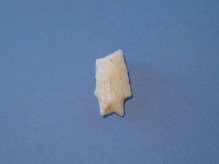
Two of my projectile points are called “Morrow Mountain” pieces. They are from the Middle Archaic period which ended around 3000 B.C. (or B.C.E., if you prefer.)

Base of a projectile, Morrow Mtn., Middle Archaic
Base of projectile, Middle Archaic, Morrow Mountain.
Arrowheads, Tools, & Rocks 012
Middle Archaic (2,000 to 3,000 B.C.E.) Morrow Mountain Projectile Point

Middle Archaic Guilford

Two other pieces are of the “Guilford” style and also date to the Middle Archaic period when Native Americans hunted bison in North Carolina.

Broken example of Middle Archaic - Guilford
Broken example of Middle Archaic – Guilford projectile point.
Middle Archaic - Guilford
Middle Archaic, Guilford projectile point.

Late Archaic

Several of the projectile points in my collection are “Savannah River Stemmed “ points from the Late Archaic period, 1000 to 3000 B.C. This period was cooler than Middle Archaic. Deer, rabbits, and raccoons were hunted for food.

Late Archaic. Flagstone or field stone argilite, probably like what's coming out of the quarry nearby.
Late Archaic. Flagstone or field stone, probably like rock that is currently being mined from a nearby quarry.
Late Archaic. Thin bioface straight-sided projectile broken in use or when re-sharpened. Good material.
Thin biface straight-sided Late Archaic projectile point. Broken either by use or when re-sharpened.

Ancient Tool:  Anvil

I was certain that Dr. May would identify one of the smooth rocks I took him as an early Native American tool. He said it was just a rock that had been smoothed by water. Another rock, which hadn’t seemed as interesting to me, turned out to be an anvil.

This is an anvil. Notice the slight depression in roughness in middle on one side.
This is a stone anvil.

Some rocks I took to the museum were magnetic, which wasn’t a surprise; our red clay soil is rich in iron. One piece that appeared to be a rock was identified as slag hammered by a blacksmith. That made sense, because my father told me that there used to be a blacksmith’s shop in what is now my front yard.

Gold?

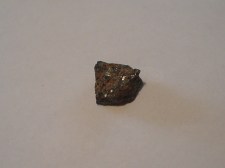
The rock I hoped he would say held flecks of gold, held flecks of worthless pyrite instead. I can see why it’s called “fool’s gold.”

pyrite and flecks of gold and lead. Dr. Alan May at Schiele thought this was a neat piece.
Lead with pyrite and flecks of gold. Dr. May thought this was an interesting piece.

Dr. May recommended that I send a detailed report about my collection to the Office of State Archaeology in Raleigh. The State has a form called “North Carolina Amateur Archaeological Site Form.” Dr. May said they will pinpoint my yard on a map and keep a record of my findings.

My visit with Dr. May brought surprises, both good ones and disappointing ones. I came home knowing that 5,000 years ago as the Egyptians developed hieroglyphic writing and the darkness was first lighted by candles, Native Americans were hunting deer and bison in my yard. Wow!

That was the end of my July 12, 2006 newspaper column. For now, it’s the end of the story. When I read the column last night for the first time in many years, I realized that I never followed through with Dr. May’s recommendation that I send a detailed report to the Office of State Archaeology in Raleigh. I’ve added that report to my “to-do” list, but writing must still come first.

Until my next blog post

I hope you have a good book to read. (I’m reading a nonfiction book, In Order to Live:  A North Korean Girl’s Journey to Freedom, by Yeonmi Park with Maryanne Vollers. It was published in 2015, but I’m finding it particularly interesting as I read it during rising tension between North Korea and the United States. I highly recommend it!)

If you are a writer, I hope you have productive writing time.

Janet

M is for MailChimp

On this the 13th day of the 2017 A to Z Blog Challenge, the featured letter is “M.” (13 letters down, 13 to go!) I had planned to write about my experience in setting up a way for people to subscribe to my e-newsletter. From what I’ve read by other bloggers, MailChimp seems to be the vehicle of choice. My plan was to write about how I had, without assistance, been able to accomplish this.

Best laid plans

Alas! I have failed. Since my blog is about my journey as a writer, I share my successes and my failures. As you can see in the sidebar to the left, my “Subscribe to Janet’s e-Newsletter” widget is not working. This is due to operator error.

I will not be deterred!

I will continue to work on this. As I write this blog post at 12:30 a.m. Eastern Daylight Time (EDT), the widget is not clickable. If I get the problem figured out in the next hour or so, I will correct it and perhaps it will be operable by the time this post is published at 6:50 a.m. EDT. (But I doubt it.)

Janet Morrison Books Newsletter

There is no newsletter yet, but I wanted to start developing a mailing list for the day I get my act together enough to write one. So, never fear! You are not going to miss my first newsletter. It has not been written. It might be months or years before I have anything newsworthy to put in a newsletter. It is another one of those things that writers are encouraged to have.

If anyone out there can help me

I will joyfully accept any assistance you are able and willing to offer me. Like I have stated many times before on my blog, I am technologically challenged. I am out of my comfort zone when it comes to all things electronic.

I read about a hack

I read about a hack for getting MailChimp to work on WordPress.com, but it was beyond my capabilities. It involved designing a sign up form on MailChimp, taking a picture of it, cropping the photo, and uploading it into WordPress.com. If I could do all that, I wouldn’t be asking for help in setting it up in the first place!

WordPress.com bloggers

I know you’re out there. Any idea what I’m doing wrong? Any idea what I need to do to get this to work? Feel free to leave advice in the comments section below. (Remember, I need directions in layman’s terms – no technical terms, please.)

Until my next blog post

I hope you have a good book to read. If you’re a writer, I hope you have quality writing time.

Janet

Disclaimer:  This is in no way an endorsement of MailChimp. Nor is it my intent to present MailChimp in a bad light. I have used MailChimp to subscribe to other writers’ newsletter and the process was seamless. Eventually, I’m sure you will be able to subscribe to my newsletter just as easily.

L is for a Line I Like in a Novel

After a challenging couple of letters this week in the 2017 A to Z Blog Challenge, I am happy to arrive on Day 12 and the letter “L.” It has become my routine to blog once-a-month about a line I like from a novel, so that is what I get to do today.

I like some sentences in novels because they make me think. Some make me see things in a new light – from another perspective. I like others because of the exquisite word choices made by the author. I like others because they paint a picture. When I come upon a sentence that grabs my attention, I jot it down in my notebook. I want to be able to read it again and again.

Mrs. Lee & Mrs. Gray, by Dorothy Love

One such line is the following sentence from Mrs. Lee & Mrs. Gray, by Dorothy Love:

“How much of life is by one simple moment decided.”

This was a thought by Mary Custis Lee as she reflected on a disagreement she’d had with her new husband, Robert E. Lee.

The sentence prompted me to stop and think. Indeed, “how much of life is by one simple moment decided.”

Until my next blog post

I hope you have a good book to read. If you’re a writer, I hope you have productive writing time.

Janet

K is for Klout.com

No, that’s not misspelled.

Settling on a K-word

My mind works in mysterious ways. For about three weeks I’ve tried to think of a word that starts with a “K” that had something to do with writing for this the 11th day of the 2017 A to Z Blog Challenge. I was still pretty much at a loss until a few minutes ago. I wasn’t even thinking about the blog challenge or the letter “K” earlier tonight when I visited a website that I look at two or three times a month. The site begins with the letter “K,” but even as I bounced around on it I didn’t have that “aha moment.”

I left the site and went on my merry way to answer a few e-mails and Tweet my thanks to several people who started following me today on Twitter. In the midst of that, my subconscious mind kicked in and said, “Wake up, Janet! You can write about Klout.com!”

I learned about Klout last September, when I got serious about having a brand and a social media presence as a writer. The website has a way to measure one’s influence on social media. I understand they use an algorithm to do this. (Algorithms are above my pay grade, so I’ll just leave it at that.)

A little explanation of Klout.com

Klout looks at how many social networks a person is active in and then gives a score of 1 to 100. You can imagine how daunting it was on September 19, 2016 when I checked my score on Klout for the first time and discovered I had a 10.

Klout immediately became a great tool for me. It gave me added incentive to be more active on social media in order to improve my score. I read that an average Klout score is 40. A score of 50 or above is considered very good. A score above 63 is fantastic. Only five percent of users score 63 or above.

Starting off at 10 points, I had my work cut out for me. Those of you who have been following my blog since last September know that I have complained and struggled and complained some more about social media. It’s not my favorite endeavor and I feel like it consumes too much of my time. I’m trying to hang in there, though, and it is getting a little easier with time and practice.

My results

It has been gratifying to see my efforts pay off. My Klout score rose to 16 by the end of September and 32 by the end of October. It was surprising how much my Klout score encouraged me to keep working at it.

By early December I reached and then surpassed the average score of 40 by three points. My score has held steady between 42 and 45 since then. Klout has proclaimed me to be an expert in writing and in reading. That’s laughable, but I’ll take it.

In conclusion

It costs nothing to sign up for Klout.com. It has mixed reviews online. There are certainly other analytics services that get more into the nitty-gritty of measuring the impact or influence one is having on social media. For a service that is free, though, I can vouch for the fact that it has provided positive feedback to me since last September – feedback that pushed me to make a conscious effort every day to keep working on my social media skills.

Until my next blog post

I hope you have a good book to read. If you’re a writer, I hope you have quality writing time.

Janet

Disclaimer:  I am getting nothing from Klout.com for writing about the website.