The Authors I Read in March

Today is the first day of the 2017 A to Z Blog Challenge. The challenge is for a blogger to blog on 26 specific days in the month of April. If that weren’t enough, there is a big caveat:  Each day’s blog must be based on the next letter of the English alphabet in chronological order. Therefore, today’s blog has to have something to do with the letter “A.”

2017 A to Z Challenge Badge
Blogging from A to Z Challenge Badge 2017

Since my first blog each month is about the books I read in the preceding month, I’ve tweaked my usual post title to read, “The Authors I Read in March” instead of the usual, “What I Read in March.” Without further ado, let’s get to those authors and their books. I had a rewarding month of reading in March!

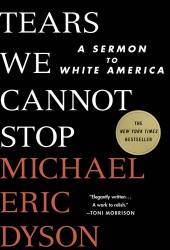
Tears We Cannot Stop:  A Sermon to White America
9781250135995

One of the categories I included in my 2017 Reading Challenge was to read a book that might change my mind. Tears We Cannot Stop:  A Sermon to White America, by Michael Eric Dyson definitely fit the bill. Reading this nonfiction book still haunts me four weeks later. Page after page, it drove home to me how those of us who are white in America take for granted our white privilege. It even goes farther than that. For the most part, we aren’t even aware of our white privilege.

An example is that, as a small child, I was told by my parents that if I ever got separated from them out in public to look for a police officer. I was told that police officers were my friend. A police officer would always help me. It has taken me to middle age to recognize that children of color in America are not told that. Their parents and grandparents have not been able to trust law enforcement officers, so they cannot be told to automatically trust such people in authority.

If I am driving and see a police car in my rear view mirror, my eyes immediately drop to the speedometer even if I’m fairly certain I’m not speeding. For a split second, I’m afraid I might be doing something wrong. “Afraid” is probably too strong a word. It’s just a fraction of a second when I think I might get a speeding ticket, but with a glance at the dial on the dashboard I’m reassured that I’m not breaking any laws and I am perfectly safe. It is impossible for me to put myself in skin of a darker shade than my Scots-Irish heritage gave me. The emotions a person of color must feel when being approached by a police officer is something I cannot identify with because I am Caucasian.

These are just two examples. The roots of this problem run deep into the foundations of our country. Tears We Cannot Stop:  A Sermon to White America, by Michael Eric Dyson made me think about these issues in more depth than I had otherwise been forced to think about them. Just by being born with white skin in America has given me privileges that I have been oblivious to all my life. It is that white privilege itself that has made my oblivion possible.

It’s not enough for me to be aware of my white privilege. It is my responsibility to work for social justice.

Michael Eric Dyson is a sociology professor at Georgetown University in Washington, DC. This is the first one of his books that I’ve read. I wanted to read it after seeing him interviewed by Tavis Smiley on PBS.

The Chilbury Ladies’ Choir
The Chilbury Ladies' Choir book cover

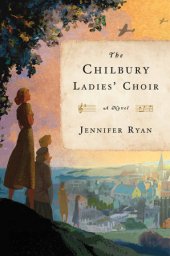
The Chilbury Ladies’ Choir, by Jennifer Ryan is a 2017 novel that is getting much-deserved praise. I gravitated to it because it is a work of historical fiction. Set in the early days of World War II in England, it is a story of how a group of women found their voices and their strengths after all the able-bodied men in the village were called away to fight the Nazis. Each of the women came about this epiphany in her own way and at her own pace. Subjects such as abortion, black market dealings, and the British class system are among the topics woven into this novel.

A native of Kent, England, author Jennifer Ryan lives in the United States. Her earlier career was as a nonfiction book editor. She wrote The Chilbury Ladies’ Choir in the form of letters and documents, much in the vein of The Guernsey Literary and Potato Peel Pie Society, by Annie Barrows and Mary Ann Shaffer. Like that 2008 novel, the characters I met in this debut novel by Jennifer Ryan will stay with me for a long time.

The Magdalen Girls
9781496706126

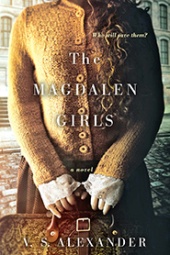
The next book I read in March was The Magdalen Girls, by V.S. Alexander. It is not the kind of book I would say I enjoyed; however, the story was compelling and I had trouble putting it down. I will be haunted by the characters in this novel. It is a dark tale based on the homes for “wayward girls” in Great Britain in the 1960s and beyond. This story is based specifically in 1964.

The Magdalen Girls paints a painful picture of the nuns who ran this particular convent and “home” (“prison” would be more accurate!) for girls and women deemed too much of a temptation for boys and men. As with any good work of fiction, just when the reader thinks things can’t possibly get worse for 16-year-old Teagan and her fellow “Magdalens,” things get progressively worse until this reader can scarcely stand to turn to the next page. The Mother Superior/Sister Anne is hiding a secret that is tearing her to pieces. Unfortunately, her way of coping with her own demons is to heap abuse upon the girls and young women under her care.

Upon entering the confines of the convent, the girls are stripped of their dignity and their identities. They are assigned new names and are never to refer to themselves or others again by their birth names. The book shines a bright light on the double standard held worldwide that girls and women must always live to a higher standard than boys and men and bear the punishment even when the male is an adult and the female is a minor.

V.S. Alexander’s next novel, The Taster, due out in January, 2018, is about one of the women who had to taste Adolf Hitler’s food in order to ensure that he wasn’t being poisoned. I’ll be on the wait list for it as soon as it shows up in the public library’s catalog. That’s just how good Ms. Alexander’s writing was in The Magdalen Girls. It wasn’t a pleasant read for its subject matter, but the writing was so vivid that I felt like I was imprisoned at the convent along with Teagan, Nora, Lea, and all the others.

Right Behind You
9780525954583

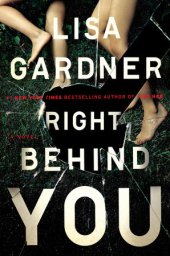
The next book that rose to the top of my wait list at the public library was Right Behind You, by Lisa Gardner. Although this is her seventh and latest (2017) installment in her Quincy and Rainie FBI profiler thrillers series, it is the first book I’ve read by Ms. Gardner. This novel made me want to read more of her books. Perhaps I should go back and read the first book in this series, The Perfect Husband, which was published in 2004.

Right Behind You is the frightening tale of a brother and sister who are separated from each other into numerous foster homes after the murder of their father. The girl is nurtured by loving foster parents, while the boy is not so fortunate. He never receives the psychological care and support he needs as a result of his father’s gruesome death. That propels him onto a path of trouble, violence, and the over-riding guilt of not being able to protect his little sister.

I don’t want to reveal other details of the book, in case you haven’t read it yet but wish to do so.

One of my objectives when I created my 2017 Reading Challenge was to read many authors I had not read before. That’s what prompted me to look for a book by Lisa Gardner. I can recommend her to other readers now. I’ll read more of her novels as time allows. “So many books! So little time!”

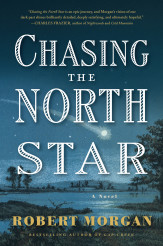
Chasing the North Star
Morgan_NorthStar_jkt_rgb_HR_2MB-1-163x246

For the March meeting of Rocky River Readers Book Club, each member of the group was asked to read any book of their choice written by Robert Morgan. I’ve read a number of novels by this North Carolina author, in addition to Boone:  A Biography, which is a biography of Daniel Boone. For book club, I read Morgan’s latest novel, Chasing the North Star.

A slave on a plantation in South Carolina, Jonah runs away on his 18th birthday. The book follows Jonah and a female runaway slave, Angel, on their dangerous trek north to freedom. At times, the story got slowed down with details of the tree branches encountered as one runs through the woods. That aside, I soon became invested in both Jonah and Angel as I cheered them on and tried to will them to reach Pennsylvania, New York, and Canada.

Robert Morgan will be the guest speaker at the public library in Concord, North Carolina on Saturday, April 22, 2017. It was in preparation for that author event that Rocky River Readers chose to read books by him in March. I look forward to hearing Mr. Morgan talk about his writing.

My next blog post

My next blog post is scheduled for Monday, April 3, and it must have something to do with the letter, “B.”

Until my next blog post

I hope you have a good book to read. (I’m reading The Heavens May Fall, by Allen Eskens.) If you’re a writer, I hope you have quality writing time.

Janet


Speedbumps!

My last blog post of each month is usually a progress report on the novel I’m writing. The Spanish Coin is its working title. A month or so ago a writing coach evaluated the first 2,000 words of my manuscript. I set about to take her recommendations and edit the remaining 94,000 words.

Speedbump

img091

Due to one thing and another, I’ve made very little progress on that project. Life got in the way. I’ve come to call such things speedbumps.

Another speedbump?

Then, I read an online article by a literary agent. Her comments were directed toward writers and their blogs.

The article was quite helpful until

I got to the part where she said a writer needs to have 50,000 engaged blog followers in order to get a book published. Whoa! I guess that’s what I get for getting all puffed up about having 1,000 blog followers just a week ago. This literary agent really knows how to burst someone’s bubble!

I would like to think that all 1,008 of my current followers are engaged (meaning they are truly interested in my writing and didn’t just hit the “follow” button out of curiosity or a sense of obligation) and that every one of them would purchase a novel I wrote. I know that’s not necessarily the case, though.

Looking forward to better (and healthier) days ahead,

I hope to report to you sometime in April that I’ve completed that work and have turned at least half of the manuscript over to the writing coach. I look forward to taking that next step toward publication and making my novel better and better. I realize that you might be growing weary of my progress reports that don’t reflect any progress.

A reminder

I plan to embark upon the 2017 A to Z Blog Challenge on April 1. The first day is “A.” I will write about the authors and books I read in March. I think you’ll enjoy that post. I read some very good books this month! (I hope my April 1 blog post will make up for this one because this is definitely not my best work.)

2017 A to Z Challenge Badge
Blogging from A to Z Challenge Badge 2017

Until my next blog post

I hope you have a good book to read. (I’m reading The Heavens May Fall, by Allen Eskens.) If you’re a writer, I hope you have productive writing time.

Janet

Save

Quote from Journalist Jonathan Stinson

Jonathan Stinson is the publisher of The Sand Mountain Reporter newspaper in Albertville, Alabama. I recently discovered him on Twitter and was immediately impressed with his level of professionalism.

I have no personal experience with the University of Alabama, but I’m beginning to think it must have a top-notch journalism school. Back in the 1980s and 1990s, one of the most-respected TV journalists in Charlotte was Bob Inman of WBTV. A native of Elba, Alabama, Robert Inman is a successful novelist today. He is a product of the University of Alabama.

Lee Perryman, one of my far-flung Morrison cousins is another graduate of the University of Alabama. Lee recently retired after a celebrated career with the Associated Press in Washington, DC. In retirement, Lee continues to champion the field of journalism in his hometown of Sylacauga, Alabama.

Many years later to happen upon another Alabama native and alumnus of that university’s Department of Journalism — Jonathan Stinson —  cannot be merely coincidental. I did not major in journalism in college but, if I were looking for a good journalism school to invest my time and money in as a student, I would certainly give the University of Alabama my serious consideration.

Here’s the quote from Jonathan Stinson that first grabbed my attention:

“Everything you write is about the reader. The sooner you accept this truth as a writer, the better off you’ll be because you’ll have a clear understanding of what it is you’re trying to do.” – quote from Jonathan Stinson’s blog, at http://JstinsonINK.com.

I typed the quote and keep it by my computer monitor so I can read it every day.

Jonathan Stinson can be followed on Twitter as @JstinsonINK and on his blog as referenced above.

In this day in America when reporters and journalists are being recklessly maligned almost daily by the US President and his staff and surrogates, it is reassuring to know that there are countless journalists in this country who are dedicated to reporting the facts. Not “alternative facts,” but facts.

Lest we forget

The First Amendment to the Constitution of the United States of America reads as follows:

“Congress shall make no law respecting an establishment of religion, or prohibiting the free exercise thereof; or abridging the freedom of speech, or of the press; or the right of the people peaceably to assemble, and to petition the Government for a redress of grievances.”

Until my next blog post

I hope you have a good book to read. (I’m reading The Second Mrs. Hockaday, by Susan Rivers.) If you’re a writer, I hope you have quality writing time.

Janet

Early X-ray and a Thimble

Did you know that a girl from the Rocky River community in Cabarrus County, North Carolina was the first person whose life was saved in the United States with the aid of the X-ray? Today’s blog post is an edited version of a local history newspaper column I wrote in 2006 for Harrisburg Horizons, a short-lived weekly newspaper. I usually blog about writing fiction, but this is an example of my nonfiction writing.

Discovery of the X-ray

Just three months after Wilhelm Conrad Roentgen of Bavaria discovered the X-ray, a scientist from Davidson, North Carolina used it in a Rocky River home to help save Ellen Harris’ life. It was a February day in 1896.

Dr. Henry Louis Smith of Davidson read about Roentgen’s discovery of the X-ray. He went to Dr. J.P. Munroe’s laboratory in the small medical school on the campus of Davidson College. The laboratory had the same equipment as that used by Mr. Roentgen.

Dr. Smith fired a bullet into the palm of a corpse’s hand. He then made a successful X-ray of the hand.

Ellen Harris Swallows Thimble

Soon thereafter, Mr. and Mrs. William Edwin Harris’ twelve-year-old daughter, Ellen, swallowed a tailor’s thimble. The open-ended thimble lodged in her throat and made it increasingly difficult for her to breathe or eat over the following days.

Tailor's Thimble
Tailor’s Thimble

Area physicians did not agree on a diagnosis. Three doctors thought she coughed up the thimble and damaged her throat in the process. One doctor speculated that the thimble hurt her throat as it passed to her stomach. Only one of the five doctors consulted thought the thimble was still in Ellen’s throat.

A man in Charlotte, the largest town in the area, told Dr. Smith about Ellen’s predicament. Dr. Smith asked the man to convey to Ellen’s parents his willingness to help them.

Ellen’s frantic father and mother believed that Dr. Smith could help their daughter. Mr. Harris traveled to Davidson in a wagon (a distance of about 30 miles — perhaps more in those days) and brought Dr. Smith and his X-ray equipment to his home near Rocky River Presbyterian Church on Rocky River Road.

Mr. and Mrs. Harris placed Ellen on a sheet fashioned into a hammock. Dr. Smith set up his crude X-ray apparatus. A large and heavy battery and induction coil powered the equipment.

According to a letter that Dr. Smith wrote to Dr. Robert M. Lafferty, he crouched on the floor under the girl. After an hour’s work with a fluoroscope, he got a fleeting glimpse of the thimble in the child’s windpipe. There was no lasting image on film like in X-rays today.

Dr. Smith returned to Davidson and the Harris family set out for a hospital in Charlotte. The doctors there refused to operate on Ellen. They wanted to see exactly where the thimble rested before they made an incision.

The Charlotte surgeons wired Dr. Smith their concerns. Surgery was Ellen’s only hope for survival. Without knowing the exact location of the thimble, though, the surgeons feared they would lose their patient on the operating table.

Dr. Smith immediately brought his X-ray equipment from Davidson to the hospital. Once more, the apparatus pinpointed the location of the thimble in Ellen’s trachea. The image paved the way for the operation.

The surgeons soon discovered that Ellen’s flesh partially grew over the rusting thimble. This made the thimble’s removal difficult and challenging. The arduous two-hour surgery saved Ellen’s life and put the Rocky River community on the medical history map!

My sources:

Early Medicine in Cabarrus, primary data collected by Eugenia W. Lore and edited by Jane Harris Nierenberg, 1990.  (Includes newspaper articles from The Concord Tribune, November 9, 1945, and December 10, 1945.)

Open the Gate and Roam Cabarrus With Us, by Adelaide and Eugenia Lore, 1971.

The Historic Architecture of Cabarrus County, North Carolina, by Peter R. Kaplan, 1981.

Hornets’ Nest:  The Story of Charlotte and Mecklenburg County, by LeGette Blythe and Charles R. Brockmann, 1961.

Until my next blog post

I hope you have a good book to read. (I finished Right Behind You, by Lisa Gardner and have started reading Chasing the North Star, by Robert Morgan.) If you are a writer, I hope you have quality writing time.

Janet
Save

5 Things I Can’t Afford to Try on Social Media in March

Although I have made some good friends via social media and it does provide a way to stay in touch with old friends or relatives who live far away, social media stresses me out. If you’ve followed my blog for very long, you already know that.

I just want to sit at my computer and write, but the publishing world tells me that I have to have a brand and I must keep my brand in front of my potential readers. I’m being told this is important before I even try to get my first novel published. It’s exhausting!

In an effort to simplify social media for myself, I have looked into a number of websites that offer to do just that. There is an old adage that says, “You get what you pay for.” If I were independently wealthy, I could purchase all kinds of services that promise to put my social media life on Easy Street. That is not the case, though. If I had a multi-million dollar business, these services might make sense. They would be business expenses. I don’t make enough money from my writing yet to need big tax write-offs.

Below, I’ve listed what I found out about five social media services that I can’t afford to try. Just because I can’t afford them doesn’t mean you shouldn’t use them. I’m not endorsing any of them, but I’m not trying to denigrate any of them either. Each Tweeter and blogger must decide for himself because each person’s situation is unique.

  1. Tweepi

The Ultimate Guide to Generating Leads on Twitter, a downloadable document by Steve Arnold, (steve.arnold@markethub.io) recommends Tweepi to, among other things, keep up with which of your followers are actually looking at your content. This allows you to drop followers that are just boosting your followers count. They aren’t interacting or helping you and you aren’t helping them. Unfortunately, the cheaper of the two plans Tweepi offers is $10.75 per month when paid annually or $12.99 per month when paid monthly. I can’t afford that, even though I recognize it would be somewhat beneficial to subscribe to a service like Tweepi.

My conclusion:  My world does not revolve around Twitter. I’m sure some of my “followers” are no longer “following” me. If they aren’t interested in books, writing, or an occasional political Tweet from me, that’s okay. I understand that literary agents and book publishers may want to have a clear idea of how many interested followers I have on Twitter, but it’s just not important enough to me right now to pay to get that information. It’s something to reconsider when I’m closer to getting a novel published.

  1. MarketHub

Mr. Arnold, of course, recommends that bloggers use MarketHub, since he is the company’s founder. His downloadable referenced above under Tweepi, states, “MarketHub pumps out extremely high value curated tweets on your behalf.” MarketHub offers a 14-day free trial. I hesitate to sign up for free trials because sometimes they’re difficult to cancel before a subscription fee kicks in. I have no idea if that’s the case with MarketHub, and I haven’t been able to find out how much MarketHub charges after the free trial period.

My conclusion:  I don’t really want a computer somewhere writing Tweets for me. I’d rather do my own writing. Period.

  1. Commun.it

With a free account, Commun.it will send out automatic weekly “Thanks for following me” Tweets; however, those Tweets include a flashy advertisement for Commun.it. I learned that the hard way. That was embarrassing! This has continued even though I went to the website and deactivated this feature which I admit I should have been aware of when I signed up. I’m still trying to determine how to best manage social media. I can’t afford a Business Account on Commun.it.

My conclusion:  I don’t know how to get rid of Commun.it. Maybe if I ignore their e-mails long enough, they will stop sending out “Thank you for following me and, by the way, don’t you also want Commun.it to send out Tweets on your behalf without your knowing it?” e-mails.

Chris Andrews, a writer in Australia who reads my blog and I read his, advised me a few days ago to look into using Clicky.com. It’s a free service that should help me with this. I signed up for it, but there’s a glitch somewhere in a code so it’s not up and running for me yet. Stay tuned. Thanks again, Chris.

  1. Moz.com’s Keyword Explorer

I keep reading online that if I’m going to have a successful blog, I must use the trending keywords in my posts and in the posts’ titles. Otherwise, my SEO (Search Engine Optimization) won’t be good. In other words, no one will find my blog.

Moz.com has a service called Keyword Explorer that helps a blogger find keywords that would be most advantageous for him or her to use in order to drive more traffic to their blog. I don’t mean to bad mouth moz.com, but their cheapest plan would cost me $948-a-year, if I chose to pay annually. If I chose to pay monthly, my annual cost would be $1,188. Ouch! That’s more money than I’ll make this year from my writing. A lot more.

My conclusion:  Keep looking.

  1. Google Keyword Planner

I looked into using Google Keyword Planner, another service that would find the best keywords for me to use in my blog post titles. Surely, it would be cheaper than Keyword Explorer. If I understood the adwords.google.com website correctly, they will “help” me for free as long as I spend at least $10-a-day on ads. No thanks! I don’t have a published novel to advertise yet.

My conclusion:  As of November 21, 2016 – just four months ago today – my blog had 220 followers and had been visited by people from 32 countries. As of 11:30 last night, I had. . . drumroll, please. . . 1,000 followers and my blog has been visited by individuals from 42 countries. I must be doing something right, and I’m not spending an arm and a leg to generate traffic.

Proof of my 1,000th blog follower on March 20, 2017!

My general conclusions today about social media

I keep a daily check on my blog and my accounts with Facebook, Twitter, and Pinterest. As long as my follower numbers steadily increase, I’m happy. And I must admit that I love seeing the flags appear on my blog’s sidebar as people in different countries visit the site. (See, I’m not completely against social media, and I’ve always loved geography!)

Social media should be fun. It should bring people together – even people who don’t agree with each other on the topic being discussed. I will continue to blog and use Twitter, Facebook, and Pinterest. I might continue to use Google+. Two weeks ago, I created an account with Instagram. I might even use it someday.

Until my next blog post

Rest assured that I do my own writing. That’s what writers do. They write.

It upsets me when someone takes my words and claims them as their own.

It upsets me when someone writes words and claim that they are mine.

For the time being, except for those pesky Tweets commun.it keeps sending out, I plan to write my own Tweets, figure out my own keywords for my blog post titles, and refuse to stress out over who is following me on Twitter. Life is too short!

I take Harper Lee, author of To Kill a Mockingbird, as my example. She didn’t play by any of the rules dictated by the publishing industry in her lifetime. I’ll play by the rules as necessary, but I’m not going to let social media control my life.

This blog post makes me sound angry. I’m not angry. Just venting some frustration. Not ready to draw a line in the sand.

I hope you have a good book to read. If you’re a writer, I hope you have quality writing time.

Janet

P.S.  Relax. My next blog post will be a sample of my writing. With any luck, it won’t be controversial and won’t contain any rants or venting.

Save

Blogging from A to Z Challenge 2017 Theme Reveal

What is the Blogging from A to Z Challenge?

The Blogging from A to Z Challenge is an annual challenge open to all bloggers during the month of April. The first challenge was issued in 2010 and has steadily grown in participants each year. It is open to bloggers who write about any topic. I just learned about the challenge a couple of week ago.

Theme Reveal Day: March 20, 2017

My Blogging from A to Z Challenge Theme Reveal

Each participating blogger selects a theme for the challenge. My theme is Janet’s Writing Journey. That’s the theme of my blog already, but this challenge will force me to delve into some aspects of reading and writing that I maybe wouldn’t have written about otherwise.

How does the Challenge Work?

The challenge is to blog 26 days during April. This is based on the fact that there are 26 letters in the English alphabet. Each blog post must have a connection to a letter in the alphabet in chronological order. Posts are made on Saturday, April 1, then Monday through Saturday of each week through the end of the month plus a post on Sunday, April 30.

Blogging from A to Z Challenge Badge 2017

My Thoughts about the Challenge

This will be a challenge for me in more than one way. As you know, I usually only blog on Tuesdays and Fridays, so blogging 26 times in April will be a stretch for me. Add to that the requirement to connect with a specific letter each day, and it will definitely be a challenge!

In case you don’t want to receive a blog post from me every day, I ask you to please bear with me in April. I plan to go back to my usual blogging routine in May.

Until my next blog tomorrow

I hope you have a good book to read. (I’m reading Right Behind You, by Lisa Gardner.) If you’re a writer, I hope you have quality writing time. If you’re a blogger, I invite you to consider committing to the Blogging from A to Z Challenge 2017. Information about the challenge can be found at http://www.a-to-zchallenge.com/p/what-is-blogging-from-to-z.html.

Janet

Save

Author Event by A.J. Hartley

It was my privilege on March 14, 2017, to hear author Dr. A.J. Hartley speak at the annual meeting of the Friends of the Harrisburg (NC) Library. Dr. Hartley is a man of many talents. He is the distinguished professor of Shakespeare in the Department of Theatre at the University of North Carolina at Charlotte, which is just several miles up the road from Harrisburg.

Author Dr. A.J. Hartley, speaking at the annual meeting of the Friends of the Harrisburg Library, March 14, 2017

Dr. Hartley’s background

Dr. Hartley has published more than 20 books, ranging from academic to mysteries, thrillers, historical fiction, and fantasies for adults, young adults, and middle grades. He credits the book The Lion, the Witch and the Wardrobe, by C.S. Lewis, as being his passport out of his economically-depressed hometown of Preston, England. He read the book when he was 10 years old, and reading subsequently opened up the world to him.

His thoughts on Shakespeare

In his very entertaining and educational presentation at the library on Tuesday night, Dr. Hartley pointed out something about William Shakespeare that I had never considered before. Shakespeare lived and wrote at a time when live theatre was a big thing in London, a town then of approximately 100,000. Going to the theatre was a common activity for all spectrums of the population. Therefore, Shakespeare had to write in a way that would appeal to everyone from the illiterate to the highly educated, from the poorest to the richest in society.

His writing routine

Dr. Hartley welcomed questions from the audience. I noticed that the teens in attendance asked some of the most interesting and probing questions.  He spends a lot of time walking his dog six miles-a-day, and that is when he does most of his writing. When he gets home, he types what he “wrote” in his head while he was walking. He used to just wing it, or in the lingo of writers, he was a pantser. That means he wrote without an outline. He now writes short outlines. Every writer has to find what works for them.

My takeaways

As a writer, the main points I came away with were the following:

  1. “If you’re wondering if you’re a writer, try quitting. If you can, you’re not.” – A.J. Hartley
  2. “Words are free.” – A.J. Hartley
  3. Dr. Hartley wrote fiction for 20 years before his first novel was published. I don’t know whether to take encouragement from that or not. He started at a much earlier age than I did!

Dr. Hartley’s website

If you’re interested in reading any of Dr. Hartley’s books, check with your local public library and also online. His website is ajhartley.net.

Until my next blog post

I hope you have a good book to read. If you’re a writer, I hope you have quality writing time. Never pass up an opportunity to hear an author speak!

Janet

Save

First Line from a Novel by Flannery O’Connor

The first line of Flannery O’Connor’s 1960 novel, The Violent Bear It Away, has to be my favorite first line.  “Francis Marion Tarwater’s uncle had been dead for only half a day when the boy got too drunk to finish digging his grave and a Negro named Buford Munson, who had come to get a jug filled, had to finish it and drag the body from the breakfast table when it was still sitting and bury it in a decent and Christian way, with the sign of its Saviour at the head of the grave and enough dirt on top to keep the dogs from digging it up,” says it all.

The Violent Bear It Away book cover
Book cover of The Violent Bear It Away, by Flannery O’Connor

What do we learn from the sentence?

From that one sentence, we know that Francis Marion Tarwater was, no doubt, named for that famous South Carolina “Swamp Fox” of the American Revolution, Francis Marion. We know that Tarwater is white, because Buford Munson is described as being a Negro. We can guess that there is an illegal still involved, although Munson could have come to fill his jug with water. The sentence tells us that Tarwater’s uncle died at the breakfast table and half a day later Tarwater was too drunk to bury him. It also tells us that Tarwater’s uncle was a Christian, and that Munson puts a cross at the head of the grave when he finishes burying Tarwater’s uncle.

The opening sentence also paints a picture of the grave of Tarwater’s uncle piled high with fresh dirt in order to prevent dogs from smelling and digging up the body. From this, we can assume there was no casket, no vault, no fence around the gravesite, and no leash laws in the area.

Tarwater is described as a boy in the opening sentence. This tells us that he was under the age of 21 (the age of majority when the novel was written) and more than likely younger than that. (We learn later that he is 14 years old.) For him to be too drunk to finish digging the grave tells us that Tarwater is either celebrating his uncle’s death or distraught with grief. Either way, it is not a desirable situation.

The young Tarwater apparently felt total responsibility to bury his uncle which insinuates that there are no relatives or good friends close by. Or, perhaps Tarwater murdered his unsuspecting uncle by putting poisonous material in his food, then got scared or felt guilty, which caused him to get drunk and  attempt to hide the evidence by burying him.

Just when we think that opening sentence with all its nooks and crannies has said it all, we realize that it has led us to an incredible number of questions. Although the novel’s opening sentence is outrageously long at 88 words and complicated with only two commas allowing us to take a breath, it accomplishes what every fiction writing textbook says a novel’s opening sentence should do:  It hooks us. It draws us in. It compels us to keep reading in order to find out what is going on and to find the answers to the many questions it raises.  What more could you ask of an opening line?

Until my next blog post

I hope you have a good book to read. If you’re a writer, I hope you have quality writing time.

The Daily Prompt – Record

I’m trying something new today. Monday is the day that I get weekly digests of the blogs I follow. I tend not to be very productive on Mondays, so it is a good day for me to read what other bloggers have to say. I follow a variety of bloggers from around the world – USA, Scotland, France, Australia, Egypt, England, Canada, India, Norway, and South Africa. I follow the blogs of other writers, as well as a young man who is a music composer, photographers, historians, pastors, stay-at-home mothers, a father whose daughter died of cancer at the age of 19, and an autistic man in the United Kingdom.

This afternoon I found a blog that was new to me: https://dailypost.wordpress.com/challenge-instructions/. The site offers a writing prompt every day. I’ve never done much with writing prompts, but this might be a way for me to blog more often than my usual Tuesdays and Fridays. It has already prompted me to do a little writing on a Monday, which is an accomplishment in itself. Today’s prompt is the word record.

Right off the bat, I’m faced with the decision of whether to use record as a noun or a verb. I chose to use it both ways.

I immediately thought about the daybooks one of my great-grandfathers kept in which he wrote daily from 1891 until his death in 1914. His daybooks (or journals) are a RECORD of life on his farm in Mecklenburg County, North Carolina. What a gem for his descendants! I wish he had RECORDED more current events. He had fought in the American Civil War, so on the anniversary dates of the battles in Richmond, Virginia, and New Bern, North Carolina were always noted.

In April, 1896 he wrote the following note in the margin:  “We Built this house in 1886 and moved in it   Earth Quake Aug the 28 the Same year.”

On May 31, 1897, after commenting on the weather, that he didn’t feel well (“I am on the Sick list.”), and what was being done on the farm, he ended the day’s daybook entry with, “a Earth Quake this Eavning 12 m to 2 o clock.”

Lee Dulin kept a daily RECORD of the weather and that day’s activities on the farm. He was a widower raising six children, his wife having died in childbirth in 1881. Trips into Charlotte for supplies were duly noted, as was his trip by train to the 1895 Cotton States and International Exposition in Atlanta. A man of few words, though, he merely wrote down the day he left for Atlanta and the day he returned. It was probably the first time he saw electric lights, but we’ll never know. He didn’t write about anything he saw at the event, which was very much like a World’s Fair.

Photo of part of a page of ciphering in one of Lee Dulin’s daybooks.

There was one fact Lee Dulin RECORDED in one of his daybooks that proved to be valuable to my sister and me as we worked on our family’s genealogy. If not for this almost overlooked note on a page of ciphering in one of the daybooks, we would not know the name of his father. In case it’s not legible here, he wrote, “James J. Dulin my Papa name.”

In today’s computerized world in which it is said that young adults have no interest in keeping a photograph or a piece of paper, I’m glad I came along in a time when family RECORDS like great-grandpa’s daybooks were valued and saved.

Incidentally, I blogged about Lee Dulin’s daybooks a year ago tomorrow, May 14, 2016, in case you want to read more about it.

Until my next blog post (which will be posted in about 11 hours)

I hope you have a good book (or an ancestor’s daybook) to read. If you’re a writer, I hope you have quality writing time.

Janet

Save

11 Things I’ve Learned about Social Media since February 21, 2017

Certain social media platforms continue to be the bane of my existence. My February 21 blog post was 5 things I learned about Social Media this weekend. I continue to learn things. Some are more useful than others. Here are 11 things I’ve learned about social media since that earlier blog post.

  1. The first word in my blog post title is the most important word, as far as Google is concerned. (“11” probably isn’t the best choice, although I’ve read that it’s better than using “10.”)
  2. I need to use long-tail keywords in my blog post title, within the post, and also in subheadings. (I had to Google “long-tail keywords.”)
  3. Long-tail keywords are a targeted search phrase of three or more words. An example is “How to write a” or “How to get to.” These are the type of things that will bring your post up on page one of a Google search. Most people don’t move on to page two. (Since I’m still learning the craft of writing, I can’t very well title a blog post, “How to Write. . .” anything.)
  4. For $9.99 per month I can pay Alexa.com (an Amazon company) to tell me how people are finding my website and blog. That’s not in my budget. (I think I’ll just keep relying on WordPress analytics.)
  5. The “block” feature on Twitter comes in handy when creepy-sounding people follow me. (I think I’ve blocked three people so far.)
  6. One of those social media intricacies is “avatar.” Why can’t we just call our ideal reader an ideal reader? There is too much terminology springing from social media. (Yes, I am officially too old to be using this stuff!)
  7. With a free account, Commun.it will send out automatic weekly “Thanks for following me” Tweets; however, those Tweets include a flashy advertisement for Commun.it. That was embarrassing!  This seemed to continue even after I went into the website and deactivated this feature which I admit I should have be aware of when I signed up. In order to prevent the ads, you have to upgrade to a business account, which is pricey for someone in my situation. I’m still trying to determine how to best manage social media.
  8. Quora.com isn’t working out for me so far. Since I majored in political science in college, the site automatically sends me government questions. Since it has been 40 years since I was in a political science class and since my interests lie more in the realm of the craft of writing today, I wish they’d send me questions (and answers) about writing.
  9. A few of my pins on my “Novel in Progress:  The Spanish Coin” board on Pinterest have been repinned by others, which is encouraging. (I hope they remember me when my novel gets published!)
  10. I read that the best times to Tweet are Monday through Thursday between 9 a.m. and 3 p.m. Eastern Time. Reading this on a Thursday night was not as helpful as it would have been on Monday morning. (It seems like this recommendation would depend on where in the world you live, but what do I know?)
  11. (And this is a constant) The more time I have to spend learning the intricacies of social media, the less time I have to read good books and work on my writing. (Actually, I learned this before February 21, but it deserves to be repeated.)

Until my next blog post

I hope you have a good book to read. (I just finished reading The Chilbury Ladies’ Choir, by Jennifer Ryan, and I highly recommend it!)


The Chilbury Ladies’ Choir, by Jennifer Ryan

If you’re a writer, I hope you have productive writing time.

If you like my blog, please share it on social media by using the icons below. I would appreciate it.

Janet

Save

Save