A Paragraph I Like from a Novel by Ann B. Ross

Ann B. Ross constructed a wonderful and hilarious paragraph in one of her novels, Miss Julia Delivers the Goods. I usually write about a sentence I like from a novel in my second blog post each month, but this paragraph of three sentences was just too good to pass up.

Miss Julia Delivers the Goods

First, to set the scene,

Mr. Pickens has expressed his regret that Hazel Marie is sick and asks Miss Julia if Hazel Marie is getting better. Hazel Marie’s teenage son is present. The son and Mr. Pickens don’t know that the unwed Hazel Marie is pregnant, although Mr. Pickens is the father of the baby. As only Miss Julia can, she replies to Mr. Pickens’ question as follows:

“ʻIt’ll be a long, drawn-out recuperation period, though – a few months, the doctor said. She’s lost a lot of weight, too, but we expect her to put a good deal back on real soon. Why, you might not even recognize her by springtime, but then she’ll level back to her normal size.’”

If that doesn’t strike you as being funny, I’m sorry I misled you. Perhaps the entire story leading up to the quote needs to be read for it to be appreciated. Ann B. Ross has written 19 books about Miss Julia, a fictional elderly Southern lady, and I believe the next installment will be released in April. If you’re looking for some good small-town Southern humor, Ann B. Ross is your author.

Until my next blog post

I hope you have a good book to read. If you’re a writer, I hope you have quality writing time.

Janet

Save

What I read in February 2017

I surprised myself by reading seven books in the short month of February. I’m having a good time reading a variety of books this year and stretching my subject matter a little.

The Underground Railroad, by Colson Whitehead

img_0277

The Underground Railroad, by Colson Whitehead, was the first book I read in February. It had been on my reading list since last summer. After having been on the wait list for it at the public library for weeks, it just happened to rise to the top and come to my Kindle Fire the day before I finished reading Glory Over Everything, by Kathleen Grissom in January https://janetswritingblog.com/2017/02/03/what-i-read-in-january-2017/. While I was still in an Underground Railroad frame of mind, I got to read Mr. Whitehead’s book. As with Glory Over Everything, I highly recommend The Underground Railroad. Both books were well-researched and well-written – just what fans of historical fiction love.

In Search of Mockingbird, by Loretta Ellsworth

In Search of Mockingbird was a huge switch in gears for me. I’d read about the book and, although it was a YA (Young Adult) novel, I was intrigued by the premise. It was worth checking out from the public library just to see how a YA book is written and to see how Ms. Ellsworth developed the story.

Erin runs away from home on the eve of her 16th birthday. She is angry with her father for waiting until that day to give her the diary that her late mother write. Erin’s favorite book is To Kill a Mockingbird and her heart’s desire is to meet Harper Lee. The diary reveals that Erin’s mother, who died when Erin was one week old, aspired to be a writer. Erin wants to be a written, too. The revelation that her mother wanted to be a writer and also loved To Kill a Mockingbird – along with her anger that her father waited 16 years to tell her about the diary – propel Erin to runaway from home in Minnesota and buy a bus ticket to Monroeville, Alabama to try to meet Harper Lee. Along the way she befriends some interesting people and learns some valuable lessons even while she teaches those new and older acquaintances some life lessons.

The Getaway Car, by Ann Patchett

This is a delightful book in which Ann Patchett humorously tells what she has learned about the craft and art of writing. She is quick to caution that every writer must find his own writing process, but she tells what she has done that worked and what did not work. I found myself highlighting many of her experience gems. I thoroughly enjoyed this book, and I know I will refer back to it often to reread the sentences and paragraphs I highlighted.

Nothing Gold Can Stay:  Stories, by Ron Rash

img_0278

This collection of 14 short stories by Ron Rash was a delight. When my book club read his novel, Serena, several years ago, I was the only person in the group that liked it. I haven’t enjoyed any of his other novels as much. Since one of my goals in 1027 is to read a short story every week, I decided to check Nothing Gold Can Stay out of the public library.

I haven’t read many short stories in a long time, and I was pleasantly surprised by my journey back into them. If you like authentic Appalachian Mountains fiction, I think you’ll like this collection of stories.

The 13th Target, by Mark de Castrique

This political thriller presents a cloak-and-dagger scenario about the Federal Reserve and its far-reaching power and influence within and outside the USA. Published in 2012, it weaves together the timely concerns of terrorism and the financial crisis in the USA. Mr. de Castrique keeps the reader guessing who knows what and who the “good guys” and “bad guys” are. Russell “Rusty” Mullins, a former Secret Service agent, is the protagonist Mr. de Castrique introduces in The 13th Target.

The Singularity Race, by Mark de Castrique

img_0279

This is Mark de Castrique’s second political thriller. If you follow my blog, you’ll recall that he and this book were the topic of my blog post on February 28 https://janetswritingblog.com/2017/02/28/author-visit-from-mark-de-castrique/. Mr. de Castrique was the guest speaker at the February meeting of Rocky River Readers Book Club on February 27.

The Singularity Race  stands alone, but you might want to read The 13th Target first in order to meet the main character, Russell “Rusty” Mullins. In The Singularity Race, the former Secret Service agent gets involved in an artificial intelligence case in which someone is trying to kill a Chinese computer expert visiting the USA.

The Secret Language of Dogs, by Victoria Stilwell

I am a dog lover from before I can remember. There is a black-and-white photo of a two- or three-year-old Janet crying her eyes out while burying her face in the thick fur of her brother’s collie named Pal. I am told that Pal was my go-to guy any time I got my feelings hurt. My life has been blessed and enriched by a wonderful line of family dogs, so I was drawn to this book.

Among other things, I learned the following from reading The Secret Language of Dogs:

  1. When my dog is smelling something and refusing to come to me, he’s not being obstinate; he’s on brain overload.
  2. Dogs are not color blind; they can see shades of green and blue.
  3. A dog has much better peripheral vision than a human.
  4. A dog’s vision is typically around 20/75, which means a dog must be 20 feet away from something in order to see what a human with 20/20 vision can see at a distance of 75 feet. (No wonder my dog can’t see the deer I’m pointing to in the backyard!)
  5. A dog has 1,700 papillae (taste buds), while a human has 9,000. (Maybe that helps explain a dog’s ability to eat another animal’s poop!)
  6. Although a dog’s fully-developed hearing allows it to hear at a frequency of 45,000 hertz – more than twice the frequency heard by humans – puppies are deaf when born.
  7. Like humans, most dogs have a lateral preference, meaning they have a dominant right or left paw. (Who knew? I’d certainly never thought about that, even though I’ve had many dog companions throughout my life. The last dog that adopted me appears to be right-pawed.)
  8. Oh — and the secret language of dogs? I learned that when my dog goes belly-up, he’s not asking for a tummy rub; he’s saying, “I want to be left alone!” Oh dear!

Other reading

In addition to the above books, I read at least one poem every day. Poets such as Robert Louis Stevenson; Elizabeth Barrett Browning; Carl Sandburg; George Darley; Robert Burns; William Wordsworth; William Shakespeare; and Ella Wheeler Wilcox.

I also read The Gospel of Mark and half of The Gospel of Luke. I feel like my blog readers are holding me accountable on reading a chapter in the Bible every day. I’ve tried many new years to do that, but I’ve never made it all the way through 365 days. This year, so far, so good!

What have you read lately?

I’m interested to know what you are reading or have read recently. Feel free to leave a comment or connect with me on social media.

Until my next blog post

I hope you have a good book to read. If you’re a writer, I hope you have quality writing time.

Janet

Save

Save

Save

Author Visit from Mark de Castrique

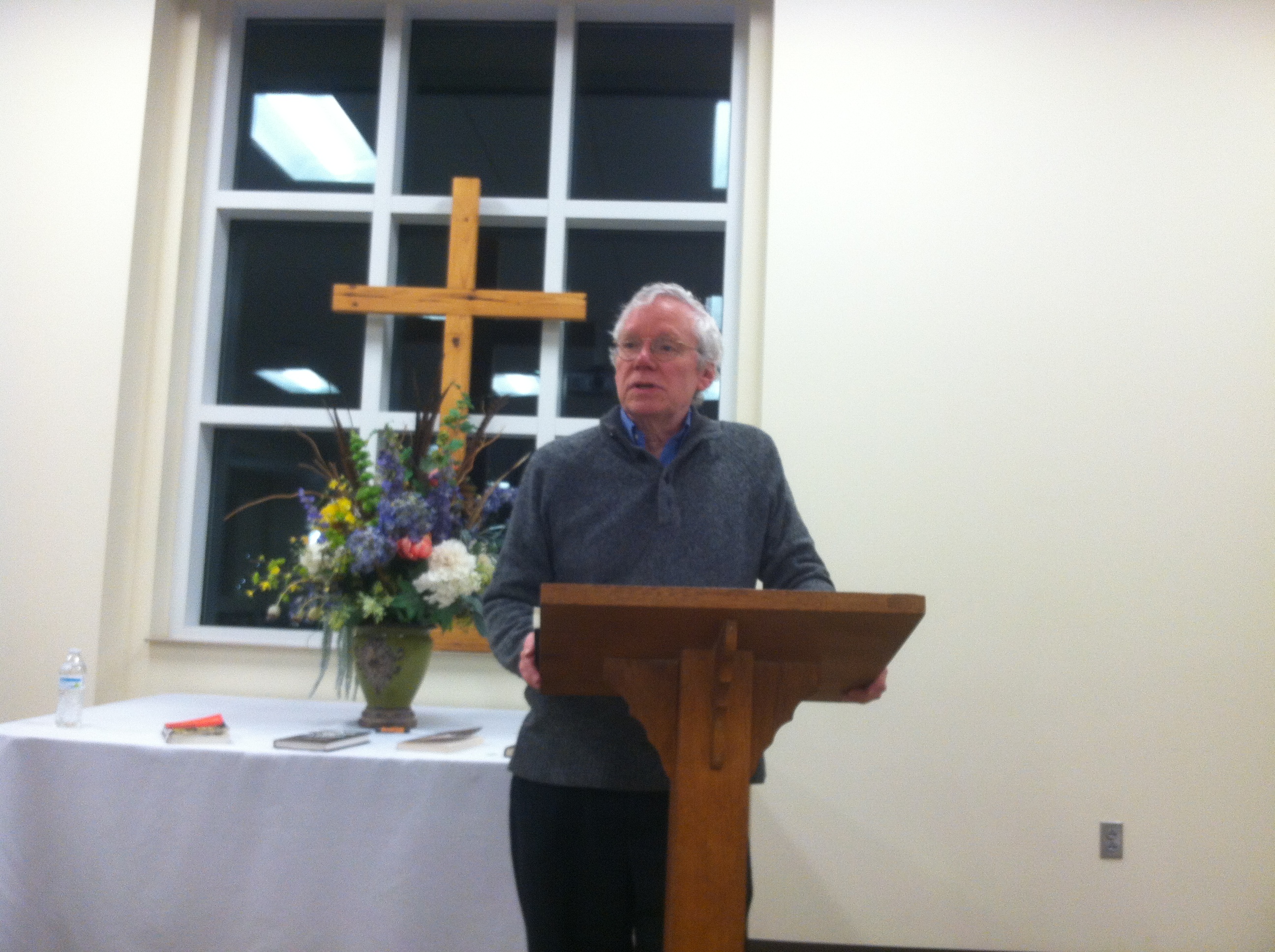
Author Mark de Castrique was the guest speaker last night at the February meeting of Rocky River Readers Book Club. He spoke to our group a couple of years ago, so we all looked forward to his return visit to talk about his two political thrillers, The 13th Target and The Singularity Race.

Mark de Castrique , speaking at Rocky River Readers Book Club, February 27, 2017

The 13th Target

Mark talked about how the economic recession of 2008 prompted him to write about the Federal Reserve in The 13th Target. For that novel, he created a protagonist named Rusty Mullins who was a former Secret Service agent.


The Singularity Race

Mark continued the Rusty Mullins character in The Singularity Race. That second thriller is about artificial intelligence. Mark pointed out the difference between the arms race in the 20th century (a race between nations) and the singularity race of the 21st century (a race between nations, organizations, corporations, universities, and possible a 17-year-old computer geek working at home.)

The book presents the conflict between the two opposing points of view by experts in the field as a backdrop for the story: (1) Ray Kurzweil, Director of Engineering, GOOGLE, says artificial intelligence will be “pivotal” in meeting the “grand challenges of humanity;” however, (2) Theoretical physicist Stephen Hawking says, “The development of full artificial intelligence could spell the end of the human race.” The book deals with the danger people who are working on artificial intelligence can be in as the race heats up. Rusty Mullins gets involved in trying to protect certain individuals who are in that race.

General remarks

In his planned topics and in answering questions from the audience, Mark talked about various aspects of writing fiction, including the following:

  • Beware of information dumps
  • When writing a series, it can be challenging to come up with fresh ways to describe location and a continuing character. You don’t want to bore the series reader, but the new reader needs to know some background from earlier books in the series.
  • The difference between a mystery and a thriller
  • If you create a world for a novel, you have to remember where everything is, whereas, if you set your story in a place that actually exists you can revisit the place to refresh your memory or even use Google Maps for details.

I have merely hit the highlights here. As I have said before, never pass up a chance to hear a writer speak.

Until my next blog post

I hope you have a good book to read. If you’re a writer, I hope you have quality writing time.

Janet

Trains Crash in Harrisburg, 1897

My blog post on February 7, 2017 Two Lines I Like from a Margaret Maron Novel was about train whistles. I quoted a couple of lines from Long Upon the Land, by Margaret Maron and reminisced about train whistles in my hometown of Harrisburg, North Carolina. Today’s blog post is an edited version of a two-part article I wrote for my “Did You Know?” local history newspaper column in Harrisburg Horizons weekly newspaper on April 4 and April 13, 2007.

nc-transportation-museum-6-19-10-010
Steam locomotive at the NC Transportation Museum, Spencer, NC.

Head-On Collision!

Did you know that the Sunday morning tranquility in Harrisburg was shattered on April 11, 1897, by the head-on collision of two steam trains?

North-bound Southern “fast mail” train No. 36 had orders to wait at Harrisburg until 11:15 for the south-bound local passenger train No. 11. The passenger train from the nearby town of Concord was running behind schedule. As No. 36 approached Harrisburg, engineer W.B. Tunstall of Danville, Virginia, expected to see No. 11 sitting in the siding.

Seeing no waiting train, Tunstall steamed ahead at 45 miles per hour. By the time the No. 11 came into view, there was nothing Tunstall could do but apply the brakes and jump out of the locomotive.

Newspaper accounts indicate that some Harrisburg residents saw what was going to happen but were helpless to do anything. The crash was heard for miles around and was likened to “a sharp crack of thunder.”  The engine of No. 11 ran over the engine of No. 36. The boiler of No. 36 rested on the floor of No. 11’s postal car.

An express car of No. 36 derailed and landed 150 feet from the track. Another car, hauling strawberries and fresh vegetables, was torn to pieces. Produce was strewn over the area. Train parts were thrown as far as seventy-five yards away.

None of the 96 passengers on No. 36 were injured. They immediately exited the train to see what had happened and, subsequently, did what they could to help the injured train and postal employees.

Less than three minutes after the collision, with its headlight up in the telegraph wires, No. 11’s postal car burst into flames. If not for the quick action of one of the train’s postal clerks, John Hill Carter, both trains probably would have burned, but newspaper accounts do not tell how he extinguished the fire. Mr. Carter was praised for risking his life to put out the fire and save others.

Casualties

The accounts of the agony suffered by the employees who were killed or injured in the wreck are given in great detail in the newspaper accounts of the day. Some were pinned under the wreckage, while others were badly burned by the steam from the boilers. Passengers formed a bucket brigade to throw cold water on one of the trapped men to help relieve his suffering from the steam.

Capt. Tunstall was found unconscious and badly scalded on an embankment. The conductor of No. 11, James Lovell of Richmond, Virginia, was cut on the face. Fitzhugh Lee, a porter on No. 11, was pinned in from the knees down. William Clemmens of East Durham, North Carolina, and R.E. Gallagher, an express messenger, were also injured.

The impact itself and the resulting release of steam caused four deaths and a number of serious injuries.

Those who were killed in the wreck or died immediately after were as follows:  Postal clerk T. Clingman Benton of Monroe, NC and Charlotte; John or Titus Eudy of Forest Hills in Concord; No. 36 fireman Will Donaldson of Lynchburg, Virginia; and J.C. Kinney of Thomasville, NC. Capt. Kinney was badly scalded. It was thought that he also inhaled steam which caused internal misery.

First Responders and Thrill Seekers

News of the collision was immediately telegraphed to the train depot in Charlotte. In less than forty-five minutes, a rescue train was dispatched from that city. It transported a Dr. McCombs and Dr. E.M. Brevard. Cots were taken for transporting the wounded and dead to Charlotte. Mr. Eudy survived the crash but died en route to Charlotte.

The citizens of Harrisburg were praised in the newspaper accounts for helping to clear the wreckage. Engines pulled from both directions to clear the track. Debris removal continued through the night, while another work crew laid a temporary track around the wreck. That track was in place by that night when the No. 35 fast mail train gingerly made its way through Harrisburg.

On April 12, 1897, The Charlotte Observer reported that hundreds of thrill seekers “on wheels, horseback and in buggies were flying toward Harrisburg. At 2 o’clock a horse could not be had in any of the stables for love or money.”  Many other people gathered at the train depot in Charlotte to await the arrival of the rescue train at 4 p.m.

That same newspaper account reported that one of the No. 36 passengers, Charles Bitterman of New Orleans, belonged to “The Riverside Wheelmen” cyclist club and was on his way to a bicycle race in New York. The article stated that Bitterman belonged “to National Circuit and will be here later with the professional men.” (Cycling clubs were all the rage in America and Europe in the 1890s.)

As I edit this article in 2017, the at-grade railroad crossings in Harrisburg have been closed and replaced by bridges in order to make way for the new high-speed rail. I have crossed that railroad thousands of times, and after learning about the 1897 train wreck in 2007 I was often reminded of the gory details of that fateful day when mangled and splintered train cars, bodies, and fresh produce were scattered in the nearby fields. It must have been an awful sight along with the screams of the injured who were in agony.

The train wreck of 1897 was, no doubt, long-remembered by Harrisburg and surrounding residents. When I interviewed Harrisburg resident and retired railway employee Harry R. Higgins on January 21, 2007, he remembered that Floyd Smith often came to the train depot in Concord when Mr. Higgins worked there. Mr. Higgins heard him tell about a block office employee who let a train into a block by mistake when another train was coming. The man realized his mistake and left in guilt because he knew what was about to happen. Mr. Higgins did not know if this was referring to the 1897 wreck in Harrisburg or not.

At the end of my article I asked for anyone who knew of a first-hand written account or oral history of the accident to please share that information with me, but no one offered additional details.

My Stint as a Newspaper Columnist

I am glad I had the opportunity to write a local history column in Harrisburg Horizons for six years. It gave me a reason to visit many of the older members of the community and take notes about their memories. Local newspapers preserved on microfilm sometimes provided a topic for me. I found it surprising that I had never heard about this horrific steam train head-on collision until I stumbled upon it in the microfilmed newspaper records. Mr. Harry R. Higgins has died since I asked him about the train wreck. He followed in his father’s footsteps as a railroad employee.

A Call to Action

If you have an interest in the local history where you live, I hope you talk to the older residents and record their memories. This is especially important if you live in a rural area or a small town that has never had a newspaper. That was the case here in Harrisburg. The town did not have a newspaper until 2006 and, unfortunately, it ceased publication in 2012.

Until my next blog post

Until my next blog post, I hope you have a good book to read. If you are a writer, I hope you have productive writing time. Please help me get the word out about my writing and my blog by clicking on the social media icons below or by the old-fashioned way – word of mouth. I appreciate it!

Janet

Save

5 things I learned about Social Media this weekend

If you follow my blog, bless you! If you follow my blog, you know that, among other things, I share my rocky journey into the world of social media. If you’re in the same boat, I hope you have found some information in my blog that was new and helpful to you.

Today’s post deviates from my plan to share a piece of my history writing. On Friday, I plan to post an article I wrote in 2007 about an 1897 head-on collision between two trains in Harrisburg, NC. Today I share my thoughts about five areas of social media that have come to my attention over the weekend.

Contact form on my blog

I was so proud on Friday that I’d figured out how to insert a comment form within the body of my blog. So far, that form has been a total flop. No one used it. If it was used, it didn’t work. I won’t try that again unless or until I learn how to benefit from it.

Quora

I mentioned Quora.com in my blog post on January 27, 2017, 3 Things to Try on Social Media in January , http://wp.me/pL80d-tt) and I’ve played around some with it some. Over the weekend, I found a 6-minute February 10, 2017 podcast offered for free on http://mschool.growtheverywhere.libsynpro.com/how-to-attract-9000-visitors-a-month-from-quora-ep-194 that/which gave several suggestions for those of us who are still trying to figure out how to best utilize Quora – or, more specifically, trying to determine if it is even a good tool for us or not. My problem is that I’m far removed from my college studies of political science to address most of the questions that come up in that area and I don’t feel qualified to answer questions about writing until I’ve gotten my first novel published. Bottom line:  I’m leaving my options open with Quora as I continue to find my niche.

Pinterest

On Saturday afternoon I finally got serious about trying to figure out where historical fiction fans hang out on social media. Finding https://www.statista.com/statistics/246183/share-of-us-internet-users-who-use-pinterest-by-age-group/ was helpful in a round-a-bout way since it presents the statistics for Pinterest users in 2016. Here’s the age breakdown:

36% 18-29 years old

34% 30-49 years old

28% 50-64 years old

16% 65 or older

I can’t afford full access to statista.com, but this bit of free information was helpful. These stats are not specific to fans of historical fiction, but I enjoy using Pinterest and it is beneficial to know what age people use it the most. It’s a piece of the puzzle.

I learned from Pinterest Analytics that I average having 13,440 views per month, but only 174 of them were engaged in my content. My most popular pin in the last 30 days was Chimney Tops Hike in Great Smoky Mountains National Park. In fact, three of my most popular pins were from my Great Smoky Mountains board. I originally set up that board (and the Blue Ridge Mountains board) to help draw attention to my vintage postcard book, The Blue Ridge Mountains of North Carolina. If this book sounds interesting to you, you can purchase in paperback or for Kindle on amazon.com.

I read another WordPress.com blogger’s post pertaining to historical fiction writers. https://kmguerin.wordpress.com/2016/07/18/social-media-for-historical-fiction-writers-part-4-facebook/https://kmguerin.wordpress.com/2016/07/18/social-media-for-historical-fiction-writers-part-4-facebook/ gave a good suggestion:  Find a trending topic or article related to the time period you are writing about and post it. I have a board on Pinterest, “Novel in Progress:  The Spanish Coin,” in which I pin photos and information pertinent to 1771 in the Waxhaws area in present-day Lancaster County, SC, as well as the Rocky River Presbyterian Church community in present-day Cabarrus County, NC (part of Mecklenburg County in 1771), and Salisbury, NC. These are the three geographic locations in my novel. I have 69 pins and 24 followers on that board as of February 20, 2017. I need to attract more people to that Pinterest board. I invite you to visit me on Pinterest by clicking on the Pinterest icon in my blog’s sidebar. Pin this blog post to one of your Pinterest boards by clicking on the Pinterest icon below.

Reading Medieval historical fiction author K.M. Guerin’s July 18, 2016 Time-Worn Pages blog post, https://kmguerin.wordpress.com/2016/07/18/social-media-for-historical-fiction-writers-part-4-facebook/http://www.socialmediaexaminer.com/how-to-get-more-pinterest-followers/ tipped me off to the fact that I was giving my blog readers a way to pin my posts to their Pinterest boards or share a link to my blog posts to their Facebook pages, but I did not provide a way for them to connect with me on social media. The proverbial lightbulb finally came on, folks!  I’ve said it before, and I’ll say it again:  I am not technologically savvy. What I’ve learned, I’ve had to dig up myself. I suppose that’s the best way to learn something new, but it surely is tedious. I read the above link to socialmediaexaminer.com on February 18, 2017 and worked until I figured out how to add “Follow me on Social Media” buttons in my blog’s sidebar. You wouldn’t believe what a sense of accomplishment that gave me!

LinkedIn and Instagram

I also picked up some ideas from reading a February 29, 2016 blog post by Jessica Lawlor on The Write Site. (https://thewritelife.com/quick-social-media-tips-for-writers-part-2) You can follow Jessica Lawlor on Twitter @jesslaw.) My takeaways:  (1) Republish some of my blog posts on LinkedIn; and (2) Instagram is a platform where I can build my brand and community, and I should refer to the link to my website or blog as found in my profile (i.e., using the words “Link in profile” somewhere in my post) because LinkedIn only allows accounts to display one link. I haven’t given up on LinkedIn, and I haven’t tried Instagram.

Until my next blog post

I hope you have a good book to read. If you’re a writer, I hope you have productive writing time.

Janet

5 Things to Try on Social Media in February

I learned a lot recently about LinkedIn from reading an online article by Lucy Jones on www.Hubspot.com (https://blog.hubspot.com/sales/fatal-linkedin-prospecting-errors-and-how-to-avoid-them#sm.0001shiksp16m8e91xasmjpt77n4a) titled “4 Fatal LinkedIn Prospecting Errors and How to Avoid Them.” (To follow Lucy Jones on Twitter:  @LucyJones_SIC.)

LinkedIn Terminology

Did you know that LinkedIn is a B2B prospecting resource? I didn’t have a clue what a B2B was, so I was lost from the start. Google is my new best friend. By going to that search engine I learned that B2B means business-to-business. “Prospecting” on LinkedIn apparently means looking for like-minded people or others in your field of interest. Most of the online information I found about prospecting on LinkedIn was geared to commerce. I’m interested in connecting with other historical fiction writers and fans of southern historical fiction.

Last week I had to identify my “ideal readers.” Now I find out that I must also identify my “ideal prospect” on LinkedIn. I think I’ll need two ideal prospects – one would be my ideal reader and the other would be my writing mentor.

I read that I need to start thinking of myself as an adviser on LinkedIn. I’m not supposed to “connect” with just anyone or everybody. I apparently need to solve someone’s “pain” or “buyer-pain” on LinkedIn. (I don’t know about you, but some of this LinkedIn lingo is becoming a pain for me!) From what I’ve read, I’m supposed to connect with people and tell them what “value” I can offer them from my expertise. Since I’m not an expert on anything, this is going to be a challenge!

Quoting from Lucy Jones’ article, “You’ve got to have a link with a prospect to have a successful ‘in’! There are multiple ways to leverage LinkedIn for introductions to prospective customers. But if you connect out of context, you’re doing more harm than good.”

Then there’s the LinkedIn etiquette to learn. It’s pretty much common sense or common courtesy if someone gives you a referral it’s only right to acknowledge the referrer.

Just when I thought things were beginning to make sense, Ms. Jones cautioned LinkedIn users (are users called Linkies?) as follows:  “If a good fit prospect is all over your site, engaging with your non-gated content….” Whoa! The next thing I need to do is find out what non-gated content is, so I switch back to my Google window.

My Google search led me to a 2014 (It appears that I’m already three years behind!) article on www.LinkedIn.com (https://www.linkedin.com/pulse/20140930153625-5817117-to-gate-or-not-to-gate-4-best-practices-for-using-content-for-lead-gen) titled, “To Gate or Not to Gate? 4 Best Practices for Using Content for Lead Gen,” by Shannon Rentner. As soon as I read the article title I was reminded that the more I learn, the more I have to learn. In other words, I don’t know enough to even know what I don’t know!

I was also reminded that trying to learn all the lingo of the various social media platforms at the age of 64 is probably not ideal, but here I am. Too bad I couldn’t learn all this 40 years ago! (Forty years ago I had mastered typing on an IBM Selectric typewriter and moved right along to struggle with how to write a rudimentary computer program and feed it into a keypunch machine in graduate school. When I walked out of the computer lab with my first stack of keypunch cards, I thought I’d attained the zenith of technology. Think chisel and stone tablet.)

I digress. Ms. Rentner gives the following definition of a gate:  “It’s the form an online user fills out in order to access a piece of content. This is also called a “Landing Page.”

Terms such as gate, un-gate, lead capture, and organic search are sprinkled throughout Ms. Rentner’s second best practice recommendation. The takeaway for me was that I need to have a giveaway on my website’s home page and other platforms. This can be an e-book or a document I’ve written. This actually sounds doable. All I need to do is figure out the logistics.

Ms. Rentner’s third best practice was that I should have a presence for my “product” on several social media “channels” like www.JanetsWritingBlog.com. Or @janetmorrisonbk on Twitter.

The fourth best practice Ms. Rentner recommends is about landing page optimization. This includes getting my prospect to fill out the form I should have for them to fill out in order to enter my giveaway contest.

Getting back to Lucy Jones’ article, the third fatal error is not following up with a prospect at the right time. The fourth fatal flaw is, “Having a poorly optimized LinkedIn profile.” This involves sharing content via Pulse – which I know nothing about. It also involves tagging contact. Perhaps this will become clearer when I stop reading about LinkedIn and start using it.

My brain says

In light of all I’ve presented in today’s blog post after reading Lucy Jones and Shannon Rentner, my brain tells me to do the following:  Revisit the LinkedIn account I created in 2013 and (1) improve my profile; (2) identify my ideal reader; (3) identify a writing mentor; and (4) write an article to post on LinkedIn. Also, (5) figure out how to give away a short story I’ve written.

My reasoning brain says

In a perfect world in which I would not have chronic fatigue syndrome and the energy and memory problems that are part and parcel to that illness, I might pursue the five tasks my brain is telling me I need to do in the immediate future. I don’t live in that perfect world, though. The reasoning part of my brain says, “Wait a minute. You know you aren’t able to commit the time and energy that would be necessary to accomplish those things.” I will add these five items to my to-do list but, at best, I will be able to tackle them slowly.

Hitting the reset button

Social media is not my forte. I’d rather be editing my novel manuscript, working on the sequel, and reading books I want to read. Social media demands have dominated my time and energy for the last several months. I’m doing social media because I want to get my name and brand out there as a writer. When the social media aspect of the writing process precludes me from writing fiction, though, I believe I’ve gotten my priorities out of whack.

I want feedback from writers!

As a writer, what is your experience with LinkedIn? Have you seen benefit from using LinkedIn? How much time do you devote to LinkedIn? Which social media platform have you found to be most beneficial to you and your readers?

I want feedback from historical fiction readers!

As a fan of historical fiction, do you connect with writers on LinkedIn? More importantly, what is your go-to social media platform for following your favorite writers?

I want feedback from librarians/media specialists, book editors, & book publishers!

What value have you found in LinkedIn for connecting with writers?

If you’re on LinkedIn

My account name is Janet Morrison – Freelance Writer, Aspiring Novelist.

Another way to contact me

I’m finally adding a contact form here. (I hope it works!)

← Back

Thank you for your response. ✨

Until my next blog post

I hope you have a good book to read. If you’re a writer, I hope you have productive writing time. I will still be finding my way!

Janet

The First Line from a Novel by Tom Rob Smith

“Since Maria had decided to die her cat would have to fend for itself.” — first sentence in Chapter One of Child 44, by Tom Rob Smith

Tom Rob Smith’s novel, Child 44, is about a serial child killer in Stalinist Russia. It is a compelling read, and I plan to read books two and three in this trilogy – The Secret Speech and Agent 6.

I knew the general premise of the story when I picked up Child 44, but the opening line of the first chapter intrigued me. The reader isn’t sure why Maria “had decided to die.” That’s what a good novel’s “hook” does. It pulls the reader in enough to make him or her read the next sentence, and the next sentence, until the reader is “hooked” and can’t stop reading.

My first thought when I read the first sentence of chapter one in Child 44 was that Maria was contemplating suicide. That was not the case. Maria (and lots of other people in her village) were starving to death. She knew the end was near.

Until my next blog post, I hope you have a good book to read. If you’re a writer, I hope you have productive writing time.

Janet

11 Things I’ve Learned about Writing

A blogging tip

A blogging tip I read last year was that a blog post titled “11 Things. . .” will attract more readers than one whose title starts with “10 Things. . .” so that’s what I’ve started doing. I’ve been writing about 11 things I’ve learned about a different subject each month.

I worked on my list of 11 things I’ve learned about writing a couple of months ago. I easily came up with nine things. I forgot to look at that list again until last night. My sister asked me what my blog post was going to be about. When I told her it was supposed to be 11 things I’ve learned about writing but I only had nine things on my list, she said, “I guess you have two more things to learn about writing!” We laughed, and I knew I had to work her quick comeback into the post.

Funny as her response was, I realized that I don’t have two more things to learn about writing. I have 2,000 or 2,000,000 more things to learn about the craft! There will always be something to learn about writing.

11 things I’ve learned about writing

  1. Mine will never be good enough.
  2. Since it is unlikely that my writing will ever measure up to that of the great writers, I should compare my writing today to my writing of yesterday and always look for improvement.
  3. If I wait until my novel manuscript is perfect, it will never be published.
  4. If no one ever reads my southern historical novel manuscript whose working title is The Spanish Coin, I must remember that my efforts were not wasted because I had a blast doing the research and the writing!
  5. There are many rules a novice fiction writer must follow, but established authors don’t have to always abide by those rules.
  6. Have your second novel well underway before you start trying to get your first one published.
  7. To be a good writer, you must be an avid reader of good writing.
  8. There is always room for improvement, so eventually you have to stop editing your work, submit it, and move on to the next project.
  9. Books about the craft of writing don’t all agree on the fine points of writing, so at some point you must rely on your gut and what feels right to you.
  10. Some days words come easier than on other days.
  11. Writing is hard work.

Until my next blog post

Until my next blog post, I hope you have a good book to read. If you’re a writer, I hope you have productive writing time.

Janet

Two Lines I Like from a Margaret Maron Novel

“Trees and thick shrubbery hid most of the track from view and muffled the noises in summer, but in winter, when Dwight was a boy and the wind was right, the train whistle could be heard at night all the way out to the farm. A lonesome sound, yet somehow, oddly comforting.” — From Long Upon the Land (A Deborah Knott Mystery), by Margaret Maron.

These two sentences make me smile. I took hearing the Southern Railway train whistles for granted all my life until last year when the at-grade rail crossings in our town were closed and replaced by bridges. This was done to make way for “the high-speed rail” between Charlotte and Raleigh. There is no longer a need for the train whistle in Harrisburg. Twenty-five trains now almost silently pass through the small town every day. I miss that whistle.

The North Carolina Railroad

The North Carolina Railroad first laid rail lines through Harrisburg in 1854. In fact, the town came into existence because a depot was built when the railroad came. Although I lived five miles from town, I could often hear the train whistle. I could lie in bed at night and hear it. It sounded particularly close if weather conditions were just right or there was snow on the ground.

020

Margaret Maron summed up my feelings about the train whistle. “A lonesome sound, yet somehow, oddly comforting.” I wish I’d written that sentence. Hearing a train whistle in the quiet wee hours of the night always made me feel that way. I would think about the passengers on the train. Was the train going north to Washington, DC and New York City, or was it going south to Atlanta and New Orleans? The trains were going somewhere and I wasn’t. Sometimes I envied the people on those trains, but mostly I just felt comfort in knowing that even though I was in my nice warm bed a few miles away life was moving on.

The Aberdeen Carolina & Western Railway

There is another rail line just a couple of miles in the other direction from my house. The Aberdeen Carolina & Western Railway operates one train per day on that line. For the near future, at least, I will be able to hear that train whistle because there is no bridge to carry vehicular traffic over the line. No doubt, that whistle will eventually become obsolete. Train whistles are going the way of the little red caboose.

I am privileged to live on land that has been in my family since the mid-1700s. I come from a long line of farmers. I wonder how my great-great-grandparents felt the first time they saw or heard a train go through Harrisburg in 1854. How exciting the advent of the locomotive in our community must have been for my eight-year-old great-grandfather!

Space Travel

Ironically, I was eight years old when the National Aeronautics and Space Administration (NASA) launched the first manned Mercury spacecraft in 1961. The 15-minute suborbital flight piloted by Alan B. Shepard, Jr. was a milestone for the United States. Although I didn’t see the launch in person, I loved seeing the pictures on TV and in newspapers and magazines. It was a great time to be a child!

Who knew a couple of sentences from Margaret Maron in Long Upon the Land would bring such thoughts to my mind? That’s the magic of fiction!

Your favorite line(s) from a novel

Do you have a favorite line or two from a novel? Feel free to share in the comments section.

Until the next time I blog

Until the next time I blog, I hope you have a good book to read. If you’re a writer, I hope you have productive writing time. I invite you to share my blog post on social media by using the icons below or recommend it to your friends.

Janet

Save

Save

What I read in January 2017

Armed with my 2017 Reading Challenge, I started January with excitement to plunge into another year of reading. I was not disappointed.

Glory Over Everything:  Beyond The Kitchen House, by Kathleen Grissom

The first novel I read in January was Glory Over Everything:  Beyond The Kitchen House, by Kathleen Grissom. I enjoyed Ms. Grissom’s The Kitchen House last October, but this sequel was really outstanding. I’m partial to historical fiction, and Glory Over Everything delivered on all counts — history, sense of time and place, and suspense.

I recommend that you read The Kitchen House first and follow it soon with Glory Over Everything because there are lots of characters and connections to remember. The sequel is the story of a light-skinned man passing as white in the 1820s and 1830s who, while doing a good deed, is hunted down as a runaway slave in northeastern North Carolina and its Great Dismal Swamp. Numerous people aid his attempt to escape via the Underground Railroad. More details might spoil the book for you.

A Body in the Snow:  A Bebe Bollinger Murder Mystery, by Christoph Fischer


I believe it was via Twitter that I learned of Christoph Fischer and his e-book, A Body in the Snow:  A Bebe Bollinger Murder Mystery. Intrigued by a mystery written by a new writer, I was eager to read this book. Mr. Fischer did a good job with character development. Each of his main characters had distinguishing habits, quirks, and personalities. He managed a large cast of characters.

This story, set in Wales during a snowstorm, kept me guessing. First, I was wondering whose body would be found in the snow, and then I kept trying to figure out who the murderer way. The book was published by Createspace Independent Publishing Platform last September, and it has a great cover. You can’t judge a book by its cover, but this indie book has a very eye-catching one.

All the Light We Cannot See, by Anthony Doerr

Yes, I finally got back to the top of the public library system’s waitlist for All the Light We Cannot See, by Anthony Doerr. After having read one-third of it in 2016, I had some trouble getting back into the story in January. I should have taken the time to start over instead of jumping in where I left off weeks ago.

Set in France during the German occupation in World War II, it is a Pulitzer Prize winning novel about a blind girl whose father makes a miniature replica of the city they live in so she can memorize the streets and buildings and find her way around. The chapter titled, “Number 4 rue Vanborel” is several pages of exquisite prose describing what is left behind in a city after the bombs of war. It is an almost poetic list of phrases and words that illustrate the small things left behind — the pieces that someone will have to pick up someday so the city can live again.

Irena’s Children, by Tilar J. Mazzeo

Continuing in the World War II vein, I read Irena’s Children, by Tilar J. Mazzeo. It is the true story of Irena Stanislawa Krzyzanowska Sendler, who saved 2,500 Jewish children in Warsaw, Poland from certain death in the Nazi concentration camps.

Irena’s father was a physician. Unlike many Polish doctors of the day, he did not mind treating Jewish patients. Many of them were too poor to pay him anything. He was an activist for equal rights and an eight-hour workday. He died of typhoid fever when Irena was just six years old, but she had inherited his compassionate heart.

For centuries, Poland had struggled for independence from neighboring Germany and Russia. At the University of Warsaw, Jews had to sit on the left and Roman Catholics on the right. Irena chose to sit with her Jewish classmates and was, therefore, beaten along with them in the riots of 1935. She was suspended from the university for marking through “Aryan” on her student identification card.

The book chronicles the German occupation of Warsaw, their forcing all Jews in the city to move into the worse part of town — which became known as the Warsaw Ghetto. The systematic rounding up of Jews to be transported to the Treblinka concentration camp consumed Irena’s life. Being a social worker/public health specialist gave her the opportunity to visit the ghetto to see to the health of the residents. This enabled her to learn the people, identify the children, and create a network for smuggling the children out. As if that weren’t enough, on flimsy cigarette paper she made secret lists of the children’s identities in a code she developed.

Turbo Twenty-Three, by Janet Evanovich

After reading two “heavy” books about World War II, I welcomed the chance to read Janet Evanovich’s latest novel in her Stephanie Plum series. I discovered her books several years ago. Since then I have read all 23 of them. I don’t have as many laugh-out-loud moments while reading her most recent books as when reading the earlier ones, but I still look forward to them as a fun read.

Stephanie Plum is a white accident-prone bounty hunter in Trenton, New Jersey. Her sidekick is a large black woman who used to be a prostitute. To say Lula has an attitude would be an understatement.

Stephanie is in love with two men. One is a police officer she’s known since first grade. He has trouble with commitment. The other man she is in love with has a chiseled body like a Greek god, owns a security company with resources the CIA would envy, and he has no interest in marriage and a family.

Turbo Twenty-Three includes Stephanie’s cousin the bail bondsman she works for, Stephanie’s parents, and her Grandma Mazur — who attends wakes at the local funeral home to try to pick up men. This particular novel involves a clown and the mysterious murders of several employees of an ice cream plant.

Sell Your Story in a Single Sentence, by Lane Shefter Bishop

I was so impressed with this book that I wrote my blog post about it on January 17. I won’t repeat that post, but I invite you to read it if you haven’t already done so. If you are a writer or have a curiosity about the process an author goes through in creating a book, you might enjoy reading that earlier blog post. It is an instructional book about the process of writing a logline. A logline is a single sentence that identifies a story’s protagonist, what the protagonist wants, and what’s at stake.

Other reading in January

In addition to the above books, in January I read a chapter in the Bible every day. This is something I’ve set out to do on many first days of January. I regret to admit that I have not made it through an entire year yet. I hope 2017 will be different. This time I started with the New Testament, which I believe will be easier to stick with than the Old Testament. In January I read all of the Book of Matthew and started on the Book of Mark.

I am also reading a poem every day in 2017, or at least I have so far. Reading from A Little Book of Cherished Poems, compiled by Kay Anne Carson, I read poems by such poets as Frost, Tennyson, Longfellow, and many poets and poems I had not read before.

Until my next blog post

Until my next blog post, I hope you have a good book to read. If you’re a writer, I hope you have productive writing time.

Janet