What I read in October

As is my custom, my first blog post of a new month is about what I read in the previous month.

The Kitchen House, by Kathleen Grissom

The first book I read in October was The Kitchen House, by Kathleen Grissom. It was the most absorbing story I’ve read in quite a while. Set in Virginia in the 1790s, it opens with Lavinia, an 11-year-old orphan girl from Ireland who is relegated to the kitchen house on a plantation. The house slaves soon become the only family Lavinia knows.

Ms. Grissom did an excellent job developing all the characters in this her first novel. From the ship’s captain who owns the plantation, his drug-addicted wife, their son, the house slaves, some of the field slaves, the overseer, and a white neighbor, each of these main characters were carefully fleshed out by the author. There are many tangled relationships among this cast of characters. As the story unfolds, the reader learns that some relationships are not as they seem. As an adult plantation mistress, Lavinia learns that she is no more free than the slaves.

I highly recommend The Kitchen House. It’s a real page turner! It was the October selection by the Rocky River Readers Book Club. I’m so glad one of the club members recommended this work of historical fiction.

It is my understanding that Kathleen Grissom had not intended to write a sequel to The Kitchen House until her readers demanded to know what happened to the characters after that first book ended. What a great compliment for a first-time author! I look forward to reading the sequel, Glory Over Everything:  Beyond the Kitchen House.

Redemption Road, by John Hart

I also read Redemption Road, by North Carolina author John Hart. A much different read than The Kitchen House, reading this literary thriller took me a little out of my comfort zone. It took me a few pages to get into the book, but then I was hooked and I became intrigued to find out how each of the main characters found redemption. It was darker and contained more graphic violence than most books I read, but I’m trying to stretch myself this year and read books from some genres to which I don’t normally gravitate.

Redemption Road reminded me that every person has baggage. It forced me to think about the fact that we encounter individuals every day who are suffering in silence due to physical abuse or other secrets they harbor. We all seek acceptance and the approval of others on some level. If we’re lucky, we find redemption — which should not be confused with revenge. We need to be patient with one another and not so quick to judge, since we don’t know what emotional, physical, or mental burden another human being is living with.

The Other Einstein, by Marie Benedict

Reminiscent of Clara in the novel Clara and Mr. Tiffany, this historical novel is based on the lives of Albert Einstein and his first wife, Mileva “Mitza” Maric. She was a brilliant physicist and mathematician in her own right, but as the years went by she lived more and more in Albert’s shadow. In fact, she was more gifted in math than her famous husband, whom she met at university in Zurich, Switzerland. Since at least the 1990s, there has been speculation that Mitza Einstein had a bigger hand — perhaps even the major hand — in much of the work for which her husband was credited. Perhaps it was Mitza who formulated the Theory of Relativity, but in the early 1900s it was nearly impossible for a woman to be recognized for intellectual accomplishments.

Mrs. Lee and Mrs. Gray, by Dorothy Love

I read the first 11 chapters of Mrs. Lee and Mrs. Gray, by Dorothy Love before it had to be returned to the public library. I hope to get back to it soon. It is based on the relationship between Mrs. Robert E. Lee and a slave named Selina Norris Gray.

There are too many good books out there calling my name and too little time for this slow reader to get to them all.

Until my next blog post in a few days, I hope you have a good book to read and, if you’re a writer, quality writing time.

Janet


Character Arc Development & The Spanish Coin

I’ve been reading about character arc and how to develop it. This has made me reflect on my 95,000-word historical fiction manuscript.

The Spanish Coin

The working title for my novel is The Spanish Coin. It begins with a dead body. The main character is Nancy. There is a cast of characters, some of whom support Nancy and one who sets out to ruin her. The story is set in South Carolina in 1771.

The main plot is about determining who murdered the local pastor. Was it Nancy?

There is a subplot about a black male slave and a free black woman. Their story runs throughout the book.

There is a subplot about Nancy’s friend, Betty, and a stranger who visits the community.

The Betrayal

Then there is the sequel that I’ve plotted out. Its working title is The Betrayal. In fact, I’ve outlined what appears to be three books to follow the story I started in The Spanish Coin. I’ve been working on this series for more than a decade, but first I need to get The Spanish Coin published.

Character Arc

There are three types of character arc, according to author and blogger K.M. Weiland:  positive, flat, and negative. As I understand it,  a positive character arc is one in which the character changes for the better or perhaps discovers she or he is stronger than they’d thought. A flat arc is one in which characters take on the world or the problem the world throws at them, but they aren’t changed inside or not changed much. Negative arcs are sometimes found when the character deals with failure.

My reading this week has brought to my attention how much my character development in The Spanish Coin sets the ground work for any books that might follow. Since I only planned to write one book, I did not have in mind how character development in The Spanish Coin would influence the plotting of sequels. I got so involved with the main and secondary characters that I wanted to know what happened to them. So far, I have an 11,000-word outline.

I need to review The Spanish Coin manuscript to look for changes I need to make regarding character development and character arc in light of my plan to continue some of the characters’s stories in additional books. With that accomplished, I need to stop procrastinating and hire an editor to evaluate the manuscript.

Until my next blog post in a few days, I hope you have a good book to read. If you are a writer, I hope you have productive writing time.

Janet

J.D. Vance – Notes from an Author’s Interview

Charlie Rose is my favorite interviewer. He welcomes people from all walks of life to his PBS program, “Charlie Rose,” and once in a while he interviews an author.

On October 18, 2016, Charlie Rose interviewed J.D. Vance, author of Hillbilly Elegy: A Memoir of a Family and Culture in Crisis. Born in Kentucky, Vance grew up in the culture of Appalachia. When he went to Yale Law School, he was possibly the only middle class white guy there. He said nothing was ever personally directed toward him, but he felt like there was a feeling of disdain for Appalachia among the people at Yale.

Vance talked about the destructive  attitude that people in Appalachia acquire from their communities. As a teenager, he started sensing that the people were cynical and frustrated. They were distrustful of the people who represented them in government.

At the age of 14, Vance started living with his grandmother. She instilled in him the importance of hard work and study. She worked to overcome the negative influences that she knew would try to pull him down.

Vance talked about the cultural divide in the United States and how the 2016 Presidential election has hit a nerve with many of the people of Appalachia. He said, “Their pride is disappearing because their jobs are disappearing.” (I think I got that quote right. The interview moved along faster than I could take notes.)

He said there’s not enough dialogue between the people of Appalachia and the people from other parts of the country. He thinks more communication would go a long way toward erasing some of the misconceptions outsiders have about Appalachia and its people.

Charlie Rose did not ask Vance anything about the craft of writing or how he goes about writing. That is what I most look for when I hear or read an interview with an author, but I guess such questions are reserved for fiction writers. The point of Mr. Rose having J.D. Vance on his program was to discuss the cultural divide and to get Vance’s firsthand assessment of it.

Until I blog again in a few days, I hope you have a good book to read. If you’re a writer, I hope you have quality writing time.

Janet

Mark de Castrique’s Mystery Writing Workshop – Part 2

Today’s blog post is a continuation of my blog post on October 19, 2016, about Mark de Castrique’s Mystery Writing Workshop I attended last Saturday at Lanier Library in Tryon, North Carolina.

lanier-library-in-tryon-nc-001

Picking up where I left off on October 19, today I will start by talking about the first of two writing exercises we did during the workshop.

A Writing Exercise

The most challenging part of the three-hour workshop was the first writing exercise. Participants were instructed to do the following in 20 minutes:

  1. Create a character who was a police officer or detective
  2. Think of (or write, if we wished) a bio for that character
  3. Place that character in a single setting
  4. Write a narrative scene in first person
  5. End the scene just before a body is discovered.

Each of us read our work aloud. Mr. de Castrique gave everyone positive feedback. I was amazed at the talent in the room. Mr. de Castrique did a good job making us feel like we were in a safe, non-judgmental place. He put all of us at ease.

Carolyn Wheat’s Four Arcs of a Book

Mr. de Castrique recommended How to Write Killer Fiction, by Carolyn Wheat. Ms. Wheat says a book has the following four arcs:

  1. The beginning
  2. The middle
  3. The place where the detective in a murder mystery faces something that seem impossible to overcome
  4. The ending.

Mr. de Castrique described each arc. He talked about novel endings that work and endings that fail.

Amateur Sleuth

The next thing Mr. de Castrique addressed was putting an amateur sleuth in your book. He talked about the advantages and disadvantages of doing that.

Theme

Mr. de Castrique said the theme is “the thing in a book that will haunt you.” He cautioned us that a book can turn into a sermon if the author tries too hard to drive a point home. (He gave Stephen King credit for having said that, but I paraphrased it.)

Group Writing Exercise

The workshop ended with a group writing exercise. It was a great idea and should help me to think of future story ideas. We had to be in agreement on our choices throughout the exercise, but it would certainly work for a writer working alone. Here’s what we got to work through together:

  1. Select a closed setting, such as a shopping mall
  2. Select six individuals whose occupations would place them at that closed setting without other people being there
  3. Assign an age to each of the six characters
  4. Decide on a secret that each character has
  5. Which one gets murdered and which one is the killer?

Five Takeaways

Five points that I took away from the workshop are as follows:

  1. A good book is one where at the end you liked the world the writer created so much that you would read the book again.
  2. If you can take a scene out without hurting the story, it never should have been there to begin with.
  3. The reader should forget she or he is reading.
  4. Every reader brings his or her own life experiences to the reading of a book, so it’s no wonder that you might hate a book but someone else might say it is the best book they’ve ever read.
  5. When stumped on what to write about, I should refer to last Saturday’s group writing exercise.

After the workshop, Mr. de Castrique autographed my copy of his new book, The Singularity Race. It was an enjoyable afternoon and well worth the cost and time invested in attending the workshop.

Until my next blog post in a few days, I hope you have a good book to read and, if you’re a writer, I hope you have productive writing time.

Janet


Mark de Castrique’s Mystery Writing Workshop – Part 1

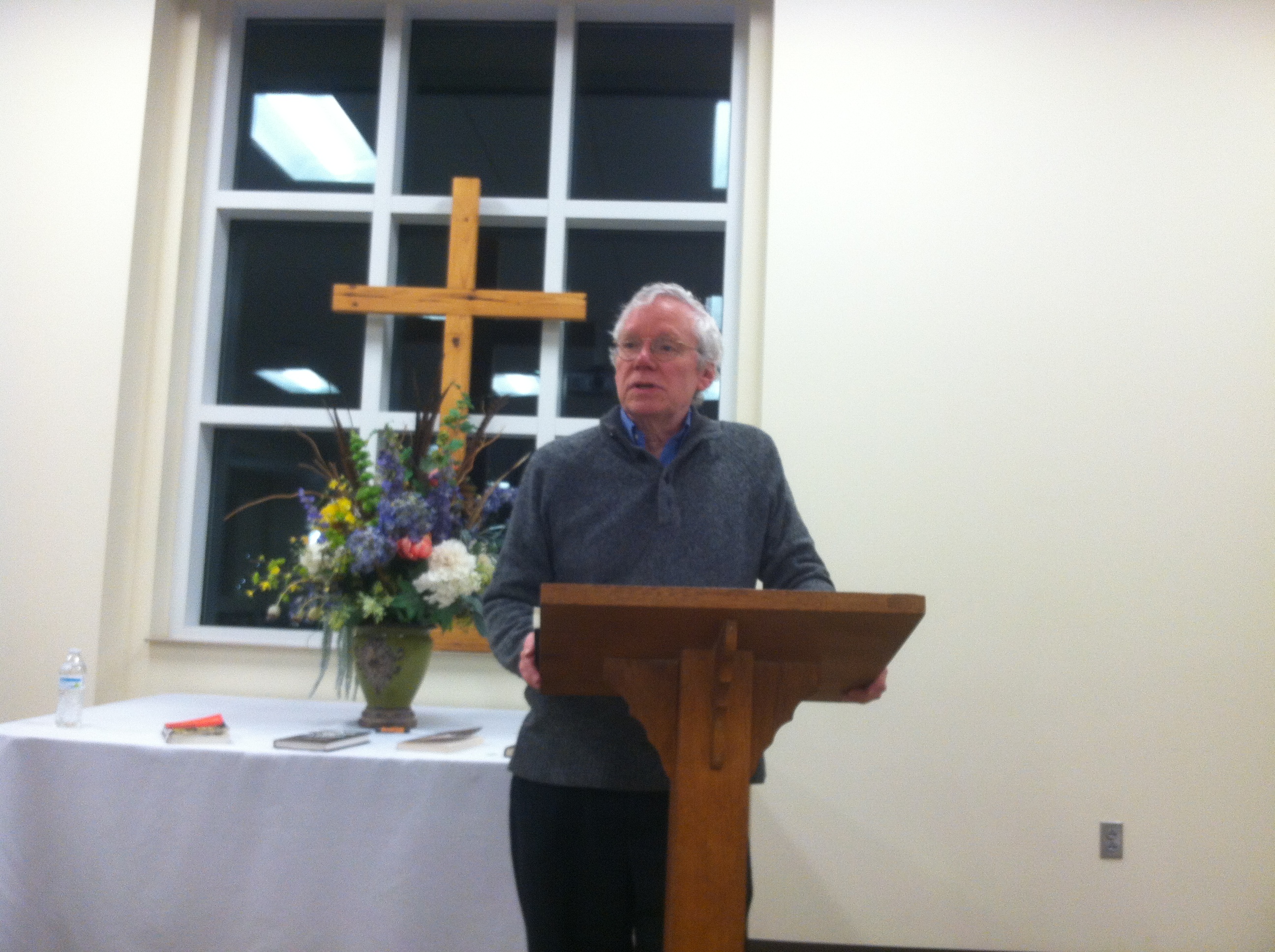
Mark de Castrique conducted a mystery writing workshop at Lanier Library in Tryon, North Carolina on Saturday afternoon. Having heard this author speak twice in the last several years, I knew I would benefit from attending his workshop.

Tryon, NC

Nestled in the foothills of the Appalachian Mountains, Tryon is an inviting place to visit on a beautiful early fall day. There were lots of people out and about in the quaint downtown business district. Tryon is dog friendly. Some of the shops provide water bowls on the sidewalks to quench the thirst of local dogs on their daily walks.

The Book Shelf Bookstore

An added highlight on Saturday was visiting the new location of Penny Padgett’s The Book Shelf Bookstore in Tryon. The shop recently moved just a few feet down South Trade Street from its former location. I was delighted to reconnect with Penny. She graciously had a book signing for me (see “Book Signing at The Book Shelf in Tryon, NC” on my blog on April 14, 2015) to publicize my vintage postcard book, The Blue Ridge Mountains of North Carolina. The new shop gives Penny more space for books and book signings. Visiting her shop also gave me a chance to purchase Mark de Castrique’s latest and sixteenth novel, The Singularity Race.

Aristotle

In the three-hour workshop, Mr. de Castrique covered Aristotle’s six components of a story:

  1. Plot
  2. Character
  3. Thought
  4. Language
  5. Melody and
  6. Spectacle.

He talked about sequence in plotting — how it has cummulative power. “A” must come before “B” which must come before “C.” He said the worst plotting for a novel is episodic, meaning the sequence of events can be in random order. (Think episodes of the old TV show, “Gilligan’s Island.” One episode did not build on the previous one.) That works for a TV program but not in a mystery novel.

What if?

Mr. de Castrique talked about the value of a writer asking, “What if?” to get his or her creative juices going. Other topics included write what you know and write from a sense of place.

Illusion of Authenticity

Mr. de Castrique talked about the different methods of research:

  1. Memory
  2. Imagination, and
  3. Fact

and how a novel needs the illusion of authenticity. If you’re writing something that cannot happen, you need to set it up so that it can possibly happen. It has to be believable.

Reader Response Theory

Mr. de Castrique talked about reader response theory, which was a new concept for me. It addresses the following:

  1. Real author
  2. Implied author
  3. Narrator
  4. Characters
  5. Narratee
  6. Authorial audience, and
  7. The reader

In my next blog post on Friday, I will write about the rest of the workshop, including descriptions of the two writing exercises we did. Until then, I hope you have a good book to read and, if you’re a writer, I hope you have productive writing time.

Janet

A Novel’s First Line

Today I’m sharing the first line of a novel. That was already my plan before I read Andrea Lundgren’s “Crafting An Authentic Beginning” that I reblogged here yesterday.

As I have kept a list of the first lines from novels in my writer’s notebook, I have focused on the first line only. In light of Ms. Lundgren’s blog post, going forward I will consider how or if the first line portrays the overall tone of the book.

Our Souls at Night, by Kent Haruf

The first line of a novel I’m sharing today is from Our Souls at Night, by Kent Haruf:

“And then there was the day when Addie Moore made a call on Louis Waters.”

Is it acceptable to begin a sentence with a conjuction?

What initially caught my attention was the fact that this sentence began with a conjunction. Somewhere along the line, I was taught that was unacceptable; however, I have discovered that this is a myth that has hounded the English language for centuries. There are, apparently, no official English grammar rules against starting a sentence with a conjunction. I will try to put that myth to rest in my mind. Old habits are hard to break.

More importantly, it’s a great sentence

I turn my attention to the more important aspect of this first sentence. The sentence did what it was designed to do. It pulled me into the book. I immediately wanted to know who Addie Moore and Louis Waters were and why Addie visited Louis. The sentence piqued my interest. I was curious to read the next sentence.

When I look at the first sentence in Our Souls at Night, as compared with the overall tone of the novel, I conclude that the opening sentence is in complete agreement with the novel. It was a perfect way for the author to introduce us to Addie and Louis. I don’t want to spoil the story for you, so I will just say that Our Souls at Night is a story of love and comfort found later in life by a widow and a widower.

The opening sentence of Our Souls at Night plunges the reader into the middle of the story. The author could have filled several pages with backstory about Addie and Louis and built up to “the day when Addie Moore made a call on Louis Waters.” I don’t think that would have necessarily grabbed my attention like the way Mr. Haruf started the book.

A movie in the works?

Our Souls at Night was Kent Haruf’s final novel. I have read that it is being made into a movie with Jane Fonda as Addie and Robert Redford as Louis. Something to look forward to! I hope the movie won’t disappoint.

Until my next blog post, I hope you have a good book to read. If you are a writer, I hope you have some quality writing time.

Janet

Crafting An Authentic Beginning

This blog post by a book reviewer is enlightening, and it gives me something new to think about regarding the writing of a novel’s hook. I’ve been taught in classes and in reading how-to books about writing that the opening sentence/paragraph/page should grab the reader’s attention. This is the first article I’ve read that addresses the importance of a novel’s opening matching the rest of the book in tone.

I wish I’d written that!

If the thought, “I wish I’d written that!” hits me while reading a book, I smack my forehead and write the sentence in my writer’s journal.

Figurative Language

In one section of my writer’s journal, I keep an ever-growing list of favorite lines from the books I read. They are sentences I want to read again and study. Some are examples of good use of description, as is the case with the sentence I quote from a David Ignatius novel in today’s blog. Some sentences get added to my list because they present a clever turn of a phrase that results in a line that rolls off the tongue. Others might be examples of metaphor, hyperbole (e.g., “I smack my forehead”), imagery, or another tool that makes language so pleasant to read or say aloud. These sentences grab my attention for a variety of reasons. I stop and reread them. I appreciate the effort it took for the author to write them. They are sentences I wish I had written.

A quote from The Director, by David Ignatius:

“She was a handsome woman, all her features fused into a hard, dark jewel: the lustrous jet-black hair that maintained its perpetual youthful color, the intelligent face that kept its smile even when she was demolishing a bureaucratic opponent; the lithe body of a former dancer.”

Let’s look at it

What a sentence! For starters, “handsome woman” is a description I rarely hear, but it is usually used to describe a tall, sturdy woman with regular features. The words, “handsome woman” immediately bring to mind a woman of a certain physical presence. She carries herself well even though she is not a young woman. She doesn’t quite fit the definition of “pretty,” but she has pleasant, memorable features. It’s one of those things that is difficult to describe, but I know it when I see it.

The rest of the above sentence written by David Ignatius is chock-full of descriptive words that paint a picture of this woman.

Read this sentence from The Director again:

“She was a handsome woman, all her features fused into a hard, dark jewel: the lustrous jet-black hair that maintained its perpetual youthful color, the intelligent face that kept its smile even when she was demolishing a bureaucratic opponent; the lithe body of a former dancer.”

You have no trouble picturing in your mind what this woman looks like, do you? I wish I’d written it.

Until my next blog post in a few days, my wish for you is that you have a good book to read and, if you are a writer, I hope you have productive writing time.

Janet

What I read in September

My first blog post each month is about the books I read during the previous month. Maybe my comments about those books will prompt you to read (or not read) one of my choices.

The Woman in Cabin 10

The first book I finished reading in September was the psychological crime thriller, The Woman in Cabin 10, by Ruth Ware. This novel took me out of my reading comfort zone. Early on lots of characters were introduced and it was a little daunting to keep them straight; however, each one’s personality soon came through and prevented confusion. The author is British, so occasionally there was a word that prompted me to use the definition feature on my e-reader. Reading The Woman in Cabin 10 makes me want to read Ruth Ware’s first novel, In a Dark, Dark Wood, even though its review are all over the place.

Prayers the Devil Answers

The second book I read in September was Prayers the Devil Answers, by Sharyn McCrumb. Inspired by on event that took place in Kentucky in 1936, this novel is the story of a woman who became a county sheriff in Tennessee after her husband’s death. Albert, her husband, had only been the county sheriff for a short time when it became ill and died in a few days. His widow, Ellie, quickly figured out that she needed to find a way to support herself and their two children.

As only Sharyn McCrumb can do, she spins a story about a strong female protagonist and backs up the tale with numerous threads that made up the fiber of the fearlessly independent residents of the southern Appalachian Mountains in the days of the Great Depression. The story includes murder and betrayal and, all the while, Ellie faces a task that will test her mettle. To tell you more would spoil the book for you.

Child 44

The other book I read in September was Child 44, by Tom Rob Smith. It is a murder mystery/historical thriller set in the former Soviet Union in the 1950s. I discovered Child 44 in a roundabout way. I started reading The Secret Speech, by Tom Rob Smith only to find out I had started reading the second book of the Child 44 Trilogy. I stopped reading The Secret Speech and checked out Child 44. Mr. Smith paints a picture of what Stalin’s Russia must have been like. No one trusted anyone and members of the secret police were everywhere.

The main plot is the story of Leo Demidov taking it upon himself to track down a serial killer. The State denied that any of the murders could be connected and, in fact, denied that most of them had occurred. Although some details were unpleasant to read, I found this novel to be a page-turner.

Child 44 was Tom Rob Smith’s debut novel. All quotes are in italics, which sometimes pulled me out of the story; however, from a writer’s point of view, I recognize that eliminated the necessity for quotation marks. That format distracted me. It also made it difficult at times to remember who was speaking.

Until my next blog post in a few days, I hope you have a good book to read and, if you are a writer, I hope you have quality writing time.

Janet

Writing talents from my mother

I’d like to think I inherited my writing talent from my mother, but she set the bar high. Today would have been her 104th birthday.

My mother was one of 10 children. She was the third youngest. She grew up on a farm in Mecklenburg County, North Carolina, attended first grade a one-room school where all 11 grades were taught in one room.  When she graduated valedictorian of a consolidated high school in Charlotte, some of her city classmates were displeased. How dare a farm girl make the highest grades in the class! She went on to major in French and English at what is now the University of North Carolina at Greensboro during the Great Depression. After graduating, she taught French and English on the high school level for five years (also during the Great Depression, being paid $70.00 per month) until her marriage and second career as a homemaker and mother.

Growing up with an English teacher for a mother can be frustrating at times. Such a child is not allowed to make grammatical errors, even in jest. Such a child is taught from birth to use the correct verb tense. You might say the use of an incorrect verb tense was my mother’s pet peeve. By her example, I grew up ever-vigilant in catching grammatical errors I heard on TV or read in a newspaper. Although my mother died more than two decades ago, I still think of her and cringe  every time I hear an error by someone on TV who “should know better” or read a mistake in a news article written by someone who “should know better.” It wasn’t until I became an adult that I appreciated what my mother did for me. It wasn’t until I tried to become a writer that I became painfully aware that I should have paid more attention to punctuation in English class.

My mother loved teaching and late in her life she wrote and self-published a history of the first 100 years of organized women’s work in our church congregation. She even wrote a little play to accompany that 100-year milestone.

I was a young adult when she wrote that book, and I did not fully appreciate her accomplishments. For one thing, I just always took for granted what my mother did. I assumed all mothers could make doll clothes and some of their children’s clothing, even if they’d never had a sewing class. I assumed all mothers taught their toddlers to sing “Row, Row, Row Your Boat” in two languages. I assumed all mothers knew how to make doll cakes for their daughters’ birthdays. I assumed all mothers could teach themselves how to knit and crochet. I assumed any mother could write a book. Wasn’t that just what all mothers did?

It wasn’t until I reached my 40s and she was gone that I realized just how gifted my mother was. I’ve had sewing and quilting lessons, but I still struggle to darn a sock or sew on a button — things she did with ease. I can make a cake and ice it, but it would take me all day to make a doll cake and it wouldn’t be as elaborate and pretty as the ones she made. It wasn’t until I took a fiction writing course at Queens University of Charlotte in 2001 and started writing short stories and longer fiction that I realized that writing is hard work. My mother made all these and a host of other things look simple. I’m 63 years old and I still can’t get all the components of a meal ready on time or at the same time.

Mama, how in the world did you do it?