The value of a good writing teacher

It was my privilege in 2001 to take a fiction writing course through the Continuing Education Department at Queens University in Charlotte. The instructor was Judith H. Simpson. Judy was a jewel and a natural-born teacher. She always had time for each of her students, and she organized and moderated the Queens Writers Group — a group that any of her former students were eligible to join.

When I get stuck, bogged down, confused, or just need a little encouragement in my writing life, I can turn to the words Judy left behind in her book (Foundations of Fiction), my notes from her class, e-mails from her that I printed and kept, or postings she made on our yahoo group’s site.

Judy Simpson's book cover 002

Judy had a way of explaining things in a nutshell and giving examples that clearly illustrated the points she was making. She delighted in seeing her students improve and succeed. I wish Judy were still here to nudge me along to get a literary agent and get my historical novel, The Spanish Coin, published.

It has been my experience that most writers are happy to share what they have learned with those of us who are still just beginning our journeys as writers. If you aspire to be a writer, I hope you will find a writing instructor/mentor like Judy Simpson. Through her class and caring, Judy helped me to take my first steps as a writer. She gave me the confidence to keep putting one foot in front of the other and to keep writing after she was gone. Come to think of it, is that not the true definition of a teacher?

The art of writing an essay

There are many rules in writing, and an essay is a specific type of nonfiction. As I prepare to write a piece to enter in the “Able in This Diverse Universe” Essay Competition in support of Four Paws for Noah, I needed to refresh my memory about the basic rules of writing an essay.

Four Paws for Noah

(Image copied from November 5, 2015, http://honeyquill.com.)

Since my modus operandi of late is writing fiction, I turned to the internet for a quick reminder of the rules for writing an essay. In today’s post, I will share some of what I found.

In a nutshell, the first paragraph contains a one- or two-sentence thesis statement, why that thesis is important, and how you plan to defend your position. The body of the essay is made up of paragraphs that lay out your thoughts on the topic. Each body paragraph should begin with a topic sentence. The closing paragraph is your conclusion. It summarizes the essay’s arguments.

That’s all well and good, but I need a little more detail.

The University of Canberra website, http://learnonline.canberra.edu.au, is detailed even to the point of recommending that the academic essayist “do the math.” The introductory and conclusion paragraphs should constitute 20% of the essay’s word count. Take the contest’s word limit and subtract 20%. The remaining number of words are available for the body of the essay. Divide that number by 150, which is the average length of an academic paragraph. These instructions take the fun out of writing. Since math has never been my forte, the thought of having to plug percentages into my writing makes me cringe.

Hoping to find less rigid guidelines, I continued my internet search. This is what I concluded:

  1.  Research topic;
  2. Summarize primary sources;
  3. Determine your stand on topic (and why the topic matters to you), and formulate thesis statement;
  4. Thesis statement should prompt reader to know that you are going to try to convince him or her of something and make them curious to see how you go about that;
  5. Keep in mind that presenting your thoughts and analysis of material at hand is more important than how well you demonstrate your ability to summarize the thoughts of others;
  6. Organize your notes and thoughts into categories, including counterarguments;
  7. Taking your experience and research into consideration, make a case for your original ideas on the subject;
  8. If you don’t have an original thought on the topic, if your stance has no opposition, or if your stance has overwhelming counterargument — don’t write the essay;
  9. Hone your thesis as you write drafts of your essay;
  10. Map out your essay;
  11. In the body of the essay, persuade the readers — usually using deductive or inductive reasoning — and by anticipating the reader’s questions;
  12. After presenting counterarguments, be sure to reaffirm your position; and
  13. Give close attention to your conclusion, for it is important.

No matter how I approached this, I felt burdened by rules. Writing an essay for Four Paws for Noah should prove to be good exercise for my writing muscles because this is going to be much different from writing fiction. For the sake of Four Paws for Noah, I hope I can get my act together and pull it off.

A renewed urgency to write

I have a renewed urgency to write, to get my historical novel manuscript for The Spanish Coin in the best shape possible, and secure the services of a literary agent to help me get the book published. Just three days after Christmas, one of my first cousins died after a 48-hour illness. Another one died this week. Three have died in the last 10 months. Life is short.

What made my cousin’s death in December different is that he was only five months older than I. Wally’s death was a wake-up call for me. I believe I will value each day in 2016 more than I did in 2015.

Carpe diem!

Thomas Lee Dulin’s Daybooks

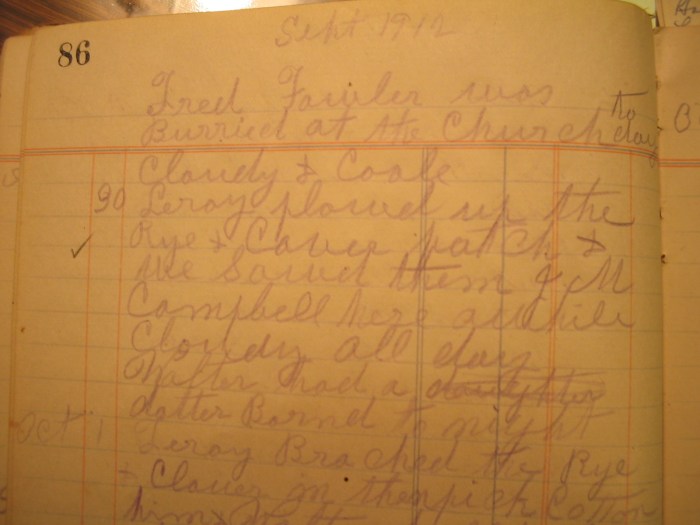
One of my great-grandfathers, Thomas Lee Dulin, kept a daybook almost every day from 1891 until 1914. Perhaps the roots of my desire to be a writer can be found in that part of my gene pool. Being born in rural North Carolina in 1842, Great-Grandpa did not have benefit of a great deal of education. For that reason I especially admire him and appreciate the fact that he sat down with his pencil and ledger and wrote nearly every day. He seldom used punctuation and his spelling was not perfect, but he probably did not have a dictionary. He made the effort almost every day, and by doing so left a great example for me to follow suit.

IMG_0075

Great-Grandpa wrote about the weather (which was of utmost importance to him as a farmer) and what was being done on his farm in Mecklenburg County, North Carolina. He noted the going price for a pound of cotton in Charlotte and surrounding markets because cotton was his main cash crop. If a neighbor stopped by to visit, he made a record of that.

According to official records, Great-Grandpa enlisted in Company H, 35th Regiment, North Carolina Troops in 1861. He gave his age as 21, although he was just 18. As a veteran of our country’s civil war, he made note of the anniversaries of the two main battles in which he participated – New Bern and Richmond. He was wounded in the left shoulder at Malvern Hill in the seven-day Battle of Richmond.

Some years ago, my mother and sister painstakingly hand-copied Great-Grandpa’s daybooks. Without realizing that today was the 154th anniversary of the Battle of New Bern, I checked that transcription to see what was going on in Thomas Lee Dulin’s world through the years on March 14. It was sobering to read his daybook entry for March 14, 1899: “37 year today I was in the Battle of Newbern, N.C.” Although in the interim he had married, been widowed at the age of 38, and left to raise his six surviving children, March 14, 1862 was forever engraved in his memory.

As the years went by, Great-Grandpa almost never failed to mention on March 14 how many years it had been since the Battle of New Bern. Oral history is valuable, but sometimes the stories get changed as they are passed down from one generation to another. The written word, especially when kept daily in a daybook, journal, or diary is a powerful record that we can hold in our hands and refer back to in order to make sure we get the facts right. My great-grandfather’s daybooks are a family and local treasure housed in the North Carolina Collection at the main branch of the Charlotte Mecklenburg Library in Charlotte, North Carolina.

Reading challenges

Some public library systems or branch libraries within larger systems issue reading challenges to encourage diversity in reading. A branch of the Charlotte-Mecklenburg Library that I frequent, the Mint Hill Public Library, has issued such a challenge for 2016.

The library in Mint Hill invites patrons to “Celebrate 2016 by reading 12 different kinds of books.” Bookmarks are provided listing 19 kinds of books from which to choose 12 types.

I enjoyed selecting the 12 kinds of books I wanted to make a conscious effort to read this year to satisfy the requirements for meeting this challenge. No matter where you live, you might enjoy participating in this exercise. It will be a good way to make yourself read some books (or at least one!) that you might not have otherwise chosen.

Here are the 19 categories of books in the Mint Hill Public Library Reading Challenge:

A book that became a movie;
a book published in 2015;
A book with a number in the title;
A nonfiction book;
a Pulitzer prize winning book;
A book more than a hundred years old;
A book that might scare you;
A book set somewhere you’ve always wanted to visit;
A book set in the future;
A book written by an author with your same initials;
A banned book;
A book from your childhood;
A book with a color in the title;
A book based on a true story;
A popular author’s first book;
A book set in a different country;
A funny book;
A mystery or thriller; and
A book with a one-word title.

How many of the 19 will you read in 2016? I’ve already checked off three categories — a book with a number in the title, a book with a color in the title, and a nonfiction book. I invite you to join me in this reading challenge.


Four Paws for Noah

Today’s post makes you aware of Four Paws for Noah and a couple of ways you can help fund the training of Appa, an assistance dog for a boy named Noah.

Noah is a nine-year-old boy who struggles with autism. There are two writing contests whose entry fees will go 100% to help pay the cost for Appa’s training.

The “Able is This Diverse Universe Essay Competition” has a March 31, 2016 deadline. You may write an up to 2000-word essay based on the themes of ableism, disability, access, and overcoming. Go to https//honeyquill.submitable.com to submit your essay and $10 entry fee.

The “Carrot Ranch Flash Fiction Writing Competition” invites a 100- to 500-word piece of fiction using the theme “a boy’s dog.” This competition has a March 31 deadline and a $15 entry fee. Visit the CarrotRanch.com website. Click on “Events” and then on “Contests” for contest details.

The way I see it, entering these competitions is a win/win situation. Time spent working on a piece for a writing contest is never wasted time. One becomes a better writer by writing. The entry fees going to support such a worthy cause is just icing on the cake.

A good writing book by James Scott Bell

Work continues on the manuscript for my historical novel (I hope!) titled The Spanish Coin. At the rate I’m tweaking it, my friends and family probably wonder if they will live to see the book in print.

I recently read James Scott Bell’s 2012 Writer’s Digest Book, Revisions and Self-Editing for Publication, 2nd Edition. In today’s post I will share some of the notes I took while reading the introduction, the early pages (“On Becoming a Writer”), and the first chapter.

An important point Mr. Bell makes is that a writer must read. Read books of all kinds — and a lot of them. Take note of what works in the books you read, then practice those techniques. I have never thought I had any talent for writing poetry. I read poetry only occasionally; however, Mr. Bell recommends that a writer read poetry to help get creative juices flowing. I never would have thought of that. I plan to read a poem each day when I sit down to write.

Mr. Bell writes, “Concept is the one-liner that will explain your story.” I know this is something I need to work on because when anyone asks me what my book is about, I struggle to verbalize a one-sentence explanation.

“Conflict is the blood of fiction, the heartbeat of narrative,” according to Mr. Bell. I am reminded of an acquaintance of mine some years ago who complained that she didn’t know why there had to be so many crises in the television series, “Dr. Quinn, Medicine Woman.” It was the conflict and crises, though, that made the program interesting to watch. Who wants to watch a show in which life is perfect? Likewise, who wants to read a book in which there is no conflict or one in which the main character has no problems to overcome?

Another morsel of wisdom from Mr. Bell is, “Write first, polish later. That’s the golden rule of production.” I need to write that on a sticky note and put it on my computer screen. My natural inclination is to try to get it right the first time. The more I write, though, the more I realize that is unlikely to happen. I might write a perfect sentence once in a while but, more times than not, when I go back and read a phrase, sentence, or paragraph again I will find a way to improve it.

Those are just the highlights from the introduction and first chapter of Revisions and Self-Editing for Publication, 2nd Edition, by James Scott Bell. Each of the other chapters addresses in detail such things as characters, plot and structure, point of view, scenes, dialogue, setting and description, and much more. I recommend the book to anyone who is learning the craft of writing.

Early in the book, Mr. Bell wrote the following: “Trust that the techniques you are learning will flow out naturally. When they don’t, you can learn to see where the problems are. That’s what self-editing and revision are all about.” The learning process never stops. For the rest of my life, I’ll be learning the craft of writing. I feel driven to write, but I know I have much to learn and much work to do on my novel manuscript before I will be ready to take the next step — either hiring a professional editor or writing a query letter to a literary agent.

Stay tuned for my journey!

Some books I read in February

On February 21 I posted a blog about some of the books I read in January. I think in the future I will blog about the books I’ve read in a given month at the end of that month or first couple of days in the following month. I have good intentions, but you know what they say about those!

“Exploring North Carolina” is one of my favorite shows on UNC-TV. The host, Tom Earnhardt, never fails to educate and entertain as he explores the varied and rich geography, geology, flora, and fauna of the state. Although the vast majority of my books come from the public library, Mr. Earnhardt’s book, Crossroads of the Natural World: Exploring North Carolina with Tom Earnhardt was a book I knew I wanted to own. It’s the kind of book from which one can learn something new every time it is read. As if I needed any encouragement to visit every nook and cranny of North Carolina, this book makes me wish I could spend all my time doing just that.

Now that Sue Grafton is nearing the end of the alphabet, I decided to start reading her books. I read A is for Alibi in January and plan to continue reading my way through her popular alpha series. I couldn’t help but notice how telephone communications have changed since A is for Alibi was published in 1982. It almost places the book in the historical fiction genre.

Another case that falls into the “so many books, so little time” category is John Grisham and his books. I finally got around to reading Gray Mountain. (Yes, Sycamore Row is still on my “want to read” list — which is growing far faster than I’ll ever be able to keep up with.) I thoroughly enjoyed Gray Mountain. I love the way Mr. Grisham gets his points across regarding social justice issues without beating us over the head. In Gray Mountain, he puts a human face on how surface mining has scarred so much of our nation’s coal-producing region.

I was delighted to win a copy of The Third Reconstruction: Moral Mondays, Fusion Politics, and the Rise of a New Justice Movement, by the Rev. Dr. William J. Barber II with Johnathan Wilson Hartgrove. I participated in the Moral Mondays Movement in North Carolina in the summer of 2014, so I was eager to read Dr. Barber’s book. Even though I pride myself for staying informed about local, state, and national politics, Dr. Barber’s book opened my eyes to some historical connections that I had not made. This book shines a light on dirty politics in North Carolina but gives strong hope that this current grassroots movement will persist.

The Dark Road to Mercy, a novel by my fellow North Carolinian Wiley Cash, is primarily set in Gastonia, North Carolina and Myrtle Beach, South Carolina. It is the sad tale of two young sisters abandoned by their father and then left in a children’s home when their mother died. Long lost Dad shows up and wants his daughters. Thus begins a tale that will keep you wondering what’s going to happen next and what the final outcome will be. If you want to read what inspired Mr. Cash’s book, read his author page on Amazon.com. I’ll be on the lookout for his next book.

David Baldacci’s The Guilty was the next book I read in February. Mr. Baldacci did not fail to give the numerous twists and turns for which he is known. This whodunit is a true page turner. As a Southerner, I think the accents were at times overdone, and I was surprised he made the mistake of having a character ask another character, “What do y’all want” when obviously speaking to one lone individual. Also, I’ve never heard a Southerner use the term, “Yous.” On a positive note, he did spell “y’all” correctly, which is something some Southerners don’t do. The deeper I got into the fascinating story, the less I noticed the vernacular. Not sure how I’d feel, though, if I were from Mississippi.

Perhaps I am just sensitive about the accents because use of accents and brogues in dialogue is something I’m struggling with in my fiction writing. I’m dealing with Carolina backcountry settlers from Scotland, Ireland, and France and slaves from Africa in my historical novel manuscript titled The Spanish Coin. Since I’m a novice writer, who am I to criticize someone like David Baldacci? I’m striving to strike a balance between giving characters authentic voices and overdoing vernacular to the point that it distracts the reader from the story. It is a writing skill I must master.

Now I’m afraid this post is too long. Do I need to blog about what I’m reading more often than monthly?

To Kill a Mockingbird

The Rocky River Readers Book Club discussed both of Harper Lee’s novels — To Kill a Mockingbird and Go Set A Watchman — earlier this week. Little did we know when planning the year’s reading that this discussion would come just three days after Ms. Lee’s death. Illness prevented my attending the meeting but, in light of Harper Lee’s recent death, I wanted to post a blog in tribute to her.

Rereading To Kill a Mockingbird is always a pleasure. One can read it just for the story. One can read it for the skillful writing. One can read it for the slice of American history on which it sheds light. One can even read it for the humor. I tend to forget Scout’s sense of humor between my readings of To Kill a Mockingbird. I love the Scout in that book.

The grown-up urbane Scout/Jean Louise of Go Set a Watchman is not as easy to love. The young adult Scout struggles — really struggles — to understand and accept Atticus. The child Scout put her father on an impossible pedestal. The adult Scout sees prejudices in him that don’t jive with the Atticus of her childhood who withstood public outcry when he represented a black man in court. She is conflicted. Throughout Go Set a Watchman I yearned for her to work through her concerns and not turn her back on Atticus.

Both of Ms. Lee’s novels give as much food for thought and fodder for discussion today as they did when they were hot off the press. Harper Lee set the bar high for great American literature. Her novels will, no doubt, be read in the United States and around the world for centuries to come.

What I read in January

My last blog post was about some of the books I read during the last quarter of 2015, and I promised my next post would be about my reading so far this year. Actually, this post will just cover four books I read in January.

After enjoying Allen Eskens’ debut novel, The Life We Bury, in 2014, I looked forward to his second book. I read The Guise of Another in January. It had more violence than I thought necessary, but perhaps I was just still in the Christmas spirit. It was an intriguing story and a page turner like his first book. I hope he keeps writing novels.

Somehow I failed to read David Ignatius’ The Director, when it was released last May. I remedied that oversight in January. I’m a big David Ignatius fan, and The Director did not disappoint.

Michael Eury is the author of several local history books here in Cabarrus County, NC. His latest rendering, Legendary Locals of Cabarrus County is a delightful collection of the life stories of Cabarrus Countians who have made a lasting mark on the southern piedmont of NC. Michael asked me to make recommendations for the people from Harrisburg that he should include in the book. I was thrilled to have a hand in that. The book turned out great!

My name finally rose to the top of the public library’s waitlist for Janet Evanovich’s Tricky Twenty-Two. Fans of Ms. Evanovich eagerly await the next installment of this chronologically-numbered Stephanie Plum series every fall. I try to get on the waitlist at the library as soon as her annual release is on order. When I need a laugh out loud book to read, give me Stephanie Plum!

As a writer, I want people to support their local independent bookstore. As a writer, I also want people to support their local public library system. No matter how you choose to get your books, just get them!

Happy reading! (Now, I need to get back to The Guilty, by David Baldacci!)