A Lost Art

How many of us take the time or even think about handwriting a letter today? It has been so long since I handwrote more than a brief thank-you note, I honestly cannot remember. It is easier to text, email, or type a letter on the computer and print it.

I mentioned in my July e-newsletter that I have been decluttering. I have attempted this chore many times in the past with limited success; however, I am on a tear this time.

I should have taken “before” and “after” pictures. I should have weighed how much stuff I donated to the thrift shop. I should have weighed the two recycle bins that were so heavy with paper and magazines that I could scarcely push them out to the road for pick up. I should have weighed the countless bags of trash. I shredded old documents until I thought our paper shredder would start to smoke.

My parents were in college when The Great Depression began. They had to make their way in this world on little money and no luxuries. Their background meant they instilled in me the value of a dollar and one should never throw away anything because “you might need it or be able to use it later.”

I am once again living in the house they built in 1960, so there are many boxes and closet shelves to go through now.

It is a freeing experience to unburden oneself from the accumulation of stuff. As I blogged about on July 1, 2024 ( Books read in June 2024), I was inspired by reading Stop Buying Bins & Other Blunt but Practical Advice from a Home Organizer, by Bonnie Borromeo Tomlinson.

I’m not saying this is the end-all be-all book about decluttering, downsizing, or rightsizing. All I know is that it was the right book for me at the right time.

One unexpected benefit or result of my current decluttering binge was the rediscovery of handwritten letters. If you have lost a parent and had a good relationship with that person, you have probably felt that tug on your heart when you come across something in their handwriting.

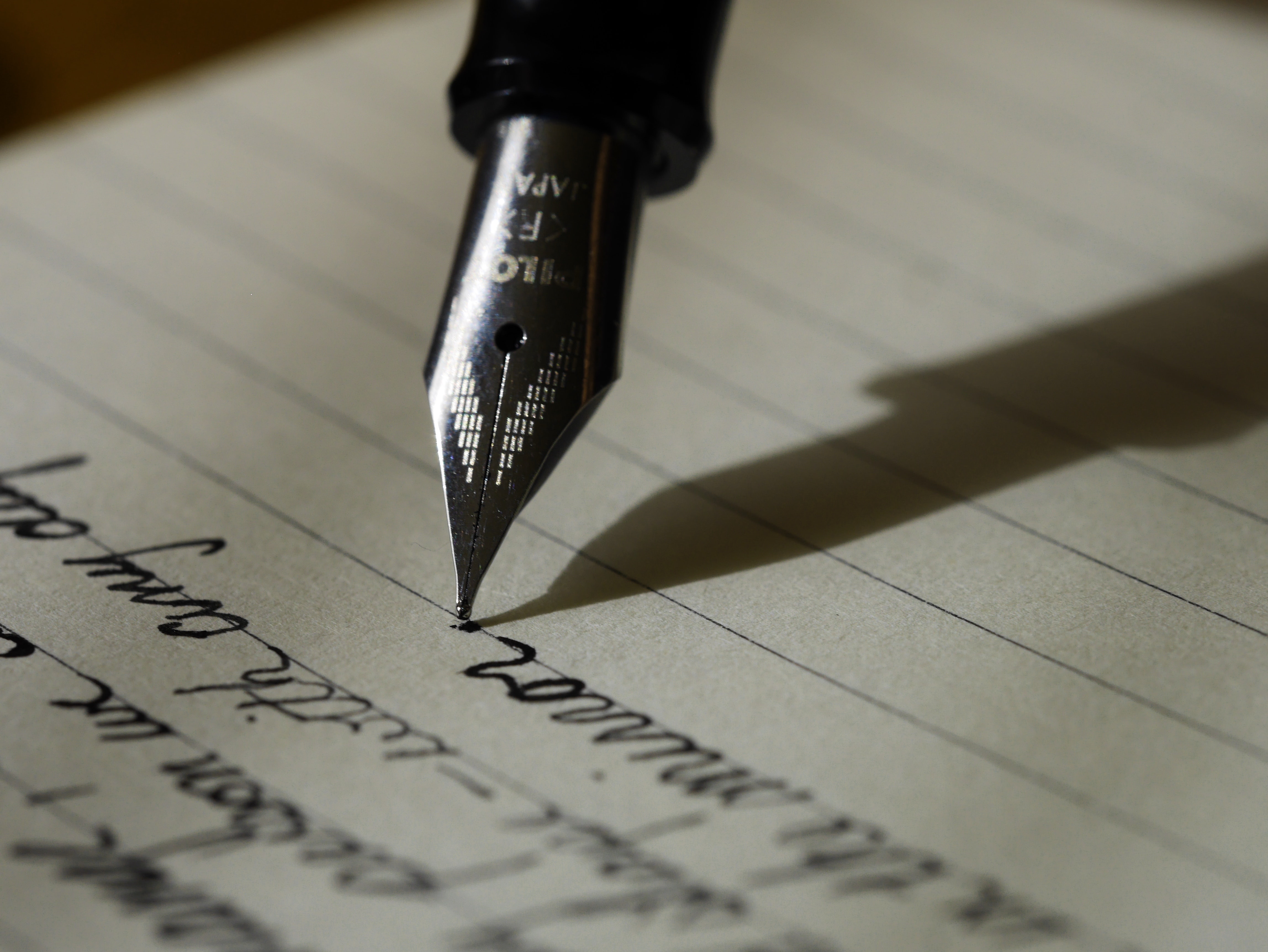
Photo by Aaron Burden on Unsplash

Perhaps you found a recipe your mother wrote on an index card or scrap of paper. Perhaps it was nothing more than your father’s signature on a document. My father was a structural steel draftsman, so he usually printed. I can readily recognize his precise printing, whether it be on a blueprint or genealogy notes he made, but it is special when I find his signature because it, of course, is in cursive.

In going through decades of stuff this summer, I have come across birthday cards signed by my parents, various aunts and uncles, and dear childhood friends who are no longer with us. Some have brought a lump to my throat and a sting to my eyes as tears begin to form. Those cards are set aside and not yet tossed in the trash or recycle bin. Someday that’s where they’ll land, but not today.

The lost art I referenced in today’s blog title is the handwritten letter. I have found many of the letters my mother wrote to me while I was away in college and in my early 20s when I found employment several hours from home. I was struck by the contrast between that time in the 1970s and early 1980s as compared to today.

Today parents text or call their children who are in college or have otherwise left home and struck out to make their way in the world. They think nothing of making that phone call or sending that text. When I was in college and during my young adult years it was expensive to call “long distance.” You had to have a very good reason for calling home when I was in college.

There was one telephone on the wall in the hallway in my freshman dorm. I knew if I received a call from my parents, it was probably to relay bad news or something that couldn’t wait two or three days for them to tell me in a letter. And there were no long conversations because every minute cost money.

I am so glad that’s the way it was because it means today I can reread all those letters my mother wrote. Today’s college students and young adults will not have such tangible memorabilia.

Several years ago, my sister and I helped a friend organize in archival binders and archival sleeves the letters he and his wife wrote to one another while he was in the military service as a fighter pilot in World War II and the Korean War. He will turn 100 years old in October. He calls occasionally to thank us again for what we did. He lives alone and the days and nights are lonely. He says he finds great comfort and joy in opening those binders and reading those letters.

We have photocopies of portions of letters one of our great-grandfathers wrote to his parents and sister while he was serving in the military during the American Civil War. How valuable those letters are to us!

While going through a box of papers last week, I came across a typewritten letter from my eldest first cousin from some 30 years ago. She was much older than I. In that letter, she shared some recollections of her mother’s. (Her mother was my father’s eldest sister and was 14 years older than he.) I had forgotten about the letter, so it was new and fresh as I read it last week.

From the letter I learned that my grandmother won prizes for her jams, jellies, canned fruits, eggs, and Rhode Island chickens. Since my grandmother died 23 years before I was born, I never knew her. However, that one sentence in my cousin’s letter gave me a beautiful glimpse into my grandmother’s life that I would not have known otherwise.

It is nice today that we can call a friend or relative and hear their voice, but in the process of making our communications so easy and instant we have lost the art of letter writing.

Do you still write letters to loved ones and friends who live faraway? Do you still have letters you have received?

For now, I’m holding on to those letters from my mother. The day might come when I’m ready to part with them, but today is not that day.

Until my next blog post

Is there someone who would appreciate a hand-written note or letter from you this week?

I will continue to go through boxes and closets and the basement. This decluttering/rightsizing thing isn’t a sprint; it’s a marathon. I have only just begun!

I hope to get back to work on my Seasonal Affective Disorder devotional book this week.

I hope you have a good book to read.

Don’t forgot the people of Ukraine.

Janet

Where do you stand on cursive writing?

As promised last week, today my blog is about the third book I read in March. It’s about the history of handwriting and the debate over whether children today should be taught cursive writing. I say, “Yes!” and I’ll explain why later.

Photo credit: Aaron Burden on unsplash.com

The History and Uncertain Future of Handwriting, by Anne Trubek

“Put your John Hancock here.” How many times have we of a certain age heard that? We, of course, immediately know that is a euphemism for our signature. But does a child of the 21st century know that? I understand that children today don’t have a clue what “clockwise” or “counterclockwise” mean. Yikes!

I discovered The History and Uncertain Future of Handwriting, by Anne Trubek while looking for a different book. I found this 154-page book fascinating and thought-provoking.

Trubek meticulously takes the reader on a journey through history. She shares facts about cuneiform and hieroglyphics. (Did you know that most cuneiform clay tablets can fit in your hand? In photographs, they look huge.) She explains how tedious and time-consuming it was for Sumerians to learn how to write and the hours people in ancient oral-based civilizations spent on memorization.

Egyptians invented writing on papyrus. When the Greeks adopted that practice, though, their papyrus was inferior and their scrolls were smaller. (Did you know that the size of ancient Greek scrolls has a bearing on literature today? For instance, the size of a scroll dictated the length of a play. Who knew?)

Socrates was anti-writing. He maintained that if people learned how to write, they’d lose their skill for remembering the spoken word. There’s probably some truth to that.

People in oral civilizations couldn’t look things up like we can today, so they developed elaborate mnemonics and also used additive structure (and… and… and) to help them remember important things. An example of this can be found in the Book of Genesis in The Bible: “In the beginning God created… and… and….”

It was the Romans who stopped using papyrus and started using parchment. Parchment made it easier to make books. Trubek says that bookstores had been established in Rome by the first century B.C.E. Take a moment to visualize that. It makes me smile.

Trubek talks about the development of the various scripts and the high-esteem held for scribes back in the day. She points out that the invention of the printing press put scribes out of business; however, the ones with good penmanship reinvented themselves and traveled around offering handwriting schools.

I’ve spent a lot of time reading handwritten documents from the 1700s and 1800s. I admire the elaborate and visually beautiful handwriting of the 1800s; however, it is sometimes difficult to decipher. One of the most interesting parts of Trubek’s book was about the evolution of handwriting in America in the 19th and early 20th centuries. Although I’ve admired the lovely handwriting of the 1800s, I’d never researched why and how it was replaced with our contemporary handwriting.

Briefly, Platt Rogers Spencer developed that flowing, fancy script we associate with the 1800s. (If you don’t know what I’m referring to, think about the Coca-Cola logo. That’s an example of Spencerian script.) Spencer proclaimed that having good penmanship was a sign that you were a Christian, educated, and a proper person. His students were advised to practice their penmanship six to twelve hours a day. (I’m sorry, Mr. Spencer, but life’s too short!)

Part of a page from my great-grandfather’s 1912 daybook

I’m reminded that in my great-grandfather’s daybooks from the 1890s and first decade of the 1900s, he occasionally mentioned that his children or grandchildren had gone to writing school that evening. That writing school was conducted at night in the Pine Hill one-room schoolhouse in Mecklenburg County, North Carolina. Notice the curly-ques Great-Grandpa made in his capital F and capital W. Also, he randomly capitalized words. I learned from Trubek’s book that such practice was part of the Spencerian script.

A.N. Palmer came along and made modifications to Spencerian script after he went to work for the Iowa Railroad and saw how time-consuming it was for the employees to record all the details required by industrialization. He removed all the curly-ques required by Spencerian script and made handwriting much easier after 1920.

Trubek’s book also covers such things as the collecting of autographs, which started in the mid-1800s, and graphology, which was started by a French priest in the 1800s.

The science of analyzing handwriting for evidentiary purposes in a court of law has had to evolve over the years. One used to be able to use the force one’s fingers used to press typewriter keys to prove who typed a document. The wear and tear on the parts of a typewriter could prove on which typewriter a document was created.

Photo credit: Csabi Elter

Consider that for a moment. I’m showing my age, but I learned to type on a manual typewriter. Now, the justice system is faced with determining the true identity of a person who electronically “signs” his or her name. How things have changed in the last 50 years!

When I think about handwriting and how people rarely hand write letters today, it makes me sad. Last year, my sister and I assisted a 97-year-old friend who wanted to preserve the letters he and his wife wrote to one another during the Korean War. What a treasure those letters are! We organized the letters in chronological order and placed them in archival binders. Hopefully, some of his descendants will see the value in those letters. When people go off to war now, they can telephone and text their loved ones. Few of those communications are saved for posterity.

In her book, Trubek points out that if a child isn’t taught cursive writing by the fourth grade, an important window of opportunity will close. She says that it is by that age that a typical child needs to master cursive in order for him or her to achieve cognitive automaticity.

Photo credit: Kelly Sikkema

Trubeck says if cursive isn’t mastered by then, the child will continue to struggle with handwriting. It will forever be a skill the person has trouble with because they didn’t learn it early enough for it to become something they can do without thinking about it. She says the “up” side of this is that this child might be able to type faster than someone who is better at handwriting.

To that, I would say it’s a big price to pay. This person might be able to get a higher-paying job later on, but what if he or she grows up and wants to do historical research for pay or for fun?

Photo credit: Alessio Fiorentino

Not being able to read handwritten primary sources will definitely be a drawback. There’s no substitute for primary sources in historical or genealogical research. In my own genealogical research I’ve found many instances where names in census and other records have been misread when they’ve been converted to typed records. When the typed copies are taken for fact, misinformation is perpetuated.

In the arena of the debate over teaching cursive or not, I still come down on the side of teaching it for the very reason I just gave.

Do you think children should be taught cursive?

I’d love to hear your thoughts on this and why you come down on one side or the other. Or, perhaps you don’t have an opinion.

For my readers in other English-speaking countries

Is there a debate about continuing to teach children cursive writing in other English-speaking countries aside from the United States?

Since my last blog post

I borrowed another book about handwriting from the public library. Power Penmanship: An Illustrated Guide to Enhancing Your Image Through the Art of Handwriting Style, by Janet Ernst, helped me address several (well, actually, six letters I’d gotten a bit sloppy in writing.)

I blame taking shorthand in high school for ruining my handwriting. Since that was 50 years ago, I decided it was time to stop making excuses and start making corrections. After spending just 10 minutes a day for six consecutive days, I was able to see some improvement. I think we never get too old to try to improve something about ourselves.

After much brainstorming about the opening scenes in the historical novel I’m writing, The Heirloom (working title), I have started working on a new plot angle. I’d hoped to switch gears from brainstorming to rewriting those opening scenes last week, but my Chronic Fatigue Syndrome (known as Myalgic Encephalomyelitis in the UK) relapse continued to drastically limit my work. When my energy level is this low, it’s tempting to stop trying to write; however, I was feeling a little better by the time the weekend rolled around. I’m back to work on The Heirloom as of Saturday. My journey as a writer surely is bumpy!

Until my next blog post

I hope you have the energy to do all the things you need or want to do.

Remember the people of Ukraine.

Janet