I write southern historical fiction, local history, and I've written a devotional book. The two novels I'm writing are set in Virginia and the Carolinas in the 1760s. My weekly blog started out to follow my journey as a writer and a reader, but in 2025 it has been greatly expanded to include current events and politics in the United States as I see our democracy under attack from within. The political science major in me cannot sit idly by and remain silent.
With the change of seasons to cool mornings, I’m trying to take some of my own advice and follow along in my new devotional book and its companion journal:
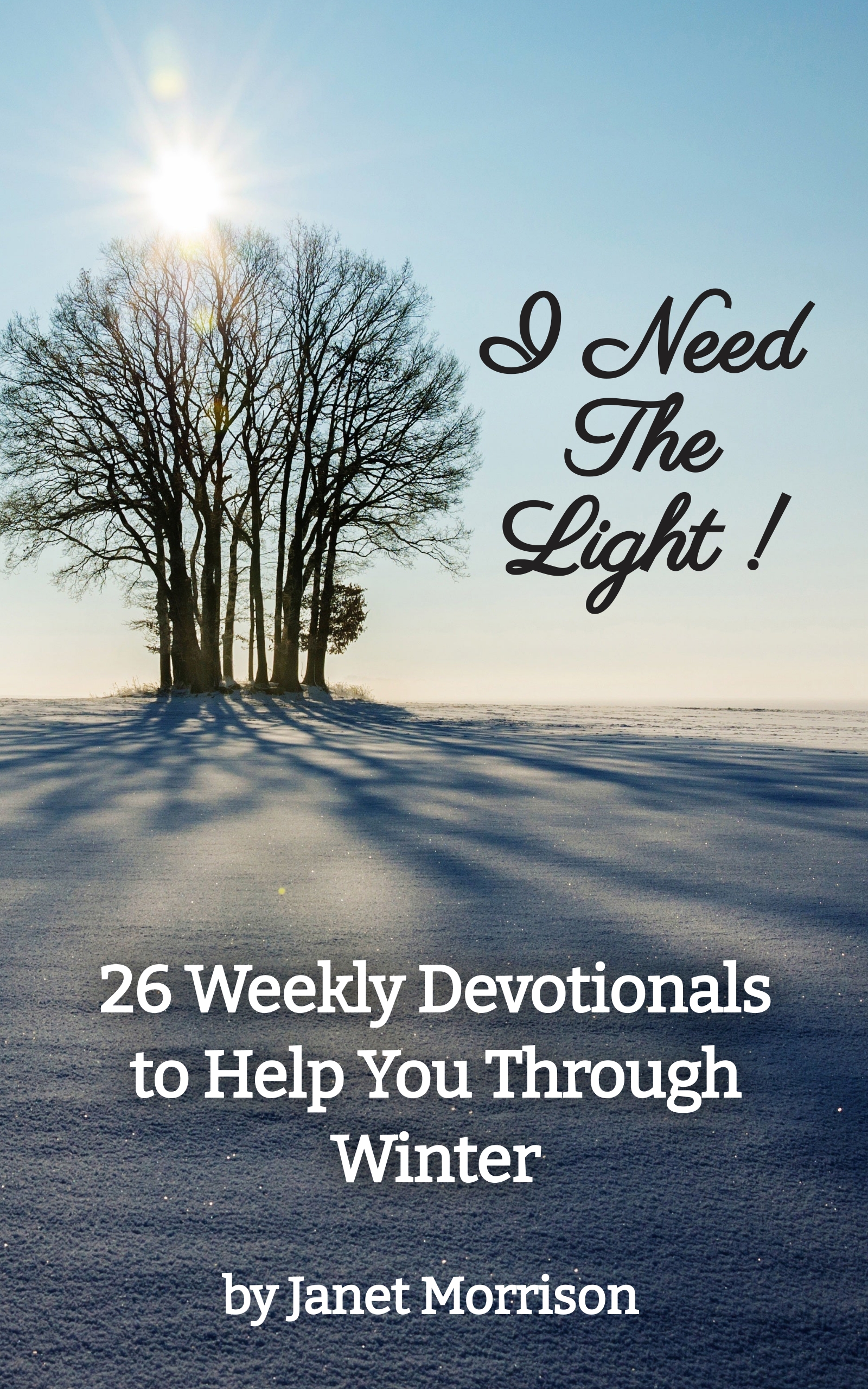
I Need The Light! 26 Weekly Devotionals to Help You Through Winter
I Need The Light! 26 Weekly Devotionals to Help You Through Winter, by Janet Morrison
And
I Need The Light! Companion Journal and Diary.
I Need The Light! Companion Journal and Diary, by Janet Morrison
In case you haven’t purchased your copies yet, here’s a sneak peek at Week 1
The Scripture for Week 1 is Genesis 1:1-5. It’s about God creating the Heavens and the Earth and light. By the power of His word – “Let there be light! – and there was light!
I can’t imagine life without light, which leads me to think that people who have been blind all their lives probably can’t imagine what light is.
Thos of us in the northern hemisphere are entering the time of the year when natural light and the warmth it brings is in short supply. Those of us with Seasonal Affective Disorder and Fibromyalgia are not fond of cold weather. In fact, it is difficult for me to enjoy the beauty of fall because I’m dreading winter.
I need the natural light to help set my circadian clock and combat the effects of Seasonal Affective Disorder, but I need Jesus Christ – The Light of the World! – for all aspects of my life. He is my Rock and my Salvation.
Look for my books on Amazon and Barnes & Noble. You should also be able to find them at your favorite independent bookstore, such as Second Look Books in Harrisburg, NC; Blue Ridge Books in Waynesville, NC; and Highland Books in Brevard, NC.
Some independent bookstores refuse to sell books that are self-published, but I know the three I listed above have ordered copies. Please support them!
Each week in my devotional book includes a recipe for a food that brings me comfort. Week 1 has my mother’s recipe for Drop Biscuits. Yum! I think I need to go to the kitchen right now and make biscuits!
I am thrilled to announce that my book, I Need The Light! 26 Weekly Devotionals to Help You Through Winter is now available!
I Need The Light! 26 Weekly Devotionals to Help You Through Winter, by Janet Morrison
Even if you love the fall and winter, I think you will benefit from reading this book.
Why I Wrote I Need The Light!
I wrote it from a place of physical challenges in cold weather, so I think people who have such illnesses and conditions as Seasonal Affective Disorder, Fibromyalgia, and Chronic Fatigue Syndrome/Myalgic Encephalomyelitis will be able to identify.
I settled on writing 26 weekly devotionals because with the onset of fall, I start dreading winter. Seasonal Affective Disorder affects me half the year.
What Does the Title I Need The Light! Mean?
To help me combat the symptoms of Seasonal Affective Disorder and sleep problems, my former physician’s assistant told me that I needed to get out in the natural light early every morning. I needed natural sunlight.
I’m not a morning person, so I had to force myself out of bed and outdoors in the morning – even in cold weather. As I walked, I repeated in my head the words, “I need the light. I need the light. I need the light. I need the light.” On about the fifth repetition, I had an epiphany: I realized I also needed The Light – Jesus Christ – “The Light of the World.”
I’ve been a Christian all my life, so it wasn’t a new concept for me that I needed Jesus Christ in all aspects of my life, but the sudden connection between “the light” and “The Light” was startling! It was then and there that God planted the idea in my mind and heart to write a book about the light and The Light.
That day, I started looking for all the references to light and The Light in the Bible.
Format of I Need The Light!’
Each week’s devotional follows this basic pattern:
The week’s Scripture reference is stated.
“Setting the Stage” in which I give a little background for that Scripture.
The week’s Scripture is then presented from The Message, The Good News Bible, The Living Bible, The New Oxford Annotated Bible (New Revised Standard Version), and TouchPoint Bible. The second week has the bonus of including the Bible verse from my great-great-grandmother’s 1849 The Psalms of David in Metre.
Insight from a Bible commentary, such as the series by Rev. William Barclay.
“My Thoughts” – Then, I usually share my thoughts about the Scripture.
“Remember” – one sentence of encouragement to ponder.
“Thought Pattern Interrupter” – One sentence to help you put a positive spin on that week.
“Activity Suggestion” – An activity you might choose to do that week to get you out of your own head/situation.
“Comfort Recipe” – A recipe that I consider a fall or winter “comfort food” from my own experience.
How to Use I Need The Light!
Readers are encouraged to read the devotional book as they choose. You don’t have to read it over a 26-week period. And each week, you can read the entire chapter in one sitting, or you can string it out over the week. It’s totally up to you to read the book in the way that best helps you.
Where to Find I Need the Light!
If you think I Need The Light! 26 Weekly Devotionals to Help You Through Winter would help you, or if you know someone who might benefit from the book, it can be purchased at your favorite independent bookstore. If you don’t find it there, please ask them to order the book from IngramSpark.
The book is available in paperback and as an e-book.
Click on “Read more” under the photo of the book cover.
At the end of the book’s description there, click on the BookShop.org buy button, which takes you to BookShop.org (a site that supports independent bookstores throughout the U.S.)
Put my book in your basket.
Select the independent bookstore you wish to support.
Place your order and have the satisfaction of knowing you are supporting an independent bookstore!
So far, Second Look Books in Harrisburg, NC; Blue Ridge Books in Waynesville, NC; and Highland Books in Brevard, NC have been very supportive of my book so I’ll give them a shout-out.
Available for your cell!
The book is also available on Amazon and from Barnes & Noble.
Here’s a Sneak Peek at I Need The Light!
From Week 12, here’s the “Setting the stage” introduction to that week’s devotional about the Parable of the Lost Coin:
“In Halley’s Bible Handbook, Henry H. Halley describes the fifteenth chapter of Luke as ‘the calm before the storm’ in Luke 14. In the fourteenth chapter of Luke, Jesus doesn’t beat around the bush as He talks about the price people will pay for following Him. He goes on to explain that He must be first in our lives. We must love Him more than we love anyone else. It’s enough to make a person question the wisdom of following Jesus!
“But then we come to Luke 15. It is a beautiful chapter about the tender, forgiving grace of Jesus. The chapter includes the Parable of the Lost Sheep, the Parable of the Prodigal Son, and the passage we’re looking at this week: The Parable of the Lost Coin.”
Does this sound like something you or a friend would like to read?
I wrote I Need The Light! 26 Weekly Devotionals to Help You Through Winter in a conversational tone as I imagined I was talking one-on-one with a good friend. If this approach to the Bible appeals to you, I hope you will look for my book.
I’m not an “in your face” kind of Christian. I’m a lifelong Presbyterian, so I’m not going to scare you into being a Christian. That’s not the Presbyterian way!
Even if fall and winter are your favorite seasons of the year, I believe you will find something of benefit in my 188-page devotional book.
I invite you to look for it!
If you read it and like it, your rating and/or brief review on such sites as Goodreads.com and Amazon will be greatly appreciated.
I considered saving today’s topic for my July 7 planned blog post about the books I am reading in June, but I decided it deserved its own post.
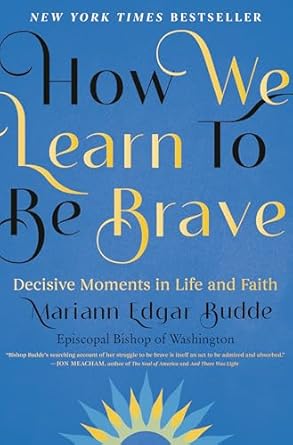
Last week, I read the fourth chapter in How We Learn to Be Brave: Decisive Moments in Life and Faith, by Mariann Edgar Budde.
How We Learn To Be Brave, by Mariann Edgar Budde
If the author’s name sounds familiar, it is because she is the Bishop of the Episcopal Diocese of Washington, D.C. and the Washington National Cathedral. She spoke boldly in the worship service on President Trump’s Inauguration Day in January 2025, and was sharply criticized by Trump for her courage.
My sister read this book and encouraged me to at least read the fourth chapter before she returned it to the public library. She said it reminded her of me and some of my life experiences. I took time to read that 34-page chapter titled, “Accepting What You Do Not Choose.”
My story (well, part of it)
At the age of 25 I accepted the fact that I had a medical problem that was incurable but could be treated with a series of surgeries. It meant that I would never have a chance to have children. Less than ten years later I accepted the fact that I had chronic fatigue syndrome and fibromyalgia, neither of which can be cured and treatment of the symptoms is poor at best.
What I was able to accept has astounded my sister. She knows better than anyone else how much physical pain I tolerate and the fatigue that makes it difficult for me to get up and face each day. She says she has asked God, “Why Janet?” but I just find that odd because I have never asked God, “Why me?”
I admit that when I get frustrated over the memory problems that accompany chronic fatigue syndrome that cause me to make mistakes and have to repeat various tasks, I do sometimes ask God why life has to be so hard.
But I’ve never asked God why I had endometriosis, a ten-pound ovarian cyst, fibroid tumors, chronic fatigue syndrome, fibromyalgia, chronic corneal erosion, and so forth. Why would I do that? Stuff happens. God never promised us that life would be a bed of roses. He promised He would always be with us. Diseases happen. Accidents happen. No one has a perfect life, so why would I expect my life to be perfect?
My father was my example
My example was my father. He was just 61 years old when he was diagnosed with multiple myeloma. I had just started my sophomore year in college. He lived for almost five more years. The chemotherapy acted like fertilizer on his cataracts and he went blind. Blindness was harder for him to accept than his cancer because there was nothing he could do to fight blindness.
He insisted on having cataract surgery against his doctors’ recommendations, but it was unsuccessful. But in those five years of sickness and eventual legal blindness, I never once heard my father ask, “Why me?” That just was not the way he approached his medical diagnoses. He continued to work every day until his eyesight made it impossible for him to drive.
What Bishop Budd’s 4th chapter had to say
I read the fourth chapter in Bishop Budde’s book, and it was comforting. She writes from a place of physical pain that I did not know she had. The book gave me some things to think about. It is always helpful to listen to another person’s perspective.
Budde writes several pages about the Rev. Dr. Martin Luther King and how he accepted the life he was dealt. She writes about acting from a place of love and putting the other person ahead of ourselves. Instead of being like the Levite and the priest in the story of the Good Samaritan, we should strive to be like the Good Samaritan.
The Levite and the priest in the story saw the man who needed help, but they were afraid of what could happen to them if they stopped to help the man. But if we try to adopt the mindset of the Good Samaritan, when we see someone who needs help or an injustice, we should ask ourselves, “What will happen to them if I don’t act?”
That is the question I have asked myself daily since January 20, 2025. What will happen to my country, to my great-nieces, to their future children, if I don’t act?
With Episcopal Bishop Michael Curry’s words in mind from Prince Harry and Meghan Markle’s wedding ceremony, Budde writes, “When we choose love in response to what we wish we could change but can’t; when we choose love as our response to the world as it is, not as what we wish it were; when we choose love over denial, or anger, or cynicism and withdrawal, we share in God’s redeeming of our world. It doesn’t make the work any easier, but it gives our efforts a sense of purpose that can carry us through. Through our imperfect efforts, God’s grace shines through us in ways we may never know or fully understand.”
Budde closes the fourth chapter with the following words:
“Our lives are full of unforeseen choices, struggles, and callings. Sometimes we can overcome these obstacles, and sometimes we must make peace with them…. Accepting what we did not choose involves a leap of faith that God is present and at work in ways that we cannot comprehend…. This kind of acceptance is not passive or fatalistic, but rather a courageous choice at a decisive moment to embrace the places we are broken as an integral part of a courageous life.”
I didn’t feel courageous at age 24 but maybe I am at 72
I don’t consider that I was courageous in accepting my physical limitations. It never occurred to me that I had a choice, so what would have been the point of fighting or lashing out at God about them?
Another participant in a Chronic Fatigue Syndrome support group in the 1980s who every month angrily said, “I refuse to be sick! I’m not going to put up with this. The rest of you can be sick if you want to, but I refuse.” I don’t know what became of her. I hope she was able to find a place of acceptance and contentment.
There was another participant in the support group who presented herself as a wealthy middle-age woman who enjoyed playing tennis every day. She could no longer play tennis and it crushed her spirit. She committed suicide.
I did not choose to have Chronic Fatigue Syndrome since April 26, 1987, but here I am.
On the other hand, I did not choose to have Donald Trump as my President, and it is taking a degree of courage for me to express my concerns in my blog. I don’t personally know but a few of the people who read my blog. WordPress tells me that people in 81 countries have read my blog just in 2025. People who may wish me harm for my opinions might read my blog. A few trolls have read it and left unpleasant comments.
I’m happy to engage in a “conversation” about the topics in my blog, but when a comment turns into a personal attack or accusations about my credibility or motives, I draw the line and I delete them. I do not owe my time and limited energy to someone who merely wants to pick a fight.
The bottom line
“The bottom line” is that we do not choose many of the things that happen to us, but we can always choose how we react to them. Our experiences make us who we are. If I had not had some medical problems, I would not be the person I am today.
We can look for constructive and creative things to do when we have physical or career setbacks. If I had not been forced to give up my chosen career due to my health at the age of 34, I might not have taken a writing course at the age of 48.
If I had not taken that writing course, I would not have had the confidence to write a local history column for the newspaper at the age of 53 to 59. If I had not taken that writing course, I would not have started a blog at the age of 60.
If I had not written 175 local history articles for the newspaper, I wouldn’t have been able to self-publish them in two books (Harrisburg, Did You Know? Cabarrus History, Books 1 and 2). If I hadn’t wanted to publish those articles in book form, I wouldn’t have learned how to format a book on the computer so I could self-publish on Kindle Direct Publishing.
If I had not taken that writing course or published those two history books, I would not have published two short stories on Amazon… or a cookbook with my sister in 2023.
If I had not taken that writing course, I would not be writing an historical novel now at the age of 72.
If I had not had Chronic Fatigue Syndrome, Fibromyalgia, and Seasonal Affective Disorder and learned how to write and self-publish, I would not have just finished writing a devotional book. I hope to publish I Need The Light in August, so stay tuned!
God did not wish for me to have any of my physical maladies, but he gave me the Holy Spirit. The Holy Spirit gives me the gumption to get up every day (although some days I don’t get up until the afternoon) and to seek God’s will in my life.
It is through The Trinity — God, Jesus Christ, and the Holy Spirit — that I have the energy and creative motivation many days to read, write, interact with the friends I’ve made around the world through my blog, sometimes dabble in genealogy, and occasionally keep learning to play the dulcimer – a musical instrument I took up in middle age.
It is through The Trinity that I was given an interest in history and political science. It is those lifelong interests that compel me to pay attention to current events. The current events in my country are sources of much stress and concern.
I see the democracy in which I have thrived all my life under attack now from within. My government is turning against its citizens and the things we value. I did not vote for any of this, but the situation is the one I’ve been dealt.
It is up to me how I react.
Some days I wish I could just turn off the news. Some days I wish I could listen to the news and then just go about my business and not be concerned. Lots of people seem to be able to do that. I am not one of them. (I am simultaneously envious of them and frustrated with them!)
The reelection of Donald Trump has upended my little weekly blog (and, therefore, my life) into an almost daily report (some say “rant”) about the dismantling of our democracy. Nothing about 2025 is what I had planned for myself, but life happens.
Now you see
So now, 1,900 words later, you see why I decided to give the fourth chapter of Bishop Mariann Edgar Budde’s book, How We Learn to Be Brave: Decisive Moments in Life and Faith, its own blog post.
Some of you might think my life is too much of an open book. I get it. Some people don’t want anyone to know they have medical problems. I don’t share that information about myself to get your sympathy. That’s not what this is about. But perhaps someone else with health problems at a young age (or at any age) can take some measure of encouragement from my blog today or from the devotional book I will blog more about later.
It’s all about faith and where we get out courage to keep putting one foot in front the other. It’s about how we react to whatever comes our way.
What are your priorities?
What creative and constructive ways have you found to express yourself and react to the life you have been given?
It’s never too late to find your voice.
It has been my experience that when life circumstances close a door, God always opens a window… or even a bigger door.
Until my next blog post
Keep reading and paying attention to what’s happening in your country and the world. Being a citizen is not a spectator sport!
Remember the brave people of Ukraine, and don’t forget the people in western North Carolina who are still recovering from last September’s hurricane and record-setting flooding and landslides… as well as a new flood and landslide two days ago just over in Tennessee which has closed I-40 to all traffic (again) for a couple of weeks.
I tend to only borrow library books that I think I’ll like. Once in a while, I’m led astray. I attempted to read eight books in May. Five of them were winners. The other three just weren’t my “cup of tea” – at least the mode in which I tried to listen to two of them just didn’t work out.
After waiting for weeks to get to the top of the waitlist at the public library for most of the books I read or listen to, it’s disappointing when one doesn’t meet my expectations. Please read on, though, for one of these might be just what you’re looking for. And each of them might be great reads in print.
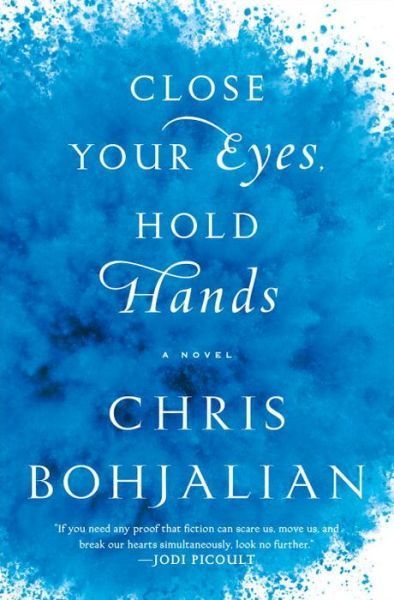
Close Your Eyes, Hold Hands by Chris Bohjalian
I’ll admit up front that I did not get through even half of this book. After hearing and seeing Chris Bohjalian interviewed online recently, I decided to give one of his novels a try. I found that the public library had Close Your Eyes, Hold Hands on Playaway and I needed a book I could listen to while I walk or do yardwork. This book fit the bill. I checked it out without knowing what the storyline was.
Close Your Eyes, Hold Hands, by Chris Bohjalian
It’s written in first person from the viewpoint of a teen girl. That can’t be easy for a male writer to do, but Mr. Bohjalian pulls it off.
Emily is at school when the nearby nuclear power plant experiences a meltdown. Her parents work at the plant and it is immediately speculated that her father is responsible for the accident. Knowing in her heart that both her parents were killed in the accident, Emily strikes out on her own rather than being evacuated to a shelter with her classmates.
I had problems with the Playaway device itself. It kept malfunctioning. At chapter nine, I gave up. I think there are 21 chapters.
My other problem with the book was the language. I know there are teen girls who use excessive foul language, but I decided I didn’t need to listen to anymore of it.
I’ll just leave it at that.
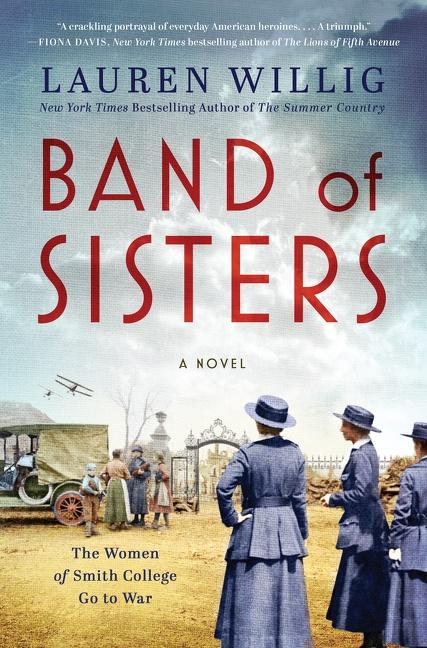
Band of Sisters, by Lauren Willig
Band of Sisters is Lauren Willig’s 27th published novel, but it’s the first one I’ve read. It has received rave reviews – and rightfully so. I listened to it on CD.
Band of Sisters, by Lauren Willig
This historical novel is based on a group of students from the all-female Smith College who volunteered to go to France during World War I to aide civilians displaced by the war. Being from Smith College, they came from wealthy families. I had trouble identifying with any of the students except for Katie, who was not from a rich family.
This failure on my part to identify with most of the characters left me feeling a little disappointed in the book. I just wasn’t able to suspend memories of my own experience of working my way through college and graduate school enough to put myself in the shoes of these wealthy young women. That’s my problem, not the author’s fault.
I will give Lauren Willig’s novels another chance. She is obviously a talented historical fiction author. Reading novels about wealthy people just isn’t interesting to me, usually. Reading about privileged white college women in 1918 didn’t interest me enough to finish listening to this book. It’s well-written and inspired by a true story, but the privileged attitudes of some of the students irritated me. I had to work my way through college, so I can’t identify with the students in this novel.
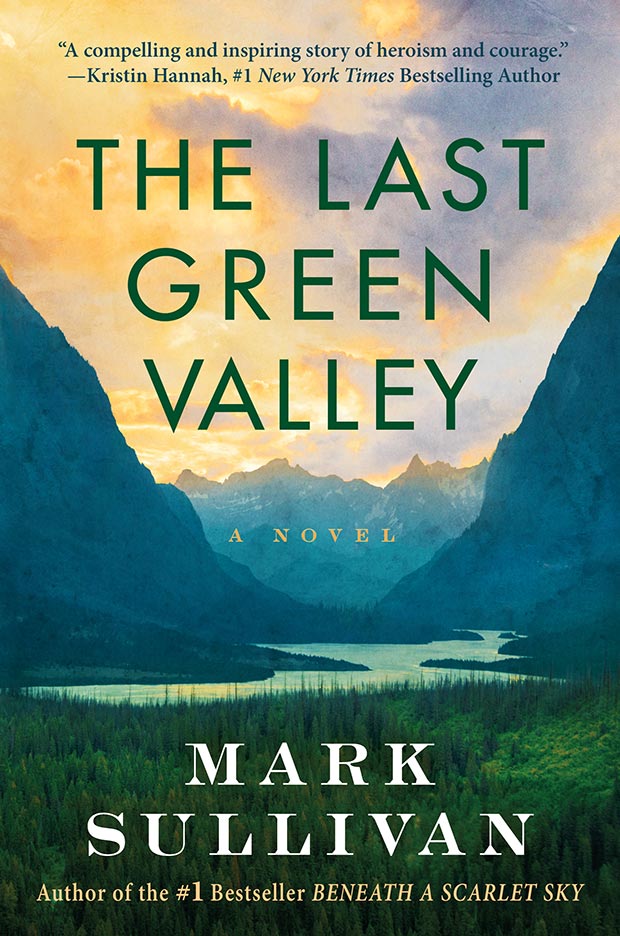
The Last Green Valley, by Mark T. Sullivan
This is a book I’d looked forward to listening to but, like I mentioned about the audio recording of Greenlights, by Matthew McConaughey in an earlier blog post, there were so many extremes in volume on this CD that I just couldn’t deal with it.
The Last Green Valley, by Mark Sullivan
I really liked Mark T. Sullivan’s earlier novel, Beneath a Scarlet Sky. If you’d like to read my comments about it, here’s a link to my January 13, 2019 blog post, The Other Books I Read in December 2019.
The Last Green Valley is probably equally as good as Beneath a Scarlet Sky. I just thought I’d mention my experience with this book on CD in case you also depend upon audiobooks.
Since my last blog post
Update on that new air fryer/toaster oven: I’m happy to report that I’ve gained confidence and understanding, and this new “gizmo” doesn’t intimidate me anymore. That said, I admit I haven’t yet tried the rotisserie feature.
We’ve weathered yet another health crisis with our almost 13-year-old diabetic rescue dog. He spent another night in a specialty veterinary hospital in Charlotte. If you live in the Charlotte area, I hope your regular vet will refer you to Charlotte Animal Referral and Emergency (CARE) when your pet needs specialized care. They’re great! They’ve saved our dog’s life three times since last August.
Except for printing spine labels for the five archival binders for our 96-year-old friend’s love letters between him and his wife during the Korean War, my sister and I have finished that project. Their more than 200 letters to each other from 1951 until early 1953 have now been organized and put in archival-quality sleeves in binders. He and we can only hope that his descendants will appreciate the treasure these letters are.
My fibromyalgia flare continues and is making it difficult to chew even soft food. I know this is probably just a temporary flare. It will pass. I just need faith and patience to supplement the pain medications.
Until my next blog post
I hope you have a good book to read. I’ve reached the top of the library waitlist for a half-dozen audiobooks at the same time. Too bad I can’t listen to one book with my right ear and another book with my left ear! I finished listening to The Elephant of Belfast, by S. Kirk Walsh. It’s a wonderful novel inspired by a true story about an elephant in the Belfast Zoo in 1940.
For those of you living in the northern hemisphere, I hope you’re having a splendid summer after being confined for so long due to the COVID-19 pandemic. I don’t have any trips planned, but I’m making the most of these warm, sunny days with fewer face-covering restrictions.
For those of you in the southern hemisphere, I learned on Friday that the National Geographic Society has named the Southern Ocean around Antarctica as Earth’s fifth ocean. I must be getting old. Since I was in school, Pluto has lost its designation as a planet and Earth no longer has just four oceans. This is proof that we should never stop learning new things.
What a great time I had reading books in October! Many books
are published in the fall of the year. I’d been on the waitlist for months for
some of those books as well as others. Of course, they all became available at
the same time. “Too many books, too little time” kicked in big time!
Today’s blog post is about what is possibly my new favorite
book and one of the other books I read in October. My blog post next Monday will
catch you up on the other books I read last month.
The Stationery Shop, by Marjan Kamali
I can’t say enough about this book! It just may be my new favorite novel. This is a story that will stay with me forever. It is a tragic story in many ways, but oh how lovely! I listened to it on CD. Mozhan Marno did a superb job reading it.
The Stationery Shop, by Marjan Kamali
This
historical novel takes us back to 1953 in Tehran, Iran. There is a chance meeting between a young man and a young
woman in a stationery shop where books are also sold. Since the young man’s
mother has already selected the woman she wants her son to marry, she is none
too happy when he announces his plans to marry this woman of lower economic
status he met at the stationery shop.
Marjan
Kamali includes just enough 20th century Iranian history to set the
stage for this story of love, betrayal, and a never-ending love between two
people. You will discover connections between different characters as you read.
It is a rich book, beautifully written.
I’m eager
now to read Marjan Kamali’s debut novel, Together
Tea, and I can’t wait to see what she writes for us next!
The Ragged Edge of Night, by Olivia Hawker
This book was a big surprise. I read that Olivia Hawker had a new book, One for the Blackbird, One for the Crow, coming out on October 8. I’m on the waitlist at the library for it. One for the Blackbird, One for the Crow sounded interesting, so I looked to see what else she had written.
I listened to her first book, The Ragged Edge of Night, on CD. It was beautifully written, and I learned from the notes at the end of the book that it was based on a true story from Ms. Hawker’s husband’s family. It was beautifully read by Nick Sandys and the author, Olivia Hawker.
The Ragged Edge of Night, by Olivia Hawker
This book contained some of the most moving and beautiful
prose of any novel I’ve read. The premise of the book is that Elisabeth Herter,
a widow with three children, is looking for a man to help her with the
responsibility of raising her three children. Along comes Anton Starzmann, a former
Franciscan friar who has been stripped of his occupation and his school by the
Nazis in 1942 Germany.
Elisabeth and Anton start corresponding. They meet in person
and agree to marry. Anton cannot father children due to an injury, but that
suits Elisabeth just fine. They will marry, be companions, and raise her
children. These are desperate times.
That’s the plot, and it’s a beautiful story. What struck me
about The Ragged Edge of Night was
how Olivia Hawker wrote Anton’s gut-wrenching fear that Hitler and the Nazis
were entrenched until the end of time so beautifully that I was brought to
tears. Through her writing, Ms. Hawker put me in Hitler’s Germany. Even though
I knew Hitler was brought down in the end, she put me in 1942 when I had no way
of knowing that.
That’s what good historical fiction does. It puts you in the
story and in the time and place, so you don’t know what the future holds.
I wish I could quote extensively from the book in order to
give you the true flavor of the prose, but I’ll settle for the following few
sentences from Anton’s point-of-view as he implores God to help him make sense
of what is happening in Germany in 1942. This prose I found so beautiful is in
chapter six. Here’s a chopped-up transcript from that chapter:
“The bells will ring, even after The Reich has fallen. Everything that is in me that is sensible, everything that is rational can’t believe it’s true. The Reich will never fall…. But when in moments of quiet, in my stillness of despair, I dare to ask what yet may be…. Christ Jesus, I always believed you were merciful, but this is a monstrous cruelty to make me dream of a time when evil may fall…. I cannot help but know it, against all sense, I believe somewhere beyond the ragged edge of night, light bleeds into this world.”
From Chapter 6, The Ragged Edge of Night, by Olivia Hawker
I hope those six sentences I pulled out of a long prayer I
transcribed from the CD entice you to read the book. Writers are advised to put
the reader in the scene. This, to me, is a prime example of just that.
My only criticisms of the CD are (1) Every time the children
in the story spoke, it was at full blast and (2) Some of the audio segments
were longer than 30 minutes. The wide range of volume is an irritating and
uncomfortable situation for people who are hearing-impaired. The excessively
long audio segments present a problem on some CD players. More than once when I
couldn’t listen to the end of a segment, I had to listen to the entire segment
a second time in order to get to the end of it.
Since my last blog
post
A fibromyalgia flare has knocked the props out from under me as we transition from summer into winter. (I think we often just skip right over fall here in North Carolina.) Eye pain has forced me to listen to books more than read them.
As you know, listening to books is not my reading format of choice. It’s going better than I expected, though. In fact, I believe listening to the CD recording of The Ragged Edge of Night possibly gave me a richer reading experience than I would have had if I’d read the words myself. That astounds me and gives me a new appreciation for audio books.
I want to read The
Stationery Shop and The Ragged Edge
of Night again. It’s rare that I find a book that I want to read a second
time.
Until my next blog
post
I hope you have a good book to read. I’m listening to Heads You Win, by Jeffrey Archer.
If you’re a writer, I hope you have productive writing time.
Thank you for reading my blog. You could have spent the last few minutes
doing something else, but you chose to read my blog. Don’t be shy – share this
blog post on social media.
Let’s continue the
conversation
I’m always interested to know what my blog readers are
reading. Please share that in the comments below or on my social media
platforms.
I’m feeling my age today, after going up into the attic on Tuesday. Not a good idea for someone of my age with CFS/ME and fibromyalgia. That said, Wednesday wasn’t a good day for me to try to figure out something new on the computer. There’s really not a good day for me to do that. I should only attempt such tasks when I’m at the top of my game. With no such days on the horizon and needing to blog about something starting with the letter “W,” I forged ahead.
What starts with W?
On the 23rd day of the 2017 A to Z Blog Challenge, the featured letter is “W.” I’ve struggled over what to write about today. There are so many possibilities, including Why I Write, Writing, Webinars I’ve Attended, Wufoo.com, or the Where Writers Win website.
W is for Wufoo.com
Wednesday was the day I could finally sit down at the computer and try to figure out how Wufoo.com could integrate with MailChimp on WordPress.com so I could have a mailing list. In the event I ever want to announce something to my readers before or without making a public announcement, I need an e-mail mailing list.
Other bloggers have such lists, so how difficult can it be, right?
I spent a couple of hours on Wednesday afternoon working my way through the simple instructions on Wufoo.com trying to set up a way for me to add a sign-up form on my blog for a mailing list. As often happens, the list of “do this and you will see that” suckered me into thinking I could do. I improvised when I “did this and I didn’t see that.” I set up an account. I created a form. I filled in blanks. I wrote little notes to my readers telling them I would never share their information with anyone. I marked the parts of the form that are not optional. I went to WordPress.com and cut and pasted the Wufoo code so it would show up as the third widget down in my blog’s sidebar. I thought I had everything accomplished, but on Wednesday night as I schedule this blog post for 6:50 a.m. Eastern Time on Thursday, April 27, no such sign-up form has appeared on my blog.
It’s my fault
I in no way blame Wufoo.com for this. It is obviously an error on my part. It has been another frustrating day in the life of someone who is technologically-challenged and just wants to be a writer.
“I’d rather do it myself!”
One day I will have to give up on setting this mailing list up myself, but I will not give up on the mailing list. I’m trying not to bother my niece’s husband with this request. He set up my website, and I’m sure he can do this for me, too. I am reminded that as a very small child, one of my favorite things to say was, “I’d rather do it myself!” Apparently, that’s still true.
A to Z Blog Challenge
I’m delighted to note that there are only three days remaining in the A to Z Blog Challenge. Topics for “Y” and “Z” are still up for grabs, in case anyone has any suggestions for me. I’m looking for words starting with “Y” and “Z” that have something to do with writing for my blog on April 29 and 30, 2017.
Until my next blog post
I hope you have a good book to read. If you’re a writer, I hope you have productive writing time.







 Janet's Writing Blog