Reading and Writing in January 2018

January is over, so it’s time for me to “fess up” about how I spent the month. Perhaps a better way to say that is “what I accomplished.” In my January 8, 2018 blog post (2018 Reading, Writing, & Living Plans) I felt I needed to be accountable to my blog readers. In order to do that, I said I’d set monthly writing goals. For January, I set a modest goal of adding 2,000 to the scenic plot outline for my historical novel, The Spanish Coin.

My writing

For starters, I failed miserably on reaching my 2,000-word goal. What I did, though, was brainstorm about story location. I continue to wrestle with what direction to take in re-writing my historical novel manuscript. The working title remains The Spanish Coin.

Historical novel progress

In January I settled on a location for the story. At least, I hope I will not change from this latest locale. I did some 1700s research on the place and worked on the story’s timeline. Location plays an important role in historical fiction. The era for the novel is the 1760’s, which is a decade earlier than my original plan.

Spanish Coin location reveal

Curious about the story’s setting?  The Camden District of South Carolina. Choosing a location for the story has freed me to proceed with the outline.

Goal for February

I tend to write detailed outlines, so I’ll go out on a limb and set a goal of 6,000 words for February.

My reading

I got my concentration back and had fun reading in January. I read what I wanted to read instead of tying myself down to any particular reading challenge.

That said, I picked up the rules for the 2018 reading challenges for the public libraries in Harrisburg and Mint Hill (I couldn’t help myself!), but I don’t plan to let them dictate what I read. With 500+ books on my “want to read” list, though, I might meet those two challenges without really trying. Incidentally, even though I read seven books in January, my “want to read” list had a net gain of 39. I realize this is not sustainable. I would have to be a speed reader and live to be a centenarian to finish my ever-growing list.

52 Small Changes: One Year to a Happier, Healthier You, by Brett Blumenthal

The book title says it all. I took note of the suggested change for each week. This week seems like a good week to start, since I didn’t begin in January. This week’s small change:  Drink enough water to stay hydrated. I’m told I should drink approximately 80 ounces of water every day. Since I normally drink less than half that amount, this constitutes more than a “small” change for me.

The Rooster Bar, by John Grisham

This latest John Grisham novel took a little different tack from his earlier books in that The Rooster Bar is about a group of law school dropouts practicing law without licenses. I found it to be more humorous than other Grisham novels I’ve read, but it was still full of suspense.

Perennial Seller: The Art of Making and Marketing Work that Lasts, by Ryan Holiday

I blogged about this book on January 22, 2018, so I direct you to that blog post if you missed it: (Works That Last.)

The Last Castle: The Epic Story of Love, Loss, and American Royalty in the Nation’s Largest Home, by Denise Kiernan

the-last-castle-9781476794044_lg
The Last Castle, by Denise Kiernan

I’ve been reading so many novels the last couple of years that I’d forgotten how long nonfiction book titles tend to be. Or maybe it’s just the three I read in January.

I thoroughly enjoyed reading this book about the Vanderbilt family and the Biltmore Estate. Living in North Carolina, I have toured the Biltmore House four times. The first time was on a sixth grade field trip. Motion sickness on the bus as it wound around the endless curves on old US-74 east of Asheville is my main memory from that day, but I digress.

My other visits to the Biltmore Estate have been very enjoyable. Reading this book made me want to plan another trip to Asheville and tour the mansion again. It is a delightful book.

Before We Were Yours, by Lisa Wingate

9780425284681
Before We Were Yours, by Lisa Wingate

This novel was inspired by the shocking history of the Tennessee Children’s Home Society during the first half of the 20th century. It is a gripping story and is expertly written. It is not a happy read, but I highly recommend this book.

The King of Lies, by John Hart

This was the January book choice of the Rocky River Readers Book Club. The novel is set in Salisbury, North Carolina, so I was familiar with some of the streets and buildings referenced in the book. It’s fun sometimes to read a book set in a location you have visited.

I though Mr. Hart could have omitted some of the “woe is me” theme in the first third of the book. The narrator’s whining about the wealthy people in this small town got old after a while. If you’ll hang in there, though, you’ll probably get so involved in trying to identify the killer that you’ll get to the point you can’t put the book down. You’ll think several times that you’ve figured out the villain’s identity but, chances are, you haven’t.

Nightwoods, by Charles Frazier

This novel has been on my “to read” list for several years, so I felt a sense of accomplishment when I finally read it. It is set in the mountains in western North Carolina.

Nightwoods is a tale about a woman who unexpectedly “inherits” her deceased sister’s twin boy and girl. The children give their aunt/new mother a challenge every day – and then her late sister’s widowed husband/killer comes to try to get the large sum of money he thinks the children took with them. The children are wild and uncommunicative. Add to that the fact that the aunt has no idea why her ne’er do well ex-brother-in-law has suddenly shown an interest in his children and has come to hunt them down.

What about December?

I just remembered that I never did blog about the books I read in December. They were a mixed bag of novels:  The Quantum Spy, by David Ignatius; Hardcore Twenty-Four, by Janet Evanovich; and The Secret, Book and Scone Society, by Ellery Adams.

David Ignatius’s political thrillers never disappoint me. The Quantum Spy was no exception.

The last two Stephanie Plum novels by Janet Evanovich disappointed me. I used to eagerly await her annual next installment of these funny novels, but “Twenty-Three” and “Twenty-Four” were too predictable.

The Ellery Adams novel is an entertaining read about four women who want to form a friendship, but each one is required to reveal a secret about herself before they can truly trust one another.

Until my next blog post

I hope you have a good book to read. I’m reading Fighting to Win: Samurai Techniques for Your Work and Life, by my fellow-blogger David J. Rogers; The Salt House, by Lisa Duffy, which was recommended by my friend Karen; Beartown, by Frekrik Backman, which is the February pick for The Apostrophe S Coffee Chat online book community; and The Woman in the Window, by A.J. Finn. That’s about one book too many for me to read at the same time, but they are different enough that I’m not getting the story lines confused.

If you’re a writer, I hope you have productive writing time.

If you subscribed to my mailing list last week, you renewed my faith in mankind. Thank you, Vicki, Colby, Katrina, and Glen!

In case you haven’t signed up for my mailing list, you have another opportunity to do so using the fill-in form below. I appreciate it!

Janet

Go back

Your message has been sent

Warning
Warning
Warning
Warning
Warning

Warning.

Pioneer Mill Gold Mine

Occasionally, I like to present samples of my writing in this blog. My blog post on May 23, 2017 was “No Place for a Preacher’s Son?” (No Place for Preacher’s Son?) The “no place for a preacher’s son” was the Pioneer Mill community in Township One of Cabarrus County, North Carolina in the 1870s.

Gold Fever!

The reason for Pioneer Mill being a “boom” place in the 1800s was due to the development of a gold mine there. Gold was first discovered in the United States in Cabarrus County in 1799.

“Gold fever” soon took hold of the region and numerous gold mines were developed in Cabarrus County in the early 1800s. In fact, so much gold was found in the area that in 1837 a branch of the United States Mint was opened in Charlotte in adjoining Mecklenburg County

I heard about the Pioneer Mill Gold Mine when I was a young child. I knew where it had been. I should have asked “the older generation” some questions about it, but now that generation is gone.

Finding myself in “the older generation,” I researched the gold mine in order to write a two-part series about it for the now defunct Harrisburg Horizons newspaper in 2012. Today’s blog hits the highlights of those newspaper articles.

After the 1799 discovery of gold on John Reed’s land in Township Ten, everyone in Cabarrus County probably started searching for gold on their property. The date that gold was first discovered at Pioneer Mill is unknown, but the 1869 Branson Business Directory described the mine as “among the earliest discovered mines in the State.

The land on which the Pioneer Mill Mine was worked in the 1800s was purchased in the 1760s by James Morrison, an immigrant from Campbeltown, Scotland. It passed down to his son, John. John and his wife, the former Mary McCurdy, had 11 children. Their youngest child, Robert Harvey Morrison, was born in 1817.

Robert Harvey Morrison remained on the family land and was quite prosperous. The stately two-story house at the entrance to the present-day Cedarvale subdivision on Morrison Road was the home he built for his family of eight children.

Mineral Rights

From a deed registered in Cabarrus County, we know that in 1853 Robert H. Morrison sold the mineral rights on his 640 acres of land to Collett Leventhorpe of Rutherford County, North Carolina and Richard H. Northrop of Albany, New York for $5,000.

In June of 1854, Messrs. Leventhorpe and Northrop, both identified as being of Rutherford County, sold the mineral rights and mining machinery to Francis Rider of New York City for $475,000.

Mr. Rider was identified as the president of the Pioneer Mill Mining Company, “an association incorporated in pursuance of the provisions of an act of the Legislature of the State of New York” that authorized the formation of “Corporations for Manufacturing, Mining, Mechanical or Chemical purposes Passed February 17th 1848.”

I requested a copy of the incorporation papers of the Pioneer Mill Mining Company from the State Archives of New York State, but the researchers there were unable to find a record of the company.

Geology

Ebenezer Emmons served as State Geologist in North Carolina from 1851 until 1863. Dr. Emmons described the veins of gold at the Pioneer Mill Mine in an undated report, “Geological Report of the Midland Counties of North Carolina” as a fine example of veins of gold coming off a foot-wall.

An electronic copy of the Emmons report can be found online through the University of North Carolina’s Documents of the South Collection at http://docsouth.unc.edu/nc/emmonsml/emmons.html. He wrote, “In some instances the segments are so distinct that on being removed the lode seems to have run out, but on working back to the foot-wall, another segment is encountered.”

“Foot-wall” is the rock underlying a mineral deposit. The report noted that the Pioneer Mill Mine was in syenite granite.

I have heard it said that in the days of dirt roads and horse-drawn wagons, when horses’ hooves clacked along the road at the intersection of Morrison Road and Pioneer Mill Road, there was a hollow sound that led to speculation that there was an old mine shaft under the roadway.

Dr. Ebenezer Emmons wrote that the Pioneer Mill Mine was in a cluster of interesting mines for which he held great expectations, although the Pioneer Mill Mine was the only one in the cluster in operation at the time of the report.

He described it as “twelve miles east of Concord, and situated upon the eastern border of the sienitic [also spelled syenite] granite, and in a belt upon which there are numerous veins carrying both gold and copper. The vein fissure in the granite is between sixteen and seventeen feet wide. Its direction is N.70°E. The true vein stone is quartz from eight to thirty inches thick, both sides of which is bounded by the killas.”

“Killas” is a Cornish mining term for metamorphic rock strata of sedimentary origin altered by heat from intruding granite.

The Emmons report indicated that there were four veins of gold on the Robert Harvey Morrison plantation. The first vein was a mile south of the Pioneer Mill Mine. Dr. Emmons found refuse ore rich in gold around an old shaft at that vein which was in quartz interspersed with “sulphurets.”

The second vein was a mile east and resembled the first. The third was a vein of gold in combination with copper pyrites. The fourth vein was of quartz and iron pyrites in the northeast part of the plantation. All four veins generally ran northeast.

Dr. Emmons reported that the Pioneer Mill Mine ground 30-40 bushels of ore daily, although he noted that at 11 revolutions per minute, the Chilean millstones in operation were not set at the proper speed for the ore being ground.

The report listed 14 totals of bushels ranging from 38 bushels to 154 bushels and the corresponding yield in gold in dollars. (It is not known if these were weekly totals over a period of time or exactly what time frame is covered by the list.) The list totaled 1,677 bushels of ore producing $5,674 in gold. That was in mid-19th century dollars, when gold was valued at $18.93 per troy ounce.

The Pioneer Mill Mine employed 15-20 men from 18 to 20 days-a-month. The cost of operating the mine was $400 per month. Dr. Emmons noted that the mine had nearly gone under after incurring too much debt, but under a new agent who was more attentive to the machinery and who had started using mercury in the Chilean mill the mine started turning the handsome profit detailed above.

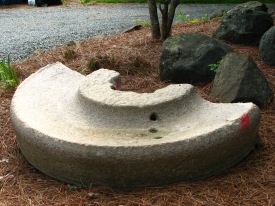
In backyard of Robert Harvey Morrison House
Part of a gold ore grinding stone from the Pioneer Mill Gold Mine.

Dr. Emmons wrote that the Pioneer Mill Mine would have had truly impressive profits had it had machinery capable of grinding 100 bushels of ore per day.

The glory days of the Pioneer Mill Mine ended with the American Civil War in 1861. It took decades for our local economy to recover from the years of the War and Reconstruction. With the passage of time, it ceased to be cost effective to mine for gold in Cabarrus County.

According to the Carolina Watchman newspaper on September 17, 1891, the Pioneer Mill Mine was then owned by Mr. E.C. Black “and he is making some nice finds. He has found several large nuggets; one worth $50, another $12 and still another $37.”

Needless to say, I was thrilled to find Dr. Emmons’ report for without it we would know almost nothing about the Pioneer Mill Mine. Driving through the Pioneer Mill community today, one would never guess that 160 years ago it was a gold mining boom town.

Until my next blog post

I hope you have a good book to read. Just for fun, I’m reading Hardcore Twenty-Four, by Janet Evanovich. All the books I requested at the public library in November (or earlier) have become available to me at the same time. I have three that have come to my Kindle and one traditional book at the library. Time will tell if I’m able to get them read in the time I have allotted by the library system.

If you’re a writer, I hope you have quality writing time.

Janet