N is for Newspaper Column

Today is the 14th day of the 2017 A to Z Blog Challenge, so the featured letter is “N.” I wrote a local history column for a weekly newspaper, Harrisburg Horizons, in Harrisburg, North Carolina for six and a half years.

My freelance “job” with the newspaper took me in many unexpected directions. One of my first columns (July 12, 2006) was titled, “Native American Projectile Points.” The following is a slightly revised version of that column. Some of the wording has been changed and all the photographs have been added to this blog post.

Do you think Harrisburg’s history began with the earliest European settlers, or even with the coming of the railroad in the 1850s? Today, I invite you to join me on a journey into prehistoric Harrisburg in the southern piedmont section of North Carolina.

Schiele Museum, Gastonia, NC

I recently made an appointment to take my collection of Indian arrowheads to Dr. Alan May, staff archaeologist at the Schiele Museum in Gastonia, NC. The first thing I learned was that I didn’t have a collection of Indian arrowheads!  The proper term is “projectile point,” which includes spear points and arrowheads.

I proudly opened the box containing my small collection. Dr. May examined each piece. I held my breath and waited for him to gasp upon spying a rare and valuable piece. He did not gasp.

My collection turned out to be mundane and of no particular interest to an archaeologist; however, the insight Dr. May shared that day gave me much to think about and opened a window on prehistoric Harrisburg.

I expected Dr. May to tell me that my projectile points dated back to the 1600s or possibly a little earlier than that. I expected him to tell me that the points were typical of the Catawba or perhaps even the Cherokee. That’s not what he said.

Middle Archaic – Morrow Mountain

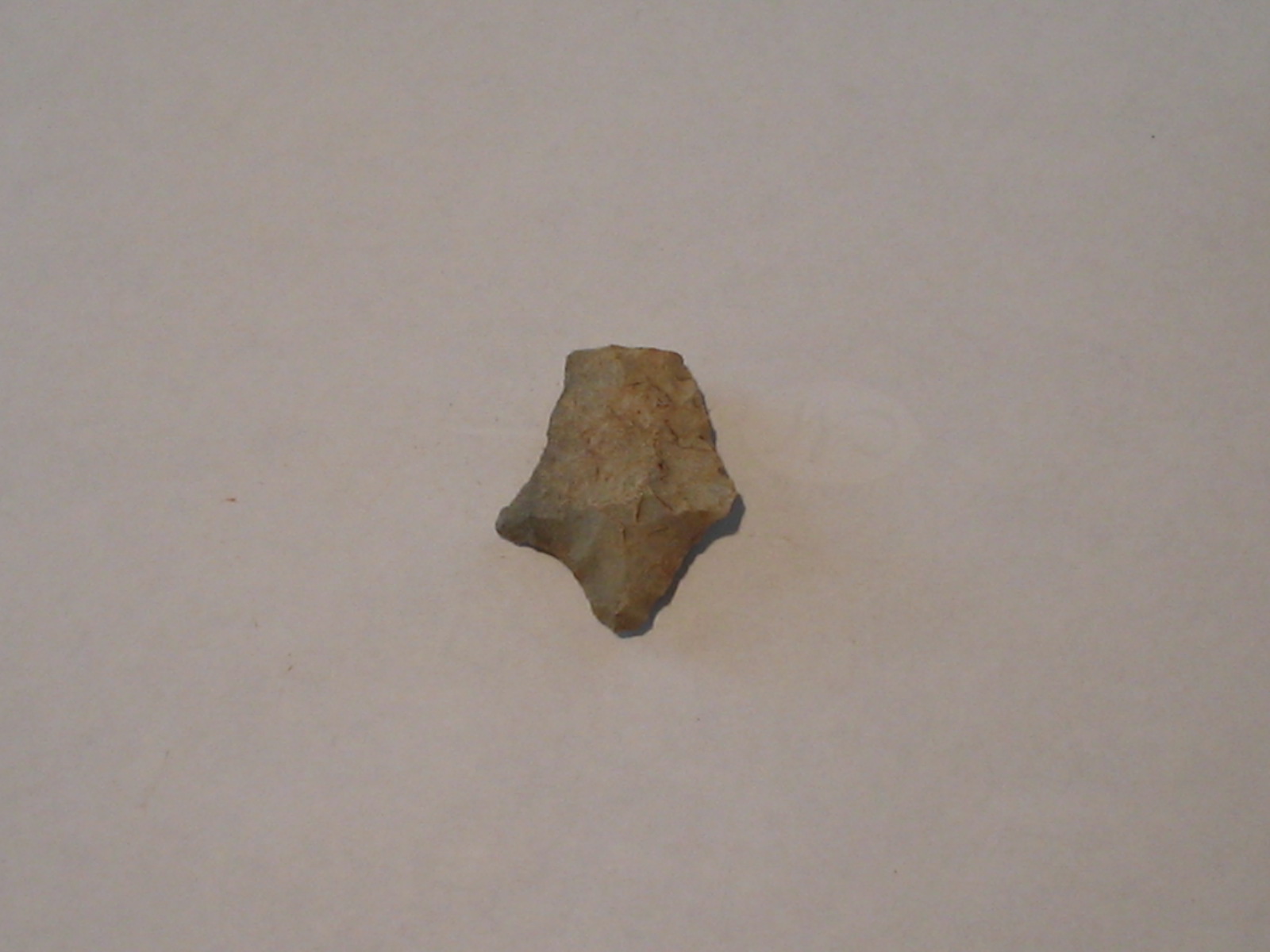
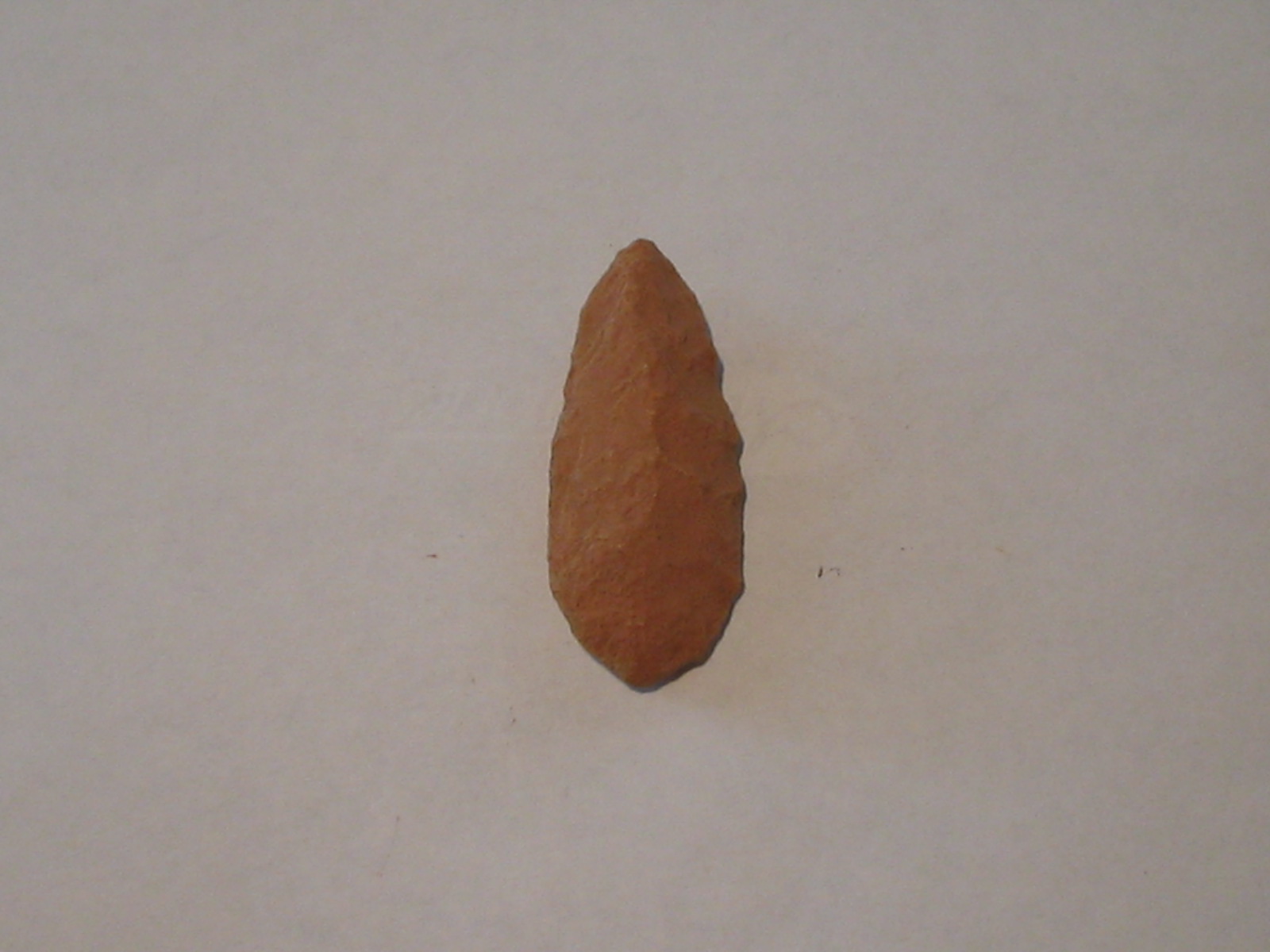
Two of my projectile points are called “Morrow Mountain” pieces. They are from the Middle Archaic period which ended around 3000 B.C. (or B.C.E., if you prefer.)

Base of a projectile, Morrow Mtn., Middle Archaic
Base of projectile, Middle Archaic, Morrow Mountain.
Arrowheads, Tools, & Rocks 012
Middle Archaic (2,000 to 3,000 B.C.E.) Morrow Mountain Projectile Point

Middle Archaic Guilford

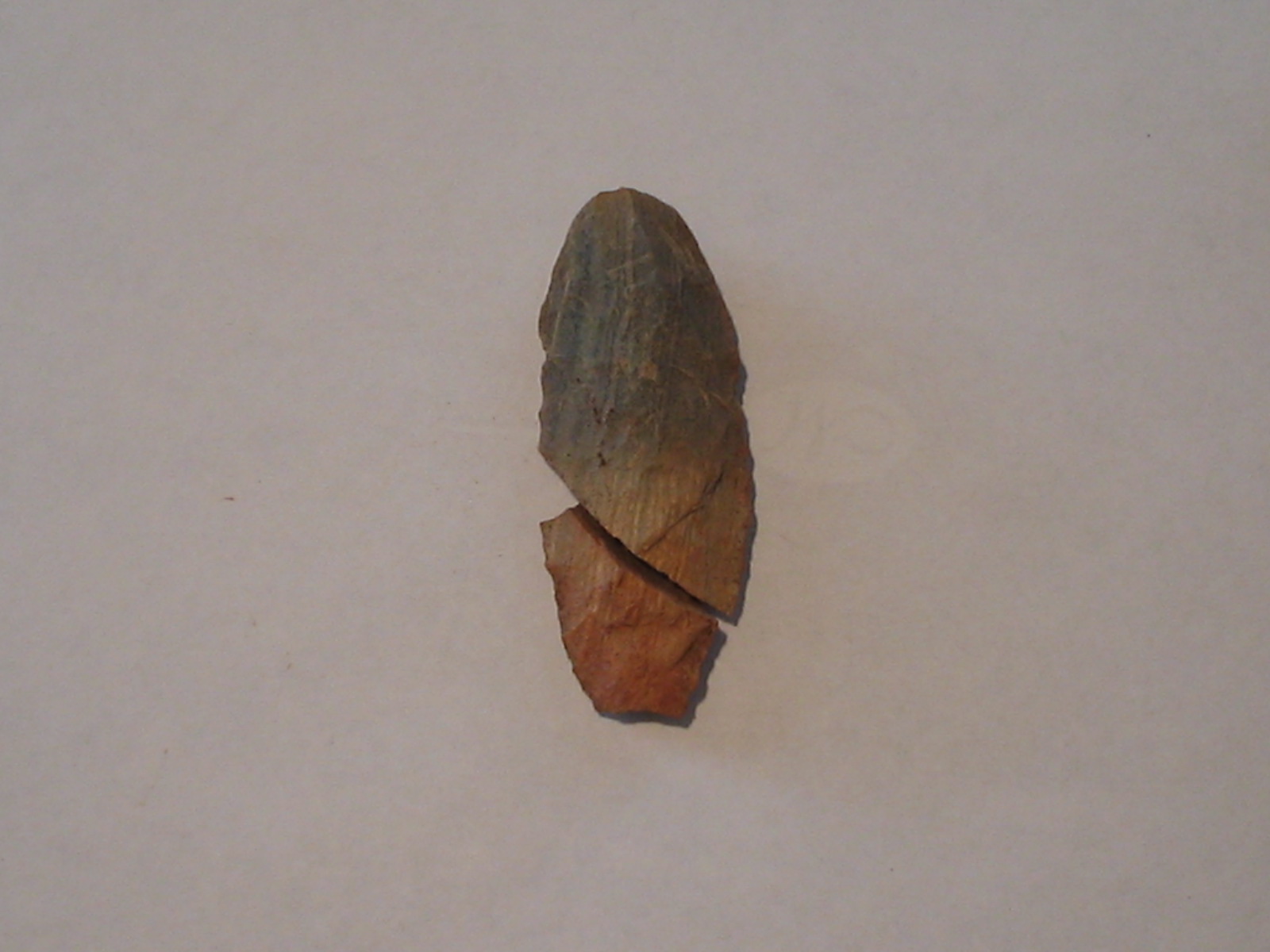
Two other pieces are of the “Guilford” style and also date to the Middle Archaic period when Native Americans hunted bison in North Carolina.

Broken example of Middle Archaic - Guilford
Broken example of Middle Archaic – Guilford projectile point.
Middle Archaic - Guilford
Middle Archaic, Guilford projectile point.

Late Archaic

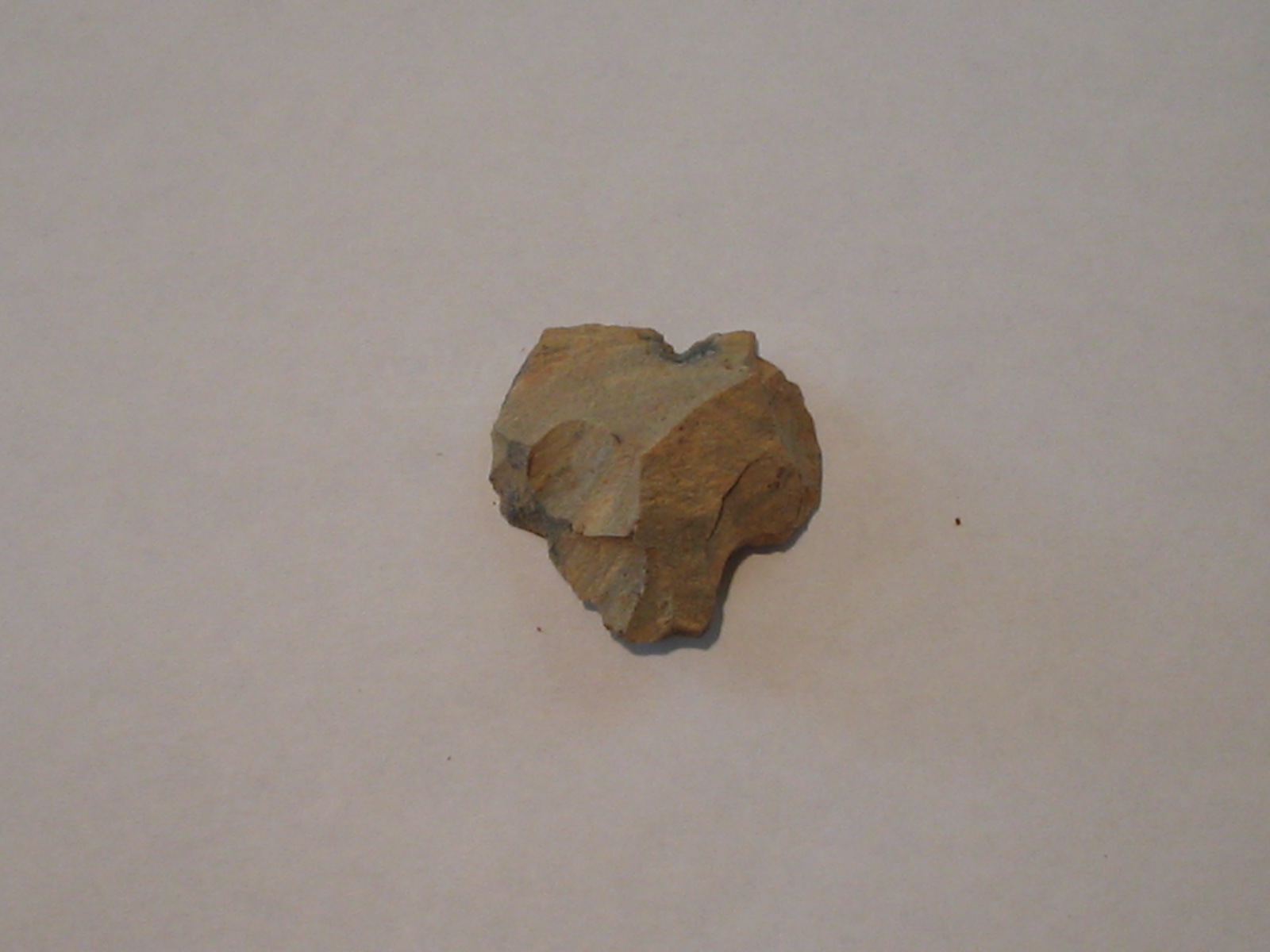
Several of the projectile points in my collection are “Savannah River Stemmed “ points from the Late Archaic period, 1000 to 3000 B.C. This period was cooler than Middle Archaic. Deer, rabbits, and raccoons were hunted for food.

Late Archaic. Flagstone or field stone argilite, probably like what's coming out of the quarry nearby.
Late Archaic. Flagstone or field stone, probably like rock that is currently being mined from a nearby quarry.
Late Archaic. Thin bioface straight-sided projectile broken in use or when re-sharpened. Good material.
Thin biface straight-sided Late Archaic projectile point. Broken either by use or when re-sharpened.

Ancient Tool:  Anvil

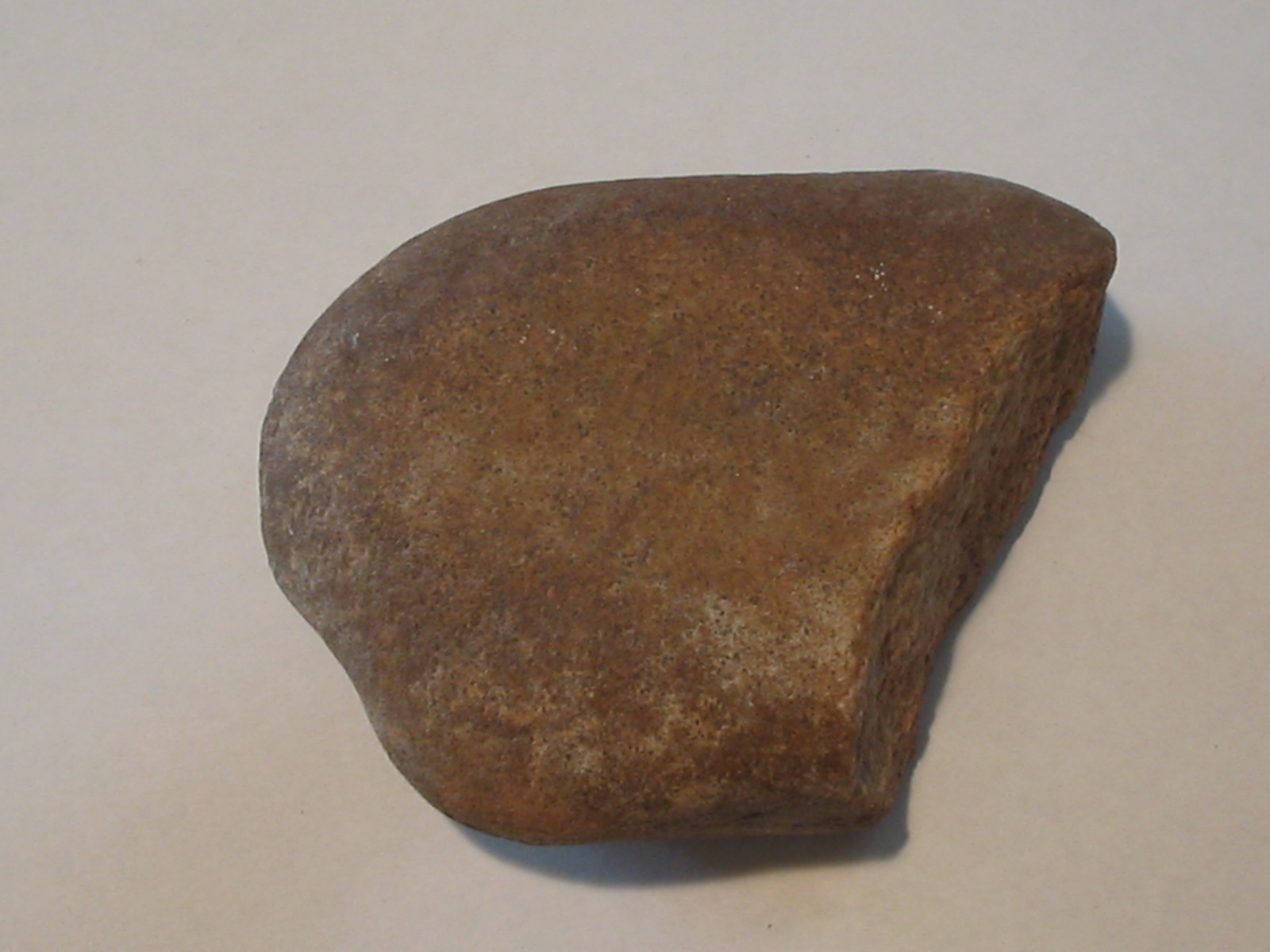
I was certain that Dr. May would identify one of the smooth rocks I took him as an early Native American tool. He said it was just a rock that had been smoothed by water. Another rock, which hadn’t seemed as interesting to me, turned out to be an anvil.

This is an anvil. Notice the slight depression in roughness in middle on one side.
This is a stone anvil.

Some rocks I took to the museum were magnetic, which wasn’t a surprise; our red clay soil is rich in iron. One piece that appeared to be a rock was identified as slag hammered by a blacksmith. That made sense, because my father told me that there used to be a blacksmith’s shop in what is now my front yard.

Gold?

The rock I hoped he would say held flecks of gold, held flecks of worthless pyrite instead. I can see why it’s called “fool’s gold.”

pyrite and flecks of gold and lead. Dr. Alan May at Schiele thought this was a neat piece.
Lead with pyrite and flecks of gold. Dr. May thought this was an interesting piece.

Dr. May recommended that I send a detailed report about my collection to the Office of State Archaeology in Raleigh. The State has a form called “North Carolina Amateur Archaeological Site Form.” Dr. May said they will pinpoint my yard on a map and keep a record of my findings.

My visit with Dr. May brought surprises, both good ones and disappointing ones. I came home knowing that 5,000 years ago as the Egyptians developed hieroglyphic writing and the darkness was first lighted by candles, Native Americans were hunting deer and bison in my yard. Wow!

That was the end of my July 12, 2006 newspaper column. For now, it’s the end of the story. When I read the column last night for the first time in many years, I realized that I never followed through with Dr. May’s recommendation that I send a detailed report to the Office of State Archaeology in Raleigh. I’ve added that report to my “to-do” list, but writing must still come first.

Until my next blog post

I hope you have a good book to read. (I’m reading a nonfiction book, In Order to Live:  A North Korean Girl’s Journey to Freedom, by Yeonmi Park with Maryanne Vollers. It was published in 2015, but I’m finding it particularly interesting as I read it during rising tension between North Korea and the United States. I highly recommend it!)

If you are a writer, I hope you have productive writing time.

Janet

Trains Crash in Harrisburg, 1897

My blog post on February 7, 2017 Two Lines I Like from a Margaret Maron Novel was about train whistles. I quoted a couple of lines from Long Upon the Land, by Margaret Maron and reminisced about train whistles in my hometown of Harrisburg, North Carolina. Today’s blog post is an edited version of a two-part article I wrote for my “Did You Know?” local history newspaper column in Harrisburg Horizons weekly newspaper on April 4 and April 13, 2007.

nc-transportation-museum-6-19-10-010
Steam locomotive at the NC Transportation Museum, Spencer, NC.

Head-On Collision!

Did you know that the Sunday morning tranquility in Harrisburg was shattered on April 11, 1897, by the head-on collision of two steam trains?

North-bound Southern “fast mail” train No. 36 had orders to wait at Harrisburg until 11:15 for the south-bound local passenger train No. 11. The passenger train from the nearby town of Concord was running behind schedule. As No. 36 approached Harrisburg, engineer W.B. Tunstall of Danville, Virginia, expected to see No. 11 sitting in the siding.

Seeing no waiting train, Tunstall steamed ahead at 45 miles per hour. By the time the No. 11 came into view, there was nothing Tunstall could do but apply the brakes and jump out of the locomotive.

Newspaper accounts indicate that some Harrisburg residents saw what was going to happen but were helpless to do anything. The crash was heard for miles around and was likened to “a sharp crack of thunder.”  The engine of No. 11 ran over the engine of No. 36. The boiler of No. 36 rested on the floor of No. 11’s postal car.

An express car of No. 36 derailed and landed 150 feet from the track. Another car, hauling strawberries and fresh vegetables, was torn to pieces. Produce was strewn over the area. Train parts were thrown as far as seventy-five yards away.

None of the 96 passengers on No. 36 were injured. They immediately exited the train to see what had happened and, subsequently, did what they could to help the injured train and postal employees.

Less than three minutes after the collision, with its headlight up in the telegraph wires, No. 11’s postal car burst into flames. If not for the quick action of one of the train’s postal clerks, John Hill Carter, both trains probably would have burned, but newspaper accounts do not tell how he extinguished the fire. Mr. Carter was praised for risking his life to put out the fire and save others.

Casualties

The accounts of the agony suffered by the employees who were killed or injured in the wreck are given in great detail in the newspaper accounts of the day. Some were pinned under the wreckage, while others were badly burned by the steam from the boilers. Passengers formed a bucket brigade to throw cold water on one of the trapped men to help relieve his suffering from the steam.

Capt. Tunstall was found unconscious and badly scalded on an embankment. The conductor of No. 11, James Lovell of Richmond, Virginia, was cut on the face. Fitzhugh Lee, a porter on No. 11, was pinned in from the knees down. William Clemmens of East Durham, North Carolina, and R.E. Gallagher, an express messenger, were also injured.

The impact itself and the resulting release of steam caused four deaths and a number of serious injuries.

Those who were killed in the wreck or died immediately after were as follows:  Postal clerk T. Clingman Benton of Monroe, NC and Charlotte; John or Titus Eudy of Forest Hills in Concord; No. 36 fireman Will Donaldson of Lynchburg, Virginia; and J.C. Kinney of Thomasville, NC. Capt. Kinney was badly scalded. It was thought that he also inhaled steam which caused internal misery.

First Responders and Thrill Seekers

News of the collision was immediately telegraphed to the train depot in Charlotte. In less than forty-five minutes, a rescue train was dispatched from that city. It transported a Dr. McCombs and Dr. E.M. Brevard. Cots were taken for transporting the wounded and dead to Charlotte. Mr. Eudy survived the crash but died en route to Charlotte.

The citizens of Harrisburg were praised in the newspaper accounts for helping to clear the wreckage. Engines pulled from both directions to clear the track. Debris removal continued through the night, while another work crew laid a temporary track around the wreck. That track was in place by that night when the No. 35 fast mail train gingerly made its way through Harrisburg.

On April 12, 1897, The Charlotte Observer reported that hundreds of thrill seekers “on wheels, horseback and in buggies were flying toward Harrisburg. At 2 o’clock a horse could not be had in any of the stables for love or money.”  Many other people gathered at the train depot in Charlotte to await the arrival of the rescue train at 4 p.m.

That same newspaper account reported that one of the No. 36 passengers, Charles Bitterman of New Orleans, belonged to “The Riverside Wheelmen” cyclist club and was on his way to a bicycle race in New York. The article stated that Bitterman belonged “to National Circuit and will be here later with the professional men.” (Cycling clubs were all the rage in America and Europe in the 1890s.)

As I edit this article in 2017, the at-grade railroad crossings in Harrisburg have been closed and replaced by bridges in order to make way for the new high-speed rail. I have crossed that railroad thousands of times, and after learning about the 1897 train wreck in 2007 I was often reminded of the gory details of that fateful day when mangled and splintered train cars, bodies, and fresh produce were scattered in the nearby fields. It must have been an awful sight along with the screams of the injured who were in agony.

The train wreck of 1897 was, no doubt, long-remembered by Harrisburg and surrounding residents. When I interviewed Harrisburg resident and retired railway employee Harry R. Higgins on January 21, 2007, he remembered that Floyd Smith often came to the train depot in Concord when Mr. Higgins worked there. Mr. Higgins heard him tell about a block office employee who let a train into a block by mistake when another train was coming. The man realized his mistake and left in guilt because he knew what was about to happen. Mr. Higgins did not know if this was referring to the 1897 wreck in Harrisburg or not.

At the end of my article I asked for anyone who knew of a first-hand written account or oral history of the accident to please share that information with me, but no one offered additional details.

My Stint as a Newspaper Columnist

I am glad I had the opportunity to write a local history column in Harrisburg Horizons for six years. It gave me a reason to visit many of the older members of the community and take notes about their memories. Local newspapers preserved on microfilm sometimes provided a topic for me. I found it surprising that I had never heard about this horrific steam train head-on collision until I stumbled upon it in the microfilmed newspaper records. Mr. Harry R. Higgins has died since I asked him about the train wreck. He followed in his father’s footsteps as a railroad employee.

A Call to Action

If you have an interest in the local history where you live, I hope you talk to the older residents and record their memories. This is especially important if you live in a rural area or a small town that has never had a newspaper. That was the case here in Harrisburg. The town did not have a newspaper until 2006 and, unfortunately, it ceased publication in 2012.

Until my next blog post

Until my next blog post, I hope you have a good book to read. If you are a writer, I hope you have productive writing time. Please help me get the word out about my writing and my blog by clicking on the social media icons below or by the old-fashioned way – word of mouth. I appreciate it!

Janet

Save

What I read in January

My last blog post was about some of the books I read during the last quarter of 2015, and I promised my next post would be about my reading so far this year. Actually, this post will just cover four books I read in January.

After enjoying Allen Eskens’ debut novel, The Life We Bury, in 2014, I looked forward to his second book. I read The Guise of Another in January. It had more violence than I thought necessary, but perhaps I was just still in the Christmas spirit. It was an intriguing story and a page turner like his first book. I hope he keeps writing novels.

Somehow I failed to read David Ignatius’ The Director, when it was released last May. I remedied that oversight in January. I’m a big David Ignatius fan, and The Director did not disappoint.

Michael Eury is the author of several local history books here in Cabarrus County, NC. His latest rendering, Legendary Locals of Cabarrus County is a delightful collection of the life stories of Cabarrus Countians who have made a lasting mark on the southern piedmont of NC. Michael asked me to make recommendations for the people from Harrisburg that he should include in the book. I was thrilled to have a hand in that. The book turned out great!

My name finally rose to the top of the public library’s waitlist for Janet Evanovich’s Tricky Twenty-Two. Fans of Ms. Evanovich eagerly await the next installment of this chronologically-numbered Stephanie Plum series every fall. I try to get on the waitlist at the library as soon as her annual release is on order. When I need a laugh out loud book to read, give me Stephanie Plum!

As a writer, I want people to support their local independent bookstore. As a writer, I also want people to support their local public library system. No matter how you choose to get your books, just get them!

Happy reading! (Now, I need to get back to The Guilty, by David Baldacci!)

First Author Event Scheduled!

My first author event/book signing for The Blue Ridge Mountains of North Carolina will be held at the public library in Harrisburg at 5:30 p.m., Thursday, September 11th. This is exciting and a bit intimidating. Author events at the other three public libraries in Cabarrus County are in the works, but no dates have been selected.

I’ve tried for two weeks to arrange author events in the three public libraries in one of the counties in the foothills of North Carolina to no avail. It is disappointing. I really want to show my support for public libraries. I will turn my attention to the next county on my list and keep you posted.

Getting back to research

For those of you who follow my local history column in Harrisburg Horizons newspaper every other week, my article was omitted last Sunday. It should be in the paper on October 7.

I neglected research for my local history column for a few weeks while I spent time making items to sell on Saturday, October 6 at the Harvest Fest at Harrisburg United Methodist Church. This is my first craft fair, so I’m eager to see how it goes. Variety is the spice of life, so I have enjoyed this recent diversion.

Monday will find me concentrating on my local history research and putting my fingers to the keyboard. Reading microfilmed records is tedious but full of surprises. I must psyche myself up to do more of that this winter.

Writing the newspaper column since May of 2006 has been a blessing to me, and I’m thrilled when people tell me how much they enjoy and look forward to my articles. I have enjoyed writing my “Did You Know?” column more than any other job I’ve ever had.

I plan to start blogging a couple of times a week to let you know what I’m working on and what I’m reading. Stay tuned.

Learning to Quilt, too?

Learning to play the mountain dulcimer at the age 57 apparently wasn’t enough of a challenge for me. Or perhaps I’m having a midlife crisis. For whatever reason, this seemed like the right time in my life to do some of the things I’ve always wanted to do.

My new endeavor is quilting. I’ve joined a small quilters group in my community.  We meet monthly. Individually and collectively they have welcomed me with open arms and much encouragement.

I literally had to blow the dust off the old Singer sewing machine. It’s one of those old “thread-it-yourself” models from the 1960s. It took a while for the machine and me to get reacquainted. Thread tension is still a bit of an issue, but I’m confident that the end result will be something of which I can be proud.  Project #1:  a sample quilt made up of a dozen 12-inch square blocks, each block a different quilt pattern.

With Block #1: Roman Square successfully completed, this week I will tackle Block #2: Log Cabin. It is fun to see the various fabrics I purchased for my quilt coming together in blocks. I had not sewn since the early 1980s and had forgotten how exciting it can be to shop for fabrics.

My assignment before the February quilting group’s (Friendship Quilters) meeting is to sew sash pieces of fabric between quilt blocks sewn earlier by other members of the group. With some luck, this piece will turn out to be a table runner to be sold at our sponsoring church’s fall bazaar. Imagine something I helped sew being sold at a bazaar!

My blog continues to be all over the map when it comes to topics. It started out to be a way for me to put out the word about my writing. Life is too short and precious to be lived enjoying only one thing, though. I continue to write a local history column for Harrisburg (NC) Horizons newspaper every other week, but playing the mountain dulcimer and sewing also beg for my time and attention. It is said that a writer writes because he or she has to. I feel the same way about playing the dulcimer. If a day passes and I don’t play this beautiful Appalachian mountain instrument, I feel cheated and my day is incomplete. I play for my own enjoyment. It is one of the most relaxing hobbies I’ve ever had.

I wish for you the same desire to learn new things. Writing, music, and sewing continue to bring new friends and pleasures into my life.

What have you always wanted to do that you have never pursued?