C is for Characterization

This is the third day of the 2017 A to Z Blog Challenge, so today’s post must have something to do with the letter “C.” Thinking in the realm of writing fiction, I settled on the word CHARACTERIZATION.

Characterization can be shown through narrative, dialogue, action, and reaction. All four should be used by a writer.

There are many things for a fiction writer to keep in mind in creating and fleshing out characters. My writing mentor from Queens University of Charlotte, Judy Simpson, said, “Don’t begin writing your story until you know all of the major characters.” I can’t remember if I followed that advice when I started writing The Spanish Coin manuscript 10 or more years ago. (There! I’ve said it! This has been a labor of love that I have worked on in spurts and fits, sometimes not touching it for more than a year at a time.) But I digress.

The famous mantra of writing instructors comes into play in characterization:  Show, don’t tell. Don’t tell the reader about a character. Reveal character details through what they say, how they say it, and what they do or don’t do.

Even though the writer might have in her notes a driver’s license description of each character (e.g., black male, brown eyes, black hair, six feet tall, 180 pounds) that is usually not the best way to introduce a character to your reader. Let those details (or just the ones that are pertinent) come out gradually and in subtle ways.

Every character has strengths and weaknesses. A “goody-two-shoes” character is boring and, let’s face it, offensive and irritating. Likewise, even the most heinous villain probably has some redeeming value.

Characters unnecessary to the story should be omitted. Related to that, a writer should not include minor characters early on in a novel because the reader might be misled and lose interest.

There is also the matter of choosing names for all the characters. Writing instructors caution beginning writers not to give two characters in the same short story or novel names that are similar. For instance, you might not want a Phil and a Phyllis in the same book.

I have struggled over the name of a free woman of color in The Spanish Coin. She was Rachel for a long time because I think Rachel is a beautiful name and it conjures up an image of a strong and elegant woman in my mind. I changed her name to Clarissa in honor of a woman of color who made a great impression on me while I was writing local history articles for a newspaper a decade ago. It will be interesting to see what the character’s name turns out to be in the final product.

Another consideration that must be taken into account, especially when writing historical fiction, is that the writer must make sure to give characters names appropriate to the time and place. For instance, you won’t find a Tammy or a Kevin in The Spanish Coin because those names were not used in 1771 in the Carolina backcountry.

Each character should have at least one distinguishing characteristic in order to help set an image in the reader’s mind. A character could have a foreign accent, a disfiguring physical feature, a hearing problem, a lisp, a limp, an annoying laugh, a mental illness, or a word or phrase that no one else says.

Who knew there were so many things to think about when giving a fictitious character a name?

Until my next blog post tomorrow

I hope you have a good book to read. (I seem to always have too many on my bedside table! One night they’re going to topple over and give me a concussion.) If you’re a writer, I hope you have quality writing time.

Janet
2017 A to Z Challenge Badge
Blogging from A to Z Challenge Badge 2017

What I read in April

I am still fairly new to blogging about my life as a writer, so please be patient as I make changes in my blog page as I learn new things. I’ve added a couple of new items this evening and will be working out the bugs in the coming days.

My first blog post each month will be about the books I read in the previous month.

Author Lee Smith’s latest book, Dimestore: A Writer’s Life, is an enjoyable book. It’s a memoir told through stories. Ms. Smith was born in the mountains of Virginia, and she has a lovely accent. As I read Dimestore, I could hear her saying the words.

In my “Some books I read in February” blog post, I reported finally starting to read Sue Grafton’s Alphabet Series of novels. I plan to read them in order, so I read B is for Burglar in April. I’m on the wait list for C is for Corpse at the public library. Apparently, I’m not the only person who is 20 years late reading her series.

Raising Ryland: Our Story of Parenting a Transgender Child with No Strings Attached, by Hillary Whittington made a lasting impression on me. It is written by the mother of a young transgender child. Labeled a girl at birth, as a toddler Ryland started letting his parents know that he really was a boy — not a tomboy, but a boy. This is a wonderful book that taught me a lot about this topic which has been making global headlines lately due to the passage of House Bill 2 (HB2) by the North Carolina state legislature. Raising Ryland should be required reading for the North Carolina governor and state legislators. It helped me have a better understanding of transgender people, and I highly recommend it. I don’t think I’ll ever forget this book.

I ended the month by reading Mrs. Roosevelt’s Confidante, by Susan Elia MacNeal. A historical novel set in Washington, DC during World War II, the book introduced me to a new historical fiction author. You can be sure I’ll read all of Susan Elia MacNeal’s books. This is Ms. MacNeal’s fifth book of fiction. She has another one scheduled for release in October 2016 titled The Queen’s Accomplice. If you like historical fiction set in the World War II era, I suggest you give Ms. MacNeal’s books a try. If you’re like me, you’ll learn some history while enjoying a suspenseful story.

To be a good writer, it is said one must be a reader. I’m not a fast reader, but I try to read a variety of genres and learn what good fiction is.

Please follow me on Twitter by clicking on the Twitter icon in the sidebar.

Janet

Some books I read in February

On February 21 I posted a blog about some of the books I read in January. I think in the future I will blog about the books I’ve read in a given month at the end of that month or first couple of days in the following month. I have good intentions, but you know what they say about those!

“Exploring North Carolina” is one of my favorite shows on UNC-TV. The host, Tom Earnhardt, never fails to educate and entertain as he explores the varied and rich geography, geology, flora, and fauna of the state. Although the vast majority of my books come from the public library, Mr. Earnhardt’s book, Crossroads of the Natural World: Exploring North Carolina with Tom Earnhardt was a book I knew I wanted to own. It’s the kind of book from which one can learn something new every time it is read. As if I needed any encouragement to visit every nook and cranny of North Carolina, this book makes me wish I could spend all my time doing just that.

Now that Sue Grafton is nearing the end of the alphabet, I decided to start reading her books. I read A is for Alibi in January and plan to continue reading my way through her popular alpha series. I couldn’t help but notice how telephone communications have changed since A is for Alibi was published in 1982. It almost places the book in the historical fiction genre.

Another case that falls into the “so many books, so little time” category is John Grisham and his books. I finally got around to reading Gray Mountain. (Yes, Sycamore Row is still on my “want to read” list — which is growing far faster than I’ll ever be able to keep up with.) I thoroughly enjoyed Gray Mountain. I love the way Mr. Grisham gets his points across regarding social justice issues without beating us over the head. In Gray Mountain, he puts a human face on how surface mining has scarred so much of our nation’s coal-producing region.

I was delighted to win a copy of The Third Reconstruction: Moral Mondays, Fusion Politics, and the Rise of a New Justice Movement, by the Rev. Dr. William J. Barber II with Johnathan Wilson Hartgrove. I participated in the Moral Mondays Movement in North Carolina in the summer of 2014, so I was eager to read Dr. Barber’s book. Even though I pride myself for staying informed about local, state, and national politics, Dr. Barber’s book opened my eyes to some historical connections that I had not made. This book shines a light on dirty politics in North Carolina but gives strong hope that this current grassroots movement will persist.

The Dark Road to Mercy, a novel by my fellow North Carolinian Wiley Cash, is primarily set in Gastonia, North Carolina and Myrtle Beach, South Carolina. It is the sad tale of two young sisters abandoned by their father and then left in a children’s home when their mother died. Long lost Dad shows up and wants his daughters. Thus begins a tale that will keep you wondering what’s going to happen next and what the final outcome will be. If you want to read what inspired Mr. Cash’s book, read his author page on Amazon.com. I’ll be on the lookout for his next book.

David Baldacci’s The Guilty was the next book I read in February. Mr. Baldacci did not fail to give the numerous twists and turns for which he is known. This whodunit is a true page turner. As a Southerner, I think the accents were at times overdone, and I was surprised he made the mistake of having a character ask another character, “What do y’all want” when obviously speaking to one lone individual. Also, I’ve never heard a Southerner use the term, “Yous.” On a positive note, he did spell “y’all” correctly, which is something some Southerners don’t do. The deeper I got into the fascinating story, the less I noticed the vernacular. Not sure how I’d feel, though, if I were from Mississippi.

Perhaps I am just sensitive about the accents because use of accents and brogues in dialogue is something I’m struggling with in my fiction writing. I’m dealing with Carolina backcountry settlers from Scotland, Ireland, and France and slaves from Africa in my historical novel manuscript titled The Spanish Coin. Since I’m a novice writer, who am I to criticize someone like David Baldacci? I’m striving to strike a balance between giving characters authentic voices and overdoing vernacular to the point that it distracts the reader from the story. It is a writing skill I must master.

Now I’m afraid this post is too long. Do I need to blog about what I’m reading more often than monthly?

What do I do with my time?

I am often asked what I do with my time, since I do not work outside the home. It puzzles me on several levels. Foremost, why does anyone care what I do with my time? Some people don’t think writing is hard work. I have friends who think a book can be written in a day, so they wonder why I haven’t finished writing my historical novel, The Spanish Coin.

Also, I have many interests. I enjoy reading; writing; rooting for my beloved Carolina Panthers (“Keep Pounding!”); genealogy; staying informed about current events and politics; sewing; quilting; playing the mountain dulcimer; crocheting; knitting; doing needlepoint; photography; cooking; baking; listening to a variety of music; and spending quality time with friends, family, and my dog. My sister and I share an online craft shop, Hickory Ridge Crafts, on Etsy.

Therefore, I hardly know where to start or how to respond when asked, “What do you do with your time?” My interests run far beyond my energy, but I am fortunate to be able to do what I’m in the mood to do most days. That, my friends, is a true blessing. I worked full time for many years, so I value my time now all the more.

I love getting back into the process!

I love getting back into the process of writing my historical novel, tentatively titled The Spanish Coin! Having a computer again and making time to get reacquainted with my 97,000-word manuscript has been fun and reassuring.

A few days ago I started with the first chapter and went to work tweaking words, phrases, sentences, and paragraphs. I have changed the layout of the house that Nancy Craighead Richardson lives in based on some things I saw in October in a house at Hart Square in Catawba County, North Carolina. That necessitates making consistent changes in the book as people move from room-to-room or can or cannot hear conversations taking place in another room. As I work my way through the manuscript for the umpteenth time, I still search for more precise words, more vivid descriptions, and tidbits to add in order to make my characters come alive.

The first hurdle I had to jump before plunging back into my manuscript was to once again come to grips with the fact that I am writing historical fiction. The historian in me was faced (once again) with a conundrum. When I write a history article or nonfiction book, I am a stickler for making sure every fact to checked and double-checked. Writing historical fiction based on a person who actually lived 250 years ago is a challenge for me. My fear is that someone will read The Spanish Coin and fall into the trap of thinking it is all based on fact.

In my manuscript I took a 1771 Carolina backcountry event and the lore that grew out of that event to weave a “what if?” story. In fact, I visited the Lancaster County SC Public Library in Lancaster on Friday just to make sure I had not overlooked something in my initial research for The Spanish Coin.

If I am fortunate enough to get my manuscript published, I must trust the readers to read it and appreciate for what it is — a work of fiction.

Postcard captions in dribs and drabs

The title for today’s blog posting came to me and triggered a question in my mind. Where or how did that saying originate? It seems that dribs dates back to the 17th century in some English, Irish, and Scottish dialects and meant “an inconsiderable quantity” or sort of like “drip.” The origin of drab in conjunction with drib isn’t as clear. It meant a “small debt or sum of money in England in the early part of the 19th century. I must admit, though, that I thought it was “drips and drabs” until I looked it up a few minutes ago. The joke is on me! It just goes to show that sometimes I think I know what I’m talking about but I actually don’t. At least I was using it correctly even though I wasn’t spelling or saying it correctly.

I had hoped to edit my historical novel manuscript, The Spanish Coin, for four hours today. (Anyone remember that Writing Plan of Action I posted about a few days ago?) Instead, a plumber was in the house working in various rooms for a couple of hours. It doesn’t take much to distract me. There was just no way I could settle down and get any uninterrupted time to edit that book between that disruption and then the aftermath of putting things back into cabinets and mopping the kitchen and bathrooms. I did not want to abandon my writing completely, so I did the research for and wrote nine vintage postcard captions in preparation for a possible piedmont North Carolina book for Arcadia Publishing. (My goal was to write two captions today.) I’ll keep you posted.

Not one single sales gene!

Making “cold calls” at bookstores and other stores that might sell my book is not my idea of fun because I was born without one single sales gene. It is difficult for me to enter a store and introduce myself and my book. Perhaps it will get easier with practice. I am much happier at the keyboard writing. That’s probably true of most writers, but promoting one’s book is part of the job.

I told my friend, Kay, that I was not cut out for life in the fast lane. She didn’t miss a beat and came back with, “Maybe you should of thought about that before you wrote a book!”

If you’ve been following my blog over the last week, I don’t want to leave you with the impression that my book was on all the bookstore shelves in the mountains. I visited several bookstores that had not heard of my book, The Blue Ridge Mountains of North Carolina. That was not a surprise.

Eastern National operates the gift/book shop at the Folk Art Center on the Blue Ridge Parkway in Asheville. There were a couple of Arcadia Publishing books available there, but mine was not one of them. The cashier said they will “probably have it eventually.” He said it has to be approved for sale by the national office, the regional office, and then the local office. I’m hopeful my book will be for sale there by spring. Winter is a slow time for tourists on the Blue Ridge Parkway, so spring will be good.

The woman at Fountainhead Books in Hendersonville was not very encouraging, but gave me the owner’s business card and told me to have Arcadia contact the owner directly. I did that when I got home, and Arcadia is following up with Fountainhead.

The Fountainhead Bookstore in Hendersonville, NC.

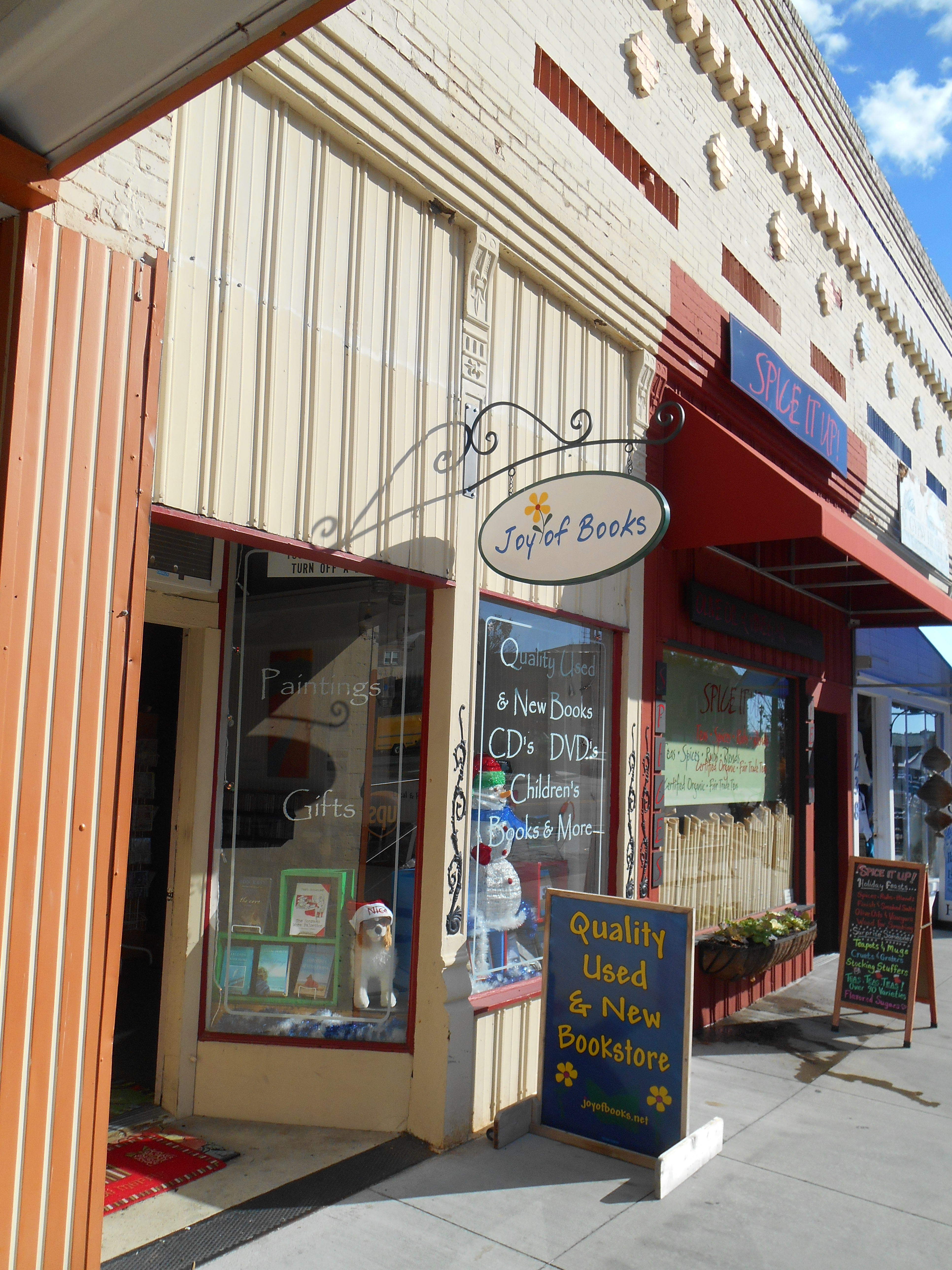
Joy of Books is the other bookstore in Hendersonville. The woman there was upbeat. She has never ordered books from Arcadia, but she has ordered from History Press and she knew that the two companies recently merged. I’m hopeful that she will order my book.

Joy of Books in Hendersonville, NC.

All the contacts I make while promoting The Blue Ridge Mountains of North Carolina will serve me well if I get to write additional vintage postcard books for Arcadia Publishing and when I get my historical novel published. The title I’ve given that 98,000-word manuscript is The Spanish Coin. Someday….

The Dry Grass of August

Today was great fun! I got to hear Anna Jean Mayhew, author of The Dry Grass of August, speak at the public library in Kannapolis, NC. The event was well attended and she answered questions until there were no more. She’s a very entertaining speaker.

Discussions of The Dry Grass of August generate interesting questions and conversations about the days before and during the Civil Rights Movement. Today’s audience was a cross-section of ages and people who grew up in various parts of the United States. Today’s program brought several perspectives to light.

The discussion about race relations combined with A.J.’s talking about her writing and life experiences made for a very enjoyable afternoon.

Back to my novel manuscript

I must stop letting life interfere with my writing! I’ve been so busy this summer making things to try to sell on Etsy in my online shop, Hickory Ridge Crafts, that I have neglected my writing. Dr. Kyle Hite’s sermon this morning at Rocky River Presbyterian prompted me to return to my Spanish Coin manuscript this afternoon. It was fun getting back to it and getting the synopsis polished.

I started writing The Spanish Coin in 2004. The manuscript has evolved from historical fiction into Christian historical fiction. This was a slow process as I tried to discern God’s will.

What’s next? Writing the dreaded query letter and seeking a literary agent.

More Tricks of the Trade

I am working my way through Chris Roerden’s book, Don’t Murder Your Mystery. Today I took his recommendation to find creative ways to describe characters. I was guilty of using driver’s license type details to paint pictures of my characters in The Spanish Coin manuscript, so I did some editing this afternoon to illustrate what those people are like instead of what they looked like. After all, habits and mannerisms make people more interesting than their height and eye color.

The learning experience continues, and I am really enjoying the process!