One of the Most Banned Books in the US: Sold, by Patricia McCormick

It is seldom that a character in a book grabs me by the throat and won’t let me go, but that’s exactly what happened the moment I started reading Sold, by Patricia McCormick.

Sold, by Patricia McCormick

In case you don’t know, this is one of the most banned books in the United States. Knowing that makes me furious and heart-broken.

Sold, by Patricia McCormick was a National Book Award Finalist for Young People’s Literature.

This book is categorized as a YA (Young Adult) book. I think it should be required reading for “young adults” which includes teens. In fact, I think it should be required reading for ‘tweens.”

If a girl is old enough to be sold into the sex trade, by golly she is old enough to read this book!

I have blogged about book banning several times recently, and I will probably blog about it in the future. It is a practice I do not understand. It is a practice I abhor. It is a practice that, if left unchallenged, will destroy our democracy. Organizations such as Moms for Liberty are trying to take our liberty away under the guise of looking out for children.

Where I come from, you don’t look out for children by taking books away from them. If your narrow-minded self wants to take books away from your own children, you have the right to do that. However, you don’t have the right to take books away from all children.

According to PEN America, Sold, by Patricia McCormick is tied for the sixth most banned book in the United States. It is banned in 11 school districts in six states.

In Sold, Lakshmi, a 12-year-old girl in Nepal is sold by her stepfather. She is taken to India where she is locked in a brothel. She is tricked into thinking that if she works in the brothel long enough, she will eventually be able to pay off the “debt” she owes the madam.

This, of course, is a myth. It works sort of like the tenant farmer system in the United States. The farm owner keeps adding charges to the tenant’s account, so the tenant never gets out of debt. In Sold, the madam keeps adding charges for clothes, make up, electricity, etc. to Lakshmi’s account. Lakshmi thinks part of the money she is earning is going to her mother. She wants her mother to be able to replace the thatched roof on their house with a tin roof. Of course, none of the money she’s earning is being sent to her mother.

This book is written in a short pieces. Each piece gives the reader another glimpse into the miserable life Lakshmi endures.

There is a satisfying ending, in case you shy away from books that don’t resolve in a way you wish; however, most girls like Lakshmi do not experience a happy ending.

The author’s note at the end of the book gives the following statistics (among others) for the time of its writing (2006):

“Each year, nearly 12,000 Nepali girls are sold by their families, intentionally or unwittingly, into a life of sexual slavery in the brothels in India. Worldwide, the U.S. State Department estimates that nearly half a million children are trafficked into the sex trade annually.”

“It won’t happen to my child.”

If you don’t want your 12-year-old daughter to know there is such a thing as sex trafficking, that’s your prerogative. Bury your head in the sand and hers, too, while you’re at it.

That does not mean she won’t fall victim to this sickening crime one day.

Don’t you owe it to her to tell her there are dangerous people out there who are very charming — some are even women — but don’t have her best interest at heart? Just because she doesn’t know sex trafficking exists doesn’t mean she won’t learn about it the hard way.

Since my last blog post

I’ve worked to make my books more visible on Pinterest. Since a free workshop about Pinterest for authors offered by Bookbrush.com helped me realize that Pinterest is a search engine and not social media, I’ve tried to utilize the platform more than I have in the past to publicize my writing. Visit my boards and pins on Pinterest at https://www.pinterest.com/janet5049/.

I found another local independent bookstore that takes self-published books that are published by Kindle Direct Publishing on consignment! I hope to be able to announce in a future blog post that The Aunts in the Kitchen: Southern Family Recipes is available at Main Street Books in Davidson, North Carolina!

I continued to try to get back on Facebook, but there are several forces beyond my control working against me – including the iCloud. All this nearly six-month long saga started with a data breach at Windstream. I miss being able to publicize my blog, website, books, and short stories on Facebook.

Until my next blog post

If Sold is not on the shelf for circulation in your local library system, request that the system purchase it. That is exactly what I did. I hope it will soon be available in the Cabarrus County Public Library system.

I hope you will read Sold, by Patricia McCormick.

For a 2020 US State Department report about human trafficking in Nepal, go to https://www.state.gov/reports/2020-trafficking-in-persons-report/nepal/. For a US State Department report on global human trafficking, so to https://www.state.gov/humantrafficking-about-human-trafficking/#human_trafficking_U_S. The statistics are overwhelming!

Look for other often-challenged or banned books and make a point to buy them or check them out of the library. Together, we can make a statement louder than that of Moms for Liberty – just like voters across the nation did in last Tuesday’s local school board elections.

Spend time in person or virtually with friends and family, even if they have views that are different from yours. Try to find a way to engage them in conversation about those topics. Try to understand why they believe what they believe.

Last, but not least… remember the people of Ukraine and the Middle East who are victims of dictators, terrorists, and wars they didn’t ask for.

Janet

“Reading Like a Writer”

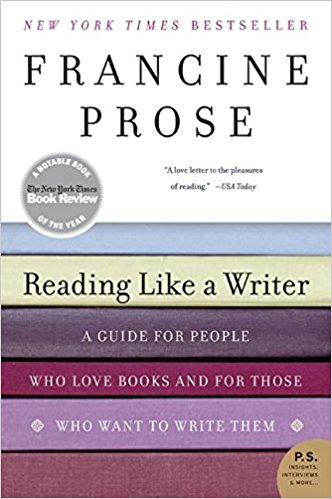
In my last two blog posts I’ve written about the books I read in March. Last Monday’s post was nearing 2,000 words, so I decided to save my comments about Reading Like a Writer:  A Guide for People Who Love Books and for Those Who Want to Write Them, by Francine Prose, for today. I’ll just hit some of the highlights.

Reading Like a Writer 5182EVgCeCL._SX330_BO1,204,203,200_
Reading Like a Writer, by Francine Prose

Chapter One:  Close Reading

I read and took copious notes from the first four chapters of this book and perused the rest of it. As an aspiring author, I loved how the first chapter confirmed that I read like a writer. It’s called “close reading,” and it means reading every word for the pleasure of getting every phrase – being conscious of such things as style, sentence formation, and how the author creates characters.

Based on what Francine Prose wrote, I no longer need to apologize for reading slowly. I’m trying to hone my craft by reading published writers.

Chapter Two:  Words

In the second chapter of Reading Like a Writer, the author recommends that you read slowly enough to read every word. She compares the language a writer uses to the way a composer uses notes and a painter uses paint.

To paraphrase Ms. Prose, reading to appreciate the writing is akin to not only admiring a beautiful painting from afar but also close up so you can see the brushstrokes.

I also appreciated Ms. Prose’s thoughts on the advice often given to writers, which is “Show, don’t tell.” Ms. Prose says this much-repeated advice confuses novice writers. I can vouch for that.

In editing my earlier manuscript for The Spanish Coin (before I started the complete rewrite), I took the “show, don’t tell” advice to the extreme. I was ruthless in cutting narrative, thinking I could best “show” through dialogue. It was all part of the learning process. Ms. Prose’s take on this is that showing is best done through “the energetic and specific use of language.”

Chapter Three:  Sentences

If I had known I would someday want to be a writer, I would have paid more attention in the 8th grade when we had to diagram sentences. I wasn’t very good at it, and I really didn’t see the point.

I hadn’t thought about sentence diagramming in years until I got to the third chapter of Ms. Prose’s book. She wrote about the value of diagramming sentences, and what she said makes sense to me now.

She lamented the fact that students are no longer taught to diagram sentences. Her explanation that sentence diagramming provides for the accounting of every word and provides a way “to keep track of which phrase is modifying which noun” gave me a way of understanding the value of the exercise that I could not have appreciated as an eighth grader.

I probably couldn’t diagram a complex sentence today if my life depended on it, but Ms. Prose might just be onto something when she insinuates that having that skill would help a writer.

This weekend I happened upon an article from the Huffington Post about diagramming sentences. Here’s the link, if you wish to take a look:  https://www.huffingtonpost.com/2014/10/01/diagram-sentence-grammar_n_5908462.html.

A word of warning, though, for those of you of “a certain age.” Reading the Huffington Post article, I soon felt like I’d entered a time warp. I don’t think our sentences had “complements” when I was in the 8th grade.

Chapter Four:  Paragraphs

In the fourth chapter of the book, Ms. Prose quotes master short story writer, Isaac Babel:

“’The breaking up into paragraphs and the punctuation have to be done properly but only for the effect on the reader. A set of dead rules is no good. A new paragraph is a wonderful thing. It lets you quietly change the rhythm, and it can be like a flash of lightning that shows the same landscape from a different aspect.’” – Isaac Babel

In all the various English courses I have taken, I don’t recall any teacher or professor ever saying to break for a new paragraph “only for the effect on the reader.” I’m still letting that sink in. It’s refreshing and freeing to think about it. It is for the writer to determine which rules are dead as far as her editor is concerned.

Chapter Seven:  Dialogue

Characters in a novel should “say what they mean, get to the point, avoid circumlocution and digression.”

Chapter Eight:  Details

Another interesting observation Ms. Prose makes is about details and the truth. She observes that details persuade that the truth is being told.

She points out that a piece of clothing can speak volumes about a character’s circumstances.

Chapter Eleven:  Reading for Courage

Continuing to fly in the face of common advice given to writers of fiction, Ms. Prose suggests that the trend in modern fiction that characters in a novel must be nice in order for the reader to identify with them is possibly not true.

She also says it’s not necessarily true that every loose end in a work of fiction needs to be tied up neatly by the end.

What a relief to read those last two theories! My characters don’t have to be nice in order for the reader to identify with them, and all the loose ends don’t have to be tied up at the end of the novel? This is in opposition to what I learned in fiction writing class back in 2001.

“Words,” by Dr. R. Brown McAlister

Chapter Two in Ms. Prose’s book brought to mind the title of the remarks made by one of the two guest speakers at my high school graduation. Dr. R. Brown McAllister, a beloved icon in Cabarrus County Schools at the time, had retired after many decades of teaching and working as a school administrator, and he had a dry but keen sense of humor. The printed program for the graduation ceremony listed “Words,” by Dr. R. Brown McAllister.

In his deadpan way, Dr. McAllister went to the podium and said something like, “I was asked to talk about words, so here I am.” That was in 1971 and I still don’t know to this day if he was asked to talk about words or to say a few words.

The more I attempt to be a writer and the more I read, the more I appreciate words.

Since my last blog post

I have made a social media plan and made an effort to do more on Twitter (@janetmorrisonbk), my writing-related boards on Pinterest (https://www.pinterest.com/janet5049), and my Janet Morrison, Writer page on Facebook. Implementing the plan will be a challenge but I’m told I must get my name out there if I hope to sell any copies of The Spanish Coin if and when it gets written and published.

I did not get much reading done last week, but I’m trying to learn that I can’t do everything I want to do. I can’t even do everything I need to do.

Until my next blog post

I hope you have a good book to read. I’ve just started reading Every Note Played, by Lisa Genova.

every-note-played-9781476717807_lg
Every Note Played, by Lisa Genova

If you’re a writer, I hope you have quality writing time

If you haven’t signed up for my sometime-in-the-future newsletters, please do so by completing the form below.

Janet

Go back

Your message has been sent

Warning
Warning
Warning
Warning
Warning

Warning.