
This has not been a good reading year for me when it comes to fiction. You may recall that I did not read any novels in April and only read a couple of books in May. There are plenty of wonderful novels out there, I’m just not in a good place mentally right now to concentrate on a plot and enjoy them. The memory problems caused by Chronic Fatigue Syndrome are a daily frustration.
Nevertheless, my blog today is about two of the four books I read or attempted to read in the month of June. I will blog about the other two tomorrow.
My Name is Emilia Del Valle, by Isabel Allende
I thought this would be the historical novel that would rescue me from my drought of reading since January 20, but not even Isabel Allende could do that.

I enjoyed the first half of the book, but then I was too distracted by current affairs to concentrate on the war in Chile in the 1890s. I wanted to see if Emilia would locate her biological father in Chile and, if she did, I wanted to see how that meeting took place and if they formed a relationship. (Spoiler alert: After that meeting took place, I began to lose interest in the rest of the plot.”
I cheered Emilia on because she was a female trying to be a writer. I cheered her n when she got a job as a reporter for The Daily Examiner in San Francisco, for that would unheard of for any newspaper in the US in the 19th century.
It was disappointing for me when I lost interest in the story. That’s not a reflection on the writing, for Isabel Allende is a wonderful novelist. Some of her other novels have held me spellbound. I think it just was not the right time for me to read this book.
Please don’t let my comments deter you from reading it.
Who Is Government?: The Untold Story of Public Service, edited by Michael Lewis, with essays by Michael Lewis, Casey Cep, Dave Eggers, John Lanchester, Geraldine Brooks, Sarah Vowell, and W. Kamau Bell
This book pulled at my heartstrings, because in my early adult life I was a public servant. That was what I prepared myself for in six years of college. As is true for most public servants/government employees in the United States, I had little interest in politics.
If that statement sounds strange to you, then you have a misunderstanding of how government in the United States works.
If that statement sounds strange to you, you need to read Who Is Government?
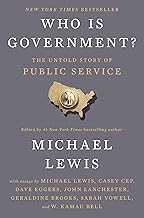
This book is a collection of stories about specific unsung heroes who work in our government. None of them wanted fame or fortune. You don’t know their names.
They were just doing their jobs, all the while dodging the arrows being shot at them daily by a general populous who choose to believe and perpetuate the myth that all government employees are incompetent and lazy.
The writers of Who Is Government? beg to differ with that long-standing misconception of government employees.
The essays in this book are about a government employees who did such things as:
- Figuring out how to make “roofs” in coal mines so they would not collapse – a problem that has killed thousands of coal miners worldwide;
- Figuring out an almost flawless way to run the National Cemetery Administration so that the 140,000 veterans and their families are interred annually are treated with the utmost precision and care as well as immaculately maintaining the final resting place for more than 4 million other veterans in our 155 national cemeteries;
- Figuring out how to build the future Nancy Grace Roman Space Telescope “which will have a panoramic field of vision a hundred times greater than the Hubble Space Telescope” and will perform something called starlight suppression to enable us to see behind and around faraway stars;
- Keeping track of every statistic imaginable, which is what the Consumer Price Index actually is – and it doesn’t just happen – it takes lots of government employees measuring things and keeping meticulous records that an individual could never do but all our lives are affected by that number;
- Catching and arresting cyber criminals who are defrauding people or perpetuating pedophilia on the internet and the dark web;
- Overseeing and accomplishing the digitalization so far of 300 million of the 13 billion government documents so that every American, regardless of their location, will have access to all the records housed by the National Archives and Records Administration;
- Working in the US Department of Justice (I hope Olivia still has a job there!) in the antitrust section because she sees helping to enforce antitrust laws as a way to make sure one person’s American Dream does not “impede on other people’s American Dream”; and
- Helping doctors find new treatments for rare deadly diseases. (I sincerely hope Heather still has her job, but I’m not optimistic.)
Each of the above stories is fascinating. Each one renews my faith in the United State Government and serves as a reminder that ours is a “government if the people, by the people, and for the people” as so eloquently stated by Abraham Lincoln in The Gettysburg Address.
As I stated a few paragraphs ago, the writers of Who Is Government beg to differ with that long-standing misconception of government employees being incompetent and lazy – that misconception that the Trump Administration and the teenagers working for Elon Musk latched onto with all their might and money this year. And thousands of hard-working, knowledgeable, dedicated, non-political government employees lost their careers.
The brain-drain and experience-drain that resulted from the massive firings and layoffs in the US Government and the trickle down through various state and local government programs won’t be recognized or calculated in its entirety for decades.
In many cases, we will never know what we lost. We will never know the cures for cancer or Alzheimer’s Disease that were missed because the researchers that were on the cusp of those discoveries were let go in the name of “government efficiency.”
We won’t be able to ever recover the beauty and plants and animals that have been and will be lost to mining and deforestation in the name of “government efficiency” and “Make America Great Again.”
If I sound bitter, it is because I am. If I sound unforgiving, it is because I am.
Who Is Government? should be required-reading for all Americans – or at least for everyone in Congress and in the Trump Administration. If they read it, they might not be so quick to paint all government employees with that “incompetent, inefficient, and lazy” brush.
I will close by quoting a paragraph in The Cyber Sleuth” essay in Who Is Government? written by Geraldine Brooks. That essay tells how effective Jarod Koopman and his cyber crime team at the Internal Revenue Service (IRS) have been in catching criminals ranging from bitcoin fraudsters to pedophiles.
This is my favorite paragraph in the book: “The next time a politician or a pundit traduces the IRS, or JD Vance suggests firing half the civil service and putting in ‘our people,’ consider whether a system that filled out its ranks with a new batch of political loyalists every four years would have the expertise of these dedicated lifelong civil servants.”
In 2016, many Trump supporters said, “We need a businessman in the White House.”
I might not be the sharpest knife in the drawer, but I’d like to know what business fires their employees without any consideration of their value or merit every four years just so they can hire all new people. I don’t think that business would last long. That business model makes no sense for a for-profit enterprise and it certainly makes no sense for the United States Government.
Hurricane Helene Update
As of Friday, of the 1,448 roads in North Carolina that were closed due to Hurricane Helene last September, 1,409 were fully open, 39 were closed, 50 had partial access, and one was closed to truck traffic. Eight roads reopened last week.
The statistics posted online by the NC DOT are a little difficult to follow as it is unclear in the chart by geographical divisions which roads are completely closed and which ones of partially closed, etc. Five US highways, three state highways, and 43 state roads are indicated on the chart without explanation of exact closure status.
I-40 is still just one lane in each direction with a 35-mph speed limit, and most the Blue Ridge Parkway in NC is still closed. That road is not included in the DOT chart since it is a federal park-maintained road.
Until my next blog post
Keep reading for pleasure.
Hold your family and friends close.
Remember the people of Ukraine and western North Carolina.
And remember the people of Texas where there was devastating flooding in the wee, dark hours of Friday morning. The death toll continues to rise as I write this, and there are still 11 missing from Camp Mystic along the Guadelupe River. From my Hurricane Helene update above, we know they have a long, difficult road ahead.
Janet








 Janet's Writing Blog