
I usually blog about the books I read the previous month in my blog post on the first Monday in the next month, but on May 5 I blogged about the Cabarrus Black Boys blowing up King George III’s munitions shipment on May 2, 1771.
I felt compelled to blog about the US being added to the CIVICUS Monitor Watchlist on May 12. The rest of the story of the Cabarrus Black Boys needed another Monday post, and I blogged about Memorial Day on May26.
Therefore, here I am on the first Monday in June needing to report to you about the books I read in April and May. Fortunately for you, I didn’t get but two books read in those 61 days. I have a lot to say about both, so settle in.
My reading in April
I was too distracted by the dismantling of the US Government and its worthwhile programs and projects to read any fiction in April. I was unable in April to read or write any fiction. I missed both.
If you’ve been reading all or most of my blog posts over the last three months, you know the majority of my reading has been current events. You also know that I am distressed, angry, and depressed over the state of things in the United States.
It is that distress and depression from the daily flood of bad news from and about the US Government that prevented my reading any fiction. As of the end of April, I had read nothing for pure enjoyment since reading The Frozen River, by Ariel Lawhon and The Lion Women of Tehran, by Marjan Kamali in January and I Was Anastasia, by Ariel Lawhon in February.
That is the longest I’ve gone in my memory without reading a novel since I finally realized in 2001 that fiction can be as educational and thought-provoking as nonfiction.
Since I deal with Seasonal Affective Disorder in the fall and winter, this is my favorite time of year (except for the snakes reappearing in my yard after their winter hibernation!) Therefore, I should have been loving each day in April and May, feeling free and confident, and simultaneously reading two or three novels at any given time. Instead, Instead, I felt like I was living in a dark cave. I checked books out from the library, but many of them were returned unread. I was in a reading slump.
My reading in May
Worth Fighting For: Finding Courage and Compassion When Cruelty is Trending, by John Pavlovitz
I mentioned a few weeks ago that I was reading this book in April. I finished it in May. John Pavlovitz wrote this book in 2024. As I mentioned in an earlier blog post, he was a pastor but his congregation left him. They decided they didn’t agree with him about welcoming the stranger and caring for the poor, so he and the congregation parted ways.
This book was right down my alley, so it may or may not be to your liking.

Mr. Pavlovitz points out that, “Fighting for the stuff that matters isn’t for the faint of heart. If courage and compassion were easy, we’d experience a lot more of them in the world…. Keep breathing, stay hydrated, and fight well!”
He writes, “As we go about the work of being compassionate human beings in days when cruelty is trending, there are two wounds we need to be constantly mindful of and sensitive to: the wounds of the world and the wounds we sustain attending to them.”
Also, “The only way humanity loses is if decent human beings allow the inhumanity to win, if they stop fighting, if they resign themselves to their circumstances.”
At the end of many chapters, Mr. Pavlovitz states a truth, asks a question, and then gives a strategy.” It took me several weeks to read the entire book because I stopped to give some thoughtful time to each of those. I did a lot of journaling. Some of it was soul searching. It was a helpful spiritual and ethical exercise.
He writes about righteous anger, and says, “…everyone believes their anger is righteous, their cause is just, and their motives are pure.” He goes on to say that Christians need to “aspire to … redemptive anger, focusing on what results from our responses, the fruit of our efforts and our activism: Do they bring justice, equity, wholeness? Are more people heard and seen and respected in their wake? Is diversity nurtured or assailed because of them?”
He says, “The beautiful collective outrage of good people is actually the antidote to hateful religion.”
As we continue through 2025, Mr. Pavlovitz has not been shy about voicing his concerns about the Trump Administration online and on social media. I think he has lost some of the optimism he held when he wrote Worth Fighting For a year ago. I’m right there with him on that!
He writes, “It’s easy to blame Donald Trump for the collective heart sickness we’ve seen here in recent years, but he didn’t create this cruelty – he simply revealed it and leveraged it to his advantage. He didn’t invent the malevolence that social media trolls revel in, but he did make it go mainstream. He didn’t pollute an entire party, but he set a precedent for open ugliness that scores of politicians have fully embraced in order to court his base – and that’s simply the ugliest truth about where we are in this moment: while those who serve as our representatives in the world continue to lower the depths of human decency, we, too, will continue to descend unless we resist it fully”
And all that just comes from the first 15% of the book.
He writes about the MAGA movement and how he wrestled with trying to figure out what made so many people fall for Donald Trump’s lies. I can identify with that. I’ve been trying to figure that out since 2016.
I gather from his more recent writings that he is not wasting anymore time on that.
The present situation and indications that the former United States as a democracy with a caring and compassionate population is rapidly becoming a hate-filled money-hungry nation turning its back on its long-time allies are the things we must focus on today.
I’m afraid it is. There is much about my country that I do not recognize in 2025.
I could write a lot more about and from Worth Fighting For, but I’ll leave it for you to read the book for yourself and do some soul searching.
We Will Not Be Silent, by Russell Freedman
When I searched my county’s public library system for books about the White Rose resistance in World War II Germany, this was the only book I found. It is a book of fewer than 100 pages, but it packs a real punch. It is nonfiction.
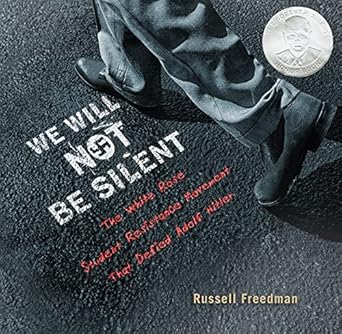
The book follows the Scholl family and several friends of the older Scholl children. Each of the boys joined the Hitler Youth and each of the girls joined the League of German Girls; however, each one became disillusioned with the militarism and lack of socialization. The drills became drudgery and the propaganda got more and more irritating.
The older son and daughter were instrumental in the secret resistance movement called the White Rose. White Rose leaflets started appearing in a few mailboxes at the end of 1942. They started with just 100 copies and asked people who received them to pass them around and copy them. The leaflets told people to resist “wherever you may be… before it is too late….”
Those words are now especially chilling to me in the United States in 2025.
The name “White Rose” was arbitrarily chosen when it was started by four medical school students. It was decided from the start that their resistance would be nonviolent.
Eventually, 12 students were involved in the movement and three more leaflets were written. A Munich architect let them use his basement and duplicating machine at night. This enabled them to print thousands of copies. They fanned out individually to purchase small amounts of supplies so as not to create suspicion.
The third leaflet encouraged acts of sabotage anywhere possible.
The fourth leaflet called Hitler a liar. It ended with, “We will not be silent. We are your bad conscience. The White Rose will not leave you in peace.”
Hans Scholl and his fellow medical students were sent to the Russian front as medics, and Sophie Scholl had to work in a German munitions factory during her summer breaks from studying at the university.
Hans’ girlfriend got a larger mimeograph machine and started a White Rose branch in Hamburg. The network then spread to Berlin and Saarbrucken.
The fifth leaflet was titled, “Leaflet of the Resistance in Germany.” Philosophy Professor Kurt Huber got involved.
Hitler was losing the war. Germany lost 330,000 of 420,000 troops in the siege on Stalingrad. It was that battle that inspired Professor Huber to write the 6th leaflet.
Thousands of copies of Leaflet Six were made. Hans, Sophie, three of their named friends and others took turns as couriers. They carried backpacks and suitcases filled with leaflets to distant towns by train and mailed some so they’d have various postmarks.
Hundreds of copies were left in phone booths at night, on parked cars, etc. Always traveling alone, they hoisted their luggage up into overhead bins on the trains, then went to sit in another car so if their luggage was searched the police could not trace who put it there. (It was another day and time, for sure!)
While Professor Huber wrote the 6th leaflet, Hans and his friends Alex and Willi took turns painting anti-Nazi slogans on university walls and public buildings. They used black tar-based paint, so the slogans would be especially difficult to remove.
Trouble hit, though, when Hans and Sophie went into a classroom building to distribute the 6th leaflet. From a third-floor stairway balcony, Sophie dropped leaflets that floated down to the lobby where a janitor saw them. He looked up and saw her.
Sophie and Hans were arrested. Others were eventually arrested, including Christophe Probst. Hans and Sophie took full blame, hoping to save the others. They were tried on February 22, 1943. It was not a real trial, of course. It was just a show to root out opposition.
Sophie, Hans, and Christophe were sentenced to be beheaded by guillotine.
More White Rose participants were arrested and beheaded, but the Resistance grew, spurred on by the executions. Leaflets were smuggled into Sweden and Switzerland. By the end of 1943, British warplanes were dropping the leaflets by the tens of thousands.
The Voice of America broadcasted praise for the White Rose students.
The White Rose students who had not yet been executed were liberated from their prisons by Allied forces after Germany surrendered.
There is a memorial to the White Rose students in the square outside the main entrance to Munich University. It is a unique memorial of white ceramic tiles made to look like the White Rose leaflets. They give the appearance of leaflets dropped on the pavement.
In the entrance hall in that classroom building where Sophie and Hans were caught, there is a bronze bust of Sophie Scholl.
The White Rose Museum was founded in 1984 by the surviving White Rose members and relatives of those who lost their lives. It is housed in that same building and is staffed by volunteers from the White Rose Foundation.
One thing that was pictured in the book that was news to me was that prior to the development of the gas chambers at the concentration camps, the Nazis used mobile gas vans in which to exterminate disabled people. “The victims were locked in an airtight compartment into which exhaust fumes were piped while the van’s engine was running, resulting in death by carbon monoxide poisoning.” In the big scheme of the atrocities of the Nazis, I suppose that isn’t surprising. I just have an image in my mind now of these vans going all over the countryside to murder people who were physically unable to be herded into boxcars to be carried off to concentration camps.
Hurricane Helene Update
As of Friday, 51 roads in North Carolina were still closed due to Hurricane Helene. That five US highways, three state highways, and 43 state roads. That report is identical to the one from Friday, May 23.
I-40 near the Tennessee line is still just two lanes with a 35 mph speed limit, and most of the Blue Ridge Parkway in NC is still closed. It will be news when I can report otherwise on either one of them.
Last Wednesday, US Secretary of Transportation Sean Duffy announced that a little more than $400 million will be going to North Carolina to reimburse the State for highway repairs and reconstruction due to Hurricane Helene. This is wonderful news!
I reported in my May 28, 2025, blog post, Hurricane Helene Recovery Update about the denial of additional matching funds from FEMA, so it was especially good news from the Department of Transportation the next day.
Governor Josh Stein says that the requested funding from FEMA that was turned down will mean the State will have less money to spend to help small businesses and municipalities.
Until my next blog post
Read! Read! Read! Please don’t be one of those people who says, “I haven’t read a book since I graduated from high school.”
Keep friends and family close.
Don’t forget the people of Ukraine and western North Carolina.
Janet

 Janet's Writing Blog