An October 29, 1777 Estate Sale

Did you know that the State Archives in Raleigh is the repository of the original copies of some estate sale records dating back to the 1700s when Cabarrus County was part of Mecklenburg County, North Carolina? These fascinating records for persons known to have lived in the area that later became Cabarrus County are also accessible on microfilm in the local history room at the main branch of the Cabarrus County Public Library in Concord, NC.

John Morrison’s Estate Sale

My great-great-great-great-grandfather, John Morrison, died in 1777 in old Mecklenburg County. A native of Campbeltown, Scotland, he lived his last thirteen years in the vicinity of the present-day Cabarrus-Mecklenburg County line. His estate papers provide a record not only of his possessions but also the names of many local people. I’m very proud to say that he was a farmer.

Robert Harris, Jr. served as clerk at John’s estate sale on October 29, 1777 – exactly 240 years ago today. Mr. Harris made note of every item sold, who bought it, and how many pounds, pence, or shillings they paid.

Buyers

The buyers were James Moore, Joseph Robb, Evan Shelby, Isaac Sellers, John Robinet, John Murphy, Francis Miller, William Driskill, James Alexander, James McCall, John and James McGinty, Joseph Bigger, Hugh Kimmons, Archibald McCurdy, John Springs, John Carothers, Joseph Calbreath, Alexander Allen, Benjamin and Robert Cochran, Steven Pritchet, Peter Borris, Robert Harris, James Stafford, John Ross, Alexander Finley, James Finney, Hector McClain, Samuel Montgomery, William Wylie, and John Finley.

Most of the surnames listed above are no longer found in our community because many families moved west in the 1790s and early 1800s. Some of the buyers lived in the area that remained in Mecklenburg County after the formation of Cabarrus in 1792, so some of the names are probably from the Mint Hill area.

Summary of Items Sold at Estate Sale

Items sold at the estate sale included eight horses; 19 sheep; 25 head of cattle; 17 hogs and a parcel of pigs; three hives of bees; 17 geese and ganders; 25 pounds of wool; a parcel of books; a great coat; two straight coats and jackets; one pair of blue britches; a pair of old buckskin britches; and a fur hat.

Also, four saddles; five bells and collars; five other collars; six bridles; two sets of horse gears; an “M” branding iron; three augurs; a drawing knife; nailing and stone hammers; a broadax; three weeding hoes; two maulrings; a wedge; a clivish; a sprouting hoe; a mattock; two falling axes; three spinning wheels; two horse trees and hangings; a cutting knife and stone; a sythe and cradle; four sickles; a flax brake; a pair of wool cards; and a pair of cotton cards.

Also, barrels for flour, rice, beef, and salt; a tapper vessel; two cedar churns; oak and walnut chests; two smoothing irons; a looking glass; one whiskey keg; and various other tools, household items, and pieces of furniture.

Other items included 6.5 pounds of iron and 14.5 pounds of steel. Steel as we know it today had not yet been developed. In 1777, steel was the name for sharpening rods used to sharpen knives and other cutting edges.

Half a wagon?

The most puzzling record in John Morrison’s estate papers is that John Springs bought half a wagon and half the wagon implements. Since no one bought the other half, it has been speculated that Mr. Springs knew that John’s wife, Mary, needed the use of the wagon but also needed the proceeds from the sale of the wagon and implements. After all, Mary was a widow with seven children still at home and a baby on the way. Perhaps Mr. Springs made a verbal agreement to let Mary Morrison keep the wagon even though he paid half the value of the wagon at the estate sale.

Another possibility is that John Morrison had bought the wagon and implements from John Springs but had only paid half the bill at the time of his death. Mr. Springs, instead of saddling Mary Morrison with the additional debt of the unpaid balance chose to simply buy back that half of the wagon and implements. When Mary Morrison died in 1781, there is no mention of a wagon in her will or her estate sale.

Lots of ammunition!

Other intriguing items sold at John Morrison’s estate sale were the 17 pounds of gun powder and 55.5 pounds of lead. That’s more gun powder and lead than a farmer needed. So why did John Morrison have so much of both?

John wrote his will on August 30, 1777. By September 3, he was dead. It is speculated that he was stockpiling munitions for the patriots’ cause in the American Revolution and that he was shot by Tories, but we will never know the real story.

My sources

The sources I relied on for writing this blog post are as follows:  John Morrison’s Mecklenburg County estate papers on file at the State Archives of North Carolina in Raleigh, NC; What Did They Mean By That? – A Dictionary of Historical Terms for Genealogists, by Paul Drake, 1994; and Descendants of John & Mary Morrison of Rocky River, by Alice Marie Morrison and Janet Sue Morrison, 1996.
Red
The Descendants of John & Mary Morrison of Rocky River, by Alice Marie Morrison and Janet Sue Morrison

I regret that Marie and I did not know about the existence of John and Mary Morrison’s estate papers when we compiled and published Descendants of John & Mary Morrison of Rocky River in 1996.

Until my next blog post

I hope you have a good book to read. If you’re a writer, I hope you have productive writing time.

Janet

The Daily Prompt – Record

I’m trying something new today. Monday is the day that I get weekly digests of the blogs I follow. I tend not to be very productive on Mondays, so it is a good day for me to read what other bloggers have to say. I follow a variety of bloggers from around the world – USA, Scotland, France, Australia, Egypt, England, Canada, India, Norway, and South Africa. I follow the blogs of other writers, as well as a young man who is a music composer, photographers, historians, pastors, stay-at-home mothers, a father whose daughter died of cancer at the age of 19, and an autistic man in the United Kingdom.

This afternoon I found a blog that was new to me: https://dailypost.wordpress.com/challenge-instructions/. The site offers a writing prompt every day. I’ve never done much with writing prompts, but this might be a way for me to blog more often than my usual Tuesdays and Fridays. It has already prompted me to do a little writing on a Monday, which is an accomplishment in itself. Today’s prompt is the word record.

Right off the bat, I’m faced with the decision of whether to use record as a noun or a verb. I chose to use it both ways.

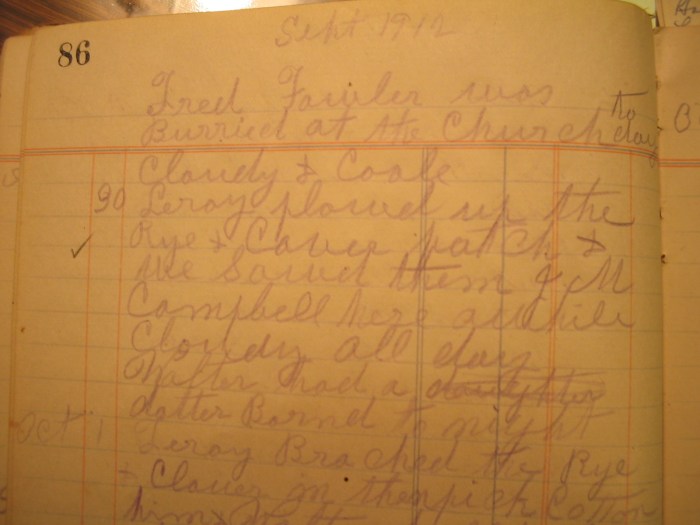
I immediately thought about the daybooks one of my great-grandfathers kept in which he wrote daily from 1891 until his death in 1914. His daybooks (or journals) are a RECORD of life on his farm in Mecklenburg County, North Carolina. What a gem for his descendants! I wish he had RECORDED more current events. He had fought in the American Civil War, so on the anniversary dates of the battles in Richmond, Virginia, and New Bern, North Carolina were always noted.

In April, 1896 he wrote the following note in the margin:  “We Built this house in 1886 and moved in it   Earth Quake Aug the 28 the Same year.”

On May 31, 1897, after commenting on the weather, that he didn’t feel well (“I am on the Sick list.”), and what was being done on the farm, he ended the day’s daybook entry with, “a Earth Quake this Eavning 12 m to 2 o clock.”

Lee Dulin kept a daily RECORD of the weather and that day’s activities on the farm. He was a widower raising six children, his wife having died in childbirth in 1881. Trips into Charlotte for supplies were duly noted, as was his trip by train to the 1895 Cotton States and International Exposition in Atlanta. A man of few words, though, he merely wrote down the day he left for Atlanta and the day he returned. It was probably the first time he saw electric lights, but we’ll never know. He didn’t write about anything he saw at the event, which was very much like a World’s Fair.

Photo of part of a page of ciphering in one of Lee Dulin’s daybooks.

There was one fact Lee Dulin RECORDED in one of his daybooks that proved to be valuable to my sister and me as we worked on our family’s genealogy. If not for this almost overlooked note on a page of ciphering in one of the daybooks, we would not know the name of his father. In case it’s not legible here, he wrote, “James J. Dulin my Papa name.”

In today’s computerized world in which it is said that young adults have no interest in keeping a photograph or a piece of paper, I’m glad I came along in a time when family RECORDS like great-grandpa’s daybooks were valued and saved.

Incidentally, I blogged about Lee Dulin’s daybooks a year ago tomorrow, May 14, 2016, in case you want to read more about it.

Until my next blog post (which will be posted in about 11 hours)

I hope you have a good book (or an ancestor’s daybook) to read. If you’re a writer, I hope you have quality writing time.

Janet

Save

Writing talents from my mother

I’d like to think I inherited my writing talent from my mother, but she set the bar high. Today would have been her 104th birthday.

My mother was one of 10 children. She was the third youngest. She grew up on a farm in Mecklenburg County, North Carolina, attended first grade a one-room school where all 11 grades were taught in one room.  When she graduated valedictorian of a consolidated high school in Charlotte, some of her city classmates were displeased. How dare a farm girl make the highest grades in the class! She went on to major in French and English at what is now the University of North Carolina at Greensboro during the Great Depression. After graduating, she taught French and English on the high school level for five years (also during the Great Depression, being paid $70.00 per month) until her marriage and second career as a homemaker and mother.

Growing up with an English teacher for a mother can be frustrating at times. Such a child is not allowed to make grammatical errors, even in jest. Such a child is taught from birth to use the correct verb tense. You might say the use of an incorrect verb tense was my mother’s pet peeve. By her example, I grew up ever-vigilant in catching grammatical errors I heard on TV or read in a newspaper. Although my mother died more than two decades ago, I still think of her and cringe  every time I hear an error by someone on TV who “should know better” or read a mistake in a news article written by someone who “should know better.” It wasn’t until I became an adult that I appreciated what my mother did for me. It wasn’t until I tried to become a writer that I became painfully aware that I should have paid more attention to punctuation in English class.

My mother loved teaching and late in her life she wrote and self-published a history of the first 100 years of organized women’s work in our church congregation. She even wrote a little play to accompany that 100-year milestone.

I was a young adult when she wrote that book, and I did not fully appreciate her accomplishments. For one thing, I just always took for granted what my mother did. I assumed all mothers could make doll clothes and some of their children’s clothing, even if they’d never had a sewing class. I assumed all mothers taught their toddlers to sing “Row, Row, Row Your Boat” in two languages. I assumed all mothers knew how to make doll cakes for their daughters’ birthdays. I assumed all mothers could teach themselves how to knit and crochet. I assumed any mother could write a book. Wasn’t that just what all mothers did?

It wasn’t until I reached my 40s and she was gone that I realized just how gifted my mother was. I’ve had sewing and quilting lessons, but I still struggle to darn a sock or sew on a button — things she did with ease. I can make a cake and ice it, but it would take me all day to make a doll cake and it wouldn’t be as elaborate and pretty as the ones she made. It wasn’t until I took a fiction writing course at Queens University of Charlotte in 2001 and started writing short stories and longer fiction that I realized that writing is hard work. My mother made all these and a host of other things look simple. I’m 63 years old and I still can’t get all the components of a meal ready on time or at the same time.

Mama, how in the world did you do it?

Thomas Lee Dulin’s Daybooks

One of my great-grandfathers, Thomas Lee Dulin, kept a daybook almost every day from 1891 until 1914. Perhaps the roots of my desire to be a writer can be found in that part of my gene pool. Being born in rural North Carolina in 1842, Great-Grandpa did not have benefit of a great deal of education. For that reason I especially admire him and appreciate the fact that he sat down with his pencil and ledger and wrote nearly every day. He seldom used punctuation and his spelling was not perfect, but he probably did not have a dictionary. He made the effort almost every day, and by doing so left a great example for me to follow suit.

IMG_0075

Great-Grandpa wrote about the weather (which was of utmost importance to him as a farmer) and what was being done on his farm in Mecklenburg County, North Carolina. He noted the going price for a pound of cotton in Charlotte and surrounding markets because cotton was his main cash crop. If a neighbor stopped by to visit, he made a record of that.

According to official records, Great-Grandpa enlisted in Company H, 35th Regiment, North Carolina Troops in 1861. He gave his age as 21, although he was just 18. As a veteran of our country’s civil war, he made note of the anniversaries of the two main battles in which he participated – New Bern and Richmond. He was wounded in the left shoulder at Malvern Hill in the seven-day Battle of Richmond.

Some years ago, my mother and sister painstakingly hand-copied Great-Grandpa’s daybooks. Without realizing that today was the 154th anniversary of the Battle of New Bern, I checked that transcription to see what was going on in Thomas Lee Dulin’s world through the years on March 14. It was sobering to read his daybook entry for March 14, 1899: “37 year today I was in the Battle of Newbern, N.C.” Although in the interim he had married, been widowed at the age of 38, and left to raise his six surviving children, March 14, 1862 was forever engraved in his memory.

As the years went by, Great-Grandpa almost never failed to mention on March 14 how many years it had been since the Battle of New Bern. Oral history is valuable, but sometimes the stories get changed as they are passed down from one generation to another. The written word, especially when kept daily in a daybook, journal, or diary is a powerful record that we can hold in our hands and refer back to in order to make sure we get the facts right. My great-grandfather’s daybooks are a family and local treasure housed in the North Carolina Collection at the main branch of the Charlotte Mecklenburg Library in Charlotte, North Carolina.