
On March 4, 2024, I blogged about three of the 5.4 books I read in February. After writing about #OnThisDay anniversary topics the last two Mondays, today I get to tell you about the other 2.4 books I read last month.
Slave Escapes & the Underground Railroad in North Carolina, by Steve M. Miller & J. Timothy Allen
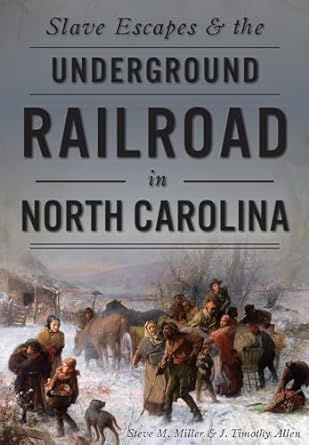
Most documented history of the Underground Railroad concentrates on how it operated in the northern states. This is understandable, considering the very secret nature of the operation. As you can tell from the title, this book is almost exclusively about the Underground Railroad in North Carolina.
This was an enlightening book, just as I anticipated. Much of it is about the part Quakers in North Carolina played in the so-called Underground Railroad. I knew that there were many Quaker early settlers in the Guilford County section of North Carolina, but I was surprised to learn that there were many Quaker settlers in the northeastern region of the state.
Another thing I learned from reading the book is that some Quakers owned slaves. The denomination gradually changed its attitude about slavery, which necessitated some creativity in how to deal with the matter. Quakers agreed to manumit their slaves in 1774, but some of their heirs refused to do so.
The book references various colonial and state laws enacted regarding slavery in North Carolina since the late 1600s. One of the laws I had never heard of was the Slave Code Act of 1741 which required local sheriffs who held runaway slaves to give descriptive details of those slaves to churches, and the churches “were then obligated to post them in an ‘open and convenient place’ for two months.” [Thank goodness we have separation of church and state now!]
The book talks about how the Great Dismal Swamp in northeastern North Carolina was a haven for runaway slaves and a hell for some area enslaved individuals. The remoteness and dense vegetation in the swamp provided hiding places for escaped slaves to take refuge; however, slave labor was used – at the cost of many slaves’ lives – to building the Dismal Swamp Canal.
Examples of newspaper notices about runaway slaves are included. Although it is assumed that all runaway slaves headed north, this book explains that some headed east in an effort to get on ships to various destinations, some fled to Tennessee, and others tried to make their way to New Orleans to board ships.
Another thing I learned from the book is that the Underground Railroad was used by white people during the Civil War. Quakers, Union sympathizers, and Confederate deserters were known to have used the system.
Summary of Miriam Margolyes’s This Much Is True
Miriam Margolyes is a British actor with an interesting life’s story. Unable to find her memoir, This Much Is True, at the public library, I settled for reading Summary of Miriam Margolyes’s This Much Is True. It was available from Charlotte-Mecklenburg Library through Hoopla.
I enjoyed the summary and it satisfied my curiosity about Ms. Margolyes’s life. I must admit that I was not that familiar with her until recently watching a “Lost in Scotland” PBS series. I had no idea how many movies and TV shows she had appeared in until I read this book.
Between Earth and Sky, by Amanda Skenandore
This was the February book for Rocky River Readers Book Club in Harrisburg, NC. I read the first 40% of it before I found part of the story line to be implausible. Others in the book club loved it. There was a lot of discussion, especially by two of the members who were all fired up about the story.
I was interested in the beginning because it was about the terrible treatment of the Native American children at a school run by white people in 1889. That is a topic we all need to be educated about. Other library books were begging for my time, though, which gave me an excuse not to finish reading the novel.
From the discussion at the book club meeting, the 60% of the novel I did not get to read apparently contained some interesting dilemmas for the main characters. I do not want to cast aspersions on the book. If you are interested in reading about the way indigenous peoples were treated in the United States in the late 1800s, I recommend this novel.
Since my last blog post
One of my regular blog readers asked me what happened to Clarence Earl Gideon after the Gideon v. Wainwright US Supreme Court ruling I blogged about last week (#OnThisDay: Gideon v. Wainwright). I realized I was remiss in not including that information in that post.
Mr. Gideon appeared in court in Florida for a retrial in August 1963. That time, he had legal counsel and was acquitted by the jury. He was never in trouble with the law again, as far as I could learn. He died of cancer in 1972 at the age of 61.
Thank you, FictionFan, for asking the follow-up question. By the way, if you enjoy reading thoughtful and honest book reviews of a wide range of genres, I recommend you visit https://fictionfanblog.wordpress.com/ to see what she is reading.
Until my next blog post
I hope you are reading a good book.
Remember the people of Ukraine and all the places in the world where innocent people are suffering.
Janet




 Janet's Writing Blog