
In last week’s blog post, I revealed that I needed to take three weeks off from blogging because I was trying to cope with depression. If you missed it, here’s the link: I’m back!.
When I wrote my June 9, 2026 blog, I had started reading the book I’m telling you about today. This book explained a lot about me. It was an eye-opener.
The Van Gogh Blues: The Creative Person’s Path through Depression, by Eric Maisel, PhD
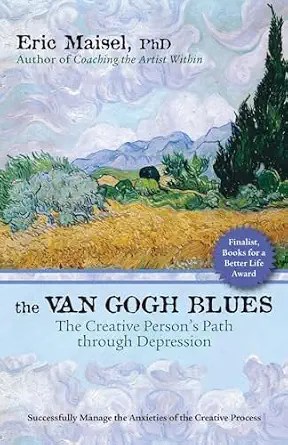
by Eric Maisel, Ph.D.
I started reading this book the last week in May, and it has been a game-changer for me. It was recommended by Rhonda Douglas of Resilient Writers in one of her online classes. Thank you, Rhonda!
I never considered myself to be depressed except for Seasonal Affective Disorder in the fall and winter, but – whether I am otherwise depressed or not – I learned something important about myself in the early chapters of this book.
Dr. Maisel explains how the depression that a creative person often experiences is different from other people’s depression and how it must be addressed differently.
I was reading along and taking some notes, and then I got to page 57. It was then that I had an epiphany. The words on pages 57 and 58 described me. I was so excited to learn this that I couldn’t wait to tell my sister.
She read those two pages and said, “This is you!” That led us to have an honest conversation about why we are so different in many ways.
I learned that, as a creative person, I need to find meaning in everything I do. That’s why I cannot just goof off. (Be careful how you read/interpret the next sentence.) I cannot do nothing. In other words, sitting down and doing nothing would drive me to distraction. If I don’t see the meaning in a task, it irritates and frustrates me to have to do it. While I’m doing that unwanted task, I’m thinking “I could be writing.”
I feel driven to fill all my waking time with an activity that has meaning for me. Otherwise, I am stressed out.
The beauty of what I got out of this book is that it’s all right that I’m made that way and it is all right that everyone else isn’t. I now know why I get frustrated and grumpy (and sometimes very angry) if I don’t see the meaning in what I’m doing. I now understand why my sister can be content to lie on the couch for hours and read a book or play a game on her tablet.
I now understand why it baffles my sister if I decide to clean out a bookcase at 10:00 at night, and she understands why I tend to do things like that. We finally, after living together off and on for more than seven decades, understand why we are so different in the way we spend our time. I can finally accept that it’s all right for her to lie on the couch and read or play games on her tablet, and she no longer has to feel guilty for not jumping up to help me clean out that bookcase.
Living with a writer, artist, or musician can’t be easy for a non-creative. I wonder how many divorces could have been avoided if more people had this information.
Creative people, in general, doubt themselves. Can I write that story? Can I paint that painting? Can I get up in front of people and sing? Can I go out on that stage and perform my part in this play? What if no one likes my story? What if no one buys my book? I’m only fooling myself if I think I can do this. I’m an idiot!
You must tell yourself that you’re better than you think you are. You have done the research. You have practiced. You know your lines. There is someone out there waiting to read your novel.
My explanation is simplified, but if you think you might be struggling with your creativeness or you live with a creative person – or you’re considering spending your life with one – it behooves both of you to read this book. It might just help you understand and accept each other for who you are.
My apologies to Dr. Maisel, in case I have misrepresented the book in any way; however, I will be grateful for the rest of my life for your enlightening me about why I am the way I am.
Reading this book gave me clarity, but my bubble burst a couple of weeks later when the realization of what my life has to be came back and hit me in the face full force. At least now I know why I find it so hard to find joy in picking up limbs and cutting sweetgum sprouts. I’ve also come to realize that I’m depressed in the summer, too, because there is no end to the yardwork and I’m getting too old for this. Besides… I’d rather be writing!.
Janet
“I was okay just a moment ago. I will learn how to be okay again.” ~ Nina LaCour


