What I Read Last Month & a Hurricane Helene Update

I did more reading in September than this blog post will reflect, but there was only one book I read from cover-to-cover: White Robes and Broken Badges, by Joe Moore.

White Robes and Broken Badges, by Joe Moore

Photo of book cover for White Robes and Broken Badges by Joe Moore
White Robes and Broken Badges, by Joe Moore

This nonfiction book will stay in my mind forever. The author infiltrated the Ku Klux Klan (KKK) for the Federal Bureau of Investigation (FBI) not once but twice. He infiltrated it both times to a level never done before, gaining access to the top echelon in the organization.

I’ve never known many details about the workings of the KKK. Never needed to. Never wanted to. However, considering where society in America stands today, it seemed like a good time to get better educated about the threat the KKK holds.

This book sheds light on just how insidious the work of the KKK is and how many its members are employed as law enforcement officers in our country. It is widespread and probably even more of a problem than the FBI knows.

It was through the undercover work of “Joe Moore” that the FBI was alerted that the problem is greater than had been realized. Joe was not an FBI agent. He was recruited by them because of his skill set.

After infiltrating the organization the first time, Joe never imagined he would be called on to do it a second time. But he was so good at it, the FBI needed him. Joe and his wife and children sacrificed a lot for what he did. Ultimately, they lost their home, most of their earthly possessions, their family connections, and friends in a matter of several hours.

The book is chilling. I know of no better word to describe the effect it had on me. Chilling. The details should make every law-abiding citizen in the country – no matter your color, race, ethnicity, or nationality – shiver.

After reading this book, I now have a better understanding of why black people in the United States do not trust law enforcement officers. How can they, when they don’t know in a traffic stop whether they are being pulled over by an honest police officer or sheriff’s deputy or if they’re being pulled over by a member of the KKK who just doesn’t happen to be hiding under a white hood?

It has always seemed a great sign of cowardice that when members of the KKK do their dirty work, they hide in their white robes. If you’re doing something you shouldn’t be doing, though, I suppose you don’t want to reveal your identity.

These are misguided people, and as a Christian I am offended that they use the cross as their symbol. Jesus Christ died on a cross for me (and for them!), so how dare they desecrate that symbol of Christ’s great sacrifice!

I highly recommend this book. It is not a pleasant read, but how do we improve as a society if we bury our heads in the sand and don’t open ourselves up to what is going on not only in the shadows but also in broad daylight?

I learned about this book while listening to National Public Radio (NPR) in August (https://www.npr.org/2024/08/12/g-s1-16223/white-robes-and-broken-badges-exposes-the-inner-workings-of-the-ku-klux-klan)

Update on Hurricane Helene in Western North Carolina

I wish I could include photographs, but I don’t want to run the risk of sharing an image that is undocumented or not in the public domain. You can use some of the links below if you wish to see pictures.

Another reason I am not including photos is that I know from my own experience after Hurricane Hugo in 1989 that pictures don’t do a disaster justice. Unless you are in the middle of a natural disaster and destruction is all you can see, hear, smell, or touch in any direction, you can’t grasp the enormity of the situation.

I know that Hurricane Helene left a wide path of destruction in Florida, Georgia, South Carolina, Tennessee, and Virginia; however, I have lived in North Carolina all my life – four of my 71 years in the mountains. The mountains are near and dear to my heart. I will blog about North Carolina and leave it to people in those other states to blog about the conditions in their states.

A couple of my blog readers said they hoped I would continue to shine a light on the destruction caused by Hurricane Helene in the mountains of North Carolina on September 26.

I do not live in the disaster zone. I’m about 100 miles east of the mountains. We just had a lot of rain, some wind, and a lot of tree branches to pick up and deal with. That is ongoing, but that and our 13-hour power outage pale in comparison to what happened in our beautiful Appalachian Mountains.

Ten days after the storm, many areas of the mountains are still inaccessible. Damage assessments are still being made. Recovery will be measured in years, not months. Some locations were wiped off the map and will not be restored because the landscape has been changed completely and forever.

The United States Geological Survey has identified 244 landslides caused in the Southeast by Hurricane Helene. Most of those are in North Carolina. More landslides will, no doubt, occur in the coming weeks with additional rainfall and freezing conditions.

As of the data I found last night, the death toll in North Carolina so far was 115, with 72 of those being in Buncombe County. There are still people unaccounted for. Many communities still have no water or sewer service. Cell phone service was spotty before the storm and restoration has been slow.

Hundreds and hundreds of power poles and thousands of miles of overhead power lines are down. Thousands of people are homeless. You might grow weary of hearing about it, but many of the people of western North Carolina are in dire straits.

As always, though, the worst of nature brings out the best in most people. The outpouring of support has been amazing. Electrical workers have come from all over the country and from Canada. Four hundred nurses have arrived in Asheville from as far away as Alaska to pitch in and help local medical personnel who have worked around the clock since September 26 even though most of them have catastrophic damage at their own homes.

Pack mules are being utilized to haul water, non-perishable food, and other necessities into the steep and rugged terrain where vehicles cannot gain access.

Two interstate highways are closed. I-40 near the Tennessee state line will probably be closed for a year. Repairs to I-26 might allow it to reopen next March. Roads and bridges washed away, houses, cars, and businesses floated away, and overnight all the necessities most of us take for granted every day vanished.

The area of devastation in western North Carolina alone covers more than 600 square miles, and it is not flat land! Every mile of those 600 square miles is not devastated. The severity of destruction various from place to place as rain totals were, of course, higher in some places than in others. Also, some areas of the mountains received more rain than others in the days leading up to the arrival of Hurricane Helene. Elevations range from around 1,500 feet to more than 6,000 feet. The destruction is unprecedented. Since 1916, all floods in western and piedmont North Carolina have been measured against The Flood of 1916. Future floods will be measured against The Flood of 2024 because by all statistics it surpassed the one in 1916.

Classes at my alma mater, Appalachian State University in Boone, have been cancelled until at least October 16. (That’s three weeks of fall semester lost.) Students at Lees-McRea College in nearby Banner Elk were evacuated by air to Hickory. Classes have been cancelled at Western Carolina University in Cullowhee the University of North Carolina at Asheville, Montreat College, Warren-Wilson College, Mars Hill University, and numerous community colleges. Blue Ridge Community College in Flat Rock, NC is closed indefinitely. Some county school systems are unable to announce when they will reopen.

The beautiful Blue Ridge Parkway that I’ve waxed poetic about so many times is closed indefinitely. US-441/Newfound Gap Road through Great Smoky Mountains National Park has reopened; however, it was not designed to handle commercial traffic, so it is not an alternate to I-40 or I-26 for large trucks. Sadly, a few people decided that did not apply to them, so they attempted to drive on Newfound Gap Road. Two serious accidents resulted – one caused by a car hauler. The highway will be closed to all traffic from 10pm until 7:30 a.m. until further notice. (https://www.nps.gov/grsm/learn/news/update-on-us441-newfound-gap-road-overnight-closure.htm)

The images coming out of the mountains are gut-wrenching. The needs are great and will continue to be for a long, long time. I hesitate to start naming charities because there are hundreds of reputable ones that are on-site and providing remarkable goods and services. World Central Kitchen (https://wck.org/), the Cajun Navy from Louisiana, Mountain Mule Packer Ranch (https://www.mountainmulepackers.com/), the Red Cross, and Samaritan’s Purse are just a few.

The Manna Food Bank (https://www.mannafoodbank.org/) which serves the Asheville and surrounding areas lost their facility and its contents. Brother Wolf Animal Rescue (https://www.bwar.org/) was flooded out but the 150 animals they were housing on September 26 were rescued by volunteers. Organizations like food banks and animal rescues need to be rebuilt and aren’t necessarily eligible for government assistance. (I saw on the Brother Wolf Animal Rescue website last night that donations to that organization are currently being matched!)

The Appalachian State University Disaster Fund (https://www.appstate.edu/disaster-relief/) is another organization for you to consider. It has stepped up to assist students, staff, and faculty members who have lost their homes. The fund also provides much-needed counselling for those traumatized by the storm.

Atrium Medical Center in Charlotte has set up its mobile hospital in Tryon in Polk County. Many towns and counties across the state have sent teams of medical personnel and swift water rescue teams to assist with the aftermath of the storm. The National Guard and 1,000 active-duty personnel from Fort Liberty (formerly, Fort Bragg) were deployed and have been on the ground since weather allowed access. Numerous restaurants are giving out free meals as they are able to prepare food.

Having just visited Boone and West Jefferson on September 12-13 and having visited Hendersonville, Asheville, Bryson City, and Cherokee this summer, it is difficult to grasp the scope of the damage. I drove on the Blue Ridge Parkway from Asheville to its southern end at Great Smoky Mountains National Park in June. I drove from Hickory through Old Fort, Black Mountain, Asheville, and Canton and into Tennessee on I-40 the last week in August.

I always breathe a sigh of relief when I make it through that treacherous stretch of I-40 approaching Tennessee because rock slides are not unusual. To know that part of that interstate literally washed away 10 days ago is hard to get my head around, though.

Know that any support you can give to the people of western North Carolina is appreciated.

Since my last blog post

I was told (again) in a webinar last week that the purpose of a blog is to solve someone else’s problem. Until I figure out how to do that, I’ll just keep blogging like I have for the last 10+ years. As of last week, I have 1,200 subscribers to my blog, so maybe I’m doing all right. If you came to my blog today seeking a solution to a problem, you are probably disappointed.

On the other hand, if you were looking for a way to lend a little aid to people trying to rebuild their lives after Hurricane Helene, I hope one of the organizations I mentioned today struck a nerve with you.

Until my next blog post

I hope you have a good book to read, a roof over your head, enough food to eat, and clean water to drink.

If all you are hearing is that FEMA and all levels of government are failing to respond to those affected by Hurricane Helene, then you are listening to the wrong sources. More than a week of lies about this from the immediate-past-twice-impeached-34-times-indicted-president is wearing thin here in North Carolina. Please fact check your sources and get your news from a variety of reputable news media.

Hold your friends and family close, for we never know what tomorrow will bring.

Don’t forget the people of Ukraine or the people of western North Carolina.

Janet

Best laid plans…

Do you ever over-organize your life?

I’m a planner. A list maker extraordinaire. The trouble is, I tend to think I can do more in a day than I actually can accomplish. Every. Single. Day.

Several inexpensive and two free online writing courses came along at the same time, and I took the bait.

As if that weren’t enough… along came Hurricane Helene.

I had a full schedule of webinars to participate in and other writing-related things I wanted/needed to do.

The rain poured on Thursday, and that was from a whole different weather system. They said it had nothing to do with Helene… that Helene’s winds and rain bands would arrive overnight and last most of the day Friday.

I got up early Friday morning to listen to the news and weather reports. It was still raining, but I thought we were probably going to be all right. Just as I started to put a pot of water on the cooktop to boil for a nice oatmeal and blueberry breakfast… the power went off.

I forget how addicted I am to writing at the computer… until the power goes off.

I’m trying to take the high road and not whine about the power being off for 14 hours. I live out in the country and have a well so when the electricity is off I don’t have any water. Things get interesting fairly quickly. However, this was a minor inconvenience compared to the widespread flooding and devastation that has and continues to occur in western North Carolina.

I live about 500 miles from where Hurricane Helene made landfall on the Gulf coast of Florida. It was hard to grasp that Helene would still be packing such a punch when she got to North Carolina, even though meteorologists warned that this could be a rain event of historic proportions in the mountains of the state.

Hurricane Helene and her remnants caused devastation in biblical proportions over hundreds and hundreds of miles. What I experienced here in the piedmont doesn’t hold a candle to what happened in the Appalachian Mountains 100 miles to the west.

Asheville, North Carolina is getting the bulk of the media coverage, so you might not be aware that the entirety of western North Carolina is in a world of hurt right now. Some areas received over 25 inches of rain from Helene.

Chunks of I-40 were washed away by flood waters while other sections are under mudslides. Virtually every highway and country road in the mountains were or still are impassable. (That total was 400 on Friday and Saturday, but dropped to 280 yesterday.) Town after town after town in addition to Asheville experienced record-breaking flooding. Not to mention all the nooks and crannies that aren’t towns but tiny communities. Many areas have not been accessed yet as I write this.

Roads are gone. Communications are down or spotty at best. The situation is dire and becomes more dangerous by the day.

Two weeks ago I blogged about my visit to my alma mater, Appalachian State University, in Boone, North Carolina (Who says you can’t go home again? Revisiting a university campus). Seeing aerial pictures of the Town of Boone under water has been gut wrenching the past days. The 21,000 students must be shell-shocked! I would have been if this had happened while I was a student there.

If you have subscribed to my monthly e-newsletter, earlier in September you read about my “field trip” to Swannanoa, North Carolina. I gave some of the history of the construction of the Western North Carolina Railroad through Swannanoa Gap in the 1870s. Sadly, the sketchy reports coming out of the Swannanoa/Black Mountain/Montreat/Old Fort area a few miles east of Asheville indicate that those particular towns are suffering severely from the flooding and landslides caused by Hurricane Helene.

The quaint small town of Chimney Rock was practically wiped off the map. Isolated communities and small towns are scattered throughout western North Carolina. The death toll is rising as search and rescue operations continue. Even the interstate highways are steep and winding.

Almost every one of the mountain towns I can think of was flooded on Friday. Cell, landline service, and electricity were knocked out. I’ve seen pictures of almost every town I can think of being under water.

Although served by two interstate and several US highways, on Friday and Saturday the city of Asheville (population 95,000) was only accessible by air.

I’m afraid the news cycle will transition to the fighting in the Middle East and back to the coming US elections. The public will soon forget Hurricane Helene. Or, there will be another natural disaster that needs our attention.

The devastation from Hurricane Helene covers hundreds of square miles in western North Carolina.

As the area slowly recovers over the coming months and years — when you know you won’t be in the way of first responders and second and third responders — visit the area and patronize the small businesses. Eat at the diners instead of the chain restaurants. Shop at the little shops and independent bookstores instead of at the big-box stores.

Western North Carolina’s economy depends on tourism. Autumn is the biggest tourist season as the native hardwood forests put on a colorful show. Tourists will not be visiting the area this fall because so many of the roads are in shambles.

Western North Carolina is famous for its apples. This is the beginning of apple season. Many orchards were severely damaged last week, but if you have the opportunity to purchase apples from North Carolina this fall or any time in the future, do so to help the farmers get back on their feet.

Western North Carolina is also famous for its Christmas trees. Many of the fir and spruce trees that have graced the White House through the years were grown in North Carolina. If you can buy a tree from North Carolina in December, do so.

Western North Carolina is known for its artisans. Quilt makers, glass blowers, textile artists, weavers, woodcrafts people, painters, musicians, potters, makers of corn husk dolls, knitters, and crocheters depend on tourists to purchase their wares. But now many of their retail outlets are gone. Seek them out online on marketplaces such as Etsy.com.

Mountaineers are sturdy, intelligent, talented, resilient, resourceful people. They roll with the punches during winter blizzards and hard times, and many of them are about as self-sufficient as a person can be in the 21st century. But when they experience a 1,000-year flood followed by the remnants of a hurricane all in the span of three days that affects every community in the region, they need a hand up. They don’t want our pity. They need our support.

If you are so moved and are able, do what you can to help the hurting people of southern Appalachia. Donate what you can to a reputable charitable organization of your choice.

Since my last blog post

I got to visit a veteran of World War II and the Korean War last week who celebrated his 100th birthday this weekend. How many people get to do that?

Until my next blog post

I’m writing this on September 29 and scheduling it for September 30. A fiber optics cable is being moved a couple of miles up the road and my internet service is going to be interrupted any minute now for an undetermined length of time. Not that Windstream gave us any warning. If not for word-of-mouth, we would have been blindsided. On second thought, I think I’ll just go ahead and hit the “publish” button and not rely on the “schedule” button! So much for my best laid plans for tomorrow!

Until my next blog post

I hope you have a good book to read.

Don’t take your family or friends for granted.

Remember the people of Ukraine and the people of western North Carolina.

Janet

This Writer Needed a Change of Scenery – Part I

Not wanting to publicize online that I was going out-of-town, you probably did not know that I spent much of the second full week of May on the Outer Banks of North Carolina. Having been there some 25 years ago, a return trip was on my and my sister’s “bucket lists.”

Along Cape Hatteras, NC

We packed so much into our trip that I decided to divide this “travelogue” into two parts. I will share Part II with you on Monday, June 3 and shift my usual “what I read last month” post to Monday, June 10.

Our departure was delayed by 24 hours by a storm that knocked out our electricity for 21 hours and took down literally hundreds of tree limbs in our yard. Yard clean up and some adjustments in our itinerary and reservations meant that we were exhausted when we finally left home, but the trip was salvaged. (And yard clean-up has continued since we returned home. Such is life when you live out in the country and have a yard full of large, old trees.)


The Outer Banks of North Carolina

The Outer Banks of North Carolina (often abbreviated as “OBX” these days) are truly a national natural treasure. They are a 120-mile-long string of barrier islands known as “The Graveyard of the Atlantic.”

Map showing locations of hundreds of shipwrecks along the Outer Banks – “Graveyard of the Atlantic”

Off Cape Hatteras is where the cold waters of the Labrador Stream collide with the warm water of the Gulf Stream. The clashing water and wind there constantly change to shape of the islands. It is said that the only constant on the Outer Banks is that they are constantly changing.

The massive sand dunes at Jockey’s Ridge are in a constant state of flux and shifts in height due to the wind. There’s a reason why the Wright Brothers decided to try out their “flying machine” there at Kitty Hawk in 1903. It seems like the wind never stops blowing.

To give you an example of the changes Mother Nature makes in the islands, the third (and present) Bodie (pronounced “body”) Island Lighthouse was completed in 1872 near the tip of Oregon Inlet. The lighthouse has never moved, but it is now two miles from the inlet! (https://www.nps.gov/caha/planyourvisit/bils.htm)

Bodie Island Lighthouse at dusk

The northern end of the Outer Banks

We knew the northern end of the Outer Banks had been highly developed since we were last there, but it was worse than we anticipated. It’s unfortunate that vacationers and summer-only residents wanted all the conveniences of home. Whether they wanted that or not, that’s what they got.

North from Whalebone Junction to Corolla is wall-to-wall development. It’s a shame what has been built on such a fragile sliver of the coast. The Nags Head Woods Preserve (https://www.nature.org/en-us/get-involved/how-to-help/places-we-protect/nags-head-woods-ecological-preserve/

Nags Head Woods Preserve

is still there protecting Jockey’s Ridge – the tallest living sand dunes in eastern United States. You can try your hand at learning to hang glide at Jockey’s Ridge State Park. (https://www.ncparks.gov/state-parks/jockeys-ridge-state-park)

There used to be miles of vacant land between Kitty Hawk and Duck and Corolla with the Spanish now-wild horses roaming freely. Now there’s a town called Southern Shores which runs into Duck which runs into Corolla. Multimillion dollar homes line NC Highway 12 and leave no vacant land.

The wild horses that have lived there for 400 years have now been corralled and fenced just north of Corolla for their own safety and one must pay a tour company big bucks to ride in a Hummer or a Jeep for a couple of hours in hopes of catching a glimpse of a few of those magnificent animals. We chose not to do that. We choose to remember them the way they used to be. Be sure and visit the gift shop of the Corolla Wild Horse Fund, Inc. (https://www.corollawildhorses.com/) where all proceeds support the maintenance and health of the wild horses.

At the north end of NC-12 there is a tiny parking lot. From there, one can hike and perhaps see some wild horses, but the lot was full when we were there.

We wanted to see the Currituck Beach Lighthouse again. (We love lighthouses!) Due to the growth of surrounding trees and the residential and commercial development in the last 25 years, the lighthouse at Corolla was more difficult to find than it was in the past. Nevertheless, we enjoyed seeing it one last time. (https://obcinc.org/currituck-beach-lighthouse/)

Currituck Beach Lighthouse

Meanwhile, traveling back south to Nags Head and Manteo…

Even if you aren’t interested in fishing, you might enjoy a stroll on Jennette’s Pier https://www.ncaquariums.com/jennettes-pier) at Nags Head. Associated with North Carolina Aquariums, this 1,000-foot-long concrete pier is a nice way to spend a few minutes or more. Fees are charged for fishing, but for $2.00 you can walk the pier and spend as much time as you like enjoying the views of the ocean and beach. The pier and its wooden predecessors have an interesting history.

We also enjoyed the North Carolina Aquarium (https://www.ncaquariums.com/roanoke-island) at Manteo on Roanoke Island. In the summer months there is a famous outdoor drama, “The Lost Colony” on Roanoke Island. That’s where North Carolina native Andy Griffith got his start in acting.

If you plan to visit the Outer Banks to see their stark beauty and leave some of the conveniences of home … well, at home, I recommend you spend two or three days on the northern banks if you must so you can visit the Wright Brothers National Memorial (https://www.nps.gov/wrbr/index.htm)

Wright Brothers Memorial, Kitty Hawk, NC

and the natural grandeur of Jockey’s Ridge,

Small portion of Jockey’s Ridge

the NC Aquarium,

One of the sea turtles at the NC Aquarium on Roanoke Island

and Jennette’s Pier,

Jennette’s Pier at Nags Head, NC

but then leave the traffic and hubbub behind and drive south from Whalebone Junction into the Cape Hatteras National Seashore.

Welcome sign at Cape Hatteras National Seashore

Please read my June 3, 2024 blog post to learn about my favorite part of the Outer Banks – the peaceful, wild, and beautiful southern end.


Until my next blog post

I hope you have a good book to read.

Remember the people of Ukraine.

Thank you for taking the time to read my blog! When you have a couple of minutes, I invite you to visit my website to see what I was doing prior to my trip and the types of writing I plan to continue to do:  https://www.janetmorrisonbooks.com.

Janet

The Other 2.4 Books I Read in February 2024

On March 4, 2024, I blogged about three of the 5.4 books I read in February. After writing about #OnThisDay anniversary topics the last two Mondays, today I get to tell you about the other 2.4 books I read last month.

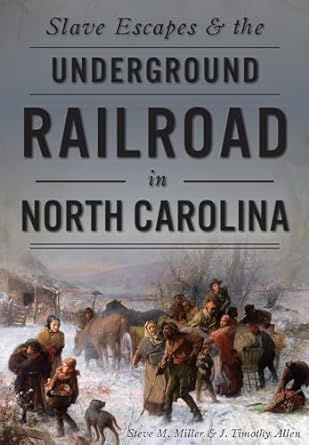
Slave Escapes & the Underground Railroad in North Carolina, by Steve M. Miller & J. Timothy Allen

Slave Escapes & the Underground Railroad in North Carolina, by Steve M. Miller & J. Timothy Allen

Most documented history of the Underground Railroad concentrates on how it operated in the northern states. This is understandable, considering the very secret nature of the operation. As you can tell from the title, this book is almost exclusively about the Underground Railroad in North Carolina.

This was an enlightening book, just as I anticipated. Much of it is about the part Quakers in North Carolina played in the so-called Underground Railroad. I knew that there were many Quaker early settlers in the Guilford County section of North Carolina, but I was surprised to learn that there were many Quaker settlers in the northeastern region of the state.

Another thing I learned from reading the book is that some Quakers owned slaves. The denomination gradually changed its attitude about slavery, which necessitated some creativity in how to deal with the matter. Quakers agreed to manumit their slaves in 1774, but some of their heirs refused to do so.

The book references various colonial and state laws enacted regarding slavery in North Carolina since the late 1600s. One of the laws I had never heard of was the Slave Code Act of 1741 which required local sheriffs who held runaway slaves to give descriptive details of those slaves to churches, and the churches “were then obligated to post them in an ‘open and convenient place’ for two months.” [Thank goodness we have separation of church and state now!]

The book talks about how the Great Dismal Swamp in northeastern North Carolina was a haven for runaway slaves and a hell for some area enslaved individuals. The remoteness and dense vegetation in the swamp provided hiding places for escaped slaves to take refuge; however, slave labor was used – at the cost of many slaves’ lives – to building the Dismal Swamp Canal.

Examples of newspaper notices about runaway slaves are included. Although it is assumed that all runaway slaves headed north, this book explains that some headed east in an effort to get on ships to various destinations, some fled to Tennessee, and others tried to make their way to New Orleans to board ships.

Another thing I learned from the book is that the Underground Railroad was used by white people during the Civil War. Quakers, Union sympathizers, and Confederate deserters were known to have used the system.

Summary of Miriam Margolyes’s This Much Is True

Miriam Margolyes is a British actor with an interesting life’s story. Unable to find her memoir, This Much Is True, at the public library, I settled for reading Summary of Miriam Margolyes’s This Much Is True. It was available from Charlotte-Mecklenburg Library through Hoopla.

I enjoyed the summary and it satisfied my curiosity about Ms. Margolyes’s life. I must admit that I was not that familiar with her until recently watching a “Lost in Scotland” PBS series. I had no idea how many movies and TV shows she had appeared in until I read this book.

Between Earth and Sky, by Amanda Skenandore

Between Earth and Sky, by Amana Skenandore

This was the February book for Rocky River Readers Book Club in Harrisburg, NC. I read the first 40% of it before I found part of the story line to be implausible. Others in the book club loved it. There was a lot of discussion, especially by two of the members who were all fired up about the story.

I was interested in the beginning because it was about the terrible treatment of the Native American children at a school run by white people in 1889. That is a topic we all need to be educated about. Other library books were begging for my time, though, which gave me an excuse not to finish reading the novel.

From the discussion at the book club meeting, the 60% of the novel I did not get to read apparently contained some interesting dilemmas for the main characters. I do  not want to cast aspersions on the book. If you are interested in reading about the way indigenous peoples were treated in the United States in the late 1800s, I recommend this novel.

Since my last blog post

One of my regular blog readers asked me what happened to Clarence Earl Gideon after the Gideon v. Wainwright US Supreme Court ruling I blogged about last week (#OnThisDay: Gideon v. Wainwright). I realized I was remiss in not including that information in that post.

Mr. Gideon appeared in court in Florida for a retrial in August 1963. That time, he had legal counsel and was acquitted by the jury. He was never in trouble with the law again, as far as I could learn. He died of cancer in 1972 at the age of 61.

Thank you, FictionFan, for asking the follow-up question. By the way, if you enjoy reading thoughtful and honest book reviews of a wide range of genres, I recommend you visit https://fictionfanblog.wordpress.com/ to see what she is reading.

Until my next blog post

I hope you are reading a good book.

Remember the people of Ukraine and all the places in the world where innocent people are suffering.

Janet

I Feel Like the World has Passed Me By

I recently read a blog post that made my head spin. It left me wondering if I can make it as a writer. The world is changing at warp speed, and I cannot keep up.

My post today is a bit of a rant. Please bear with me. I’m curious. Do you feel the same way, or am I just an old fuddy-duddy? (Granted, if I casually use the term “fuddy-duddy,” I probably am one.)


What set off this particular rant (a.k.a., blog post)?

The blog post I’m referring to is https://writersinthestormblog.com/2024/02/social-media-best-practices-for-authors-in-2024/. This is a blog I have followed for years and I usually benefit from reading the posts. This particular one gave me pause.

I didn’t realize how much I was lagging behind in the world of social media until I learned that “you might want to consider IG Thread, Mastodon, or Bluesky (still in Beta and by invite only). The stated goal of Threads is to become part of the Fediverse (of which Mastodon is a part) so many people have just jumped straight over to Mastodon.”

WHAT?

That one paragraph was confusing on so many levels.

I continued reading and learned that there is also a social media platform called BeReal, in case I want people to know where I am at all times.

No thanks.

I learned that Reddit “has released an API in preparation for its upcoming IPO.” I have used Reddit, but I don’t know an API from an IPO. In fact, I have very little interest in learning the difference. (I’ve looked them up before, but I don’t have enough brain cells to clutter up my head with information I don’t need to recall.) It’s frustrating to read an article about what authors need to know about social media when you don’t understand the abbreviations. It’s overwhelming.

Granted, API and IPO were clickable, but the assumption is that I should already know what they are. It just reinforces my feelings that I’m so far behind there’s no hope for me to catch up. And, oh… in my spare time, when I’m not studying the latest technological advances and numerous social media platforms, I can do historical research and turn that into a novel.

I also learned from the Writers in the Storm blog post that “Google has been talking about E-A-T for a few years now, but with the extensive use of generative AI, they have added another E. This is good news for us, as their requirements and Quality Rater Guidelines for good content will almost certainly exclude most AI-created content. E-E-A-T stands for Expertise, Experience, Authoritativeness, and Trustworthiness.”

The explanation of E-E-A-T was much appreciated because I had never heard of E-A-T in the first sentence of that paragraph, much less E-E-A-T.

My readers know I’m not the most computer-savvy person in the world, but I have managed to write a blog on a regular basis since January 24, 2010, format and publish two local history books, two short stories, and a cookbook for publication. All but the cookbook are available in electronic as well as print form. I’m on Facebook and have many boards of interest on Pinterest. I’ve learned how to create book covers and memes. I put a new meme on Pinterest six days a week to publicize my various books and short stories. I’ve created bookmarks, flyers, and business cards. I publish an e-newsletter. I have my own website.

Apparently, it is not enough.

I should not have to be a technology whiz to be an author, but I have read and heard a multitude of times that I need tens of thousands of followers on social media if I stand a chance of catching the eye of a literary agent or book publisher.

Perhaps I was born in the wrong century.


And did I mention the scammers I have to deal with several times a week?

I’m proud of my vintage postcard book, The Blue Ridge Mountains of North Carolina, published by Arcadia Publishing in 2014; however, I can’t visualize it as a movie. I get numerous phone calls from people speaking broken English telling me that I can make boatloads of money if I agree to let them turn the book into a movie. I received a call a couple of weeks ago from someone claiming to be with HBO promising me $300,000 if I would allow them to turn my postcard book into a made-for-TV movie.

The Blue Ridge Mountains of North Carolina, by Janet Morrison

Yeah, right! I’m sure it would be a blockbuster.


Since my last blog post

I’m putting the finishing touches on my March newsletter. If you have not subscribed to my newsletter, please go to https://www.janetmorrisonbooks.com, click on the “Subscribe” button, and fill in your email address. In return, you will receive a free downloadable copy of one of my short stories, “Slip Sliding Away: A Southern Historical Short Story” and you will receive my newsletter every other month.

In my newsletters I give details of the “field trips” I take to do research for my historical short stories and the historical novels I’m working on as well as photographs from those trips. I give more information about the things I’m doing to move my writing career forward than I do in my weekly blog posts.

I promise I won’t bombard your inbox with emails!


Until my next blog post

I hope you have a good book to read. As usual, I’m reading several books. So many books… so little time!

Please get your news from more than one reliable source.

Remember the people of Ukraine and let your representatives in Washington, DC know how you feel about aid to that country. It just might get through to them and make a difference.

Janet

Following up on last week’s blog post: Book Banning

I was gratified by the responses my blog post of last Monday received. Thank you to everyone who responded, and thank you to the ones of you who reblogged my post about book banning. In case you missed it, here’s the link: Book Banning is Democracy Banning!

In last week’s post I listed the 19 books that had been banned the week before by the school board in Hanover County, Virginia. I failed to list other books or tell you how you can find lists of other books that have been challenged in the United States.

You can simply put “Challenged Books” or “Banned Books” in your favorite online search engine. Or, you can look for reputable sites like the American Library Association’s website for intellectual freedom: https://www.ala.org/advocacy/bbooks/

Barnes and Noble has a list of more than 230 challenged books on its website at https://www.barnesandnoble.com/b/banned-books/_/N-rtm.

Imagine if these shelves were empty! (Photo by Rabie Madaci on Unsplash)

Let’s flood our public library systems and bookstores with requests for such books! Here’s a partial list. You might find many others when you do your own search. The following list of 101 books that have been challenged or banned somewhere in the United States is in no particular order.

Hunger Games, by Suzanne Collins

They Both Die at the End, by Adam Silvera

What I Know Now: Letters to My Younger Self, by Ellyn Spragins

The Giver, by Lois Lowry

1984, by George Orwell

The Great Gatsby, by F. Scott Fitzgerald

Fahrenheit 451, by Ray Bradbury

The Lord of the Flies, by William Golding

To Kill a Mockingbird, by Harper Lee

The Glass Castle, by Jeannette Walls

Harry Potter and the Sorcerer’s Stone, by J.K. Rowling

Maus I: A Survivor’s Tale: My Father Bleeds History, by Art Spiegelman

Where the Wild Things Are, by Maurice Sendak

How the Garcia Girls Lost Their Accents, by Julia Alvarez

New Kid, by Jerry Craft

Animal Farm, by George Orwell

The Kite Runner, by Khaled Hosseini

The Handmaid’s Tale, by Margaret Atwood

My Sister’s Keeper, by Jodi Picoult

The Dairy of a Young Girl, by Anne Frank

The Catcher in the Rye, by J.D. Salinger

The Bluest Eye, by Toni Morrison

The 1619 Project: A New Origin Story, by Nicole Hannah-Jones

Brave New World, by Aldous Huxley

The Hate U Give, by Angie Thomas and Amandla Stenberg

Of Mice and Men, by John Steinbeck

Lord of the Flies, by William Golding

This Book is Gay, by Juno Dawaon and David Levit

I Know Why the Caged Bird Sings, by Maya Angelou

Gender Queer: A Memoir, by Maia Kobabe

Hop on Pop, by Dr. Seuss

Their Eyes Were Watching God, by Zora Neale Hurston

How the Word is Passed, by Clint Smith

Twilight, by Stephanie Meye

Beloved, (a Pulitzer Prize Winner) by Toni Morrison

The Pillars of the Earth, by Ken Follett

Girl, Interrupted, by Susanna Kaysen

Where the Sidewalk Ends, by Shel Silverstein

The Grapes of Wrath, (a Pulitzer Prize Winner), by John Steinbeck

The Color Purple, by Alice Walker

Speak, by Laurie Halse Anderson

Slaughterhouse-Five, by Kurt Vonnegut

Lolita, by Vladimir Nabokov

The Absolutely True Diary of a Part-Time Indian, by Sherman Alexie

All American Boys, by Jason Reynolds and Brendan Kiely

The Autobiography of Malcolm X, as told to Alex Haley

A Farewell to Arms, by Ernest Hemingway

The Poet X, by Elizabeth Acevedo

Looking for Alaska, by John Green

Persepolis: The Story of a Childhood, by Margane Satrapi

Midnight in the Garden of Good and Evil, by John Berendt

Class Act: A Graphic Novel, by Jerry Craft

One Flew Over the Cuckoo’s Nest, by Ken Kesey

Monday’s Not Coming, by Tiffany D. Jackson

Fifty Shades of Grey, by E.L. James

The Other Wes Moore, by Wes Moore

Like Water for Chocolate, by Laura Esquivel

What If It’s Us, by Becky Albertalli and Adam Silvera

A Time to Kill, by John Grisham

A Lesson Before Dying, by Ernest J. Gaines

The Da Vinci Code, by Dan Brown

And Tango Makes Three, by Justin Richardson and Peter Parnell

Child of God, by Cormac McCarthy

Feed, by M.T. Anderson

A Separate Peace, by John Knowles

Stamped from the Beginning, by Ibram X. Kendi

Go Ask Alice, by Anonymous

Stranger in a Strange Land, by Robert A. Heinlein

Different Seasons, by Stephen King

For Whom the Bell Tolls, by Ernest Hemingway

The Lord of the Rings, by J.R.R. Tolkien

Native Son, by Richard Wright

Angela Davis: An Autobiography, by Angela Y. Davis

Skeleton Crew: Stories, by Stephen King

Thirteen Reasons Why, by Jay Asher

Stamped: Racism, Antiracism, and You: A Remix of the National Book Award-Winning Stamped from the Beginning, by Jason Reynolds and Ibram S. Kendi

Simon vs. the Homo Sapiens, by Becky Albertalli

All Boys Aren’t Blue: A Memoir, by George M. Johnson

The Red Badge of Courage, by Stephen Crane

Water for Elephants, by Sara Gruen

The Prince of Tides, by Pat Conroy

Tiger Eyes, by Judy Blume

Four Hundred Souls: A Community History of African America, 1719-2019, by Ibram X. Kendi, Keisha N. Blain

A Thousand Acres, a Pulitzer Prize Winner, by Jane Smiley

Kaffir Boy: The True Story of a Black Youth’s Coming of Age in Apartheid South Africa, by Mark Mathabane

Beach Music, by Pat Conroy

The Adventures of Huckleberry Finn, by Mark Twain

Blood in the Water: The Attica Prison Uprising of 1971 and Its Legacy, a Pulitzer Prize Winner, by Heather Ann Thompson

The Tenth Circle, by Jodi Picoult

The Jungle, by Upton Sinclair

Girl With the Blue Earring, by Tracy Chevalier

Catch-22, by Joseph Heller

Palestine, by Joe Sacco

Gone With the Wind, by Margaret Mitchell

Bridge to Terabithia, A Newberry Award Winner, by Katherine Peterson

The Sun Also Rises, by Ernest Hemingway

Addie on the Inside, by James Howe

Call of the Wild, by Jack London

Olive’s Ocean, a Newberry Honor Book, by Kevin Henkes

A Stone in My Hand, by Cathryn Clinton

Tilt, by Ellen Hopkins

How Often Are Books Challenged Where You Live?

There is an interactive map of the United States of the American Library Association’s website, https://www.ala.org/advocacy/bbooks/by-the-numbers. Hover the curser over a state to find basic information about book challenges in that state in 2022.

For instance, in my home state of North Carolina, there were 32 attempts to restrict access to books last year involving 167 titles. The most challenged book in North Carolina was Looking for Alaska, by John Green.

That map revealed some surprises. There were 45 attempts to restrict access to books in Massachusetts last year involving 57 books. In Michigan, the figures were 54 and 359. In Pennsylvania, 56 and 302. In Florida, 35 and 991. But Texas was at the top of the list (or bottom as the case may be) with 93 attempts to restrict access to books in 2022 involving a whopping 2,349 titles!

Photo by Enrique Macias on Unsplash

Different books are listed as the most-challenged book in the various states; however, Florida and Texas agree on The Bluest Eye, by Toni Morrison. I wrote about that book in my blog post last week. I want to say to the book challengers in Florida and Texas, “You’ve got to be kidding!”

If you want to read more about the topic of book banning…

Here’s the link to the website of PEN America. PEN America is made up of more than 7,500 novelists, journalists, nonfiction writers, editors, poets, essayists, playwrights, publishers, translators, agents, and other writing professionals, as well as devoted readers and supporters who join with them to carry out PEN America’s mission to protect free expression in the United States and around the world: https://pen.org/report/banned-in-the-usa-state-laws-supercharge-book-suppression-in-schools/.  

Until my next blog post

I hope you’re reading a book that someone has tried to get banned from a library. Let’s flood our public library systems and bookstores with requests for books that someone doesn’t want us to read!

I hope you make time for friends and family. Read to the children in your life and encourage them to read for fun.

Stop right now and visit my website (https://janetmorrisonbooks.com/) to subscribe to my newsletter. I took a special “field trip” to benefit my historical fiction writing on May 20. I’ll tell you all it in my July newsletter!

Just for signing up, you’ll receive a free downloadable copy of “Slip Sliding Away: A Southern Historical Short Story” to give you a taste of my fiction writing.

Remember the brave people of Ukraine.

Janet

19 Blue Ridge Mountains Trivia Questions

August 25, 2019 will mark the fifth anniversary of the publication of my vintage postcard book, The Blue Ridge Mountains of North Carolina. To mark this milestone, I’m testing your knowledge of some of the interesting facts I included in the book.

#BlueRidgeMtnsOfNC #PostcardBook
The Blue Ridge Mountains of North Carolina by Janet Morrison

The book covers the 23 westernmost counties in North Carolina and the three counties in eastern Tennessee in which a portion of the Great Smoky Mountains National Park is located. If you have the book, you have my permission to cheat. That’s only fair to those of you who purchased my book. I’ll ask a few questions. You’ll find the answers in my blog post on August 19, 2019.

Although most of the original postcards are in color, they appear in black and white in both of the book’s formats. I tried to include pictures of several of the postcards in today’s blog post, but due to technical problems I was only able to post one vintage postcard image.

Here are the questions:

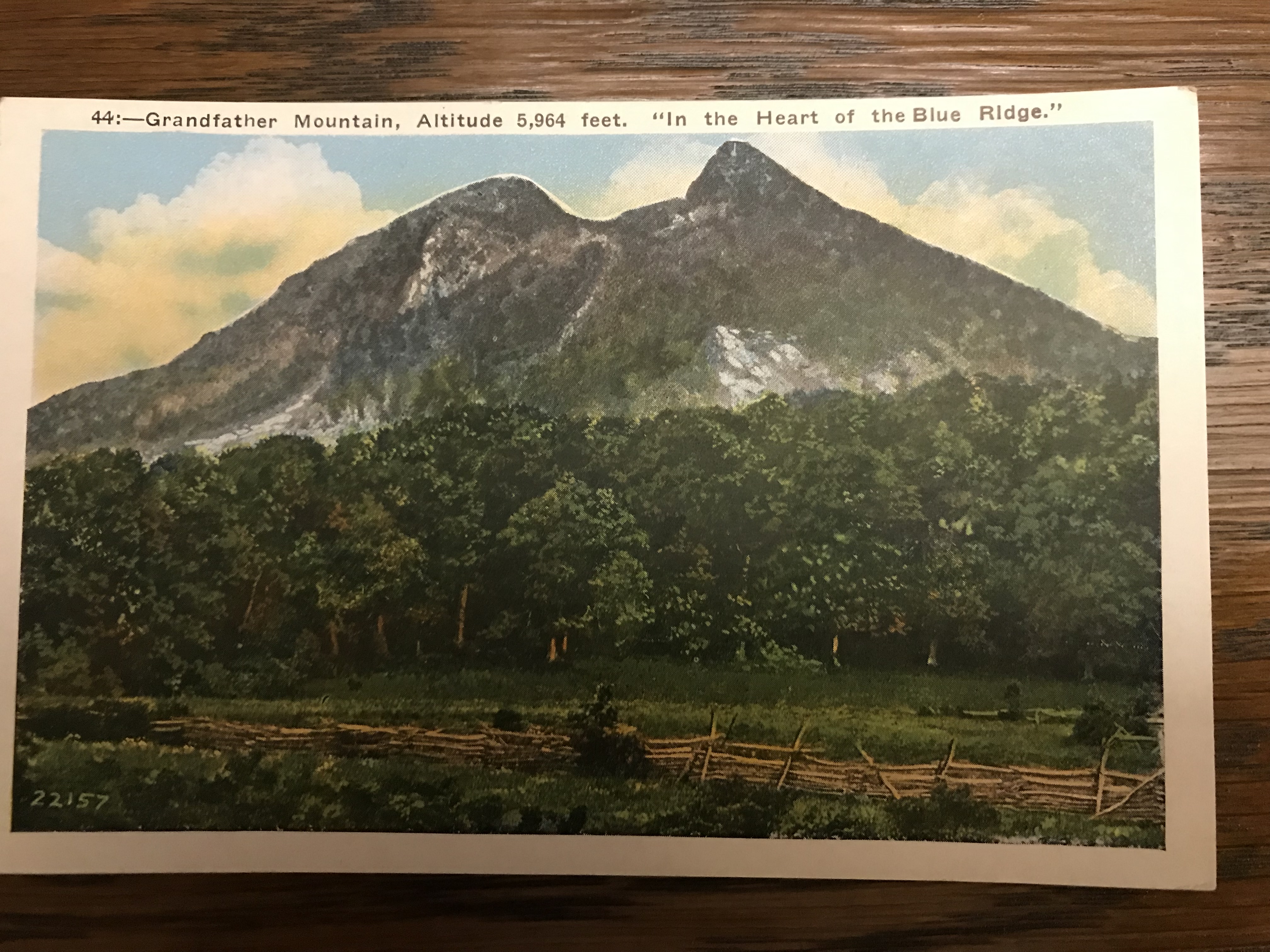
1.  Why was Grandfather Mountain named a member of the international network of Biosphere Reserves in 1992?

#GrandfatherMtn #GrandfatherMountain
Grandfather Mountain, North Carolina

2. What does Linville Falls in North Carolina have in common with Niagara Falls?

3.  How did Edwin Wiley Grove make his fortune which enabled him to build the Grove Park Inn in Ashevile, North Carolina?

4.  What part did the Civilian Conservation Corps (CCC) play in the construction of the Blue Ridge Parkway during The Great Depression?

5.  When George W. Vanderbilt purchased Mt. Pisgah in 1897, what grand plan did the mountain become part of temporarily? 

6.  What groups of people were housed at Assembly Inn in Montreat, North Carolina in 1942?

7.  Jerome Freeman bought 400 acres of land in Rutherford County, North Carolina that included the Chimney Rock around 1870 for $25. How much did the State of North Carolina pay for Chimney Rock Park in 2007?

8.  What new breed of hunting dog was developed by a German pioneer family in the late 1700’s in the Plott Balsams subrange of the Blue Ridge Mountains?

9.  What is an early 20th century feat of engineering on the Newfound Gap Road in Great Smoky Mountains National Park?

10.  How fast can a black bear run?  

11.  It is illegal in Great Smoky Mountains National Park to willfully get within how many feet of a black bear?

12.  What is the name of the 57,000 acres of land purchased by the Cherokee in the 1800s and held in trust by the United States Government?

13.  Is Qualla Boundary technically a reservation?

14.  Did the Cherokee people lived in tipis?

15.  What forest contains one of the largest groves of old-growth trees in the Eastern United States? 

16.  What hydroelectric dam was used in the 1993 Harrison Ford movie, The Fugitive?

17.  What is the tallest dam east of the Rocky Mountains in the United States?

18.  One of the oldest postcards in my book is of Cullowhee Normal School in the mid- to late-1920s. What is the name of that school today?

19.  Started in 1935, the Blue Ridge Parkway’s “missing link” was completed in 1987. What is the connecting one-fourth-mile long piece that filled the “missing link” called?

In case you’d like to take the easy way out and find the answers to all these questions in one book, you may order The Blue Ridge Mountains of North Carolina, by Janet Morrison, in paperback or e-book from Amazon.com, request it at your local bookstore, or order it directly from https://www.arcadiapublishing.com/. Time is short. I’ll supply the answers in my blog post next Monday, August 19.

The contract I signed with Arcadia Publishing was for five years, so you’d better get a copy of the book while it’s still being published.

Since my last blog post

I discovered that the links that I had on my blog to my presence on several social media networks were not working properly, except for the one to my Pinterest account. Therefore, I removed the links to Facebook, Twitter, and LinkedIn. I’ll announce in a future blog post when those links are up and running again.

Until my next blog post

If you’d like to follow me on Twitter, @janetmorrisonbk. If you’d like to follow my business page on Facebook, it’s Janet Morrison, Writer. If you’d like to follow me on LinkedIn, go to https://www.linkedin.com/in/janet-morrison-writer.

I hope you have a good book to read. I’m reading Searching for Sylvie, by Jean Kwok.

If you’re a writer, I hope you have quality writing time.

Thank you for taking the time to read my blog. You could have spent the last few minutes doing something else, but you chose to read my blog.

Let’s continue the conversation

Please don’t include any of the trivia answers in your comments. If you want to indicate how many of them you think you know the answers to, you may indicate that number or the numbers of the questions you think you can answer.

Read my book or read my blog post next Monday for all the answers.

Janet

Delving Deeper into Dialects and Accents in Fiction

My blog post last week, https://janetswritingblog.com/2019/06/10/a-wake-up-call-from-dr-henry-louis-gates-jr/, was about how reading Stony the Road:  Reconstruction, White Supremacy, and the Rise of Jim Crow, by Henry Louis Gates, Jr. tipped the scales for me in writing dialect and accents in fiction. One thing led to another, and that post became too long. Today’s blog post includes what I deleted from last Monday’s post.

Stony the Road: Reconstruction, White Supremacy, and The Rise of Jim Crow, by Henry Louis Gates, Jr.

If this is a topic you’re struggling with, I hope these two blog posts will trigger some questions in your mind and lead you to try to come to terms with this aspect of fiction writing.

If you are a reader but don’t aspire to write fiction, I hope my thoughts on the subject will spark a new awareness in you. It’s not just about literature, it’s about how we view our fellow citizens.

My wake-up call

The awakening Dr. Gates’ book prompted in me helped me realize that, except for using an occasional “ye” or “’Tis” for an Irish character’s speech, I wasn’t using any sort of dialect in the white characters’ dialogue. So why in the world was I using dialect in the dialogue of the slaves in the novel I’m writing, The Doubloon?

A device in writing is the use of attributing certain words or phrases to a particular character. This is done to help the reader distinguish one character from another. There is a way to do this without using “Plantation Dialect.”

Thank you, Dr. Gates, for turning that light bulb on in my head.

Another resource for writing vs. not writing accents in dialogue

Images from Louise Harnby’s “Writing Natural Dialogue & Thoughts” blog post from May 20, 2019.

I looked for additional professional advice on the topic of writing accents in dialogue and found the following blog post by fiction editor and proofreader Louise Harnby:  https://www.louiseharnbyproofreader.com/blog/writing-dialogue-and-thoughts-8-problems-and-how-to-fix-them.

She stated, “Bear in mind that dialogue tells us what words have been spoken, not how they’re spelled. Phonetic spelling can turn dialogue into pastiche, and offensive pastiche at that. It’s also difficult to absorb and distracts readers from your story.”

That led me to edit the dialogue I had written for a Frenchman in my novel manuscript. There is so much to learn. Times are changing. What was acceptable in fiction years ago or even last year, might not be acceptable now. Some people call this political correctness. That term has taken on negative backlash connotations, so I prefer to say, “When you know better, you do better.” Maya Angelou is credited with saying, “Do the best you can until you know better. Then when you know better, do better.”

A piece of advice I took from Ms. Harnby’s blog post is this: “Use location rather than pronunciation to enrich characterization – how where they’re from affects the story, their perception of the conflict or their approach to solving it.” I think this is harder than writing phonetically, but nobody said writing a novel set in the 18th century American South would be easy.

Reinforced by listening to Iron House, by John Hart

My awareness of this matter was reinforced a couple of weeks ago as I listened to Iron House, by John Hart. Listening to the novel drove home the question about the use of accent in fiction. I did not finish listening to Iron House because I became completely distracted by the over-the-top Southern accent used by the professional reader.

Iron House, by John Hart

The way in which the professional reader exaggerated the speech of at least two characters in Iron House reminded me of the extreme Southern accents used by the actors in the old television series “In the Heat of the Night.” Since the series was set in Mississippi, the actors used such slow and pronounced “Southern” accents that it was irritating to my North Carolina ears. It came across as Hollywood making fun of the way I talk.

Iron House is set in North Carolina. I’ve lived my entire life in that state, and I’ve never heard anyone talk with the extreme drawl of Caravel and Abigail in the audio edition of that novel. It piqued my curiosity, so I checked out the printed version from the public library just to see how Mr. Hart wrote the words. Sure enough, he did not write the book phonetically to convey over-the-top pronunciation in any words of dialogue Caravel or Abigail had. So why did the publisher think it was acceptable for the reader of the audio edition of the novel to use a fake accent?

In all fairness, Iron House was published eight years ago. Perhaps an audio edition recorded in 2019 would be done differently.

This has all been quite an eye-opener for me on my journey as a writer. Sometimes I’ve wished I’d started my writing career as a young adult, but now I realize I would have been a very different writer at 26 than I am at 66. I think the 66-year-old me would be embarrassed by the fiction written by the 26-year-old me.

Thinking about my reading experience

If I’m reading the dialogue of a character from Boston, my brain knows what a Boston accent sounds like. I’ve known people from Boston, so I know they pronounce some things differently than I do but not like the over-the-top Boston accents we sometimes encounter on TV or in movies. The writer doesn’t have to spell a Bostonian’s dialogue phonetically for me to catch on.

Outsiders tend to paint everyone from New Jersey with the same phonetic brush, too. I know people from New Jersey, and they don’t sound anything like Vinny in the 1992 comedy movie “My Cousin, Vinny.”

But somehow, there is a difference between an actor conveying a regional accent and an actor portraying what Dr. Henry Louis Gates, Jr. refers to as “Plantation Dialect.” Although, I don’t appreciate an actor giving exaggerated pronunciations to a Southern character, it’s not the same as an actor giving exaggerated pronunciations to a black character. I think regional accents should be celebrated, but there is no place for “Plantation Dialect” in fiction in 2019.

I don’t have a problem with a Southern character saying “y’all” in the printed dialogue in a novel. I say it naturally. It rolls right off my tongue like butter. But I do have a problem with printed dialogue in a present-day novel having a black character saying “Nome” instead of “No, ma’am.” “Gwine” used to appear in the dialogue of black slaves in literature. I never did understand how “I’m going to” or even “I’m gonna” got translated into “gwine.”

Literature evolves as society evolves. When you know better, you should do better. I still have a lot to learn.

It will interesting to see how the dialogue in my novel is accepted or rejected by literary agents, editors, and publishers. When that time comes, I’ll let you know.

Until my next blog post

I hope you have a good book to read. I’m reading The Prayer Box, by Lisa Wingate and Mr. Churchill’s Secretary, by Susan Elia MacNeal.

If you’re a writer, I hope you have quality writing time.

Thank you for reading my blog. You could have spent the last few minutes doing something else, but you chose to read my blog.

Let’s continue the conversation

Do you like reading fiction in which dialect is expressed through the spelling of words in dialect, or are you turned off by this practice? Do you think it’s time for us in 2019 to reassess how dialect is used in fiction? Should writers give readers enough credit to assume they can imagine how a character from a certain region would pronounce certain words?

Those of you who live in countries other than the United States are urged to chime in on this topic. Is this something authors in other countries are faced with as they write about regionalisms or even a past history in which certain groups of people were enslaved?

If today’s blog didn’t interest you, please come back next Monday for a different topic.

Janet

#TwoForTuesday: Two Really Funny Books

I’m participating in the third month of Rae’s Reads and Reviews’ #TwoForTuesday blog prompts. Rae’s blog post yesterday, https://educatednegra.blog/2019/04/01/april-two-for-tuesday-prompts/ lists the prompts for every Tuesday in April. If you’d like to participate, visit Rae’s blog post and leave her a message in the comments section.

Each month’s prompts are more challenging than the ones from the previous month. It remains to be seen if I can come up with books to write about this month. Rae is stretching my memory to think back through my many years of reading.

With today’s theme in mind, I selected two book series instead of two individual books. (There I go, bending the rules again!) They are series I enjoyed a few years ago. They are books you might enjoy when you want something light to read, although after a while they become somewhat predictable.

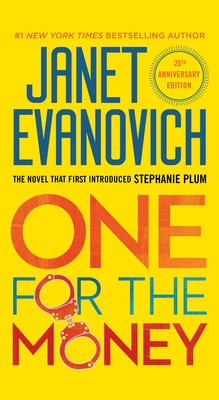
Janet Evanovich’s Stephanie Plum Series

I appreciate how Ms. Evanovich numbers her books in this series in chronological order. It makes it easy to keep up with where you are in the series, especially if you’re late coming to her books and you want to remember which ones you’ve read.

Stephanie Plum is a bounty hunter for her New Jersey cousin of questionable character. Stephanie is white. Her sidekick is a large black woman named Lula. There’s no end to the trouble Stephanie and Lula get into. This usually involves Stephanie’s car getting blown up and one of her two heart throbs, Ranger, coming to her rescue. The earlier books in this series were fresh and laugh-out-loud funny. After 25 books, though, they don’t make me laugh as much.

One for the Money, by Janet Evanovich

If you want to give Ms. Evanovich’s Stephanie Plum books a try, start with One for the Money in order to get acquainted with the recurring cast of characters. The books don’t have to be read in order, but occasionally knowing what has transpired in the past will help you appreciate a later book.

Ms. Evanovich writes one book every year now in this series, with Look Alive Twenty-Five being released last fall. The Stephanie Plum books are stereotypically-New Jersey.

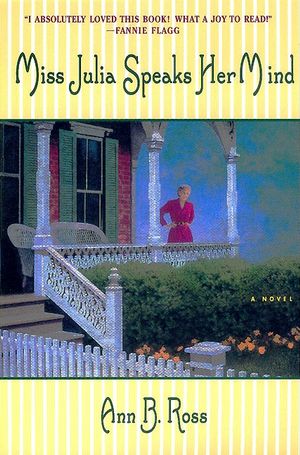
Ann B. Ross’ Miss Julia Novels

I read a few of Ann B. Ross’ Miss Julia novels a few years ago before I got hooked on historical fiction. That’s not to say they don’t still make me laugh.

Miss Julia Speaks Her Mind, by Ann B. Ross

Miss Julia is an elderly widow who lives in a town in western North Carolina. Every time Miss Julia thinks life might settle down, a relative or other ne’er do well shows up on her doorstep to throw a monkey wrench into her life.

Miss Julia rolls with the punches with good humor. Start with Ann B. Ross’ debut novel, Miss Julia Speaks Her Mind. This is great Southern fiction.

Ironically, Ms. Ross’ latest Miss Julia novel is being published today. The title is Miss Julie Takes the Wheel.

Until my next blog post

Thank you, Rae, of “Rae’s Reads and Reviews Blog” for this month’s #TwoForTuesday blog post prompts. Visit her blog, https://educatednegra.blog.

Happy reading!

Let’s continue the conversation

In the comments section below, tell me about one or two books that made you laugh.

Janet

Two for Tuesday: Two Books that Remind Me of Someone

Have you ever read a book and thought one of the characters was a dead ringer for someone you knew?

Today’s #TwoForTuesday writing prompt “two books that remind you of someone,” turned out to be more difficult for me than I had anticipated, but I chose A Man Called Ove, by Fredrik Backman and The Importance of Pot Liquor, by Jackie Seals Torrence. One is a well-known book and the other one not so much.

A Man Called Ove, by Fredrik Backman

A Man Called Ove, by Fredrik Backman

The main character in this book, Ove, reminds me of a relative of mine who I will not identify for obvious reasons.

Ove is a 59-year-old man at odds with the world. From the opening scene of computer-illiterate Ove attempting to buy a computer from a much younger computer geek store assistant to the scenes in which Ove pays his respects to foreign cars, much of his personality and outlook on life resonated with me and brought to mind my relative. That’s what made much of A Man Called Ove so funny to me.

The Importance of Pot Liquor, by Jackie Seals Torrence

The Importance of Pot Liquor, by Jackie Torrence

Chances are, you’ve never heard of this book. Chances are, you have no idea what pot liquor is unless you’re of a certain age and a native of North Carolina or another state in the American South. I’ll start by giving an explanation of “pot liquor.” It has nothing to do with the alcoholic kind of liquor. It is sometimes spelled “pot likker.”

What in the world is pot liquor?

Pot liquor is the liquid left in the pot after beans or other vegetables have been cooked and removed from the pot. I learned the term from my mother who was born more than 100 years ago on a farm and was one of 10 children. In other words, she grew up in a household where no food was wasted.

Therefore, I also grew up in a household where no food was wasted. We would never (and still wouldn’t dream of) pouring pot liquor down the drain. (Well, actually, I don’t drink or save broccoli pot liquor. I have to draw the line somewhere.)

When a pot of beans or other vegetables had been eaten and only the juice remained, my mother would usually offer the “pot liquor” to me. I rarely turned it down. What my mother knew that I didn’t know is that pot liquor is nutritious. It contains the vitamins and minerals that the cooking water leached out of the vegetables. I just thought it tasted good. My favorite has always been black eyed peas.

To this day, I like pot liquor, but now I usually freeze it. I keep a quart container in the freezer in which I add pot liquor from the cooking of various vegetables. This combination of various pot liquors is eventually used when I make homemade vegetable soup or have a recipe that calls for vegetable broth.

A note about the author

The author of The Importance of Pot Liquor, Jackie Torrence, lived in Salisbury, North Carolina, not far from where her slave ancestors lived on Second Creek. Though born with a speech impediment, Ms. Torrence became a master storyteller and traveled the United States performing her stories and teaching others the craft of storytelling. She died in 2004, confined to a wheelchair due to arthritis.

Back to the book title…

With my explanation of pot liquor (which probably made some of you gag) out of the way, let’s get back to the book that reminds me of someone. I read the book in 2011, so I don’t remember the details of the book. That’s all right, because it is the title itself of Jackie Seals Torrence’s 1994 book, The Importance of Pot Liquor, which reminds me of my mother and also of an elderly family friend and distant relative, Miss Eugenia Lore.

Miss Eugenia and “The Wah”

Miss Eugenia was quite a character and very much a product of her generation and family history. She was born in 1888 in Concord, North Carolina. Her father served in the Army of the Confederate States of America during the Civil War. She showed us the canteen he carried in the War which, in her Southern accent, she always referred to it as “The Wah.”

The portrait of Robert E. Lee that hung on her parlor wall had been purchased by her father as part of a fundraiser to secure the money needed to erect a statue of Lee in Richmond, Virginia. If anyone in her presence dared to call it the “Civil War,” she was quick to correct them with the words, “There was nothin’ civil about it!”

Unlike my mother, Miss Eugenia was raised in town. Her mother had “help” as in The Help, by Kathryn Stockett. One time Miss Eugenia made a disparaging remark about pot liquor because no one of her social status would have drunk it, and my mother responded with something like, “Oh, I love pot liquor. You don’t know what you’re missing.” Miss Eugenia was visibly appalled. In her mind, only an African-American household servant would “have” to drink pot liquor.

I agree with my mother. Miss Eugenia didn’t know what she was missing!

Until my next blog post

Thank you, Rae, of “Rae’s Reads and Reviews Blog” for this month’s #TwoForTuesday blog post prompts. I learned about it in her January 8, 2019 blog post:  https://educatednegra.blog/2019/01/08/two-for-tuesday-prompts/comment-page-1/#comment-1646.

Let’s continue the conversation

Thank you for taking the time to read my blog today.

Is there an “Ove” in your family?

Had you ever heard of pot liquor before reading my blog post? Do you like pot liquor or do you find it disgusting?

What is a book that reminds you of someone?

Janet