
May is Get Caught Reading Month, Mystery Month, National Share a Story Month, and Latino Book Month, so I wish you a happy May in all those ways and the other ways you celebrate it.
Here in the northern hemisphere, it is truly the month when we transition into summer. What’s not to love about that? (I know… humidity, snakes, and mosquitoes, but let’s not go there.)
As has been my practice (some months and years more so than others), I like to blog early in the month about some of the books I read the previous month.
I will point out (again) that I am not a book reviewer. There are people who do that as a profession, and I am not one of them. Occasionally, I receive an email from a stranger asking me to review their book. I don’t do that. My reading time is precious and I only read the books I choose to read.
My fiction reading has been sparse for several months now due to the brain fog that is part of ME/CFS, which I have lived with for 39 years.
This is frustrating, to say the least. I used to love to read and, as a fiction writer, it is especially difficult for me to admit that I have difficulty reading a novel and remembering what I’ve read on a page – much less to try to remember the plot of a story.
This makes for embarrassing times at book club, where I feel like an intruder in a group where everyone else knows the minute details of novels. All I can do is marvel at what extraordinary memories they have as I sit quietly and listen to the discussion.
You may wonder how and why I’m trying to write novels. I have spent years working on two novels, and I have no idea when either of them will be completed. It is only because I have worked with this story and these characters for so long that I am able to believe I can finish writing the book. It is challenging work, but writing brings me joy and a sense of accomplishment.
That said, I will share a little of what I read, or more accurately, finished reading in April.
40 Days of Decrease: A Different Kind of Hunger, A Different Kind of Fast, by Alicia Britt Chole
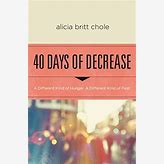
I’ve been a Presbyterian all my life, so fasting for Lent has never been a thing for me. There has been a growing emphasis on Lent in the Presbyterian Church USA in recent decades, but fasting or “giving up something for Lent” is not part of that emphasis.
I was drawn to the title of this book several years ago. I finally purchased a used copy of it and looked forward to reading it in the 40 days of Lent leading up to Easter this year.
I am a flawed human being and a flawed Christian. I read it “religiously” (pardon the pun) for the first 20 days. Then, I got distracted. I lost my focus and read the last 20 chapters on a hit-and-miss basis. That is not a reflection of the book. It is merely a reflection on me and my failings.
This book is excellent! If you want to give up eating chocolate or something for Lent, that’s quite all right, but this book takes a different approach. I believe it takes a deeper approach.
For each day during Lent, the book encourages the reader to give up something in their lives.
For instance, on Day 1, we are encouraged to give up Lent “as a project” with a beginning and ending date. On Day 2, we are encouraged to give up regrets. That is a huge one! Especially if you are in your later years. Another day we are encouraged to not speed up sorrow. Give yourself and others time to grieve. Don’t rush it.
As you can see, this book is packed with baggage we all have. Each day gave me something to ponder and to try to get rid of.
I highly recommend 40 Days of Decrease: A Different Kind of Hunger, A Different Kind of Fast, by Alicia Britt Chole. I don’t plan to wait until Lent 2027 to re-read it. Most of the topics in the book are things that I need to work on constantly. I think many of us could benefit from reading it throughout the year. Some of the daily topics could be dwelt on for a week.
Even though the book was designed to be read in daily increments during Lent, I refuse to feel guilty for taking several extra weeks to finish reading it. In fact, I think that’s perfectly okay.
It takes some of us longer than 40 days to get our lives straightened out. I’m a work in progress.
Travels with George: In Search of Washington and His Legacy,by Nathaniel Philbrick
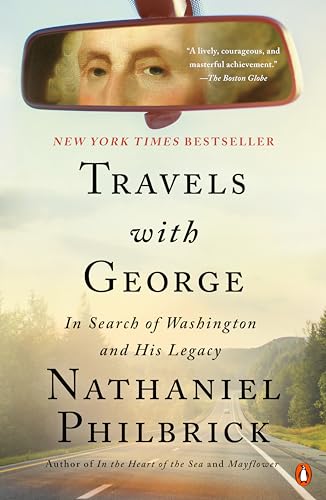
I wanted to read the entire book, but I was unable to devote the time necessary to do that. My reading for pleasure tends to just be for the pleasure in the moment of reading a well-written, interesting novel. This book is not a novel but a retracing of George Washington’s 1791 tour of the southern states. I was especially interested in his travels in South Carolina and North Carolina in light of the novel I’m writing.
I enjoyed that part of the book and took some notes for future reference. I was disappointed, though, that the book jumped from Washington’s time with the Catawba Indians to “his next stop in Salisbury.”
Washington’s next stop was not Salisbury. He traveled to Charlotte, and spent the next night (May 29, 1791) as a personal guest of Red Hill Tavern owner Martin Phifer, Jr. near the present-day intersection of US-29 and Poplar Tent Road in Concord, Cabarrus County.
Mr. Phifer had served with Washington at Valley Forge, so they were more than acquaintances.
I’m puzzled over why the author skipped over Mecklenburg and Cabarrus counties and went directly to Rowan County.
Otherwise, what he covered that I got to read was very interesting and easy to follow. I think anyone interested in George Washington or his tour of The South in 1791 would enjoy this book.
Until my next blog post
I hope you have one or more good books that you’re reading! I’m reading The Mad Wife, by Meagan Church and Brawler: Stories, by Lauren Groff.
Janet
The government should be afraid of its citizens, not the other way around.


 Janet's Writing Blog