I write southern historical fiction, local history, and I've written a devotional book. The two novels I'm writing are set in Virginia and the Carolinas in the 1760s. My weekly blog started out to follow my journey as a writer and a reader, but in 2025 it has been greatly expanded to include current events and politics in the United States as I see our democracy under attack from within. The political science major in me cannot sit idly by and remain silent.
With the change of seasons to cool mornings, I’m trying to take some of my own advice and follow along in my new devotional book and its companion journal:
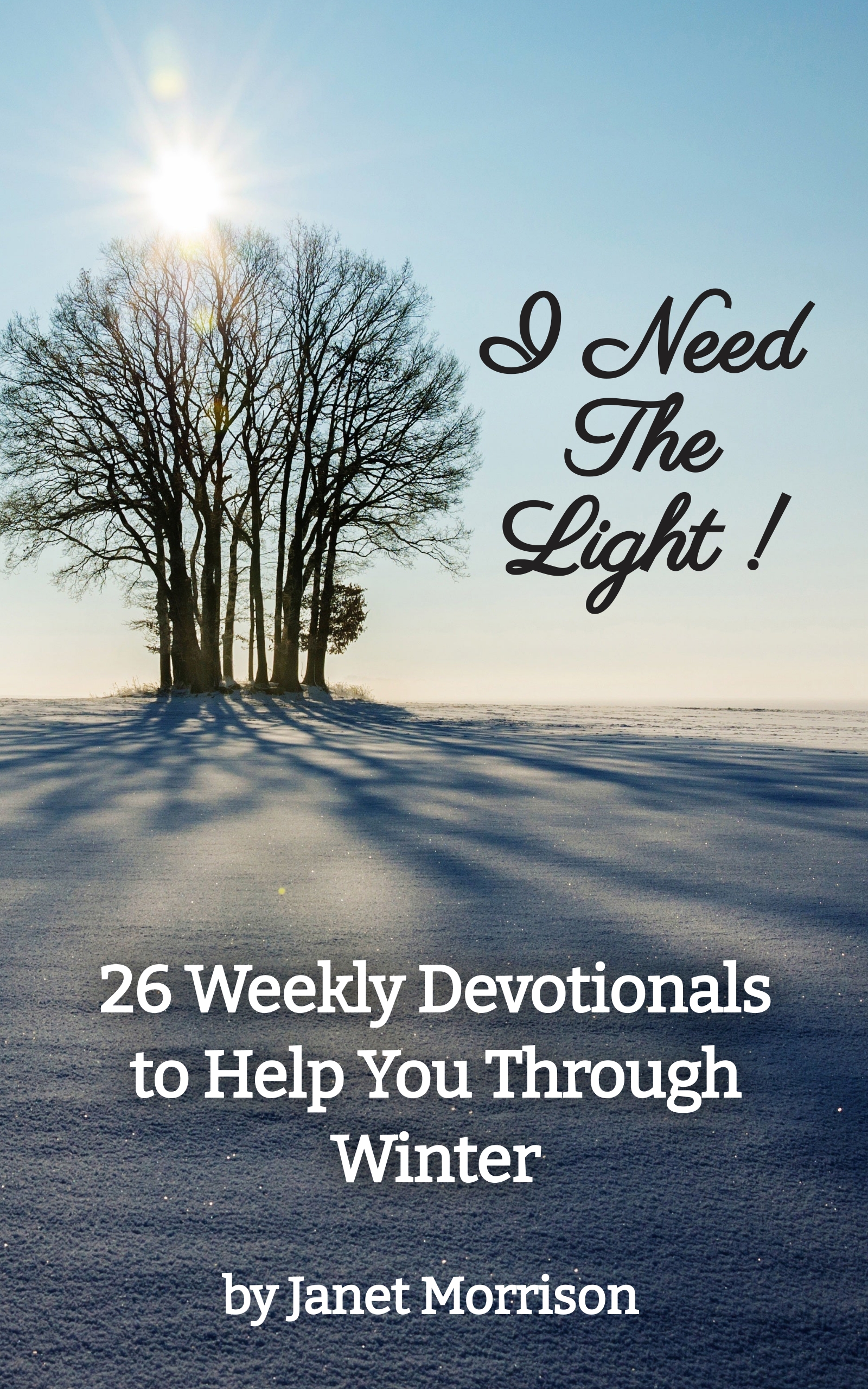
I Need The Light! 26 Weekly Devotionals to Help You Through Winter
I Need The Light! 26 Weekly Devotionals to Help You Through Winter, by Janet Morrison
And
I Need The Light! Companion Journal and Diary.
I Need The Light! Companion Journal and Diary, by Janet Morrison
In case you haven’t purchased your copies yet, here’s a sneak peek at Week 1
The Scripture for Week 1 is Genesis 1:1-5. It’s about God creating the Heavens and the Earth and light. By the power of His word – “Let there be light! – and there was light!
I can’t imagine life without light, which leads me to think that people who have been blind all their lives probably can’t imagine what light is.
Thos of us in the northern hemisphere are entering the time of the year when natural light and the warmth it brings is in short supply. Those of us with Seasonal Affective Disorder and Fibromyalgia are not fond of cold weather. In fact, it is difficult for me to enjoy the beauty of fall because I’m dreading winter.
I need the natural light to help set my circadian clock and combat the effects of Seasonal Affective Disorder, but I need Jesus Christ – The Light of the World! – for all aspects of my life. He is my Rock and my Salvation.
Look for my books on Amazon and Barnes & Noble. You should also be able to find them at your favorite independent bookstore, such as Second Look Books in Harrisburg, NC; Blue Ridge Books in Waynesville, NC; and Highland Books in Brevard, NC.
Some independent bookstores refuse to sell books that are self-published, but I know the three I listed above have ordered copies. Please support them!
Each week in my devotional book includes a recipe for a food that brings me comfort. Week 1 has my mother’s recipe for Drop Biscuits. Yum! I think I need to go to the kitchen right now and make biscuits!
I am thrilled to announce that my book, I Need The Light! 26 Weekly Devotionals to Help You Through Winter is now available!
I Need The Light! 26 Weekly Devotionals to Help You Through Winter, by Janet Morrison
Even if you love the fall and winter, I think you will benefit from reading this book.
Why I Wrote I Need The Light!
I wrote it from a place of physical challenges in cold weather, so I think people who have such illnesses and conditions as Seasonal Affective Disorder, Fibromyalgia, and Chronic Fatigue Syndrome/Myalgic Encephalomyelitis will be able to identify.
I settled on writing 26 weekly devotionals because with the onset of fall, I start dreading winter. Seasonal Affective Disorder affects me half the year.
What Does the Title I Need The Light! Mean?
To help me combat the symptoms of Seasonal Affective Disorder and sleep problems, my former physician’s assistant told me that I needed to get out in the natural light early every morning. I needed natural sunlight.
I’m not a morning person, so I had to force myself out of bed and outdoors in the morning – even in cold weather. As I walked, I repeated in my head the words, “I need the light. I need the light. I need the light. I need the light.” On about the fifth repetition, I had an epiphany: I realized I also needed The Light – Jesus Christ – “The Light of the World.”
I’ve been a Christian all my life, so it wasn’t a new concept for me that I needed Jesus Christ in all aspects of my life, but the sudden connection between “the light” and “The Light” was startling! It was then and there that God planted the idea in my mind and heart to write a book about the light and The Light.
That day, I started looking for all the references to light and The Light in the Bible.
Format of I Need The Light!’
Each week’s devotional follows this basic pattern:
The week’s Scripture reference is stated.
“Setting the Stage” in which I give a little background for that Scripture.
The week’s Scripture is then presented from The Message, The Good News Bible, The Living Bible, The New Oxford Annotated Bible (New Revised Standard Version), and TouchPoint Bible. The second week has the bonus of including the Bible verse from my great-great-grandmother’s 1849 The Psalms of David in Metre.
Insight from a Bible commentary, such as the series by Rev. William Barclay.
“My Thoughts” – Then, I usually share my thoughts about the Scripture.
“Remember” – one sentence of encouragement to ponder.
“Thought Pattern Interrupter” – One sentence to help you put a positive spin on that week.
“Activity Suggestion” – An activity you might choose to do that week to get you out of your own head/situation.
“Comfort Recipe” – A recipe that I consider a fall or winter “comfort food” from my own experience.
How to Use I Need The Light!
Readers are encouraged to read the devotional book as they choose. You don’t have to read it over a 26-week period. And each week, you can read the entire chapter in one sitting, or you can string it out over the week. It’s totally up to you to read the book in the way that best helps you.
Where to Find I Need the Light!
If you think I Need The Light! 26 Weekly Devotionals to Help You Through Winter would help you, or if you know someone who might benefit from the book, it can be purchased at your favorite independent bookstore. If you don’t find it there, please ask them to order the book from IngramSpark.
The book is available in paperback and as an e-book.
Click on “Read more” under the photo of the book cover.
At the end of the book’s description there, click on the BookShop.org buy button, which takes you to BookShop.org (a site that supports independent bookstores throughout the U.S.)
Put my book in your basket.
Select the independent bookstore you wish to support.
Place your order and have the satisfaction of knowing you are supporting an independent bookstore!
So far, Second Look Books in Harrisburg, NC; Blue Ridge Books in Waynesville, NC; and Highland Books in Brevard, NC have been very supportive of my book so I’ll give them a shout-out.
Available for your cell!
The book is also available on Amazon and from Barnes & Noble.
Here’s a Sneak Peek at I Need The Light!
From Week 12, here’s the “Setting the stage” introduction to that week’s devotional about the Parable of the Lost Coin:
“In Halley’s Bible Handbook, Henry H. Halley describes the fifteenth chapter of Luke as ‘the calm before the storm’ in Luke 14. In the fourteenth chapter of Luke, Jesus doesn’t beat around the bush as He talks about the price people will pay for following Him. He goes on to explain that He must be first in our lives. We must love Him more than we love anyone else. It’s enough to make a person question the wisdom of following Jesus!
“But then we come to Luke 15. It is a beautiful chapter about the tender, forgiving grace of Jesus. The chapter includes the Parable of the Lost Sheep, the Parable of the Prodigal Son, and the passage we’re looking at this week: The Parable of the Lost Coin.”
Does this sound like something you or a friend would like to read?
I wrote I Need The Light! 26 Weekly Devotionals to Help You Through Winter in a conversational tone as I imagined I was talking one-on-one with a good friend. If this approach to the Bible appeals to you, I hope you will look for my book.
I’m not an “in your face” kind of Christian. I’m a lifelong Presbyterian, so I’m not going to scare you into being a Christian. That’s not the Presbyterian way!
Even if fall and winter are your favorite seasons of the year, I believe you will find something of benefit in my 188-page devotional book.
I invite you to look for it!
If you read it and like it, your rating and/or brief review on such sites as Goodreads.com and Amazon will be greatly appreciated.
How many of us take the time or even think about handwriting a letter today? It has been so long since I handwrote more than a brief thank-you note, I honestly cannot remember. It is easier to text, email, or type a letter on the computer and print it.
I mentioned in my July e-newsletter that I have been decluttering. I have attempted this chore many times in the past with limited success; however, I am on a tear this time.
I should have taken “before” and “after” pictures. I should have weighed how much stuff I donated to the thrift shop. I should have weighed the two recycle bins that were so heavy with paper and magazines that I could scarcely push them out to the road for pick up. I should have weighed the countless bags of trash. I shredded old documents until I thought our paper shredder would start to smoke.
My parents were in college when The Great Depression began. They had to make their way in this world on little money and no luxuries. Their background meant they instilled in me the value of a dollar and one should never throw away anything because “you might need it or be able to use it later.”
I am once again living in the house they built in 1960, so there are many boxes and closet shelves to go through now.
It is a freeing experience to unburden oneself from the accumulation of stuff. As I blogged about on July 1, 2024 ( Books read in June 2024), I was inspired by reading Stop Buying Bins & Other Blunt but Practical Advice from a Home Organizer, by Bonnie Borromeo Tomlinson.
I’m not saying this is the end-all be-all book about decluttering, downsizing, or rightsizing. All I know is that it was the right book for me at the right time.
One unexpected benefit or result of my current decluttering binge was the rediscovery of handwritten letters. If you have lost a parent and had a good relationship with that person, you have probably felt that tug on your heart when you come across something in their handwriting.
Photo by Aaron Burden on Unsplash
Perhaps you found a recipe your mother wrote on an index card or scrap of paper. Perhaps it was nothing more than your father’s signature on a document. My father was a structural steel draftsman, so he usually printed. I can readily recognize his precise printing, whether it be on a blueprint or genealogy notes he made, but it is special when I find his signature because it, of course, is in cursive.
In going through decades of stuff this summer, I have come across birthday cards signed by my parents, various aunts and uncles, and dear childhood friends who are no longer with us. Some have brought a lump to my throat and a sting to my eyes as tears begin to form. Those cards are set aside and not yet tossed in the trash or recycle bin. Someday that’s where they’ll land, but not today.
The lost art I referenced in today’s blog title is the handwritten letter. I have found many of the letters my mother wrote to me while I was away in college and in my early 20s when I found employment several hours from home. I was struck by the contrast between that time in the 1970s and early 1980s as compared to today.
Today parents text or call their children who are in college or have otherwise left home and struck out to make their way in the world. They think nothing of making that phone call or sending that text. When I was in college and during my young adult years it was expensive to call “long distance.” You had to have a very good reason for calling home when I was in college.
There was one telephone on the wall in the hallway in my freshman dorm. I knew if I received a call from my parents, it was probably to relay bad news or something that couldn’t wait two or three days for them to tell me in a letter. And there were no long conversations because every minute cost money.
I am so glad that’s the way it was because it means today I can reread all those letters my mother wrote. Today’s college students and young adults will not have such tangible memorabilia.
Several years ago, my sister and I helped a friend organize in archival binders and archival sleeves the letters he and his wife wrote to one another while he was in the military service as a fighter pilot in World War II and the Korean War. He will turn 100 years old in October. He calls occasionally to thank us again for what we did. He lives alone and the days and nights are lonely. He says he finds great comfort and joy in opening those binders and reading those letters.
We have photocopies of portions of letters one of our great-grandfathers wrote to his parents and sister while he was serving in the military during the American Civil War. How valuable those letters are to us!
While going through a box of papers last week, I came across a typewritten letter from my eldest first cousin from some 30 years ago. She was much older than I. In that letter, she shared some recollections of her mother’s. (Her mother was my father’s eldest sister and was 14 years older than he.) I had forgotten about the letter, so it was new and fresh as I read it last week.
From the letter I learned that my grandmother won prizes for her jams, jellies, canned fruits, eggs, and Rhode Island chickens. Since my grandmother died 23 years before I was born, I never knew her. However, that one sentence in my cousin’s letter gave me a beautiful glimpse into my grandmother’s life that I would not have known otherwise.
It is nice today that we can call a friend or relative and hear their voice, but in the process of making our communications so easy and instant we have lost the art of letter writing.
Do you still write letters to loved ones and friends who live faraway? Do you still have letters you have received?
For now, I’m holding on to those letters from my mother. The day might come when I’m ready to part with them, but today is not that day.
Until my next blog post
Is there someone who would appreciate a hand-written note or letter from you this week?
I will continue to go through boxes and closets and the basement. This decluttering/rightsizing thing isn’t a sprint; it’s a marathon. I have only just begun!
I hope to get back to work on my Seasonal Affective Disorder devotional book this week.
The novels I’ve drafted or at least outlined are not going to be short. They aren’t going to be 1,000-page tomes (300,000 words!) like the Outlander series by Diana Gabaldon either. A sweet spot for historical novels falls somewhere between 90,000 and 120,000 words. I’m aiming for the low 90,000s.
At the other extreme is the genre called flash fiction or minimalist fiction. By definition, flash fiction falls somewhere between six words and usually 1,000 words. There are some 1,500-word exceptions.
For me, it’s easier to write a story of thousands of words than one of a thousand words. It’s a challenge to develop characters and a plot in 1,000 words.
But I mentioned a starting point of six words. The example of such a concise story is attributed to Ernest Hemingway, although, the efficacy of that attribution is not proven. Nevertheless, here is that six-word piece of flash fiction:
“For sale: baby shoes, never worn.”
Wow! You would be hard pressed to find six words that pack more of a punch! The author could have gone on to explain why the baby shoes had never been worn, but isn’t it more effective to let the reader’s mind fill in the blanks?
Photo by Drew Hays on Unsplash
In fact, it would have been easier for the writer to elaborate. Boiling down an entire story into six words is nearly impossible. I can’t imagine that I’d ever be able to do it, but fiction writers today are encouraged to delete all unnecessary words – to make every word count.
That’s the lesson flash fiction teaches a writer, so I think it’s a good exercise for aspiring novelists to practice.
I submitted a 28-word story to an “On the Premises” mini-contest in May. The guidelines were to write in any genre a story of 25 to 50 words in which two opposing points of view were shown. It was an interesting exercise. My first two versions were exactly 50 words. I continued to pare down the unnecessary words. Satisfied with my eighth version of the story, I hit the “submit” button.
Here’s the story I submitted:
This house has stories to tell. Close your eyes. Just listen. You hear that? Children laughing and playing.
Yeah, then going off to war and not coming home.
Photo by Anne Nygård on Unsplash
The winner out of the 212 entries was announced on May 10. My story wasn’t the winner. Perhaps I edited out too many words. I’ll keep trying.
Or, you can go to your public library system’s online catalog and do a search for it – or ask a librarian for suggestions. If you prefer, you can do a search on Amazon or a general search in your favorite search engine.
Since my last blog post
I finished writing the first draft of a devotional book designed especially for people who have Seasonal Affective Disorder in the colder months of the year.
With the family cookbook my sister and I have compiled finally formatted, we started the tedious proofreading phase.
I started proofreading the historical short stories I’ve finished writing.
Until my next blog post
I hope you’re reading a book that is so engrossing you didn’t want to put it down to read my blog.
Don’t forget to subscribe to my newsletter by visiting https://www.janetmorrisonbooks.com. Thank you! I plan to send out my September newsletter the first week of the month. Remember, subscribers to my newsletter receive a free downloadable short story I wrote: “Slip Sliding Away”, which takes place in the Appalachian Mountains in the 1870s.
Make time for friends and family. They won’t always be here.
Remember the people of Ukraine, Maui, and Jacksonville, Florida.
Banned Books Week began yesterday in the United States. The American Library Association shines a spotlight on challenged books for one week every September. It’s important for us to pause and consider which books have been challenged and the reasons for those challenges.
My sister holds a Master’s degree in Library Science and was a school media specialist for 30 years. Therefore, I’ve had a front row seat to the book challenges she faced during her tenure in middle and high schools. I know her stance against banning books and, now that I’m a writer, I have a clearer view of how I feel about the topic.
Censorship is a dangerous weapon against a free society. I don’t know about you, but I don’t want someone else deciding what I should or shouldn’t read – or more importantly – what I can and cannot read.
What Banned Books Week isn’t
Age appropriateness is one thing, but that’s not what Banned Books Week is about. It’s about various segments of the population thinking they have the right to dictate what the rest of us can and cannot read.
American Library Association’s Theme Announcement for 2021 Banned Books Week
In the above article, Betsy Gomez wrote: “With a central image showing two hands sharing a book, the 2021 theme is intended to be inclusive and emphasizes the ways in which books and information bring people together, help individuals see themselves in the stories of others, and aid the development of empathy and understanding for people from other backgrounds.”
The following books were the most often challenged books this year as of April, including the reasons they were challenged, according to BannedBooksWeek.org:
“George by Alex Gino. Challenged, banned, and restricted for LGBTQIA+ content, conflicting with a religious viewpoint, and not reflecting “the values of our community.”
Stamped: Racism, Antiracism, and You by Ibram X. Kendi and Jason Reynolds. Banned and challenged because of the author’s public statements and because of claims that the book contains “selective storytelling incidents” and does not encompass racism against all people.
All American Boys by Jason Reynolds and Brendan Kiely. Banned and challenged for profanity, drug use, and alcoholism and because it was thought to promote antipolice views, contain divisive topics, and be “too much of a sensitive matter right now.”
Speak by Laurie Halse Anderson. Banned, challenged, and restricted because it was thought to contain a political viewpoint, it was claimed to be biased against male students, and it included rape and profanity.
The Absolutely True Diary of a Part-Time Indian by Sherman Alexie. Banned and challenged for profanity, sexual references, and allegations of sexual misconduct on the part of the author.
Something Happened in Our Town: A Child’s Story about Racial Injustice by Marianne Celano, Marietta Collins, and Ann Hazzard, illustrated by Jennifer Zivoin. Challenged for “divisive language” and because it was thought to promote antipolice views.
To Kill a Mockingbird by Harper Lee. Banned and challenged for racial slurs and their negative effect on students, featuring a “white savior” character, and its perception of the Black experience.
Of Mice and Men by John Steinbeck. Banned and challenged for racial slurs and racist stereotypes and their negative effect on students.
The Bluest Eye by Toni Morrison. Banned and challenged because it was considered sexually explicit and depicts child sexual abuse.
The Hate U Give by Angie Thomas. Challenged for profanity, and because it was thought to promote an antipolice message.”
Bringing this right up to two weeks ago
Just a couple of weeks ago there were protests in York, Pennsylvania over a school board’s banned books policy. I believe the policy sets a bad precedent. It’s encouraging that many students and parents protested the policy. Please read the article from the York Daily Record from September 13, 2021: Central York board maintains ban on Black and Hispanic books (ydr.com)
The incident in York, PA begs the question: Do you know what your local school board’s policy is on book challenges/banning?
I went online to see what my local school board’s policy was and didn’t find anything specific about book challenges. Therefore, I believe it falls under the general procedure for any complaints. That protocol is teacher/school personnel, principal, school/parent relations specialist, superintendent, and finally, the board of education.
An interesting dichotomy
There’s an interesting dichotomy about challenging books: Making the list is probably the best free publicity a book can receive. Just tell me I shouldn’t do something, and human nature tells me to do it. The same holds true for challenged books. Just tell people they shouldn’t read a particular book, and then watch it fly off the bookstore and library shelves!
Since my last blog post
Last week’s online class was about writing in deep point-of-view. This is something I’m working on in my novel-in-progress. This week’s class was very informative. I’ve edited the first chapter in my manuscript and employed deep point-of-view.
I learned last week that white-tail deer like to eat hydrangeas, geraniums, lily-of-the-valley, periwinkle, and green poplar leaves. At least they waited until the end of summer to strip the hydrangeas of their blossoms and leaves!
Until my next blog post
Ready or not, October is coming on Friday. October is National Book Month and National Reading Group Month.
There’s a touch of autumn in the air. I’m already all bundled up even indoors. My fingers are like icicles as I type these words. If you have followed my blog for a while, you know it’s not my favorite season. I have Seasonal Affective Disorder, so it will take extra effort for me to be upbeat in the next five or six months. For my blogger friends in Australia, may I come and visit you for a few months?
We had a very warm and long summer in North Carolina this year. In fact, summer stretched all the way through September and into October. With highs in the lower 90s and heat indices close to 100 degrees Fahrenheit several times in October, many folks who moved here from colder climates began to worry that autumn would never arrive.
As often happens in North Carolina, summer ended and winter ones began. We seemed to have a relatively short time of fall temperatures. Just a couple of weeks ago it was in the high 70s Fahrenheit. Yesterday morning it was well below freezing here, and the snow machines were busy making snow at one or more ski resorts in the Blue Ridge Mountains of North Carolina.
An early autumn photo I took in the Great Smoky Mountains several years ago
No more kidding myself that I could avoid winter. If you’ve followed my blog for a year or more, you know that I suffer from Seasonal Affective Disorder. I don’t mention this to get your sympathy but in the hope that others who have this seasonal form of depression might read my blog and know that they aren’t alone.
For most of my adult life, I have dreaded winter. That annual longing for warmer temperatures and longer hours of daylight eventually morphed into a dread of autumn.
Don’t get me wrong. I enjoy the bright reds, yellows, and oranges of the various hardwood trees when fall arrives, but we have a big yard and many huge old trees. By late fall/early winter, we are buried in dead leaves. I’m reminded of some of the words from “Camelot” that describe a world where it only rains at night and all the mess disappears by morning. (I paraphrase.) In my version of Camelot, all the dead leaves would disappear overnight once they’ve turned brown.
It’s hard for me to enjoy the beauty of autumn because I know winter isn’t far behind. I am on medication now that helps me cope with my discomfort with fall and winter, but I don’t think there’s a magic pill to help me cope with the mountains of dead leaves.
It’s time for me to hunker down for winter. I hope to work on genealogy, sewing, and my writing in the coming months while I try not to count the days until spring.
Until my next blog post
I hope you have a good book to read. I’m reading The White Darkness, by David Grann. It’s a nonfiction book about walking across Antarctica. It seemed like an appropriate book to read now that winter is here.
If you’re a writer, I hope you have quality writing time.
Thank you for reading my blog. You could have spent the last few minutes doing something else, but you chose to read my blog. I appreciate it! I welcome your comments.
Let’s continue the conversation.
Do you dread autumn and/or winter? Maybe you love these seasons. If you do, share some of the things you like about the colder time of the year. Maybe you’ll make me aware of some of the things I should look forward to when the daylight hours grow short and you have to bundle up to go outside.
To my readers from “down under,” do you see any advantages in having your seasons the opposite of those of us in the northern hemisphere? It would seem odd to me to celebrate Christmas, New Year’s Day, and my birthday in the summer; however, I suppose it would seem strange to you to celebrate those special days in the dead of winter.



 Janet's Writing Blog