10 Random Facts about Myself in 2016, Revisited

In today’s blog post, I am revisiting my blog post from April 8, 2016. I had been asked to share 10 random facts about myself. It is interesting exactly eight years later to reread that post and see that little has changed.

Here are the 10 random facts about myself as I offered them eight years ago today, with new insights and details added within brackets:

1. I have what is called Chronic Fatigue Syndrome (CFS) in the United States but is known as Myalgic Encephalomyelitis (ME) in the rest of the world. My energy and stamina are limited, and my memory problems and mental fog make my research and writing tedious and time consuming. I often feel as if I live in a vat of molasses. Nothing comes easily.

2. I started working on the manuscript of my proposed historical novel, The Doubloon/The Spanish Coin, in 2005. I am still tweaking it. [I was startled to be reminded that I started writing The Doubloon/The Spanish Coin 19 years ago! After editing that manuscript down from 120,000 to 96,600 words, I am now concentrating on turning the main character’s backstory into a novel to publish before I publish The Doubloon/The Spanish Coin. The tentative title of that novel is The Heirloom.]

3. As a young adult, I was a “fiction snob.” I thought there was nothing to learn or gain by reading fiction. You can imagine how shocked my sister was when, at the age of 48 in 2001, I told her that I had registered for a fiction writing class! That’s when I started learning to write [and truly appreciate and enjoy reading] fiction.

4. Although my appearance, manner, and personality give the impression that I am conservative, I am a liberal when it comes to politics.

5. After wanting to play the Appalachian lap dulcimer since first being introduced to the instrument as a college freshman, I finally purchased one and attended a four-day dulcimer workshop in 2010. Due to random fact #1, I still don’t play well and probably never will; however, I do play for my own enjoyment. I often listen to dulcimer music while I write. (I’m listening to some as I write this blog post.) [I still don’t play the dulcimer very well, but I am once again trying to practice almost every day. This is for my own enjoyment. A huge “plus” is that learning to play a musical instrument is supposed to be good for one’s brain.]

6. I live on land that has been in my family since the 1760s.

7. I sleep in a bed that my father made using timber from our land in the 1940s.

8. I wish I could sing.

9. I could drive a tractor before I was old enough to drive a car.

10. Taking the fiction writing course and attending the dulcimer workshop were life-changing experiences for me, and I will forever be grateful that I got out of my comfort zone and took advantage of both opportunities.

No matter your age, stretch yourself and follow your dreams.

What do you have to lose?


Since my last blog post

Photo by Janet Morrison at Joara

I participated in my first archaeological dig! I checked it off my “bucket list,” but I hope it won’t be my last one. If you want to read all about it, please subscribe to my every-other-month e-newsletter by going to https://www.janetmorrisonbooks.com and clicking on the “Subscribe” button. You will also receive my free downloadable historical short story, “Slip Sliding Away.” I will write about the archaeological dig in my May 2024 e-newsletter.


I submitted a 3,575-word contemporary short story to an international short story competition recently. It was the first time I entered a piece of fiction written in first-person to a competition, so I was pleased when I learned that my story was judged to be in the top 10% of submittals. In spite of that “top 10%” label, I opened the critique with some trepidation.

Photo by Christin Hume on Unsplash

In a nutshell, the critique only had two negative comments: (1) The title (“Someone is Trying to Kill Me”) gave too much away and (2) I wrapped up the protagonist’s dilemma too quickly. The positive comments included, “It’s rare that I tell an author that the story we turned down needs to be significantly longer, because many of our entries drag a very thin, uninteresting idea out for many more pages than it is worth. But I think “Kill” needs to be a lot longer…. Detailed, interesting, step-by-step… this story has ‘detective novel’ written all over it… I’d read that story. It would be far too long for our magazine, but so what? Get it published somewhere else, or publish it yourself on Amazon or he web or something. Finish the story and put it out there.”

What a morale booster!


Until my next blog post

If there is a novel in you that is begging to be written… WRITE IT!

Read a good book or two this week.

Support your local public library and independent bookstore.

Remember the people of Ukraine.

Janet

As a Reader of Historical Novels, Do You Read the Author’s Notes Before or After you Read the Book?

Do you like having Author’s Notes at the end of an historical novel so you’ll know what was true, what was fiction, and what actually happened but was adjusted time-wise or by location to fit the flow of the story?

The Author’s Notes are almost always found at the back of an historical novel. I used to wait and read the Author’s Notes after I had finished reading an historical novel, but now I always read those notes first. The notes not only give insight about the story, but also make clear which parts of the book are based on fact and which parts are fictional.

Do you read the Author’s Notes before or after you read an historical novel?

An example from my ghost story

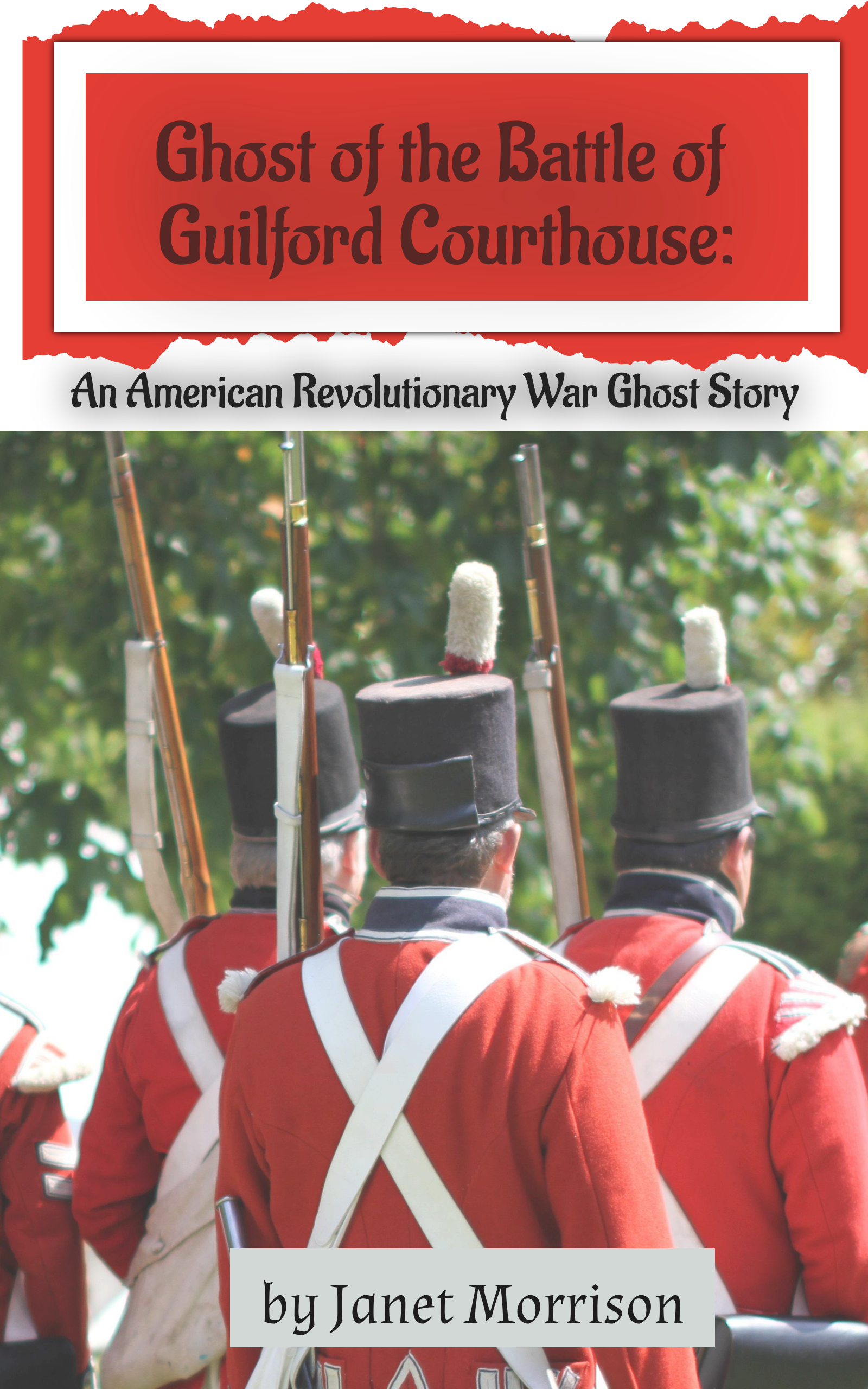
I thought it only fitting to include Author’s Notes at the end of my short story: Ghost of the Battle of Guilford Courthouse: An American Revolutionary War Ghost Story. In case you haven’t purchased the short story yet, here is my Author’s Note from the ghost story:

“I’ve never believed in ghosts, but this story is based on the events my sister and her housemate experienced in their condominium in Greensboro, North Carolina in the 1980s. The upstairs commode would flush when no one was upstairs. Cans occasionally fell off the pantry shelf. A house guest was frightened by the sensation that someone had walked into her bedroom and stood at the foot of the bed. In fact, she thought this person had called her by name – Mary. She had no knowledge of the unexplained incidents the residents had experienced.

“Peter Francisco was an actual American soldier in the Battle of Guilford Courthouse. At six-feet-six-inches tall and 260 pounds, he was much larger than the average American man during that era. He was credited with being ruthless with his broadsword. There is a visitors’ center on the grounds of the Battle of Guilford Courthouse; however, the rest of the story is fiction.”

After reading my Author’s Note, are you more interested or less interested in reading my ghost story?

Since my last blog post

I’ve edited three of the historical short stories I drafted a few months ago. I took inventory of my historical short stories. I want to write five more from scratch before I publish the collection. Something to look forward to in 2024!

I’ve done more research about the colonial settlement of Bethabara, North Carolina and read more resources about Shallowford on the Yadkin River. This is needed research for my first historical novel. Something else to look forward to!

Until my next blog post

If you haven’t subscribed to my newsletter through my website, https://www.janetmorrisonbooks.com, please do so before you miss any more newsletters. The next one will go out around November 1. For subscribing, you’ll receive a free downloadable copy of “Slip Sliding Away: A Southern Historical Short Story,” so you can get a feel for my historical fiction writing. I have a “field trip” planned before October is over, but you’ll have to subscribe to my newsletter to hear about it.

Have you ordered my American Revolution e-ghost story?  “Ghost of the Battle of Guilford Courthouse: An American Revolutionary War Ghost Story” is available from Amazon, along with my other books: https://www.amazon.com/dp/B0CH7JCP11/. October is the perfect time to read a ghost story!

Anytime is the perfect time to purchase a cookbook! Have you ordered your copy of The Aunts I the Kitchen: Southern Family Recipes? Order one for yourself and one for each of your aunts at https://www.amazon.com/dp/B0CJLKFDPR/. (It’s not too early to start your Christmas shopping.)

Make time for your friends and family.

Remember the people of Ukraine and Israel. Terrorism has no place in our world.

Janet

The Wide Range of Books I Read in September 2023

Although September gave me 30 days in which to read, I had more books on my list to read than time allowed. Nevertheless, I enjoyed the three novels and the one nonfiction book I managed to squeeze into my schedule.

You Can Run, by Karen Cleveland

You Can Run, by Karen Cleveland

Karen Cleveland is a former CIA analyst. She writes spy thrillers now. You Can Run, like the other books of hers I have read, Need to Know (see my April 2, 2018 blog post: More March 2018 Reading) and The New Neighbor (see my October 10, 2022 blog post: Spy Thriller, WWI Novel, Nonfiction, and Historical Mystery Read Last Month are real page turners. When you read one of her books in bed at night, don’t plan on getting any sleep. You’ll have to read “just one more chapter.”

In You Can Run, the protagonist, Jill, works for the CIA. She is being blackmailed. To save the life of her young son, she does something illegal. She spends the rest of the novel looking over her shoulder. Saying she spends the rest of the novel “looking over her shoulder” hardly does the plot justice. One bad thing after another happens, as she and her family and others get pulled deeper into the spiral and they can’t get out. No matter what you do, do not under any circumstances read the “Epilogue” until you have finished reading the entire book, including the last chapter. The “Epilogue” will ruin the story for you. I didn’t see it coming!

The Wind Knows My Name, by Isabel Allende

The Wind Knows My Name, by Isabel Allende

I usually don’t enjoy novels that flip back and forth between protagonists, and when I got to page 67 in the large print edition of The Wind Knows My Name, I was so invested in Samuel Adler that I was quite jolted when a turned the page and found myself reading about a new protagonist.

But… Isabel Allende is a masterful writer, and I was soon just as invested in the little girl who illegally crossed the Rio Grande and into the United States on her father’s tired back. The story of that little girl took me directly to the Mexican-US border of today and the desperation the “illegal aliens” experience in their home countries. How desperate must they be to risk their lives to try to get themselves – or even only their children – into the United States?

And how desperate did Samuel Adler’s mother feel when she put her young son on a train to get him away from the clutches of the Nazis and to relative safety in England?

In The Wind Knows My Name, Isabel Allende weaves compelling stories about these individuals and then makes a connection between the characters. I recommend everything that Isabel Allende writes.

And on top of that, she is a very nice person. She donated an autographed copy of one of her novels to the Friends of the Harrisburg Library for our autographed book sale a decade or so ago.

Falling, by T.J. Newman

Falling, by T.J. Newman

Falling is T.J. Newman’s debut novel, and it’s a good one! My sister read it and recommended it to me and our book club.

I recently read that one of the keys to writing good fiction is to give the protagonist an impossible choice. Falling fits that perfectly. In a nutshell, a commercial airline pilot is forced to decide whether to crash the plane and save his wife and children, or not crash the plane and let his wife and children be murdered.

This novel takes you minute-by-minute through the scenario. There are red herrings and there is a surprise twist. The author is a former flight attendant, so she knows the inside of a commercial jet and protocols well.

What will the pilot decide to do?

According to her “About the Author” page on Goodreads.com, Universal Pictures is making a movie based on the novel.

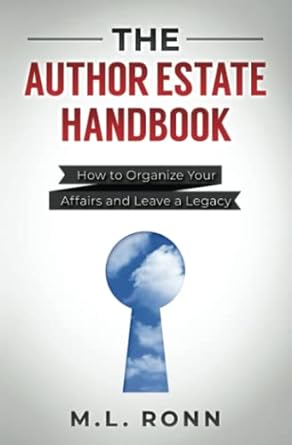
The Author Estate Handbook: How to Organize Your Affairs and Leave a Legacy, by M.L. Ronn

The Author Estate Handbook: How to Organize Your Affairs and Leave a Legacy, by M.L. Ronn

I mention this book in case other writers out there are interested in its topic. By reading the book, I discovered that I have done some things right but I’ve overlooked other things I need to take care of before I die.

The author explains how an author’s estate is different from everyone else’s estate. As an author, you own “intellectual property.” You own copyrights that will live on for 70 years after your death. If those things are not properly addressed in your will, you are leaving a mess for your heirs.

I’m not just talking about published books here. If you blog, your blog posts are “intellectual property,” so you need to tell your heirs what you want done with your blog when you die.

Each chapter lists specific tasks you need to take care of, if you’re a writer. I highly recommend this book to writers.

Since my last blog post

Our first shipment of author copies of The Aunts in the Kitchen: Southern Family Recipes arrived and the book is now available at Second Look Books in Harrisburg, NC as well as on Amazon! Plans are being made to have a book event on November 4 at the bookstore! Stay tuned.

I got the new Covid vaccine and am happy to report I had no ill effects. Those people who insist on belittling Covid 19 have obviously not known someone who has died from the virus or been severely sickened by it. I’m growing weary of Covid jokes by the fortunate few who have escaped it or have not known someone who has or is suffering through it. I thought we had gotten beyond the jokes, but I learned differently last week.

Until my next blog post

Have you ordered my American Revolution e-ghost story?  “Ghost of the Battle of Guilford Courthouse: An American Revolutionary War Ghost Story” is available from Amazon, along with my other books: https://www.amazon.com/dp/B0CH7JCP11/. Don’t let October slip past you without reading my ghost story!

“Ghost of the Battle of Guilford Courthouse: An American Revolutionary War Ghost Story,” by Janet Morrison

Have you ordered The Aunts in the Kitchen: Southern Family Recipes? I think it would be a wonderful present for a friend’s birthday or other special occasion, but it’s impossible for me to be objective. If you’re in the Charlotte area, it’s available at Second Look Books, 4519 School House Commons in Harrisburg. If not, you can find it at https://www.amazon.com/dp/B0CJLKFDPR/.

The Aunts in the Kitchen: Southern Family Recipes, by Janet Morrison and Marie Morrison

Don’t forget to subscribe to my e-newsletter at https://www.janetmorrisonbooks.com and receive a free downloadable copy of my southern historical short story, “Slip Sliding Away.”

Make time for your friends and family.

Remember the people of Ukraine and Israel. Terrorism cannot be tolerated.

Janet

How much Regional Accent and Dialect is Too Much in Historical Fiction?

When it comes to using dialect or regional accents in a novel, there are no definitive rules. It depends on the writer’s voice, the genre, and personal taste. Personal taste is where the rubber meets the road.

Too much of something like dialect in a novel sort of falls into the “I know it when I see it” category.

The rule of thumb

The rule of thumb is to avoid using it to the point of making the novel difficult to read. If the reader finds it exhausting to decipher the words, it means you have crossed that imaginary line. If the reader must wade through so much dialect that they are yanked out of the story, it means there is too much dialect.

Photo by Tim Mossholder on Unsplash

My experience with “y’all” in “Slip Sliding Away”

In my early drafts of my historical short story, “Slip Sliding Away,” I set the plot in the late 1700s. Something kept nagging at me, though. I wanted to use “y’all” in the story.

If you have read the story and you are from the southern part of the United States, you know the funeral scene with the intoxicated pallbearers struggling to get up the hill to the cemetery just screams out for the use of “y’all.”

There was a problem, though. My trusty resource for determining when a word came into common usage, English Through the Ages, by William Brohaugh, failed me! I did not find ‘y’all” in the book.

My second resource for such dilemmas is Merriam-Webster’s Collegiate Dictionary, Tenth Edition, for it tells when words came into common use. I looked up “y’all” and to my great disappointment, the dictionary just said, “var [variation] of you-all.”

I cringed. Why would anyone say, “You all” when there is a perfectly good contraction that just rolls off the southern tongue?

While I’m airing my grievances about the use and misuse of “y’all,” let me just say that if one is going to write the contraction, please put the apostrophe in the correct place. Don’t make me cringe by writing, “ya’ll.” I see it on all kinds of southern merch and it’s just not right. But I digress.

I turned several pages beyond “y’all” in the dictionary and looked up “you all.” First, I discovered it is hyphenated. Who knew? Then I learned that “you-all” was in common use in 1824. That information was helpful. It told me that I had to move my late-1700s story to 1824 or later.

I never did find anything definitive telling me when southerners started taking the easy way out by addressing two or more people as “y’all.” I figure that surely by the 1870s the word was in use, so I set the final draft of “Slip Sliding Away” in that decade.

Did you have any idea about the minutiae writers of historical fiction have to deal with? (Yes, I know. I’m not supposed to end a sentence with a preposition; however, it just seems awkward to write – or read – “Did you have any idea about the minutiae with which writers of historical fiction have to deal?” My mother was an English teacher, and I think she would agree with me on this one.)

What about the dialect in Where the Crawdads Sing, by Delia Owens?

After reading Where the Crawdads Sing, I found myself alone in the world in saying that novel contained too much dialect. Everyone else who read it absolutely loved it. I liked it, too, but I was distracted by the amount of dialect used. Maybe I had read too many articles and books about the craft of writing and I was just hyper aware of the dialect.

With more than 617,000 reviews with an average of 4.7 out of 5 stars on Amazon and 18 million copies sold worldwide, Where the Crawdads Sing is obviously an amazing novel. Apparently, Delia Owens knew exactly how much dialect to include in it to please millions of readers. I wish I were talented enough to have written it!

Since my last blog post

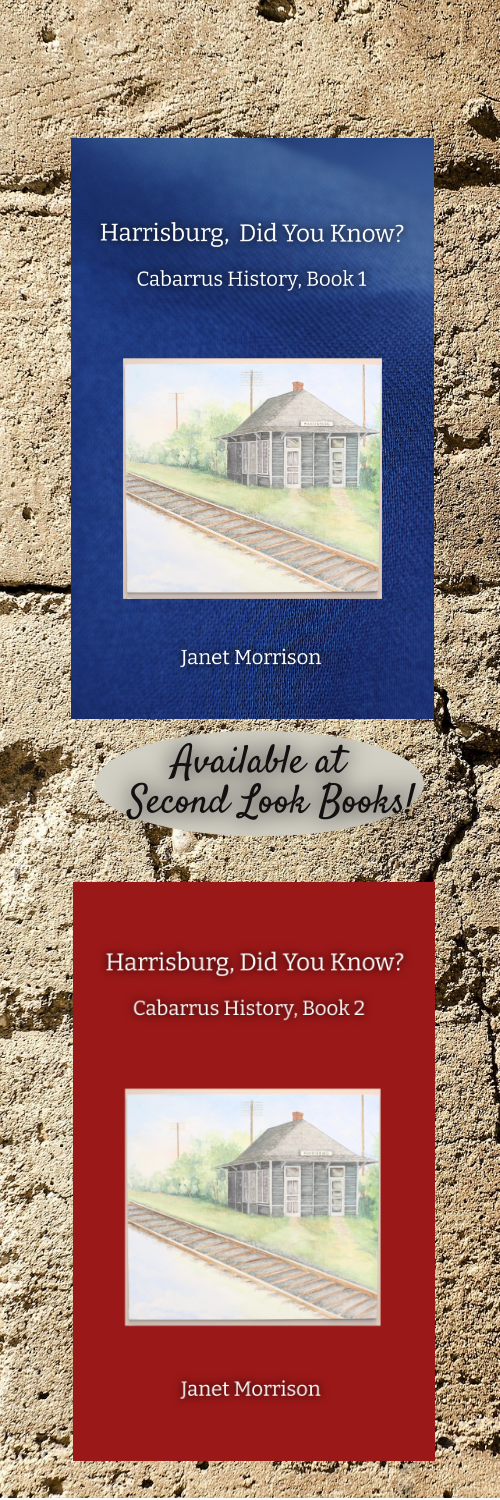
It was a busy week and I got to check off one big task that has been on my to-do list for months. On Friday, my church friend who took the cover photograph for my two local history books, Harrisburg, Did You Know? Cabarrus History, Book 1 and Harrisburg, Did You Know? Cabarrus History, Book 2, took photographs for the cover of the family cookbook my sister and I have been compiling for a couple of years. With the formatting finally completed, I felt safe in getting the cover designed. Look for an announcement regarding the publication of The Aunts in the Kitchen: Southern Family Recipes in a future blog post and in my November newsletter.

My sister and I took a day trip that was a combination Revolutionary War/genealogy trip. It was a wonderful day. I’ll tell you about in my November newsletter.

Speaking of my newsletter, you can find out about the cookbook, my various other writing projects, and the historical “field trips” I take if you simply go to https://www.janetmorrisonbooks.com and click on the “Subscribe” button. You will immediately receive a free downloadable copy of “Slip Sliding Away” as well as my future every-other-month newsletters. Thank you to all 42 of you who have taken the time to subscribe.

Until my next blog post

What do you have to say about the amount of regional accent or dialect in a novel? I would like to hear your thoughts on the topic.

Have you ordered my American Revolution e-ghost story?  “Ghost of the Battle of Guilford Courthouse: An American Revolutionary War Ghost Story” is available from Amazon, along with my other books: https://www.amazon.com/dp/B0CH7JCP11/.

Take time for friends and family.

Thank you for taking time to read my blog post. Y’all come back now, ya hear?

Remember the people of Ukraine, Maui, Libya,….

Janet

Who decides what you have access to at the library?

A few weeks ago I blogged about book banning. (See Book Banning is Democracy Banning! June 19, 2023.) I planned to blog about “How do you decide what to read next?” on July 14, but my computer had other ideas. I’m saving that post for August because I felt compelled to take a different approach today.


Book challenges and book banning

I didn’t plan to bash anyone in this post; however, I keep reading about more and more cases of book challenges and book banning across the United States and how various state legislatures (Arkansas, to name one) are passing laws that are putting our society on the slippery slope of censorship.

Fortunately, on Saturday, in response to a lawsuit filed by libraries, librarians, bookstore, and publishing companies,  a federal judge temporarily blocked portions of Act 372 in Arkansas, which would criminalize librarians who knowingly let a minor see objectionable sexual content.

Senate Bill 90 in North Carolina is tame by comparison to Arkansas’s Act 372, which had been scheduled to become law tomorrow. NC Senate Bill 90 is still under review and, if signed into law, will add new constraints on public libraries and public school libraries, and will add additional hoops through which librarians, school superintendents, and local school boards must jump. As if their jobs weren’t challenging enough!

Warren County, Virginia and the Houston Independent School District in Texas have been in the news recently, too, on this topic.

This terrifies me! This is the United States of America, and a vocal narrow-minded group of people are yanking local and state governing bodies around as if they have rings in their noses.


Book by book…

Book by book, library by library, school system by school system, the whittling away of our right to read is eating away the foundations on which our country was founded. If not for public education in the United States, how many of our citizens would know how to read?

Public education is under attack by many state legislatures, including the one here in North Carolina. Vouchers to give parents money to send their children to private school? Give me a break! Why would a state legislature give money for private education when one of its responsibilities is to fund and support public education?

The ignorant few will soon decide what we can read and cannot read. Politicians are usurping the roll of professional librarians in deciding which books can go on library shelves.

Pay attention! What’s happening in your state and in your county? The state legislature in North Carolina has a history of voting in the dead of the night. You just never know what you’re going to wake up to in the morning.

This leads me to the question I ask in the blog post title today: Who decides what you can and cannot read?

There’s a connection between today’s question and the current trend toward banning books in the United States.

Do you want politicians deciding what you can and cannot read? Do you want local politicians deciding what your child can or cannot read?


Since my last blog post

I didn’t intend to take a three-week break from blogging this month, but my computer had other ideas. I won’t bore you with the details. I’ll just say, it was unsettling and frustrating being unable to log into my WordPress account for 18 days.

I hope you missed me. I missed y’all!


Until my next blog post

If you haven’t subscribed to my newsletter through my website, https://www.janetmorrisonbooks.com, please do so before you miss any more newsletters. For subscribing, you’ll receive a free downloadable copy of “Slip Sliding Away: A Southern Historical Short Story,” so you can get a feel for my historical fiction writing.

I hope you have a good book to read and time to read it. Read! Read! Read! And please support your local public library!

Make time for friends and relatives, even if you don’t agree with them about politics.

Remember the brave people of Ukraine.

Janet

The Other Books I Read (or Meant to Read) in June 2023

June turned out to be a strange month of reading for me. If my blog post last week didn’t convince you of that, just wait until you read today’s post.


Yellowface, by R.F. Kuang

Yellowface, by R.F. Kuang

I heard R.F. Kuang interviewed about her new novel on “Friends and Fiction” on Facebook on May 24, 2023 – the same night Lee Smith was a guest. The New York Times called it, “a blistering satire about publishing.”

This novel might appeal more to writers than “normal” readers. It’s about two young women who barely know one another. One is an outrageously successful author, while the other on is living hand to mouth. When the successful writer chokes to death, the other writer steals her unfinished manuscript and gets it published under her name. No one will be the wiser… or will they?

One of the threads throughout the book is racism. Not the usual way we tend to think of racism: white versus black. The racism running through this book is white versus Asian.

There was an unexpected twist at the end of the book.

I Will Find You, by Harlan Coben

I Will Find You, by Harlan Coben

It had been a while since I’d read a Harlan Coben novel, so I decided to give his new one a try. I listened to it on CD. The nine discs last just a little more than 10 hours, so I was able to set aside time to listen to one disc per day.

In this novel, David Burroughs is wrongly imprisoned for killing his three-year-old son. But did his son really die? After five years in prison, David is determined to find his son.

Time Management for Writers, by Sandra Gerth

Time Management for Writers, by Sandra Gerth

I needed this! I have all the time in the world, and yet I don’t seem to get anything accomplished. This little gem of a book gave me some practical suggestions and a systematic way to organize my time. I read it the first week in June, so I’ve had almost month to work out some new scheduling ideas. I say “almost a month” because I spent five days in Georgia to attend the wedding of one of my great-nieces.

The book addresses such time killers as email and social media and recommended that those things only be checked twice a day. It suggested “bundling” similar tasks such as working on the content for several blogs on the same day, selecting the photographs to illustrate those posts another time or day, and scheduling the blogs another time.

I’ve always given myself goals for when to complete certain tasks involved in writing a book or short story, but this book was a strong reminder that I need to be serious about those “deadlines” and be accountable to someone else for meeting those goals.

If you feel overwhelmed, this book might help you even if you aren’t a writer.

Grow Your Own Herbs: The 40 Best Culinary Varieties for Home Gardens, by Susan Belsinger and Arthur O. Tucker

This is a book I checked out from the public library to look for some specific information I need for the historical novel I’m writing. I decided to include it in today’s blog post because some of my readers might be interested in the book.

I you have any interest in growing herbs and using them in your kitchen, I recommend this book. It contains detailed information for growing, harvesting, and using 40 herbs. It includes recipes for herb butters, pastes, oils, and vinegar infusions.

The 180-page section about those 40 herbs is beautifully illustrated and organized in a way that makes it easy to find specific information you’re looking for. It made me wish I could grow all 40 of them! Unfortunately, I don’t have much of a green thumb when it comes to growing herbs.

Three books I won’t elaborate on because I read them for research purposes:

The Ultimate Guide to Old-Fashioned Country Skills, edited by Abigail R. Gehring

Edible Paradise: How to Grow Herbs, Flowers, Veggies and Fruit in Any Space, by Vera Greutink

How to Write a Series: A Guide to Series Types and Structure plus Troubleshooting Tips and Marketing Tactics, by       Sara Rosett (Kindle) – This was a second reading of this book. I read it the first time in December 2021 and wrote about it in my January 3, 2022 blog post, Books Read in December 2021.

Books I didn’t finish reading in June and why:

Loyalty, by Jodi Picoult

I made the mistake of requesting this novel on CD from the public library. I eagerly popped the first disc into my CD player and settled back to enjoy another Jodi Picoult novel. Unfortunately, right off the bat, the narrator in his Italian accent (which should have been – and maybe was – a good match for a story set in Sicily) immediately read a list of the characters in the book along with their occupations or how they were related to the other characters.

After listening to a seemingly endless cast of characters whose names I’d never be able to understand or remember, I stopped the CD before getting to the first chapter.

I should have counted the characters. I’m guessing there must have been 20 or so.

Reading the novel might be easier than listening to it, but I don’t plan to try.

The Castle Keepers, by Aimie K. Runyan, J’nell Ciesielski, and Rachel McMillan

This book is a collection of three novellas written by Aimie K. Runyan, J’nell Ciesielski, and Rachel McMillan. When I first read about the book, I was under the conception that each author wrote one novella, and perhaps that’s true. My surprise, upon getting the book from the public library was to learn that it is not revealed which author wrote which novella in the collection.

The book follows one family. The first novella takes place in 1870. The second novella is set in 1917, and the last one is set in 1945. Most of the reviews I read mentioned that the first two novellas were better than the third one.

Due to the small print and my attention being pulled to historical research, I ended up returning this book to the public library unread. Maybe I can give it another try at a later date.

The Lost English Girl, by Julia Kelly and The Midwife of Auschwitz, by Anna Stuart

I returned these two historical novels to the public library after realizing I wasn’t going to have time to read them, even though the Julia Kelly book was large print. Maybe another time will work for me to read and enjoy them.

Since my last blog post

I was able to send out my Janet Morrison Books July 2023 Newsletter after overcoming some technical issues. I hope you received your issue via email. If you have subscribed, please visit http://www.janetmorrisonbooks.com and click on the “subscribe” button. As a bonus, you’ll receive a downloadable copy of “Slip Sliding Away: A Southern Historical Short Story” I enjoyed writing.

Yardwork keeps calling my name, but with the heat index of around 100 to 106 degrees F. nearly every day, I have to pick and choose the time of day and length of time I work. Progress has been at a snail’s pace.

I’ve been working on several historical short stories.

Until my next blog post

I hope you have a good book to read – one that will whisk you away from the stresses in your life, entertain you, educate you, and give you a new perspective. I’m reading Cradles of the Reich, an historical novel about part of Hitler’s plan for creating a master race, by Jennifer Coburn.

Cradles of the Reich, by Jennifer Coburn

Spend time with friends and family. Remember the treasure they are, even if they don’t agree with you about politics.

Remember the people of Ukraine.

Janet
Following up on last week’s blog post: Book Banning

I was gratified by the responses my blog post of last Monday received. Thank you to everyone who responded, and thank you to the ones of you who reblogged my post about book banning. In case you missed it, here’s the link: Book Banning is Democracy Banning!

In last week’s post I listed the 19 books that had been banned the week before by the school board in Hanover County, Virginia. I failed to list other books or tell you how you can find lists of other books that have been challenged in the United States.

You can simply put “Challenged Books” or “Banned Books” in your favorite online search engine. Or, you can look for reputable sites like the American Library Association’s website for intellectual freedom: https://www.ala.org/advocacy/bbooks/

Barnes and Noble has a list of more than 230 challenged books on its website at https://www.barnesandnoble.com/b/banned-books/_/N-rtm.

Imagine if these shelves were empty! (Photo by Rabie Madaci on Unsplash)

Let’s flood our public library systems and bookstores with requests for such books! Here’s a partial list. You might find many others when you do your own search. The following list of 101 books that have been challenged or banned somewhere in the United States is in no particular order.

Hunger Games, by Suzanne Collins

They Both Die at the End, by Adam Silvera

What I Know Now: Letters to My Younger Self, by Ellyn Spragins

The Giver, by Lois Lowry

1984, by George Orwell

The Great Gatsby, by F. Scott Fitzgerald

Fahrenheit 451, by Ray Bradbury

The Lord of the Flies, by William Golding

To Kill a Mockingbird, by Harper Lee

The Glass Castle, by Jeannette Walls

Harry Potter and the Sorcerer’s Stone, by J.K. Rowling

Maus I: A Survivor’s Tale: My Father Bleeds History, by Art Spiegelman

Where the Wild Things Are, by Maurice Sendak

How the Garcia Girls Lost Their Accents, by Julia Alvarez

New Kid, by Jerry Craft

Animal Farm, by George Orwell

The Kite Runner, by Khaled Hosseini

The Handmaid’s Tale, by Margaret Atwood

My Sister’s Keeper, by Jodi Picoult

The Dairy of a Young Girl, by Anne Frank

The Catcher in the Rye, by J.D. Salinger

The Bluest Eye, by Toni Morrison

The 1619 Project: A New Origin Story, by Nicole Hannah-Jones

Brave New World, by Aldous Huxley

The Hate U Give, by Angie Thomas and Amandla Stenberg

Of Mice and Men, by John Steinbeck

Lord of the Flies, by William Golding

This Book is Gay, by Juno Dawaon and David Levit

I Know Why the Caged Bird Sings, by Maya Angelou

Gender Queer: A Memoir, by Maia Kobabe

Hop on Pop, by Dr. Seuss

Their Eyes Were Watching God, by Zora Neale Hurston

How the Word is Passed, by Clint Smith

Twilight, by Stephanie Meye

Beloved, (a Pulitzer Prize Winner) by Toni Morrison

The Pillars of the Earth, by Ken Follett

Girl, Interrupted, by Susanna Kaysen

Where the Sidewalk Ends, by Shel Silverstein

The Grapes of Wrath, (a Pulitzer Prize Winner), by John Steinbeck

The Color Purple, by Alice Walker

Speak, by Laurie Halse Anderson

Slaughterhouse-Five, by Kurt Vonnegut

Lolita, by Vladimir Nabokov

The Absolutely True Diary of a Part-Time Indian, by Sherman Alexie

All American Boys, by Jason Reynolds and Brendan Kiely

The Autobiography of Malcolm X, as told to Alex Haley

A Farewell to Arms, by Ernest Hemingway

The Poet X, by Elizabeth Acevedo

Looking for Alaska, by John Green

Persepolis: The Story of a Childhood, by Margane Satrapi

Midnight in the Garden of Good and Evil, by John Berendt

Class Act: A Graphic Novel, by Jerry Craft

One Flew Over the Cuckoo’s Nest, by Ken Kesey

Monday’s Not Coming, by Tiffany D. Jackson

Fifty Shades of Grey, by E.L. James

The Other Wes Moore, by Wes Moore

Like Water for Chocolate, by Laura Esquivel

What If It’s Us, by Becky Albertalli and Adam Silvera

A Time to Kill, by John Grisham

A Lesson Before Dying, by Ernest J. Gaines

The Da Vinci Code, by Dan Brown

And Tango Makes Three, by Justin Richardson and Peter Parnell

Child of God, by Cormac McCarthy

Feed, by M.T. Anderson

A Separate Peace, by John Knowles

Stamped from the Beginning, by Ibram X. Kendi

Go Ask Alice, by Anonymous

Stranger in a Strange Land, by Robert A. Heinlein

Different Seasons, by Stephen King

For Whom the Bell Tolls, by Ernest Hemingway

The Lord of the Rings, by J.R.R. Tolkien

Native Son, by Richard Wright

Angela Davis: An Autobiography, by Angela Y. Davis

Skeleton Crew: Stories, by Stephen King

Thirteen Reasons Why, by Jay Asher

Stamped: Racism, Antiracism, and You: A Remix of the National Book Award-Winning Stamped from the Beginning, by Jason Reynolds and Ibram S. Kendi

Simon vs. the Homo Sapiens, by Becky Albertalli

All Boys Aren’t Blue: A Memoir, by George M. Johnson

The Red Badge of Courage, by Stephen Crane

Water for Elephants, by Sara Gruen

The Prince of Tides, by Pat Conroy

Tiger Eyes, by Judy Blume

Four Hundred Souls: A Community History of African America, 1719-2019, by Ibram X. Kendi, Keisha N. Blain

A Thousand Acres, a Pulitzer Prize Winner, by Jane Smiley

Kaffir Boy: The True Story of a Black Youth’s Coming of Age in Apartheid South Africa, by Mark Mathabane

Beach Music, by Pat Conroy

The Adventures of Huckleberry Finn, by Mark Twain

Blood in the Water: The Attica Prison Uprising of 1971 and Its Legacy, a Pulitzer Prize Winner, by Heather Ann Thompson

The Tenth Circle, by Jodi Picoult

The Jungle, by Upton Sinclair

Girl With the Blue Earring, by Tracy Chevalier

Catch-22, by Joseph Heller

Palestine, by Joe Sacco

Gone With the Wind, by Margaret Mitchell

Bridge to Terabithia, A Newberry Award Winner, by Katherine Peterson

The Sun Also Rises, by Ernest Hemingway

Addie on the Inside, by James Howe

Call of the Wild, by Jack London

Olive’s Ocean, a Newberry Honor Book, by Kevin Henkes

A Stone in My Hand, by Cathryn Clinton

Tilt, by Ellen Hopkins

How Often Are Books Challenged Where You Live?

There is an interactive map of the United States of the American Library Association’s website, https://www.ala.org/advocacy/bbooks/by-the-numbers. Hover the curser over a state to find basic information about book challenges in that state in 2022.

For instance, in my home state of North Carolina, there were 32 attempts to restrict access to books last year involving 167 titles. The most challenged book in North Carolina was Looking for Alaska, by John Green.

That map revealed some surprises. There were 45 attempts to restrict access to books in Massachusetts last year involving 57 books. In Michigan, the figures were 54 and 359. In Pennsylvania, 56 and 302. In Florida, 35 and 991. But Texas was at the top of the list (or bottom as the case may be) with 93 attempts to restrict access to books in 2022 involving a whopping 2,349 titles!

Photo by Enrique Macias on Unsplash

Different books are listed as the most-challenged book in the various states; however, Florida and Texas agree on The Bluest Eye, by Toni Morrison. I wrote about that book in my blog post last week. I want to say to the book challengers in Florida and Texas, “You’ve got to be kidding!”

If you want to read more about the topic of book banning…

Here’s the link to the website of PEN America. PEN America is made up of more than 7,500 novelists, journalists, nonfiction writers, editors, poets, essayists, playwrights, publishers, translators, agents, and other writing professionals, as well as devoted readers and supporters who join with them to carry out PEN America’s mission to protect free expression in the United States and around the world: https://pen.org/report/banned-in-the-usa-state-laws-supercharge-book-suppression-in-schools/.  

Until my next blog post

I hope you’re reading a book that someone has tried to get banned from a library. Let’s flood our public library systems and bookstores with requests for books that someone doesn’t want us to read!

I hope you make time for friends and family. Read to the children in your life and encourage them to read for fun.

Stop right now and visit my website (https://janetmorrisonbooks.com/) to subscribe to my newsletter. I took a special “field trip” to benefit my historical fiction writing on May 20. I’ll tell you all it in my July newsletter!

Just for signing up, you’ll receive a free downloadable copy of “Slip Sliding Away: A Southern Historical Short Story” to give you a taste of my fiction writing.

Remember the brave people of Ukraine.

Janet

Excitement the Week My New Book Arrived!

Promising to tell my blog readers about my journey as a writer, I have the privilege today of telling you about last week’s arrival of my new book, Harrisburg, Did You Know? Cabarrus History, Book 2.

My first copies of the local history book arrived on Sunday. That evening, I also finished drawing in black ink two maps of 1900s Harrisburg, NC on 11×17-inch paper. I’d drawn the maps in pencil years ago based on my memory and the recollections of Mr. Ira Lee Taylor. Mr. Taylor was born in the early 1920s and lived to be in his mid-nineties. He was a great resource for me when I was writing the local history column from 2006 through 2012.

Mr. Taylor’s memory of stores and other businesses such as the livery stable made it possible for me to include many buildings that were long gone by the time I was born in the 1950s.

Since the town experienced several road closures and the addition of a four-lane bridge over the railroad tracks due to the high-speed rail improvements about a decade ago, it’s important to have a record in the form of a map so the town’s earlier layout won’t be forgotten.

Monday morning, I took the two maps to have photocopies made. Since the owner of the local bookstore had told me that several people who purchased my first local history book had said they wished they had a map of the way the town used to look, I thought she’d be happy to have my two 11×17-inch maps to sell for maybe $2.50. That didn’t work out, which was disappointing.

On Monday and Tuesday, I got to give copies of my new book to several people who have been instrumental in helping me with details of local history. I mailed several of those to people who live out-of-town, but I got to deliver others in person.

I designed and had bookmarks printed to give away with each book. One side of the bookmark has pictures of both of the Harrisburg local history books and the other side has a photo of my “Slip Sliding Away” short story along with my website and QR code so people will know how to get a downloadable copy of my short story by subscribing to my newsletter.

Above, one side of my bookmark; below, the other side of my bookmark.

I also delivered copies of my first and second local history books to a local bookstore which already had two people on the waitlist for Book 2. After taking the books to the store, I posted announcements on three Facebook pages so people would know that my new book was available locally and on Amazon. I’ve enjoyed getting comments and replying to comments – some from people I know and some from people I’ve never met. It’s gratifying to know that people are enjoying both my books.

Wednesday gave me a break from all the book activity, as a cousin visited from New York with her two-year-old son. It was great to sit and visit and watch a very active toddler investigate parts of our house and yard.

On Thursday, I got to have lunch with three local people to talk about local history. It was interesting, and I learned some things I hadn’t known before. Don’t jump to any conclusions, though; I don’t have a third local history book in me!

Early in the week, I made the decision to give myself Thursday and Friday off from hawking my book. Being a native and lifelong North Carolinian, the “March Madness” of the Men’s and Women’s NCAA Basketball is something I’ve always blocked out time for on my calendar. Both of my NC State University teams got knocked out in the first round, but I’ll continue to watch the games the next three weekends.

Photo by Gene Gallin on Unsplash

On Saturday, I delivered more copies of Harrisburg, Did You Know? Cabarrus History, Book 2 to the bookstore in Harrisburg, so the shop is well-stocked for this week.

When not hawking books or watching basketball, I spent a good bit of time pouring over old deeds, plats, and maps as I tried to figure out exactly where I live in relation to the land purchased by my ancestors in the 1760s. I enjoy activities like that.

Until my next blog post

I’ll continue to publicize my books, and I’ll keep spreading the word that I now publish an electronic newsletter every other month for people who subscribe to it on my website: https://www.janetmorrisonbooks.com. I also give away a downloadable short story to subscribers. I appreciate those of you who have taken advantage of this opportunity.

I hope you have a good book to read. The right of people to read is under attack in some states within the United States, and that’s a frightening situation. It’s more important than ever for freedom-loving people everywhere to read, read, read. Support your local public library and your local bookstore! Don’t let anyone dictate what you can and cannot read!

I plan to get back to work on the book of family recipes I started compiling a few months ago before the history books demanded my time. That’s my next project, but I’m eager to also get back to writing my first historical novel.

Take care of each other.

Don’t forget the people of Ukraine. In particular, remember the 16,000 children who have been forced by the Russians to go to Russia in the last 14 months. Only 300 of the 16,000 have been able to get back to their homeland of Ukraine.

Janet

Three Compelling Books I Read in February 2023

After a couple of months of not getting to read much for pleasure, February turned out to be just what I needed to get back in the habit of reading. My favorite genre, historical fiction, really came through for me last month.

The Diamond Eye, by Kate Quinn

The Diamond Eye, by Kate Quinn

I listened to this historical novel on CD. I was spellbound from disc one until the very end of disc 11. I yearn to write historical fiction so vividly. I long to captivate readers with fiction based in an era not their own. Kate Quinn has established herself as a master of the art and craft of writing historical fiction.

The Diamond Eye is based on a true story. Mila Pavlichenko lives in the part of the Soviet Union that is now Ukraine. She works at a library and adores her young son. When World War II transitions to the invasion of Russia by Nazi Germany, Mila does the unthinkable. She becomes a sniper for the Russian Army. And she excelled at it.

After her official kill count reaches 300, Mila becomes a national heroine and is sent on a tour of the United States to drum up support for the fight against Hitler. There, she meets President and Mrs. Roosevelt. Eleanor Roosevelt, seeing a bit of her own independent nature in the sniper, befriends Mila.

The book follows Mila through the war and how she constantly has to prove herself because she’s a woman and not automatically taken seriously. She’s called the usual names that men who are threatened by strong women call them.

It is a stunning novel and reminded me why I enjoy reading historical fiction. Yes, it’s fiction because conversations are imagined, but reading well-written historical novels is an enjoyable way to learn a lot of history.


The Home for Unwanted Girls, by Joanna Goodman

The Home for Unwanted Girls, by Joanna Goodman

This is another gripping historical novel. I was so impressed by Saskia Maarleveld’s reading of The Diamond Eye, that I looked for other books she had recorded. That’s how I found The Home for Unwanted Girls. I thought that was an interesting way to find another good book!

The Home for Unwanted Girls is about an unwed mother in Quebec in the 1950s who is forced by her parents to give up her baby girl. The book shines a light on the ugly history of the orphanage system in Quebec at that time. When the orphanage is turned into an insane asylum and the orphans are forced to take care of the patients, the outcome for the girls seems hopeless.

This novel follows the life of one of those orphans and the 15-year-old mother who wanted desperately to keep her. The mother never gives up on finding her child, even though she is told the girl died.


The Escape Artist: The Man Who Broke Out of Auschwitz to Warn the World, by Jonathan Freedland

The Escape Artist, by Jonathan Freedland

This book was spellbinding! It tells the stories of 19-year-old Rudolf Vrba and Fred Wetzler who did the impossible in April 1944. They escaped from Auschwitz! The book tells how Vrba studied the precision with which the Nazis conducted searches and exactly how long the guards searched when a prisoner was unaccounted for. He and Fred worked with two accomplices to plan the escape of Vrba ad Wetzler. Their two accomplices were to stay behind while Vrba and Wetzler escaped to take the truth of what was happening at Auschwitz out into the world.

It’s a fascinating read. It follows Vrba and Wetzler after their escape. The eye-opening part of the book was the aftermath of their escape. They testified and provided written descriptions of the horrors of Auschwitz. Their testimonies matched to the nth detail; however, their words and their physical conditions of malnutrition fell on deaf ears.

Winston Churchill didn’t want to bomb the rail lines going into Auschwitz because England bombed in the daytime. President Franklin D. Roosevelt didn’t want to bomb because it would be a diversion from plans. Jewish organizations in Europe refused to believe what was happening at Auschwitz because it was just too extreme. How can people do such things to their fellow human beings?

Along with the tragic murdering of Jews at Auschwitz, the fact that world leaders who had the power and where withal to do something about it in fact chose not to act is a gut punch.

My general takeaway from the book is that one’s life and future can be determined by someone else’s snap decision. Decisions were made on a whim by guards at Auschwitz every day that determined who lived, who died, and who escaped.

It’s a book that will haunt me.


Since my last blog post

I continue to try to get the word out about my second local history book, Harrisburg, Did You Know? Cabarrus History, Book 2.

I also continue to ask people to go to my website, https://www.janetmorrisonbooks.com and subscribe to my newsletter. Subscribers receive a free downloadable copy of my first historical short story, “Slip Sliding Away: A Southern Historical Short Story.”

“Slip Sliding Away: A Southern Historical Short Story,” by Janet Morrison

Until my next blog post

I hope you have a good book to read. I know where you can get a good historical short story to read!

Take care of one another.

Remember the people of Ukraine.

Janet

Harrisburg, Did You Know? Cabarrus History, Book 2 is Published!  

I’m pleased to announce that not only did my second proof copy of Harrisburg, Did You Know? Cabarrus History, Book 2 arrive in a timely manner, but it was also in fairly good order!

The cover is now a reddish-brown instead of dark brown. (I don’t think I’ll try to self-publish any more books with a red cover! We all learn from our mistakes.)

There were still a few formatting errors that resulted from the last “chapter” (my research notes) being almost 30,000 words in length, but at least Carl Higgins’ World War II B-26 bomber was flying horizontally on page 467.

Although the manuscript was proofread and corrected several times, three typos got past me. I strive for perfection, but I’ve yet to see a perfectly printed book. I can live with three typos in a 536-page book.

Available on Amazon!

Harrisburg, Did You Know? Cabarrus History, Book 2 is now available in paperback and for Kindle from Amazon. Click on https://www.amazon.com/dp/B0BW2QMLHC/ for the paperback or click on https://www.amazon.com/dp/B0BXBQ1F79/ for the Kindle book. I shortened the Amazon URL so they wouldn’t look so intimidating. If they don’t work, just put the name of the book in a search on Amazon.

Available soon at Second Look Books!

The paperback book will be available in a few weeks at Second Look Books in Harrisburg.

The first issue of my newsletter!

Those of you who read my blog post last Monday and subscribed to my newsletter before March 1, received the first issue of the Janet Morrison Books Newsletter (clever name, eh?) on Friday. I hope you enjoyed the variety of information it contained.

If you’ve read my vintage postcard book, The Blue Ridge Mountains of North Carolina, you were able to answer the trivia question near the end of the newsletter.

Please subscribe to my newsletter & receive a free short story!

I’m working hard to get my writing career off the ground, so please subscribe to my newsletter. I plan to send out a newsletter every other month, so be sure and visit my website, https://www.janetmorrisonbooks.com  and subscribe so you won’t miss another issue. You’ll also receive a downloadable copy of my short story, “Slip Sliding Away: A Southern Historical Short Story.”

Thanks for being on this journey with me!

All these recent accomplishments are the culmination of a lifetime of studying local history and learning how to research and document it and 22 years of studying the craft of writing.

It’s been a bumpy journey. Thank you for having faith in me and offering encouraging words along the way! I have some loyal lifelong friends and just as loyal friends I’ve made through my blog and Facebook. I value each and every one of you.

Buckle up! I’m just getting started!

I’m working on a family cookbook, more historical short stories, and an historical novel. With my two local history books and first short story published, I look forward to concentrating on my fiction writing.

Until my next blog post

I hope you have a good book (or historical short story!) to read.

Make time for your family and a hobby.

Don’t forget the people of Ukraine.

Janet