#OnThisDay: 2nd Anniversary of Hurricane Helene Status Report

Since western North Carolina was so severely damaged by Hurricane Helene beginning on September 26, 2024, I am blogging about it today. I don’t want people to forget, and I want people to know that the people in the region are still recovering from the storm.

Trouble came on a scale no one could have predicted.

You can find thousands of photographs from the disaster online. I just did not have permission to post any of them.

Summary of Hurricane Helene Damages in North Carolina (Data gathered from various online sources, some not in agreement, of course. This is my best effort as a regular citizen.)

Lives lost: 106

Total estimated damages: Nearly $60 billion

Federal funds received to date: $14.4 billion

Highest recorded rainfall, September 25-27, 2024: 30.78 inches in Busick, a community near Mount Mitchell in Yancey County

Landslides: More than 2,000

Dams that failed or were severely damaged: 40

Tornadoes spawned: 8

Housing units destroyed or severely damaged: 3,800

Housing units damaged: 125,000

Timberland damaged: 822,000 acres

Trees downed in national forests in NC: Millions

State-maintained roads destroyed or heavily damaged: 5,000 miles

State-maintained bridges destroyed or damaged: 700

State-maintained culverts destroyed or damaged: 700

Privately-owned roads, bridges, and culverts severely damaged: 7,000

Water and sewer systems damaged: More than 160

Jobs lost in western NC in the month after the hurricane: 19,000


Examples of Assistance western NC has received:

Search and Rescue members sent from California: 151

Starlink internet terminals sent from a Kentucky storm chaser: 30

Starlink internet terminals contributed by SpaceX: 500

Line crews sent from T&T Line Construction of Hornwell, New Brunswick, Canada: 11

Additional line crews from Quebec, Canada: several

Line crews from across the US: multiple

Helicopters sent in to transport and set power poles: Duke Energy

Disaster relief assistance: 1st Battalion of the 169th Aviation Regiment of the Connecticut Army National Guard

Volunteer private helicopters in rescue efforts: Operation AirDrop and the Carolina Emergency Response Team

Meals provided by World Central Kitchen: More than 64,000

Affordable microhomes built by Beloved Asheville: 12 so far, with another village planned in nearby Swannanoa

New housing units built by Blue Haven, Inc. (a 501(c)(3) organization which is part of singer Eric Church and his wife, Katherine’s Chief Cares Foundation: 37 (Please visit https://chiefcares.org/ and https://wataugaonline.com/eric-churchs-chief-cares-expanding-in-western-nc/ to learn how this endeavor works and is being expanded.)

Value of pizzas donated to Asheville residents by Mellow Mushroom: $5,000

Liters of water distributed by FEMA: 6.5 million

Meals distributed by FEMA: 7.1 million

Cajun Navy arrived from Louisiana immediately with search-and-rescue teams. They stayed for weeks, if not months.

Heavy equipment work donated by Precision Grading of Tryon, NC (a small excavating and grading company that now includes a 501(c)(3) division to handle donations whose name is now Precision Grading & Disaster Relief.) Basically, their disaster relief work is free-of-charge, but individuals receiving insurance benefits for damages are requested to pay the company for work done.): More than 500 days of very hard work and counting. Visit https://myfox8.com/video/north-carolina-nonprofit-owner-worked-500-days-straight-helping-hurricane-helene-victims-rebuild/12197331/ for a recent report.

Mountain Mule Packers Ranch’s nonprofit Mission Mules (in Mount Ulla, NC) carried tons of food, water, insulin, building supplies to areas inaccessible by other means in North Carolina.

Books collected and distributed by 21st Century Packhorse Librarian: 9,000

PVC pipes cleaned out of the French Broad River due to the flooding of the IPEX plastics manufacturing plant in Woodfin, NC by volunteers from the environmental nonprofit MountainTrue: 6 million pounds. (IPEX has agreed to pay MountainTrue $500,000 for their efforts.)

Amish people from Pennsylvania and Ohio came and built tiny homes for people who had lost their home to the hurricane, but I could not find the exact number.

Rebuilding projects completed or underway in Yancey and Mitchell counties by Rebuilding Hollers, a 501(c)(3) organization: 585 (Visit https://rebuildinghollers.org/Projects for more details.)


Looking to the Future

Landslides:  The State of North Carolina is remapping western NC using new LiDAR (Light Detection and Ranging) scans that show the actual damage and waterway channel shifts as a result of Hurricane Helene. That data will continue to be processed for updated flood-hazard maps. That information will be shared with FEMA.

Information I found indicates that FEMA flood zone maps concentrate on rivers and coastal storm surge. Western NC is 300 to 400 miles from the coast. The steep terrain and 30-inch rainfall associated with the hurricane turned tiny streams into raging rivers that were not accounted for on FEMA flood maps. Therefore, fewer than 3% of the properties in western NC that were most damaged by Hurricane Helene are included in FEMA’s mapped flood zone areas.

LiDAR scans that have been superimposed over older maps that predicted potential landslide locations have lined up very well and have identified many additional landslide-prone locations. This information will be used to restrict future development.

Water, Wastewater, and Sewer Systems:  Water, wastewater, and sewer systems receiving State funds for repairs and reconstruction are required to repair/reconstruct to a higher, storm-resilient standard and not merely rebuilding to the pre-Helene standards. The NC Department of Environmental Quality has awarded grants totaling more than $1 billion for water and wastewater infrastructure in western NC counties. Another $750 million is needed.

Dam Repair/Reconstruction:  After not having a state budget for a couple of years, the NC General Assembly finally adopted a budget this summer. It includes $20 million toward the repairing and reconstruction of failing dams. Government officials and environmentalists will hopefully work together to implement work to be done. Reports indicate that some of the dams were constructed to supply water to textile mills that no longer exist and those dams – at least one of which dates back to 1905 – were not built for flood control. This, no doubt, will be a contentious issue over the coming years as removal of a dam is not a simple undertaking.


Brother Wolf Animal Rescue

If you’ve been following my blog for the last two years, you will remember that I have written a number of times about Brother Wolf Animal Rescue in Asheville, North Carolina. Staff and others did an amazing job of evacuating all the animals before the facility was wiped out by Helene’s flood waters.

The American Society for the Prevention of Cruelty to Animals in Asheville stepped up and provided temporary quarters for Brother Wolf, and a campaign was held to raise money for a land and building(s) in a less vulnerable location. Having temporary space provided by the local ASPCA made it possible for Brother Wolf to find homes for more than 900 animals in 2025 and many more were given medical care.

In 2026, the ASPCA awarded Brother Wolf a $1 million grant toward its rebuilding!

Brother Wolf Animal Rescue is a registered 501(c)(3) organization. For more information, visit https://www.bwar.org/.


Blue Ridge Parkway in North Carolina

If you follow my blog, you know that the Blue Ridge Parkway is near and dear to my heart. Portions of the parkway are still closed, but it is predicted to be fully-reopened in NC by the end of 2026; however, not all hiking trails, picnic areas, or other recreation areas will be fully restored by then.

Please visit https://www.nps.gov/blri/planyourvisit/roadclosures.htm if you want more information or are planning a trip. That website is updated weekly.

Keep in mind that the North Carolina portion of the parkway runs from Milepost 216.9 at the Virginia state line to its terminus at Milepost 469.1, so most of the parkway is open now. Motorists just need to check maps of the parkway and plan accordingly.

If you’re planning a trip to enjoy the beautiful fall foliage in the Blue Ridge Mountains, be sure to get off the parkway occasionally to support restaurants and small businesses because they took a big hit in multiple ways since September 26, 2024.


Interstate 40 in Pigeon River Gorge

For months after the hurricane, I gave updates from the North Carolina Department of Transportation on I-40, US highways, state highways, and state roads as they were reopened – and in many cases – rebuilt. That story continues two years later and will not soon end.

I invite you to watch a two-minute video at https://www.ncdot.gov/news/press-releases/Pages/2026/2026-09-02-i-40-reconstruction-update.aspx, which is part of a September 2, 2026 update from the NC DOT. (Note the size of the Pigeon River under normal times in the right portion of the photo.) The numbers are staggering and the ultimate estimated completion date for the 5.5 miles of I-40 that were destroyed or severely damaged by the hurricane is now the end of 2029.

As is indicated in the referenced video, the state hopes to have three lanes open by the end of 2028. Currently, only two lanes (one eastbound and one westbound) are open with a 35 mile-per-hour speed limit.


US-176 in North Pacolet River Gorge

A 1.1-mile stretch of this federal highway between Tryon and Saluda, NC has been closed since Hurricane Helene. It has received little publicity, and I’m afraid I have failed to mention it in my earlier hurricane recovery blog posts.

A month ago, Blythe Construction of Charlotte was awarded the contract for this $32 million highway reconstruction project. The work is projected to be completed late in 2029. The project faces many of the same challenges as the reconstruction of I-40, as the highway is/was wedged between a river and steep terrain.

The flooding of the North Pacolet River during the hurricane washed out portions of the highway and all the soil underneath it. Some of the slopes where the highway was now drop as much as 60 feet down to the river.

Engineering for such a reconstruction project usually takes five to seven years but was fast-tracked and completed in less than two years. For more details, visit https://www.ncdot.gov/news/press-releases/Pages/2026/2026-08-17-us-176-helene-contract-awarded.aspx.


In Closing

I look forward to the day I don’t need to give Hurricane Helene updates! Perhaps on the storm’s fifth anniversary, Brother Wolf Animal Rescue will be settled in its new facility, the Blue Ridge Parkway will be fully restored to its former glory, I-40 will almost be rebuilt through the Pigeon River Gorge, and US-176 through the North Pacolet River Gorge between Tryon and Saluda will almost be rebuilt.

I apologize to the countless individuals, organization, and companies that I have failed to name that have and will continue to work tirelessly to help the residents of western NC recover from Hurricane Helene.

Janet

All history is local, but no history is just local.

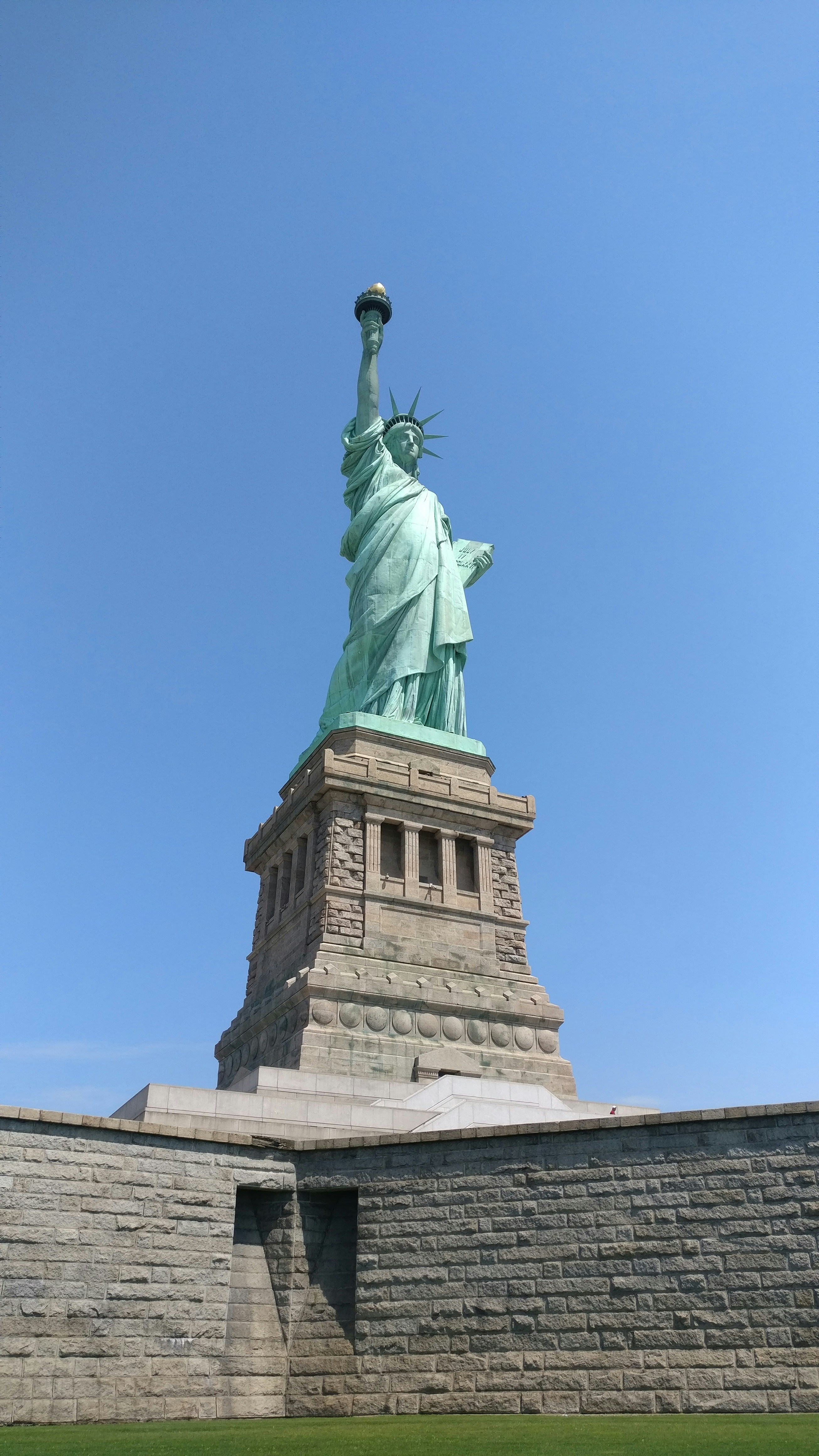
#OnThisDay: Statue of Liberty Dedicated, 1886 & a Hurricane Helene Update

Lots of Americans have Statue of Liberty stories. It was a welcome sight for many immigrants coming into the port at New York City. It was a welcome sight for one of my first cousins when he came home from serving in the US Army in Europe during World War II. And it was a thrill when I saw it from a Staten Island Ferry back in the mid-1980s.

The statue was being restored and prepared for its centennial when I saw it from afar. It was closed to visitors and completely encased in scaffolding. I could barely tell Lady Liberty was in there, yet it was still a thrill to see this national landmark and prized gift from the people of France.

The Statue of Liberty was dedicated by President Grover Cleveland 138 years ago today. Imagine the excitement on that day and the days leading up to the event as people watched the progression of the construction process!

Never having seen it close up, it’s difficult for me to grasp the size of the 151-foot- tall statue. I read that the American people paid for the granite foundation and pedestal, while the people of France paid for the statue itself.

Photo of the Statue of Liberty
Photo by Vinayak Sharma on Unsplash

The statue was sculpted by a Frenchman, Frederic Auguste Bartholdi, who consulted with Gustave Eiffel about structural issues.

In doing research for this blog post I also learned that William Tecumseh Sherman of American Civil War fame (though more infamous here in The South!) selected the site for the statue.

The statue is made of copper sheeting over an iron framework. The flame of the torch held by Lady Liberty is coated in gold leaf. The seven spikes on her crown represent the seven seas and seven continents. The tablet she holds represents knowledge and is inscribed with the date of our country’s Declaration of Independence.

The Statue of Liberty is an international symbol of liberty and the freedoms we enjoy as citizens of the United States of America.


Hurricane Helene Update on Western North Carolina

I hoped today’s update would be shorter than the previous ones I’ve given, but there is a lot to report. If your time and interest are limited, please take advantage of the headings in bold print. Much of today’s update is positive, while some of it is daunting.

Governor Roy Cooper announced that first responders and others have come from 39 states to help with rescue and recovery efforts in western NC! Thank you to each of you!

Hay bales: Last week I reported on hay bales coming from farmers in Ohio and Pennsylvania. Add Kentucky to that list… and no doubt other states I just didn’t hear about. I read a report online from the newspaper in Boone that more than 50 tractor trailer loads of hay bales came to Watauga County from Ohio! They also brought feed for various farm animals, tarps, baby supplies, and posts and barbed wire for fencing.

Photo of a field dotted with big round bales of hay
Photo by Nick Fewings on Unsplash

I read a report from Haywood County, about 100 miles south of Watauga, on smokymountainnews.com,. That county’s Agricultural Extension Office knew hay was coming and worked out the logistics of storage and distribution. The agent there said some farmers lost more than 300 bales in the flood.

Farmers helping farmers…. It’s what they do!

Precision Grading:  I’ve been following a small grading company, Precision Grading, in Saluda, NC on Facebook, and I’m just blown away by what this man is doing. He has worked free-of-charge with his bulldozer and backhoe 12 hours a day since the storm to help individuals with debris pickup on their land, cutting new driveways for them, and literally cleaning out the Green River.

If you’ve ever driven I-26 between Asheville, NC and Greenville, SC, you probably remember the section that traverses the Green River Gorge. The bridge is so high, you can’t see the river below. There are runaway truck ramps along the southbound lanes. That area is more isolated than Asheville, Chimney Rock, and Bat Cave, so it is not getting any media attention. This man is not charging anyone for his work, except for the occasional job that insurance is paying for. He says the work is gut wrenching because everything he pulls out of the river was someone’s car, house, or prized possession.

If you would like to support Jake Jarvis’ work, you can send a check to Precision Grading, 99 Polaris Drive, Saluda, NC  28773. He did not want to take donations but finally concluded that donations will enable him to do more work for people in need without charging them. Fuel and maintenance on his heavy equipment is not cheap. I do not know him personally, so do your own research about him.

It is heart-warming, especially in today’s political environment to see that a disaster brings out the best in most people.

Brother Wolf Animal Rescue is still accepting monetary donations to enable the 501(c)3 nonprofit organization to rebuild on higher ground in Asheville. They lost all physical assets in the flood. Here’s the link to their website (https://www.bwar.org/) where you can donate and read about their work. There’s a touching story about Gandolf, a dog rescued from the flood waters.

Statistics: The death toll from Hurricane Helene in NC now stands at 98.

The estimated damage from Hurricane Helene in North Carolina is a staggering $53 billion.

Roads: The storm severely impacted approximately 5,000 miles of state-maintained roads in western North Carolina. Interstates 26 and 40 are still closed near the TN line. A total of 404 roads remain closed.

Electricity: I’ve seen videos online of power poles being brought in by helicopter to places inaccessible by vehicle. One Duke Energy representative said the helicopters make it possible to set a pole in an hour instead of what would be a 10-hour job. The terrain is challenging under the best circumstances, so the helicopters have been a game changer.

Water system in Asheville: My sister learned from a friend there last week that they can flush toilets now, which is a huge milestone for the residents. Here’s the link to an informative briefing by City of Asheville Water Resources on October 25: https://www.youtube.com/watch?v=e6EH3zKjaGE). You’ll learn in this 6.5-minute briefing how the Hurricane Helene flood catastrophe could have been “exponentially worse” if the government had not put in an auxiliary/emergency spillway as a safeguard less than four years ago!

(If you’re a nerd about such things, as I am, here’s a link to a document about the planning and construction of that spillway by McGill Associates: https://www.mcgillassociates.com/north-fork-auxiliary-spillway-and-embankment-improvement-project/.

Blue Ridge Parkway: There is no estimated reopening date for the beautiful parkway. Portions of it that are used by residents to get from one side to the other for work or school are receiving top priority in reopening efforts. A 20-mile stretch near Grandfather Mountain opened last Wednesday. The other 250 miles in NC remain closed.

Public School Systems: Just to give you an idea about the recovery situation 32 days after Hurricane Helene hit western NC…

Avery County. Schools are scheduled to reopen on November 6.

Ashe County. Schools are scheduled to reopen on tomorrow.

Buncombe County. Schools reopened on Friday.

Watauga County. Schools reopened on Thursday.

With so many roads still closed, the school systems have had to scramble to work out bus routes and designated pick-up and drop-off locations.

Colleges and universities:

Asheville-Buncombe Technical Community College: Classes resume today because the campus now has power, non-potable water, and internet.

Lees-McRae College in Banner Elk: Classes will be conducted online through November 4.

Warren Wilson College: In-person classes resume today. Still under a boil water order, the college has secured potable water for meal preparation from their food provider.

IV Bag Manufacturer:  Through the US Department of Health and Human Services, President Biden invoked the Defense Production Act so Baxter International will have priority access to specific material needed so it can get back to production. One production line is scheduled to start operations this week.

World Central Kitchen (WCK) is still serving the people in western NC and eastern TN. First Lady Dr. Jill Biden volunteered at their walk-up meal, fruit, and water distribution site in Asheville on Friday. According to the WCK website (https://www.worldcentralkitchen.org/en-us/news/jill-biden-visits-wck-asheville-north-carolina) , since the September 25 flood, “With 84 restaurant partners in North Carolina and Tennessee, we’ve served 979,976 meals to date in the southeastern US. Given the ongoing challenges with water access, we’ve also channeled our efforts to distribute more than 768,000 gallons of potable water in North Carolina alone…. In areas like Swannanoa, Hendersonville, Burnsville, Marshall, Yancey County, and more, power and water restoration is slowest, and we expect our support to be needed there for longer.”

Fundraising Concert

Ironically, the “Concert for Carolina” at Bank of America Stadium in Charlotte on Saturday started at 7pm after a two-hour rain and lightning delay… the first rain the area has had since Hurricane Helene in September. I got to watch the live stream and heard/saw portions of it mixed in with a lot of buffering. It was the best concert ever!

Organized by Luke Combs and Eric Church, all artists (including the Avett Brothers, James Taylor, Keith Urban, Sheryl Crow, Billy Strings, Scottie McCreery, Chase Rice, and Parmalee) donated their time and talents so all proceeds and donations could go to help specific organizations in western North Carolina.

The concert raised $24,513,185, included $1 million donated by Dolly Parton. A surprise during the concert was when Nicole Kidman joined her husband on stage and announced that it was his birthday. Then, Eric Church led the 82,000 people in attendance in singing “Happy Birthday to You” to Keith Urban.

Tourism: I found a list online last Thursday of 10 towns in western NC that were still “closed to visitors” and four towns (including Asheville) that were “open with limitations.” Towns are beginning to open back up to visitors, but many rural areas are still very much in recovery mode… and will be for months, if not years. Check reliable sources before making travel plans.

Maybe next Monday’s update will be shorter!

Until my next blog post

Don’t forget to sign up for my e-Newsletter by visiting https://janetmorrisonbooks.com/ and clicking in “Subscribe.” You’ll receive a free downloadable copy of my “Slip Sliding Away” short story. My next e-Newsletter will be sent to you during the first full week of November. Teaser: My “field trip” report this time is Boone’s Cave Park on the Yadkin River.

I hope you have a good book to read. I have several I’m trying to finish by Thursday, so I can blog about them next Monday.

Remember the people of Ukraine and Western North Carolina.

Janet