Censorship and Reader Sensitivities

I try to plan my blog topics well in advance so I’ll have time to devote to writing each one. The fancy name for it is “editorial calendar.” Today was a day I had trouble settling on a topic. I’d made a list of possibilities, but none of them really grabbed me.

Another blogger came to my rescue on April 12, 2021. John W. Howell, an author of thriller novels, inspirational fiction, and family life fiction, wrote What to Do With Books That Are Insensitive to Social Norms | Story Empire (wordpress.com) and in it he referred to his March 24, 2021 blog post, Avoiding Insensitivity in Characters or Story | Story Empire (wordpress.com). Viola! I was inspired to write today’s post.

(Here’s a link to Mr. Howell’s Story Empire website and blog: https://storyempirecom.wordpress.com/.)

An Example of Book Censorship

Reading Mr. Howell’s blog posts got me thinking about book censorship and the closely-related topic of cultural appropriation and reader sensitivities.

The very idea of a book being censored or people demanding that certain books be banned from public libraries, school libraries, and bookstores really gets my ire up. Book censorship is a slippery slope. Images of book burnings in Nazi Germany come to mind.

#bookburning #censorship
Photo credit: Jonny Caspari on unsplash.com

The American Library Association’s (ALA) annual list of the top books requested for banning or restricted reading is fresh on my mind. Here’s the link to the ALA’s website where you can see the list: http://www.ala.org/advocacy/bbooks/. To Kill a Mockingbird, by Harper Lee is consistently on that list. It’s on the list the ALA published earlier this month. One reason given for its being requested for banning is that the lawyer who represents the black man in court is white. The story is set in Alabama in the 1930s, so it is true to the time and place that the lawyer and all the jurors would be white. Racial injustice is the core theme of the novel. The book was published in 1960, and little had changed by then.

I believe we can learn the lessons of history by reading good historical fiction. It’s one thing to read a list of laws governing people of color in the United States in the 1930s, but how better to illustrate and shine a bright light on the laws – written and unwritten – prior to the Civil Rights Act of 1965 than to bring them to life on the pages of a novel and the subsequent movie based on that book?

I’d no sooner had that thought than I found Jabari Asim’s article from July 17, 2015 on Publishers Weekly: https://www.publishersweekly.com/pw/by-topic/columns-and-blogs/soapbox/article/67521-rethinking-to-kill-a-mockingbird.html. (Please take time to read his entire piece after reading this blog post.)

Being a black man, Mr. Asim offers a different perspective than the one I can offer. His words made me stop and think. Perhaps I had read To Kill a Mockingbird with naive blue eyes. Mr. Asim is one of the most influential African American literary critics of this generation. If you’re not familiar with his work, please visit his website: https://jabariasim.org/about_jabari_asim/.

Among Mr. Asim’s sentences that made me reconsider my stance are the following: “Mockingbird, like Uncle Tom before it, often strikes me as a form of literary ointment for white guilt, meant to soothe outbreaks of conscience while dispelling perceptions of how pervasive white supremacy is. Its homespun patter and deep-fried homilies enable many readers to overlook its sketchily drawn black characters—little more than archetypes—and bask in the glow of Atticus Finch’s exemplary moral courage.”

Also, this: “Some days I can ignore Mockingbird’s mostly pedestrian prose and regard it as a cleverly subversive send-up of white racism, minus Mark Twain’s stylistic flair but dutifully echoing his irreverent tone.”

And this: “Other days I marvel at Mockingbird’s apparent prescience when, years before Fox News and talk radio, Atticus Finch says to his brother, ‘Why reasonable people go stark raving mad when anything involving a Negro comes up, is something I don’t pretend to understand.'” 

What is To Kill a Mockingbird‘s place, then? It’s likely to be debated for decades to come.

#ToKillaMockingbird #censorship
To Kill a Mockingbird, by Harper Lee

Self-censorship, Cultural Appropriation, and Reader Sensitivities

Being a writer can involve self-censorship, and there are degrees of that when it comes to reader sensitivities. I’m not a published novelist, but as I work on my historical novel I’m ever-cognizant of reader sensitivities.

Most of us practice self-censorship in our communications with others. Some people who should self-censor are sadly unaware. As a writer, I feel the need to self-sensor. I don’t use racial slurs in my speaking or thinking, but that doesn’t mean I won’t need to include one in my writing in order to be true to time and place. It doesn’t mean I condone the use of such words. My challenge in writing a novel presented from multiple points-of-view is having the audacity to put myself in the skin of a person of color – especially a person of color who is male and enslaved in the United States in the 18th century.

Doing so is somewhat akin to cultural appropriation, which is a dominant culture adopting a practice that is inherent in or associated with a minority culture. I’m not doing that in my novel, but I am attempting to write thoughts, emotions, and conversations of three people of color. I want to be aware of possible reader sensitivities, but I don’t want that awareness to fundamentally change my writer’s voice.

I’m writing a novel set in the North and South Carolina backcountry in 1769. It includes two black male slaves, one free black woman, a Frenchman, and a number of white Scottish and Irish settlers. I’ve been working on this novel for many years. If I were to look at my first draft, there would be many cringe-worthy words and scenes. I started out really over-doing writing accents phonetically. It was tedious to write, and I’ve since learned that it’s not appropriate. It can be degrading, and it can be exhausting for the reader.

I’ve grown as a person and as a writer since I started the book probably a decade ago. I’m striving to make the final product true to the time and place. I’ve done extensive research – even into the laws on the books in South Carolina in 1769 that governed the fabric of the clothing slaves were permitted to wear.

If and when my novel is published, I hope no one’s sensitivities will be offended, but that’s probably wishful thinking. I’m attempting to write a book that will be entertaining and educational. I hope it will be a book that will cause readers to put themselves in the skin of the various characters and come away with an appreciation of history.

An Earlier Blog Post about Cultural Appropriation in Writing

Author and administrator of the “Writers on the Path to a Page-Turner” Facebook group, Barbara Kyle, wrote the following: “The move to self-censorship for fear of ‘cultural appropriation’ is a sad state of affairs. Author Morgan Jones eloquently champions the opposite position: ‘Fiction remains the best means we have of finding connection where there seems to be none; and the novel, of all forms, encourages a search that’s deep and sustained. By reading (or writing) one, you’ve travelled somewhere else. You’ve moved, if only slightly, towards others. In a world that finds and increasingly exploits division and difference, this in an invaluable, precious exercise.”

I copied the above quote several years ago and taped it to the top of my computer monitor. In trying to find an online link for you, I was reminded that I used it in my August 27, 2018 blog post, Cultural Appropriation in Writing. Ms. Kyle shared (and I included in that 2018 blog post) this link to an October 1, 2016 article in The Guardian (https://www.theguardian.com/books/2016/oct/01/novelists-cultural-appropriation-literature-lionel-shriver.) Please go back and read my earlier blog post and click on the link to Mr. Shriver’s article in The Guardian.

Where do we go from here?

I think writers would do well to keep in mind the following question asked by John. W. Howell in his March 24, 2021 blog post referenced in my opening paragraph today: “Am I knowingly or unknowingly writing characters or a story which casts aspersions on anyone relative to their race, nationality, gender, sexual preference, religion, disabilities, or age?”

Mr. Howell goes on to say, “The key to the question is we may write something that we didn’t think would discriminate but did that exactly.” He also said, “The caution here is that if you are not part of a group you are writing about, be very diligent in your research. Some would say unless you are a part of a group, don’t write about them. I disagree since I do not want to believe that writers can only write what they know.”

#Censorship #readersensitivities
Gone With the Wind, by Margaret Mitchell

In his follow-up blog post on April 12, 2021 (also referenced above in my opening paragraph), Mr. Howell gave Gone with the Wind as an example of a book that could be criticized on several fronts due to its glorification of the Southern plantation. A little later in his blog post he said the following: “Maybe because I’m an author, I hate to see a book be declared undesirable, but it does seem that we should embrace a discussion of any book that is outside our social norms. Include in the discussion why a text no longer reflects current attitudes. If we were to discuss why certain depictions in a book are wrong, we all would better understand each other. Maybe, more importantly, we could learn more about what actions and depictions are especially hurtful.”

I agree with Mr. Howell on that. Let’s not ban books from our library and bookstore shelves. Let’s read and discuss them and, thereby, learn to do better.

Since my last blog post

I enjoyed all the beautiful azaleas in our yard. I don’t think they’ve ever been prettier. All good things must come to an end – or so “they” say. Wednesday afternoon brought snow 100 miles away in the North Carolina mountains, and Thursday and Friday mornings brought record-breaking below freezing low temperatures to my house. I hope this was winter’s last gasp.

Until my next blog post

I hope you have at least one good book to read this week. I have more books checked out from the library than I can possibly read. It’s a nice dilemma to have.

Enjoy a relaxing hobby.

Note: Tomorrow is National Tell a Story Day in the USA. Don’t tell a lie. Tell a story. Tell a young person about one of your good memories. It will give them something to remember you by.

Note: Ironically, Wednesday is the anniversary of author Harper Lee’s birth in 1926. Some literary critics say a person who writes just one novel (such as Harper Lee’s To Kill a Mockingbird) is not a great author. (I know, I know. Her unpublished manuscript for Go Set a Watchman was published in 2015, so she actually wrote two books.) My example is still valid. Ms. Lee died in 2016, and until 2015 she was known as an acclaimed author who wrote “only” one book. I’m not saying the historical novel I’m writing is a great novel, but it gives me hope to know that Harper Lee “only” got one novel published during her lifetime. If I only get one novel published, I’ll be more than happy.

Note: Watch out for May! It arrives on Saturday. May is “Get Caught Reading Month”. Start making your plans for getting caught.

Janet

#Idiom: Stick-in-the-Mud/Fuddy-Duddy/Old Fogey

My blog post last week was about a difficult subject, the American Civil War. I decided to write about a less serious topic today.

I was driving to one of my favorite places (the public library) recently, when the expression “stick-in-the-mud” flew into my head out of nowhere. I don’t have a clue what brought that on unless it was all the rain we’d had that week and our yard had turned into a sea of mud. Who knows how the human brain works?

When I got home, I thought: blog post! My research led me to idioms meaning essentially the same thing as stick-in-the-mud. Those others are “fuddy-duddy” and “old fogey.”

stick-in-the-mud
Photo credit: Annie Spratt on unsplash.com

When were they first used?

One source says “stick-in-the-mud” was used as early as 1700, while Merriam-Webster attributes

it’s advent to 1832. English Through the Ages, by William Brohaugh says 1735.

Merriam-Webster says “fuddy-duddy” originated in 1904, while William Brohaugh’s book says

it came into general usage in 1905.

Merriam-Webster says “fogey” dates back to 1780. William Brohaugh agrees.

What does it mean?

All three of these idioms are colorful ways to insult someone for being old-fashioned, stuck in their ways, slow to accept change, etc.

Some examples of how the idiom is used

Don’t be such a stick-in-the-mud!

Don’t be a fuddy-duddy!

Get with the program. You’re being a stick-in-the-mud.

As language loses its color

#stick-in-the-mud
Photo credit: Joseph J. Cotten on unsplash.com

I’m sad to report that “fuddy-duddy,” “fogey,” and “old fogey” did not make the cut when The American Heritage Dictionary of Idioms, by Christine Ammer was published in 1997. I guess that means I’m a fuddy-duddy and an old fogey for even including those expressions in today’s blog.

It’s idioms like “stick in the mud” that make the English language interesting. A synonym for it is “antediluvian,” but I much prefer “stick-in-the-mud.” Don’t you?

A question for multilinguals

For those of you who are fluent in languages other than English, do you know of a colorful idiom for antediluvian in another language?

A question for my friends and relatives

Are people calling me a stick-in-the-mud, a fuddy-duddy, or an old fogey behind my back? I hope not!

Since my last blog post

The spring weather has been beautiful! Our yard is ablaze with azalea blossoms and irises. I enjoyed doing a little yardwork, and I have stiff joints now to prove it. I also have poison oak on my face and arm to prove it, although I thought I was being careful to avoid it.

Until my next blog post

If you’re new to my blog, you might like to read my earlier posts about idioms: #Idioms: Reading the Riot Act on January 25, 2021, and #Idioms: As All Get Out on March 29, 2021.

I hope you have a good book to read. I’m listening to The Lost Girls of Paris, by Pam Jenoff, and I’m reading The Good Sister, by Sally Hepworth.

I hope you have time for a hobby this week.

I hope the Covid-19 pandemic is getting under control where you live.

Janet

#OnThisDay: The War that Never Ends

The American Civil War began on April 12, 1861, when southerners fired on Fort Sumter, South Carolina. Fort Sumter was, of course, a United States military fort on the coast of South Carolina.

Photo credit: Michelle Burdick on unsplash.com

The American Civil War was the culmination of the falling apart of a nation.

Confederate Gen. Robert E. Lee surrendered his troops to US Gen. U.S. Grant at Appomattox Court House, Virginia, on April 9, 1865, but fighting continued for a while west of the Mississippi River. U.S President Andrew Johnson declared the war over in all states but Texas on April 2, 1866. After accepting the new state constitution for Texas, President Johnson officially declared the insurrection over on August 20, 1866.

Death toll

The exact number of deaths in the American Civil War is unknown, but it seems to be agreed upon that it was at least 620,000 and as high as 750,000.

Local losses

In 1999, I compiled a booklet, “Rocky River Presbyterian Church and the War Between the States,” about how the American Civil War affected Rocky River Presbyterian Church in Cabarrus County, North Carolina. Established in 1751, in 1860 the congregation had 616 members. 440 of them were White and 176 of them were Black. The congregation lost 72 men in the Civil War. Their average age was 28. The youngest was 16 and the oldest was 44. Of the 72 who died, 52 died between January 1862 and November 1863. I’ve tried to imagine what an emotional impact that had on this farming community, but I can’t.

Rocky River Presbyterian Church, Cabarrus County, North Carolina

I researched each of the 72 men and boys in published genealogies, church records, census records, etc. in an effort to put names and real people on the statistics. Some families were hit especially hard, losing several sons.

Another local loss

In addition to the numerical and economic loss those 72 men and boys cost the congregation, the war resulted in a radical and racial change in the church’s make up. In 2004, I compiled another booklet, “Slaves and Free Blacks Known to be Associated with Rocky River Presbyterian Church Prior to 1870.” My purpose was to compile in one document all known records about the slaves and free Blacks who were communing and/or baptized members of the congregation from the earliest extant church records (1835) through 1870.

Photo credit: US Library of Congress, via unsplash.com.

I was astounded when the project was finished to find that I had a list of 917 slaves and 11 free Blacks. In addition to the church membership rolls and Session disciplinary trial minutes, I searched the 1860 and 1863 Cabarrus County Tax Assessment Lists – which listed every slave living in the county at those times—and the US Census records for Cabarrus County from 1870 and 1880. (By the way, the county tax assessment lists recorded not only the names of each slave under his or her master’s name, but also included each slave’s age, physical condition, and value. They are sobering documents.)

In 1867, present-day Bellefonte Presbyterian Church was formed by former Black members of Rocky River. The White pastor of Rocky River, being a product of the place and time, was hurt when the Black members of his congregation chose to go two or three miles up the road to establish their own church. Unfortunately, he saw them as children who didn’t know what they were doing. He didn’t understand why they didn’t want to stay at Rocky River and continue to sit in the balcony while the White members sat downstairs on the main floor of the sanctuary. No wonder they left! That’s easy for us to see today.

How racism continues to this day

Southerners tend to romanticize about the Civil War, but I doubt there was anything romantic about it at the time. The wives, mothers, sisters, and younger brothers were left behind to try to farm the best they could, not knowing when or if their loved ones would come home. I would not have wanted to be alive during that time.

All four of my great-grandfathers and one of my great-great-grandfathers fought on the losing side in the American Civil War. They were farmers in North Carolina. They did not own slaves. In trying to put myself in their places in that place and time, I can’t help but think they didn’t have much choice in joining the North Carolina Troops when the war began.

Lee Dulin, home from the Civil War

One was a boy of 16, no doubt out on a bit of an adventure with his neighborhood friends in the same company. He wrote letters to his parents and sister asking them to send him socks. One was in the 1st NC Cavalry and survived a severe head wound at Gettysburg that left him with headaches and a convulsive disorder for the rest of his life. One had restricted use of one of his arms for the rest of his life due to injuries sustained in the Seven Days Battle of Richmond. One was in Charleston at the end of the war and walked the 200 miles home. One of my great-great-grandfathers was a man in his early 50s – much too old to go off to war, but that’s what he did. It’s hard to find the romance in any of that. They came home defeated, with perhaps a little worthless Confederate currency, only to have to go back to eking out a living by farming in a broken economy.

They were not the ones who built monuments to Confederate leaders. They did not raise the Confederate battle flag by their houses to show their Southern pride. They just went back to the hard-working lives they’d known since birth and tried to live out their lives as law-abiding American citizens.

I don’t know what any of those five ancestors of mine thought about race. I can’t sit in judgment of any of my ancestors any more than I can take credit for anything good they accomplished in their lives. Each of us is accountable for our own ideas, beliefs, and actions.

Where do we go from here?

Until Americans have an honest discussion about slavery and the ramifications of it… until people across the country study the facts and recognize that slavery existed in some northern states… until people across the country realize that northern states benefitted from the slavery in the South because the slaves picked the cotton that was sent to northern textile mills to be turned into fabric for people there to sell and wear at a low cost due to slavery… until people across the country accept each other and fight for all citizens to have the same rights and chances to excel… until as individuals we admit our prejudices and have the courage to speak up when we see racial injustice… I’m afraid the American Civil War will never be over.

Photo credit: Nathan Dumlao on unsplash.com

My heart sinks at the sight of the Confederate battle flag because, to people of color, it is a symbol of hate. I didn’t see it that way when I was growing up because I was White, but I do now. When you know better, you should do better.

As Americans, it’s easy for us to sit back, protected by the Atlantic Ocean on the east and the Pacific Ocean to the west and criticize the Arabs and Jews in Israel holding grudges over wrongs committed centuries ago, but many Americans are unwilling to forgive and forget when it comes to our own Civil War after 160 years. We can’t see the plank in our own eye because we’re concentrating on the speck in someone else’s eye.

#ElectoralCollge #USConstitution #12thAmendment
Photo by Luke Michael on Unsplash.com

Since my last blog post

We finally got to bring our diabetic dog home from the hospital last Thursday. He was hospitalized for eight days with bronchial pneumonia. We’re so thankful for the good care he received at CARE (Charlotte Animal Referral & Emergency) once again.

Until my next blog post

Continue to celebrate D.E.A.R. (Drop Everything And Read) Month. I hope you have at least one good book to read this week.

Make time for a hobby.

Note: The two booklets I referenced in today’s blog, “Rocky River Presbyterian Church and the War Between the States” and “Slaves and Free Blacks Known to be Associated with Rocky River Presbyterian Church Prior to 1870,” are available through http://www.JanetMorrisonBooks.com. Click on “Rocky River Presbyterian Church Booklets.”

Janet

6 Books I Read in March 2021

I didn’t think March could match February in the books I got to read, but I was wrong. Good books just keep being published, and I’m having a wonderful time reading them.


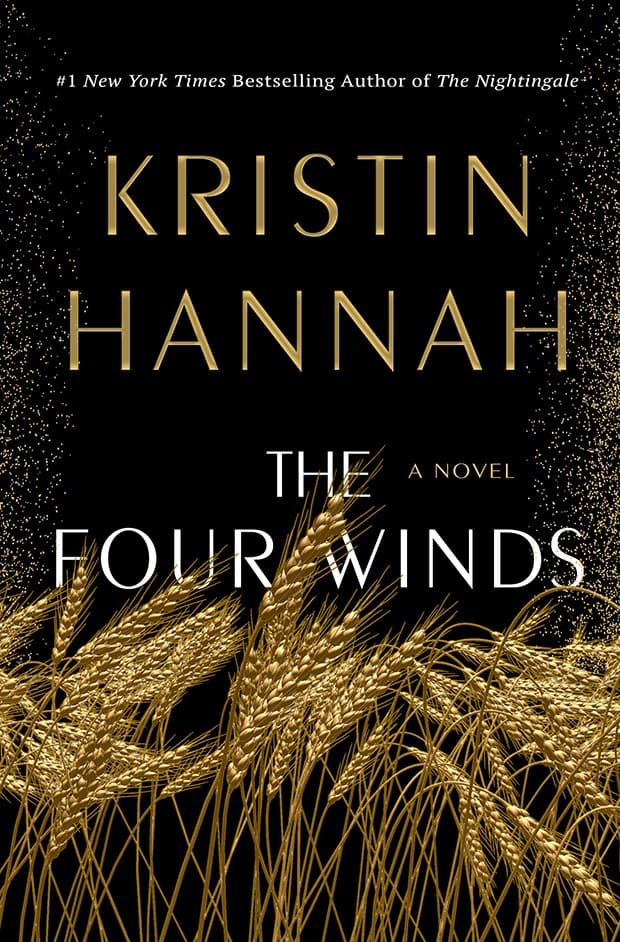
The Four Winds, by Kristin Hannah

The Four Winds, by Kristin Hannah

What a wonderful historical novel! In my opinion, The Four Winds is even better than Ms. Hannah’s 2015 novel, The Nightingale.

The Four Winds plunges the reader into the Dust Bowl and The Great Depression and never lets go. It’s been decades since I read The Grapes of Wrath, by John Steinbeck, but The Four Winds put me in the dust, grit, and terror of that time even more than the Steinbeck classic. Maybe that has something to do with my age when I read each book, but somehow The Four Winds made a stronger impact on me.

This novel follows Elsa, a young woman starved for love. She throws caution to the wind, for once in her life, and it turns out to have dire consequences. I don’t want to give the story away, so I’ll just say it follows Elsa through the Dust Bowl in Texas and a desperate journey to California in hopes of a better and a healthier life. The book illustrates the difficult lives of migrant workers and how promises and dangers of unionization in the 1930s. There are strong secondary characters in the book.

I blogged about The Nightingale, by Kristin Hannah in my June 2, 2017 blog post, You Need to Read These Books! and The Great Alone, by Kristin Hannah in my March 26, 2018 blog post, Some March Reading, in case you want to know what I thought about them.


Daylight, by David Baldacci

Does Atlee Pine find her sister?
Daylight, by David Baldacci

If you’ve been following David Baldacci’s Atlee Pine series, you’ll love this book. This novel reveals many details about Atlee’s parents and childhood. She continues to search for her twin sister, Mercy, who was abducted from their bedroom when they were six years old. Her journey takes her into some very dark places and danger lurks at every turn.

Will Atlee find Mercy in Daylight? You need to read it for yourself to find out! This is Baldacci at his best.


52 Small Changes for the Mind, by Brett Blumenthal

52 Small Changes for the Mind, by Brett Blumenthal

This is a self-help book that probably should be read a week at a time over 52 weeks, but I had checked it out from the library. I read it over several days and took notes so I can slowly absorb the points it makes that I can benefit from. Many of the recommendations are things I’m already doing, but several really stepped on my toes and got my attention.

Here are a few examples from the book:

Week 9 – “Kick indecision.” Don’t waste time trying to make the perfect choice.

Week 14 – “Silence your inner critic.”

Week 15 – “Go beyond your comfort zone.”

Week 27 – “Minimize screen time.” (I thought this just applied to teens and young adults who spend too much time on their cell phones, but this segment made me realize that I’m guilty of spending too much time on the computer and using my tablet.

Week 39 – Recognize your fears and confront them.

Week 49 – “Deal with [your] demons.”

There are helpful tools and resources at the back of the book.


Soul of a Woman, by Isabel Allende

The Soul of a Woman, by Isabel Allende

This turned out to be a surprisingly short book. I checked it out as an MP3 from the public library and listened to the entire book in an afternoon.

Ms. Allende begins the book with some experiences from her childhood and life in several countries, but the bulk of the book is about the status of women throughout the world.

She addresses all manner of abuses women endure at the hands of men and sometimes at the hands of other women. She writes about how tradition perpetuates the practice of female mutilation in parts of the world, how women are invisible in some regions due to Islamic law and practice, and how female babies are not valued and are sometimes killed in some cultures and countries simply due to their gender. She addresses human trafficking. She writes about how women the world over must struggle for every inch of progress they make in the business world.

Ms. Allende established The Isabel Allende Foundation in 1996 to pay homage to her daughter, Paula, who died at the age of 29 in 1992. The foundation works for the empowerment of girls and women through nonprofits in Chile and the San Francisco Bay Area. To read more about the foundation, go to https://isabelallende.org.


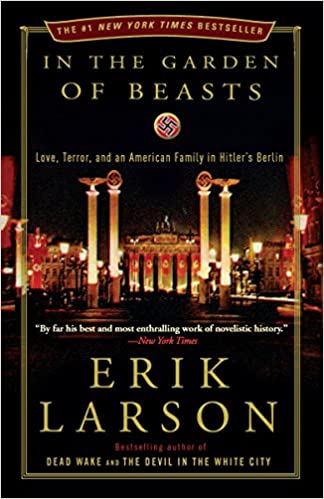
In the Garden of Beasts, by Erik Larson

In the Garden of Beasts, by Erik Larson

I think I’ve read all of Erik Larson’s books now, until Thunderstruck is released later this year. Yes, I’m on the waitlist for it at the public library.

My earlier attempt to read In the Garden of Beasts didn’t work out. I just couldn’t get into the book. Although the premise of this book should be equally as gripping as his other books, even the second time around it didn’t hold my interest quite as well as Isaac’s Storm (Three Books Read in December 2020) or Dead Wake: The Last Crossing the Lusitania (4 Books I Read in February 2021.)

In the Garden of Beasts is the story of William Edward Dodd, US Ambassador to Berlin from 1933 until 1937, during the rise of Adoph Hitler. His mid-20s daughter, Martha – who is estranged from her husband — accompanies him and becomes quite a liability as she soaks in the nightlife of the city and forms a romantic relationship with a Russian.

Dodd was a professor, a thrifty, unassuming man – much the opposite of his daughter. He was the butt of jokes among his peers in Berlin because he insisted on driving his old car and wearing the clothes he’d worn as a professor back in the Midwest. Martha inherited none of her father’s personality traits.

This is a nonfiction book, meticulously researched, as are all of Erik Larson’s books. I learned a lot from the book. It was interesting to get a glimpse of the rising of the Third Reich from the perspective of an American living in Berlin.


The Train to Crystal City: FDR’s Secret Prisoner Exchange Program and America’s Only

Family Internment Camp During World War II, by Jan Jarboe Russell

FDR's Secret Prisoner Exchange Program and America's Only Family Internment Camp During World War II
The Train to Crystal City, by Jan Jarboe Russell

You may recall that in my February 8, 2021 blog post, 4 Books I Read in February 2021, one the books I wrote about was the novel The Last Year of the War, by Susan Meissner.

As soon as news broke that Japan had attacked Pearl Harbor, the lives of all Japanese immigrants and Americans of Japanese descent were at risk. The FBI started arresting the men for no reason other than their ancestry.

I learned a lot from this book. One thing I hadn’t known about was the Asian Exclusion Act, passed in 1924, which made it illegal for Japanese immigrants to become US citizens.

Here’s a quote from pages 28-29 of the book about the steps President Franklin D. Roosevelt took to create a vehicle through which a hostage exchange program could be put into place in the event the United States entered World War II:

“On September 1, 1939, the day German tanks, infantry, and cavalry invaded Poland with 1.5 million troops, Roosevelt created a highly secretive division within the Department of State called the Special Division. He ordered this division to identify American civilians… who were currently in Japan and Germany and who would be in danger when the United States joined the war…. More than 100,000 American civilians were in harm’s way. A few months later, Roosevelt authorized the Special War Problems Division to find Japanese and Germans in America and in Latin America who could be used as hostages in exchange for the more valuable of the Americans…. In 1940, [FBI Director J. Edgar] Hoover installed the first group of FBI agents in Latin America. Based on the FBI reports, Roosevelt was convinced that Germans and Japanese in Latin America were a direct threat to hemispheric security.”

In addition, FDR formed an agreement with Peru that paved the way for 1,800 Japanese Peruvians with no ties to the U.S. to be brought to internment camps in Texas and other states. Pressure was put on other Latin American countries to do the same. All except Argentina, Mexico, and Brazil complied and deported Germans. Those three nations had internment camps of their own.

The men held in the internment camps were given an ultimatum. If they wanted to be reunited with their families — and these reunions had to take place inside the camp at Crystal City, Texas – they had to sign papers stating that they would relocate to their ancestral home country after the war. Imagine living for decades in the United States and then having to relocate to Germany or Japan as soon as World War II was over. Families were forced to make unimaginable choices in order to stay together.

I could go on and on, but perhaps I’ve given you enough detail that you will want to read the book for yourself. It was a real eye opener for me!


Until my next blog post

How is D.E.A.R. (Drop Everything and Read) Month going for you? I hope you have one or more good books to read this month.

Spend some time enjoying a hobby this week.

Keep wearing a mask, even if you’ve been vaccinated against Covid-19, so we can get back to doing all the things we like to do – like seeing relatives we haven’t seen in almost 18 months.

Note: National Library Week in the USA started yesterday. Support your local public library!

Janet