I write southern historical fiction, local history, and I've written a devotional book. The two novels I'm writing are set in Virginia and the Carolinas in the 1760s. My weekly blog started out to follow my journey as a writer and a reader, but in 2025 it has been greatly expanded to include current events and politics in the United States as I see our democracy under attack from within. The political science major in me cannot sit idly by and remain silent.
Can you imagine hearing and then seeing meteor blazing across the sky and then crashing through a tree before plunging several feet into the dirt? That’s what happened on Hiram Bost’s farm on October 31, 1849.
Photo by Juskteez Vu on Unsplash
I grew up in Cabarrus County, but I’d not heard of the meteorite until I happened upon a newspaper article about it while doing research on another topic for a local history column I was writing in 2009 for Harrisburg Horizons weekly newspaper. Last week while I was formatting those newspaper articles for two planned books in 2023, I thought the highlights of the seven-part series I wrote about Mr. Bost’s meteorite would make an interesting blog post on this Halloween.
Although the meteorite landed near Midland in Cabarrus County, it was mistakenly named “Monroe.” Meteorites are usually named for where they land. The town of Monroe is actually in the adjoining county and not where the 1849 meteorite crashed to the Earth.
I’ve never heard a meteor or seen one up close. The closest I’ve come is seeing an occasional “shooting star.” The witnesses of the 1849 meteorite described explosions and rumblings They saw a white-hot object in the sky even though it was broad daylight.
Word of the meteorite spread by the proverbial grapevine and in newspapers in Charlotte and Concord. When word reached the Charlotte Branch of the United States Mint, a Mint employee and a Charlotte doctor headed some 20 to 25 miles to the site by horse-drawn wagon.
Knowing he had an item of interest and unknown value on his hands, Mr. Bost displayed the meteorite on top of a pole for all to come and see. It was accompanied by a sign warning people not to touch or break the rock.
I was naïve enough to think that perhaps the Monroe meteorite had ended up intact at the North Carolina Museum of Natural History, but I soon found out that the meteorite has been chopped and sliced into countless pieces and the museum in Raleigh doesn’t even have a piece of it.
One thing led to another, as is always the case when I do historical research, and I went down the rabbit hole of searching for the locations that own part of the meteorite. What I discovered is that pieces and slivers of the meteorite are owned by universities, museums, The Vatican, and private companies and individuals around the world.
I learned that bits and pieces of the Monroe meteorite are for sale by rock and mineral dealers and are sometimes available through rock and mineral auctions. Those pieces and slivers are priced by the gram and aren’t cheap.
To learn more, be on the lookout for my book, Harrisburg, Did You Know? – Book 2 on Amazon in 2023.
I expect to publish Harrisburg, Did You Know? – Book 1 on Amazon in January 2023. I’ll give progress reports in future blog posts. Even if you don’t live in the Harrisburg, North Carolina area, I think you’ll find something of interest in both my local history books.
Since my last blog
I continue to write my first historical novel, The Heirloom.
I hired a company to completely redesign my outdated website, JanetMorrisonBooks.com. My writing is taking a new path and I need a new website to reflect that. With numerous decisions to be made and the holiday season approaching, it might be January before I can unveil the new site.
My sister and I continue to proofread Harrisburg, Did You Know?—Book 1. When I blogged last week, I thought the books would only be available for Kindle, but I now hope to also have them published in paperback.
A word about my blog
Last week’s blog post included a note about a change in my follower count on my blog and the reason I was given for the widget policy change. Apparently, I wasn’t the only blogger to complain, for this week the count once again includes the 1,000+ followers that were dropped last week. I’m happy again!
Until my next blog
I hope you have a good book to read.
Remember the brave people of Ukraine who face freezing to death this winter.
Not everyone wants to read historical fiction. I understand that. There are several fiction genres that I don’t enjoy, so I avoid them. There are too many books I want to read to take time to read genres that don’t appeal to me. For instance, horror.
I happen to like historical fiction, but there is one big misconception that might be keeping you from reading novels that fall in that category.
Okay, what is that misconception?
Since the word “fiction” is part of the name of the historical fiction genre, there is a misconception that novels in the genre are not historically accurate. If you read reputable historical fiction writers, you know that couldn’t be further from the truth.
The Ballad of Tom Dooley: A Ballad Novel, by Sharyn McCrumb
I had the privilege of hearing Sharyn McCrumb speak in conjunction with the publication of the ninth novel in her ballad series, The Ballad of Tom Dooley. Ms. McCrumb is a meticulous historical researcher. In her speech that day, she adamantly pointed out that some historical fiction books are better researched than history books.
That has really stayed with me more than a decade after hearing Ms. McCrumb speak.
When considering to read a historical novel, I suggest you turn to the back of the book and read the Author Notes. Very often there are several pages after the last chapter in the book in which the author explains her inspiration for the book and a bit of the research involved in writing the book.
The topic of literary license is often addressed in the Author Notes. Good historical fiction writers are transparent and quick to point out any instances in which they adjusted the time or place of an event to make the story flow more smoothly.
You might not be convinced yet to read historical fiction. You might think that just because historical novels contain conversations that cannot be documented, the book cannot be trusted as being true. If written by a conscientious writer, conversations and narrative in the novel will be true to the time and place to the best of the author’s ability. Keep in mind that it’s a work of fiction, and don’t get bent out of shape if some of the dialogue doesn’t ring true to you.
I write history and I write historical fiction. The research I do for the writing of historical fiction is just as detailed and important as the research I do for the writing of history.
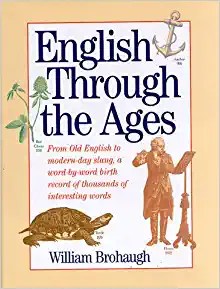
English Through the Ages, by William Brohaugh
You might be surprised to know that in the 1760s historical fiction I’m writing, I’m careful not to use words that were not in general use during that time. I keep English Through the Ages, by William Brohaugh within arm’s reach while I’m writing. Sometimes there is a perfect word I want a character to say but then I discover it wasn’t in general usage until later. I have to find another word.
And you thought I spent all my time just gazing out the window and eating bonbons!
Next week’s blog post topic
Next week I plan to blog about something that happened on October 31, 1849 in Cabarrus County, North Carolina. I wrote about it for a newspaper article a few years ago. I look forward to sharing a bit of that well-researched article with you on my blog.
Since my last blog
I’ve worked on my novel, The Heirloom, every day except yesterday. (I really try to set aside Sunday as a day of rest.) I feel great about how the manuscript is coming along. I’m really having fun with it, imagining myself on The Great Wagon Road in 1766.
I’ve made progress toward getting my website redesigned. I’m excited about that and will keep you posted.
I finished formatting Harrisburg, Did You Know?—Book 1 on Saturday. The proofreading will take another couple of weeks. By then, I hope to have a photograph to use for the cover. Everything seems to be falling in place within the publication schedule I set for myself. By this time next month, I hope to be close to it being available as an e-book.
A word about my blog
You might have noticed on my blog where it says “Join ___ other followers,” the number plummeted this week. I spent the better part of an hour in chat with WordPress tech support before they identified the cause.
The verdict was that the widget that enables me to show the number of followers on my blog changed last week without bloggers (or apparently tech support) being told.
On Wednesday it said, “Join 2,104 other followers,” but on Thursday night it said, “Join 988 other followers.” My heart sank! Tech support stayed on the case until it was determined that now the widget only displays the number of email and WordPress bloggers who follow me. It no longer includes the 1,000+ people who follow my blog on social media.
If you have a WordPress blog, did you notice this change?
Until my next blog
I hope you have a good book to read – and time to read it!
In case you want to know about more book bloggers than I’ve written about in the last weeks, I’m suggesting a few more for you to check out. These are listed in random order.
Photo credit: Ugur Akdemir on Unsplash
The Chocolate Lady’s Book Review Blog
I must admit, I was attracted to this blog by the word “chocolate” being in the title. What can I say?
Davida Chazan is originally from Illinois but moved to Israel at the age of 21. She writes this blog from her home in Jerusalem. She covers a variety of books, and you can always count on an honest review from her.
Here’s the link to Davida’s website: https://tcl-bookreviews.com/. By clicking on “A-Z Index of Book Reviews By Title” at the top of her website, you can bring up an extensive alphabetical list of the books she has reviewed. By “extensive,” I mean extensive!
Also, she has a fun drop-down list of authors you can access by clicking on “Countdown Questions Author Index.” You can really have some fun with this. Click on a book listed under the author’s name and it brings her Davida’s review of that book. Click on the author’s name, though, and it brings up a delightful list of questions Davida asked the author along with the author’s answers. The last time I checked, there are more than 40 authors on that particular list.
The website also has a clickable “Women in Translation” button at the top. Click on it to see the authors who write in a language other than English. They are celebrated in the month of August.
Photo by James Barker on Unsplash
The Reading Ladies Book Club
Carol, a retired fifth-grade teacher is the brains behind this book blog. Her favorite genres are historical fiction, literary fiction, and contemporary fiction. She is an ardent reader and enjoys sharing her thoughts about the books she reads.
Here’s the link to The Reading Ladies Book Club website: http://Reading Ladies – Book Club. On the home page, you can easily peruse and click on the titles and covers of the books Carol has recently reviewed.
Click on “Blogging Resources for Bloggers” at the top of her website for blog posts in which Carol has shared advice for bloggers.
If you’re in a book club (or if you aren’t in a book club), I highly recommend you click on “Book Club Recommendations” at the top of her website. As you might guess, it brings up a list of books by genre and how many stars Carol gave each one.
To see a list of the books Carol has reviewed, click on “Book Reviews A-Z & Book Lists.” After the alphabetical list of books is a list of her blog posts that were about more than one book.
There is a section to click on if you’re just interested in nonfiction books, and she has a special section that harkens back to her days as a teacher: “My Newberry Award Project.” Click on that button to bring up a list of the annual winner of The John Newberry Medal every year4 since 1922! That award is given by the American Library Association to the author deemed to have made the best contribution to American books for children.
As you can see, there’s something for everyone in The Reading Ladies Book Club Blog.
Photo credit: Gülfer ERGİN on Unsplash
Steph’s Book Blog
I love the subtitle of Steph’s Book Blog: “Read a Book – Be Amazed – Tell the World.” How great is that?
Steph says she is a lifelong reader who also dabbles in genealogy, local history, and photography. (Sounds a lot like me!)
By clicking on “Blog Posts” at the top of her website, https://stephsbookblog.com, you can scroll through her recent book reviews. Or, if you’re looking for her review of a book by a particular author, you can click on “Authors” for a drop-down menu of authors by alphabet.
There’s also a search box in which you can type a book title or author’s name.
Some authors participate in a “Blog Tour” in which various book bloggers read and review a specific book of theirs (usually a new release) on an organized schedule. Steph has a clickable “Blog Tours” button through which you can find a list of the books she has reviewed as part of a blog tour.
Photo by Eliabe Costa on Unsplash
Bonnie Reads and Writes
I just recently found this book blog via Twitter. Bonnie says she’s “lucky enough to live in the Smoky Mountains.” I’d say she is, therefore, “lucky enough.” I love the Great Smoky Mountains! But I digress.
The ”Launch a Bestseller” course by Tim Grahl is going great! I have learned so much already and have gotten back on track with my writing.
I continue to format my “Did You Know?” local history newspaper articles for publication as a couple of Kindle books.
Until my next blog post
I hope you have a good book to read – and time to read it!
Remember the brave people of Ukraine, the grieving people of Uvalde, the Floridians who lost so much to Hurricane Ian, and the people grieving last week’s mass murder in Raleigh.
In addition to the three novels I blogged about last week, in September I read three other novels and one nonfiction book. It’s my pleasure today to blog about those four books. I hope at least one of them will appeal to you enough that you’ll decide to read it. Support your local public library and your local independent bookstore!
The New Neighbor, by Karen Cleveland
The New Neighbor, by Karen Cleveland
I read Need to Know, by Karen Cleveland in March 2018 and blogged about it in my April 2, 2018 blog post, More March 2018 Reading. I really enjoyed that novel, so I don’t know what it took me more than four years (has it really been four years since 2018?) to read another of her books.
The New Neighbor is a spy thriller. The main character and most of her neighbors on a quiet cul-de-sac work for the CIA. She’s been trying to identify and take down a spy who is working against the United States for 18 years of her career. The code name for this person is “The New Neighbor,” so it’s a constant play on words throughout the book – Is the new neighbor the actual new neighbor on the cul-de-sac, or is it one of her long-time neighbors and friends on the cul-de-sac, or is it someone who lives who knows where, or is it …?
I look forward to reading another of Karen Cleveland’s novels as soon as I pare down my current reading list. She is a former CIA Analyst.
Switchboard Soldiers: A Novel of the Heroic Women Who Served in the US Signal Corps in World War I, by Jennifer Chiaverini
Switchboard Soldiers, by Jennifer Chiaverini
This historical novel made me aware of the first women to serve in the United States Army. It was World War I and General John Pershing needed efficient telephone operators who were fluent in both English and French to serve throughout France – including the front lines.
It was taking male soldiers one minute to connect a call. That was unacceptable, so General Pershing did a radical thing. He put out a call for qualified female telephone operators. More than 7,600 women responded. The women could connect a phone call in ten seconds.
They proved themselves just as qualified and dedicated as any male American soldiers and were credited in helping the Allies win World War I. It’s a shame their story hasn’t been told for more than a century, but author Jennifer Chiaverini has down a wonderful job telling us their story now.
I learned in the Author Notes at the end of the book that, although they were considered soldiers in the US Army during World War I, took the oath of office, were issued uniforms, had to go through the rigorous gas mask training, had to obey all rules and regulations of the US Army, etc. – after the war they were not considered military veterans and were not eligible for any veterans’ benefits until 1977 when President Jimmy Carter proclaimed them to be veterans. Of course, by then fewer than 60 of the 7,600 women were still alive to enjoy any of the benefits.
The other novels by Ms. Chiaverini that I’ve enjoyed are Mrs. Lincoln’s Dressmaker (which I read in April 2013 before I started regularly blogging about the books I read); Resistance Women (see my September 2, 2019 blog post, 3.5 of the 5.5 Books I Read in August 2019; and Mrs. Lincoln’s Sisters (see my August 10, 2020 blog post, Two Other Books I Read in July 2020.)
Listening Well: Bringing Stories of Hope to Life, by Heather Morris
Listening Well, by Heather Morris
If you’ve been reading my blog for a while, you know I’ve read three excellent novels by Heather Morris.
In Listening Well, Ms. Morris writes a lot about her life. She grew up in New Zealand and now lives in Melbourne, Australia. She writes about her growing up years as a way to tell us about the elders in her family and how they – especially her great-grandfather – taught her to listen.
She recommends that we all practice listening actively and then she sets about to give practical tips of how to listen to elders and how to listen to children. She also encourages us to listen to ourselves and trust ourselves because if we can trust ourselves and be a friend to ourselves, we can be a good friend to someone else.
She writes about listening to Lale Sokolov, the tattooist of Auschwitz, and what an honor it was to listen to him.
Ms. Morris says that all too often we listen to someone only to think of what we can say and how we can turn the conversation about us and not the other person.
This is a good read. I imagine most of us can learn something from it.
Second Street Station: A Mary Handley Mystery, by Lawrence H. Levy
Second Street Station, by Lawrence H. Levy
I wanted to read this book because it is a categorized as historical mystery. I read about 60% of it. It was a bit of stretch for there to be a female detective in the 1890s, but I was willing to suspend disbelief and go along with it.
It was a bit of a stretch to think of Thomas A. Edison being a criminal, but I kept reading. Where the wheels fell off the wagon for me, though, was when Mary Handley was able to watch the trajectory of ricocheting bullets and roll out of their way.
Since there had been no reference to Mary Handley having such superpowers, I felt completely pulled out of the story at that point. I read a few more pages and decided to move on to other library books that were needing my attention. It suddenly felt like historical fiction meets sci-fi.
If the book had been publicized as such, that would have been fine – and probably would make an interesting genre; however, that wasn’t a direction I expected “historical mystery” to take. I’ve since read several reviews online that were also thrown off by this part of the novel.
All that being said, though, I hesitate to be critical of a novel since I’ve yet to publish one of my own. I have much to learn about writing historical fiction. If you enjoy historical mysteries, give Second Street Station a try and let me know what you think of it. I’d like to be proven wrong in my assessment.
Since my last blog post
I took a free 3-Day online “How to Write a Series” course offered by Carissa Andrews of The Author Revolution. It was very helpful. And did you hear me say it was free? It will probably be offered again next year, so if you aspire to write a book series, I recommend you check out The Author Revolution online.
The historical fiction series I’m working on just might be five books instead of four. Book 2, The Doubloon is written and put away. Book 1, The Heirloom is my work in progress. Books 3-5, The Betrayal, The Revolution, and The Banjo are in various states of being outlined. My body is telling me I should have started this project decades ago.
I continued to format the local history newspaper articles I wrote from 2006 through 2012 for publication as two Kindle books. Look for future announcements about Harrisburg, Did You Know?- Book 1 and Harrisburg, Did You Know? – Book 2.
I started working through the video modules in Tim Grahl’s “Launch a Bestseller” course last week. The modules have already helped me understand the marketing tasks I need to do beginning seven to nine months before I publish my first novel.
In terms of marketing, I’ll have to condense some of those early tasks into just a couple of months or so for Harrisburg, Did You Know? – Book 1 and The Aunts in the Kitchen.
Me thinks I have too many irons in the fire!
Until my next blog post
Today I start taking the five-week online “Sticky Blogging – Master Class: “Attract Your True Fans” Course. Who knows? Perhaps in the coming weeks and months I’ll write better blog posts. Maybe I’ll come up with more interesting and eye-catching post titles.
I hope you have a good book to read.
Remember the brave people of Ukraine, the grieving people of Uvalde, and the devastated people of Florida.
I read some interesting and thought-provoking books in September. In today’s blog post, I’ll share my reactions to three of the novels I read. I hope you’ll be inspired to add one or more of them to your reading list.
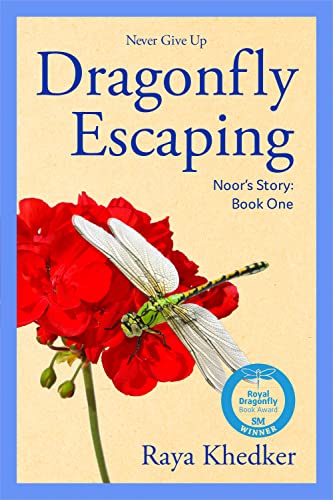
Dragonfly Escaping, Noor’s Story: Book One, by Raya Khedker
Dragonfly Escaping: Noor’s Story: Book One, by Raya Khedker
I learned about this novel through the Jennifer Tar Heel Reader book blog. After reading Jennifer’s review of the book, I went on Twitter to find out a little more about the author.
On Twitter I found a discussion about the book’s cover. I chimed in that I liked the cover, and the author and I enjoyed several days of messaging to one another about the struggles of writing and publishing.
The story immediately grabbed my attention and I knew I was hooked and would have to keep reading to find out what happened to Noor Zulfiker. Noor is bound in an arranged marriage to Rajat, an older man who is a physician and her parents think will be quite a catch for their daughter. But Noor is in love with a young man named Chirag Jagdev. Chirag isn’t rich and his financial future isn’t potentially as bright as the doctor’s.
There is physical abuse, so very soon the reader really starts pulling for the teenage Noor and hoping Rajat gets his comeuppance.
This book shines a light on the emotional and physical abuse the women in India are subjected to by men. Noor is abused from all directions and desperately wants to leave India. It is raw and unrelenting in this first novel of a planned series about Noor.
If you like exotic locations, Dragonfly Escaping takes place in New Dehli and Lima over a span of 1979 to 1992, with connections and references to Spain and Canada thrown in for interest.
If you aren’t put off by reading about an abusive relationship, I recommend this novel by Raya Khedker. It’s her debut novel and it was released in January 2022. Lo and behold, Dragonfly Hunting: Noor’s Story: Book Two, was released last week – on September 27 – so I’m already playing catch-up!
I look forward to whatever Raya Khedker and Noor have in store for us in Book Two.
Raya Khedker was born in India and currently lives in the United States.
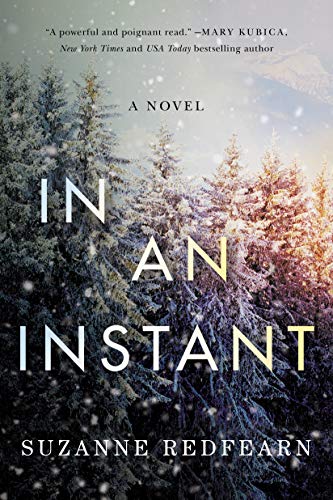
In an Instant, by Suzanne Redfearn
In an Instant: A Novel, by Suzanne Redfearn
This novel is written through the eyes of Finn, a 16-year-old girl. Spoiler alert: She’s alive in the beginning of the book but is soon dead. Probably 95% of the book is told through Finn’s eyes and ears as she moves about at will and reports how everyone reacts to her death and the other related events. It is a clever format.
The story is compelling. It delves into each person’s reaction to the incident that takes Finn’s life. It’s about family dynamics, friendships, and how individuals react to a traumatic situation. Each of us knows how we think or hope we’d react in a given circumstance, but do we truly know how we’d react when push comes to shove?
On the negative side, I had to suspend disbelief throughout a sizeable segment of the book as, although all the characters were in a situation of total darkness, they were able to move about and see everything clearly.
Also, I think the author gave Fen a vocabulary and level of understanding that a typical 16-year-old doesn’t have. And, speaking of vocabulary, I find the overuse of expletives offensive and it cheapens the writing. This becomes especially noticeable when one is listening to a book. It was excessive and pulled me out of the story. John Grisham is a reasonably successful novelist even though it is his policy and practice to not use curse words or raunchy language in his books. If John Grisham can have a lucrative writing career without using foul language, perhaps others should follow his example.
I thought the Easter dinner scene was forced. Why would a family that showed absolutely no religious inclinations suddenly put a tremendous emphasis on a traditional Easter ham dinner?
All that said, I reiterate that In an Instant is a gripping story and the premise of a person’s spirit being able to continue to roam the earth and see and hear intimate conversations and activities of family and friends is a bit unsettling and gives much food for thought.
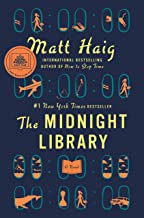
The Midnight Library, by Matt Haig
The Midnight Library, by Matt Haig
When Nora Seed “decides to die,” she finds herself in The Midnight Library. Her school librarian from long ago is there to explain to Nora that The Midnight Library isn’t exactly the afterlife. It’s an endless library of books – each one giving you the chance to undo your regrets and do something different. It’s between life and death. Disgusted at first to be there, Nora eventually appreciates the opportunities it provides.
The novel involves the theory or idea of parallel universes and allows Nora to move from one life to another and experience or re-experience an occupation or family situation.
The lesson this novel teaches is that every decision we make has an outcome. A different decision at any given time could have changed the course of our lives.
I didn’t know what to expect when I checked out the book on CD. I thoroughly enjoyed listening to it to see what Nora’s next experience would be and how it was all going to turn out for her.
The only irritation I felt in listening to the book was the fact that the British reader pronounced “library” the way the English do, turning this three-syllable word into a two-syllable word.” It’s like fingernails on a chalkboard to me. If you’re too young to understood the analogy, I’m afraid I can’t help you.
Since my last blog post
Here in the southern piedmont of North Carolina, it rained sideways all day on Friday and felt more like winter than autumn as what was left of Hurricane Ian passed through after making its third landfall near Georgetown, South Carolina. We came through it unscathed, though, and for that I’m relieved and thankful.
I’ve been working on my genealogy. I knew that three of my 16 g-g-g-grandmothers were Neelys. Last week I found their father’s will and discovered they were sisters. I guess that means I’m my own cousin. Small gene pool here in the 1700s!
Until my next blog post
My heart goes out to all the people severely affected by Hurricane Ian in Cuba, all over Florida, and the east coast of the US.
Today I’m excited to begin taking a three-day online workshop about writing a book series. It’s sure to help me as I continue to work on The Heirloom and its sequel, The Doubloon.








 Janet's Writing Blog