Local History is Revealed in National Archives Holdings

The first documented gold discovery in the United States was here in present-day Cabarrus County, North Carolina in 1799. The discovery by a little boy playing in Little Meadow Creek led to gold fever in the area. Numerous gold mines were dug and mined to various levels of success.

In fact, there was enough gold found in the southern piedmont of North Carolina that a branch of the United States Mint was built in Charlotte in 1836 and 1837. It opened for the production of gold coins in 1837.

A trip to the National Archives at Atlanta (which is in the Atlanta suburb of Morrow, Georgia) a few years ago gave me the opportunity to look at ledger books from the Mint in Charlotte. Within those pages I recognized names from my community.

Register of Gold – Branch Mint – Charlotte

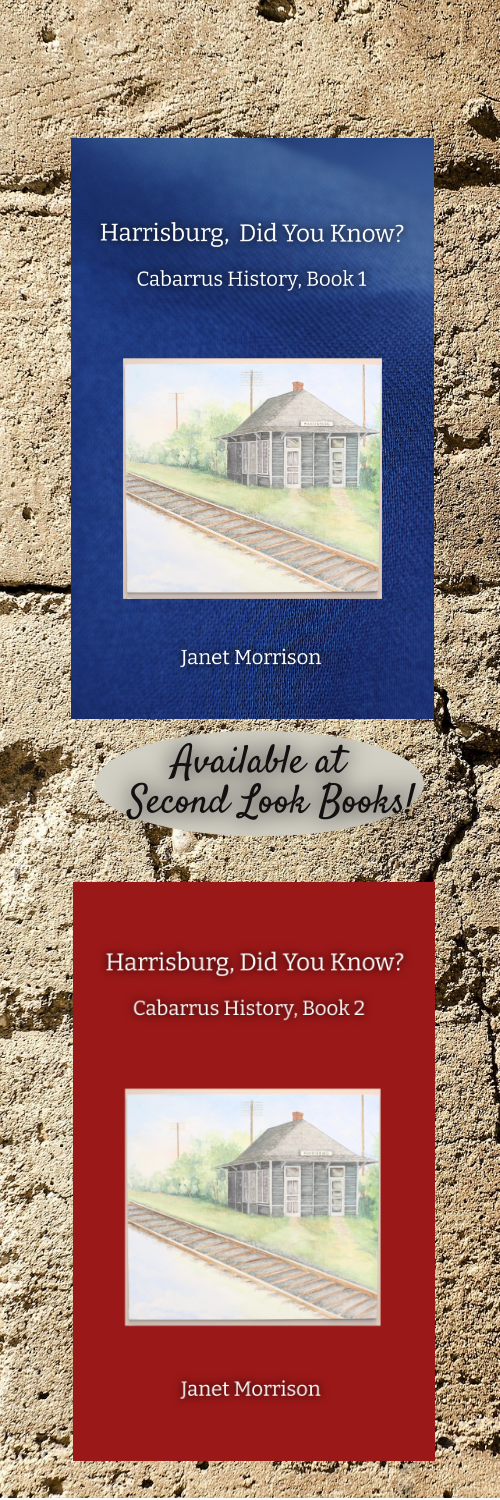
I’m blogging about some of that information today to give you an example of the type of documented local history I included in Harrisburg, Did You Know? Cabarrus History, Book 2. Although the book (and Harrisburg, Did You Know? Cabarrus History, Book 1) concentrate on Harrisburg, both books do include articles about other communities in Township One.

One of the communities rich in history in the township is Pioneer Mills. Little more than a quiet crossroads now, it was a center of activity in the mid-1800s after the discovery of gold and the opening of Pioneer Mills Gold Mine.

I recognized names such as John C. Barnhardt from the Pioneer Mills community as taking 123 ounces of amalgam to the Charlotte Mint on August 31, 1843, for which he was paid $2,340.33. That was no small sum of money in 1843!

Robert Harvey Morrison, on whose land the Pioneer Mills Gold Mine was located, was paid more than $4,000 for the gold bars and amalgam he took to the Mint from late in 1846 into early 1850.

Other names I recognized in the Mint ledgers included two other Barnhardts,  Robert R. King, three men with the surname Treloar, and R.B. Northrop.

Comparing US Census records, Charlotte Mint records, and various years of Branson Business Directories helped me get a better idea of what the Pioneer Mills Community must have looked like 150 to 180 years ago. There was a general store, a dry goods store, a blacksmith, a school, and a post office, In 1869, Pioneer Mills Community had three physicians.

Gold mining brought people from Canada, Great Britain, and New York to Pioneer Mills. Gold mining, no doubt, brought some undesirable people into the community, which led the wife of the pastor of Rocky River Presbyterian Church to say in the early 1870s that Pioneer Mills “is no place for a preacher’s son!”

If you’d like to read more about the history and people of Cabarrus County, North Carolina, you might enjoy Harrisburg, Did You Know? Cabarrus History, Books 1 and 2. They are available in paperback at Second Look Books in Harrisburg and in paperback and for Kindle from Amazon.

By the way, you can visit the research room at the National Archives at Atlanta (in Morrow, Georgia) by appointment only. Visit the website for more information:  https://www.archives.gov/atlanta.

Until my next blog post

I hope you have a good book to read.

I hope you spend time with family and good friends.

And, as always, remember the people of Ukraine and count your blessings.

Thank you for taking the time to read my blog.

Janet

Excitement the Week My New Book Arrived!

Promising to tell my blog readers about my journey as a writer, I have the privilege today of telling you about last week’s arrival of my new book, Harrisburg, Did You Know? Cabarrus History, Book 2.

My first copies of the local history book arrived on Sunday. That evening, I also finished drawing in black ink two maps of 1900s Harrisburg, NC on 11×17-inch paper. I’d drawn the maps in pencil years ago based on my memory and the recollections of Mr. Ira Lee Taylor. Mr. Taylor was born in the early 1920s and lived to be in his mid-nineties. He was a great resource for me when I was writing the local history column from 2006 through 2012.

Mr. Taylor’s memory of stores and other businesses such as the livery stable made it possible for me to include many buildings that were long gone by the time I was born in the 1950s.

Since the town experienced several road closures and the addition of a four-lane bridge over the railroad tracks due to the high-speed rail improvements about a decade ago, it’s important to have a record in the form of a map so the town’s earlier layout won’t be forgotten.

Monday morning, I took the two maps to have photocopies made. Since the owner of the local bookstore had told me that several people who purchased my first local history book had said they wished they had a map of the way the town used to look, I thought she’d be happy to have my two 11×17-inch maps to sell for maybe $2.50. That didn’t work out, which was disappointing.

On Monday and Tuesday, I got to give copies of my new book to several people who have been instrumental in helping me with details of local history. I mailed several of those to people who live out-of-town, but I got to deliver others in person.

I designed and had bookmarks printed to give away with each book. One side of the bookmark has pictures of both of the Harrisburg local history books and the other side has a photo of my “Slip Sliding Away” short story along with my website and QR code so people will know how to get a downloadable copy of my short story by subscribing to my newsletter.

Above, one side of my bookmark; below, the other side of my bookmark.

I also delivered copies of my first and second local history books to a local bookstore which already had two people on the waitlist for Book 2. After taking the books to the store, I posted announcements on three Facebook pages so people would know that my new book was available locally and on Amazon. I’ve enjoyed getting comments and replying to comments – some from people I know and some from people I’ve never met. It’s gratifying to know that people are enjoying both my books.

Wednesday gave me a break from all the book activity, as a cousin visited from New York with her two-year-old son. It was great to sit and visit and watch a very active toddler investigate parts of our house and yard.

On Thursday, I got to have lunch with three local people to talk about local history. It was interesting, and I learned some things I hadn’t known before. Don’t jump to any conclusions, though; I don’t have a third local history book in me!

Early in the week, I made the decision to give myself Thursday and Friday off from hawking my book. Being a native and lifelong North Carolinian, the “March Madness” of the Men’s and Women’s NCAA Basketball is something I’ve always blocked out time for on my calendar. Both of my NC State University teams got knocked out in the first round, but I’ll continue to watch the games the next three weekends.

Photo by Gene Gallin on Unsplash

On Saturday, I delivered more copies of Harrisburg, Did You Know? Cabarrus History, Book 2 to the bookstore in Harrisburg, so the shop is well-stocked for this week.

When not hawking books or watching basketball, I spent a good bit of time pouring over old deeds, plats, and maps as I tried to figure out exactly where I live in relation to the land purchased by my ancestors in the 1760s. I enjoy activities like that.

Until my next blog post

I’ll continue to publicize my books, and I’ll keep spreading the word that I now publish an electronic newsletter every other month for people who subscribe to it on my website: https://www.janetmorrisonbooks.com. I also give away a downloadable short story to subscribers. I appreciate those of you who have taken advantage of this opportunity.

I hope you have a good book to read. The right of people to read is under attack in some states within the United States, and that’s a frightening situation. It’s more important than ever for freedom-loving people everywhere to read, read, read. Support your local public library and your local bookstore! Don’t let anyone dictate what you can and cannot read!

I plan to get back to work on the book of family recipes I started compiling a few months ago before the history books demanded my time. That’s my next project, but I’m eager to also get back to writing my first historical novel.

Take care of each other.

Don’t forget the people of Ukraine. In particular, remember the 16,000 children who have been forced by the Russians to go to Russia in the last 14 months. Only 300 of the 16,000 have been able to get back to their homeland of Ukraine.

Janet

Three Compelling Books I Read in February 2023

After a couple of months of not getting to read much for pleasure, February turned out to be just what I needed to get back in the habit of reading. My favorite genre, historical fiction, really came through for me last month.

The Diamond Eye, by Kate Quinn

The Diamond Eye, by Kate Quinn

I listened to this historical novel on CD. I was spellbound from disc one until the very end of disc 11. I yearn to write historical fiction so vividly. I long to captivate readers with fiction based in an era not their own. Kate Quinn has established herself as a master of the art and craft of writing historical fiction.

The Diamond Eye is based on a true story. Mila Pavlichenko lives in the part of the Soviet Union that is now Ukraine. She works at a library and adores her young son. When World War II transitions to the invasion of Russia by Nazi Germany, Mila does the unthinkable. She becomes a sniper for the Russian Army. And she excelled at it.

After her official kill count reaches 300, Mila becomes a national heroine and is sent on a tour of the United States to drum up support for the fight against Hitler. There, she meets President and Mrs. Roosevelt. Eleanor Roosevelt, seeing a bit of her own independent nature in the sniper, befriends Mila.

The book follows Mila through the war and how she constantly has to prove herself because she’s a woman and not automatically taken seriously. She’s called the usual names that men who are threatened by strong women call them.

It is a stunning novel and reminded me why I enjoy reading historical fiction. Yes, it’s fiction because conversations are imagined, but reading well-written historical novels is an enjoyable way to learn a lot of history.


The Home for Unwanted Girls, by Joanna Goodman

The Home for Unwanted Girls, by Joanna Goodman

This is another gripping historical novel. I was so impressed by Saskia Maarleveld’s reading of The Diamond Eye, that I looked for other books she had recorded. That’s how I found The Home for Unwanted Girls. I thought that was an interesting way to find another good book!

The Home for Unwanted Girls is about an unwed mother in Quebec in the 1950s who is forced by her parents to give up her baby girl. The book shines a light on the ugly history of the orphanage system in Quebec at that time. When the orphanage is turned into an insane asylum and the orphans are forced to take care of the patients, the outcome for the girls seems hopeless.

This novel follows the life of one of those orphans and the 15-year-old mother who wanted desperately to keep her. The mother never gives up on finding her child, even though she is told the girl died.


The Escape Artist: The Man Who Broke Out of Auschwitz to Warn the World, by Jonathan Freedland

The Escape Artist, by Jonathan Freedland

This book was spellbinding! It tells the stories of 19-year-old Rudolf Vrba and Fred Wetzler who did the impossible in April 1944. They escaped from Auschwitz! The book tells how Vrba studied the precision with which the Nazis conducted searches and exactly how long the guards searched when a prisoner was unaccounted for. He and Fred worked with two accomplices to plan the escape of Vrba ad Wetzler. Their two accomplices were to stay behind while Vrba and Wetzler escaped to take the truth of what was happening at Auschwitz out into the world.

It’s a fascinating read. It follows Vrba and Wetzler after their escape. The eye-opening part of the book was the aftermath of their escape. They testified and provided written descriptions of the horrors of Auschwitz. Their testimonies matched to the nth detail; however, their words and their physical conditions of malnutrition fell on deaf ears.

Winston Churchill didn’t want to bomb the rail lines going into Auschwitz because England bombed in the daytime. President Franklin D. Roosevelt didn’t want to bomb because it would be a diversion from plans. Jewish organizations in Europe refused to believe what was happening at Auschwitz because it was just too extreme. How can people do such things to their fellow human beings?

Along with the tragic murdering of Jews at Auschwitz, the fact that world leaders who had the power and where withal to do something about it in fact chose not to act is a gut punch.

My general takeaway from the book is that one’s life and future can be determined by someone else’s snap decision. Decisions were made on a whim by guards at Auschwitz every day that determined who lived, who died, and who escaped.

It’s a book that will haunt me.


Since my last blog post

I continue to try to get the word out about my second local history book, Harrisburg, Did You Know? Cabarrus History, Book 2.

I also continue to ask people to go to my website, https://www.janetmorrisonbooks.com and subscribe to my newsletter. Subscribers receive a free downloadable copy of my first historical short story, “Slip Sliding Away: A Southern Historical Short Story.”

“Slip Sliding Away: A Southern Historical Short Story,” by Janet Morrison

Until my next blog post

I hope you have a good book to read. I know where you can get a good historical short story to read!

Take care of one another.

Remember the people of Ukraine.

Janet

Harrisburg, Did You Know? Cabarrus History, Book 2 is Published!  

I’m pleased to announce that not only did my second proof copy of Harrisburg, Did You Know? Cabarrus History, Book 2 arrive in a timely manner, but it was also in fairly good order!

The cover is now a reddish-brown instead of dark brown. (I don’t think I’ll try to self-publish any more books with a red cover! We all learn from our mistakes.)

There were still a few formatting errors that resulted from the last “chapter” (my research notes) being almost 30,000 words in length, but at least Carl Higgins’ World War II B-26 bomber was flying horizontally on page 467.

Although the manuscript was proofread and corrected several times, three typos got past me. I strive for perfection, but I’ve yet to see a perfectly printed book. I can live with three typos in a 536-page book.

Available on Amazon!

Harrisburg, Did You Know? Cabarrus History, Book 2 is now available in paperback and for Kindle from Amazon. Click on https://www.amazon.com/dp/B0BW2QMLHC/ for the paperback or click on https://www.amazon.com/dp/B0BXBQ1F79/ for the Kindle book. I shortened the Amazon URL so they wouldn’t look so intimidating. If they don’t work, just put the name of the book in a search on Amazon.

Available soon at Second Look Books!

The paperback book will be available in a few weeks at Second Look Books in Harrisburg.

The first issue of my newsletter!

Those of you who read my blog post last Monday and subscribed to my newsletter before March 1, received the first issue of the Janet Morrison Books Newsletter (clever name, eh?) on Friday. I hope you enjoyed the variety of information it contained.

If you’ve read my vintage postcard book, The Blue Ridge Mountains of North Carolina, you were able to answer the trivia question near the end of the newsletter.

Please subscribe to my newsletter & receive a free short story!

I’m working hard to get my writing career off the ground, so please subscribe to my newsletter. I plan to send out a newsletter every other month, so be sure and visit my website, https://www.janetmorrisonbooks.com  and subscribe so you won’t miss another issue. You’ll also receive a downloadable copy of my short story, “Slip Sliding Away: A Southern Historical Short Story.”

Thanks for being on this journey with me!

All these recent accomplishments are the culmination of a lifetime of studying local history and learning how to research and document it and 22 years of studying the craft of writing.

It’s been a bumpy journey. Thank you for having faith in me and offering encouraging words along the way! I have some loyal lifelong friends and just as loyal friends I’ve made through my blog and Facebook. I value each and every one of you.

Buckle up! I’m just getting started!

I’m working on a family cookbook, more historical short stories, and an historical novel. With my two local history books and first short story published, I look forward to concentrating on my fiction writing.

Until my next blog post

I hope you have a good book (or historical short story!) to read.

Make time for your family and a hobby.

Don’t forget the people of Ukraine.

Janet