
I had never heard of the “Bonus Army” or this incident until I stumbled across it while looking for blog topics I could write about on or near — their anniversary dates. This one belonged on yesterday’s blog but got crowded out by the 157th anniversary of the ratification of the 14th Amendment to the U.S. Constitution.
Since the “Bonus Army” needed its own day on my blog, that’s today’s topic.
Why the name “Bonus Army”
As the federal government is prone to do, it came up with a plan to reward individuals who served in the military during World War I but there was a catch. They couldn’t receive their “bonus” payment until 1945 – nearly 30 years after their combat service.
Established by Congress in 1924, the so-called “Tombstone Bonus” would be paid to World War I veterans in 1945 to thank them for their service.
It brings to mind the case of soldiers who were in the American Revolution in the 1770s but were not eligible for a pension until 1832 when most of them were dead.
There seems to be a pattern here.
But then came The Great Depression
The stock market crashed in 1929, and by 1932 things were not getting any better.
Desperate for financial relief, 400 World War I veterans gathered in Portland, Oregon. Led by veteran Walter M. Waters, on May 17, 1932, they left Portland on a donated train and traveled to Iowa, from where they had to walk and hitchhike the remaining 900 miles to Washington, D.C. to make politicians acknowledge their dire straits.
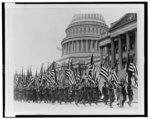
Other veterans learned of the movement and headed to Washington, D.C. By June 1, 1932, there were 1,500 veterans in the nation’s capital to plead with Congress and President Herbert Hoover to find a way to give them their bonus checks early.
The veterans camped out in various locations across Washington, D.C. The Anacostia Flats site was the largest of their shanty towns at 30 acres. It gained the name “Camp Bartlett” because it was John H. Bartlett, the former Assistant Postmaster General and former Governor of New Hampshire who owned the land and let the veterans camp there.

On June 1, D.C. Police Superintendent Brigadier General Pelham D. Glassford asked Congress for $75,000 to feed the veterans, but the request was denied.
In mid-June, the U.S. House of Representatives approved the immediate payment of the bonus, but the U.S. Senate rejected it. President Hoover had said he would veto the bill if it passed in both chambers.
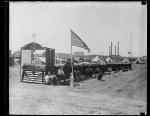
Veterans kept coming to Washington to plead their case. By the end of July, 1932, it was estimated that up to 20,000 of them had arrived.
It did not end well
In an action that rattles one’s nerves even to read about it 93 years later, on July 28, 1932, President Hoover ordered the U.S. Army and local police to remove all the protesting veterans from Washington.
General Douglas MacArthur led the mission. George S. Patton, whose name we all know from World War II, also participated. In an ironic turn of events, one of the veterans expelled from the nation’s capital by Patton was Joe Angelo, the soldier who saved Patton’s life in World War I.
Some 3,500 U.S. Army infantry and cavalry troops were called up to rid the city of the marchers. Of that number, 800 were actively used in the mission while the other 2,700 were held in reserve.
Violence ensued as the marchers resisted, but they were no match for the fire power of the U.S. Army. Five tanks manned by soldiers with machine guns, troops using tear gas and bayonets, and troops with torches setting fire to the encampments was more than the unarmed veterans could overcome.
Some of them thought they would be safe at Camp Bartlett, since it was on private land and the order to evacuate had only mentioned federal lands. They soon learned that Camp Bartlett was to be cleared also.
General MacArthur threatened to have a civilian bystander arrested for shouting, “The American flag means nothing to me after this!” at the troops.
One of the marchers, William Hashka of Chicago, was shot and killed near the U.S. Capitol.
Excuses and reactions
In a statement that sounds all too familiar to us in 2025, President Hoover claimed that many of the marchers were not veterans. He said they were Communists and criminals.
Falling in line with Hoover, MacArthur said only ten percent of the marchers were veterans.
Vice President Charles Curtis was heckled about the incident while making a speech in Las Vegas on July 29. He responded with, “You cowards, I’m not afraid of any of you.”
Police Superintendent Glassford said on July 29 that the use of federal troops had caused the trouble and that it could have been handled peacefully.
Does any of this sound familiar to you in 2025?
Some newspapers across the nation endorsed Hoover’s actions, while others called it “sheer stupidity.”
In 1936, the World War I veterans received their bonus, but it took Congress overriding President Franklin D. Roosevelt’s veto to accomplish it.
During World War II, in 1944, Congress passed the G.I. Bill to assist veterans.
Until my next blog post
I hope you have a good book to read.
Don’t forget the people of Ukraine and western North Carolina – or the starving children in Gaza.
Janet

 Janet's Writing Blog
I met a retired Navy Intel officer whose family hated MacArthur because his grandfather was part of the Bonus Army. However, he worked with an Admiral who has been a young lieutenant when they broke the Japanese code in the early days of WWII. The Admiral’s rule was nobody some ill of MacArthur do he had to change his tune about MacArthur. He later wrote a book about that experience call Cocktails with the Admiral.
LikeLike
Very interesting that you had that connection with someone directly involved in the Bonus Army! I had not known about MacArthur’s involvement in the Bonus Army incident until a few days ago.
LikeLiked by 1 person
Thanks, Janet . 6 degrees of sepat…
LikeLike
*separation
LikeLike
I came across this story a few years ago in a biography of MacArthur by Arthur Herman. I hadn’t heard of it previously either. It seems it really made MacArthur a hated figure among a lot of Americans, according to Herman.
LikeLike
I read today that General Eisenhower tried to convince him not to personally go into Washington with the troops, but being the head-strong person he was, he went in. Right-wingers praised his actions because they thought he saved America from the Communists! (Those right-wing conservatives think there is a Communist hiding behind every rock and every bush!) I wish I’d known about this when I could have asked by father about the Bonus Army and what he thought of MacArthur — or asked my brother’s father-in-law. He was a World War I veteran.
LikeLiked by 1 person