I write southern historical fiction, local history, and I've written a devotional book. The two novels I'm writing are set in Virginia and the Carolinas in the 1760s. My weekly blog started out to follow my journey as a writer and a reader, but in 2025 it has been greatly expanded to include current events and politics in the United States as I see our democracy under attack from within. The political science major in me cannot sit idly by and remain silent.
Author: janetsm
In November 2025, I published Traveling Through History: A Collection of Historical Short Stories. In the fall of 2025, I published a devotional book: I Need The Light! 26 Weekly Devotionals to Help You Through Winter AND I Need The Light! Companion Journal and Diary. I write North Carolina local history and Southern American colonial historical fiction. I enjoy doing extensive research as well as the writing that research supports. My stories and novels-in-progress are about the common people. I'm the author of Harrisburg, Did You Know? Cabarrus History, Books 1 and 2 and a vintage postcard book titled The Blue Ridge Mountains of North Carolina.
Just a note to let you know that the shingles virus has transitioned into postherpetic neuralgia. My eye is healing beautifully, but the burning pain due to damaged nerves throughout the right side of my head is presenting quite a challenge and can last for months. I am still unable to read or do much at all, so my writing is almost at a standstill.
I hope to be able to resume blogging in a few weeks.
I am taking this opportunity to remember authors Joyce and Jim Lavene. This husband and wife team wrote novels together. I cannot imagine writing a novel with another person, but Joyce and Jim made it look easy. They shared a love and marriage that spanned decades. Writing as Joyce and Jim Lavene, J.J. Cook, and Ellie Grant, the duo produced about 50 novels. I have counted at least 47 on their website, but I maybe missed a few.
Joyce and Jim lived here in Cabarrus County, North Carolina. They quietly churned out books and two different years visited Rocky River Readers Book Club to regale us with stories about the characters they created and their writing habits. They could finish one another’s sentences when talking about their books, and I suspect they did that in “real life,” too.
Joyce died suddenly in October 2015 and Jim died just as unexpectedly last week. Their genuine smiles and interest in people will be missed, as will all the novels they would have written if things had been different.
If you get a chance, you might enjoy reading one of Joyce and Jim Lavene’s books. Most of them would be categorized as cozy mysteries. At least for now, their website is still up. The address is http://www.joyceandjimlavene.com/. Their books are listed on the website.
As a novelist wannabe, I appreciated the encouragement Joyce and Jim gave me.
I have always wanted my historical novel, The Spanish Coin, to be published by a publishing house. That desire was based on my thinking that would be a stamp of approval for my writing skills. Being published by a publishing house would validate me as an author.
My thoughts have changed recently. The publishing business is changing so fast that self-publishing is becoming more acceptable. I’m not getting any younger, the road to securing the services of a literary agent and eventually (maybe) getting my manuscript picked up by a publisher, and something like 18 months later seeing the book in print make me rethink things.
My main reason for writing is not to make money; however, reaching the point where my income from writing escalates from the Internal Revenue Service categorizing it as a “hobby” to recognizing it as my profession would be rewarding. The royalties earned by self-publishing appear to far exceed those paid by publishing houses.
I write because I’m compelled to do so. As a child, I kept diaries. Diaries in the early 1960s only provided a space approximately one inch by three inches for each day’s comments. I quickly outgrew that format and took to using notebook paper. That way I could write as much as I wanted to each day. I kept such a journal during middle and high school, some during college, and sporadically throughout my adult life. It always surprises me when I hear someone say they don’t like to write. I can’t imagine!
The fact that the self-published author has to do his own marketing is often labeled a detriment when writers list the pros and cons of that route, but the other side of the coin is that the author has full control over getting the word out about his book. Although my vintage postcard book, The Blue Ridge Mountains of North Carolina, was published by a history book publisher, most of the marketing of the book fell on my shoulders.
The more I read about self-publishing, the more I think it just might be the way for me to go. Before I make that decision, though, I must do some research to determine how readers of historical fiction prefer their books. Do they prefer e-books or traditional books? If they prefer e-books, I must research all my self-publishing options — which already seems like comparing apples to oranges — so I can make an educated decision.
Like so many facets of the business of writing, sorting through all the options of publishing can feel overwhelming. For now, I need to concentrate on finishing The Spanish Coin and getting it professionally edited.
I plan to blog about my progress on my novel the end of every month.
I am still fairly new to blogging about my life as a writer, so please be patient as I make changes in my blog page as I learn new things. I’ve added a couple of new items this evening and will be working out the bugs in the coming days.
My first blog post each month will be about the books I read in the previous month.
Author Lee Smith’s latest book, Dimestore: A Writer’s Life, is an enjoyable book. It’s a memoir told through stories. Ms. Smith was born in the mountains of Virginia, and she has a lovely accent. As I read Dimestore, I could hear her saying the words.
In my “Some books I read in February” blog post, I reported finally starting to read Sue Grafton’s Alphabet Series of novels. I plan to read them in order, so I read B is for Burglar in April. I’m on the wait list for C is for Corpse at the public library. Apparently, I’m not the only person who is 20 years late reading her series.
Raising Ryland: Our Story of Parenting a Transgender Child with No Strings Attached, by Hillary Whittington made a lasting impression on me. It is written by the mother of a young transgender child. Labeled a girl at birth, as a toddler Ryland started letting his parents know that he really was a boy — not a tomboy, but a boy. This is a wonderful book that taught me a lot about this topic which has been making global headlines lately due to the passage of House Bill 2 (HB2) by the North Carolina state legislature. Raising Ryland should be required reading for the North Carolina governor and state legislators. It helped me have a better understanding of transgender people, and I highly recommend it. I don’t think I’ll ever forget this book.
I ended the month by reading Mrs. Roosevelt’s Confidante, by Susan Elia MacNeal. A historical novel set in Washington, DC during World War II, the book introduced me to a new historical fiction author. You can be sure I’ll read all of Susan Elia MacNeal’s books. This is Ms. MacNeal’s fifth book of fiction. She has another one scheduled for release in October 2016 titled The Queen’s Accomplice. If you like historical fiction set in the World War II era, I suggest you give Ms. MacNeal’s books a try. If you’re like me, you’ll learn some history while enjoying a suspenseful story.
To be a good writer, it is said one must be a reader. I’m not a fast reader, but I try to read a variety of genres and learn what good fiction is.
Please follow me on Twitter by clicking on the Twitter icon in the sidebar.
Since I usually read two or three books at the same time, today I pose the following question: Can I write more than one book at the same time?
I know authors often have to make final corrections in one book while writing their next book, but is it possible to work on two or three book drafts at the same time?
I’m in the self-editing stage of The Spanish Coin — my 95,000-word historical novel manuscript, but I’m eager to start writing two nonfiction books. One of my book ideas is based on the events that make such an impression on my mind that I remember them as many of 60 years later. What is it about a possibly mundane event that etches itself on our memories to such a degree that decades later we can recall them with clarity? I want to explore that and write about those events in my life.
Another idea I’m toying with literally popped in my mind while walking one morning after being diagnosed with Seasonal Affective Disorder (SAD) and being told the benefits of seeking light early in the morning. I’ll leave it at that for now, not wanting to give away the details of my idea.
One of my inner debaters tells me to put these two ideas on hold and concentrate on completing The Spanish Coin. In rebuttal, another of my inner debaters says variety is the spice of life and it will expand my mind to schedule time to work on at least one of my nonfiction book ideas while I devote the majority of my time to my novel.
In a future blog post I’ll tell you which of my inner debaters won.
Have you ever worked on more than one manuscript at once? Share your experience with me and my blog followers.
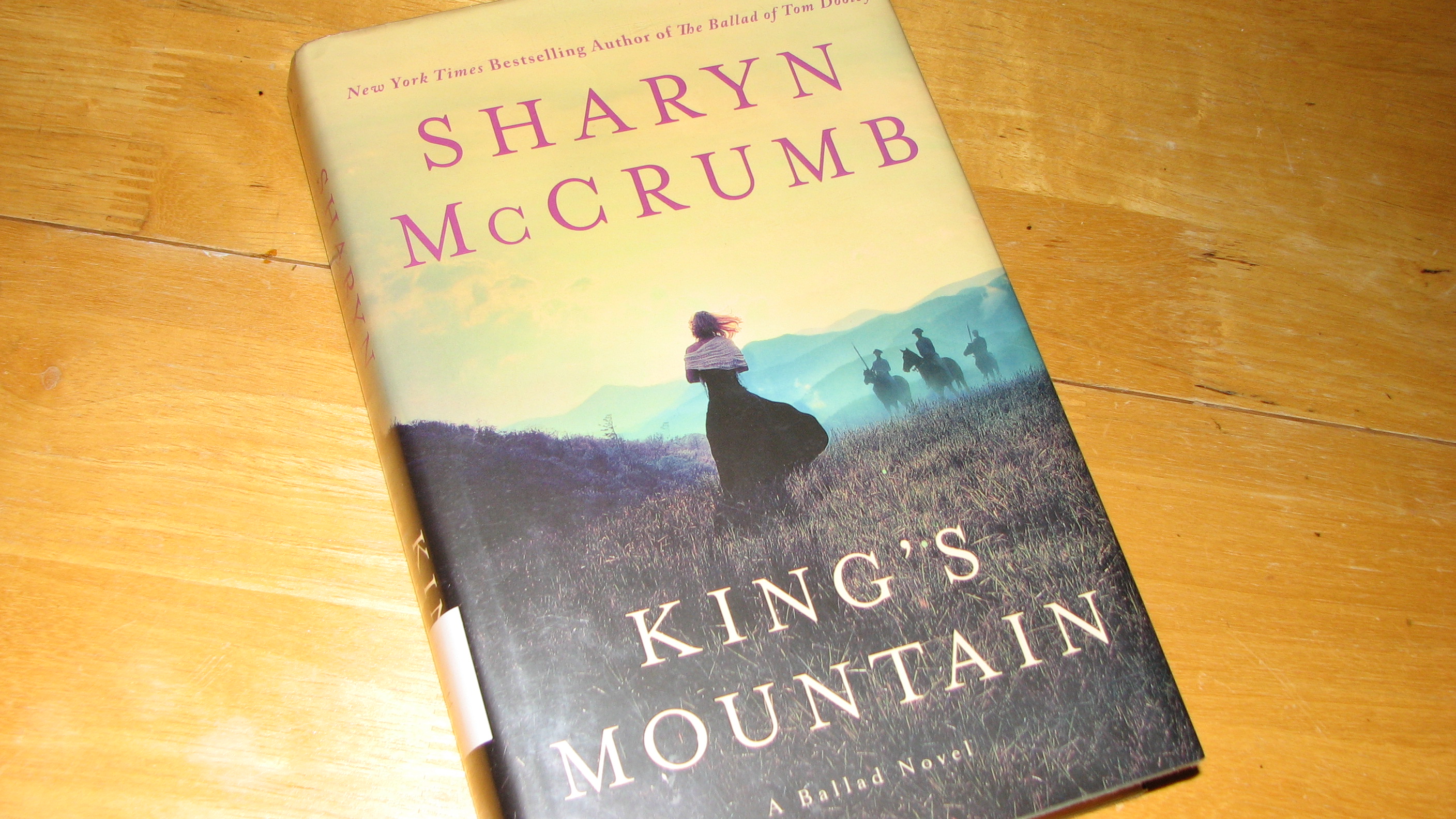
King’s Mountain: A Ballad Novel, by Sharyn McCrumb was this month’s selection for discussion by Rocky River Readers Book Club. I looked forward to reading it. I even checked it out from the library, but I didn’t get it read. After sitting in on the discussion a couple of hours ago, though, I will definitely read it. After all, historical fiction is my first love, and I had ancestors who took part in the Battle of King’s Mountain on October 7, 1780. In fact, they lived within shouting distance of the battle.
Sharyn McCrumb is meticulous when it comes to doing the historical research to back up her novels. I had the pleasure of hearing her speak in Wilkesboro, North Carolina several years ago, and I was tremendously impressed with the depth of her research. She sets the bar high for would-be historical fiction writers like me.
The majority of King’s Mountain: A Ballad Novel gives the history of what led up to this battle of the American Revolution and personal stories of people who actually participated in the battle or supported those people. The Americans who took part in the battle were farmers who made up various companies of militia. They were up against Gen. Patrick Ferguson and his British troops under the command of General Cornwallis. Ferguson is remembered for his harsh treatment of American patriots.
Although the Redcoats took a position on the mountain, the militiamen won the battle and set things in motion for another Cornwallis defeat at Guilford Courthouse the following spring and the surrender of the British at Yorktown.
The discussion at the book club meeting really piqued my interest in the book for all the interesting personal stories about the participants in the Battle of King’s Mountain, such as Mary Patton making gunpowder; Ferguson having a chance to shoot George Washington but, thinking he would have a chance on the battlefield, deciding to wait; and Davy Crockett’s connection with Gov. John Sevier of Tennessee. The discussion also makes me want to visit the King’s Mountain National Battlefield again.
On another note, everything I read about blogging tells me that I need to do it on a schedule, as in at the same time on the same day(s) of the week. I’m making an effort to blog on Mondays and Fridays. Doing it at the same time? That will be a work in progress!
April 23, 2016 is World Book and Copyright Day. Thank goodness our creative work is protected by copyright laws! Some people will, of course, find ways to use another’s work and claim it as their own. The author does, however, have recourse through the court system when infractions are discovered. I’ve never had to go that route. I’m sure it’s a hassle. Expense is always involved when you have to sue someone.
The closest I’ve come to such a problem was after my sister and I published three genealogy books in 1996. A religious organization based in Utah asked us for permission to put all the information from our books online. We were floored! We had just sunk thousands of dollars into getting 500 hardcover copies of each book printed and knew it would take us years to recoup our money, so our answer was an unequivocal, “No!” We were just glad they asked us before they acted.
There was also a case a few years ago when I was asked to write an article for a genealogical society’s quarterly journal. I was flattered and thrilled to do so. After preparing the journal for printing, the editor was kind enough to send me a copy of my article to proofread. Imagine my shock when I discovered that she had added sentences here and there without indicating they were editor’s notes. It wouldn’t have been so bad if the information she had added had been true, but none of it was! When I called her on it, she said the content she had added had been assumptions. Since she did not see that she had done anything wrong, I pulled my article from her publication. It is a respected journal, so it saddens me now to know that nothing in it can be trusted. The editor was not claiming my work as her own, but my credibility as a writer and a historian would have been tarnished if the misinformation she inserted in my article had been published.
On April 5, 2016 Janice Wald of the blog, MostlyBlogging.com, shared a guest post by Kathleen Aherne. Ms. Ahearne’s website is called “The Blogger’s Lifestyle,” and her blog’s address is http://www.kathleenaherne.com/the-blog/. Her April 5 blog is a good source for the basics about copyright and plagiarism as those issues pertain to writing a blog. The post addresses images as well as the written word.
Unless an article or book is identified as fiction, we trust the author or editor. Once that trust is broken, it can never be completely restored.
A few months ago I started keeping a writer’s notebook of itms that could help me in my own writing. The notebook is divided into various sections, including “First Lines of Novels,” “Agents, Editors, etc.,” “Blog Post Ideas,” “Notes from Author Interviews I Saw or Read,” and “Lines I Like.” I’m doing my first writer’s notebook. My biggest challenge is guessing at how many pages to allot to each section.
My writer’s notebook – Volume 1
First Lines of Novels
In the “First Lines of Novels” section I write down the opening sentence or paragraph from every book I read. Some of them make me think, I wish I’d thought of that!
Literary Agents, Editors, etc.
Occasionally, in the acknowledgements page, a novelist reveals the name of their literary agent or editor. I try to make a note of those names, especially if the book is historical fiction.
Notes from Author Interviews
When I hear an author being interviewed on National Public Radio (NPR) or see one being interviewed on TV (usually on PBS – the Public Broadcasting System) by Charlie Rose or Tavis Smiley, I grab a pen and paper so I’m ready to jot down a quote, an idea, a recommendation, or a book name that piques my interest. The University of North Carolina public TV system (UNC-TV) has a weekly program called “Bookwatch” that features interviews with North Carolina writers. I especially enjoyed Lee Smith’s February 25, 2016 appearance on that show and her comments about her new book, Dimestore: A Writer’s Life. I read the book and thoroughly enjoyed it. I could hear Ms. Smith’s lovely Southern accent in my head as I read it.
Blog Post Ideas
This section is self-explanatory, but I find my writer’s notebook is a good place to write down blog post ideas. If I don’t write down ideas immediately, chances are I won’t remember them later.
Lines I Like
When I happen upon an unusually beautiful, humorous, or well-written passage in a book, I write it down in this section of my notebook. These are phrases, sentences, or paragraphs I want to read over and over again. I note the author’s name and the name of the book, of course.
I’ll end this post with a selection from that portion of my notebook:
“Their recent conversations skipped like stones across the surface of their lives, never finding depth, never touching the trouble that had been visited upon Alexander.” ~ The Guise of Another, a novel by Allen Eskens.
It’s been an interesting four days since my last blog post. Today’s post is (as the title suggestions) an update on my adventures in sorting out social media. I’m a writer, not an IT person.
Facebook
For those of you who follow me on Facebook, you already know I’ve made no progress there. I’m finding it a challenge to share articles I find online on my Janet Morrison, Writer Facebook page. It is secondary to my personal page. Sometimes I’m given the option of sharing on either page, but usually my only choice is to share on my personal page. Also, when I try to install a Facebook button on my blog, it takes you to my personal page. I don’t want to merge my two pages, but that might be my only option.
Pinterest
I’ve made a point to pin to several of my Pinterest boards every day. Instead of being satisfied to just pin quotes about writing to my “The Writing Life” board, I’m making a concerted effort to find more substantive and helpful articles about the craft of writing. Since April 4 my Pinterest followers have increased from 32 to 40. That’s not a huge number, but it’s 25% — which sounds better. I wrote a nonfiction vintage postcard book, The Blue Ridge Mountains of North Carolina in 2014. I hope my “Blue Ridge Mountains” and “Great Smoky Mountains” boards will result in some book sales. I invite you to follow me or my boards you find of interest at http://www.pinterest.com/janet5049.
I’ve had a Twitter account for longer than I care to remember, but I’ve hesitated to use it. There! I’ve said it! I have retweeted 14 tweets and sent five original tweets all in the last eight days. I’m still a little in the dark about hashtags. I’m following 51 people and 14 are following me. I’m resisting the temptation to check out Twitter for Dummies from the library after my less than stellar experience with I-Phones for Dummies.
Blogger Networking
One encouraging thing that has resulted from my plunging deeper into social media this week is that I was contacted by a fellow blogger who is also writing a book and dealing with some of the same social media issues I’m struggling with. #MyNameIsJamie @Sonni_quick gave me some wisdom from her experience and we commiserated about our mutual shortcomings when it comes to building our platforms online. It was reassuring to find out I’m not the only person feeling my way through the maze of social media of tweets, Facebook, blogs, etc.; however, Sonni is ahead of me on the learning curve.
Summary
It felt good to make some progress this week after a couple of nonproductive months, I have also found encouragement and inspiration in the poetry, prose, and articles shared by the bloggers I follow.
My Next Blog
In my next blog on April 18, I plan to write about the writer’s notebook I keep. See you then!




 Janet's Writing Blog