Sorting out social media

You won’t have to follow my blog long before you figure out that I am technologically-challenged. As an aspiring writer, I read lots of advice. It seems to say that I need to be savvy when it comes to social media. Technology does not come naturally for me and, since there are no five-year-olds in my household to instruct me, I continue to muddle along. Perhaps you find yourself in the same boat.

Twitter

Twitter is my current challenge. I set up my Twitter account last August. I wanted on Twitter to build my blog following and my “platform.” Of course, that hasn’t worked out too well because I was afraid to Tweet. In fact, I sent out my first Tweet about 12 hours ago, and I have my first follower! So far, so good. I might give it another go tomorrow.

“They” say I need to use hashtags to attract people who are interested in the things in which I’m interested. I’m of the generation that still calls the hashtag symbol “the pound key.” Actually, I still think of it as the symbol for number. It only became “the pound key” with the advent of push-button phone. Now I’m really showing my age!

“They” say I need to engage with people. Not my comfort zone! I just want to sit at my computer and write books, but that’s not the way the world of writing books works now.

“They” say I need to set aside time each day to work on Twitter until I get comfortable with it. Great! I have to add one more thing to my daily schedule! My stress level rises just thinking about it.

“They” say I need to post new Tweets throughout the day — and Tweet other people’s articles. This sounds like a full-time job to me — and you know from my latest blog that I have limited energy.

“They” say I need to hire a social media strategist, but I can’t afford to do that right now.

“They” have no idea how taxing all this social media stuff is for me!

My blog

On the bright side, I am getting more comfortable with my blog. My current plan/goal is to blog on Mondays and Fridays. I have 23 followers, and you can’t imagine how thankful I am for each and every one. Other bloggers might laugh at my follower count, but it truly amazes me that even 23 people are interested in what I have to say about my writing journey.

Pinterest

I am addicted to Pinterest. I got on Pinterest for the same reasons I created a Twitter account. I have five Pinterest boards related to my writing including The Writer’s Life, Novel in Progress- The Spanish Coin, Janet’s Writing Blog, Blue Ridge Mountains, and Great Smoky Mountains; however, I find myself spending more time looking for recipes than for writing pins. I’m still learning how to use Pinterest to my best benefit as a writer. I invite you to follow me or my boards you find of interest at http://www.pinterest.com/janet5049.

Facebook

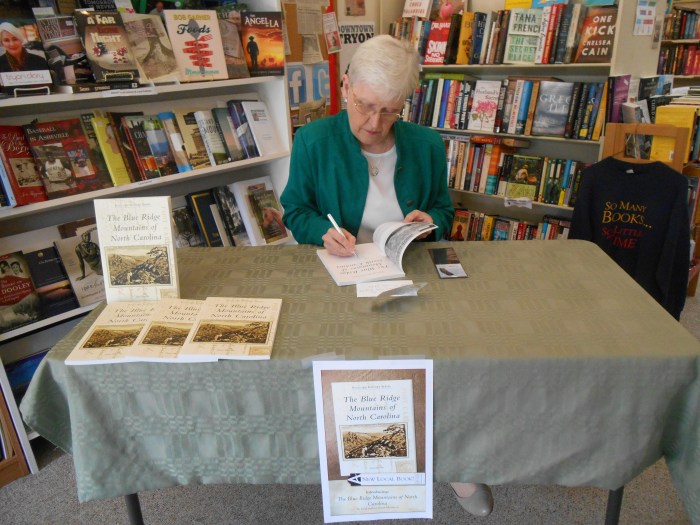
I reluctantly got on Facebook after feeling like I was missing out on some local happenings, but I soon took the plunge and set up a second Facebook page for Janet Morrison, Writer. When I was feverishly visiting independent bookstores and libraries to publicize after the release of my vintage postcard book, The Blue Ridge Mountains of North Carolina, it was easy to post pictures and write posts on Facebook about those endeavors. I must admit, though, that I have neglected the Janet Morrison, Writer Facebook page since that flurry of activity. Putting more effort into that page is on my to-do list.
Janet-The Book Shelf Tryon,NC 003
Janet, autographing a copy of her book at The Book Shelf in Tryon, North Carolina.

LinkedIn

It seems to me that LinkedIn is more beneficial to someone who is either looking for a job or seeking to network with others in their field in order to move up the corporate ladder. It just does not appeal to me as a way to further my writing. Maybe I’ll see it differently later in my journey.

Google+ and Instagram

During my recent illness flare, I was invited to join Google+. I was told last week that Instagram is easier than Facebook. Looking into both of these platforms is on my ever-growing to-do list.

My conclusions

My conclusions after trying to educate myself about social media are as follows:
1. I can’t possibly use all social media platforms;
2. I don’t need to use all social media platforms;
3. There are social media platforms out there that I haven’t heard of;
4. There will always be new social media platforms introduced for me to consider, so I will forever be playing catch up;
5. I should find the social media platforms that I’m comfortable with and that best meet my needs and concentrate my efforts there; and
6. After accomplishing #5 (that’s “number 5”) I can get back to my writing — which was the point in all this to begin with!

10 random facts about me

Liebster Award

In my blog post a couple of days ago, I wrote about being nominated for the Liebster Award. One of the requirements was that I post 10 random facts about myself. I put that off until today, for reasons that will become more clear when you read my list. I have tried to keep my limited energy a secret from my readers, but it is time to “come clean.”

1. I have what is called Chronic Fatigue Syndrome (CFS) in the United States but is known as Myalgic Encephalomyelitis (ME) in the rest of the world. My energy and stamina are limited, and my memory problems and mental fog make my research and writing tedious and time consuming. I often feel as if I live in a vat of molasses. Nothing comes easily.

2. I started working on the manuscript of my proposed historical novel, The Spanish Coin, in 2005. I am still tweaking it.

3. As a young adult, I was a “fiction snob.” I thought there was nothing to learn or gain by reading fiction. You can imagine how shocked my sister was when, at the age of 48 in 2001, I told her that I had registered for a fiction writing class! That’s when I started learning to write fiction.

4. Although my appearance, manner, and personality give the impression that I am conservative, I am a liberal when it comes to politics.

5. After wanting to play the Appalachian lap dulcimer since first being introduced to the instrument as a college freshman, I finally purchased one and attended a four-day dulcimer workshop in 2010. Due to random fact #1, I still don’t play well and probably never will; however, I do play for my own enjoyment. I often listen to dulcimer music while I write. (I’m listening to some as I write this blog post.)

6. I live on land that has been in my family since the 1760s.

7. I sleep in a bed that my father made of pine from our land in the 1940s.

8. I wish I could sing.

9. I could drive a tractor before I was old enough to drive a car.

10. Taking the fiction writing course and attending the dulcimer workshop were life-changing experiences for me, and I will forever be grateful that I got out of my comfort zone and took advantage of both opportunities.

No matter your age, stretch yourself and follow your dreams. What do you have to lose?

Liebster Award

Thank you, philipcraddock.wordpress.com for nominating me for the Liebster Award! Please take a look at the Philip Craddock Writing Portfolio blog. Philip writes short stories, poetry, and songs.

Liebster Award

If you are unfamiliar with the Liebster Award, you can read all about it at theglobalaussie.com. In a nutshell, the purpose of the award is to connect with bloggers and discover new blogs, particularly those of us with fewer than 200 followers.


My favorite blog

In keeping with the rules of the Liebster Award, I want to tell you a little about my favorite blog, https://journeywithsarah.wordpress.com/. In this blog, Sarah’s mother chronicles her teenage daughter’s journey as she battles cancer.

Sarah and her mother show remarkable courage and positivity even as they know the teen’s time is limited. Sarah has fearlessly tried every treatment her oncologists have recommended. Some have worked for a short while. Others have been less successful. In the midst of all her pain and physical weakness, though, Sarah has persevered and lived each day to the fullest.

Sarah’s mother shows that same upbeat attitude and faith in God. I can’t imagine how difficult it is for a parent to hear that his or her child has cancer and then remain positive throughout the child’s battle.

What an example Sarah and her mother set for us! I only hope if the day comes that I am faced with an adversary as cruel as cancer, that I will live life as graciously as Sarah.


Random facts about me

Liebster Award nominees are asked to list 10 random facts about themselves in their post about the award. I’m working on that and plan to share those facts in my next blog post in a few days.


Blogs I follow

Another requirement of the Liebster Award is that nominees must nominate five or as many as 10 other bloggers for the award. Taking a look at the blogs I follow, I see that I don’t know how many followers most of them have, but I imagine they all exceed the 200 followers limit. In my next blog post, you will learn why I simply don’t have enough energy to contact each one of them to determine how many followers they have. I regret that I cannot fulfill this element of the award rules. I will simply list my favorite blogs and invite you to check them out. They are as follows:

  1. https://htmm.wordpress.com/
  2. https://journeywithsarah.wordpress.com/
  3. http://emilierichards.com/blog/
  4. https://thehistoricaldiaries.wordpress.com/
  5. http://raulconde001.com/
  6. http://davidsnape.me/
  7. http://honeyquill.com/
  8. http://globalconsilium.com/
  9. http://5kidswdisabilities.com/
  10. https://yummyinsidemytummy.wordpress.com/
  11. https://tech189.wordpress.com/category/technology/


Questions presented to me by Philip Craddock:

1. What is your favourite poem? “If,” by Rudyard Kipling

2. What is your biggest regret? That I waited until middle age to start writing.

3. Which country would you most like to visit/visit again? Scotland!

4. What is your favourite dessert? plain cheesecake

5. If you could travel back in time to any point in history, what time period would you visit? The 1770s.

6. If you were a superhero, what would your superhero name & your superpower be? This is way out of my usual consideration, so answering this question is a real challenge. Let’s see…. Janet the Superbird. My superpower would be that I could fly.

7. Do you have any phobias? Snakes!

8. What are your goals for 2016? Publish my historical novel, The Spanish Coin.

9. Not including your own blog, which blog would you most like other people to Follow?  https://journeywithsarah.wordpress.com/

10. What motivated you to start blogging? I wanted to share my journey as an author-wannabe, and ultimately build a platform to promote my published books.

11. What is the strangest fact about yourself that you’re willing to admit to?  My illness has my circadian clock off by about six hours, which means I’m always out of sync with the rest of my local world.

The Official Rules of the Liebster Award 2016

As required, I am listing the 2016 rules for the Liebster Award as found at http://theglobalaussie.com/.

“Back in 2011 the rules were a simple case of acknowledgement of the nominator and to nominate 5 more. Now in 2016 it is a little more involved!

“If you have been nominated for The Liebster Award AND YOU CHOOSE TO ACCEPT IT, write a blog post about the Liebster award in which you:

  1. Thank the person who nominated you, and post a link to their blog on your blog. Try to include a little promotion for the person who nominated you. They will thank you for it and those who you nominate will also help you out as well.
  1. Display the award on your blog — by including it in your post and/or displaying it using a “widget” or a “gadget”. (Note that the best way to do this is to save the image to your own computer and then upload it to your blog post.) At the bottom of this post I’ve included a whole lot of images you can use for your 2016 Liebster Award.
  1. For the 2016 Liebster Award I will be shaking things up! Write a 150-300 word post about your favourite blog that is not your own. Explain why you like the blog, provide links.
  1. Provide 10 random facts about yourself. (This year I’m making this optional. If you wish to engage with your readers it’s a great idea to include random facts about you.)
  1. Nominate 5 – 11 blogs that you feel deserve the award, who have a less than 200 followers. (Note that you can always ask the blog owner this since not all blogs display a widget that lets the readers know this information!)
  1. List these rules in your post (You can copy and paste from here.) Once you have written and published it, you then have to:
  1. Inform the people/blogs that you nominated that they have been nominated for the Liebster award and provide a link for them to your post or mine if you don’t have all the information so that they can learn about it (they might not have ever heard of it!)”

My energy wanes and it is now the wee hours of the morning here in North Carolina. I hope you’ve enjoyed today’s post as much as I enjoyed writing it. It took me a little out of my comfort zone, which was a good exercise.

Watch for my next blog post in which I will list 10 random facts about myself.

Janet Morrison


Accents in fiction writing

One of the multitude of issues I’ve faced while writing the manuscript for my historical novel tentatively titled The Spanish Coin, is how to use accents. When I started writing fiction, I tended to go overboard with accents. It has been a long process of learning just how much to incorporate accents into my writing, and I’m not confident that I have it right yet.

Scottish & Scots-Irish

Most of my characters either hail from the lowlands of Scotland or present-day Northern Ireland or are first generation Americans whose parents came from those places. In writing for such characters, one needs to strike a balance between using accents too much or too little.

In The Spanish Coin, I want the reader to know the accents of my characters without those accents being a distraction. If an accent or dialect pulls the reader out of the story, it works as a detriment instead of adding flavor to the reading.

African-American

George is an African-American slave in The Spanish Coin. The year is 1771 in the Carolina backcountry. When answering a question, I have George say, “Yessum” or “Yessuh” instead of “Yes, mam” or “Yes, sir.”

Clarissa is a free woman of color in my novel’s manuscript, so she speaks with less of an accent than George or the slave, Caesar, from a nearby farm. Subtle distinctions make each character’s personality shine through.

French

One of the characters I enjoyed creating for The Spanish Coin is Monsieur Jean LeBlanc of France. He passes through on his way to and from Salisbury, North Carolina and Charles Town, South Carolina. His accent was fun to write. When writing or reading his dialogue, I invariably hear the voice of French chef Jacques Pepin in my head.

Summary

Part of the joy of writing historical fiction is selecting words and accents from a particular time and place. The challenge is to use those words and accents enough — but just enough.

What I read (or attempted to read) in March

My blog topic today was supposed to be “What I read in March,” but a more accurate title is “What I read (or attempted to read) in March.”

Considering the fact that March had 31 days, it is particularly frustrating that I only read one complete book: Miss Julia Delivers the Goods, by Ann B. Ross.

Ann B. Ross’s Miss Julia Books

In case you aren’t familiar with Ann B. Ross’s Miss Julia series of novels, they are set in western North Carolina and revolve around the misadventures of Miss Julia, a widow with a big heart and a penchant for getting herself into predicaments. For Rocky River Readers Book Club on March 21, we were each asked to read a Miss Julia book of our choice. It had been several years since I’d read one, so I enjoyed getting reacquainted with this fictional character.

Books I Attempted to Read

Due to health circumstances beyond my control, including almost daily vertigo, I was unable to read very long at a time or with any regularity. The result was a number of half- or quarter-read books that had to return to the library.

A few of the books I started reading in March include: Raising Ryland: Our Story of Parenting a Transgender Child, by Hillary and Jeff Whittington; B is for Burglar, by Sue Grafton; The Family Tree, by Karen Branan; Forgotten Seastress, by Liz Trenow; Forsaken, by Ross Howell, Jr.; and King’s Mountain, by Sharyn McCrumb.

I look forward to finish reading each of these book eventually, but not until my head stops spinning and my eyes quit jumping.

Happy reading to each of us in April!

3 plotline considerations

In my blog on March 25, 2016, I wrote about my writing instructor, Judith H. Simpson. Taking her fiction writing course at Queens University in Charlotte in 2001 was a life-changing experience. Writing the 95,000-word manuscript of a historical novel with the working title The Spanish Coin has brought me much joy. When I started my writing journey, I didn’t even know what I didn’t know. Some days, I think that’s still true.

Today’s blog post looks at some of the things Judy taught about plotline. She said in developing a plotline a writer needs to consider the stakes, “that dreaded middle,” and plausibility.

No matter which genre, a book’s main character must have something at stake. Something the main character holds near and dear must be at risk.

Pics for Blog 008

Chances are the writer has the book’s beginning and end well in hand before “that dreaded middle” comes together. The main character must take two steps forward and one step back throughout the middle portion of the novel. Every time the main character makes progress, that forward movement must be met with a setback.

Is the plot plausible? It cannot sound contrived. When the reader finishes a book, he must be able to look back and know that the manner in which the main character went about solving her problems, dealing with conflicts, and meeting her challenges was logical.

Without high stakes, a compelling middle, and plausibility, the reader will be disappointed in the plot and, therefore, will not be satisfied when he finishes the book — IF he finishes it.

I invite you to also follow my writing journey on Pinterest www.pinterest.com/Janet5049, where I have various boards pertaining to writing and some of my other interests.


The value of a good writing teacher

It was my privilege in 2001 to take a fiction writing course through the Continuing Education Department at Queens University in Charlotte. The instructor was Judith H. Simpson. Judy was a jewel and a natural-born teacher. She always had time for each of her students, and she organized and moderated the Queens Writers Group — a group that any of her former students were eligible to join.

When I get stuck, bogged down, confused, or just need a little encouragement in my writing life, I can turn to the words Judy left behind in her book (Foundations of Fiction), my notes from her class, e-mails from her that I printed and kept, or postings she made on our yahoo group’s site.

Judy Simpson's book cover 002

Judy had a way of explaining things in a nutshell and giving examples that clearly illustrated the points she was making. She delighted in seeing her students improve and succeed. I wish Judy were still here to nudge me along to get a literary agent and get my historical novel, The Spanish Coin, published.

It has been my experience that most writers are happy to share what they have learned with those of us who are still just beginning our journeys as writers. If you aspire to be a writer, I hope you will find a writing instructor/mentor like Judy Simpson. Through her class and caring, Judy helped me to take my first steps as a writer. She gave me the confidence to keep putting one foot in front of the other and to keep writing after she was gone. Come to think of it, is that not the true definition of a teacher?

The art of writing an essay

There are many rules in writing, and an essay is a specific type of nonfiction. As I prepare to write a piece to enter in the “Able in This Diverse Universe” Essay Competition in support of Four Paws for Noah, I needed to refresh my memory about the basic rules of writing an essay.

Four Paws for Noah

(Image copied from November 5, 2015, http://honeyquill.com.)

Since my modus operandi of late is writing fiction, I turned to the internet for a quick reminder of the rules for writing an essay. In today’s post, I will share some of what I found.

In a nutshell, the first paragraph contains a one- or two-sentence thesis statement, why that thesis is important, and how you plan to defend your position. The body of the essay is made up of paragraphs that lay out your thoughts on the topic. Each body paragraph should begin with a topic sentence. The closing paragraph is your conclusion. It summarizes the essay’s arguments.

That’s all well and good, but I need a little more detail.

The University of Canberra website, http://learnonline.canberra.edu.au, is detailed even to the point of recommending that the academic essayist “do the math.” The introductory and conclusion paragraphs should constitute 20% of the essay’s word count. Take the contest’s word limit and subtract 20%. The remaining number of words are available for the body of the essay. Divide that number by 150, which is the average length of an academic paragraph. These instructions take the fun out of writing. Since math has never been my forte, the thought of having to plug percentages into my writing makes me cringe.

Hoping to find less rigid guidelines, I continued my internet search. This is what I concluded:

  1.  Research topic;
  2. Summarize primary sources;
  3. Determine your stand on topic (and why the topic matters to you), and formulate thesis statement;
  4. Thesis statement should prompt reader to know that you are going to try to convince him or her of something and make them curious to see how you go about that;
  5. Keep in mind that presenting your thoughts and analysis of material at hand is more important than how well you demonstrate your ability to summarize the thoughts of others;
  6. Organize your notes and thoughts into categories, including counterarguments;
  7. Taking your experience and research into consideration, make a case for your original ideas on the subject;
  8. If you don’t have an original thought on the topic, if your stance has no opposition, or if your stance has overwhelming counterargument — don’t write the essay;
  9. Hone your thesis as you write drafts of your essay;
  10. Map out your essay;
  11. In the body of the essay, persuade the readers — usually using deductive or inductive reasoning — and by anticipating the reader’s questions;
  12. After presenting counterarguments, be sure to reaffirm your position; and
  13. Give close attention to your conclusion, for it is important.

No matter how I approached this, I felt burdened by rules. Writing an essay for Four Paws for Noah should prove to be good exercise for my writing muscles because this is going to be much different from writing fiction. For the sake of Four Paws for Noah, I hope I can get my act together and pull it off.

A renewed urgency to write

I have a renewed urgency to write, to get my historical novel manuscript for The Spanish Coin in the best shape possible, and secure the services of a literary agent to help me get the book published. Just three days after Christmas, one of my first cousins died after a 48-hour illness. Another one died this week. Three have died in the last 10 months. Life is short.

What made my cousin’s death in December different is that he was only five months older than I. Wally’s death was a wake-up call for me. I believe I will value each day in 2016 more than I did in 2015.

Carpe diem!

Thomas Lee Dulin’s Daybooks

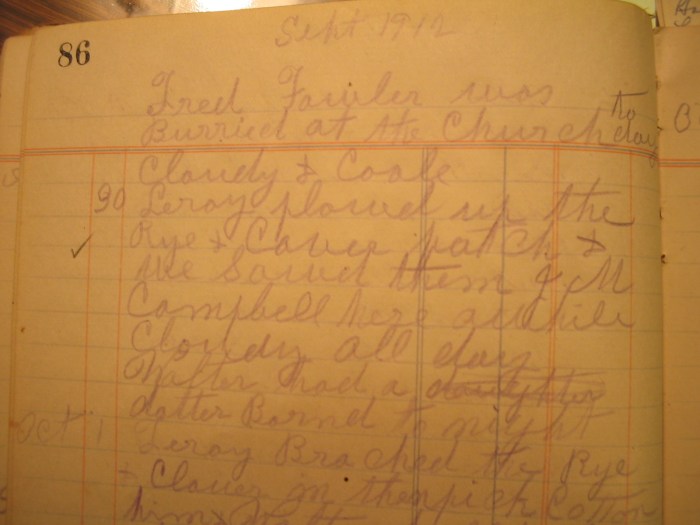
One of my great-grandfathers, Thomas Lee Dulin, kept a daybook almost every day from 1891 until 1914. Perhaps the roots of my desire to be a writer can be found in that part of my gene pool. Being born in rural North Carolina in 1842, Great-Grandpa did not have benefit of a great deal of education. For that reason I especially admire him and appreciate the fact that he sat down with his pencil and ledger and wrote nearly every day. He seldom used punctuation and his spelling was not perfect, but he probably did not have a dictionary. He made the effort almost every day, and by doing so left a great example for me to follow suit.

IMG_0075

Great-Grandpa wrote about the weather (which was of utmost importance to him as a farmer) and what was being done on his farm in Mecklenburg County, North Carolina. He noted the going price for a pound of cotton in Charlotte and surrounding markets because cotton was his main cash crop. If a neighbor stopped by to visit, he made a record of that.

According to official records, Great-Grandpa enlisted in Company H, 35th Regiment, North Carolina Troops in 1861. He gave his age as 21, although he was just 18. As a veteran of our country’s civil war, he made note of the anniversaries of the two main battles in which he participated – New Bern and Richmond. He was wounded in the left shoulder at Malvern Hill in the seven-day Battle of Richmond.

Some years ago, my mother and sister painstakingly hand-copied Great-Grandpa’s daybooks. Without realizing that today was the 154th anniversary of the Battle of New Bern, I checked that transcription to see what was going on in Thomas Lee Dulin’s world through the years on March 14. It was sobering to read his daybook entry for March 14, 1899: “37 year today I was in the Battle of Newbern, N.C.” Although in the interim he had married, been widowed at the age of 38, and left to raise his six surviving children, March 14, 1862 was forever engraved in his memory.

As the years went by, Great-Grandpa almost never failed to mention on March 14 how many years it had been since the Battle of New Bern. Oral history is valuable, but sometimes the stories get changed as they are passed down from one generation to another. The written word, especially when kept daily in a daybook, journal, or diary is a powerful record that we can hold in our hands and refer back to in order to make sure we get the facts right. My great-grandfather’s daybooks are a family and local treasure housed in the North Carolina Collection at the main branch of the Charlotte Mecklenburg Library in Charlotte, North Carolina.