As a Reader of Historical Novels, Do You Read the Author’s Notes Before or After you Read the Book?

Do you like having Author’s Notes at the end of an historical novel so you’ll know what was true, what was fiction, and what actually happened but was adjusted time-wise or by location to fit the flow of the story?

The Author’s Notes are almost always found at the back of an historical novel. I used to wait and read the Author’s Notes after I had finished reading an historical novel, but now I always read those notes first. The notes not only give insight about the story, but also make clear which parts of the book are based on fact and which parts are fictional.

Do you read the Author’s Notes before or after you read an historical novel?

An example from my ghost story

I thought it only fitting to include Author’s Notes at the end of my short story: Ghost of the Battle of Guilford Courthouse: An American Revolutionary War Ghost Story. In case you haven’t purchased the short story yet, here is my Author’s Note from the ghost story:

“I’ve never believed in ghosts, but this story is based on the events my sister and her housemate experienced in their condominium in Greensboro, North Carolina in the 1980s. The upstairs commode would flush when no one was upstairs. Cans occasionally fell off the pantry shelf. A house guest was frightened by the sensation that someone had walked into her bedroom and stood at the foot of the bed. In fact, she thought this person had called her by name – Mary. She had no knowledge of the unexplained incidents the residents had experienced.

“Peter Francisco was an actual American soldier in the Battle of Guilford Courthouse. At six-feet-six-inches tall and 260 pounds, he was much larger than the average American man during that era. He was credited with being ruthless with his broadsword. There is a visitors’ center on the grounds of the Battle of Guilford Courthouse; however, the rest of the story is fiction.”

After reading my Author’s Note, are you more interested or less interested in reading my ghost story?

Since my last blog post

I’ve edited three of the historical short stories I drafted a few months ago. I took inventory of my historical short stories. I want to write five more from scratch before I publish the collection. Something to look forward to in 2024!

I’ve done more research about the colonial settlement of Bethabara, North Carolina and read more resources about Shallowford on the Yadkin River. This is needed research for my first historical novel. Something else to look forward to!

Until my next blog post

If you haven’t subscribed to my newsletter through my website, https://www.janetmorrisonbooks.com, please do so before you miss any more newsletters. The next one will go out around November 1. For subscribing, you’ll receive a free downloadable copy of “Slip Sliding Away: A Southern Historical Short Story,” so you can get a feel for my historical fiction writing. I have a “field trip” planned before October is over, but you’ll have to subscribe to my newsletter to hear about it.

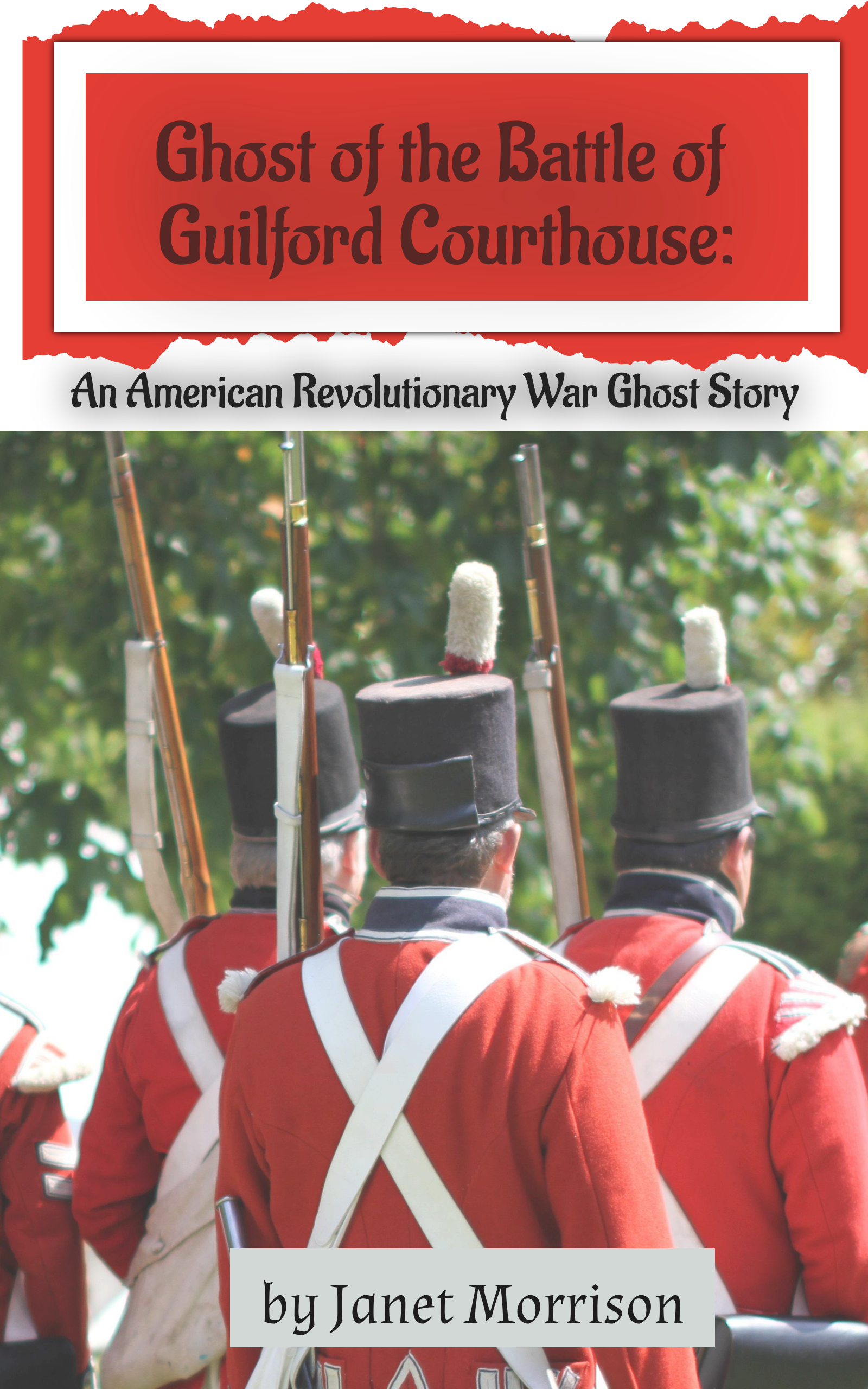
Have you ordered my American Revolution e-ghost story?  “Ghost of the Battle of Guilford Courthouse: An American Revolutionary War Ghost Story” is available from Amazon, along with my other books: https://www.amazon.com/dp/B0CH7JCP11/. October is the perfect time to read a ghost story!
Anytime is the perfect time to purchase a cookbook! Have you ordered your copy of The Aunts I the Kitchen: Southern Family Recipes? Order one for yourself and one for each of your aunts at https://www.amazon.com/dp/B0CJLKFDPR/. (It’s not too early to start your Christmas shopping.)

Make time for your friends and family.

Remember the people of Ukraine and Israel. Terrorism has no place in our world.

Janet

To Write or Not To Write Historical Short Stories? What do you think?

Calling all historical fiction fans: I need your help with something!

I mentioned in May 1, 2023 blog post, Some of the Books I Read in April 2023 that I was toying with the idea of writing some historical short stories related to the historical novel I’m working on. I’d read that suggestion in Writing Short Stories to Promote Your Novels, by Rayne Hall as a way to create interest in the characters in one’s novel before that book’s publication.

Since I need to grow my mailing list greatly before I publish the novel, it appears I’ll have plenty of time to write a few short stories. The process should produce various benefits to me and my potential readers.

Photo by Aaron Burden on Unsplash

In addition to my novel readers getting a head start in learning about some of the book’s characters and the 18th century world in which they live, such writing will help me flesh out the characters and get better acquainted with them. You and I can both get a good grasp on what makes them tick.

I’ve been brainstorming ideas for the stories. If it all works out like I envision, I will self-publish the stories in an ebook collection. My timeline is written in pencil with a big eraser nearby. If nothing else in the last year of self-publishing two local history books and trying to self-publish a family cookbook, I’ve learned that flexibility is a necessity.

Readers, what do you think? If you’re a fan of historical fiction, let me know what you think of this project. Would you enjoy getting acquainted with some of the characters in my novel(s) and the world in which they live in the 1760s and 1770s before getting to read the novel(s)?

Characters such as Elizabeth Steele who had tavern in Salisbury, North Carolina? George, who was a slave in The Waxhaws in South Carolina? Oliver McNair, who was educated at the College of William and Mary in Williamsburg, Virginia, and ended up in The Waxhaws? Betty Jackson’s story of family obligations in The Waxhaws?

Would you be interested in reading such short stories while I continue to work on my novels?

In the meantime… if you haven’t subscribed to my newsletter yet, please visit my website at https://www.janetmorrisonbooks.com and click on the “subscribe” button. In return, you’ll receive a free downloadable copy of my first historical short story, “Slip Sliding Away” and you’ll receive my e-newsletter every other month. Do it right now!

Since my last blog post

My research last week for my historical fiction writing focused on how food was cooked in the southern colonies in the 1760s and 1770s. I have a growing appreciation for how time consuming it was to prepare a meal then.

A funny thing happened to me at the public library the other day. I had been given some soft mountain mint and was eager to find a book with good information about how to root it. I typed, “how to grow mint” in the library system’s search engine. The response I received was, “Nothing found for how to grow mint. Did you mean ‘how to grow marijuana’? View 13 results.” It’s sort of a sad commentary that the system has no books about how to grow mint, but 13 books on how to grow marijuana. a sign of the times, I suppose. (Before you try to enlighten me, yes, the library had plenty of books about growing herbs. I just started by looking for one specifically about mint.)

Until my next blog post

Take time on this Memorial Day in the United States to remember and give thanks for those who gave their lives in the military service of our country.

I hope you have a great book to read.

Take time to enjoy friends and family.

Remember the people of Ukraine.

Don’t forget to give me some feedback about my short story plan!

Janet

Three Compelling Books I Read in February 2023

After a couple of months of not getting to read much for pleasure, February turned out to be just what I needed to get back in the habit of reading. My favorite genre, historical fiction, really came through for me last month.

The Diamond Eye, by Kate Quinn

The Diamond Eye, by Kate Quinn

I listened to this historical novel on CD. I was spellbound from disc one until the very end of disc 11. I yearn to write historical fiction so vividly. I long to captivate readers with fiction based in an era not their own. Kate Quinn has established herself as a master of the art and craft of writing historical fiction.

The Diamond Eye is based on a true story. Mila Pavlichenko lives in the part of the Soviet Union that is now Ukraine. She works at a library and adores her young son. When World War II transitions to the invasion of Russia by Nazi Germany, Mila does the unthinkable. She becomes a sniper for the Russian Army. And she excelled at it.

After her official kill count reaches 300, Mila becomes a national heroine and is sent on a tour of the United States to drum up support for the fight against Hitler. There, she meets President and Mrs. Roosevelt. Eleanor Roosevelt, seeing a bit of her own independent nature in the sniper, befriends Mila.

The book follows Mila through the war and how she constantly has to prove herself because she’s a woman and not automatically taken seriously. She’s called the usual names that men who are threatened by strong women call them.

It is a stunning novel and reminded me why I enjoy reading historical fiction. Yes, it’s fiction because conversations are imagined, but reading well-written historical novels is an enjoyable way to learn a lot of history.


The Home for Unwanted Girls, by Joanna Goodman

The Home for Unwanted Girls, by Joanna Goodman

This is another gripping historical novel. I was so impressed by Saskia Maarleveld’s reading of The Diamond Eye, that I looked for other books she had recorded. That’s how I found The Home for Unwanted Girls. I thought that was an interesting way to find another good book!

The Home for Unwanted Girls is about an unwed mother in Quebec in the 1950s who is forced by her parents to give up her baby girl. The book shines a light on the ugly history of the orphanage system in Quebec at that time. When the orphanage is turned into an insane asylum and the orphans are forced to take care of the patients, the outcome for the girls seems hopeless.

This novel follows the life of one of those orphans and the 15-year-old mother who wanted desperately to keep her. The mother never gives up on finding her child, even though she is told the girl died.


The Escape Artist: The Man Who Broke Out of Auschwitz to Warn the World, by Jonathan Freedland

The Escape Artist, by Jonathan Freedland

This book was spellbinding! It tells the stories of 19-year-old Rudolf Vrba and Fred Wetzler who did the impossible in April 1944. They escaped from Auschwitz! The book tells how Vrba studied the precision with which the Nazis conducted searches and exactly how long the guards searched when a prisoner was unaccounted for. He and Fred worked with two accomplices to plan the escape of Vrba ad Wetzler. Their two accomplices were to stay behind while Vrba and Wetzler escaped to take the truth of what was happening at Auschwitz out into the world.

It’s a fascinating read. It follows Vrba and Wetzler after their escape. The eye-opening part of the book was the aftermath of their escape. They testified and provided written descriptions of the horrors of Auschwitz. Their testimonies matched to the nth detail; however, their words and their physical conditions of malnutrition fell on deaf ears.

Winston Churchill didn’t want to bomb the rail lines going into Auschwitz because England bombed in the daytime. President Franklin D. Roosevelt didn’t want to bomb because it would be a diversion from plans. Jewish organizations in Europe refused to believe what was happening at Auschwitz because it was just too extreme. How can people do such things to their fellow human beings?

Along with the tragic murdering of Jews at Auschwitz, the fact that world leaders who had the power and where withal to do something about it in fact chose not to act is a gut punch.

My general takeaway from the book is that one’s life and future can be determined by someone else’s snap decision. Decisions were made on a whim by guards at Auschwitz every day that determined who lived, who died, and who escaped.

It’s a book that will haunt me.


Since my last blog post

I continue to try to get the word out about my second local history book, Harrisburg, Did You Know? Cabarrus History, Book 2.

I also continue to ask people to go to my website, https://www.janetmorrisonbooks.com and subscribe to my newsletter. Subscribers receive a free downloadable copy of my first historical short story, “Slip Sliding Away: A Southern Historical Short Story.”

“Slip Sliding Away: A Southern Historical Short Story,” by Janet Morrison

Until my next blog post

I hope you have a good book to read. I know where you can get a good historical short story to read!

Take care of one another.

Remember the people of Ukraine.

Janet

To Nitpick or Not to Nitpick? That is the Question.

Are you as surprised as I am to learn that the word “nitpicking” first came into use in 1956? That means I’m older than the word nitpicking!

          It also means I can’t use “nitpick” or any form of the word in my historical fiction writing.

Nitwit

          One of my characters wanted to call another character a nitwit. That’s what led me to my discovery about nitpicking. It turned out that I can’t use nitpick, nitpicking, or nitwit in my historical fiction writing, unless I move my stories from the 1760s to the 1960s. That’s just not possible, unless I plunge my characters into a time warp.

          In case you care, “nitwit” wasn’t in common usage until around 1922. I don’t propose that you or I call people hurtful names, but I can’t help what my fictional characters do or say.

Guidelines for historical fiction

          There are words we use in everyday life without giving (or needing to give) any thought to their origins. That would make life beyond tedious. That’s not what I’m talking about here.

Photo by Brett Jordan on Unsplash

          As a writer of historical fiction, I must be careful not to include a word not in common usage at the time of my short story or novel. If one of my 18th century characters used the word “nitwit,” you might not notice; however, if one of my 18th century characters said “telephone” it would yank you right out of the story and it would ruin my credibility. It is through that process of checking on certain words that I’ve happened upon many surprises.

          My surprises fall all along a spectrum. There are words such as nitpick that I would’ve guessed had been in use for centuries. On the other hand, I didn’t expect that the term “fast lane” was in common use before the year 1050. (That’s not a typo. The year 1050.) After seeing that while I was looking up a different word, I began to doubt myself and wondered if I needed to look up every word I wrote.

          Of course, that’s not practical. By writing about this today I’ve probably opened myself up to a great deal of scrutiny when my historical short stories and my first historical novel are eventually published. Knock yourself out! I’m doing the best I can.

Concerted effort

          Today’s blog post falls into the same quirky category as an earlier one. In the title of one of my 2018 blog posts I asked if an individual can make a concerted effort. The point of that post was that by its very definition it takes two or more people working together to make a concerted effort.

          One of my blog readers took me to task on that one. She insisted that she always made a concerted effort in everything she did. She seemed insulted by my blog post and missed my point.

          It wasn’t my intent to insult anyone or hurt anyone’s feelings. I was merely pointing out a nuance in the English language. I’m attempting to be a writer. It comes with the territory.

          Words are fascinating!

Until my next blog post

Keep reading books.

When you read a good book, be sure to tell the author by writing a review or even writing a letter to the author. You should be able to reach them through their website.

Remember the brave people of Ukraine. It saddens me that only 49% of registered voters in North Carolina voted in the mid-term election last Tuesday. Democracy is a fragile thing. We don’t have to share a border with Russia to know that.

Thank you for reading my blog today! I hope to see you here again next Monday.

Janet