I write southern historical fiction, local history, and I've written a devotional book. The two novels I'm writing are set in Virginia and the Carolinas in the 1760s. My weekly blog started out to follow my journey as a writer and a reader, but in 2025 it has been greatly expanded to include current events and politics in the United States as I see our democracy under attack from within. The political science major in me cannot sit idly by and remain silent.
Today is Memorial Day in the U.S. Take time to think about the members of our armed forces who have given their lives since 1775 so we can live in a free country.
Photo by Janne Simoes on Unsplash
Memorial Day used to be on May 31, but then the American people got spoiled and didn’t want a holiday to fall willy-nilly on just any day of the way, so now we remember our citizens who have died on the battlefield on a Monday so we can combine it with trips and furniture and car sales.
No excuse is too small for retailers to make a buck on such a sacred day.
My guess is that most Americans have no idea what Memorial Day is really about. When I hear someone say, “Happy Memorial Day,” I have to shake my head. What is happy about a day of remembrance of our war dead?
Since Memorial Day falls on May 25 this year, it shares the day with the opening of the 1777 Constitutional Convention in Philadelphia.
After we declared our independence from Great Britain, we needed a framework for a government to replace the monarchy. The Articles of Confederation were adopted by the Continental Congress in November 1777. It was in that document, penned by John Dickinson of Delaware, that the name “United States of America” first appeared.
The Continental Congress continued to govern the new country through the end of the Revolutionary War.
Janet
The government should be afraid of its citizens, not the other way around.
Every year on May 20 or sometime that week I blog about the Mecklenburg Declaration of Independence. It was signed on May 20, 1775 – a full year before the national declaration.
Unfortunately, the original copy was lost when John McKnitt Alexander’s house burned. The writers and signers got together after the fire and reconstructed the document from memory.
Since the original copy was lost, there are naysayers today. I don’t know what their motives are, but they insist on seeing the original in order to believe it existed. A newspaper account in the Raleigh Register on April 30, 1819 does not suffice as proof for them.
There has never been any love lost between Raleigh – the State Capital – and Charlotte (in Mecklenburg County), so I find it surprising that a Raleigh newspaper ever acknowledged the document. For a newspaper in Raleigh – of all places – to do so only indicates to me a level of certification.
May 20, 1775 was added to the North Carolina state flag in 1861, so there must have been a high degree of belief that the document was real. Again, with the historical seat of power in North Carolina being in the eastern part of the state, the legislators would not have been quick to given Mecklenburg County any credit on the state flag.
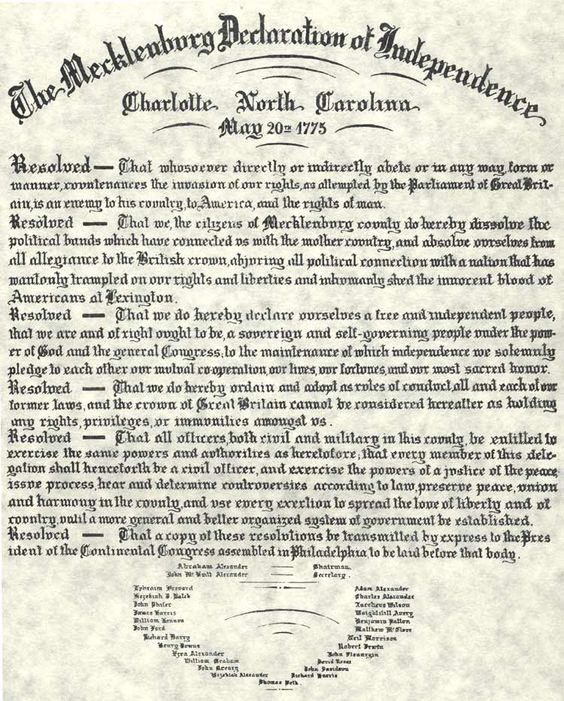
Here is the wording of the Mecklenburg Declaration of Independence, as it was recreated after being lost in a fire, and as it is found in The Hornet’s Nest: The Story of Charlotte and Mecklenburg County, by LeGette Blythe and Charles Raven Brockmann, published in 1961:
That whosoever directly or indirectly abetted or in any way, form or manner countenanced the unchartered & dangerous invasion of our rights as claimed by G. Britain is an enemy to this County – to America & to the inherent & inaliable rights of man.
We the Citizens of Mecklenburg County do hereby desolve the political bands which have connected us to the Mother Country & hereby absolve ourselves from all allegiance to the British crown & abjure all political connection, contract or association with that nation who have wantonly trampled on our rights & liberties & inhumanely shed the innocent blood of American patriots at Lexington.
We do hereby declare ourselves a free and independent people – are & of right ought to be a sovereign & self-governing association, under the control of no power other than that of our God & the general government of the congress, to the maintainence of which independence civil & religious we solemnly pledge to each other our mutual cooperation, our lives, our fortunes & our most sacred honor.
As we now acknowledge the existence & control of no law or legal officers, civil or military, within this County, we do hereby ordain & adopt as a rule of life, all, each & every of our former laws – wherein nevertheless the crown of great Britain never can be considered as holding rights, privileges, immunities, or authority therein.
It is also further decreed that all, each & every military officer in this County is hereby reinstated in his former command & authority, he acting conformably to these regulations. And that every member present of this delegation shall henceforth be a civil officer, viz, a Justice of the peace in the character of a “Committee-man” to issue process, hear & determine all matters of controversy according to sd. Adopted laws – to preserve peace, union & harmony in sd. County & to use every exertion to spread the love of country & fire of freedom throughout American until a more general & organized government be established in this province. A selection from the members present shall constitute a Committee of public safety for sd. County.
That a copy of these resolutions be transmitted by express to the President of the Continental Congress assembled in Philadelphia, to be laid before that body.
Ephraim Brevard
Hezekiah J. Balch
John Phifer
James Harris
William Kennon
John Foard
Richard Barry
Henry Downs
Ezra Alexander
Charles Alexander
Zaccheus Wilson
Waightstill Avery
Benjamin Patton
Matthew McClure
Neil Morrison
Robert Irwin
John Flennegin
David Reese
William Graham
John Queary
Hezekiah Alexander
Adam Alexander
John Davidson
Richard Harris
Thomas Polk
Abraham Alexander
John McKnitt Alexander
Recreation of the May 20, 1775 Mecklenburg Declaration of Independence
Captain James Jack rode horseback from Charlotte to Philadelphia to deliver a copy of the Mecklenburg Declaration of Independence and a copy of the May 31, 1775 Mecklenburg Resolves to the Second Continental Congress. It is disputed that he made it to Philadelphia with the Declaration, but he did get there with the Mecklenburg Resolves.
Archibald and Maggie Sellers McCurdy lived in the part of Mecklenburg County that became Cabarrus County in 1792. Mr. McCurdy stood on the steps of the Mecklenburg County courthouse in Charlotte on May 20, 1775 and heard the declaration read.
He came home and told his wife, Maggie, that they needed to make a list – perhaps written, perhaps mental – of all the people in the community that they could trust. The community was dominated by patriots, but they needed to evaluate which of their neighbors and associates could be trusted in the coming inevitable war for independence.
I wrote a story about the Mecklenburg Declaration of Independence and the McCurdy’s, “Whom Can We Trust?” and included it in my book, Traveling Through History: A Collection of Historical Short Stories.
My book is available in paperback and e-book on Amazon, and the paperback is available sometimes at Second Look Books in Harrisburg, NC.
Janet
All history is local, but no history is just local
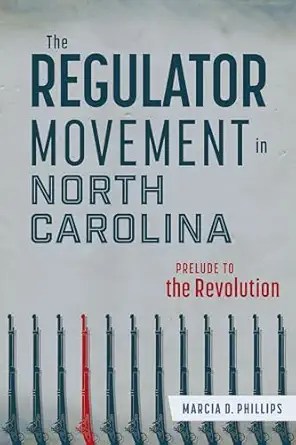
This weekend I finished reading and taking copious notes from an excellent new nonfiction book, The Regulator Movement in North Carolina: Prelude to the Revolution, by Marcia D. Phillips.
Today is National Tell a Story Day, and this nonfiction book tells quite a story!
The Regulator Movement in North Carolina: Prelude to the Revolution, by Marcia D. Phillips
If you want to know some of the little-known background leading up to the American Revolution, I highly recommend this book. As a native North Carolinian, I learned about the Regulators in North Carolina History classes; however, to read the details of it as an adult is to better grasp the terror that many residents of my state were living under in the late 1760s and early 1770s.
The author did an amazing job, like no one else I’ve read, of giving hundreds of years of history leading up to the Regulator Movement in North Carolina. She wrote about how the feudal system in Europe and even the Magna Carta laid the groundwork for what happened here in the mid-1700s!
I had never connected some of the dots that Ms. Phillips connected, but it all fits together now in my mind.
The book also does a great job of explaining the differences between the Regulator Movement in North Carolina and the Regulator Movement in South Carolina. That’s something important for me to keep in mind as I write my historical novels in progress.
Quoting from The Regulator Movement in North Carolina: Prelude to the Revolution, by Marcia D. Phillips,
“In a nutshell, the North Carolina Regulators were not attempting to overthrow the colonial government, just convince it to be the same one they had for years and true to British common law. Their actions were not intended to disrupt the law but to ensure the government’s actions were regulated, to promote uniformity and fairness. The issues of the day – excessive taxation and fees with limited recourse in the assembly, lack of justice in court rulings, and forced taxation for the Anglican Church, which none of the Regulators attended – were the sticking points but also indicative of underlying principles being violated. These discontented farmers were even willing to self-regulate if the colonial government would allow it.”
The Regulators signed petitions in an effort to get Governor Tryon to address their grievances. His appointed officials in the North Carolina Piedmont – particularly in the northern Piedmont part of the province owned by Lord Granville – were robbing the citizens blind and pocketing the money they collected.
They were sick and tired of paying tax to support the Anglican Church. They were Presbyterians and Baptists, and they wanted the right to pay their own clergy. Their clergy were not allowed to officiate over marriages or funerals. For people who had left Europe for religious freedom, this was unacceptable.
The Regulator Movement in North Carolina came to a head in Alamance County on May 16, 1771, when Governor Tryon ordered eight cannons to fire upon a group of Regulators who had asked to be heard. Under the Johnston Riot Act, Tryon gave them until noon to disperse; however, instead of arresting them at noon when they did not disperse, he turned eight cannons on them. It is called the Battle of Alamance, but it was really an ambush.
As the book gives in detail, that was not the end of Tryon’s reign of terror. He had a number of Regulators hanged and had many of their farms burned to the ground.
The book includes an extensive bibliography for readers wanting to do additional research. Thank you, Ms. Phillips, for giving us such a concise and well-researched account of the Regulator Movement in North Carolina.
Perhaps it is partly because of our current political environment that, but while reading this book, it struck me how similar Governor William Tryon of North Carolina was to Donald Trump. I’m not just referring to the fact that he built an extravagant palace for himself while in office.
Some leaders build palaces. Others build ballrooms and triumphal arches.
But it is the pattern of retribution demonstrated by Tryon and by Trump that hit me as an undeniable and frightening similarity between the two men.
Janet
The government should be afraid of its citizens, not the other way around.
My blog post from yesterday grew to be too long, so I divided it into two parts. Before reading today’s post, it would be useful for you to read yesterday’s to put today’s post into context: Is The United States of America a Christian Nation? – Part 1.
As I stated yesterday, Christian Nationalists love to say that the United States was founded as a Christian nation, but you will not find the words “Christian” or “Jesus” in the Declaration of Independence or the U.S. Constitution.
The First Amendment to the U.S. Constitution prohibits the United States from making any “law respecting an establishment of religion, or prohibiting the free exercise thereof.”
Americans, under our Constitution, are free to practice any religion they choose. They are free to practice no religion whatsoever. That is one of the bedrocks and beauties of the United States of America.
That is why I find the likes of U.S. Secretary of Defense Pete Hegseth so dangerous. As I noted in yesterday’s blog post, he sees our current war in Iran as a holy war. But the United States of America does not fight holy wars. The day we start down that road will be the beginning of our demise.
One only needs to look at the history of Europe to see how differing interpretations of Christianity in government can create great conflict. When one monarchy favors Roman Catholicism to the detriment of Protestantism… or a monarchy favors Protestantism to the detriment of Roman Catholicism we see oppression and wars.
My Presbyterian ancestors experienced that struggle in Scotland and it, no doubt, influenced them to come to America in the mid-1700s. My ancestors on the Kintyre Peninsula of Scotland had to worship in secret in the 1600s in gatherings called conventicle because the monarchy favored Roman Catholicism at the time.
(One of the historical short stories in my book, Traveling Through History: A Collection of Historical Short Stories is about the Covenanters in Scotland and how they were punished for not espousing the Roman Catholic traditions.)
In Colonial America, religious freedom and religious overreach were issues. As noted in my Author’s Notes after “You Couldn’t Help But Like Bob” story in my short story book, fines ordered by the courts in Colonial Virginia were often to be paid to the Church of England or the Anglican Church.
There was no separation of church and state in Colonial America. In Colonial North Carolina, the Episcopal church held sway over the government. It was illegal in North Carolina for a Presbyterian minister to officiate over a marriage. Marriages conducted by Presbyterian ministers were not recognized by the Royal Government. My Presbyterian colonial North Carolina ancestors were on the wrong side of the law.
It is almost impossible for 21st century Americans to comprehend how life was in colonial times. That is why it makes it so easy for Christians in 21st century America to call for the Ten Commandments to be posted on public school classroom walls and courtroom walls. They do not grasp the danger – the slippery slope – such actions can lead to.
In their hearts and minds, they think they are doing a good thing. They think they are following Jesus’ instructions found in Matthew 28:18-20: “Then Jesus came to them and said, “All authority in heaven and on earth has been given to me. Therefore go and make disciples of all nations, baptizing them in the name of the Father and of the Son and of the Holy Spirit, and teaching them to obey everything I have commanded you. And surely I am with you always, to the very end of the age.”
But Jesus did not say we are to make our governments Christian. Christianity is a personal acceptance of Jesus Christ as one’s Lord and Savior. It is not a belief to be imposed upon another human being. It is not a belief system to be used as a cudgel by a government. To see it that way is blasphemous and indicates a basic misunderstanding of Jesus Christ.
Photo by Tim Wildsmith on Unsplash
In Matthew 22:15-21 (as found in the New International Version of the Bible), the Pharisees try to trap Jesus by questioning him about paying taxes:
Then the Pharisees went out and laid plans to trap him in his words. They sent their disciples to him along with the Herodians. “Teacher,” they said, “we know that you are a man of integrity and that you teach the way of God in accordance with the truth. You aren’t swayed by others, because you pay no attention to who they are. Tell us then, what is your opinion? Is it right to pay the imperial tax to Caesar or not?” But Jesus, knowing their evil intent, said, “You hypocrites, why are you trying to trap me? Show me the coin used for paying the tax.” They brought him a denarius, and he asked them, “Whose image is this? And whose inscription?” “Caesar’s,” they replied. Then he said to them, “So give back to Caesar what is Caesar’s, and to God what is God’s.”
In Mark 12:13-17, that same encounter between Jesus and the Pharisees is recorded as follows in the New International Version of the Bible:
Later they sent some of the Pharisees and Herodians to Jesus to catch him in his words. They came to him and said, “Teacher, we know that you are a man of integrity. You aren’t swayed by others, because you pay no attention to who they are; but you teach the way of God in accordance with the truth. Is it right to pay the imperial tax to Caesar or not? Should we pay or shouldn’t we?” But Jesus knew their hypocrisy. “Why are you trying to trap me?” he asked. “Bring me a denarius and let me look at it.” They brought the coin, and he asked them, “Whose image is this? And whose inscription?” “Caesar’s,” they replied. Then Jesus said to them, “Give back to Caesar what is Caesar’s and to God what is God’s.”
Getting back to Matthew 28:18-20, yes, Jesus instructed us to spread the Gospel, but the Christians who want to force the Gospel on people by weaponizing the government with the Bible are taking the easy way out. They are taking a dangerous way out. The Bible and its words should never be used as a weapon.
Not once in the New Testament did Jesus force or instruct His followers to force His brand of religion on the government or on the people via the government.
The First Amendment to the Constitution of the United States of America
Christians have countless ways to share the Good News of Jesus Christ with others. Forcing the Gospel on people through our government is not one of them.
Janet
The government should be afraid of its citizens, not the other way around.
I don’t know if the Pledge of Allegiance is still recited in public school classrooms like it was in the 1950s and 1960s.
Photo by Cris Constantin on Unsplash
I will be 73 years old this week, and I remember standing beside my desk in elementary school, facing the American flag that hung from a wooden dowel at an angle from the wall of the classroom, putting my right hand over my heart, and reciting the Pledge of Allegiance.
I did it even before I understood the words we were saying.
I pledged my allegiance to the flag and to the republic it represented.
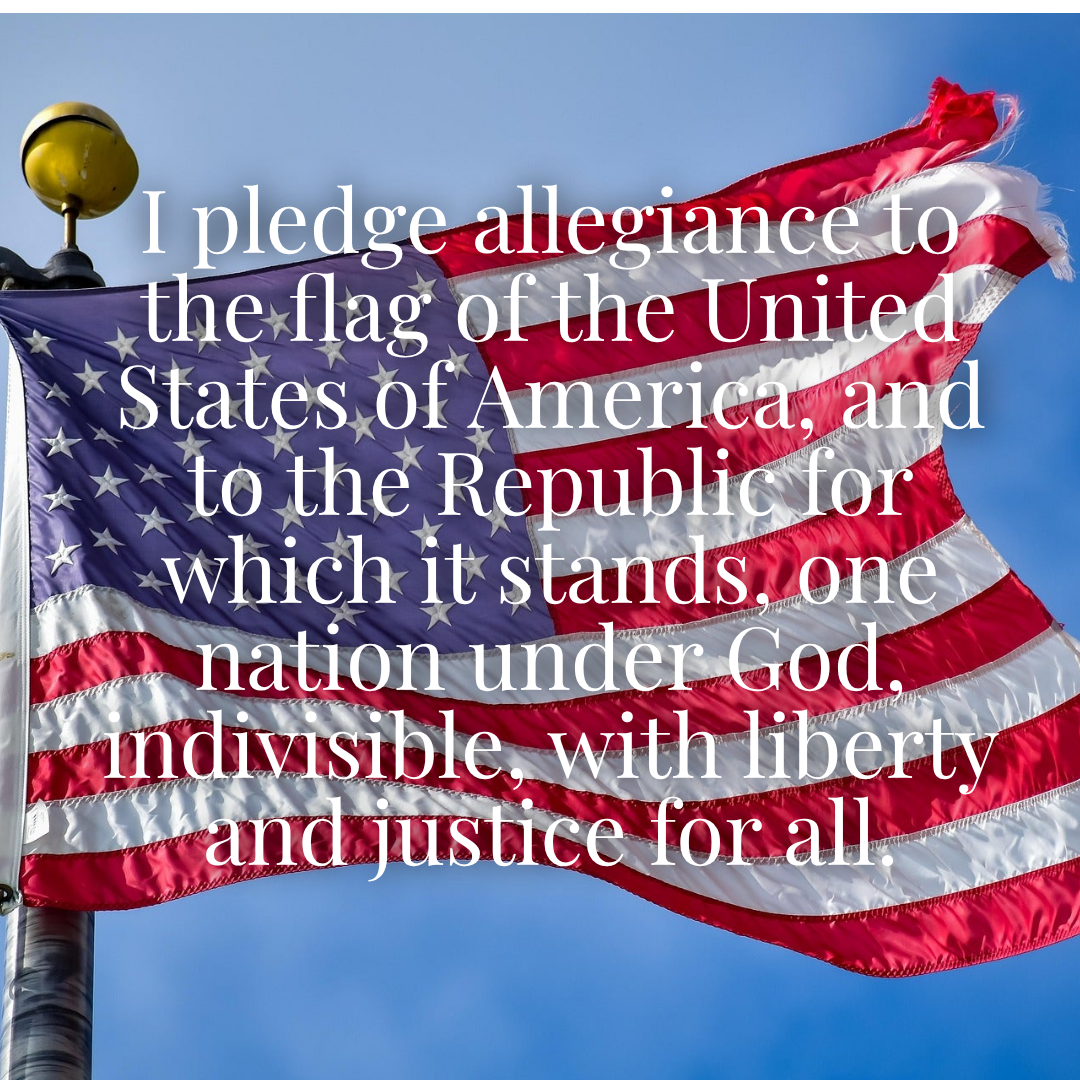
“I pledge allegiance to the flag of the United States of America and to the Republic for which it stands, one nation, under God, indivisible, with liberty and justice for all.”
My generation learned from an early age to revere the flag and to revere the ideals the United States of America strives to attain and uphold.
We were born after World War II. Yes, we are the “boomers” who the Gen X-ers make fun of. We did not yet know or comprehend the horrors of war. We had no concept of liberty and justice. We were too young to know that our country was special and unlike any other country in the world.
We slowly learned those things. We learned that all American citizens did not enjoy the same rights and privileges that we in an all-white school took for granted. We learned about civil rights by living through the Civil Rights Movement and school desegregation. We learned that all people are the same, regardless of skin pigment.
Somehow, the 31 simple – yet profound – words of the Pledge of Allegiance settled into our bones and our minds and our souls.
I might not remember what I ate for breakfast this morning, but the words of the Pledge of Allegiance still easily roll off my tongue.
Did Donald Trump ever learn the words of the Pledge of Allegiance? Perhaps it was not taught and recited in the prestigious private schools he attended in New York. I don’t know.
Did James Donald Bowman recite the Pledge of Allegiance in his school in Ohio? My hunch is that he did, even though he seems to have forgotten. You probably know him as James David “J.D.” Vance. (I still think it is a stretch to call the northeastern suburbs of Cincinnati “Appalachia,” but I digress.)
What about Kristi Noem? Was she taught the Pledge of Allegiance in the school she attended in South Dakota? Surely, she was. I know nothing about the political science department at South Dakota State University, but I question the validity of her Bachelor’s degree.
And what about Gregory Bovino? Did he learn the Pledge of Allegiance as a young student in California? I am appalled to report that he graduated from Western Carolina University and received a Master’s degree from my alma mater, Appalachian State University. This sickens me. I don’t know what his degrees are in. I pray they are not in political science. His buzzcut, his olive-green uniform, his practice of hurling tear gas canisters at protesters have allowed him to become the poster child for the crackdown on illegal immigration that the Trump regime espouses. The cross body strap his uniform includes is reminiscent of Hitler’s “brown shirts.” This is not a look that we are accustomed to seeing in the United States. On Saturday, Bovino adamantly told us that the federal agents in Minneapolis had followed their training that morning when they killed Alex Pretti. Before Mr. Pretti’s bullet-riddled body was cold, Bovino claimed that Pretti “wanted to do maximum damage and massacre law enforcement.” That’s how afraid members of the Trump regime are of a Veterans Administration ICU nurse armed with a cell phone.
What about Stephen Miller? It is ironic that he allegedly campaigned to get the Pledge of Allegiance said in his high school in California. Most of the things he says about our rights as Americans call into question the political science education he received at Duke University.
Karoline Leavitt is of a younger generation, so perhaps she never learned the Pledge of Allegiance. She often wears a necklace from which hangs a cross – a symbol of Jesus Christ. It is offensive when people wear cross necklaces or verbally claim to be followers of Jesus Christ, yet the truth is not in them.
What has happened to these people? Did the Pledge of Allegiance not settle in their bones and their souls?
The Pledge of Allegiance does not mention telling lies. That comes from the Bible. The Eighth Commandment instructs us to “not bear false witness.’ In other words, it tells us not to lie.
When a person is raised in a home where the truth is always told, that commandment becomes second nature. It becomes a core value. Telling the truth is what you do. You don’t have to pause and decide whether to tell the truth. It’s just what you do.
When a person is exposed to lies in their home or in their work place, perhaps the telling of lies becomes second nature to them.
I don’t know much about the private lives of the people in the Trump Administration, but I know they are feeding the American people and the world a lot of lies about what transpired on Saturday morning in Minneapolis, Minnesota.
They are telling me not to believe my eyes and ears.
Two days after the murder, members of the Trump regime are still defiant. They will defend the actions of the ICE and Border Patrol Officers until the end. Until the end of our democracy. They told us weeks ago that Trump’s federal agents are above the law.
They seem to have lost sight of the Pledge of Allegiance, the Declaration of Independence, the Constitution of the United States of America, and the Ten Commandments.
The United States is a country rooted in the rule of law and the ideals proclaimed in our founding documents. The political party to which Donald Trump and his regime belong claims to be rooted in the Bible. They don’t pay much attention to the New Testament, but they claim to love the Old Testament.
That’s where the Ten Commandments are found. It is in the Old Testament that we are instructed not to tell lies.
I suggest that Trump and the members of his regime take a few minutes to sit quietly and read the Pledge of Allegiance, the Declaration of Independence, the Constitution of the United States of America, and the Ten Commandments. All of this might be new literature for them, but I think taking time to read these documents and Bible verses might be beneficial for them and the nation they vowed to serve and protect.
My faith in what is being taught in the political science departments at the public and private universities in the United States is being shaken. I fear the students who were born after my college days are not being taught the tenets of democracy that I was taught in school and on the university level. I fear they are not being taught to serve the public with integrity and honesty.
I fear they were not taught that the government should be afraid of its citizens, not the other way around.
I would have much preferred to have written scene 43 in my historical novel this afternoon, but I’ve spent several hours contemplating and writing this blog post. And yet, people wonder why it is taking me so long to write my novel. My brain is being torn between 2026 and 1768.
The irony is not lost on me. The people I’m writing about who were living in North Carolina in 1768 were also rebelling against tyranny. That’s not what the novel is about, but the colonists’ patience with the English Crown was already growing thin.
Janet
The government should be afraid of its citizens, not the other way around.
Once-a-week, since November 25, I have blogged about a different story from my new book, Traveling Through History: A Collection of Historical Short Stories.
The sixth story in the book is “Whom Can We Trust? A Mecklenburg Declaration of Independence Short Story.”
Tradition tells us that Archibald and Maggie Sellers McCurdy built their log cabin in what is now Cabarrus County, North Carolina, in 1773. At that time, Cabarrus had not yet been formed out of the eastern part of old Mecklenburg County. Their house was on the National Register of Historic Places until vandals burned it down a few years ago. Sadly, I never did see the house, but I have seen photographs of it and detailed floor plans and exterior drawings have been preserved.
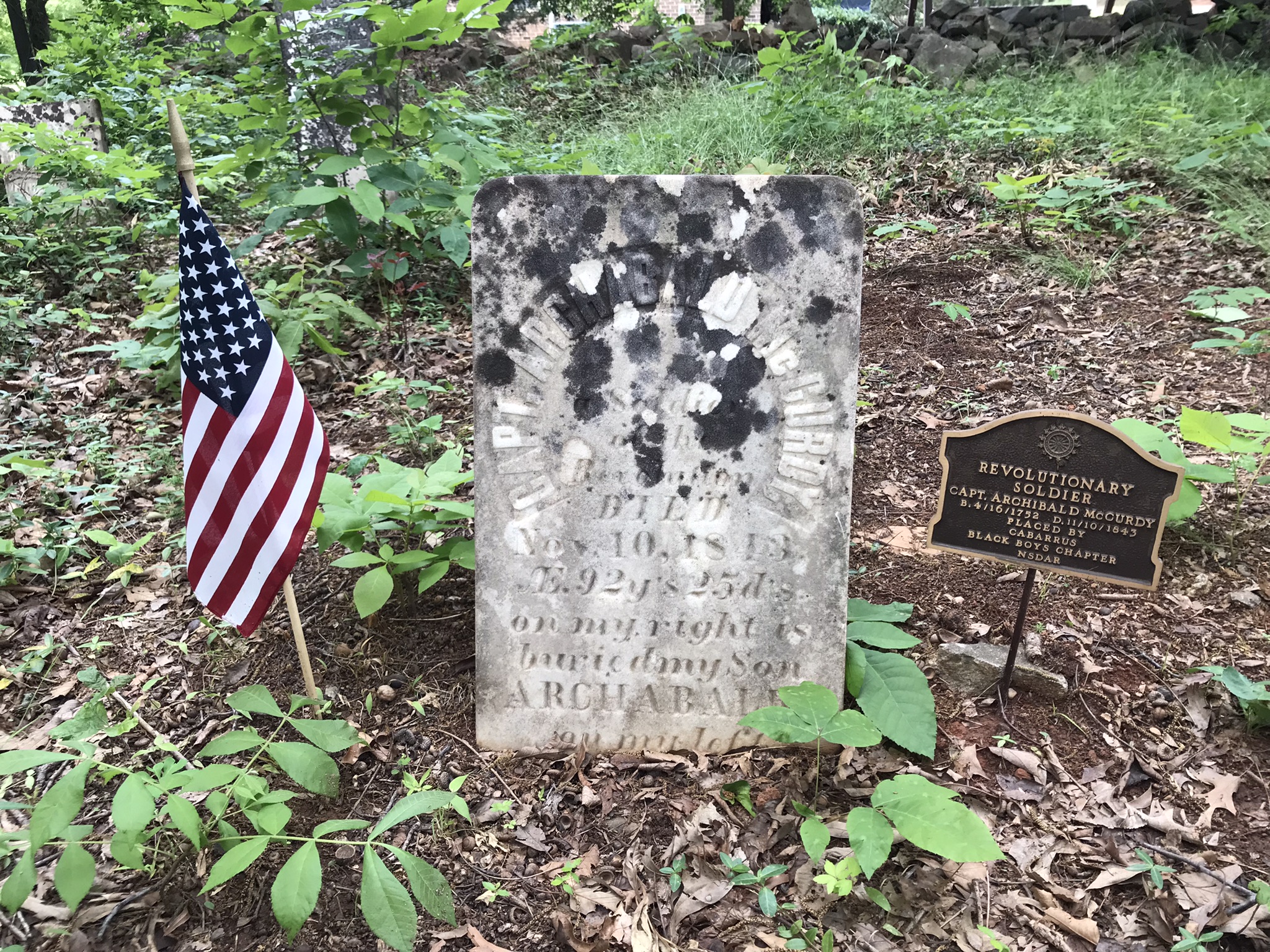
Archibald McCurdy’s gravestone at Spears Graveyard of Rocky Ri er Presbyterian Church, Cabarrus County, North Carolina
Those drawings and photographs made it easy for me to imagine the McCurdys’ lives. Theirs are names I’ve heard all my life. Archibald was a foot solider in the militia during the Revolutionary War. Maggie was a patriot in her own right, as she earned the name “She-Devil” by the British and Tories. I explain a couple of her feats in the Author’s Note at the end of “Whom Can We Trust?”
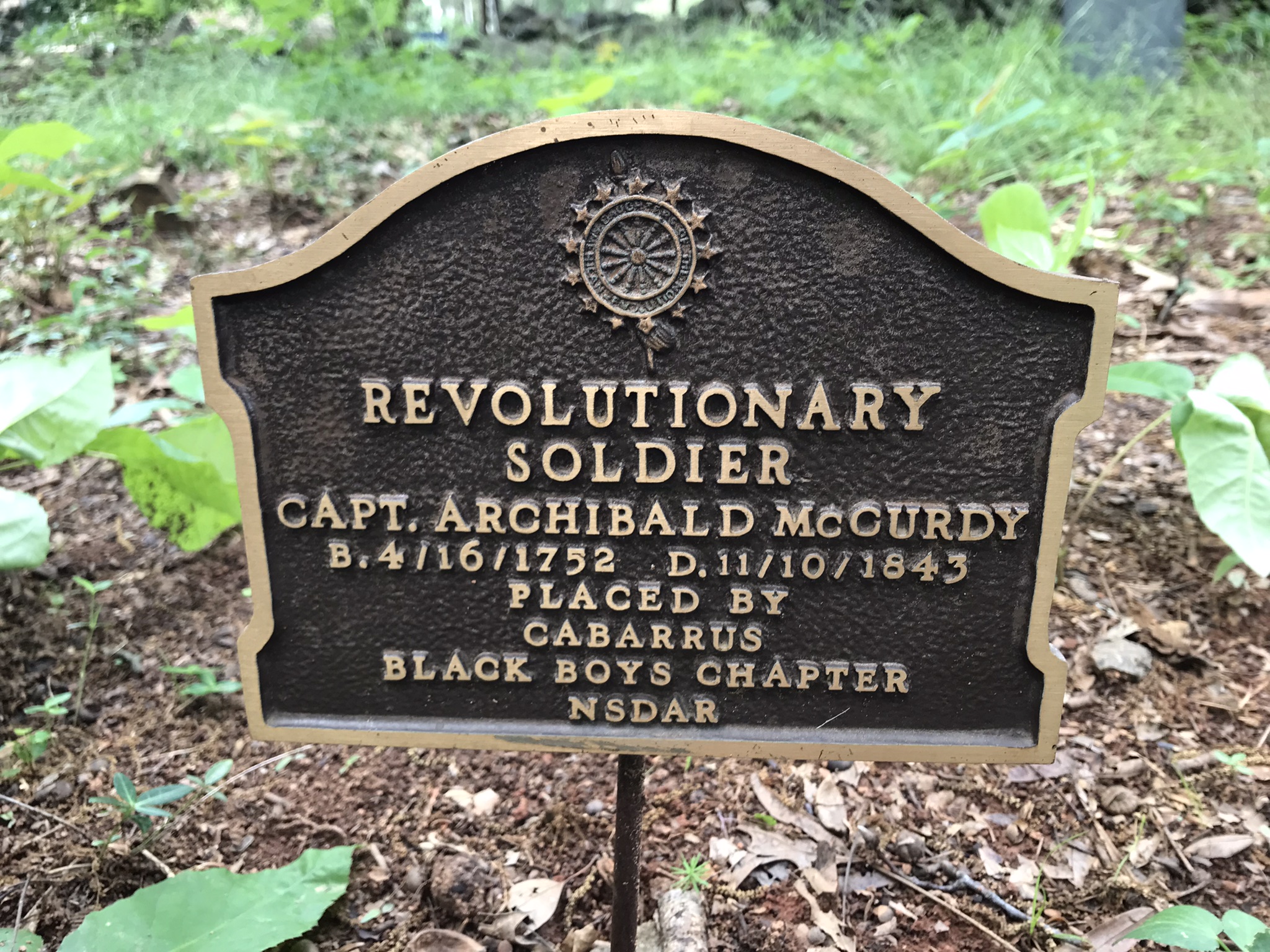
Marker placed at Archibald McCurdy’s grave by the Daughters of the American Revolution
The story is set in May 1775 at the time of the signing of the Mecklenburg Declaration of Independence. I was inspired by a story I’ve heard all my life about what Archibald McCurdy did on the day that document was signed.
You can find the paperback at Second Look Books in Harrisburg, NC, or ask for it at your local independent bookstore. Bookstores can order it from IngramSpark.
The fictional character I’m introducing to you today is George. He is a slave in South Carolina in the mid-1700s in the third story in Traveling Through History: A Collection of Historical Short Stories, “To Run of Not to Run.”
When you meet George, he is a young boy. He and his father, who was born in Senegal, have just been sold and are being taken from Camden to the Waxhaws.
Photo by Asso Myron on Unsplash
Here’s an excerpt from when George and his father are in the back of a wagon being taken to their new living situation in the Waxhaws:
“George sensed his father was tiring of his questions, so he shut his eyes tight and tried to turn off his mind. But the harder he tried not to think, the more questions flooded his head. The ones that kept crowding out all the others were ones he knew not to ask because he was afraid his papa did not know the answers. When will we see Mama again? When are we going to be free?“
You will follow George as he has a lot to learn and grows up fast. His new master’s son is about his age. Therein forms a dynamic that will ultimately be further developed in the historical novels I am planning and writing.
Remember George. He is a character who grew out of my imagination and has never let me go. I don’t think he will let you forget him either.
Getting into the skin, brain, and soul of a young boy with black skin who is living as a slave in America in the mid-1700s allowed me to stretch my imagination in ways that my other fictional characters did not.
Where to purchase Traveling Through History: A Collection of Historical Short Stories
You can find my new short story collection on Amazon in e-book and paperback. You can find the paperback at Second Look Books in Harrisburg, NC, or ask for it at your local independent bookstore.
Hurricane Helene Recovery Update
I haven’t offered a Hurricane Helene recovery update since my November 3 blog post.
As of Friday, December 5, 25 roads in North Carolina were still closed due to Hurricane Helene’s wind, flooding, and landslides on September 26, 2024. That is a decrease of six roads since a month ago. There are three U.S. highways, two State highways, and 20 state roads closed more than 14 months after the hurricane.
In Tennessee… as of Tuesday, December 2, U.S. 321in Elk Mills, in the Watauga Lake area, is officially reopened since being heavily damaged by the hurricane.
Sections of the Blue Ridge Parkway in North Carolina will remain closed until at least next fall, and I-40 at the Tennessee line will continue to be just two lanes at 35 miles-per-hour for a couple more years while five miles of the highway are being rebuilt in the Pigeon River Gorge.
The following success story was cut and pasted from a U.S. Forest Service – National Forests in North Carolina Facebook post on December 3, 2025: “Two decades ago, after Hurricane Frances and Ivan, our ecosystems team saw how erosion could unravel an entire ecosystem. Brady Dodd, hydrologist for the National Forests in North Carolina, developed and executed a plan to reshape eroded riverbanks, plant riparian flood resistant species and add erosion prevention structures. After Helene arrived, the banks held, and the water ran clear due to the work that had been done years prior. This story serves as a model to our forests as we continue to build resilience into each of our Helene recovery projects.”
We’ve gone from fall leaf season to snow ski season in western North Carolina since my last update. Be aware that you might run into a detour, and you can’t drive the full length of the Blue Ridge Parkway.
If you visit, please drop by Blue Ridge Books in Waynesville and Highland Books in Brevard. Tell them I sent you. They sell my books!
I don’t know whether American students still learn about Nathan Hale. I’ve heard that students are now taught that U.S. History began when George Washington became President.
I hope that is an urban myth. If a child isn’t taught that there was an American Revolution, a Revolutionary War, and why those came about, it will not mean anything to them to know that George Washington was our first President.
In case you need a refresher about who Nathan Hale was, I’ll give a brief summary.
Nathan Hale
Nathan Hale was born in Connecticut in 1755. He graduated from Yale University in 1773 and became a teacher. He joined a Connecticut regiment in 1775 and was commissioned as a captain the next year.
Hale went behind enemy lines on Long Island during the siege of New York. Deemed guilty of spying, he was captured on September 21, 1776. He was hanged by the British in Manhattan on September 22, 1776.
He was barely 21 years old! I did not realize he was that young until I was doing some research to write today’s blog post.
Things were not going well for the Americans, so leaders used Nathan Hale’s hanging as a rallying cry.
Hale has often been quoted as saying, “I regret that I have but one life to give for my country,” but there is no proof that he uttered those words. British Captain Frederick Macenzie, who witnessed the hanging, wrote in his diary that Hale’s last words were, “it is the duty of every good officer to obey any orders given him by his commander-in-chief.”
Hurricane Helene Update, 51.5 weeks after the disaster
As of Friday, 38 roads in North Carolina were still closed due to Hurricane Helene. That count included five US highways, two state highways, and 31 state roads.
Interstate 40 is, of course, still just two lanes, 35 miles-per-hour.
Don’t hesitate to travel to western North Carolina. Just be aware that there are still spotty road closures. The area needs tourists to support all the small businesses struggling to recover from this September 26, 2024, natural disaster. Eat at a diner instead of a fast-food chain restaurant. Make sure the souvenir you buy was handmade by a local artisan and not mass-produced by a large corporation.
A Note in Closing
I’m pleased to announce the publication of I Need The Light! Companion Journal and Diary to go along with I Need The Light! 26 Weekly Devotionals to Help You Through Winter. Both books are available on Amazon.
We are living in strange times. Pay attention to what is happening. Ignore the attacks on free speech at your own peril.
Along the lines of yesterday’s blog post, today I’m writing about the lack of a separation of church and state in public education in Oklahoma.
My concern is that once one of the 50 states in our country gets away with the eroding of the separation of church and state, other states with such leanings take note and follow suit.
The separation of church and state is in the very foundation of our country. My sister and I came across a blatant example of how things were in colonial Virginia while we were doing genealogical research.
One of our ancestors was in and out of jail in Virginia in the early 1700s for such things as “playing cards on the Sabbath.” What hit us in the face, though, was that every time he was put in jail for playing cards on the Sabbath, abusing a judge, or not paying his court fine, his fine was that he had to give the Church of England so many pounds of tobacco.
That was the law in colonial days, and it one of the root causes of the American Revolution.
It is no surprise, then, that the first clause in our Bill of Rights – the first clause in the First Amendment to the Constitution of the United States is, “Congress shall make no law respecting an establishment of religion.”
The First Amendment to the Constitution of the United States of America
Ryan Walters in Oklahoma
Oklahoma School Superintendent Ryan Walters said on Friday that his state will no longer give statewide reading and math tests. Each school district will be left to choose what tests to give its students.
So much for trying to have a statewide standard in education.
Walters has been a controversial person as he set out from the beginning to disrupt education in Oklahoma. He made a name for himself by requiring every classroom to be equipped with a Bible with very specific criteria.
Only two Bibles on the market met those criteria: Lee Greenwood’s “God Bless the U.S.A. Bible” (endorsed by Donald Trump, who gets a commission for copies sold) and “We The People Bible” endorsed by Donald Trump, Jr. Greenwood’s Bible sells for $60 and Trump, Jr.’s Bible sells for a mere $90. Walters asked for bids to buy 55,000 of them. (Jesus must be so proud of both of them… er… all three of these men.
Last November, Walters emailed school superintendents across Oklahoma to announce that the State had purchased 500 “God Bless the U.S.A.” Bibles and required that students be shown a prerecorded video of the announcement. That video of Walters included his making accusations against his political opponents and then he transitioned into a prayer for “Trump’s [campaign] Team” and praying against Trump’s opponents. As State School Superintendent, Walters has no power to dictate curriculum.
What are Ryan Walters’ qualifications to be a state school superintendent?
He is a Republican.
He supports the book-banning organization Moms for Liberty.
He requested that teachers show their students a video of him praying for Donald Trump.
He lashes out against “woke ideology.”
He has accused teachers of trying to indoctrinate students.
He labeled the Oklahoma Education Association is a “terrorist organization.”
He says the separation of church and state is a liberal “myth.”
He claims the “left-wing media” hates the Bible.
The Oklahoma Education Association
Take a look at the “Vision, Mission, and Values” of the Oklahoma Education Association on the teachers’ organization website (https://okea.org/about-oea/) and tell me what indicates it is a “terrorist organization.”
Questionable ethics
Speaking at a town hall, Walters responded to, “How does the Tulsa Race Massacre not fall under your definition of critical race theory?” by saying, “Let’s not tie it to the skin color and say that the skin color determined that.”
In May 2022, it was reported by newspapers in Oklahoma that even while working as the state’s Secretary of Education, Walters stayed on as the executive director of Every Kid Counts Oklahoma, a nonprofit organization that was somehow able to pay Walters $120,000 per year. The organization was/is funded by national school privatization proponents and charter school expansion advocates including the Walton Family Foundation and a group funded by Charles Koch.
It seems like an oxymoron for an advocate for the privatization of public schools to hold the office of Secretary of Education for a state. (North Carolina dodged that bullet in the November 2024 election.)
After successfully campaigning for reelection as State Superintendent of Public Instruction in 2022, Walters was fined for 14 violations of Oklahoma political campaign finance ethics rules.
Conclusion
Standardized tests in the United States have been under attack for years. I am not personally qualified to say the tests are good or bad. I believe all such educational resources should be up for constant scrutiny to elevate the education of the children in the United States; however, to just eliminate the testing does not seem to be a good answer.
Leaving curriculum selection and testing up to each little school district is a recipe for disaster. Look at the individuals on your local school board. What are their qualifications for making such decisions?
It’s past time for Americans to start paying more attention to the names on a ballot and not just to those running for President. Government begins on the local level. I caution you against voting for anyone just because they seem to be “a good person.”
There are a lot of Rayn Walters-types running for office in the United States, so be careful who you vote for.
There are lots of wolves walking around in sheep’s clothing.
Today is the 250th anniversary of the signing of the Mecklenburg Declaration of Independence in Mecklenburg County, North Carolina. It predated the national Declaration of Independence by more than a year.
A recreation of the Mecklenburg Declaration of Independence.
In case it sounds familiar, I have blogged about the Mecklenburg Declaration of Independence on or near May 20th several times in the more than ten years I’ve been blogging.
My immigrant ancestors were among the Scottish Presbyterian pioneers who settled old Mecklenburg County, North Carolina. Years of discontent in the American colonies were piled on top of the anti-British Crown feelings they brought with them across the Atlantic.
Weary of unfair taxes imposed by the Crown and the discrimination they were subjected to as Presbyterians slowly brought the settlers to the boiling point. An example of the persecution these Presbyterians felt were the Vestry and Marriage Acts of 1769. Those acts fined Presbyterian ministers who dared to conduct marriage ceremonies. Only Anglican marriages were recognized by the government.
On May 20, 1775, the citizens of Mecklenburg County, North Carolina declared themselves to be free and independent of the rule of Great Britain. It was a sober and sobering declaration not entered into lightly. Those American patriots meant business, and they knew the risks they were taking.
Archibald McCurdy, an elder in Rocky River Presbyterian Church, heard the document read from the steps of the log courthouse in Charlotte. When he got home, he and his wife, Maggie, listed everyone they knew of who could be trusted in the coming fight for American independence.
No original copies of the Mecklenburg Declaration of Independence survive today. The local copy was lost in a house fire at the home of one of the signers. The copy taken to the Continental Congress in Philadelphia by Captain James Jack on horseback was also lost. Later, signers of the document recreated it from memory.
Nevertheless, those of us who were raised on stories of the Mecklenburg Declaration of Independence and the brave souls who risked their lives to sign it know that the document was real. The blood of the American patriots still flows in our veins and their spirit of freedom still beats in our hearts.
Hurricane Helene Update
As of last Friday, 54 roads in North Carolina were still closed due to Hurricane Helene. That count included five US highways, four state highways, and 45 state roads. That’s a decrease of one state highway and one state road since the week before.
Until my next blog post
I hope you have a good book to read.
Remember the people of Ukraine and western North Carolina. Their situations are quite different, but the people in both places are stressed and weary.