I write southern historical fiction, local history, and I've written a devotional book. The two novels I'm writing are set in Virginia and the Carolinas in the 1760s. My weekly blog started out to follow my journey as a writer and a reader, but in 2025 it has been greatly expanded to include current events and politics in the United States as I see our democracy under attack from within. The political science major in me cannot sit idly by and remain silent.
After a couple of months of not getting to read much for pleasure, February turned out to be just what I needed to get back in the habit of reading. My favorite genre, historical fiction, really came through for me last month.
The Diamond Eye, by Kate Quinn
I listened to this historical novel on CD. I was spellbound from disc one until the very end of disc 11. I yearn to write historical fiction so vividly. I long to captivate readers with fiction based in an era not their own. Kate Quinn has established herself as a master of the art and craft of writing historical fiction.
The Diamond Eye is based on a true story. Mila Pavlichenko lives in the part of the Soviet Union that is now Ukraine. She works at a library and adores her young son. When World War II transitions to the invasion of Russia by Nazi Germany, Mila does the unthinkable. She becomes a sniper for the Russian Army. And she excelled at it.
After her official kill count reaches 300, Mila becomes a national heroine and is sent on a tour of the United States to drum up support for the fight against Hitler. There, she meets President and Mrs. Roosevelt. Eleanor Roosevelt, seeing a bit of her own independent nature in the sniper, befriends Mila.
The book follows Mila through the war and how she constantly has to prove herself because she’s a woman and not automatically taken seriously. She’s called the usual names that men who are threatened by strong women call them.
It is a stunning novel and reminded me why I enjoy reading historical fiction. Yes, it’s fiction because conversations are imagined, but reading well-written historical novels is an enjoyable way to learn a lot of history.
The Home for Unwanted Girls, by Joanna Goodman
This is another gripping historical novel. I was so impressed by Saskia Maarleveld’s reading of The Diamond Eye, that I looked for other books she had recorded. That’s how I found The Home for Unwanted Girls. I thought that was an interesting way to find another good book!
The Home for Unwanted Girls is about an unwed mother in Quebec in the 1950s who is forced by her parents to give up her baby girl. The book shines a light on the ugly history of the orphanage system in Quebec at that time. When the orphanage is turned into an insane asylum and the orphans are forced to take care of the patients, the outcome for the girls seems hopeless.
This novel follows the life of one of those orphans and the 15-year-old mother who wanted desperately to keep her. The mother never gives up on finding her child, even though she is told the girl died.
The Escape Artist: The Man Who Broke Out of Auschwitz to Warn the World, by Jonathan Freedland
The Escape Artist, by Jonathan Freedland
This book was spellbinding! It tells the stories of 19-year-old Rudolf Vrba and Fred Wetzler who did the impossible in April 1944. They escaped from Auschwitz! The book tells how Vrba studied the precision with which the Nazis conducted searches and exactly how long the guards searched when a prisoner was unaccounted for. He and Fred worked with two accomplices to plan the escape of Vrba ad Wetzler. Their two accomplices were to stay behind while Vrba and Wetzler escaped to take the truth of what was happening at Auschwitz out into the world.
It’s a fascinating read. It follows Vrba and Wetzler after their escape. The eye-opening part of the book was the aftermath of their escape. They testified and provided written descriptions of the horrors of Auschwitz. Their testimonies matched to the nth detail; however, their words and their physical conditions of malnutrition fell on deaf ears.
Winston Churchill didn’t want to bomb the rail lines going into Auschwitz because England bombed in the daytime. President Franklin D. Roosevelt didn’t want to bomb because it would be a diversion from plans. Jewish organizations in Europe refused to believe what was happening at Auschwitz because it was just too extreme. How can people do such things to their fellow human beings?
Along with the tragic murdering of Jews at Auschwitz, the fact that world leaders who had the power and where withal to do something about it in fact chose not to act is a gut punch.
My general takeaway from the book is that one’s life and future can be determined by someone else’s snap decision. Decisions were made on a whim by guards at Auschwitz every day that determined who lived, who died, and who escaped.
It’s a book that will haunt me.
Since my last blog post
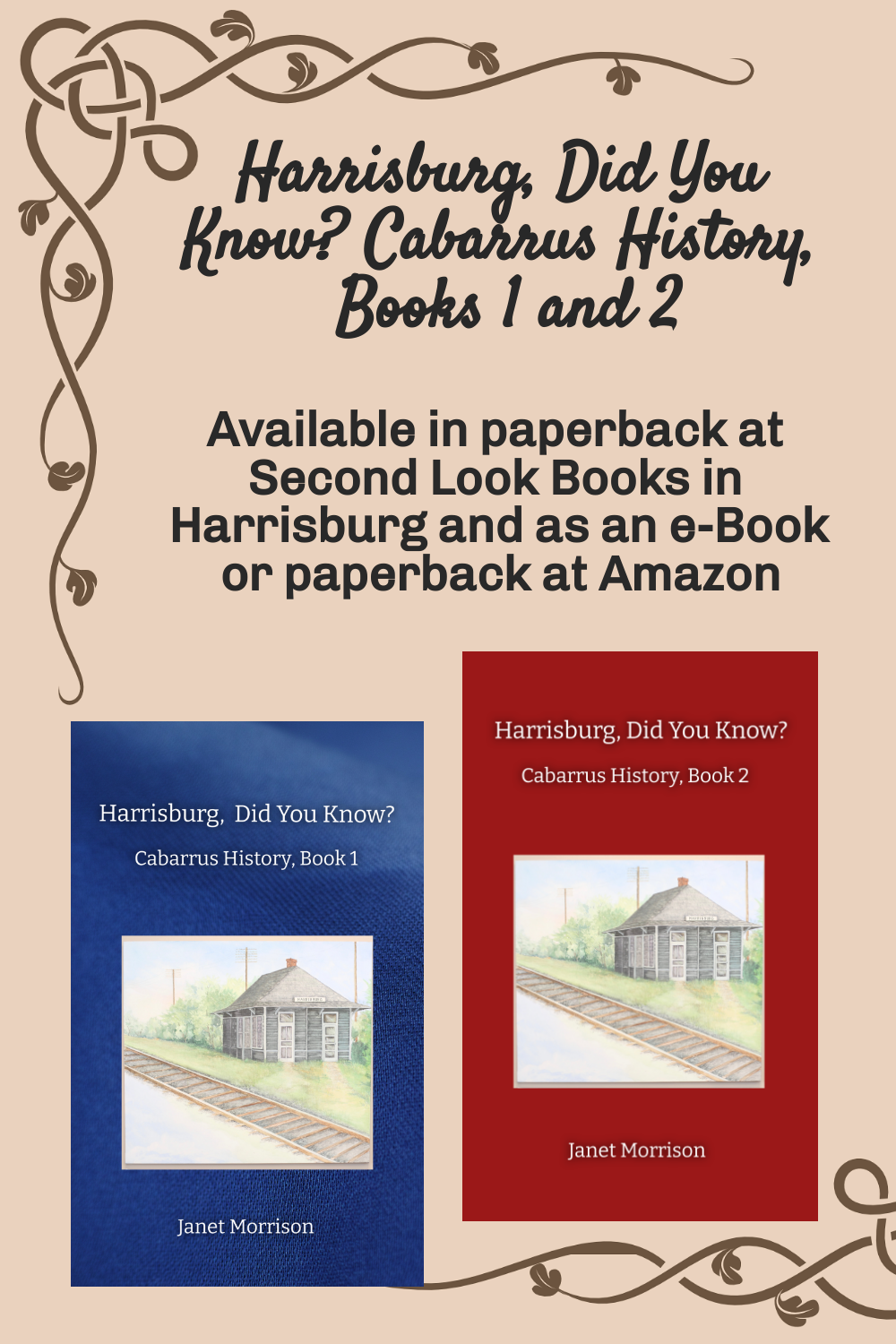
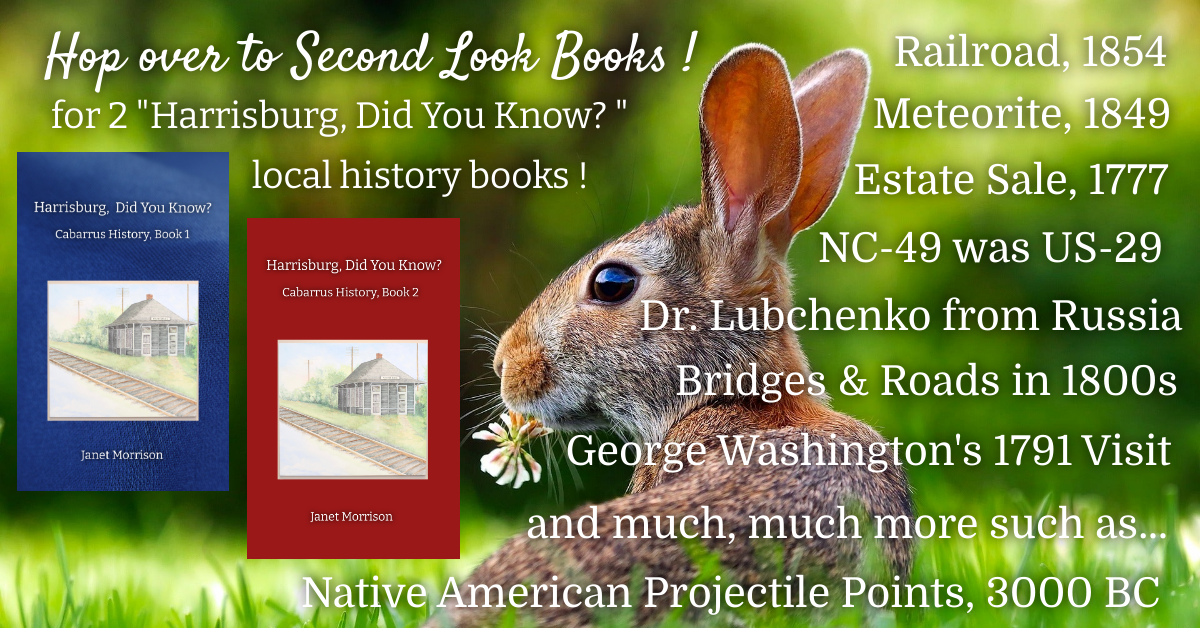
I continue to try to get the word out about my second local history book, Harrisburg, Did You Know? Cabarrus History, Book 2.
I also continue to ask people to go to my website, https://www.janetmorrisonbooks.com and subscribe to my newsletter. Subscribers receive a free downloadable copy of my first historical short story, “Slip Sliding Away: A Southern Historical Short Story.”
“Slip Sliding Away: A Southern Historical Short Story,” by Janet Morrison
Until my next blog post
I hope you have a good book to read. I know where you can get a good historical short story to read!
I’m pleased to announce that not only did my second proof copy of Harrisburg, Did You Know? Cabarrus History, Book 2 arrive in a timely manner, but it was also in fairly good order!
The cover is now a reddish-brown instead of dark brown. (I don’t think I’ll try to self-publish any more books with a red cover! We all learn from our mistakes.)
There were still a few formatting errors that resulted from the last “chapter” (my research notes) being almost 30,000 words in length, but at least Carl Higgins’ World War II B-26 bomber was flying horizontally on page 467.
Although the manuscript was proofread and corrected several times, three typos got past me. I strive for perfection, but I’ve yet to see a perfectly printed book. I can live with three typos in a 536-page book.
Available on Amazon!
Harrisburg, Did You Know? Cabarrus History, Book 2 is now available in paperback and for Kindle from Amazon. Click on https://www.amazon.com/dp/B0BW2QMLHC/ for the paperback or click on https://www.amazon.com/dp/B0BXBQ1F79/ for the Kindle book. I shortened the Amazon URL so they wouldn’t look so intimidating. If they don’t work, just put the name of the book in a search on Amazon.
Available soon at Second Look Books!
The paperback book will be available in a few weeks at Second Look Books in Harrisburg.
The first issue of my newsletter!
Those of you who read my blog post last Monday and subscribed to my newsletter before March 1, received the first issue of the Janet Morrison Books Newsletter (clever name, eh?) on Friday. I hope you enjoyed the variety of information it contained.
If you’ve read my vintage postcard book, The Blue Ridge Mountains of North Carolina, you were able to answer the trivia question near the end of the newsletter.
Please subscribe to my newsletter & receive a free short story!
I’m working hard to get my writing career off the ground, so please subscribe to my newsletter. I plan to send out a newsletter every other month, so be sure and visit my website, https://www.janetmorrisonbooks.com and subscribe so you won’t miss another issue. You’ll also receive a downloadable copy of my short story, “Slip Sliding Away: A Southern Historical Short Story.”
Thanks for being on this journey with me!
All these recent accomplishments are the culmination of a lifetime of studying local history and learning how to research and document it and 22 years of studying the craft of writing.
It’s been a bumpy journey. Thank you for having faith in me and offering encouraging words along the way! I have some loyal lifelong friends and just as loyal friends I’ve made through my blog and Facebook. I value each and every one of you.
Buckle up! I’m just getting started!
I’m working on a family cookbook, more historical short stories, and an historical novel. With my two local history books and first short story published, I look forward to concentrating on my fiction writing.
Until my next blog post
I hope you have a good book (or historical short story!) to read.
Did you ever see the Sauline Players perform? Chances are you did if you went to school in the piedmont of North Carolina in the early- to mid-1900s.
As I write that, though, it occurs to me that I don’t know if they performed at the schools for black children. I hope they did, for their performances were a real treasure for those of us who lived in rural areas and didn’t have easy access to live theatrical performances.
Two of the 91 local history articles in my new book, Harrisburg, Did You Know? Cabarrus History, Book 1, are about the Sauline Players. I’ll share some highlights from those articles in today’s blog post.
When I researched the Sauline Players for Harrisburg Horizons newspaper in 2011, I was surprised to learn that the theatrical troupe was based in the small Gaston County town of Belmont, North Carolina. I have fond memories of their performances in the auditorium at Harrisburg High School in the early 1960s when I was in elementary school.
In 2010, I learned that Joseph Sauline was with another traveling acting troupe in Charlotte in the 1920s when that company went broke. Not to be outdone, Mr. Sauline stayed in the area and organized his own acting group — the Sauline Players.
An online search in 2010 led me to a Sauline Players listing on the acting resume of Ms. Joan McCrea. I was able to get in touch with her agent, who in turn gave Ms. McCrea my contact information. Imagine my surprise one day when I answered the phone and found actress Joan McCrea in Los Angeles on the other end of the line!
The ensuing correspondence with Ms. McCrea turned my single newspaper article about the Sauline Players into a two-part series.
If you want to know more about the Sauline Players and other local history articles I wrote for Harrisburg Horizons newspaper, look for my book, Harrisburg, Did You Know? Cabarrus History, Book 1.
Harrisburg, Did You Know? Cabarrus History, Book 1, by Janet Morrison
Where to purchase Harrisburg, Did You Know? Cabarrus History, Book 1
Paperback available at Second Look Books, 4519 School House Commons, Harrisburg, NC
My book received a lot of positive and well-placed publicity last week. The proprietor of Second Look Books in Harrisburg tells me sales have been brisk.
I took a long enough break from formatting Harrisburg, Did You Know? Cabarrus History, Book 2 to design the cover for the paperback. Then, it was back to formatting. I’m pleased to have the cover designed so I could mark that task off my to-do list.
Until my next blog post
I hope you have a good book to read. I’m reading a couple of books now. It’ll be interesting to see how many I get read in January.
The encampment of the Continental Army at Valley Forge began 245 years ago today. We’re all familiar with the image of George Washington leading his troops across the frigid Delaware River. We know that it was a bitterly cold winter, but there are some interesting facts I hope to surprise you with today.
1,700 to 2,000 soldiers died of disease at the six-month encampment.
Food for the troops was scarce. The Oneida delegation, allies of the Patriots, arrived in May 1778 with white corn. Polly Cooper of the delegation instructed them on how to safely prepare the corn for consumption and stayed after most of her fellow Oneidans had left. She received a shawl from Martha Washington in thanks for her assistance.
In December it went down to 6 degrees F., 12 degrees F. in January, 12 degrees F. in February, and 8 degrees F. in March.
It was the last time United States soldiers served in a racially-integrated army until the Korean War in the 1950s.
The volunteer drill master was Baron von Steubon, a Prussian military commander. The Prussian military drills and tactics he taught the troops were used by the United States military for the next 30 years.
It is thought that 250 to 400 women were in the encampment, serving as cooks, nurses, laundresses, and menders of clothing.
Mary Ludwig Hayes, a.k.a., Molly Pitcher, was at Valley Forge with her husband. She is remembered for jumping into service to help load a cannon at the Battle of Monmouth Courthouse after her husband was wounded.
Hannah Till was an enslaved cook for George Washington at Valley Forge. She purchased her freedom a few years later and became a salaried cook.
We hear a lot about our “forefathers” but not enough about our “foremothers!”
Since my last blog post
Look who’s reading my book! He must have found it on Amazon or in Harrisburg, NC at Second Look Books or Gift Innovations! It’s in short supply in Harrisburg until I get my next shipment. If you prefer an e-book, remember it’s available for e-book and in paperback from Amazon.
Until my next blog post
I hope you have a wonderful Christmas or whatever holidays you are celebrating.
I hope you enjoy time with family and friends.
Remember the suffering people of Ukraine.
I’ll see you again here at my blog on December 26 – the last Monday in 2022!
On the first Monday of the month I usually blog about the books I read the previous month. There was a good reason that didn’t work out this month. My local history book, Harrisburg, Did You Know? Cabarrus History, Book 1, had been published and I couldn’t wait to announce it on my blog last week.
It was a good month for that to happen because I didn’t have any earth-shattering news about the books I read in November. Working toward getting several books published in the coming days and months left me little time to read.
Most of my reading time was spent on books about the craft of writing and history books I needed for research. Those aren’t necessarily the type books my blog readers want to know about.
Those books included Sketches of Virginia, by Henry Foote and Artisans of the North Carolina Backcountry, by Johanna Miller Lewis. The “Artisans” book was especially helpful as I worked on my novel.
I tried to read some fiction. It just didn’t work out well – partly because of my time constraints and partly because the books I chose didn’t grab my attention enough for me to make time for them.
I started reading Less is Lost, by Andrew Sean Greer. I really enjoyed his earlier book, Less. It was humorous. Less is Lost is probably humorous, too. I only got to page 12 in the large print edition. I’ll check it out again later.
I started reading The Unlikely Pilgrimage of Harold Fry, by Rachel Joyce. It is an odd story about a man who sets out one morning to walk to the mailbox. He’s worried about a former co-worker who has cancer and lives far away. Instead of stopping at the mailbox to mail a letter to her, he just keeps walking. I got to page 66 in the large print edition. He was still walking. I didn’t have time to read the next 381 pages to see if he made it to his destination.
I started listening to Mad Honey, by Jodi Picoult. After falling asleep too many times to count and having to re-listen to the first several discs, when I got to disc number four I seriously questioned why I was trying so hard. I don’t know if it was me or the book. It just didn’t work out. I’ve enjoyed other Jodi Picoult books I’ve read, but this one just didn’t work for me.
Until my next blog post
Harrisburg, Did You Know? Cabarrus History, Book 1 is available on Amazon in many countries. Here’s the link to it in the United States: https://www.amazon.com/dp/1888858044/ for e-book; https://www.amazon.com/dp/1888858044/ for paperback. (Thank you, Rebecca Cunningham for cluing me in that there’s a way to shorten those outrageously long URLs Amazon gives a book.! This looks much better. I hope the links work!)
In case you live in the Harrisburg area and prefer to purchase Harrisburg, Did You Know? Cabarrus History, Book 1 locally instead of ordering it online, it is now available in limited numbers in Harrisburg at Second Look Books at 4519 School House Commons and at Gift Innovations at 4555 NC Hwy. 49. I’m pleased to announce that those local small businesses will have my book!
I hope you have a good book to read. If it happens to be Harrisburg, Did You Know? Cabarrus History, Book 1, then all the better!
There are many things that make the United States of America a special place. One of those is the Thanksgiving holiday we celebrated last Thursday.
Thanksgiving Day is a wonderful concept. It’s a holiday most workers get to enjoy as businesses close for the day. It’s a day set aside to reflect on the things you’re thankful for. It’s a day to gather with friends and relatives. It’s a day on which many of us eat more than we should.
Photo by Diliara Garifullina on Unsplash
It’s a day most of us think back on the Thanksgiving Days in the past. We remember loved ones who are no longer here. We remember the aromas in the kitchens of our childhoods.
Even in the chaos that sometimes accompanies large family gatherings on Thanksgiving Day, most of us are prompted to take a moment to think about our blessings.
Life is hard. Things – good and bad – happen. Illness and loss set us back, change our plans, and sometimes change the trajectory of our lives. The life we envisioned isn’t how things turned out.
One of the things I was thankful for on Thanksgiving Day last Thursday was the opportunity life has given me to pursue whatever interests I’ve had. Illness derailed my professional life when I was a young adult, but God has continued to open doors for me. I’ve learned from every experience.
There’s an old adage that says “you can’t teach an old dog new tricks,” but I’m living proof that you can.
I’ve heard it’s good for one’s brain to learn new skills. My brain must be about to explode. I’ve really been stretching its limits lately.
Photo by Diliara Garifullina on Unsplash
Since my blog post last week, I created a cover for a paperback nonfiction book. And it’s not just any old cover. The back cover sports a QR Code I created for my website! Not bad for this 69-year-old non-techy person.
Those of us fortunate to reach that age need to keep reinventing ourselves for as long as physical and mental health and our life circumstances permit. It’s easy to take those things for granted until they aren’t there.
Since my last blog post
I continued to work toward the publication of Harrisburg, Did You Know? Cabarrus History, Book 1. I continued to format and proofread Harrisburg, Did You Know? Cabarrus History, Book 2.
I revisited a short story I wrote several months ago. It’s beneficial to let a piece of writing rest for a while and then read it with fresh eyes and tweak it where it can be improved. I hope to publish a collection of short stories in 2023.
Until my next blog post
I hope you have a good book to read. If I finish reading a book in November, I’ll blog about it next Monday. Writing and learning technology left little time for reading this month.
I try to plan my blog topics well in advance so I’ll have time to devote to writing each one. The fancy name for it is “editorial calendar.” Today was a day I had trouble settling on a topic. I’d made a list of possibilities, but none of them really grabbed me.
Reading Mr. Howell’s blog posts got me thinking about book censorship and the closely-related topic of cultural appropriation and reader sensitivities.
The very idea of a book being censored or people demanding that certain books be banned from public libraries, school libraries, and bookstores really gets my ire up. Book censorship is a slippery slope. Images of book burnings in Nazi Germany come to mind.
Photo credit: Jonny Caspari on unsplash.com
The American Library Association’s (ALA) annual list of the top books requested for banning or restricted reading is fresh on my mind. Here’s the link to the ALA’s website where you can see the list: http://www.ala.org/advocacy/bbooks/. To Kill a Mockingbird, by Harper Lee is consistently on that list. It’s on the list the ALA published earlier this month. One reason given for its being requested for banning is that the lawyer who represents the black man in court is white. The story is set in Alabama in the 1930s, so it is true to the time and place that the lawyer and all the jurors would be white. Racial injustice is the core theme of the novel. The book was published in 1960, and little had changed by then.
I believe we can learn the lessons of history by reading good historical fiction. It’s one thing to read a list of laws governing people of color in the United States in the 1930s, but how better to illustrate and shine a bright light on the laws – written and unwritten – prior to the Civil Rights Act of 1965 than to bring them to life on the pages of a novel and the subsequent movie based on that book?
Being a black man, Mr. Asim offers a different perspective than the one I can offer. His words made me stop and think. Perhaps I had read To Kill a Mockingbird with naive blue eyes. Mr. Asim is one of the most influential African American literary critics of this generation. If you’re not familiar with his work, please visit his website: https://jabariasim.org/about_jabari_asim/.
Among Mr. Asim’s sentences that made me reconsider my stance are the following: “Mockingbird, like Uncle Tom before it, often strikes me as a form of literary ointment for white guilt, meant to soothe outbreaks of conscience while dispelling perceptions of how pervasive white supremacy is. Its homespun patter and deep-fried homilies enable many readers to overlook its sketchily drawn black characters—little more than archetypes—and bask in the glow of Atticus Finch’s exemplary moral courage.”
Also, this: “Some days I can ignore Mockingbird’s mostly pedestrian prose and regard it as a cleverly subversive send-up of white racism, minus Mark Twain’s stylistic flair but dutifully echoing his irreverent tone.”
And this: “Other days I marvel at Mockingbird’s apparent prescience when, years before Fox News and talk radio, Atticus Finch says to his brother, ‘Why reasonable people go stark raving mad when anything involving a Negro comes up, is something I don’t pretend to understand.'”
What is To Kill a Mockingbird‘s place, then? It’s likely to be debated for decades to come.
To Kill a Mockingbird, by Harper Lee
Self-censorship, Cultural Appropriation, and Reader Sensitivities
Being a writer can involve self-censorship, and there are degrees of that when it comes to reader sensitivities. I’m not a published novelist, but as I work on my historical novel I’m ever-cognizant of reader sensitivities.
Most of us practice self-censorship in our communications with others. Some people who should self-censor are sadly unaware. As a writer, I feel the need to self-sensor. I don’t use racial slurs in my speaking or thinking, but that doesn’t mean I won’t need to include one in my writing in order to be true to time and place. It doesn’t mean I condone the use of such words. My challenge in writing a novel presented from multiple points-of-view is having the audacity to put myself in the skin of a person of color – especially a person of color who is male and enslaved in the United States in the 18th century.
Doing so is somewhat akin to cultural appropriation, which is a dominant culture adopting a practice that is inherent in or associated with a minority culture. I’m not doing that in my novel, but I am attempting to write thoughts, emotions, and conversations of three people of color. I want to be aware of possible reader sensitivities, but I don’t want that awareness to fundamentally change my writer’s voice.
I’m writing a novel set in the North and South Carolina backcountry in 1769. It includes two black male slaves, one free black woman, a Frenchman, and a number of white Scottish and Irish settlers. I’ve been working on this novel for many years. If I were to look at my first draft, there would be many cringe-worthy words and scenes. I started out really over-doing writing accents phonetically. It was tedious to write, and I’ve since learned that it’s not appropriate. It can be degrading, and it can be exhausting for the reader.
I’ve grown as a person and as a writer since I started the book probably a decade ago. I’m striving to make the final product true to the time and place. I’ve done extensive research – even into the laws on the books in South Carolina in 1769 that governed the fabric of the clothing slaves were permitted to wear.
If and when my novel is published, I hope no one’s sensitivities will be offended, but that’s probably wishful thinking. I’m attempting to write a book that will be entertaining and educational. I hope it will be a book that will cause readers to put themselves in the skin of the various characters and come away with an appreciation of history.
An Earlier Blog Post about Cultural Appropriation in Writing
Author and administrator of the “Writers on the Path to a Page-Turner” Facebook group, Barbara Kyle, wrote the following: “The move to self-censorship for fear of ‘cultural appropriation’ is a sad state of affairs. Author Morgan Jones eloquently champions the opposite position: ‘Fiction remains the best means we have of finding connection where there seems to be none; and the novel, of all forms, encourages a search that’s deep and sustained. By reading (or writing) one, you’ve travelled somewhere else. You’ve moved, if only slightly, towards others. In a world that finds and increasingly exploits division and difference, this in an invaluable, precious exercise.”
I copied the above quote several years ago and taped it to the top of my computer monitor. In trying to find an online link for you, I was reminded that I used it in my August 27, 2018 blog post, Cultural Appropriation in Writing. Ms. Kyle shared (and I included in that 2018 blog post) this link to an October 1, 2016 article in The Guardian (https://www.theguardian.com/books/2016/oct/01/novelists-cultural-appropriation-literature-lionel-shriver.) Please go back and read my earlier blog post and click on the link to Mr. Shriver’s article in The Guardian.
Where do we go from here?
I think writers would do well to keep in mind the following question asked by John. W. Howell in his March 24, 2021 blog post referenced in my opening paragraph today: “Am I knowingly or unknowingly writing characters or a story which casts aspersions on anyone relative to their race, nationality, gender, sexual preference, religion, disabilities, or age?”
Mr. Howell goes on to say, “The key to the question is we may write something that we didn’t think would discriminate but did that exactly.” He also said, “The caution here is that if you are not part of a group you are writing about, be very diligent in your research. Some would say unless you are a part of a group, don’t write about them. I disagree since I do not want to believe that writers can only write what they know.”
Gone With the Wind, by Margaret Mitchell
In his follow-up blog post on April 12, 2021 (also referenced above in my opening paragraph), Mr. Howell gave Gone with the Wind as an example of a book that could be criticized on several fronts due to its glorification of the Southern plantation. A little later in his blog post he said the following: “Maybe because I’m an author, I hate to see a book be declared undesirable, but it does seem that we should embrace a discussion of any book that is outside our social norms. Include in the discussion why a text no longer reflects current attitudes. If we were to discuss why certain depictions in a book are wrong, we all would better understand each other. Maybe, more importantly, we could learn more about what actions and depictions are especially hurtful.”
I agree with Mr. Howell on that. Let’s not ban books from our library and bookstore shelves. Let’s read and discuss them and, thereby, learn to do better.
Since my last blog post
I enjoyed all the beautiful azaleas in our yard. I don’t think they’ve ever been prettier. All good things must come to an end – or so “they” say. Wednesday afternoon brought snow 100 miles away in the North Carolina mountains, and Thursday and Friday mornings brought record-breaking below freezing low temperatures to my house. I hope this was winter’s last gasp.
Until my next blog post
I hope you have at least one good book to read this week. I have more books checked out from the library than I can possibly read. It’s a nice dilemma to have.
Enjoy a relaxing hobby.
Note: Tomorrow is National Tell a Story Day in the USA. Don’t tell a lie. Tell a story. Tell a young person about one of your good memories. It will give them something to remember you by.
Note: Ironically, Wednesday is the anniversary of author Harper Lee’s birth in 1926. Some literary critics say a person who writes just one novel (such as Harper Lee’s To Kill a Mockingbird) is not a great author. (I know, I know. Her unpublished manuscript for Go Set a Watchman was published in 2015, so she actually wrote two books.) My example is still valid. Ms. Lee died in 2016, and until 2015 she was known as an acclaimed author who wrote “only” one book. I’m not saying the historical novel I’m writing is a great novel, but it gives me hope to know that Harper Lee “only” got one novel published during her lifetime. If I only get one novel published, I’ll be more than happy.
Note: Watch out for May! It arrives on Saturday. May is “Get Caught Reading Month”. Start making your plans for getting caught.
The American Civil War began on April 12, 1861, when southerners fired on Fort Sumter, South Carolina. Fort Sumter was, of course, a United States military fort on the coast of South Carolina.
Photo credit: Michelle Burdick on unsplash.com
The American Civil War was the culmination of the falling apart of a nation.
Confederate Gen. Robert E. Lee surrendered his troops to US Gen. U.S. Grant at Appomattox Court House, Virginia, on April 9, 1865, but fighting continued for a while west of the Mississippi River. U.S President Andrew Johnson declared the war over in all states but Texas on April 2, 1866. After accepting the new state constitution for Texas, President Johnson officially declared the insurrection over on August 20, 1866.
Death toll
The exact number of deaths in the American Civil War is unknown, but it seems to be agreed upon that it was at least 620,000 and as high as 750,000.
Local losses
In 1999, I compiled a booklet, “Rocky River Presbyterian Church and the War Between the States,” about how the American Civil War affected Rocky River Presbyterian Church in Cabarrus County, North Carolina. Established in 1751, in 1860 the congregation had 616 members. 440 of them were White and 176 of them were Black. The congregation lost 72 men in the Civil War. Their average age was 28. The youngest was 16 and the oldest was 44. Of the 72 who died, 52 died between January 1862 and November 1863. I’ve tried to imagine what an emotional impact that had on this farming community, but I can’t.
Rocky River Presbyterian Church, Cabarrus County, North Carolina
I researched each of the 72 men and boys in published genealogies, church records, census records, etc. in an effort to put names and real people on the statistics. Some families were hit especially hard, losing several sons.
Another local loss
In addition to the numerical and economic loss those 72 men and boys cost the congregation, the war resulted in a radical and racial change in the church’s make up. In 2004, I compiled another booklet, “Slaves and Free Blacks Known to be Associated with Rocky River Presbyterian Church Prior to 1870.” My purpose was to compile in one document all known records about the slaves and free Blacks who were communing and/or baptized members of the congregation from the earliest extant church records (1835) through 1870.
Photo credit: US Library of Congress, via unsplash.com.
I was astounded when the project was finished to find that I had a list of 917 slaves and 11 free Blacks. In addition to the church membership rolls and Session disciplinary trial minutes, I searched the 1860 and 1863 Cabarrus County Tax Assessment Lists – which listed every slave living in the county at those times—and the US Census records for Cabarrus County from 1870 and 1880. (By the way, the county tax assessment lists recorded not only the names of each slave under his or her master’s name, but also included each slave’s age, physical condition, and value. They are sobering documents.)
In 1867, present-day Bellefonte Presbyterian Church was formed by former Black members of Rocky River. The White pastor of Rocky River, being a product of the place and time, was hurt when the Black members of his congregation chose to go two or three miles up the road to establish their own church. Unfortunately, he saw them as children who didn’t know what they were doing. He didn’t understand why they didn’t want to stay at Rocky River and continue to sit in the balcony while the White members sat downstairs on the main floor of the sanctuary. No wonder they left! That’s easy for us to see today.
How racism continues to this day
Southerners tend to romanticize about the Civil War, but I doubt there was anything romantic about it at the time. The wives, mothers, sisters, and younger brothers were left behind to try to farm the best they could, not knowing when or if their loved ones would come home. I would not have wanted to be alive during that time.
All four of my great-grandfathers and one of my great-great-grandfathers fought on the losing side in the American Civil War. They were farmers in North Carolina. They did not own slaves. In trying to put myself in their places in that place and time, I can’t help but think they didn’t have much choice in joining the North Carolina Troops when the war began.
Lee Dulin, home from the Civil War
One was a boy of 16, no doubt out on a bit of an adventure with his neighborhood friends in the same company. He wrote letters to his parents and sister asking them to send him socks. One was in the 1st NC Cavalry and survived a severe head wound at Gettysburg that left him with headaches and a convulsive disorder for the rest of his life. One had restricted use of one of his arms for the rest of his life due to injuries sustained in the Seven Days Battle of Richmond. One was in Charleston at the end of the war and walked the 200 miles home. One of my great-great-grandfathers was a man in his early 50s – much too old to go off to war, but that’s what he did. It’s hard to find the romance in any of that. They came home defeated, with perhaps a little worthless Confederate currency, only to have to go back to eking out a living by farming in a broken economy.
They were not the ones who built monuments to Confederate leaders. They did not raise the Confederate battle flag by their houses to show their Southern pride. They just went back to the hard-working lives they’d known since birth and tried to live out their lives as law-abiding American citizens.
I don’t know what any of those five ancestors of mine thought about race. I can’t sit in judgment of any of my ancestors any more than I can take credit for anything good they accomplished in their lives. Each of us is accountable for our own ideas, beliefs, and actions.
Where do we go from here?
Until Americans have an honest discussion about slavery and the ramifications of it… until people across the country study the facts and recognize that slavery existed in some northern states… until people across the country realize that northern states benefitted from the slavery in the South because the slaves picked the cotton that was sent to northern textile mills to be turned into fabric for people there to sell and wear at a low cost due to slavery… until people across the country accept each other and fight for all citizens to have the same rights and chances to excel… until as individuals we admit our prejudices and have the courage to speak up when we see racial injustice… I’m afraid the American Civil War will never be over.
Photo credit: Nathan Dumlao on unsplash.com
My heart sinks at the sight of the Confederate battle flag because, to people of color, it is a symbol of hate. I didn’t see it that way when I was growing up because I was White, but I do now. When you know better, you should do better.
As Americans, it’s easy for us to sit back, protected by the Atlantic Ocean on the east and the Pacific Ocean to the west and criticize the Arabs and Jews in Israel holding grudges over wrongs committed centuries ago, but many Americans are unwilling to forgive and forget when it comes to our own Civil War after 160 years. We can’t see the plank in our own eye because we’re concentrating on the speck in someone else’s eye.
Photo by Luke Michael on Unsplash.com
Since my last blog post
We finally got to bring our diabetic dog home from the hospital last Thursday. He was hospitalized for eight days with bronchial pneumonia. We’re so thankful for the good care he received at CARE (Charlotte Animal Referral & Emergency) once again.
Until my next blog post
Continue to celebrate D.E.A.R. (Drop Everything And Read) Month. I hope you have at least one good book to read this week.
Make time for a hobby.
Note: The two booklets I referenced in today’s blog, “Rocky River Presbyterian Church and the War Between the States” and “Slaves and Free Blacks Known to be Associated with Rocky River Presbyterian Church Prior to 1870,” are available through http://www.JanetMorrisonBooks.com. Click on “Rocky River Presbyterian Church Booklets.”
Today’s blog post is a continuation of my blog post last Monday, https://janetswritingblog.com/2019/10/21/great-smoky-mountains-revisited-part-1-of-2/. It is about my recent trip to Great Smoky Mountains National Park and is illustrated with pictures of several of the postcards included in my vintage postcard book, The Blue Ridge Mountains of North Carolina, and photographs I took on my trip in September.
Black Bears!
Here’s a picture of one of the many black bear postcards in my vintage postcard book, The Blue Ridge Mountains of North Carolina.
PHOTO OF LINEN-FINISH POSTCARD OF A BLACK BEAR IN GREAT SMOKY MOUNTAINS NATIONAL PARK
And here are pictures of the bears I saw on this trip to the
Great Smoky Mountains. The first picture is of a black bear, probably about two
years old, after it crossed the road in front of our car. It completely ignored
us, which was fine with us! (All these bear photos were taken from inside our
car and using the zoom feature on my cell phone camera. As I stated in last
Monday’s blog post, it’s against the law to willingly get within 150 feet of an
elk or black bear in Great Smoky Mountains National Park.)
BLACK BEAR, PERHAPS TWO YEARS OLD, PHOTOGRAPHED IN GREAT SMOKY MOUNTAINS, 2019
WELL-CAMOUFLAGED FEMALE BLACK BEAR IN GREAT SMOKY MOUNTAINS NATIONAL PARK. HER TWO CUBS WERE IN THE BUSHES UP THE MOUNTAINSIDE.
If the car in front of us hadn’t stopped, we might have driven right by this mother bear and her two cubs. The mother was down in a ditch. After a couple of minutes, her two cubs came running down the hill. It was difficult to get good pictures due to the trees and undergrowth.
November 2016 Fire Damage
One of the iconic places in the park is Chimney Tops. I was sad to see that the late November 2016 wildfires had engulfed this double-peaked mountain in Swain County, North Carolina. The “up side” is that today the granite folds and rough edges of Chimney Tops are visible because the trees on the mountain were destroyed in the fires.
Here, I compare the photographs I took in September 2019 with a 1936 real photograph postcard I used in my vintage postcard book:
Picture of a 1936 real photograph postcard of “Newfound Gap Highway” and “Chimney Tops.”
Chimney Tops in Great Smoky Mountains National Park in September 2019, still recovering from 2016 wildfires.
This mountainside, scarred by the 2016 wildfires, now shows off the rough, rocky folds that trees hid before the fires.
Evidence of more 2016 fire damage in Great Smoky Mountains National Park.
Clouds in a Valley
Cloud in a valley in Great Smoky Mountains National Park on September 15, 2019.
We were in the right place at the right time for this photo
of white clouds down in a valley in the park.
Why are they called
the Great Smoky Mountains?
As I stated in my book, “The Great Smoky Mountains are
called “smoky” due to the fog that rises from the valleys and mountainsides.”
These mountains were suffering under drought conditions when I visited the park in September 2019. August, September, and early October were very dry. My sister and I couldn’t help but notice there was very little of the typical wisps of fog when we were there a month ago. In fact, we only saw a little of it on our last day in the park. Here’s a photograph I took, but it isn’t a good representation of the multitude of wisps of fog that gave this sub-range of the Appalachian Mountains their name.
A fair, but not great, example of how the Great Smoky Mountains got their name. Photo taken in September 2019.
Summary
I hope you can hear the babbling brooks and smell the wildflowers of Great Smoky Mountains National Park sometime. It is truly a national treasure. In fact, it is a global treasure. I’m fortunate to live just a few hours from this national park.
Great Smoky Mountains National Park was designated a World Heritage Site in 1983.
We owe a debt of gratitude to the men who served in the Civilian Conservation Corps and helped build Great Smoky Mountains National Park.
Unlike many national parks in the United States, no admission fees are charged for entrance into the Great Smoky Mountains National Park. Many families were displaced when the park land was purchased. Before agreeing to sell their land to the U.S. Government, those families (most of whom were poor farmers) made the government agree that no admission to the park would ever be charged.
Since my last blog post
Since my last blog post, my sister and I spent several days on the coast of South Carolina. We enjoyed fresh seafood in Calabash, North Carolina.
Until my next blog
post
I hope you have a good book to read. I’m reading The Beekeeper of Aleppo, by Christy Lefteri.
If you’re a writer, I hope you have quality writing time.
Thank you for reading my blog. You could have spent the last few minutes
doing something else, but you chose to read my blog.
Let’s continue the
conversation
Have you visited the Great Smoky Mountains? If so, what were your impressions of it? What was the highlight of your trip?
The Blue Ridge Mountains of North Carolina on the shelf at Lake Junaluska Bookstore.
As I stated in my blog post last Monday, https://janetswritingblog.com/2019/10/21/great-smoky-mountains-revisited-part-1-of-2/, I hate to “blow my own horn,” but I’d be remiss if I didn’t take this opportunity to tell you how you can have your own copy of my vintage postcard book, The Blue Ridge Mountains of North Carolina, published by Arcadia Publishing in 2014.
Don’t let the name fool you, it covers all the mountainous counties in western North Carolina and the three counties in eastern Tennessee that are partially in Great Smoky Mountains National Park. Electronic and paperback copies are available from Amazon.com. Paperback copies are available from the publisher at https://www.arcadiapublishing.com/, at quality bookstores, or from me personally.
Sign on US-441/Newfound Gap Road to alert visitors that they are entering the national park.
Several weeks ago I took a vacation from blogging, writing, and all social media. It was wonderful! I hope you can try it sometime.
My sister and I spent a week in and around the Great Smoky Mountains National Park in Tennessee and North Carolina.
For seven days, I didn’t check my blog for comments. I didn’t text. I didn’t call anyone. I didn’t Tweet. It was fabulous!
“The Great Smoky Mountains lay in the middle of the Cherokee Indians’ territory in the mid-1600s when Spanish explorer Hernando de Soto arrived.”
page 69, The Blue Ridge Mountains of North Carolina, by Janet Morrison.
“Welcome to Cherokee Indian Reservation” sign in Cherokee and in English
The Blue Ridge Mountains of North Carolina, by Janet Morrison
Since the park was included in my vintage postcard book, The Blue Ridge Mountains of North Carolina, I enjoy visiting the park to see what has changed and what has remained the same since my childhood and since my book’s publication in 2014.
Today and next Monday, I’ll share some highlights from my trip, including a few of the pictures I took. I’ll also include photographs of some of the vintage postcards from my book, which is pictured to the right.
Elk!
Elk were reintroduced into the Great Smoky Mountains in 2001
and 2002. I’d never seen an elk until this recent trip! What a thrill it was to
see a herd of elk, including this buck, in the river that runs behind the
Oconoluftee Visitor Center near the main North Carolina entrance to Great Smoky
Mountains National Park just north of Cherokee, NC! This bull was a
jaw-dropping sight as he surveyed his herd of female elk (cows) cooling off in
this cool mountains stream. (It was late afternoon and in the mid-90s F.)
An elk bull in Great Smoky Mountains National Park
It is illegal to willingly get within 150 feet of an elk or
black bear in Great Smoky Mountains National Park. Don’t worry, I was behind a
fence that was guarded by a park ranger, and I used the zoom feature on my cell
phone camera.
Sign reminding visitors that elk are back in the park.
For more information about the reintroduction of elk in Great Smoky Mountains National Park and the safeguards people should take when seeing them, go to https://www.nps.gov/grsm/learn/nature/elk.htm.
The Loop/Helix
One of the most famous construction features on
US-441/Newfound Gap Road, which traverses Great Smoky Mountains National Park
from one side to the other is “The Loop.” The highway tunnels under itself to
form a helix.
Here are pictures of two of the three postcards of “The
Loop” in my vintage postcard book.
This is a photo of a 1936 “real photograph postcard” of “The Loop” on Newfound Gap Road in Great Smoky Mountains National Park.
This is a photo of another 1936 “real photograph postcard” of “The Loop” on Newfound Gap Road in Great Smoky Mountains National Park.
The next two paragraphs are quotes from the captions I wrote for the three postcards on pages 80-81 of my book:
“Newfound Gap Road in Great Smoky Mountains National Park
tunnels under itself, forming a helix. The design replaced two dangerous
switchbacks on the old Tennessee Highway 71, which was built in the 1920.”
Signage to alert drivers that they are approaching “The Loop” on Newfound Gap Road in Great Smoky Mountains National Park
“These black-and-white glossy real-photo postcards were made
in 1936. The Great Smoky National Park Roads & Bridges portion of the
Historic American Engineering Record of the National Park Service gives many
details about the Loop. Probably designed by Charles Peterson, the Loop was
constructed in 1935 by C.Y. Thomason Company of Greenwood, South Carolina, at a
cost of $77,644. Stone quarried nearby and reinforced concrete were used in the
construction of the bridge portion, which is 95 feet long, 42 feet wide, and 21
feet high in the center of the arch.”
Since its construction in 1935, trees and other natural vegetation has been allowed to grow and flourish. I appreciate that; however, it makes it almost impossible now to fully see and admire this engineering feat. It might still be possible to see the entire Loop from Chimney Tops Mountain nearby, but it’s impossible to get a satisfactory photograph of it from ground level due to the trees. Therefore, I had to settle for the above picture of The Loop signage.
The first time I rode through The Loop was at the age of nine. It’s still a thrill, 57 years later!
Babbling Brooks
A stream in Great Smoky Mountains National Park
One of my favorite features in Great Smoky Mountains
National Park is all the babbling brooks. Little River Road runs parallel to
the Little River for many miles in the park between Sugarlands Visitor Center
and Cades Cove. Little River and the other streams in the park are full of
bounders and rocks of all sizes, indicating the history of these mountains from
the Ice Age.
Another stream in Great Smoky Mountains National Park
Since my last blog post
It took much patience and persistence (and some grinding of my teeth), but I eventually worked out a new way of inserting photographs in my blog posts last Tuesday. What a relief, to be able to present today’s post and next Monday’s the way I had envisioned! I hope you enjoy the photographs today.
I had the opportunity to watch and listen to another free webinar about the craft of writing on Monday. It was about Author Accelerator’s “Inside Outline” tool. It piqued my interest. Of course, to use the tool I’d have to pay a fee, so I haven’t made that commitment. If you, like I, are learning to write a book, you might want to look into this tool at https://www.authoraccelerator.com/. The tool was developed by Jennie Nash.
Until my next blog
post
I hope you have a good book to read. I’m reading The Ragged Edge of Night, by Olivia Hawker.
If you’re a writer, I hope you have productive writing time.
Thank you for reading my blog. You could have spent the last few minutes
doing something else, but you chose to read my blog.
Watch for my blog post next Monday. It is a continuation of today’s post and will feature black bears, the double-peaked mountain called Chimney Tops, damage from the late November 2016 wildfires, babbling brooks, white clouds down in a valley one morning, and why the Great Smoky Mountains have that moniker.
A few words about my book
I hate to “blow my own horn.” I’d be remiss, though, if I didn’t take this opportunity to tell you how you can have your own copy of my vintage postcard book, The Blue Ridge Mountains of North Carolina, published by Arcadia Publishing in 2014.
Don’t let the name of the book fool you, it covers all the mountainous counties in western North Carolina and the three counties in eastern Tennessee that are partially in Great Smoky Mountains National Park. Electronic and paperback copies are available from Amazon.com at https://www.amazon.com. Paperback copies are available from the publisher at https://www.arcadiapublishing.com/, at quality bookstores, or from me personally.
Let’s continue the
conversation
Have you visited the Great Smoky Mountains? If so, what were your impressions of it? What was the highlight of your trip? Did you see any black bears? Did you see elk? Did you hike? Did you go camping? The recreational opportunities in the Great Smoky Mountains are unlimited! I’d love to hear about your experiences there.
Also, please let me know how you usually view my blog. Do you look at it on your desktop computer, on a tablet, or on your phone?
I’m trying to be more cognizant of the fact that a growing number of people are reading blogs on their phones. The layout of the blog translates differently on the various formats.
For instance, what looks good on a cell phone, doesn’t look quite as good on a desktop computer. Today’s blog post falls into that category. I’ve spent a lot of time on it, trying out “spacers” and “separators.” I’ve never used those tools before. Your patience is appreciated as I learn and experiment with some new blogging techniques.
Remember, I’m a writer — not a computer whiz. This is all part of my journey as a writer, which is what my blog is about.
Thank you for sharing my blog with your friends — in person and on social media!