I write southern historical fiction, local history, and I've written a devotional book. The two novels I'm writing are set in Virginia and the Carolinas in the 1760s. My weekly blog started out to follow my journey as a writer and a reader, but in 2025 it has been greatly expanded to include current events and politics in the United States as I see our democracy under attack from within. The political science major in me cannot sit idly by and remain silent.
There are many things that make the United States of America a special place. One of those is the Thanksgiving holiday we celebrated last Thursday.
Thanksgiving Day is a wonderful concept. It’s a holiday most workers get to enjoy as businesses close for the day. It’s a day set aside to reflect on the things you’re thankful for. It’s a day to gather with friends and relatives. It’s a day on which many of us eat more than we should.
Photo by Diliara Garifullina on Unsplash
It’s a day most of us think back on the Thanksgiving Days in the past. We remember loved ones who are no longer here. We remember the aromas in the kitchens of our childhoods.
Even in the chaos that sometimes accompanies large family gatherings on Thanksgiving Day, most of us are prompted to take a moment to think about our blessings.
Life is hard. Things – good and bad – happen. Illness and loss set us back, change our plans, and sometimes change the trajectory of our lives. The life we envisioned isn’t how things turned out.
One of the things I was thankful for on Thanksgiving Day last Thursday was the opportunity life has given me to pursue whatever interests I’ve had. Illness derailed my professional life when I was a young adult, but God has continued to open doors for me. I’ve learned from every experience.
There’s an old adage that says “you can’t teach an old dog new tricks,” but I’m living proof that you can.
I’ve heard it’s good for one’s brain to learn new skills. My brain must be about to explode. I’ve really been stretching its limits lately.
Photo by Diliara Garifullina on Unsplash
Since my blog post last week, I created a cover for a paperback nonfiction book. And it’s not just any old cover. The back cover sports a QR Code I created for my website! Not bad for this 69-year-old non-techy person.
Those of us fortunate to reach that age need to keep reinventing ourselves for as long as physical and mental health and our life circumstances permit. It’s easy to take those things for granted until they aren’t there.
Since my last blog post
I continued to work toward the publication of Harrisburg, Did You Know? Cabarrus History, Book 1. I continued to format and proofread Harrisburg, Did You Know? Cabarrus History, Book 2.
I revisited a short story I wrote several months ago. It’s beneficial to let a piece of writing rest for a while and then read it with fresh eyes and tweak it where it can be improved. I hope to publish a collection of short stories in 2023.
Until my next blog post
I hope you have a good book to read. If I finish reading a book in November, I’ll blog about it next Monday. Writing and learning technology left little time for reading this month.
Can you imagine hearing and then seeing meteor blazing across the sky and then crashing through a tree before plunging several feet into the dirt? That’s what happened on Hiram Bost’s farm on October 31, 1849.
Photo by Juskteez Vu on Unsplash
I grew up in Cabarrus County, but I’d not heard of the meteorite until I happened upon a newspaper article about it while doing research on another topic for a local history column I was writing in 2009 for Harrisburg Horizons weekly newspaper. Last week while I was formatting those newspaper articles for two planned books in 2023, I thought the highlights of the seven-part series I wrote about Mr. Bost’s meteorite would make an interesting blog post on this Halloween.
Although the meteorite landed near Midland in Cabarrus County, it was mistakenly named “Monroe.” Meteorites are usually named for where they land. The town of Monroe is actually in the adjoining county and not where the 1849 meteorite crashed to the Earth.
I’ve never heard a meteor or seen one up close. The closest I’ve come is seeing an occasional “shooting star.” The witnesses of the 1849 meteorite described explosions and rumblings They saw a white-hot object in the sky even though it was broad daylight.
Word of the meteorite spread by the proverbial grapevine and in newspapers in Charlotte and Concord. When word reached the Charlotte Branch of the United States Mint, a Mint employee and a Charlotte doctor headed some 20 to 25 miles to the site by horse-drawn wagon.
Knowing he had an item of interest and unknown value on his hands, Mr. Bost displayed the meteorite on top of a pole for all to come and see. It was accompanied by a sign warning people not to touch or break the rock.
I was naïve enough to think that perhaps the Monroe meteorite had ended up intact at the North Carolina Museum of Natural History, but I soon found out that the meteorite has been chopped and sliced into countless pieces and the museum in Raleigh doesn’t even have a piece of it.
One thing led to another, as is always the case when I do historical research, and I went down the rabbit hole of searching for the locations that own part of the meteorite. What I discovered is that pieces and slivers of the meteorite are owned by universities, museums, The Vatican, and private companies and individuals around the world.
I learned that bits and pieces of the Monroe meteorite are for sale by rock and mineral dealers and are sometimes available through rock and mineral auctions. Those pieces and slivers are priced by the gram and aren’t cheap.
To learn more, be on the lookout for my book, Harrisburg, Did You Know? – Book 2 on Amazon in 2023.
I expect to publish Harrisburg, Did You Know? – Book 1 on Amazon in January 2023. I’ll give progress reports in future blog posts. Even if you don’t live in the Harrisburg, North Carolina area, I think you’ll find something of interest in both my local history books.
Since my last blog
I continue to write my first historical novel, The Heirloom.
I hired a company to completely redesign my outdated website, JanetMorrisonBooks.com. My writing is taking a new path and I need a new website to reflect that. With numerous decisions to be made and the holiday season approaching, it might be January before I can unveil the new site.
My sister and I continue to proofread Harrisburg, Did You Know?—Book 1. When I blogged last week, I thought the books would only be available for Kindle, but I now hope to also have them published in paperback.
A word about my blog
Last week’s blog post included a note about a change in my follower count on my blog and the reason I was given for the widget policy change. Apparently, I wasn’t the only blogger to complain, for this week the count once again includes the 1,000+ followers that were dropped last week. I’m happy again!
Until my next blog
I hope you have a good book to read.
Remember the brave people of Ukraine who face freezing to death this winter.
Occasionally, I like to present samples of my writing in this blog. My blog post on May 23, 2017 was “No Place for a Preacher’s Son?” (No Place for Preacher’s Son?) The “no place for a preacher’s son” was the Pioneer Mill community in Township One of Cabarrus County, North Carolina in the 1870s.
Gold Fever!
The reason for Pioneer Mill being a “boom” place in the 1800s was due to the development of a gold mine there. Gold was first discovered in the United States in Cabarrus County in 1799.
“Gold fever” soon took hold of the region and numerous gold mines were developed in Cabarrus County in the early 1800s. In fact, so much gold was found in the area that in 1837 a branch of the United States Mint was opened in Charlotte in adjoining Mecklenburg County
I heard about the Pioneer Mill Gold Mine when I was a young child. I knew where it had been. I should have asked “the older generation” some questions about it, but now that generation is gone.
Finding myself in “the older generation,” I researched the gold mine in order to write a two-part series about it for the now defunct Harrisburg Horizons newspaper in 2012. Today’s blog hits the highlights of those newspaper articles.
After the 1799 discovery of gold on John Reed’s land in Township Ten, everyone in Cabarrus County probably started searching for gold on their property. The date that gold was first discovered at Pioneer Mill is unknown, but the 1869 Branson Business Directory described the mine as “among the earliest discovered mines in the State.
The land on which the Pioneer Mill Mine was worked in the 1800s was purchased in the 1760s by James Morrison, an immigrant from Campbeltown, Scotland. It passed down to his son, John. John and his wife, the former Mary McCurdy, had 11 children. Their youngest child, Robert Harvey Morrison, was born in 1817.
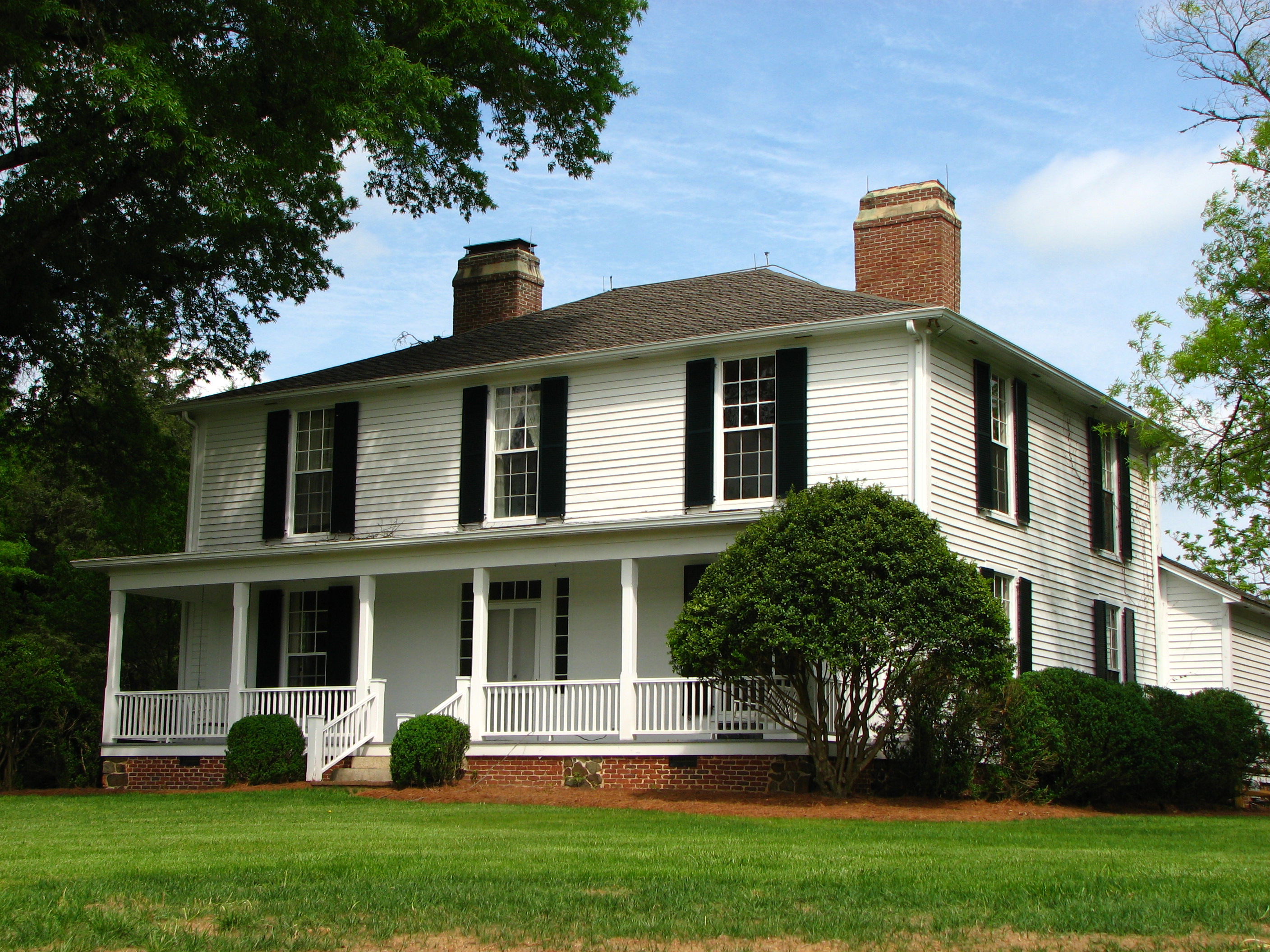
Robert Harvey Morrison remained on the family land and was quite prosperous. The stately two-story house at the entrance to the present-day Cedarvale subdivision on Morrison Road was the home he built for his family of eight children.
Mineral Rights
From a deed registered in Cabarrus County, we know that in 1853 Robert H. Morrison sold the mineral rights on his 640 acres of land to Collett Leventhorpe of Rutherford County, North Carolina and Richard H. Northrop of Albany, New York for $5,000.
In June of 1854, Messrs. Leventhorpe and Northrop, both identified as being of Rutherford County, sold the mineral rights and mining machinery to Francis Rider of New York City for $475,000.
Mr. Rider was identified as the president of the Pioneer Mill Mining Company, “an association incorporated in pursuance of the provisions of an act of the Legislature of the State of New York” that authorized the formation of “Corporations for Manufacturing, Mining, Mechanical or Chemical purposes Passed February 17th 1848.”
I requested a copy of the incorporation papers of the Pioneer Mill Mining Company from the State Archives of New York State, but the researchers there were unable to find a record of the company.
Geology
Ebenezer Emmons served as State Geologist in North Carolina from 1851 until 1863. Dr. Emmons described the veins of gold at the Pioneer Mill Mine in an undated report, “Geological Report of the Midland Counties of North Carolina” as a fine example of veins of gold coming off a foot-wall.
An electronic copy of the Emmons report can be found online through the University of North Carolina’s Documents of the South Collection at http://docsouth.unc.edu/nc/emmonsml/emmons.html. He wrote, “In some instances the segments are so distinct that on being removed the lode seems to have run out, but on working back to the foot-wall, another segment is encountered.”
“Foot-wall” is the rock underlying a mineral deposit. The report noted that the Pioneer Mill Mine was in syenite granite.
I have heard it said that in the days of dirt roads and horse-drawn wagons, when horses’ hooves clacked along the road at the intersection of Morrison Road and Pioneer Mill Road, there was a hollow sound that led to speculation that there was an old mine shaft under the roadway.
Dr. Ebenezer Emmons wrote that the Pioneer Mill Mine was in a cluster of interesting mines for which he held great expectations, although the Pioneer Mill Mine was the only one in the cluster in operation at the time of the report.
He described it as “twelve miles east of Concord, and situated upon the eastern border of the sienitic [also spelled syenite] granite, and in a belt upon which there are numerous veins carrying both gold and copper. The vein fissure in the granite is between sixteen and seventeen feet wide. Its direction is N.70°E. The true vein stone is quartz from eight to thirty inches thick, both sides of which is bounded by the killas.”
“Killas” is a Cornish mining term for metamorphic rock strata of sedimentary origin altered by heat from intruding granite.
The Emmons report indicated that there were four veins of gold on the Robert Harvey Morrison plantation. The first vein was a mile south of the Pioneer Mill Mine. Dr. Emmons found refuse ore rich in gold around an old shaft at that vein which was in quartz interspersed with “sulphurets.”
The second vein was a mile east and resembled the first. The third was a vein of gold in combination with copper pyrites. The fourth vein was of quartz and iron pyrites in the northeast part of the plantation. All four veins generally ran northeast.
Dr. Emmons reported that the Pioneer Mill Mine ground 30-40 bushels of ore daily, although he noted that at 11 revolutions per minute, the Chilean millstones in operation were not set at the proper speed for the ore being ground.
The report listed 14 totals of bushels ranging from 38 bushels to 154 bushels and the corresponding yield in gold in dollars. (It is not known if these were weekly totals over a period of time or exactly what time frame is covered by the list.) The list totaled 1,677 bushels of ore producing $5,674 in gold. That was in mid-19th century dollars, when gold was valued at $18.93 per troy ounce.
The Pioneer Mill Mine employed 15-20 men from 18 to 20 days-a-month. The cost of operating the mine was $400 per month. Dr. Emmons noted that the mine had nearly gone under after incurring too much debt, but under a new agent who was more attentive to the machinery and who had started using mercury in the Chilean mill the mine started turning the handsome profit detailed above.
Part of a gold ore grinding stone from the Pioneer Mill Gold Mine.
Dr. Emmons wrote that the Pioneer Mill Mine would have had truly impressive profits had it had machinery capable of grinding 100 bushels of ore per day.
The glory days of the Pioneer Mill Mine ended with the American Civil War in 1861. It took decades for our local economy to recover from the years of the War and Reconstruction. With the passage of time, it ceased to be cost effective to mine for gold in Cabarrus County.
According to the Carolina Watchman newspaper on September 17, 1891, the Pioneer Mill Mine was then owned by Mr. E.C. Black “and he is making some nice finds. He has found several large nuggets; one worth $50, another $12 and still another $37.”
Needless to say, I was thrilled to find Dr. Emmons’ report for without it we would know almost nothing about the Pioneer Mill Mine. Driving through the Pioneer Mill community today, one would never guess that 160 years ago it was a gold mining boom town.
Until my next blog post
I hope you have a good book to read. Just for fun, I’m reading Hardcore Twenty-Four, by Janet Evanovich. All the books I requested at the public library in November (or earlier) have become available to me at the same time. I have three that have come to my Kindle and one traditional book at the library. Time will tell if I’m able to get them read in the time I have allotted by the library system.
If you’re a writer, I hope you have quality writing time.
Today’s blog post is an edited local history newspaper column I wrote for the August 23, 2006 edition of Harrisburg Horizons newspaper, Harrisburg, North Carolina. Appearing in the newspaper as “Pioneer Mills: No Place for a Preacher’s Son,” it paints a picture of the Rocky River and Pioneer Mills communities in Cabarrus County in the 1870s.
Manse wasn’t ready!
The Rev. Joseph B. Mack came from Charleston, South Carolina in 1871 to be the pastor of Rocky River Presbyterian Church. When he and his family arrived, the manse the congregation was building for his family to live in was not completed.
Church members Robert Harvey Morrison and his wife, the former Mary Ann Stuart, moved their family into a tenant house and gave the new minister’s family their home in the Pioneer Mills community. This was no small sacrifice because the manse was not completed until 1873! The Morrisons’s two youngest children, an 18-year-old daughter and a 16-year-old son were still in the household, and Mr. and Mrs. Morrison were in their 50s.
Robert Harvey Morrison Home, built circa 1846. (Photograph taken by Janet Morrison, May 3, 2008.)
The Robert Harvey Morrison home was built as early as 1846 when he inherited the land from his father. The house and its numerous out-buildings have been on the National Register of Historic Places since 1990.
In case you’re wondering
Robert Harvey Morrison was a relative of mine but not a direct ancestor. In the 1800s my part of the family didn’t live in grand houses like the one pictured. Gold was never found on the property my part of the family owned. There was a gold mine on the land that Robert Harvey Morrison inherited from his father.
Pioneer Mills was a gold-mining boom town in the early- to mid-19th century. It was apparently still a rip-roarin’ place in 1871.
Dr. William Mack’s memories in 1912
A special homecoming was held at the church on August 12, 1912. Rev. Mack’s son, Dr. William Mack, was unable to attend. He sent his regrets from New York and put some of his childhood memories on paper. Fortunately for us, his letter to homecoming master of ceremonies Mr. Morrison Caldwell was printed in the Concord newspapers the following week.
Dr. Mack wrote, “My first Rocky River recollection is of getting off the train at Harris Depot [now, Harrisburg, NC] and going in the dark to the home of Uncle Solomon Harris.” I don’t believe Dr. Mack was related to Mr. Harris. This was probably a term of endearment and respect.
He continued, “There we met Ed and ‘Little Jim’ (to distinguish him from ‘Big Jim,’ the son of Mr. McKamie Harris.) Uncle Solomon had the biggest fire-place I ever saw; it seemed as big as a barn door.
“Shortly afterwards we went to Pioneer Mills…. There… was the old Gold mine, Barnhardt’s store and McAnulty’s shoemaker shop…. While there I decided to become either a merchant or shoemaker, for Barnhardt’s store and McAnulty’s shop kindled young ambitions; better to ‘keep store’ or ‘mend shoes,’ than as a preacher’s son to be moving around from place to place.
“But Pioneer Mills was ‘no place for a preacher’s son.’ Soon we moved again; this time to the brand new brick parsonage, close by the church. We used to go to church in a big closed carriage drawn by two mules; now, every Sunday, we walked to church, going down a steep hill, across a branch, and through the grove to the famous old house of worship.”
Dr. Mack’s letter also read, “Those were happy years; happy in springtime with its apple blossoms, song birds, morning-glories and Tish McKinley’s Sassafras tea; happy in the summertime, with its blackberries and plums, its bob-whites in the wheat fields, its lightning and thunder storms, its bare-footed boys and girls, and its bitter quinine to keep off third-day chills; happy in the autumn time, with its white fields of unpicked cotton and its beautiful trees with leaves of myriad hues; and happy in the wintertime, with its snows, its big hickory back-logs, its boys in boots red-topped and toes brass-tipped, its red-cheeked girls in wraps and ‘choke rags,’ and its Christmas Holidays and turkeys.”
Dr. Mack’s colorful memories paint an idyllic picture of life in Township One in Cabarrus County in the early 1870s. I hope the children growing up here in the 21st century will have equally-as-fond memories of this place.
My sources
My sources for this blog post were the following: The Presbyterian Congregation on Rocky River, by Thomas Hugh Spence, Jr, 1954; The Concord Daily Tribune, August 16, 1912; The Concord Times, August 19, 1912; http://www.hpo.ncdcr.gov/nr/CA0498.pdf (photocopy of the National Register of Historic Places Registration Form for Robert Harvey Morrison Farm and Pioneer Mills Gold Mine); and Descendants of James & Jennet Morrison of Rocky River, by Alice Marie Morrison and Janet Sue Morrison.
Until my next blog post
Please share this or any of my other blog posts on social media by using the buttons below. Thank you!
I hope you have a good book to read. If you’re a writer, I hope you have productive writing time.
On the 20th day of the 2017 A to Z Blog Challenge, the featured letter is “T.” Most people don’t enjoy reading about taxes, but today I am blogging about the 1863 Cabarrus County Tax Assessment. I can safely say that there is only one Cabarrus County in the United States, and it is located in the southern piedmont of North Carolina.
What’s so special about it?
Cabarrus County is one of the few North Carolina counties for which the 1863 Tax Assessment records exist.
It is sobering to read the pages of the 1863 Cabarrus County Tax Assessment. It is a list of every slave owner in Cabarrus County, North Carolina at that time, along with the name, age, physical condition, and monetary value of each of their slaves. I can’t imagine what it must feel like to read this tax document through African American eyes.
I was pleased to find these records in 2003 when I was compiling a list of the 1,000+ slaves and free persons of color who were members of or were baptized at Rocky River Presbyterian Church between Concord and Harrisburg in Cabarrus County prior to 1870. I was able to supplement the church’s records with these tax records for my privately printed-on-demand booklet, “Slaves and Free Blacks Known to be Associated with Rocky River Presbyterian Church Prior to 1870.”
The following is a slightly edited version of one of my local history newspaper columns published in 2006 in Harrisburg Horizons weekly newspaper. The name of my column was, “Did You Know?” The original version of the article can be found on my website at http://janetmorrisonbooks.com/1863%20tax.html.
Did You Know?
Did you know that Cabarrus County is one of the few counties in North Carolina for which the 1863 Tax Assessment records exist? It wasn’t until I inquired in Charlotte and at the State Archives in Raleigh that I learned that no such records survived for Mecklenburg County.
“What’s the big deal?” you may ask.
The Congress of the Confederate States of America passed Statute 177 on August 19, 1861, which authorized the levying of a tax to help finance the Southern states’ government and military during the American Civil War. A tax rate of fifty cents per $100 valuation was established.
Taxable property included “real estate, slaves, merchandise, stocks, securities, money, and other property.” Subsequent legislation expanded the list in April, 1863, to include agricultural products, many occupations and trades, some businesses, and income.
The Cabarrus County Board of Assessors met at the courthouse in Concord on April 9, 1863. The Board increased the values of thirteen pieces of property in District (now Township) One and then recorded the names of all taxpayers by district.
The 1863 Cabarrus Tax Assessment records list each property owner in alphabetical order by district. The districts of 1863 essentially coincide with today’s townships. There are columns for number of acres of land owned, value per acre, and total value. The river or creek on which the land lay is also indicated.
In 1863, real estate in what is now Township One (the township in which Rocky River Presbyterian Church is located) ranged in value from $6 to $400 per acre. Most land was valued in the $6 to $20 per acre range. One of the exceptions was the half acre of land owned by Howie and Johnston, mercantile business partners in Harrisburg. Although their store closed in 1858, the property was valued at $200 in 1863.
It is interesting to read about the old land values and to think how things have changed, but the most intriguing part of the 1863 Tax Assessment records for me is the list of slaves. Under each slave holder is a list of their slaves by name. The age of each slave is given, along with their value. In cases of physical or mental disability, the type of disability is listed.
Pattern in slaves’ monetary value
There is a definite pattern in how the slaves were valued. Male children were generally valued at the rate of $100 for each year of their age, while female children were valued at $50 less. Slaves less than one year old were valued at $100. Young adult female slaves were typically valued at around $1,400, while young adult male slaves were valued around $1,600. The value of a slave in his or her late 30s began to decrease.
Two slaves listed as being blacksmiths were valued at $1,800 each, which was the highest value of any slaves in Township One.
It is sobering to read the names of the slaves and to see a monetary value placed on them. As an amateur genealogist and historian, I see tremendous value in the records.
Sources I used
1863 Cabarrus County Tax Assessment List on microfilm at the Lore Local History Room, Cabarrus County Public Library, Concord, North Carolina
The Confederacy: A Guide to the Archives of the Government of the Confederate States of America, by Henry Putney Beers, 1968.
Until my next blog post
I hope you have a good book to read. (After reading one-third of Bittersweet, by Colleen McCullough, I decided I wasn’t interested enough in the story to finish the book. I’m reading The Mother’s Promise, by Sally Hepworth.)
If you are a writer, I hope you have productive writing time.
Today is the 14th day of the 2017 A to Z Blog Challenge, so the featured letter is “N.” I wrote a local history column for a weekly newspaper, Harrisburg Horizons, in Harrisburg, North Carolina for six and a half years.
My freelance “job” with the newspaper took me in many unexpected directions. One of my first columns (July 12, 2006) was titled, “Native American Projectile Points.” The following is a slightly revised version of that column. Some of the wording has been changed and all the photographs have been added to this blog post.
Do you think Harrisburg’s history began with the earliest European settlers, or even with the coming of the railroad in the 1850s? Today, I invite you to join me on a journey into prehistoric Harrisburg in the southern piedmont section of North Carolina.
Schiele Museum, Gastonia, NC
I recently made an appointment to take my collection of Indian arrowheads to Dr. Alan May, staff archaeologist at the Schiele Museum in Gastonia, NC. The first thing I learned was that I didn’t have a collection of Indian arrowheads! The proper term is “projectile point,” which includes spear points and arrowheads.
I proudly opened the box containing my small collection. Dr. May examined each piece. I held my breath and waited for him to gasp upon spying a rare and valuable piece. He did not gasp.
My collection turned out to be mundane and of no particular interest to an archaeologist; however, the insight Dr. May shared that day gave me much to think about and opened a window on prehistoric Harrisburg.
I expected Dr. May to tell me that my projectile points dated back to the 1600s or possibly a little earlier than that. I expected him to tell me that the points were typical of the Catawba or perhaps even the Cherokee. That’s not what he said.
Middle Archaic – Morrow Mountain
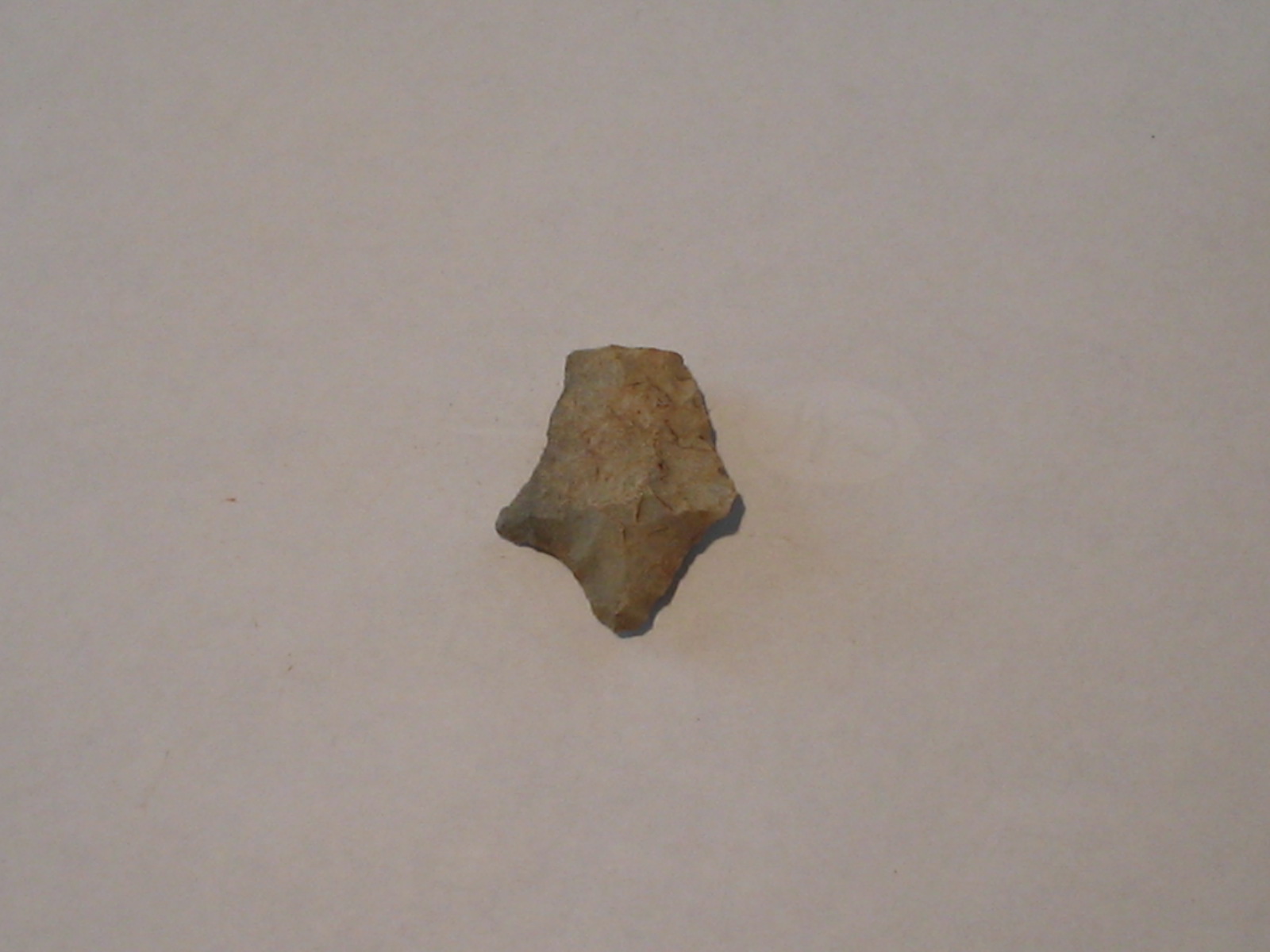
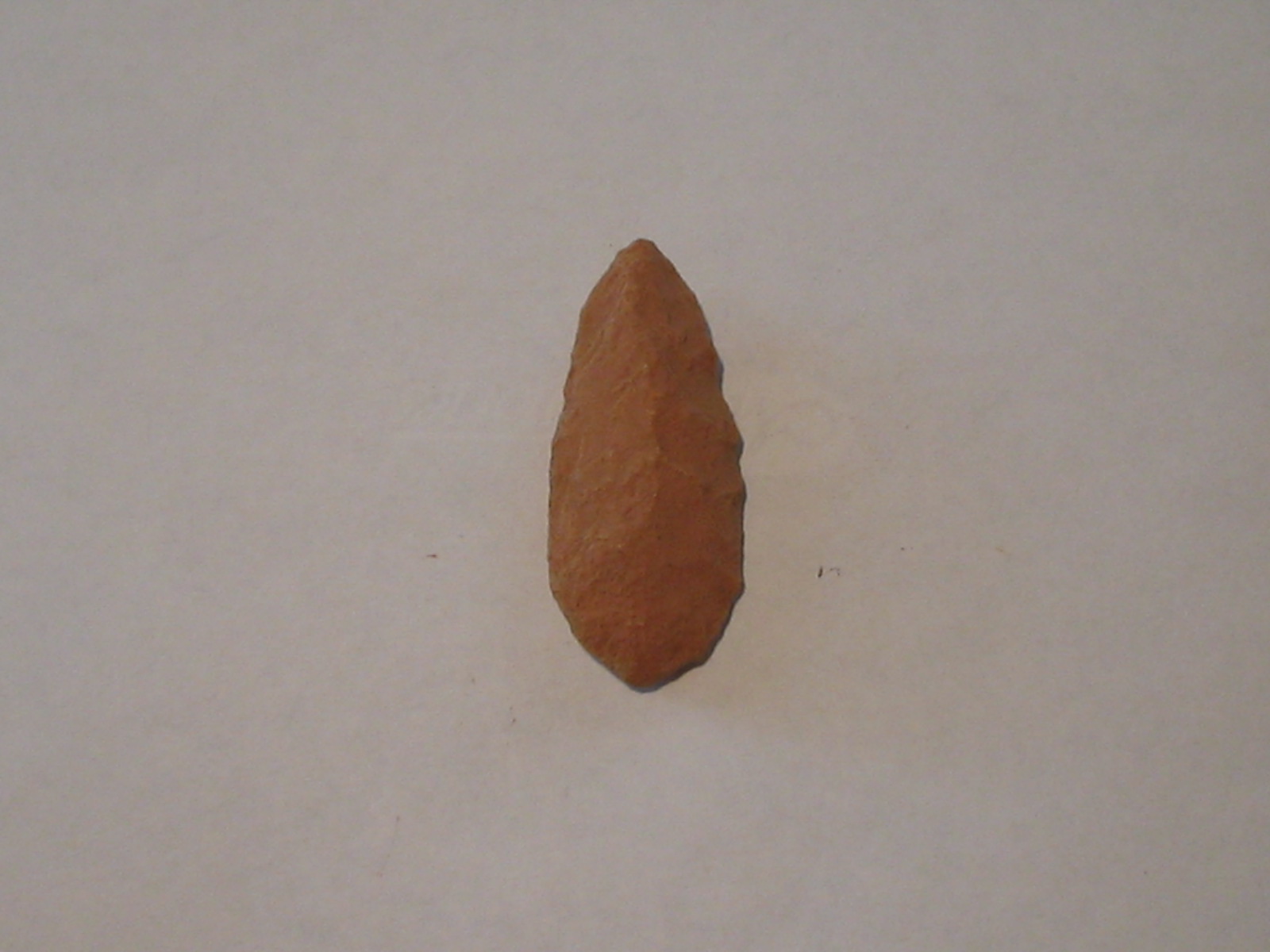
Two of my projectile points are called “Morrow Mountain” pieces. They are from the Middle Archaic period which ended around 3000 B.C. (or B.C.E., if you prefer.)
Base of projectile, Middle Archaic, Morrow Mountain.
Middle Archaic (2,000 to 3,000 B.C.E.) Morrow Mountain Projectile Point
Middle Archaic Guilford
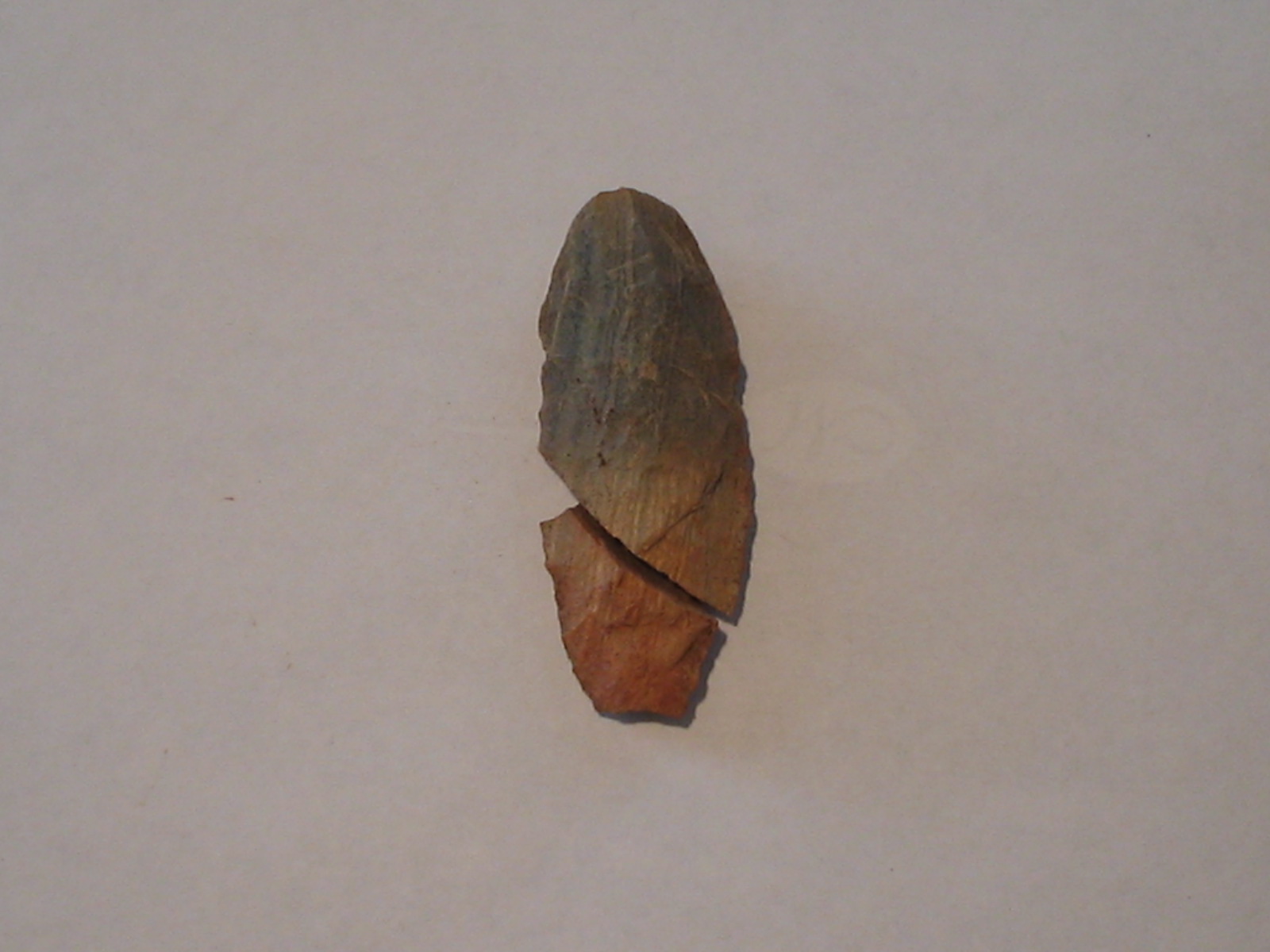
Two other pieces are of the “Guilford” style and also date to the Middle Archaic period when Native Americans hunted bison in North Carolina.
Broken example of Middle Archaic – Guilford projectile point.
Middle Archaic, Guilford projectile point.
Late Archaic
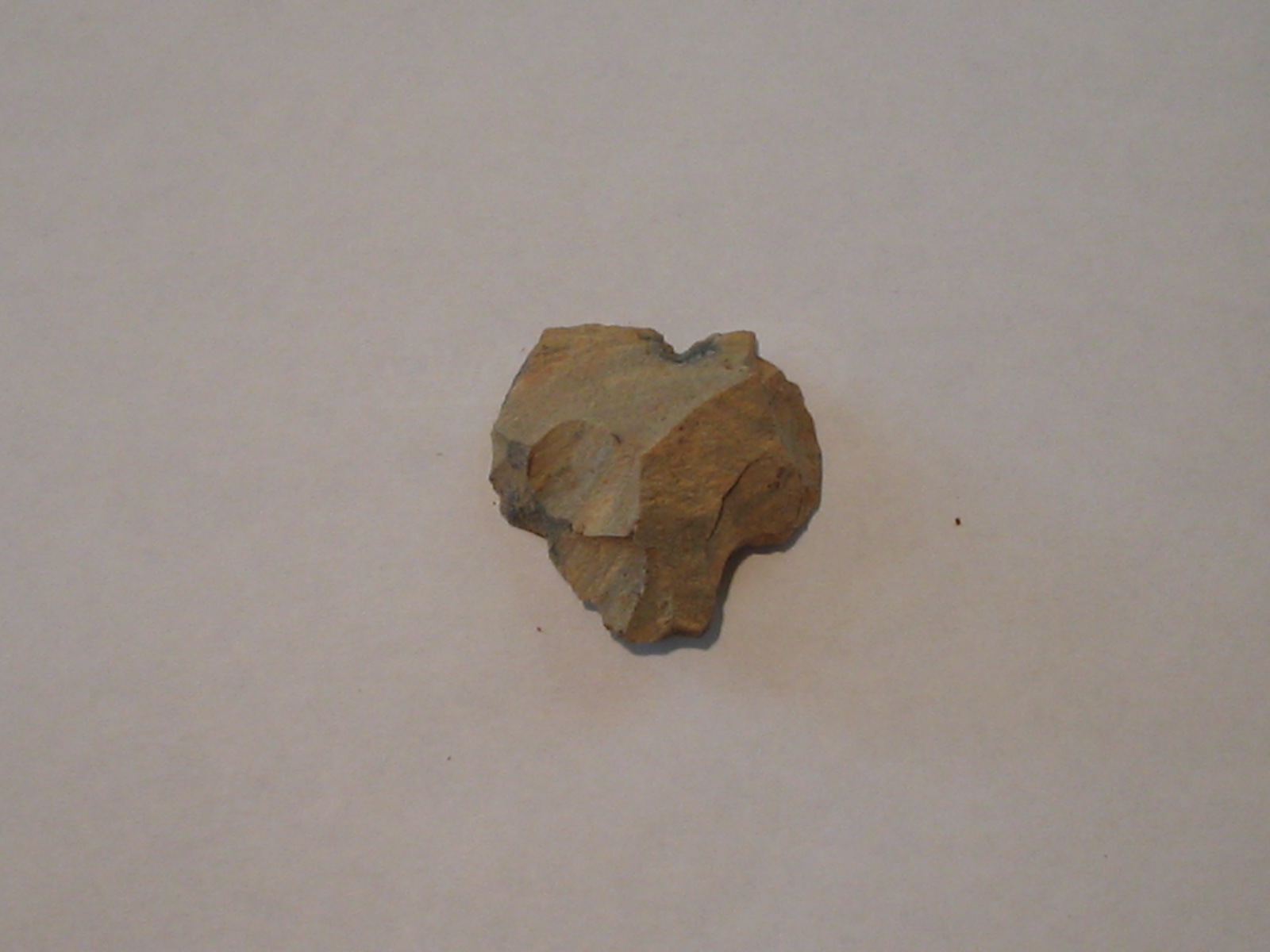
Several of the projectile points in my collection are “Savannah River Stemmed “ points from the Late Archaic period, 1000 to 3000 B.C. This period was cooler than Middle Archaic. Deer, rabbits, and raccoons were hunted for food.
Late Archaic. Flagstone or field stone, probably like rock that is currently being mined from a nearby quarry.
Thin biface straight-sided Late Archaic projectile point. Broken either by use or when re-sharpened.
Ancient Tool: Anvil
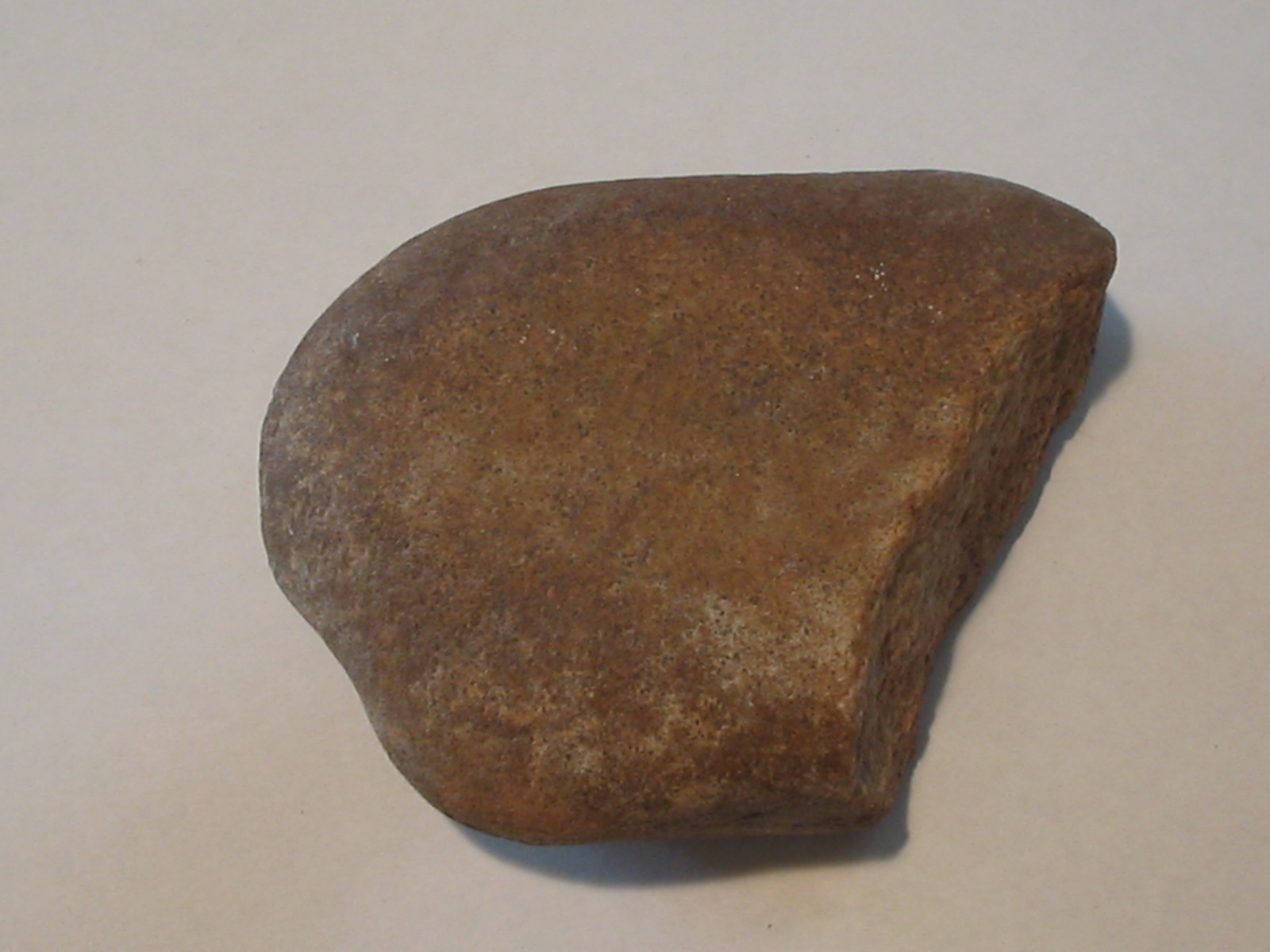
I was certain that Dr. May would identify one of the smooth rocks I took him as an early Native American tool. He said it was just a rock that had been smoothed by water. Another rock, which hadn’t seemed as interesting to me, turned out to be an anvil.
This is a stone anvil.
Some rocks I took to the museum were magnetic, which wasn’t a surprise; our red clay soil is rich in iron. One piece that appeared to be a rock was identified as slag hammered by a blacksmith. That made sense, because my father told me that there used to be a blacksmith’s shop in what is now my front yard.
Gold?
The rock I hoped he would say held flecks of gold, held flecks of worthless pyrite instead. I can see why it’s called “fool’s gold.”
Lead with pyrite and flecks of gold. Dr. May thought this was an interesting piece.
Dr. May recommended that I send a detailed report about my collection to the Office of State Archaeology in Raleigh. The State has a form called “North Carolina Amateur Archaeological Site Form.” Dr. May said they will pinpoint my yard on a map and keep a record of my findings.
My visit with Dr. May brought surprises, both good ones and disappointing ones. I came home knowing that 5,000 years ago as the Egyptians developed hieroglyphic writing and the darkness was first lighted by candles, Native Americans were hunting deer and bison in my yard. Wow!
That was the end of my July 12, 2006 newspaper column. For now, it’s the end of the story. When I read the column last night for the first time in many years, I realized that I never followed through with Dr. May’s recommendation that I send a detailed report to the Office of State Archaeology in Raleigh. I’ve added that report to my “to-do” list, but writing must still come first.
Until my next blog post
I hope you have a good book to read. (I’m reading a nonfiction book, In Order to Live: A North Korean Girl’s Journey to Freedom, by Yeonmi Park with Maryanne Vollers. It was published in 2015, but I’m finding it particularly interesting as I read it during rising tension between North Korea and the United States. I highly recommend it!)
If you are a writer, I hope you have productive writing time.
One of the rewards for writing the “Did You Know?” local history column for Harrisburg Horizons newspaper from 2006 through 2012 is that people still tell me they miss it since the newspaper ceased publication. Another reward is that I occasionally receive an e-mail from a stranger asking a question or making a comment about one of my local history column topics.
My most recent such communication came from a woman who was looking for information about the Sauline Players and discovered that I had written about them for the newspaper. I shared my two-part series on the acting troupe with her and we corresponded for a couple of days to compare our memories. She recalled seeing them perform at Marion Junior High School and Glenwood High School in McDowell County, North Carolina in the 1950s, and I have fond memories of seeing them perform in the auditorium of Harrisburg High School in the 1960s.
It is gratifying when someone expresses that a newspaper column or short story I wrote has enlightened them or brought them joy. One of the beauties of the internet is that it makes serendipitous connections possible.
Yesterday my sister and I conducted our fourth (and last) Local and Rocky River Presbyterian Church History Talk and Tour. We had these monthly, September through November, skipped December, and then started again in January. Response has fluctuated. It was worth a try. I spent hours planning the topics. I had enough topics to last two or three years. No doubt, someone who has not attended any of the four talks so far will complain that we are discontinuing the programs. That’s human nature.
Yesterday’s topics were the Rev. Dr. John Makemie Wilson and the Rocky River Academy. Dr. Wilson was the pastor of Rocky River and Philadelphia Presbyterian Churches in Cabarrus and Mecklenburg Counties for 30 years in the early decades of the 19th century. He served as teacher at Rocky River Academy for much of that time. Completing their studies at Rocky River Academy prepared the students for entrance in the University of North Carolina at Chapel Hill. Twenty-five of the academy’s students went on to become Presbyterian ministers. One of them, the Rev. Dr. Robert Hall Morrison, was a founder and the first president of Davidson College.
The three-part series of local history columns I wrote about the Rocky River Academy for Harrisburg Horizons newspaper came in handy as I prepared for yesterday’s program.
Last night I spent some time editing the manuscript of my historical novel, The Spanish Coin, in preparation to submit it in a writing competition. More on that later.
When I started writing a local history column for Harrisburg Horizons newspaper in 2006, I visited 88-year-old Mr. Ira Lee Taylor. Mr. Taylor lived in Harrisburg his entire life and had an incredible memory. He had been my mail carrier all my growing-up years and I was in school with his daughter. Aside from that, I never really knew him. I expected to visit him once and get the answers to my questions about Harrisburg in the early 20th century. I found Mr. Taylor to be so knowledgeable and eager to talk that I went back to see him numerous times over the next eight years. His memory and eagerness to share stories enabled me to write more newspaper articles — and write with more detail — than I would have otherwise been able to write.
I not only learned a lot about the Harrisburg of Mr. Taylor’s youth, but I heard his personal recollections of the D-Day invasion of Normandy and subsequent battles in the European Theatre of World War II. He recalled the sights, sounds, and smells of war. As a former North Carolina State University student of forestry, he remembered how heartbreaking it had been to see the Hurtgen Forest ravaged by artillery. When he delivered mail to our house all those years, I had no idea about his war experience. Hearing this elderly veteran talk about the war gave me a whole new appreciation for the sacrifices “the greatest generation” made.
The last times I visited Mr. Taylor were at a nursing home. It was sad to see him in a wheelchair in his room instead of in his comfortable living room in his home on Stallings Road. The lives of the residents of several blocks of Stallings Road have been disrupted by construction associated with the high-speed rail. I am glad Mr. Taylor did not have to witness what the government is doing to the neighborhood in which he lived his entire life.
Mr. Taylor died last Wednesday, just 13 days shy of his 96th birthday. Sadly for me, I did not hear about his death until this evening after his funeral had been held. I regret that I did not get to pay my last respects to this gentleman who helped me in my writing and added so much local interest to the last eight years.








 Janet's Writing Blog