More Thoughts about Author’s Brand

Since my last blog post, What is an Author’s Brand… and How Do I Get One? I have done more reading on the subject and I’ve taken my first steps in figuring out/designing my brand. If you’re also an aspiring novelist, perhaps my blog posts on this topic will help you. Disclaimer: I am learning as I go. I am no expert.

“The Basics of Author Branding,” by Theresa Meyers

In her article, “The Basics of Author Branding,” Theresa Meyers, the president of Blue Moon Communications (http://Bluemooncommunications.com/white_papers/author_branding.htm) stresses the importance of mapping out your branding plan. Since I love maps, this concept appeals to me.

How an Author Brand Works

Theresa Meyers gives three steps to explain how an author brand works.

  1. When readers love your stories, they will “believe that they have formed a relationship” with you. (She calls this “emotional Velcro.”);
  2. Garnering accolades within the writing community and publishing industry will create a public perception of you; and
  3. Your author’s voice will set you apart. You have a unique way of writing.

Summary of Theresa Meyers’s Article

What I came away with is that the following things must be done in order to form your author’s brand, and they must be done in the following order:

  1. Produce good quality product;
  2. Decide on your message points;
  3. Be consistent;
  4. Get your name/brand out there; and
  5. “Find a word or phrase . . . to define what you do or your unique aspect and own it.”

That last part got my attention. I haven’t seen anyone else give that tip. It has me thinking. I write historical fiction, but what sets my historical fiction apart?

The second item on the list also got my attention. I’m not sure I know what my message points are.

YourWriterPlatform.com’s “Brand Story Worksheet”

In addition to studying what Theresa Meyers wrote about author branding, I have put some serious thought into answering the first four of the 12 questions on the “Brand Story Worksheet found at http://YourWriterPlatform.com.

Right off the bat, the first question forced me to put in writing my beliefs and worldview and analyze how that influences my writing. That was a sobering exercise. It made me seriously consider and discover why I write the historical fiction I write and aspire to write.

The second question forced me to write down my personality strengths and weaknesses. Maybe I did this exercise on a bad day, but I was stunned when I came up with 11 weaknesses and just three strengths! It seems I have some rough edges that need to be smoothed out a little bit.

The third question made me put in writing what motivates me to write. I already knew the answer(s), but it was helpful to write it down. It helped me focus.

The fourth question was harder to answer than I anticipated when I first read it. I not only had to try to identify the types of readers that will value my writing but also say why they will value it.

Until my next blog post, I will continue to work my way through the remaining eight questions on the worksheet, I’ll start drawing my author brand “map,” and I’ll do some research on “message points.” It’s too bad I can’t just write and have the reading public magically clamoring for my work. I’d rather be writing than spending my time jumping through these author branding “hoops,” but that would be too easy. This is a journey. It will not be accomplished overnight.

A Call to Action

I welcome your comments about this and my earlier blog posts, and I invite you to share my blog by clicking on the social media icons below.

Until my next post, I wish you a good book to read and, if you’re a writer, I hope you have quality writing time. And if you’re an American, I wish you a Happy Thanksgiving on Thursday.

Janet

What is an Author’s Brand… and How Do I Get One?

Today’s blog post is for writers who are in the same boat with me. I’ve been working on a novel for years. I hope to get it published in the next several years. I am trying to learn all I can about the craft of writing as well as the craft of being an author. In the 21st century It’s not enough to write a 100,000-word piece of earth-shaking fiction. An author has to have a brand and build a platform.

To tell you how far I’ve come in the last week, a few days ago I didn’t know the difference between brand and platform. I have a hunch I’m not alone in my confusion. I do not claim to be an authority on this subject. In fact, I’m far from it. Today’s post grew out of my need to try to figure out author brand and author platform.


What is an author’s brand?

After searching online for explanations of an author’s brand, I have concluded that my brand as an author is who I am, what I choose to share about myself, and what I want readers to think when they see or hear my name.


What is an author’s platform?

The best I can tell, an author’s platform is his or her visibility and ability to sell books.


How do brand and platform mesh?

An author’s brand underpins his or her platform. It’s part of the foundation. Brand, therefore, must precede the building of a platform.


When should I design my brand as an author?

Today, or perhaps yesterday.


How do I establish my brand as an author?

  • Set goals and objectives
  • Identify what readers of your genre are looking for
  • Determine how you are different from other writers in your genre
  • Feel comfortable in your own skin as a writer
  • Don’t be shy about telling your own story
  • Find your niche and focus on it
  • Take care to manage how you are perceived
  • Explore ways you can turn readers of your genre into fans of your work


How am I perceived?

How potential readers perceive you is created by a variety of ways. Everything from website, logo, social media presence, business cards, any printed materials, to your photo affect how you are perceived. In other words, be consistent in how you project yourself.


How can you learn from my mistakes?

Unfortunately, when I had my website set up, it was primarily to showcase the three family genealogies compiled in the 1990s by my sister and me. I knew I wanted to be a novelist, but at that time I really knew next to nothing about writing fiction.

I set up a Facebook account on June 14, 2011 in order to keep up with community events and news. Much later (August 12, 2014) I added a Janet Morrison, Writer Facebook page as a way to publicize my public appearances to promote my vintage postcard book, The Blue Ridge Mountains of North Carolina.

In 2010, I started half-heartedly writing a blog. I struggled with content and how often to post. It wasn’t until 2014 and the publishing of my vintage postcard book that I got serious about blogging.

Kicking and screaming, I created a Twitter account on April 11, 2016.

I did all these things in piecemeal fashion as I struggled to learn what an aspiring novelist should do in order to get noticed. The operative word is “piecemeal.” There’s nothing wrong with taking a gradual approach, but my mistake was that I did not have an overall plan and, therefore, I was not systematic. I was focusing on the individual trees instead of the entire forest. I did not understand author brand as it relates to author platform. In conclusion, I tried to build my platform without supporting it with a brand. I got the cart before the horse.


Where do I go from here?

With my website, blog, and Twitter account already in place, I have no choice but to keep forging ahead. Otherwise, I will lose my momentum and many of the followers I have. (I experienced that this summer while I had shingles in my eye.)

While I forge ahead, though, I know now that I need to design my brand. I have written the manuscript of a historical mystery. Although Arcadia Publishing reminded me during the editing process that my postcard book was not intended to be a history book, I believe it did help people to perceive me as a writer and historian.

My plan for the coming weeks is to hire a professional editor to evaluate my historical mystery manuscript (working title is The Spanish Coin) and to take the steps necessary to design my brand.

I don’t expect this to be easy. Nothing worthwhile is easy. Researching and stating facts and theories about author branding is one thing. Putting that knowledge into practice is altogether something else.


Some of the resources I used in writing this post are:

I would be remiss if I did not disclose and provide links to the online sources I used this week in writing this blog post.


A call to action

If you find this blog post helpful or if you wish to contradict or correct any of my statements, please leave a comment and give JanetsWritingBlog.com exposure by clicking on the social media icons below.

Until my next blog post, I hope you have a good book to read and, If you’re a writer, I hope you have quality writing time.

Janet

Character Arc Development & The Spanish Coin

I’ve been reading about character arc and how to develop it. This has made me reflect on my 95,000-word historical fiction manuscript.

The Spanish Coin

The working title for my novel is The Spanish Coin. It begins with a dead body. The main character is Nancy. There is a cast of characters, some of whom support Nancy and one who sets out to ruin her. The story is set in South Carolina in 1771.

The main plot is about determining who murdered the local pastor. Was it Nancy?

There is a subplot about a black male slave and a free black woman. Their story runs throughout the book.

There is a subplot about Nancy’s friend, Betty, and a stranger who visits the community.

The Betrayal

Then there is the sequel that I’ve plotted out. Its working title is The Betrayal. In fact, I’ve outlined what appears to be three books to follow the story I started in The Spanish Coin. I’ve been working on this series for more than a decade, but first I need to get The Spanish Coin published.

Character Arc

There are three types of character arc, according to author and blogger K.M. Weiland:  positive, flat, and negative. As I understand it,  a positive character arc is one in which the character changes for the better or perhaps discovers she or he is stronger than they’d thought. A flat arc is one in which characters take on the world or the problem the world throws at them, but they aren’t changed inside or not changed much. Negative arcs are sometimes found when the character deals with failure.

My reading this week has brought to my attention how much my character development in The Spanish Coin sets the ground work for any books that might follow. Since I only planned to write one book, I did not have in mind how character development in The Spanish Coin would influence the plotting of sequels. I got so involved with the main and secondary characters that I wanted to know what happened to them. So far, I have an 11,000-word outline.

I need to review The Spanish Coin manuscript to look for changes I need to make regarding character development and character arc in light of my plan to continue some of the characters’s stories in additional books. With that accomplished, I need to stop procrastinating and hire an editor to evaluate the manuscript.

Until my next blog post in a few days, I hope you have a good book to read. If you are a writer, I hope you have productive writing time.

Janet

Mark de Castrique’s Mystery Writing Workshop – Part 2

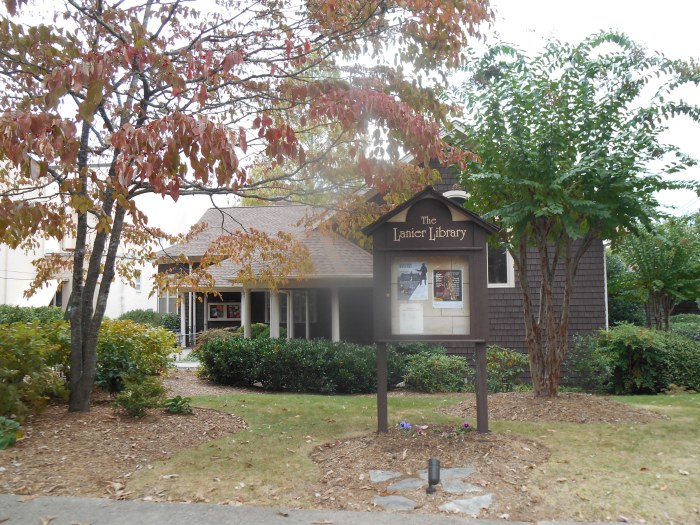
Today’s blog post is a continuation of my blog post on October 19, 2016, about Mark de Castrique’s Mystery Writing Workshop I attended last Saturday at Lanier Library in Tryon, North Carolina.

lanier-library-in-tryon-nc-001

Picking up where I left off on October 19, today I will start by talking about the first of two writing exercises we did during the workshop.

A Writing Exercise

The most challenging part of the three-hour workshop was the first writing exercise. Participants were instructed to do the following in 20 minutes:

  1. Create a character who was a police officer or detective
  2. Think of (or write, if we wished) a bio for that character
  3. Place that character in a single setting
  4. Write a narrative scene in first person
  5. End the scene just before a body is discovered.

Each of us read our work aloud. Mr. de Castrique gave everyone positive feedback. I was amazed at the talent in the room. Mr. de Castrique did a good job making us feel like we were in a safe, non-judgmental place. He put all of us at ease.

Carolyn Wheat’s Four Arcs of a Book

Mr. de Castrique recommended How to Write Killer Fiction, by Carolyn Wheat. Ms. Wheat says a book has the following four arcs:

  1. The beginning
  2. The middle
  3. The place where the detective in a murder mystery faces something that seem impossible to overcome
  4. The ending.

Mr. de Castrique described each arc. He talked about novel endings that work and endings that fail.

Amateur Sleuth

The next thing Mr. de Castrique addressed was putting an amateur sleuth in your book. He talked about the advantages and disadvantages of doing that.

Theme

Mr. de Castrique said the theme is “the thing in a book that will haunt you.” He cautioned us that a book can turn into a sermon if the author tries too hard to drive a point home. (He gave Stephen King credit for having said that, but I paraphrased it.)

Group Writing Exercise

The workshop ended with a group writing exercise. It was a great idea and should help me to think of future story ideas. We had to be in agreement on our choices throughout the exercise, but it would certainly work for a writer working alone. Here’s what we got to work through together:

  1. Select a closed setting, such as a shopping mall
  2. Select six individuals whose occupations would place them at that closed setting without other people being there
  3. Assign an age to each of the six characters
  4. Decide on a secret that each character has
  5. Which one gets murdered and which one is the killer?

Five Takeaways

Five points that I took away from the workshop are as follows:

  1. A good book is one where at the end you liked the world the writer created so much that you would read the book again.
  2. If you can take a scene out without hurting the story, it never should have been there to begin with.
  3. The reader should forget she or he is reading.
  4. Every reader brings his or her own life experiences to the reading of a book, so it’s no wonder that you might hate a book but someone else might say it is the best book they’ve ever read.
  5. When stumped on what to write about, I should refer to last Saturday’s group writing exercise.

After the workshop, Mr. de Castrique autographed my copy of his new book, The Singularity Race. It was an enjoyable afternoon and well worth the cost and time invested in attending the workshop.

Until my next blog post in a few days, I hope you have a good book to read and, if you’re a writer, I hope you have productive writing time.

Janet


Mark de Castrique’s Mystery Writing Workshop – Part 1

Mark de Castrique conducted a mystery writing workshop at Lanier Library in Tryon, North Carolina on Saturday afternoon. Having heard this author speak twice in the last several years, I knew I would benefit from attending his workshop.

Tryon, NC

Nestled in the foothills of the Appalachian Mountains, Tryon is an inviting place to visit on a beautiful early fall day. There were lots of people out and about in the quaint downtown business district. Tryon is dog friendly. Some of the shops provide water bowls on the sidewalks to quench the thirst of local dogs on their daily walks.

The Book Shelf Bookstore

An added highlight on Saturday was visiting the new location of Penny Padgett’s The Book Shelf Bookstore in Tryon. The shop recently moved just a few feet down South Trade Street from its former location. I was delighted to reconnect with Penny. She graciously had a book signing for me (see “Book Signing at The Book Shelf in Tryon, NC” on my blog on April 14, 2015) to publicize my vintage postcard book, The Blue Ridge Mountains of North Carolina. The new shop gives Penny more space for books and book signings. Visiting her shop also gave me a chance to purchase Mark de Castrique’s latest and sixteenth novel, The Singularity Race.

Aristotle

In the three-hour workshop, Mr. de Castrique covered Aristotle’s six components of a story:

  1. Plot
  2. Character
  3. Thought
  4. Language
  5. Melody and
  6. Spectacle.

He talked about sequence in plotting — how it has cummulative power. “A” must come before “B” which must come before “C.” He said the worst plotting for a novel is episodic, meaning the sequence of events can be in random order. (Think episodes of the old TV show, “Gilligan’s Island.” One episode did not build on the previous one.) That works for a TV program but not in a mystery novel.

What if?

Mr. de Castrique talked about the value of a writer asking, “What if?” to get his or her creative juices going. Other topics included write what you know and write from a sense of place.

Illusion of Authenticity

Mr. de Castrique talked about the different methods of research:

  1. Memory
  2. Imagination, and
  3. Fact

and how a novel needs the illusion of authenticity. If you’re writing something that cannot happen, you need to set it up so that it can possibly happen. It has to be believable.

Reader Response Theory

Mr. de Castrique talked about reader response theory, which was a new concept for me. It addresses the following:

  1. Real author
  2. Implied author
  3. Narrator
  4. Characters
  5. Narratee
  6. Authorial audience, and
  7. The reader

In my next blog post on Friday, I will write about the rest of the workshop, including descriptions of the two writing exercises we did. Until then, I hope you have a good book to read and, if you’re a writer, I hope you have productive writing time.

Janet

I wish I’d written that!

If the thought, “I wish I’d written that!” hits me while reading a book, I smack my forehead and write the sentence in my writer’s journal.

Figurative Language

In one section of my writer’s journal, I keep an ever-growing list of favorite lines from the books I read. They are sentences I want to read again and study. Some are examples of good use of description, as is the case with the sentence I quote from a David Ignatius novel in today’s blog. Some sentences get added to my list because they present a clever turn of a phrase that results in a line that rolls off the tongue. Others might be examples of metaphor, hyperbole (e.g., “I smack my forehead”), imagery, or another tool that makes language so pleasant to read or say aloud. These sentences grab my attention for a variety of reasons. I stop and reread them. I appreciate the effort it took for the author to write them. They are sentences I wish I had written.

A quote from The Director, by David Ignatius:

“She was a handsome woman, all her features fused into a hard, dark jewel: the lustrous jet-black hair that maintained its perpetual youthful color, the intelligent face that kept its smile even when she was demolishing a bureaucratic opponent; the lithe body of a former dancer.”

Let’s look at it

What a sentence! For starters, “handsome woman” is a description I rarely hear, but it is usually used to describe a tall, sturdy woman with regular features. The words, “handsome woman” immediately bring to mind a woman of a certain physical presence. She carries herself well even though she is not a young woman. She doesn’t quite fit the definition of “pretty,” but she has pleasant, memorable features. It’s one of those things that is difficult to describe, but I know it when I see it.

The rest of the above sentence written by David Ignatius is chock-full of descriptive words that paint a picture of this woman.

Read this sentence from The Director again:

“She was a handsome woman, all her features fused into a hard, dark jewel: the lustrous jet-black hair that maintained its perpetual youthful color, the intelligent face that kept its smile even when she was demolishing a bureaucratic opponent; the lithe body of a former dancer.”

You have no trouble picturing in your mind what this woman looks like, do you? I wish I’d written it.

Until my next blog post in a few days, my wish for you is that you have a good book to read and, if you are a writer, I hope you have productive writing time.

Janet

Online sites for writers

Today’s post is about a half dozen websites for writers that I discovered this week. I do not endorse any of the websites. I’m merely sharing the sites with those of you who are writers and, in some cases, commenting on my first impressions of the sites.

Online-Utility.org

Online-Utility.org is a free online tool. It measures readability and calculates the grade level at which one could read your text with ease. It also instantaneously lists every sentence in your text that “it” suggests you “rewrite to improve readability.” I was stunned at the number of sentences this tool listed that needed my attention in the first 100 pages of my novel manuscript; however, the website description admits that “In general, these tests penalize writers for polysyllabic words and long, complex sentences.” After quickly perusing the Online-Utility.org list of my sentences that needed attention, I concluded that the great majority of my words had more than one syllable and I am guilty of writing a complex sentence on occasion. I am attempting to write fiction for adults. I concluded that this free online tool better serves someone who is writing for young children or new readers of the English language.

thewritingpractice.com

I also happened upon thewritingpractice. The site has articles about the craft of writing. I will definitely visit that website again.

Writers’ Village University

Another website is that of Writer’s Village University. This site offers college-level classes for its members. I have found few reviews of this site on objective websites but many posts from people asking if anyone has used it. The Writer’s Village University website lists numerous glowing remarks from students, but I find it suspect that there is not one single mediocre or negative review. The writing groups aspect of the website might be its best member benefit. The sites lacks sufficient course descriptions for me to join with confidence. I welcome feedback from any current or former members of the website.

inkandquills.com and The Spanish Coin

As energy allows, I continue to edit my historical novel manuscript I’m calling The Spanish Coin. I was up to chapter 16 of 20 putting my characters’ thoughts in italics when a couple of days ago I read Kaitlin Hillerich’s article titled “How to Write Your Character’s Thoughts” on inkandquills.com. Ms. Hillerich says putting thoughts in italics or using speech tags creates “a barrier between the character and the reader.” She sees thoughts in italics as an interruption by the writer. Ms. Hillerich recommends that the writer lets the character convey his or his thoughts with their own voice. In other words, you can stay in third person point of view but write so it seems like the character is the narrator. This approach makes sense to me, so I will start once more on the first page of my novel’s manuscript, remove the thoughts in italics, and try to accomplish what Ms. Hillerich recommends. I hope my next step after that will be getting a professional to critique my 95,852-word manuscript. If I keep reading “how to write” articles and blogs, I’ll never get The Spanish Coin published. I think I sub-consciously procrastinate because I dread getting umpteen rejection letters from literary agents.

jamigold.com

One website leads to another when I get online. I often start out on Pinterest.com and find many websites about writing. I do not read paranormal fiction, but I recently discovered the jamigold.com website about paranormal writing. I was pleasantly surprised to find a plethora of helpful blog posts there for any writer. Some posts are about self-publishing. There is a new blog series about planning your newsletter. There are posts about how to keep readers and types of extra content you might want to consider including on your website.

Janice Hardy’s Fiction University

The Jami Gold website led me to blog.janicehardy.com — Janice Hardy’s Fiction University. The site contains more than 1,000 articles about writing. Whew! I don’t know where to begin.

No wonder I haven’t finished editing my novel. I spend too much time reading about writing and not enough time writing. And did I mention I’m a procrastinator?

Feel free to tweet about my blog, pin my posts on one of your Pinterest boards, and tell your friends to visit my blog and my website, janetmorrisonbooks.com. Until my next post, I wish you a good book to read and productive writing time for those of you who are writers.

10 Things I’ve Learned about Twitter

I’m new to Twitter this year. Call me old. Call me anti-social. I struggle with it. The following are 10 things I’ve learned about Twitter:

1. You not only are expected to send a tweet every day, you’re expected to send out tweets throughout the day.

2. It’s amazing how much you can say in 140 characters.

3. It’s amazing how much you can’t say in 140 characters.

4. Twitter for Dummies is too advanced for me.

5. As a hopeful would-be novelist, I’m told that I must have a presence and a following on Twitter.

6. As an introvert, I am pulled out of my comfort zone when I use Twitter.

7. All I wanted to do was write a book. At the age of 63, I didn’t bargain for Twitter.

8. By the time I get comfortable using Twitter, it will be obsolete.

9. Nothing I want to tweet about, such as #historicalfiction, is trending. I wonder why. LOL!

10. I might Tweet occasionally, but I refuse to let it or a SmartPhone dictate my life. If that means my novel, The Spanish Coin, will never be published… so be it.

I am willing to try to learn new things, but creating a presence on Twitter just might require more effort than I’m able to give it.

Can I write more than one book at a time?

Since I usually read two or three books at the same time, today I pose the following question:  Can I write more than one book at the same time?

I know authors often have to make final corrections in one book while writing their next book, but is it possible to work on two or three book drafts at the same time?

I’m in the self-editing stage of The Spanish Coin — my 95,000-word historical novel manuscript, but I’m eager to start writing two nonfiction books. One of my book ideas is based on the events that make such an impression on my mind that I remember them as many of 60 years later. What is it about a possibly mundane event that etches itself on our memories to such a degree that decades later we can recall them with clarity? I want to explore that and write about those events in my life.

Another idea I’m toying with literally popped in my mind while walking one morning after being diagnosed with Seasonal Affective Disorder (SAD) and being told the benefits of seeking light early in the morning. I’ll leave it at that for now, not wanting to give away the details of my idea.

One of my inner debaters tells me to put these two ideas on hold and concentrate on completing The Spanish Coin. In rebuttal, another of my inner debaters says variety is the spice of life and it will expand my mind to schedule time to work on at least one of my nonfiction book ideas while I devote the majority of my time to my novel.

In a future blog post I’ll tell you which of my inner debaters won.

Have you ever worked on more than one manuscript at once? Share your experience with me and my blog followers.

Janet