I write southern historical fiction, local history, and I've written a devotional book. The two novels I'm writing are set in Virginia and the Carolinas in the 1760s. My weekly blog started out to follow my journey as a writer and a reader, but in 2025 it has been greatly expanded to include current events and politics in the United States as I see our democracy under attack from within. The political science major in me cannot sit idly by and remain silent.
In last Monday’s blog post, I wrote about three of the books I read in June. Today, I write about three other books I read last month.
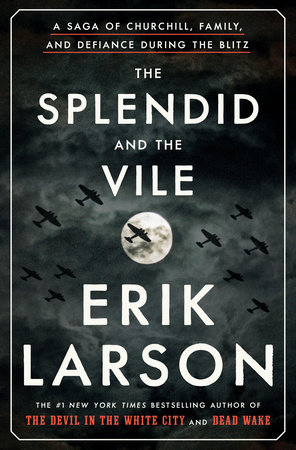
The Splendid and the Vile, by Erik Larson
Having read and liked Erik Larson’s The Devil in the White City: Murder, Magic and Madness and the Fair that Changed America in February, I was eager to read his new book, The Splendid and the Vile. I listened to The Splendid and the Vile and thoroughly enjoyed it.
The Splendid and the Vile, by Erik Larson
This nonfiction book reads like fiction, and I mean that as a compliment. It doesn’t read like a history book. Erik Larson has a way of doing that. If you aren’t a fan or student of history – specifically World War II era – you might not enjoy The Splendid and the Vile as much as I did.
It follows Winston Churchill and his family and friends. His teenage daughter, Mary, plays an important role as she gives us a glimpse of how a teenage girl would perhaps react to the London Blitz. She very much just wanted to be a teenager.
Mr. Larson weaves a fascinating story of Mr. Churchill and his associates. Being Prime Minister of Great Britain, he was in a position to make friendships and acquaintances with people of power. There were some connections he had with Americans that I hadn’t been aware of. Churchill’s son was a constant source of concern, along with the son’s wife, to put it mildly.
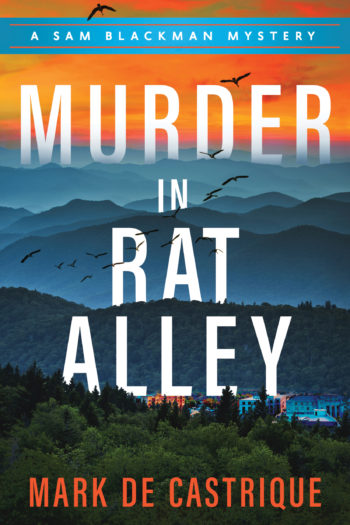
Murder in Rat Alley, by Mark de Castrique
If you’re a mystery fan, you might want to check out Murder in Rat Alley, by Mark de Castrique. This is the seventh book in his Sam Blackman series, but you don’t need to have read any of the earlier books in the series to enjoy this one. If Mark de Castrique is a new author for you, this is a good novel to start with.
Murder in Rat Alley, by Mark de Castrique
Set in Asheville, North Carolina and the Pisgah Forest area, Iraq War veteran and amputee Sam Blackman is a private investigator. His side kick and love interest is Nakayla Robertson. When a body is discovered on the grounds of the Pisgah Astronomical Research Institute, Blackman is called in to unravel a decades old mystery.
When they get too close to solving the murder, their lives are in more danger than they even imagine.
This novel gives interesting background information about the former space program monitoring facility that now collects weather data. It also brings in the flavor of the Asheville music scene. It is sprinkled with the humor that keep Sam and Nakayla together and which balances their private lives with the serious work they do.
If you like a good mystery and want to mentally escape to the North Carolina mountains, give Murder in Rat Alley a try.
The Engineer’s Wife, by Tracey Enerson Wood
The Chief Engineer for the design and construction of the Brooklyn Bridge, William Roebling becomes quite ill during the years it took to build the bridge. His wife, Emily, had taken a deep interest in his work and started studying his engineering books.
The day comes when William is no longer physically able to go to the worksite. Emily starts going in his place and takes on more and more responsibility for the construction of the bridge.
This is a work of historical fiction based on a bit of truth, but the majority of the novel is indeed fiction. I thoroughly enjoyed the book, but I was somewhat disappointed to read in the author notes at the end of the book that so much of it was fiction.
I still recommend it as a good read, but you might want to read the author’s notes before reading the book instead of afterwards like I did. For instance, P.T. Barnum plays a major role in the novel, but it turns out he was probably no more than an acquaintance of the Roeblings.
My apologies to the author, Tracey Enerson Wood, for not being able to insert an image of her book in my blog post today. This is her debut novel. I can’t wait to see what she writes next!
Until my next blog post
I hope you have a good book to read.
If you’re a writer or other artist, I hope you have good creative time this week.
Stay safe. Stay well. Wear a mask out of respect for other people until the Covid-19 pandemic is under control.
A variety of events threw my blog off schedule this month. If you are a regular reader of my blog, you know that on the first or sometimes first and second Mondays of the month I write about the books I read the previous month. In July, I had to split my “Books Read in June 2020” blog posts into two installments. The first installment is posted today. The second installment will follow next Monday, if my computer cooperates.
June came with a host of good books to read. After being closed for nearly three months due to the Covid-19 pandemic, the public libraries in our area reopened for patrons to pick up books they had on reserve. I got on the waitlists specifically for MP3 books I could download to my tablet and for newly-released books “on order,” so I could be assured of checking out new books that had not yet been in circulation.
Of course, when the library system reopened for pick-up service only, I had six books to pick up immediately. Some months are overloaded with good reads, and June was definitely in that category. It was a wonderful “problem” to have!
I hope my remarks about these books will pique your interest. Perhaps you’ll discover an author you’ve never read before – or a new book by an author you like. I don’t consider myself a book reviewer. I think true book reviewers have some rules to follow. I just enjoy sharing what I think and what I learn from some of the books I read.
The Book of Lost Friends, by Lisa Wingate
The Book of Lost Friends, by Lisa Wingate
Lisa Wingate showed us in Before We Were Yours that she has a talent for taking a little-known fact from history, thoroughly researching it, and writing a novel that educates and entertains. The Book of Lost Friends is another such book.
In the years following the American Civil War, former slaves tried to reconnect with their relatives and friends. The slavery culture often tore families apart by parents and their children and brothers and sisters often being sold to different masters. Ms. Wingate discovered that the Methodist denomination offered a place in one of its newspaper-like publications where people could post information about a relative or friend they wanted to reconnect with. Those published notices adopted the name, “Lost Friends.”
The Book of Lost Friends follows two plot lines. One is in Louisiana in 1875 and introduces us to Hannie, a former slave; Juneau Jane, her illegitimate Creole half-sister, and Lavinia, the heir to a plantation now in shambles. The three women head for Texas. Along the way, Hannie becomes hopeful that she will find her long lost mother and eight siblings.
The other plot line is in Louisiana in 1987 and introduces us to a teacher, Benedetta Silva, who is trying to make history and literature come alive for her high school students. Seen as “an outsider,” “Benny” works to make her way in a small town on the Mississippi River. She is appalled at the poverty many of her students live in. Warned to stay away from a certain abandoned plantation house, curiosity gets the best of Benny. What she finds hidden in that house could change her life and the lives of her students forever.
One of the things I liked in the book was the “Negativity Rule” “Benny” enforced in her classroom. Under that rule, if a student spoke negatively about another student, the student in the wrong had to say three positive things about the other student. The author’s use of this rule to illustrate that it takes three times the work to undo the damage done by a negative is a lesson we could all learn.
The Man from Spirit Creek, by Barbara Kyle
The Man from Spirit Creek, by Barbara Kyle
I never win anything, so I was shocked when I received an email from book coach and author Barbara Kyle telling me I had won a copy of her new novel, The Man from Spirit Creek on Audible! I had just picked up six library books that afternoon that had been held for me – some since a couple of days before the libraries had to close on March 15 due to the Covid-19 pandemic. I had just started listening to The Book of Lost Friends, by Lisa Wingate, but I was tempted to go ahead and start listening to Barbara Kyle’s book.
I took an online writing course taught by Barbara Kyle a couple of years ago, and I’d meant ever since then to read one of her novels. She lives in Canada and The Man from Spirit Springs is set in Alberta.
Ms. Kyle’s novel puts the reader smack-dab in this western Canadian province. She weaves the geography and geology (oil) of this prairie land into the story so well that you can taste the dust in your mouth and smell the rotten eggs smell of “sour” gas. This present-day story gets into the nitty-gritty of the clash between ranchers and big oil. It’s full of suspense, betrayal, revenge, family ties, the love between two sisters, and the romantic loves of both of them.
Liv Gardner is the attorney for Falcon Oil, the oil and gas company she and her fiancé, Mickey Havelock, own in Houston, Texas. Someone is sabotaging their rigs in Alberta. Liv goes to Spirit Creek, Alberta under the guise of having a temporary job with a lawyer there as she tries to figure out how to get the saboteur to give up his tactics and sell out to them.
The saboteur is sheep farmer Tom Wainwright. His beef with Falcon Oil? He blames Falcon’s “sour” gas, which is released 24/7, for his wife’s miscarriages and eventual death and for the miscarriages and deaths of many of his sheep.
Even as Liv and Mickey plan their wedding, Liv gets personally involved with Wainwright in spite of the fact that she went to Alberta to stop his efforts to ruin Falcon Oil. She discovers his human-side and lets her heart overtake her good sense. There’s a murder. Wainwright is arrested. But is he the killer? And will Liv and Mickey get back together?
You’ll love all the twists and turns in this contemporary Canadian western novel of suspense. It transported me all the way to Alberta for several days. What better way to “get away” during this pandemic than to curl up with a very engaging book?
How to Be An Antiracist, by Ibram X. Kendi
How to Be an Antiracist, by Ibram X. Kendi
There are many eye-opening things to take from Ibram X. Kendi’s book, How to Be An Antiracist, but the most important lesson I learned from reading it is the difference being “not racist” and “antiracist.” I’ve been guilty of saying, “I’m not a racist.” It’s possible I’ve even said, although I hope I haven’t, “I’m not a racist, but….” “But” says, “Oh yes you are!”
In the words of Mr. Kendi in his book, “What’s the problem with being ‘not racist?’ It is a claim that signifies neutrality…. The opposite of racist isn’t not racist it is antiracist.”
Mr. Kendi anticipates the reader asking, “What’s the difference?” That’s what I wanted to know. In the introductory pages of his book, he eloquently answers that question. In fact, if you don’t want to or don’t have time to read the entire book, I recommend you read the introduction. You might not agree with it. It might not change your mind but, if you’ll read it with an open and curious mind, it will definitely give you something to think about.
What’s the difference between “not racist” and “anti-racist?” Mr. Kendi explains it as follows: “One endorses either the idea of a racial hierarchy as a racist or racial equality as an antiracist. One either believes problems are rooted in groups of people as a racist or locates the roots of problems in power and policies as in antiracist. One either allows racial inequalities to persevere as a racist or confronts racial inequities as an antiracist. There is no in-between safe space of not racist. The claim of not racist neutrality is a mask for racism.”
He goes on to say that “color-blindness” and “not a racist” means you fail to see race and you fail to see racism. Something I got from the book was to claim you don’t see race is disrespectful of people of another race. We need to recognize race and not pretend it doesn’t exist or that we don’t notice it. We need to celebrate it for what it is.
Mr. Kendi addresses his own racism in the book and how people of any race can be racist. As he states in the book’s introduction: “This book is ultimately about the basic struggle we’re all in: The Struggle to be fully human and to see that others are fully human.” He describes antiracism as “an unlit dirt road.” It’s not easy to find one’s way on an unlit dirt road. He calls on all of us to look at power and policy. He says, “We know how to be racist. We know how to pretend to be not racist. Now let’s know how to be anti-racist.”
The big picture that made a lasting impression on me was that to be anti-racist is to stand up and speak out when you see injustice. To sit idly by, is to be complicit. As long as you see yourself as “not a racist,” you give yourself permission to sit idly by and ignore evil because you think it doesn’t affect you.
People of various religion and no religion read my blog around the world. I’m a Christian. I think Jesus Christ is calling on Christians to call out injustice when we see it. I’m pointing to myself. I’ve been guilty of sitting idly by, turning the other way, keeping my mouth shut because I didn’t want to cause an argument or hurt someone’s feelings. I am, by nature, a quiet person. My voice often gets drowned out by louder voices and more assertive people. It is my challenge now to stop being “not racist” and start being “anti-racist” as I feel I’m being called to be.
(Since I listened to the audio edition of the book, I hope I got all the quotes right. My apologies to Mr. Kendi if I made any errors.)
Until my next blog post
I hope you have at least one good book to read.
I hope you have quality creative time, if you’re a writer or other artist.
I hope you stay safe and well. I hope you wear a mask to protect others.
If you haven’t told your best friend how much you love them recently, call or write them a note and tell them now. Tomorrow might be too late.
Perhaps you noticed my weekly Monday blog post never showed up last week. My nearly life-long friend, Kay Jewett Nalbone, died on Sunday. Although not unexpected, it was difficult to accept.
When you’ve been friends for 57 years and shared each other’s joys and struggles, you have a bond. What it boils down to is that I no longer have a friend with the same memories I have.
Another long-time friend from my graduate school days, Ray Griffin, didn’t know Kay and was not aware of her declining condition. It was serendipitous that Ray’s new book of poetry arrived in the mail on Monday. If ever I needed a collection of poems to sit down with and relax, it was Monday and Tuesday.
The name of Ray’s book is Winsome Morning Breeze: A Collection of Sonnets and Tanka. It is available online or you can request it at your favorite independent bookstore. It is beautifully illustrated with watercolors by Marti Dodge.
Many selections in Ray’s book resonated with me for different reasons. Having lost two good friends since February, the last two lines of “I Was a Fool” on page 21 has special meaning for me:
“To live one’s life most fully and with zest,
One must not ever let the moment rest.”
“On Dragon’s Tail” on page 19, on the other hand, brought a smile to my face as Ray eloquently wrote about his experience of driving the portion of US-129/TN-115/NC-115 in the Appalachian Mountains known as The Dragon’s Tail due to its 318 curves in 11 miles. It is a favorite of motorcycle and sports car enthusiasts and a fun drive for those of us who love to drive in the mountains. What fun!
Photo by Jordan Whitt on Unsplash
And here’s a lovely turn of phrase from Ray’s sonnet, “Fallen Leaves” on page 109: “I feel as though I am within a large kaleidoscope.”
“Daughter” on page 107 brought tears to my eyes as Ray recalls the birth of his and Ida’s daughter 31 years prior. I remember sitting on the floor and playing with their precious daughter when she was just four or five years old.
Ray and I studied political science and public administration. He had a successful 26-year career as a city manager. He is now an adjunct professor of politics in Virginia. His poems, “Barbara Jordan” on pages 85-87 and “I’m But an Old Man” on pages 73-79 are as heartfelt as any pieces in the book. I could hear Barbara Jordan’s distinctive voice from the Watergate hearings as I read the poem he named after her.
I hope I’ve shared just enough from Winsome Morning Breeze: A Collection of Sonnets and Tanka, by Ray Griffin to whet your appetite. It will be a book I will reach for often. I will read it over and over, and I believe you will, too.
Until my next blog post
I hope you have a good book to read. I’m reading Shiner, by Amy Jo Burns and We Wear the Mask: 15 True Stories of Passing in America, edited by Brando Skyhorse and Lisa Frazier Page.
If you’re a writer or other artist, I hope you have productive creative time during the Covid-19 pandemic.
Be safe. Be well. Wear a mask in respect for other people.
Yesterday I did something that was very difficult. Due to the COVID-19 pandemic, I decided not to attend a memorial service for an old friend. She died in Waterloo, Belgium on February 26. Due to the pandemic, her memorial service at her home church, Bethel United Methodist in Midland, North Carolina, had to be postponed until yesterday.
Teresa Beth Hough Koestal, Artist and Friend
I got to know Beth in the ninth grade. She stood out in the crowd even at that age in our class of around 200 students. She was artistic and funny. She was unassuming and gracious. She was beautiful inside and out.
Her leadership qualities were rewarded our senior year when she was elected class president. A group of us girlfriends rode together to a concert at Memorial Stadium in Charlotte one night. The main attraction for us was teen heartthrob Bobby Sherman. I’m not certain, but I believe Beth was our driver. That was about as wild and crazy as we got back in the day.
Beth’s artistic ability blossomed and, by our senior year, we knew we were in the presence of a true artist. After college, Beth eventually moved to New York City, where she met her husband, Jaap Koestal. Jaap was from The Netherlands. They moved to Amsterdam and Beth starting making a name for herself in the European art world.
They later moved to Belgium, where she continued to hone her craft. She was commissioned to paint many paintings and portraits. A highlight in her career was when she was commissioned to paint more than eighty plein air paintings commemorating the bicentenary anniversary of the Battle of Waterloo in 2015.
She even created a series of coloring books about the Battle of Waterloo to entice children to learn about history and appreciate art. She sent me several sketches from her coloring books while they were in the planning stages for me and my sister to give her feedback. Like I was qualified to do that!
In recent years, Beth and I communicated occasionally via Facebook and Facebook private messages. She knew that now in our sixties, I was an aspiring novelist. She sent words of encouragement along my journey. My novel isn’t published yet. I had looked forward to the day I could send her a copy with my thanks and admiration.
She was one of those people who found the most interesting and varied things to share on Facebook – whether it be art, archeology, architecture, nature, or science. She loved to learn new things and was interested in everything.
During this pandemic, it wasn’t an easy decision not to attend Beth’s memorial service. I have not attended several funerals in the last several months, including one for one of my first cousins. A part of me just can’t believe Beth is gone. I thought going to her memorial service would make her death more real for me, but I was afraid to go and risk catching the coronavirus.
This is life during the Covid-19 pandemic in 2020.
Until my next blog post
Stay safe. Stay well. Wear a mask out of respect for others.
If not for the 12th Amendment to the US Constitution, Donald Trump could now be president and Hillary Clinton could now be vice president. Talk about an unworkable state of affairs!
The ratification of an amendment to the US Constitution deserves a blog post on its anniversary. Unfortunately, the 12th Amendment gets into the Electoral College – something that has always baffled me. I’m probably the last person who should be trying to explain the 12th Amendment to you, but I’m going to plow my way through it.
Photo by Element5 Digital on Unsplash
As soon as I started doing the necessary research so I could write today’s blog post, I ran into conflicting dates. I’m going with June 15, 1804 as the date the 12th Amendment to the United States Constitution was ratified. I’ll address the conflicting date later in this post
What is the 12th Amendment about?
The 12th Amendment to the US Constitution determined how every US President and Vice President have been elected since 1804. It mandates that electors in the Electoral College vote for president on one ballot and for vice president on a separate ballot.
Presidential Elections Prior to the 12th Amendment
Under Article II, Section 1 of the US Constitution, each state was entitled to appoint a slate of electors equal to the number of US Senators and US House Representatives the state had. Each state had (and still has) two Senators. The number of Representatives a state has is based on population.
Every four years those electors, now known as the Electoral College, chose the president and vice president. Each of them could vote for two people; however, they couldn’t vote for someone from their state of residency.
The highest vote getter became president and the one with the second highest number of votes became vice president, as long as their total votes exceeded one-half the number of appointed electors. Therefore, the president and the vice president weren’t necessarily from the same political party.
If no one got a majority of votes, or if two candidates received the same number of votes, the House of Representatives chose the president and the person with the second highest number of votes became vice president.
Photo by Luke Michael on Unsplash
Political Parties
In the 1790s, differences of opinion on domestic and foreign policies became pronounced enough that two political parties formed. The founders of the United States had not anticipated the formation of strong political organizations/parties. The two parties were known as the Federalists and the Democratic-Republicans.
Yes, it’s very confusing to us in 2020 when there are two major political parties in the US: Democrat and Republican.
The Federalists wanted a strong central government that was friendly to Great Britain. The Democratic-Republicans wanted strong local governments and were more in line with the French Revolution.
The Early US Presidents
Without opposition, George Washington was elected the first US president in 1788 and again in 1792. He announced he would not seek a third term. He became increasingly aligned with the Federalists, although he saw the dangers inherent in factionalism. John Adams was Washington’s vice president. He identified himself with the Federalists. Thomas Jefferson was Washington’s Secretary of State until 1793. Jefferson became the leader of the Democratic-Republicans.
The 1796 election was the first time candidates for president ran from two political parties. John Adams and Charles C. Pinckney were the foremost Federalists running against Thomas Jefferson. John Adams won a majority of votes, but Thomas Jefferson was elected vice president. Remember, they were from opposing political parties and ideologies. Such a situation is difficult for modern Americans to imagine.
Moving on the 1800 election, John Adams ran for reelection and Thomas Jefferson ran for president again. The political parties had gotten stronger and electors divided their votes between “only” five candidates. John Adams received 65 votes. In order to avoid a tie vote between Adams and Pinckney, one of the electors from Rhode Island voted for John Jay so Adams would have a one vote advantage over Pinckney.
But Democratic-Republicans Thomas Jefferson and Aaron Burr each received 73 votes. The Federalists thought they had an edge in the House of Representatives that would result in the election of the more conservative Aaron Burr, so they weren’t worried. They thought they could work better with a President Aaron Burr than a President Thomas Jefferson.
In order to be elected president, a candidate had to receive nine votes from the 16 states. Eight states favored Jefferson, six aligned with Burr, and two states were divided in how to cast their votes. Voting on the floor of the House of Representatives continued for six days and 35 ballots!
Photo by visuals on Unsplash
Although he personally favored Burr, Delaware elector James A. Bayard let it be known that he would vote for Jefferson after Senator Samuel Smith assured him that Jefferson would not undo the accomplishments of the Washington and Adams administrations. In the end, 10 states voted for Jefferson, electing him the third US president.
The 1800 election proved to the Federalists and the Democratic-Republicans that the electoral system was deeply flawed.
On December 9, 1803 Congress proposed a 12th Amendment to the Constitution.
What the 12th Amendment did
The 12th Amendment didn’t change the structure of the Electoral College but, in order to understand the purpose of the amendment, one needs to have some knowledge of the Electoral College.
Whereas the Constitution had required each elector to vote for two people for president (yes, you heard me right!), the 12th Amendment required each elector to cast one vote for president and one vote for vice president.
If no one receives a majority of votes for president, the House of Representatives will choose the president under the rules of the original procedure as set forth in the Constitution, except they will choose between no more than three candidates instead of five, as was stipulated in Article II, Section 1 of the Constitution.
In case no candidate receives a majority of votes for vice president in the Electoral College, the US Senate chooses the winner from the top two vote getters. However, if there is a tie between multiple candidates, the Senate will choose from all those in the tie.
Additionally, the 12th Amendment requires a two-thirds quorum for balloting procedures. It also provided for a remedy should a president not be chosen by March 4. That remedy was that the newly-elected vice president would act as president until the election of the president could be settled. (March 4 was the first day of a presidential term until the ratification of the 20th Amendment in 1933 which established January 20 as the first day of a presidential term.)
Under the 12th Amendment, if no president or vice president have been elected by January 20, Congress will appoint a president. We almost got into that situation in the 2000 election, but that’s a whole other story, #HangingChads.
The Pros and Cons of the Electoral College
I’ve read various reasons and speculations about why the framers of the US Constitution provided the Electoral College as a way to elect the president. I’ve read that it was to ensure that people who had wisdom (in other words, that knew about politics, had some education, and understood this new form of government) would have enough sense to elect a president.
I’ve read that they didn’t want people living in the population centers of the nation to have an advantage over the citizens in the backcountry because the people in the cities would be more likely to know the candidates. (They obviously didn’t foresee the advent of the radio or television.)
There is much confusion over the Electoral College. As a political science college student, I was more interested in the administration of government than its political aspect. I made a conscious decision not to take the senior-level Political Science course called “The Electoral Process.” Looking back, perhaps I should have taken that class.
Photo by Sincerely Media on Unsplash
With practically every presidential election, pro-Electoral College and anti-Electoral College opinions rise to the surface. There are people who would prefer the candidate receiving the majority of the popular vote (the votes of all citizens) to be president, while people who like the idea of the popular vote in each state being sifted through the Electoral College electors of their state want us to keep the Electoral College.
I’m going to go out on a limb today and say that I would like to see the Electoral College ended. I think each American’s vote should count equally to every other American’s vote. The people in favor of the Electoral College typically fear a populous state such as California or New York could influence an election by the sheer number of voters who live there.
Americans stand in line to cast their votes for president on the first Tuesday in November every four years, and then the electors who make up the Electoral College meet in their states on the first Monday after the second Wednesday in December and cast their votes.
Since we elect the president and vice president via the Electoral College, in 2016, Donald Trump became president even though Hillary Clinton had some three million more popular votes than Trump. There are other elections in which the top popular vote getter lost the election, but I think that one example suffices.
I think it’s time to rethink the electoral process, but I’m not impassioned enough about it to lead the campaign to amend the 12th Amendment.
Ratification of the 12th Amendment
Photo by Anthony Garand on Unsplash
On June 15, 1804, 189 days after the 12th Amendment had been proposed by Congress, it was ratified by 14 or the 16 states. North Carolina was the first state to ratify it, doing so on December 21, 1803. By the end of February 1804, it had been ratified by nine states.
By mid-May 1804, Delaware, Massachusetts, and Connecticut had rejected the amendment. New Hampshire ratified the 12th Amendment on June 15, 1804, meeting the requirement that in order to be adopted, a US Constitutional amendment must be ratified by three-fourths of the states.
What about the conflicting dates I found?
Technically, when three-fourths of the states have ratified a US Constitutional amendment, it is officially ratified and becomes law. That’s what happened on June 15, 1804 with the 12th Amendment. That’s why I went with today being the anniversary of the amendment’s ratification.
Secretary of State James Madison sent a letter to the state governors on September 25, 1804, declaring the 12th Amendment as ratified. Some history books use September 25, 1804 as the date of ratification.
Since my last blog post
I opened my blog with some trepidation last Monday. I didn’t know how my blog post that morning would be received. I was very pleased with the response the post got. As of last night at 10:00 pm, last Monday’s post, “I can’t breathe!”, has had 147 visitors from 15 countries. That’s a record for my blog. It has received more comments than any of my other blog posts. My thanks to each reader!
Until my next blog post
If you still have questions about the 12th Amendment and the Electoral College, please research them. I’ve said all I know about the subject, and I’m still a bit confused. Perhaps I should have gone with the September 25 date. That date doesn’t fall on a Monday (the day I blog) until 2023. After more than a little frustration, I wish I’d postponed today’s post until then!
I hope you have a good book to read. I’m reading The Book of Lost Friends, by Lisa Wingate.
If you’re a writer or other artist, I hope you have lots of creative time.
Be safe. Be well. Wear a mask in respect for other people.
I planned to blog about point-of-view in fiction writing today. I don’t know about you, but I haven’t been able to settle my mind around point-of-view in fiction the last couple of weeks and especially not in the last seven days.
I don’t take lightly what I’m posting here today. I’ve wrestled with the words all weekend. I take no joy in saying what is on my heart.
I live in the United States. This is a watershed moment in this country. We are beginning to come to grips with social and racial injustice which has existed in America since its very founding. I will blog about point-of-view in fiction writing at another time when it seems more appropriate.
What happened May 25, 2020
On May 25, 2020, a police officer murdered Mr. George Floyd who was suspected of passing a counterfeit $20 bill. He might not have even known the bill was counterfeit. Three other officers were there. Two were new on the job, so I can’t help but think the officer in charge was making a show for them.
Mr. Floyd was slammed to the pavement. One police officer held his knee on the man’s neck for nearly nine minutes. Part of the time, two other offices held the hand-cuffed man down by pressing down on his back. One of the officers asked his superior officer twice, “Shouldn’t we turn him over?”
Among the last words Mr. Floyd uttered were, “I can’t breathe!” He lost consciousness and died on the scene. The police officers were white. Mr. Floyd was black. It was all captured on a 17-year-old young woman’s cell phone video.
This type of thing has happened over and over again. One would think it would have stopped when the police knew that there’s always someone nearby with a cell phone, but this has happened repeatedly in the United States even as rogue police actions are captured on camera.
I want to believe that most police officers are honest, fair, and people of good character; however, we all know that there are officers who represent the worst in our society. There are “good” people and “bad” people among us and in every walk of life.
But the problem is more systemic than that. As police departments have been weaponized more and more since September 11, 2001, I think there has grown within that brotherhood more of a military mindset than existed before.
As a white woman, I’ve had several bad experiences with police officers. I can’t begin to imagine how it must feel to be a person of color dealing with a police officer. White people like to think, “If you’re not doing anything wrong, you have nothing to worry about.” Sadly, that’s not the reality that black people live every day in the United States.
For black people in America, doing the right thing and being compliant when stopped by a police officer isn’t necessarily enough. Mr. Floyd didn’t resist arrest, as far as can be seen on the video. That wasn’t enough to save his life.
What happened to Mr. George Floyd on May 25 was tragic and abhorrent. “I can’t breathe!”
Photo by Mitchell Luo on Unsplash
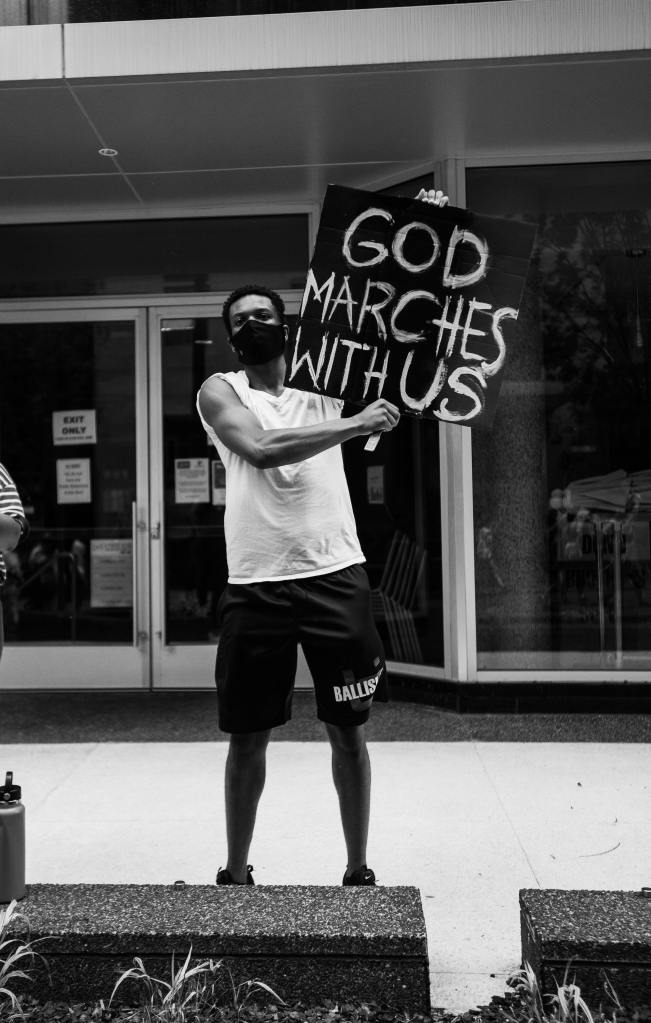
In response to this incident, there have been peaceful protests by hundreds of thousands of people of all colors across the nation. (My favorite sign in the photo above is the one that says, “If you’re not angry, you aren’t paying attention.”)
Photo by Andrew Winkler on Unsplash
In some of the cities, a violent element has emerged and committed acts of violence and looting of businesses. The few looters give the peaceful demonstrators a bad name and they draw attention away from the real issues.
I was horrified to watch the murder of Mr. Floyd on television. I was saddened and angered to watch the looting on television. The rioting and looting only served to take the spotlight off of Mr. Floyd and the other black men and women who have died at the hands of rogue cops. The looting of businesses hurts the very people for whom the peaceful protesters are marching.
Insurrection Act of 1807 Threat
Last Monday, Donald Trump threatened to enact the Insurrection Act of 1807 and, in the process, turned the police against a group of peaceful protesters with tear gas, flash bangs, and rubber bullets so he could stage a photo-op across the street from the White House at a church. I heard the Attorney General of the United States say it wasn’t tear gas. He said it was pepper spray. He went on to say that pepper spray is not an irritant. And so it goes. And so it goes.
Mr. Trump went on the threaten to deploy the US military into states if state governors didn’t put an end to the protests. He essentially said that if the governors didn’t take care of the problem, he would.
For those of you who are not US citizens, I want you to understand how despicable Mr. Trump’s threat is.
Photo by Gayatri Malhotra
Since Washington, DC (District of Columbia) is not a state or in a state, the president has the authority to call in the US military into that city; however, he does NOT have the authority to order the US military into states if the governors don’t put a stop to the protests in their states. He cannot legally do that. Under the Insurrection Act of 1807, the president can only mobilize the military in a US state at the request of that state’s governor.
What has happened over the last two weeks has made me sick to my core. I cannot find the words to adequately express my anger, sadness, disappointment, shock, sorrow, or fear.
The US military is supposed to protect us, not beat us into submission! Mr. Trump’s idea of “law and order” is to quell anyone or any group that dares to speak out against him.
The list of retired US military officers who have spoken out against Mr. Trump’s threats last Monday continues to grow. Several have used strong language such as saying Mr. Trump is “a threat to the Constitution.”
Use of a Church and the Bible just as props
The icing on the cake was when Mr. Trump posed in front of a church and held up a Bible. Then, he called his all-white White House staff to stand with him for another photo-op with the Bible.
Numerous religious leaders have spoken out against what Mr. Trump did in front of St. John’s Church last Monday. He held a Bible in the air and looked stone-faced into the cameras. He didn’t read from the Bible, he didn’t pray, and he didn’t call for prayer for our country in crisis. He offered no words of consolation for all the hurting people. He didn’t mention Mr. George Floyd.
Still oblivious, on Friday Mr. Trump said “George” (not “George Floyd” and not “Mr. Floyd”) was probably looking down on us and saying it was a great day because the unemployment rate in the US dropped to 13.3% in April. He failed to mention that unemployment rates for black Americans increased to 16.8%.
My hope and prayer
I pray that people will think long and hard before they vote in November on the national, state, and local levels. Every four years, Americans tend to say, “This is the most important election in our lifetimes.” I’ve thought and said that myself. It was certainly true about the 2016 election but, if the 2020 presidential election goes the way the 2016 election did, there will be a real constitutional crisis in store for us.
Photo by Andy Feliciotti on Unsplash
The United States Senate had a chance in January to impeach Mr. Trump and remove him from office. The Republican majority caved. They’ve been predictably silent throughout the Covid-19 pandemic and the president’s mishandling of the current racial injustice crisis.
Mr. Trump’s answer has been to make threats and have layer after layer of fencing and concrete blockades built around the White House in the past week. He got an expensive education, but it’s sad he wasn’t given a history or civics lesson. The White House is “the people’s house.” It’s not his house. It’s his, rent-free for four years.
It was never my intent to use my blog as a political platform, but I have this internet platform and I would be remiss if I ignored what is happening in America. It is way past time for all Americans to look within ourselves and honestly recognize our prejudices. I believe we all have prejudices. Each of us has flaws and faults.
If I see injustice and I don’t speak out, I’m complicit. I’m part of the problem. There is racism in the White House. There is racism in the US justice system. There is racism within city and county police departments.
Until people in all positions of authority and those of us who are not in positions of authority recognize and name our prejudices, the problem of social and racial injustice in the United States will remain with us.
Until we embrace these words in the US Declaration of Independence, “all men are created equal,” our country can’t reach its full potential. Until Americans of all colors can reach their full potential, our country can’t reach its full potential. I sincerely hope 2020 is a turning point for the good of the whole of the United States.
“I have a dream…”
Photo by Sonder Quest on Unsplash
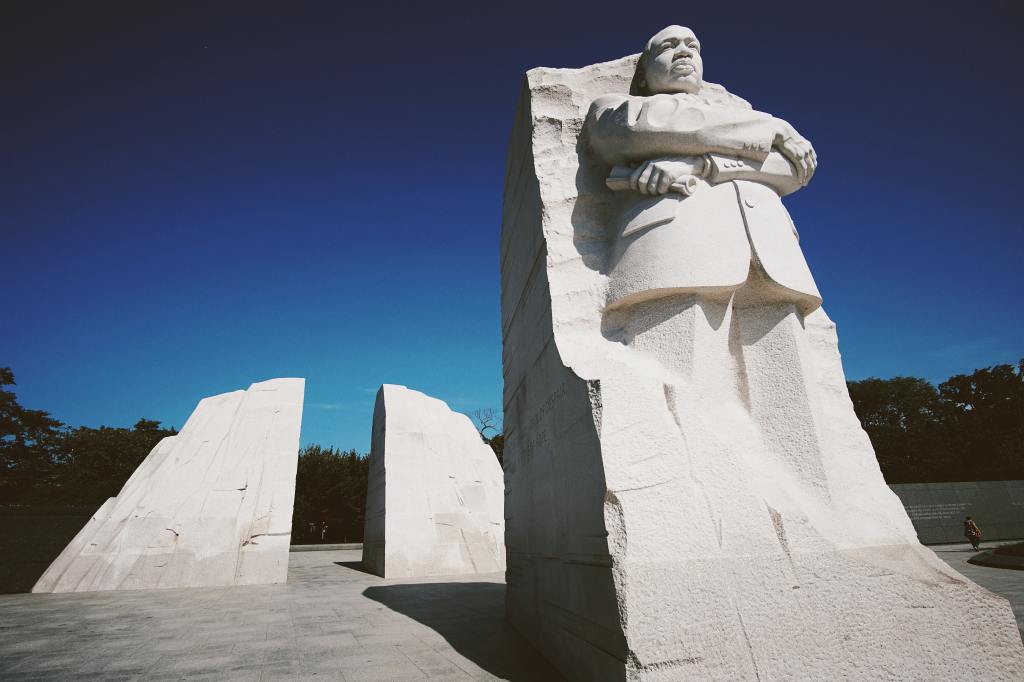
I pray that the day will come when the words of Dr. Martin Luther King in his “I Have a Dream” speech August 28, 1963 become a reality. Dr. King said, in part, the following:
“I have a dream that one day this nation will rise up and live out the true meaning of its creed: ‘We hold these truths to be self-evident: that all men are created equal.’
“I have a dream that one day on the red hills of Georgia the sons of former slaves and the sons of former slave owners will be able to sit down together at the table of brotherhood….
“I have a dream that my four little children will one day live in a nation where they will not be judged by the color of their skin but by the content of their character.”
We’ve come a long way since 1963, when I was 10 years old, but I’m appalled to realize how far we still have to go before Dr. King’s dream can become a reality. It’s been 57 years since his speech. Let that sink in for a minute. Fifty-seven years.
I thank God I live in a country where I have the right to criticize the government and political office holders without fear of retribution. I pray it will remain so today and especially after the November 2020 election. Free speech is a fragile thing.
Until my next blog post
I hope you have a good book to read. I suggest you make a conscious effort to read a book written by a person whose skin color is different from your own. Ask for a recommendation at your local library or bookstore.
Continue to stay safe during the Covid-19 pandemic. Care for one another. Wear a mask to protect others.
Treat others the way you want to be treated. Be an instrument of God’s peace. Seek ways in which you can work for social justice.
To have had 31 days, the month of May passed leaving me feeling like I didn’t read very much. Actually, I read a lot. There were several books I started but didn’t finish. That’s what left me feeling as if I didn’t read much. There are always more books to be read than I have time to read. What a fortunate situation!
The books I chose to read in May were all over the place. Three of them turned out not to be what I expected, which is always disappointing.
A Conspiracy of Bones, by Kathy Reichs
This is Kathy Reichs’ latest novel and I thoroughly enjoyed it. Set in Mecklenburg and Lincoln counties in North Carolina and Lake Wylie, South Carolina, the book features Reichs’ well-known protagonist, forensic anthropologist Temperance Brennan.
A Conspiracy of Bones, by Kathy Reichs
Temperance is at odds with the new Mecklenburg County medical examiner. Against the medical examiner’s wishes and orders, Temperance pursues the case of a body found in Lincoln County. There are gory details about the state of the body, but the story line concentrates on who killed the man and why.
In the process of solving the crime, Temperance faces bodily harm and attempts on her life. She has a knack for going where she shouldn’t go and getting into all sorts of situations. Fairly early on, Temperance suspects the larger case involves child pornography. Is she correct, or is this a red herring Ms. Reichs included just to throw us off track?
Cutting for Stone, by Abraham Verghese
After listening to this book for three hours and having 21 more hours remaining – and reading a synopsis of it – I decided I couldn’t concentrate long enough to listen to the rest of it. The synopsis revealed a plot that sounded better suited for a series of books. I just couldn’t finish it.
Cutting for Stone, by Abraham Verghese
The prose was vivid, explicit, beautiful, and at times humorous. During the Covid-19 pandemic, it was just another book I couldn’t concentrate enough to see it through.
Big Lies in a Small Town, by Diane Chamberlain
After Cutting for Stone, this book was a delight. It is the eighth book I’ve read by Diane Chamberlain. I’m tempted to say it’s my favorite of the eight, but that might just be because I just finished it.
Big Lies in a Small Town, by Diane Chamberlain
Set in Edenton, North Carolina in 1940 and 2018, it is a story of racial discrimination, rape, child neglect, trust, jealousy, revenge, and love.
Ms. Chamberlain weaves an intriguing tale of a woman coming from “up North” to paint a large mural on the wall of the post office in Edenton. There is backlash because a local male artist had applied for the job. When a local black high school student is invited by the artist to assist her in the project, tongues in the small town wagged.
Decades later, an artist who is serving a prison term for a crime her boyfriend committed is chosen to get early parole if she will restore the mural. This leads to the discovery of several bizarre aspects of the mural. The restoring artist sets out to find out what became of the original artist and why she included the strange items and images in the mural. Add to this the suspense of an almost impossible deadline for the restoration and opening of an art museum, and you have the ingredients for a beautifully written mystery.
Writing Vivid Plots: Professional Techniques for Fiction Authors (Writer’s Craft Book 20), by Rayne Hall
This book probably won’t interest you unless you are learning the craft of fiction writing. If you are a student of fiction writing, though, I recommend the book.
Writing Vivid Plots helped me in two specific ways. It explained the important differences in plotting a serial and a series. It also had a short chapter about the difference in plotting a novel and plotting a short story.
By the way, a serial is a story broken into different installments that should be read in order. A series is a group of books having the same characters but which usually stand on their own and can be read in any order.
Long Bright River, by Liz Moore
As often happens lately, I can’t remember what prompted me to get on the waitlist for this book at the public library. I don’t know what I was expecting, but this wasn’t it. How it had been described to me must have left something out. A true representation of the book wouldn’t have led me to want to read it.
Long Bright River, by Liz Moore
This is Liz Moore’s fourth novel and the first of hers I’ve read. The book is well-written. In fact, listening to it held my attention. What I wasn’t prepared for, though, was the way the book left me feeling hopeless against the drug abuse problem in our world.
Michaela “Mickey” Fitzpatrick is a Philadelphia police officer. She tires of all the murders in her district. It seems that most of prostitutes. Every time another murder call comes in, she holds her breath for fear that this time it was her sister, Kacey. Their childhoods weren’t happy. There was little love in the family. The two sisters, once so very close, went their separate ways.
The overriding story is that of family drama, but it’s all wrapped up in the opioid crisis. I never lost interest in the book, as I wanted to know what happened to Kacey. Also, there was Mickey’s son, Thomas. Or was he her son? In the end there was some hope that Kacey would stay clean and never start using drugs again, but it left me with scant hope.
This novel left me rather depressed about the outlook for Kacey, Mickey, and the two children they had between them in the end. In that respect, the book is probably a true reflection of family life when a member is addicted to drugs. It’s also a true reflection of how every member of a family is affected when one member is abusing drugs – and what an empty feeling is left when that person dies as a result of their addiction.
I’m glad I listened to the book. After I finished listening to it, I read a review in which the writer talked about how confusing it was to try to read a book with no quotation marks. Ditto that for me. I wouldn’t have stuck with a physical copy of the book.
Commonwealth, by Ann Patchett
Having read State of Wonder, The Dutch House, and Bel Canto by Ann Patchett, I looked forward to reading Commonwealth, her novel published in 2016. Commonwealth never drew me in. I was listening to it, which I think probably made it more difficult for me to keep all the characters straight.
Commonwealth, by Ann Patchett
I couldn’t identify with any of the characters, so I never felt invested in the story. It started in California at a christening party where every one got drunk. This is not my life experience, so right off the bat I couldn’t identify with these people. Then, it jumped 50 years later with all the same family members, including a raft of cousins.
The book just didn’t appeal to me. I listened to it for three and a half hours but wasn’t motivated to listen to another seven hours.
The Tea Girl of Hummingbird Lane, by Lisa See
It amazes me how time passes. If someone had asked me when I started reading The Tea Girl of Hummingbird Lane, by Lisa See, but had to return it to the public library before I got even halfway through it, I would have guessed, “Sometime last year.” The joke is on me, though, for when I looked back through my blog posts to see if I referenced reading part of this book, I was stunned to find that it was exactly three years ago! In my blog post on June 2, 2017, I commented that the book had fascinated me “in how it shed light on some of the superstitions held by the Chinese.” Here’s the link to that post: https://janetswritingblog.com/2017/06/02/you-need-to-read-these-books/.
The Tea Girl of Hummingbird Lane, by Lisa See
I also wrote in that blog post: “The novel follows a young Chinese girl who is painfully aware from birth that she is not valued because she is female. Her family has to walk for hours to pick tea leaves for a meager amount of income. It is a difficult life. Her mother is the local midwife and she tells her daughter that she must follow in her footsteps in that occupation. There is a ray of hope, though, because her school teacher tells her that she can leave the harsh mountain environment and make something of herself. I look forward to checking the book out again in order to see how her life turns out!”
Three years later, I checked out the MP3 edition of the book and listened to it on my tablet. There is so much more to the book than my first impressions. I can’t believe it took me three years to return to it. Although the early part of the book was familiar to me, I listened to it from start to finish.
This is a rich story that follows Li-Yan throughout her life. She is intellectually gifted, but life places many stumbling blocks in her path. She falls in love and has a child – a girl. Having a child out of wedlock in China in 1995 was taboo, and out of shame Li-Yan puts her baby in a cardboard box along with a tea cake and leaves the box near an orphanage.
Li-Yan’s life continues to be full of strife, but she never stops loving her baby and wondering where she is and what her life is like. Learning that she was adopted by an American couple and raised in the United States, she could only hope she had a good life.
The novel also follows the life of Li-Yan’s baby, now named Haley. Through an interesting turn of events, Haley becomes interested in tea, which leads her back to her homeland.
My description of The Tea Girl of Hummingbird Lane is woefully inadequate. The novel is described on Lisa See’s website, http://www.lisasee.com/books-new/the-tea-girl-of-hummingbird-lane/, as “A powerful story about two women separated by circumstance, culture, and distance, The Tea Girl of Hummingbird Lane is an unforgettable portrait of a little known region and its people and a celebration of the bonds of family.”
Since my last blog post
Civil unrest has erupted in cities all over the United States in response to last Monday’s death of Mr. George Floyd at the hands of a Minneapolis, Minnesota police officer who used excessive force against Mr. Floyd which resulted in Mr. Floyd’s death. I am sad, and I am angry. I believe that most law enforcement officers are good people, but there is a growing problem in America of white police officers using excessive force against people of dark skin. It is indicative of a deep-seated racial prejudice.
The events of this past week and conversations I’ve had with other bloggers and friends on Facebook have been eye-opening. I know that some of my Facebook friends – many of whom I have known since first grade – are prejudiced. They have shown their true colors since Donald Trump was elected president in 2016, and it has surprised and saddened me to learn these things about the people I thought I knew. I have come to realize that the America that I was taught as a young student to see as “a melting pot” is not a melting pot at all. It never was. It is a myth that has been perpetuated for more than 200 years.
America is at a crossroads. We each have a choice to make. Are we going to bury our heads in the sand and pretend we are fine and everyone around us is fine? Or are we going to stand up for the abused? When we see injustice, are we going to turn our heads and keep silent? If so, nothing will ever change. Until those of us with lighter skin recognize that we have benefited and profited from our white privilege, nothing will change. Until we speak up against injustice, nothing will change.
Until my next blog post
I hope you have a good book to read.
If you are a writer or other artist, I hope you have productive creative time.
Thank you for taking the time to read my blog post today.
Stay safe. Stay well. Wear a face mask as a show of respect for others.
Let’s continue the conversation OR Our call to action
Examine your life, as I will continue to examine mine. Ask yourself if you truly see others as your equal. Examine your beliefs and look for the myths among them. After taking an honest inventory of your “philosophy of life,” take action. Register to vote. Write letters to your elected officials – local, state, and national – and tell them where you stand. Tell them the changes you want to see. Tell them what bothers you about the status quo. Perhaps more importantly, even during this Covid-19 pandemic, reach out to people who don’t look like you. Find common ground from which you can begin an honest conversation.
In doing the research necessary to refresh my memory enough to write today’s blog post, I discovered just how close the United States came to failing in the 1780s. As a younger student of history, I didn’t grasp the fragility and gravity of the situation. In an effort to stabilize and save the new nation, a constitutional convention was called for in the spring of 1787. Today’s blog post will attempt to give you an idea about what necessitated that convention which opened 233 years ago today.
It was a contentious time. It was a time of trial and error as the former colonists, who had just won a war for independence from Great Britain against all odds, faced the difficult work of creating a nation and there was no guide book for them to follow.
The Articles of Confederation
The Continental Congress agreed on “Articles of Confederation” in November 1777. The document formed more of an alliance than a nation. The Articles gave Congress the power to wage war, conduct diplomacy, and arbitrate disputes between the various states. Each state had one delegate. Going to war required nine of the 13 votes in favor. All 13 states had to ratify the Articles of Confederation in order for them to go into effect. Any amendments also required unanimous votes.
Congress could not, under the Articles of Confederation, enact laws. In fact, it had to rely on the states to recruit soldiers for the Continental Army. States were free to regulate trade and enact laws and the Congress had no power over them.
State boundaries needed to be established and states needed the authority to maintain authority within those boundaries. The Articles of Confederation left too much to chance and interpretation.
How could the 13 states go about forming a union with only the Articles of Confederation holding them together? They feared creating a Congress strong enough to interfere with issues within the individual states. After all, they knew what life was like under a strong central government. In today’s vernacular, they would have said, “Been there. Done that.” They knew what they didn’t want in a national government, but it wasn’t easy to agree on what they wanted or needed.
Photo by Juliana Kozoski on Unsplash
Small states wanted a federal government that could control westward expansion. They feared that, without a strong central government, states like Virginia and New York would prosper financially from selling their western lands and, therefore, become more solvent and more attractive to settlers than the smaller states.
Virginia and New York eventually relinquished their claims on “western lands.” That was enough to persuade Maryland to ratify the Articles of Confederation on February 2, 1781 –finally making ratification of the Articles unanimous and complete.
Territories
To begin to address the problems associated with western expansion, Congress started establishing temporary territories that could later become states. I’ll get into some of the details of how that was carried out in a blog post planned for July 13, 2020 on the anniversary of the adoption of the third Northwest Ordinance in 1787.
State Constitutions
By the end of 1776, 10 states had adopted constitutions. Connecticut and Rhode Island still operated under their charters. Massachusetts didn’t adopt a state constitution until 1780.
Most of the state constitutions began with a stated bill of rights. A free press, freedom of religion, the right to petition, trial by jury, and due process under the law were the items most states included in their constitutions. Most of them made it clear that the people wouldn’t stand for hereditary offices. In other words, there would be no American aristocracies.
In reaction to the royal governors the states’ residents had suffered under, the state constitutions limited executive power. They limited who could vote: only white men who owned enough property to support a family. It was believed if a man had a landlord, he would not be free to vote his own mind. Several states restricted those men who could serve in their legislatures to the very wealthy.
After the Revolutionary War
Although the Americans won the war for independence, they had paid a big price in deaths and the economy. The new country had no silver or gold mines to back an economy. Fortunately, many British and other European merchants offered American businessmen credit because they were eager to reestablish trade with their former clients. However, the British blocked America from trading with the West Indies. That restriction was instrumental in plunging American merchants into debt in the years after the war.
Photo by Ibrahim Rifath on Unsplash
A recession followed the war while the new country tried to get on its feet. There were economic inequalities between the “haves” and the “have-nots,” so not much has changed in two and half centuries.
Frustration increased as states racked up debt and taxed citizens. In Massachusetts, South Carolina, and New Hampshire farmers began to mobilize much as the Regulators had prior to the revolution. They went so far as to block county courts from meeting so farm foreclosures could not be processed. Some states chose to forgive debts in an attempt to avoid armed conflict. Seven of the 13 states started printing paper money.
Conservatives started having misgivings about the outcome of the war. They saw many states as being too democratic, and they started calling for a Constitutional Convention.
James Madison’s input
James Madison was turned to for advice. He had studied state governments and concluded a popular majority could govern every bit as tyrannically as a monarch. He said that the rich minority should be protected from the poorer majority.
Conventional wisdom of the day was that a republic had to be small so representatives could really know their constituents. Madison bucked that theory. To quote from Pulitzer Prize winning historian Alan Taylor’s book, American Revolutions: A Continental History, 1750-1804, Madison thought that if voters had a larger population from which to elect their leaders, “the purest and noblest characters” would be elected to office. (I wonder if he would still hold to that belief today.)
Madison met with Alexander Hamilton and 10 other “nationalists” in September 1786 to draft an appeal to Congress to call for a constitutional convention. Congress wanted the Articles of Confederation to remain but agreed to call a convention to write amendments. Congress also stipulated that the amendments would have to be approved by Congress and each state legislature.
The nationalists feared that the country would plunge into anarchy and the result would either be a monarch or a splintering of states into several confederations.
What happened 233 years ago today?
A Constitutional Convention was scheduled to open on May 25, 1787 in Philadelphia with the purpose of revising and strengthening the Articles of Confederation. However, what happened over the next four months was the drafting of the United States Constitution.
Every state except Rhode Island sent delegations to the convention. James Madison convinced George Washington that he should attend as a Virginia delegate. As a group, the 55 delegates were elitists. More than half of them held college degrees. More than half of them owned slaves. None represented the populist views of the farmers and other citizens of modest means.
Independence Hall in Philadelphia, PA. Photo by Alejandro Barba on Unsplash
The convention was held in what is now known as Independence Hall. On the first day, George Washington was unanimously elected to preside over the group. The doors and windows were kept shut and they agreed to a strict code of secrecy. No outsiders were allowed inside.
What transpired over the next four months?
Delegates came and went as the weeks went by. In fact, all 55 were never in attendance at the same time. Though multiple delegates came from each state, each state was allowed only one vote. Just as seems to be the rule instead of the exception with American politicians in 2020, they talked a good talk about “the common good,” but they all fought for their own state’s interests.
“The Virginia Plan” was presented on May 29. It called for a bicameral legislature with both houses having a number of representatives based on population. It called for a powerful national government with an executive branch and a judicial branch in addition to the legislative branch. Smaller states didn’t like the Virginia Plan.
The “New Jersey Plan” was presented in mid-June. Under that plan, there would be only one legislative body and much of the government would continue as it was under the Articles of Confederation.
Believing both plans were weak, Alexander Hamilton presented is own plan on June 18 in a five-hour harangue. He maintained that Great Britain had the best government in the world and that America should copy it. Under Hamilton’s plan, the electoral college would elect the president and senators and they would serve for life! Only the House of Representatives would be elected by popular vote of the people. Congress would not have the power to override a presidential veto. All state governors would be appointed by the national government.
For the next month, the delegates debated the Virginia Plan and the New Jersey Plan, not thinking the majority of citizens would accept the British model championed by Alexander Hamilton. They were essentially deadlocked until Benjamin Franklin and the Connecticut delegation presented a plan whereby there would be a bicameral legislature. Each state would have equal representation in the Senate, but representation in the House would be based on population. That compromise plan was adopted on July 16 by a vote of five to four. The Massachusetts delegation could not agree on which way to vote.
The following day, July 17, seven of 10 delegations voted against Hamilton’s idea that the national government should be able to veto state laws. They also voted to prohibit states from issuing paper money.
Another point of contention for the convention was slavery. Slaves made up about four percent of the population of northern states and about 40 percent of the population of Southern states. Southern delegates wanted a national government strong enough to protect their property rights but not strong enough to emancipate slaves.
Photo by Hussain Badshah on Unsplash
Since virtually all the delegates regarded blacks as inferior to whites, the debates came down more to regional interests than the morality of slavery. The compromise that was struck was the “three-fifths clause” which said that three-fifths of slaves would count in the allocation of congressional seats and presidential electors. In essence, it meant that a slave was considered to be only three-fifths of a person.
In August, 1787, as the hot and humid Philadelphia summer dragged on, there was heated debate over the future of the slave trade. The Georgia and South Carolina delegates wanted to continue to bring slaves from Africa, but the upper-southern states had more slaves than they needed. They wanted to be able to sell their slaves to planters in the Lower South when the African slave trade ended.
But the South Carolina and Georgia delegates valued continued slave trade more than they valued the national union. They threatened to pull out of the convention. By doing so, they called the bluff of Northern delegates who prospered from the slave trade through their shipping and shipbuilding interests. The Northern delegates wanted the national government to enact “navigation acts” that would favor northern vessels over foreign ones and would increase shipping costs for Southerners.
Slave-holding states lobbied for a fugitive-slave clause under which northern states were required to return runaway slaves to their owners. Euphemisms were used in the constitution they were drawing up in order to avoid using the words “slaves” or “slavery.”
The United States Constitution, therefore, protected slavery through the three-fifths clause, the “fugitive-slave clause, and by approving the slave trade for an additional 20 years. These compromises proved to be short-sighted. They appeared necessary to preserve the union, but they set the United States on a long-term racial division that still exists 233 years later.
The convention spent more time figuring out the national legislative branch than it did the executive branch. It was assumed that George Washington would be the first U.S. President, so the constitution created a strong executive. Both houses of Congress would need a two-thirds majority vote to override a Presidential veto. The president and vice-president would be elected to four-year terms and could be reelected indefinitely. State legislatures would choose the electoral college and that group would elect the president and vice-president.
Not much time was spent on the judicial branch. A Supreme Court would be created and Congress would have the power to create courts that would serve subordinately to it. It was made clear that state laws and courts would be trumped by U.S. laws, treaties, and the U.S. Constitution.
US Constitution signed on September 17, 1787
After numerous heated debates, 39 of the 42 delegates who had hung in there that long, signed the Constitution on September 17, 1787. The governor of Virginia refused to sign it. Fellow-Virginian George Mason said he’d rather chop off his hand than sign it. Alexander Hamilton wasn’t pleased with the final document, but he signed it because he feared the alternative was anarchy.
As difficult as the convention had been, the hard work lay ahead as each state had to ratify the Constitution. It would take a year to accomplish that, but that is a story for another day and another blog post.
Since my last blog post
I’ve spent more time reading nonfiction than fiction. My brain is tired. I’m listening to Long Bright River, by Liz Moore.
Until my next blog post
I look forward to concentrating on reading fiction in the coming days.
I hope you have a good book to read.
If you’re a writer or other artist, I hope you have quality creative time.
Thank you for taking time to read my long blog post today. It was longer than I wanted it to be, but I concluded that anyone truly interested in the topic would read it and anyone not interested in the topic wouldn’t read it no matter how short or long it was. I hope I judged correctly.
Let’s continue the conversation
What jumped out at you in today’s blog post? What surprised you?
I recently took a free online personality test. It was an interesting way to spend a few minutes. It sized me up fairly well on some counts, but I still haven’t figured out how it arrived at the assessment that I have an adventurer’s personality.
The article I read talked about how a writer’s writing process should be designed based on his or her personality. With that in mind, I took the test on https://www.16personalities.com/free-personality-test and had the following results:
1. I’m 92% an introvert when it comes to how I interact with my environment. The only surprise there was that it wasn’t 100%!
2. I spend 55% of my mental energy observing.
3. I’m slightly more feeling than thinking by nature when making decisions or planning.
4. I’m evenly split between being “judging” and “prospecting” when it comes to my work, planning, and decision-making tactics.
5. I am 79% turbulent and 21% assertive in my confidence in my abilities and decisions. The test website said this is my identity and “this tract underpins all others.” That’s spot on!
The “bottom line” was that I have the personality of an adventurer. Say what? I read on because I really don’t see myself as an adventurer. Here’s the introduction to the explanation:
“Adventurer personalities are true artists, but not necessarily in the typical sense where they’re happy out painting little trees…. Rather, it’s that they see aesthetics, design and even their choices and actions to push the limits of social convention. Adventurers enjoy upsetting traditional expectations with experiments in beauty and behavior – chances are, they’ve expressed more than once the phrase, ‘Don’t box me in!’”
It goes on to say that adventurers seem unpredictable and they like risky behaviors.
Photo by Maarten Duineveld on Unsplash
Risky behaviors? The examples given are gambling and extreme sports. No way! I don’t even know how to purchase a lottery ticket, and the most extreme sport I’ve played is basketball.
The website says adventurers don’t take biting criticism well. Yes, that’s me, and it doesn’t bode well for me as I try to get my novel published.
Photo by Lacie Slezak on Unsplash
It said adventurers need to take “time each day to understand their motivations” to allow them “to use their strengths to pursue whatever they’ve come to love.”
It seems, according to the website, I’m charming, sensitive to others, imaginative, passionate, curious, and artistic. I don’t know about charming.
An adventurer’s weaknesses
Now we’ll explore my supposed weaknesses. Apparently, according to the website, I’m fiercely independent, unpredictable, easily stressed, overly competitive, and have fluctuating self-esteem. I’m not sure about being unpredictable. I am independent and easily stressed, but I don’t see myself as overly competitive. Am I?
It says I’m spontaneous and not a good planner. That couldn’t be further from the truth. I love to plan trips down to the nth degree! As I mentioned in my blog post last week, https://janetswritingblog.com/2020/04/20/support-an-independent-bookstore-please/, I plan my blog post topics a year in advance. I make lists. I don’t always follow through with those lists, but I continue to make them. I’m a planner.
Other traits of adventurers
The website says adventurers abide by “live and let live,” but they need lots of personal space and freedom. Yes, that’s me.
It says adventurers make fun parents. I’ve always said God knew what He was doing when he didn’t give me children. I have never had the patience a good parent needs.
In career, it says adventurers are experimenters and trendsetters. That’s so not me! It says in the workplace, an adventurer does not like rules and is a risk taker. That’s not me at all! As a supervisor, it says an adventurer doesn’t like controlling others and often jumps right in to work on a project with subordinates. I think that was the kind of manager I was.
Quoting from Janice Hardy’s introductory remarks about Jacqueline Myers: Ms. Myers “coaches writers using a proprietary methodology that helps them overcome their debilitating creative blocks so they can write un-put-down-able books.”
This is very much an over simplification of Ms. Myers’ assessment of an introvert such as myself, but she recommends that writers who are introverts need peace and quiet and uninterrupted writing time. Introverts can’t be rushed when they’re writing. We like plans and outlines.
Thinking about myself, I agree with the uninterrupted part; I easily lose my train of thought if I’m interrupted. However, I usually have music or even the TV playing in the background while I work.
Ms. Myers recommends that an introvert “find a critique partner who understands you and your work. Make sure it’s someone you trust, who will be gentle and honest with you.” I haven’t looked for a critique partner because I have trouble concentrating on the details in someone else’s writing — and I don’t always see the big picture. I would be a terrible critique partner.
After stating her thoughts about many types of writers, Ms. Myers said, “…writers read, study, and listen to writing experts who may or may not be able to help. What we don’t recognize is that we each have our own magical method within us. But instead of trusting and embracing it, we think someone else must have a better system. When we let go of all the complicated and contradictive writing advice out there and tap into our own innate writing process, we can effortlessly write in a way that touches, informs, and entertains our audience.”
I’m still in the phase of reading “how-to” books about writing. I’m constantly learning more about the craft of writing, but I think I have to find my own writing process through trial and error. Sometimes I read conflicting advice but not often.
My conclusion
I will, no doubt, continue to read writing advice written by experts. I will, no doubt, continue to cobble that advice together into future #FixYourNovel blog posts. I will, no doubt, continue to second guess myself and doubt my abilities and talents. When all is said and done, though, I will settle into my unique writing process. Perhaps some day I will trust myself to write the way I want to write and what I want to write.
More about the 16personalities.com personality test
The 16 personalities website goes on to explore “why,” “how,” and “what if?” If you want to learn (or verify) which personality type you are and why you are the way you are, this is a free online test. I am in no way recommending or endorsing the website. In addition to the free test, you can purchase other personality packages on the website. I took the test for fun and that’s as far as I’m going.
Since my last blog post
Since last Monday’s blog post, I’ve accomplished very little. I’ve done some reading and worked on some future blog posts.
I’ve spent more time reading the blogs of other people than I’ve spent reading books. I learn a lot from other bloggers. Like books, many blogs can transport the reader to another world. I follow blogs of artists, poets, photographers, writers, book reviewers, cooks, storytellers, traveloguers, psychologists, pastors, quilters, political commentators, and others who blog about whatever is on their minds. The bloggers I follow live all around the world, and I enjoy the different perspectives each of them offers.
Until my next blog post
Read a good book.
I hope you have productive and creative time. If you’re a writer and you’re struggling with the writing process, perhaps you’re trying to fit a round ball in a square hole. Perhaps you’ve read “how to write” books and articles until you can’t read any more. Perhaps, like me, you just haven’t been able to get your mind off the pandemic long enough to concentrate on finishing that book you started writing a decade ago. Maybe this will be our week to “get our mojo back,” “get back in the groove,” or “get back in ‘the zone.'”
Stay safe and well. Continue to take necessary precautions during this COVID-19 pandemic. If your job is not considered “essential” during this time of staying at home, I hope you find rest. If you have lost your job due to the pandemic, I hope you have adequate food and shelter.
Let’s continue the conversation
Have you taken a personality test? Did it jibe with the way you see yourself? Have you taken the test I wrote about today? If so, did you agree with the findings?
If you’ve been in an artistic slump lately but found your way out of it, please share what you think triggered your motivation to get creative again.
This isn’t what I had planned to blog about today, but after receiving an email from an independent bookstore in the small western North Carolina town of Sylva last week, I decided it was time for me to put in a plug for independent bookstores.
Some of us (including myself!) are guilty of ordering books from big online stores. By doing so, we might save a little money, but during this time of pandemic it just might be more important for us to order our books online from an independent bookstore.
If you’ve followed my blog for long, you know I’m a supporter of public libraries. I still am and always will be; however, the public libraries are closed now for an indefinite length of time. I still borrow e-books and some downloadable audiobooks from the public library, but many books are not available in those formats.
City Lights Bookstore & Café, Sylva, North Carolina, in December 2014
Today I’m highlighting City Lights Bookstore in Sylva, North Carolina. Chris Wilcox and his staff there would really appreciate your ordering a book or two (or more!) from his shop, https://www.citylightsnc.com/.
The website states: “Selling new and used books, cards, gifts, journals, maps, and more since 1985.“
Nestled in the Appalachian Mountains in western North Carolina, Sylva is a fairly small town. Although the county seat of sparsely-populated Jackson County, the downtown business district in only a few blocks long.
The town heavily depends on the summer tourist season and the faculty and students of nearby Western Carolina University. But classes are online now and the students have gone home until further notice. With the summer tourist season looking doubtful this year, the independent businesses in places like Sylva need our support.
Chris is trying to stay in business, but he really needs our help. He and his shop hold a special place in my heart because City Lights was one of the first bookstores to carry my vintage postcard book when it was published in 2014. When I visited the shop, Chris invited me to autograph the copies he had in stock. That made me feel so good!
If you live in the Sylva area, Chris is offering curbside service on Tuesdays through Saturdays from 10:00 a.m. until 6:00 p.m. (except for siesta time from 3:30 until 4:00.) The store is closed for browsing to help curb the spread of Coronavirus-19, but you can browse on the shop’s website: https://www.citylightsnc.com/ and place your order for delivery via the United States Postal Service.
I love the stated goal of City Lights Bookstore: “Our goal is to share the literature of the region with the world, and the world of books with our community.”
In addition to the books other independent bookstores carry, City Lights Bookstore has a wonderful selection of regional books, fiction and nonfiction, from the Appalachians, including books about The Eastern Band of Cherokee Indians.
Fighting this pandemic is a marathon, not a sprint. If you are able, please support City Lights Bookstore this week and every week or two. It would be a shame if City Lights Bookstore or any other independent bookstore went out-of-business due to the pandemic.
Chris has made it easy for you. If you want to order a book from his shop or set up a private wishlist, all you have to do is submit your email address through his website and verify that you’re a human being. He’ll then send you an email with a special link for you to use to set up an account. Easy peasy!
Chris has no idea I’m blogging about his shop today. I bet he’ll wonder what’s going on when he starts to receive book, journal, and map orders from my blog readers! His shop is closed on Mondays, but I imagine you can go ahead and create an account online and place your order.
If you’re ever in Sylva, drop by City Lights Bookstore and tell Chris that Janet Morrison sent you even though he probably doesn’t remember my name. It’s not like my vintage postcard book, The Blue Ridge Mountains of North Carolina was a bestseller! City Lights Café is located downstairs and is a good place to grab lunch.
Since my last blog post
I’ve been somewhat at loose ends. There are numerous books I could have read and just as many writing projects I could have worked on. It took most of the week, but I finally settled on concentrating on reading books about the craft of writing. Those books held my interest longer than any novels I picked up.
I reworked my “editorial calendar” for my blog for the next 12 months. More than a few topics in my #FixYourNovel series needed to be rescheduled for later this year and even into 2021.
Until my next blog post
If you’re fortunate enough to have an independent bookstore in your town, do what you can to keep it in business. If you don’t, I invite you to visit Sylva, North Carolina’s City Lights Bookstore online: https://www.citylightsnc.com/. I know you’ll find something you want to order.
I hope you have a good book to read. Who knows? Maybe I’ll get my mind back on reading fiction. Or maybe I’ll put some of the writing techniques I learned last week into practice and make some progress on my novel or the short stories I’m writing.
I hope you have creative time.
I hope you stay safe and well. Please stay at home if your job allows that during this pandemic. Follow the rules, if not for yourself, do it for the rest of us. You can do this.
Let’s continue the conversation
If you know of an independent bookstore that’s struggling during this pandemic, please give us the name and location along with website details, if possible, in the comments below or in the comments when I post this on my Facebook page, Janet Morrison, Writer. That way, my readers and I will discover some independent bookstores all over the world!