Did You Meet Your 2017 Reading Challenge?

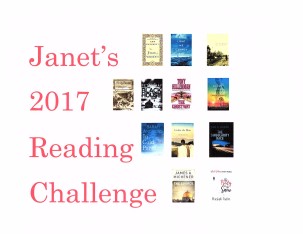
As 2017 approached, I took ideas from other reading challenges and developed “Janet’s 2017 Reading Challenge.” If you took my challenge, [Want a reading challenge for 2017?] I commend and thank you. I had some success with this challenge, but I fell short in many areas.
img086

Here’s a recap of Janet’s 2017 Reading Challenge, and a report of sorts on how I did.


  1. A book of poetry – I did well with this for a few months. I read a poem every day, but then I missed a few days and this fell off my radar. The book of poetry I chose was A Little Book of Cherished Poems, compiled by Kay Anne Carson. Reading poetry is supposed to help me be a better writer, even though I’m not a poet.


  1. A Sci-Fi book – As I said in my blog on December 26, 2017, I’m not a sci-fi fan and this didn’t happen.


  1. A nonfiction book – I read several, but the one I’ll list here is Killers of the Flower Moon: The Osage Murders and the Birth of the FBI, by David Grann.


  1. Books by 12 authors I’ve never read – This one was easy. Of the 63 books I read in 2017, 43 of them were written by authors I’d never read before. The following are 12 examples:

The Body in the Snow (A Bebe Bollinger Murder Mystery), by Christoph Fischer;

The Underground Railroad:  A Novel, by Colson Whitehead;

If the Creek Don’t Rise, by Leah Weiss;

A Mother’s Promise, by Sally Hepworth;

Right Behind You, by Lisa Gardner;

Irena’s Children, by Tilar J. Mazzeo;

All the Light We Cannot See, by Anthony Doerr;

The Magdalen Girls, by V.S. Alexander;

Grief Cottage, by Gail Godwin;

The Midnight Cool, by Lydia Peelle;

The Nightingale, by Kristen Hannah; and

Hatteras Light, by Philip Gerard.


  1. A novel set in each of the seven continents – I read the following:

North America – too numerous to list here;

South America – State of Wonder, by Ann Patchett;

Europe – There were many good ones, including The Saboteur, by Andrew Gross; The      Chilbury Ladies’ Choir, by Jennifer Ryan; and The Magdalen Girls, by V.S. Alexander; and The Orphan’s Tale, by Pam Jenoff.

Asia – I started reading The Tea Girl of Hummingbird Lane, by Lisa Lee. I didn’t get it    finished. It’s still on my “want to read” list.

Africa – The Lost History of Stars, by Dave Boling;

Australia – The Light Between Oceans, by M.L. Stedman.

Antartica – I wanted to read In Cold Pursuit (Em Hansen Mysteries), by Sarah Andrews. I didn’t get around to it.


  1. A novel by a North Carolina author – This one was easy. There are an abundance of good writers in North Carolina. To name just two novels I read by North Carolina authors in 2017: The Silent Sister, by Diane Chamberlain and Chasing the North Star, by Robert Morgan.


  1. A novel set in North Carolina – The Stolen Marriage, by Diane Chamberlain, and The Last Ballad, by Wiley Cash, to name just two.


  1. Re-read a favorite book – I couldn’t decide between The Help, by Kathryn Stockett; Roots, by Alex Haley; Tom Sawyer, by Mark Twain; and The Adventures of Huck Finn, by Mark Twain, so I didn’t re-read any of them. There were too many new books I wanted to read.


  1. A book written in the 1700s – I never got around to this one.


  1. A book written in the 1800s – I never got around to this one.


  1. A book written in the 1900s – I can’t believe I never got around to this one. It seems like just yesterday it was 1999. I did read Bird-by-Bird: Some Instructions on Writing and Life, by Anne Lamott, 1994; but my intention was to read a novel written in the 1900s.


  1. A biography, autobiography, or memoir – In Order to Live: A North Korean Girl’s Journey to Freedom, by Yeonmi Park. (I highly recommend this one.)


  1. A book about a religion other than my own – I wanted to read If the Oceans Were Ink: An Unlikely Friendship and a Journey to the Heart of the Quran, by Carla Power, but didn’t get to it.


  1. A book that might change my mind – I read Same Kind of Different as Me, by Ron Hall and Denver Moore. This book helped me to see homeless people in a new light. Tears We Cannot Stop: A Sermon to White America, by Michael Eric Dyson, gave me a lot to think about and helped me be more cognizant of the advantages I’ve had in my life in America due to white privilege.


  1. A book just for fun – I read Turbo Twenty-Three by Janet Evanovich and Hardcore Twenty-Four, by Janet Evanovich. Both were disappointing because after this many books in the Stephanie Plum Series, the plot is too predictable. The next time I want to read an entertaining book, I might go with Mark Twain.


  1. A book that will teach me a new skill – Since I am losing my hearing and don’t know what the future holds, I thought it might be a good idea to learn sign language. I soon discovered this was easier said than done at the age of 64. I have sporadically studied The American Sign Language Phrase Book, by Louie J. Fant.


  1. A book that was originally written in a language other than English – A Man Called Ove, by Fredrik Backman.


  1. A book written in Spanish (a language I haven’t studied since 1973) – I started re-reading Don Quijote de la Mancha, by Miguel de Cervantes, in January. That’s as far as I got.


  1. A book published in 1953 (the year I was born) – It’s not easy to find books that old! Go Tell it on the Mountain, by James Baldwin, was on my list. I didn’t get it read.


  1. A book that is the first in a series I haven’t read any of before – I started reading Death of a Gossip, by M.C. Beaton, but it didn’t grab my interest.


  1. The second book in a series of which I’ve read the first book — Everything Over Glory, by Kathleen Grissom


  1. A book written by an author I’ve met – The 13th Target, by Mark de Castrique.


  1. A book of short stories – Nothing Gold Can Stay: Stories, by Ron Rash.


  1. A book published in 2017 – I read several, but one I haven’t mentioned yet for this challenge is Here and Gone, by Haylen Beck (a.k.a. Stuart Neville.) I thought this was a terrific thriller.


  1. A book about the craft of writing historical fiction – I intended to read The Art and Craft of Writing Historical Fiction: Researching and Writing Historical Fiction, by James Alexander Thom. I started reading it and taking notes. Somewhere along the way, I misplaced it. Still looking for it. Surely, it’s here somewhere.


  1. A Nobel Prize winner – Well, this is embarrassing. <crickets chirping>


  1. A political thriller – The Quantum Spy, by David Ignatius.

How did you do?

If you participated in a reading challenge in 2017, how did you do? This isn’t a competition. I just hope you enjoyed the books you read.

Until my next blog post

I wish you a Happy New Year!

I wish you many good books to read. I’m reading The Rooster Bar, by John Grisham.

If you’re a writer, I wish you quality writing time and publication.

Janet

I Forgot to Blog!

I try to plan most of my blog posts in advance. My ideas for my blog post yesterday included my thoughts about finding time to write during the holidays and just taking the easy way out and posting a photograph. The caption was going to be optional.

Did you notice I said, “My ideas for my blog post yesterday….?” There was no blog post yesterday. Not only have I squandered time for writing in December, I forgot to post a blog yesterday. No rambling thoughts about writing. No photograph. No caption. No blog post.

Squirrel 4
Who, me?

For those of you who hang on my every word and look forward to Monday mornings just because you know you’ll have a Janet Morrison blog post to read, I apologize. To the rest of you (and you know who you are) I join you in asking, “Who knew Janet blogged on Mondays?”

I forgot to blog, and the world continued to turn on its axis and revolve around the sun. Time did not stand still.

Next Monday is another holiday, but I’ll try to get back on track. On January 1, 2018, I plan to blog about how successful I was in meeting my 2017 personal reading challenge. There are holes like in Swiss cheese in my reading accomplishments this year. I could fill some of those holes by reading the rest of this week. I want to read, but I also want to sew. I also want to get my dulcimer out of its case and see if I still know how to play it.

I decided to take a few minutes today to reflect on the pros and cons of participating in a reading challenge.

The pros:

(1)  A reading challenge can prompt you to read something you might not otherwise read. Hence, the word “challenge.” For instance, one item on my personal reading challenge this year was to read a science fiction book. I’m not a fan of sci-fi. Sorry, I’m just not. I thought putting it on my challenge would force me to read a sci-fi book. It did not. I procrastinated for 12 months. It didn’t happen.

(2) A reading challenge nudges you to read a variety of books.

The cons:

(1)  I can only think of one. You can get so wrapped up in meeting your reading challenge that you miss the chance to read books you’d rather be reading. If you are a competitive person, you might let the challenge become more important than the reading. If that happens, the purpose of the challenge has been hijacked.

Your thoughts

Where do you stand when it comes to participating in a reading challenge? Do you find them helpful? Do you think they’re fun? Do you find them to be freeing or restraining? I invite you to comment about your reading challenge experiences below.

Until my next blog post

I hope you have a good book to read.

If you’re a writer, I hope you have quality writing time.

On this day after Christmas, I hope all my Christian readers had an Advent season filled with blessings and a Christmas day overflowing with joy as you remembered the birth of our Lord and Savior, Jesus Christ.

May the love, compassion, and joy of the season continue in our lives in the coming year.

Janet

Pioneer Mill Gold Mine

Occasionally, I like to present samples of my writing in this blog. My blog post on May 23, 2017 was “No Place for a Preacher’s Son?” (No Place for Preacher’s Son?) The “no place for a preacher’s son” was the Pioneer Mill community in Township One of Cabarrus County, North Carolina in the 1870s.

Gold Fever!

The reason for Pioneer Mill being a “boom” place in the 1800s was due to the development of a gold mine there. Gold was first discovered in the United States in Cabarrus County in 1799.

“Gold fever” soon took hold of the region and numerous gold mines were developed in Cabarrus County in the early 1800s. In fact, so much gold was found in the area that in 1837 a branch of the United States Mint was opened in Charlotte in adjoining Mecklenburg County

I heard about the Pioneer Mill Gold Mine when I was a young child. I knew where it had been. I should have asked “the older generation” some questions about it, but now that generation is gone.

Finding myself in “the older generation,” I researched the gold mine in order to write a two-part series about it for the now defunct Harrisburg Horizons newspaper in 2012. Today’s blog hits the highlights of those newspaper articles.

After the 1799 discovery of gold on John Reed’s land in Township Ten, everyone in Cabarrus County probably started searching for gold on their property. The date that gold was first discovered at Pioneer Mill is unknown, but the 1869 Branson Business Directory described the mine as “among the earliest discovered mines in the State.

The land on which the Pioneer Mill Mine was worked in the 1800s was purchased in the 1760s by James Morrison, an immigrant from Campbeltown, Scotland. It passed down to his son, John. John and his wife, the former Mary McCurdy, had 11 children. Their youngest child, Robert Harvey Morrison, was born in 1817.

Robert Harvey Morrison remained on the family land and was quite prosperous. The stately two-story house at the entrance to the present-day Cedarvale subdivision on Morrison Road was the home he built for his family of eight children.

Mineral Rights

From a deed registered in Cabarrus County, we know that in 1853 Robert H. Morrison sold the mineral rights on his 640 acres of land to Collett Leventhorpe of Rutherford County, North Carolina and Richard H. Northrop of Albany, New York for $5,000.

In June of 1854, Messrs. Leventhorpe and Northrop, both identified as being of Rutherford County, sold the mineral rights and mining machinery to Francis Rider of New York City for $475,000.

Mr. Rider was identified as the president of the Pioneer Mill Mining Company, “an association incorporated in pursuance of the provisions of an act of the Legislature of the State of New York” that authorized the formation of “Corporations for Manufacturing, Mining, Mechanical or Chemical purposes Passed February 17th 1848.”

I requested a copy of the incorporation papers of the Pioneer Mill Mining Company from the State Archives of New York State, but the researchers there were unable to find a record of the company.

Geology

Ebenezer Emmons served as State Geologist in North Carolina from 1851 until 1863. Dr. Emmons described the veins of gold at the Pioneer Mill Mine in an undated report, “Geological Report of the Midland Counties of North Carolina” as a fine example of veins of gold coming off a foot-wall.

An electronic copy of the Emmons report can be found online through the University of North Carolina’s Documents of the South Collection at http://docsouth.unc.edu/nc/emmonsml/emmons.html. He wrote, “In some instances the segments are so distinct that on being removed the lode seems to have run out, but on working back to the foot-wall, another segment is encountered.”

“Foot-wall” is the rock underlying a mineral deposit. The report noted that the Pioneer Mill Mine was in syenite granite.

I have heard it said that in the days of dirt roads and horse-drawn wagons, when horses’ hooves clacked along the road at the intersection of Morrison Road and Pioneer Mill Road, there was a hollow sound that led to speculation that there was an old mine shaft under the roadway.

Dr. Ebenezer Emmons wrote that the Pioneer Mill Mine was in a cluster of interesting mines for which he held great expectations, although the Pioneer Mill Mine was the only one in the cluster in operation at the time of the report.

He described it as “twelve miles east of Concord, and situated upon the eastern border of the sienitic [also spelled syenite] granite, and in a belt upon which there are numerous veins carrying both gold and copper. The vein fissure in the granite is between sixteen and seventeen feet wide. Its direction is N.70°E. The true vein stone is quartz from eight to thirty inches thick, both sides of which is bounded by the killas.”

“Killas” is a Cornish mining term for metamorphic rock strata of sedimentary origin altered by heat from intruding granite.

The Emmons report indicated that there were four veins of gold on the Robert Harvey Morrison plantation. The first vein was a mile south of the Pioneer Mill Mine. Dr. Emmons found refuse ore rich in gold around an old shaft at that vein which was in quartz interspersed with “sulphurets.”

The second vein was a mile east and resembled the first. The third was a vein of gold in combination with copper pyrites. The fourth vein was of quartz and iron pyrites in the northeast part of the plantation. All four veins generally ran northeast.

Dr. Emmons reported that the Pioneer Mill Mine ground 30-40 bushels of ore daily, although he noted that at 11 revolutions per minute, the Chilean millstones in operation were not set at the proper speed for the ore being ground.

The report listed 14 totals of bushels ranging from 38 bushels to 154 bushels and the corresponding yield in gold in dollars. (It is not known if these were weekly totals over a period of time or exactly what time frame is covered by the list.) The list totaled 1,677 bushels of ore producing $5,674 in gold. That was in mid-19th century dollars, when gold was valued at $18.93 per troy ounce.

The Pioneer Mill Mine employed 15-20 men from 18 to 20 days-a-month. The cost of operating the mine was $400 per month. Dr. Emmons noted that the mine had nearly gone under after incurring too much debt, but under a new agent who was more attentive to the machinery and who had started using mercury in the Chilean mill the mine started turning the handsome profit detailed above.

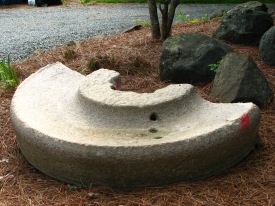
In backyard of Robert Harvey Morrison House
Part of a gold ore grinding stone from the Pioneer Mill Gold Mine.

Dr. Emmons wrote that the Pioneer Mill Mine would have had truly impressive profits had it had machinery capable of grinding 100 bushels of ore per day.

The glory days of the Pioneer Mill Mine ended with the American Civil War in 1861. It took decades for our local economy to recover from the years of the War and Reconstruction. With the passage of time, it ceased to be cost effective to mine for gold in Cabarrus County.

According to the Carolina Watchman newspaper on September 17, 1891, the Pioneer Mill Mine was then owned by Mr. E.C. Black “and he is making some nice finds. He has found several large nuggets; one worth $50, another $12 and still another $37.”

Needless to say, I was thrilled to find Dr. Emmons’ report for without it we would know almost nothing about the Pioneer Mill Mine. Driving through the Pioneer Mill community today, one would never guess that 160 years ago it was a gold mining boom town.

Until my next blog post

I hope you have a good book to read. Just for fun, I’m reading Hardcore Twenty-Four, by Janet Evanovich. All the books I requested at the public library in November (or earlier) have become available to me at the same time. I have three that have come to my Kindle and one traditional book at the library. Time will tell if I’m able to get them read in the time I have allotted by the library system.

If you’re a writer, I hope you have quality writing time.

Janet

Another Case of Wondering

A couple of weeks ago my blog post (Sometimes I Have to Wonder ) was about some strange recommendations I got from Pinterest. As a follow-up to that, today’s post is about a similar experience I had on Amazon.com

Occasionally, I do a search for my vintage postcard book, The Blue Ridge Mountains of North Carolina on Amazon to see where it comes up in the search, to see how many copies remain and if Amazon is placing another order, and the fluctuating price.

Author Copies Arrived July 23 2014 017
My book!

When I did that a few days ago, I was dumbfounded by the books that come up as “Sponsored products related to this item.” In case you haven’t been following my blog for several years, you might not know that in 2014 Arcadia Publishing published a vintage postcard book that I wrote. The title, The Blue Ridge Mountains of North Carolina, pretty much says what a potential buyer can expect to find:  narrative built around vintage postcards from the mountains in western North Carolina.

The following is a list of the “Sponsored products related to this item” as listed by Amazon.com on December 4, 2017:

How to Mount Aconcagua: A Mostly Serious Guide to Climbing the Tallest Mountain Outside the Himalayas, by Jim Hodgson;

The Journey in Between: A Thru-Hiking Adventure on El Camino de Santiago, by Keith Foskett;

Coloring Books For Adults Volume 6: 40 Stress Relieving and Relaxing Patterns, Adult Coloring Book Series, by Coloring Craze.com;

Farthest North:  Being the Record of a Voyage of Exploration of the Ship “Fram” 1893-96 and of a Fifteen Months’ Sleigh Journey, by Dr. Nansen and Lieut. Johansen (1897);

Vagabonds in France, by Michael A. Barry; and

Adult Coloring Book: 30 Day of the Dead Coloring Pages, Dia De Los Muertos (Anti Stress Coloring Books for Grown-ups, by Coloring Craze.

That was just the first of three pages of “Sponsored products related to” The Blue Ridge Mountains of North Carolina, by Janet Morrison.

Klout.com

Klout.com is a website that measures one’s activity on social media. I mentioned Klout.com in my April 13, 2017 blog post, K is for Klout.com.I understand that 50 is considered a good score on Klout.com. My all-time high score so far was attained on April 18, 2017:  45.31. Hmmm. Odd that I hit my all-time high score just five days after I blogged about Klout.com!

My score has now dropped to 42, so my goal of reaching 50 by the end of the end is highly unlikely. It will be interesting to see if my score increases this week after mentioning the website in today’s blog. There might be something fishy going on here.

My point in mentioning Klout.com today is because when I checked my score on December 8, the site reported that I was an expert on languages. I had to laugh.

I am a native speaker of English, and I neither speak nor write it correctly all the time. I studied Spanish 40+ years ago. I can count to three in French, although I doubt my pronunciation is correct and I’d be hard-pressed to spell those numbers correctly.

You get my drift. I am in no way an expert on languages. Several months ago, Klout.com reported that I was also an Excel expert. Thank you, Klout.com, for your vote of confidence, but I am in no way an expert on anything related to computers.

I think such things are determined by the use of algorithms. That’s all I need to know. I never did understand or like math.

Until my next blog post

If I can get my act together, next Monday I’ll blog about an interesting piece of local history.

I hope you have a good book to read. I’m reading at (yes, reading at) A Gentleman in Moscow, by Amor Towles. I keep checking it out of the public library when I have other books to read. I’m beginning to wonder if it’s just not the right time for me to read the book. It’s interesting, but obviously not holding my attention enough to make me drop everything else and read it. I think it’s me and not the book.

Shameless plug:  If you don’t have a good book to read, may I suggest you order The Blue Ridge Mountains of North Carolina, by Janet Morrison. You might be able to arrange delivery before Christmas, if you hurry. You can order the electronic version and get it instantaneously, of course.

Author Copies Arrived July 23 2014 020
Silas and Janet were equally excited the day “their” book arrived in July, 2014.

If you’re a writer, I hope you have quality writing time and I hope the algorithms used by Amazon.com are kinder to you than they are to me.

Hmmm. I wonder if I did a search for Adult Coloring Book:  30 Day Of The Dead Coloring Pages, would my postcard book would come up as a related item?

Janet

Seasonal Affective Disorder in November

I tried reading several novels in November that just didn’t grab my attention. I will not name them here. It’s disappointing to sit down to read a book and just not get “into it” even after 10 or 20 pages.

Still Life, by Louise Penny

The only book I read in November was Still Life, by Louise Penny. It was the book read by the Rocky River Readers Book Club last month. I really tried to like it, but I just couldn’t stay interested in it. Don’t blame the author or the book. Louise Penny is a popular author. I believe it wasn’t the right time for me to try to read her first book.

One of the items in the Reader’s Bill of Rights (my blog post two weeks ago:  Reader’s Bill of Rights) is the right to skip pages. I did too much of that while reading Still Life, so when I got to the last page I still didn’t know “who dunnit.” I enjoyed the book club discussion of the book last Monday night and found out how much I’d missed by not giving it my full attention.

After reading four to six books every month in 2017, suddenly in November I lost my motivation to read. I wanted to read. At first, I thought I was distracted by my desire to get back to work on my historical novel manuscript. It just didn’t work out very well.

Seasonal Affective Disorder

As I wrote today’s blog post, I concluded that the culprit in my recent inability to concentrate enough to read is Seasonal Affective Disorder. In case you aren’t familiar with this disorder, there is reliable information about it at the Mayo Clinic’s website:  https://www.mayoclinic.org/diseases-conditions/seasonal-affective-disorder/symptoms-causes/syc-20364651. I think I’ve had it all my life but just got a diagnosis several years ago.

cameron-stow-91861

Photo by Cameron Stow on Unsplash

What I’m reading

As November came to a close, I was halfway through The Quantum Spy, by David Ignatius. I’m eager to find out who the “mole” is, but Seasonal Affective Disorder is restricting my reading time and messing with my ability to concentrate.

I’ve checked out A Gentleman in Moscow twice. This time, I hope to finish reading it. Last Christmas in Paris, by Hazel Gaynor and Heather Webb. It is the December book choice for an online book club I joined earlier this fall. It’s a book reminiscent of The Guernsey Literary and Potato Peel Pie Society, by Annie Barrows.

I also continue to listen to The Rooster Bar, by John Grisham, but you know I’m not a fan of books on CD. I’m on the waitlist for the electronic copy of it at the public library. One way or the other, I will finish it.

The Spanish Coin

I’ve worked on my scenic plot outline for the rewrite of The Spanish Coin several days in the last week in an effort to get it off “the back burner.” The outline kept calling my name in November and I was excited to get back to it. I hadn’t worked on it in several months, so I had to reacquaint myself with the new plot line.

My blog is about my journey as a writer, and that includes my reading. That journey was bumpy in November. Better days lie ahead as my Seasonal Affective Disorder symptoms abate in the coming months. Too bad I can’t live in the northern hemisphere from April until mid-September and then live in the southern hemisphere for the remainder of the year!

Until my next blog post

I hope you have a good book to read. I’ll try to finish the books I’ve started.

If you’re a writer, I hope you have quality writing time.

Janet

Sometimes I Have to Wonder

Raise your hand if you are addicted to Pinterest. I am guilty.

I have boards on Pinterest about various aspects of writing, cooking, blogging, local history, the Blue Ridge Mountains of North Carolina (which just happens to also be the title of my vintage postcard book published by Arcadia Publishing), the North Carolina coast, quilting, Southernisms, hearing loss, and many of my other hobbies and interests.

If you follow my blog, you know that I generally write about books I’ve read, samples of my writing, or things I’ve learned about the art and craft of writing. I have a board on Pinterest called “Janet’s Writing Blog” where I pin each of my blog posts.

If you participate in Pinterest and have interest boards on the site, you probably get e-mails from Pinterest with suggested pins that might be of interest to you based on your boards. Those e-mails usually make sense; however, one I received a couple of weeks ago fell into the category of “sometimes I have to wonder.”

Considering the content I pin to my “Janet’s Writing Blog” interest board, why did Pinterest send me an e-mail titled, “A few new ideas for your board Janet’s Writing Blog” which included the following pins for me to visit?

“How much space do goats really need?”

“How to make homemade chicken feed – a simple formula.”

“Halloween Pumpkin Wall Clock A9 Nice for gift or home.”

“DIY Garden Fence.”

“Pinned for what they used to hinge the gate.”

“What to wear – frivolous Friday.”

Another one with a photo of a fence was titled, “So simple – inexpensive – would work    for the dogs.”

And last but not least:  “Small chicken coop and fenced area for egg laying.”

jairo-alzate-188815(1)

(Photo by Jairo Alzate on Unsplash)

It served a purpose

The Pinterest e-mail served a purpose, although not its intended one. It made me laugh. It loses some of its punch here since I can’t include the photos that accompanied each suggestion.  As I scrolled down through the recommended pins for my Janet’s Writing Blog interest board, I laughed again and again.

I try to find something to laugh about every day. A good laugh, when not at the expense of another person, is good for the soul. Thanks, Pinterest!

Until my next blog post

I hope you have something to laugh about.

If you’d like to visit my Pinterest page and see my various interest boards, go to https://www.pinterest.com/janet5049/.

I hope you have a good book to read. I’m reading The Quantum Spy, by David Ignatius; Last Christmas in Paris, by Hazel Gaynor and Heather Webb; A Gentleman in Moscow, by Amor Towles; and The Rooster Bar, by John Grisham. And, yes, sometimes I get the story lines and characters confused.

If you’re a writer, I hope you have productive writing time this week.

Janet

Reader’s Bill of Rights

rathish-gandhi-211551

Sometimes a novel’s story summary sounds interesting but fails to deliver. Sometimes it’s a matter of it just not being the right time for you to read that particular book. Sometimes the opening “hook” does its job and pulls you into the story, but the following pages fall short and your interest wanes.

Life is short. There are too many good books out there to spend time reading one that does not measure up or appeal to you.

I used to think if I started reading a book, I owed it to the author to finish reading it. I no longer abide by that. When I joined a book club a few years ago at the Kannapolis branch of the Cabarrus County Library system, I was introduced to a “Reader’s Bill of Rights.” Perhaps you are familiar with it. It is attributed to Daniel Pennac in Better Than Life, published by Coach Press in 1996:

“Reader’s Bill of Rights

  1. The right to not read
  2. The right to skip pages
  3. The right to not finish
  4. The right to reread
  5. The right to read anything
  6. The right to escapism
  7. The right to read anywhere
  8. The right to browse
  9. The right to read out loud
  10. The right to not defend your tastes” – Daniel Pennac

If you do not live in the United States, “Bill of Rights” might be an unfamiliar term for you. That is what the first 10 amendments to the U.S. Constitution are collectively called. It is not coincidental that Mr. Pennac listed 10 items in his “Reader’s Bill of Rights.”

In the United States, we take for granted our access to books and other reading material. Millions of people in the world are not that fortunate. Americans tend to take free public libraries for granted until elected local government officials threaten to close libraries or radically curtail their hours of operation due to financial constraints. Many of them see libraries as an easy target. They see libraries as “fluff.” We suffered through this in the county in which I live during the downturn of the economy that started in 2008. What was taken from us in a proverbial “blink of an eye” took several years to reinstate.

We have wonderful public library systems in Cabarrus and Mecklenburg Counties in North Carolina. I utilize both systems most weeks. The Harrisburg branch of the Cabarrus County system is a very inviting hub of activity. When Harrisburg’s public library branch opened in 2001, our community started to feel like a real town.

I do not take my right to read lightly. I hope you have the right to read anything you want to read. As you can see from the table of flags on this blog page, people from at least 73 different countries have read my blog. When I write my blog posts, I try to be mindful of that.

Some of my readers live in countries where there is no free press and there are heavy prices to pay (such as prison life at hard labor or even execution) if you read something that is banned. Knowing that a few individuals in such countries are putting themselves at risk by reading one of my blog posts has put unexpected pressure on me.

Please don’t take your right to read for granted! This Thanksgiving season in America, I’m thankful for my right to read and for free public libraries.

Until my next blog post

I hope you have a nice Thanksgiving Day with family and friends.

I hope you have a good book to read. I’m reading Quantum Spy, by David Ignatius.

If you are a writer, I hope you have quality writing time.

I hope you live in a country where you have the freedom to write and read anything you want.

Janet

“More in common than we think”

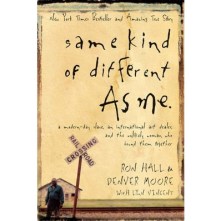
For today’s blog post I’m highlighting two sentences from Same Kind of Different As Me, by Ron Hall and Denver Moore with Lynn Vincent. You may recall that I read this nonfiction book in September and commented about it in my October 2, 2017 blog post, Some Great September Reads.

0849900417.jpg.1458336228
Same Kind of Different as Me, by Ron Hall and Denver Moore, with Lynn Vincent

“ʻEver man should have the courage to stand up and face the enemy,’ I said, “ʻcause ever person that looks like a enemy on the outside ain’t necessarily one on the inside. We all has more in common than we think.’” – Homeless man Denver Moore speaking in Same Kind of Different As Me, by Ron Hall and Denver Moore with Lynn Vincent.

Lessons to learn

We can all probably learn many lessons from Same Kind of Different As Me. I think the theme of the book is that under the pigment shade of our skin, we are all the same. When we judge others based on their outward appearance, we often rob ourselves of an opportunity for making a new friend, or at the very least, an opportunity to have cordial interaction with a stranger.

I’m not naïve enough to advocate that we just approach strangers willy-nilly and befriend them. There are people out there who are up to no good; however, that is not a good excuse for being afraid of everyone who does not look like we do.

Polarization in America

In our current polarized population in the United States, it seems we’re becoming more a nation of “they” and “us” than the “melting pot” I grew up learning about in history classes. We tend to fear the unknown. As long as our fellow citizens whose skin is a different shade from our own are seen as people to be feared or as an enemy, we will continue to be a divided people and none of us will be able to reach our potential. Our nation certainly won’t reach its potential until we learn how to get along with one another.

This applies to people of another racial or ethnic background, but it also applies to people who espouse political stances different from our own. I’m old enough to remember when Democrats and Republicans could agree to agreeably disagree. Now it seems that neither side has any desire to try to reach common ground on any issue.

Discovering the fun of compromise

As a political science major in college, one of the courses that still stands out in my memory is the one called The Legislative Process. Going into the course, I wasn’t very excited. I had never been a political person. I was studying political science to prepare myself for a career in city management (or so I thought.) Much to my surprise, The Legislative Process turned out to be an invigorating course.

Class members were arbitrarily divided into two groups. Each group was assigned a piece of legislation they had to fight to get passed. Of course, the two proposed laws were polar opposites of each other. The two groups had to work together and create a compromise bill.

I recall that one day when the bell rang and we were supposed to leave the classroom so another class could come in, the professor struggled to get us to stop debating and leave. Although we knew we could pick up where we left off at our next class meeting two days later, we were so wrapped up in the process – and HAVING SO MUCH FUN – that we didn’t want to stop. I have forgotten many of the intricacies of that political science course, but I accidentally learned that compromise can be fun.

The “takeaway”

Let’s stop being afraid of one another and start letting ourselves find the fun and joy that come from interacting with one another and finding common ground. And when we cannot readily find common ground, let’s remember how – or learn how – to compromise.

Find a place for compromise in your own life and work to get compromise back into the vocabulary and mindset of our local, state, national, and world leaders.

When I sat down to write about those two sentences from Same Kind of Different As Me, I thought I knew where I was going. I anticipated writing a short, maybe 300-word blog post. Like life and the legislative process, though, writing has many surprises. One of them is that this blog post is approaching 1,000 words.

Until my next blog post

I hope you have a good book to read. David Ignatius’s new thriller, The Quantum Spy is in transit to me at the public library. I have enjoyed his other novels, so I’m looking forward to reading this one.

After being overwhelmed this year with books I wanted to read, I plan to cut back somewhat on my reading for a while and spend more time on my writing. It is said that one has to read a lot in order to be a good writer.

I’ve learned a lot from the many good books I’ve read in 2017, and now I look forward to putting some of that new knowledge into practice by getting back to work on my historical novel manuscript with the working title, The Spanish Coin.

It’s been fun to work on my manuscript’s outline the last few days. There’s another surprise! I never thought I would use the words “outline” and “fun” in the same sentence. Outlining a work of fiction is hard work but, when I’m in the proper frame of mind, it can also be fun.

If you are a writer, I hope you have found the perfect balance between reading and writing. I hope you have productive writing time.

Janet

Some Good New Books

I’ve read some very good books this year, and it’s been a pleasure to share my thoughts about them on my blog. Today’s blog post highlights the five novels I read in October. Four of them (Love and Other Consolation Prizes, by Jamie Ford; The Deep Dark Descending, by Allen Eskens; The Last Ballad, by Wiley Cash; and The Stolen Marriage, by Diane Chamberlain) were published in October. The other book, News of the World, by Paulette Jiles, was published in October of 2016.

 Love and Other Consolation Prizes, by Jamie Ford

9780804176750
Love and Other Consolation Prizes, by Jamie Ford

I eagerly awaited the release of Jamie Ford’s latest novel, Love and Other Consolation Prizes, and it did not disappoint. After hearing Mr. Ford speak at the Bookmarks Festival of Books and Authors in Winston-Salem, North Carolina in September, I really looked forward to reading this book. My September 18, 2017 blog post, Bookmarks Festival of Books and Authors, was about that festival and the seven authors I got to hear speak.

Historical fiction is near and dear to my heart, so it’s no wonder that I enjoyed reading Love and Other Consolation Prizes. Mr. Ford took a reference to an actual shocking event at the 1909 Alaska-Yukon-Pacific Exposition held in Seattle, Washington and created a powerful story about the young boy named Ernest who was raffled off at the Exposition. Yes. You read that correctly. Something different was raffled off each day of the fair, and one day it was an orphaned child!

The Chinese slave trade around the turn of the 20th century and the thriving red light district of Seattle in the early 1900s provided the perfect backdrop for this book. Mr. Ford gives us chapters set in 1909-1911 and chapters set in 1962 around the World’s Fair in Seattle so we can follow the amazing fictional life of Ernest – a mixed race boy from China.

 The Deep Dark Descending, by Allen Eskens

deep-dark-descending-225
The Deep Dark Descending, by Allen Eskens

I became a fan of Allen Eskens’s writing when I read his first novel, The Things We Bury. I’ve now read all four of his novels. Here are the links to my blog posts that talked about his first three novels:  The Life We Bury, by Allen Eskens; What I read in January; My writer’s notebook; and What I Read in April  ­.

The Deep Dark Descending is a dark story of just how deeply a person can descend when his anger, bitterness, and desire for revenge become an obsession.

In this novel, Minneapolis homicide detective Max Rupert sets out to find and punish the person or persons who murdered his wife. The case had been ruled an accident, but Rupert could not accept that.

The Deep Dark Descending takes the reader to the frigid Minnesota-Canada border and a frozen lake. Put this novel on your winter reading list.

The Last Ballad, by Wiley Cash

lastballadhc_c
The Last Ballad, by Wiley Cash

The Last Ballad is author Wiley Cash’s newly-released novel. It is set in Gaston County, North Carolina and is based on the life of textile millworker Ella May Wiggins. Ms.Wiggins was murdered in Gastonia, North Carolina in 1929 during a riot that resulted from efforts to organize the millworkers into a union. Labor unions have never been popular in the state, and that was definitely the case in the textile industry in the early 20th century.

Although I grew up an hour from Gastonia, I had never heard about this incident. In fact, Wiley Cash is a native of Gastonia and he only recently learned of it.

The Last Ballad takes the reader into a world of poverty inhabited by both black and white millworkers in the 1920s. Ms. Wiggins was a white single mother who lived in an otherwise black neighborhood. She was instrumental in trying to get her black neighbors and co-workers the right to strike for better wages. The white workers didn’t have the right to strike either, but until Ms. Wiggins pushed the point, the possibility of black workers going on strike was unimaginable in that time and place.

This is a story of a woman’s courage as she fought for better working and living conditions for her children and her neighbors.

The Stolen Marriage, by Diane Chamberlain

newcoverTSM
Diane Chamberlain Author Event The Stolen Marriage, by Diane Chamberlain

After having met Diane Chamberlain at the On the Same Page Book Festival in West Jefferson, North Carolina last year (Diane Chamberlain Author Event )and enjoying two of her other novels (Pretending to Dance A Novel’s First Line and The Secret Sister Books I’ve been reading), I got on the waitlist for The Stolen Marriage as soon as it was “on order” at the public library. The novel’s October 3, 2017 release date finally arrived!

I love it when I can read an expertly-written novel and learn something at the same time. Like Wiley Cash’s The Last Ballad, Diane Chamberlain’s The Stolen Marriage delivered in a big way. I regret that I cannot read The Stolen Marriage again for the first time. It was that good!

The Stolen Marriage was inspired by the true story of the citizens of Hickory, North Carolina building – and getting up and running – a hospital for polio patients in just 54 hours in 1944. Being a native of North Carolina, born in 1953, this is another piece of history that I didn’t know. It was an amazing feat in this small town in Catawba County, and it was covered by Life magazine. In historical literature, it is referred to as “The Miracle in Hickory.”

The fictional story Ms. Chamberlain created around this event is one of trust, love, and betrayal. There are numerous plot twists in this novel. It will keep you up at night turning pages.

 News of the World, by Paulette Jiles

6.png
News of the World, by Paulette Jiles

The premise and title of News of the World, by Paulette Jiles, intrigued me when I read a blurb about it, so I borrowed it from the public library.

This is a tale of a fictional character known as Captain Kidd who traveled around Texas in the 1800s getting paid to have public readings of articles from various newspapers. Many people were illiterate and newspapers were rare in the region.

Captain Kidd agrees to return Johanna, a young white girl, to her family in southwest Texas. Years earlier, Johanna had been kidnapped by the Kiowa tribe of Native Americans. Being raised by the Native Americans, Johanna had no recollection of the habits and mores of her white family.

Johanna and Captain Kidd had a shaky and unpredictable relationship as Kidd tried his best to fulfill his promise to return Johanna to her family. Their journey across Texas is filled with misunderstandings, attacks by outsiders, challenging traveling conditions, and additional attempts to kidnap Johanna. The two of them gradually learn how to communicate and co-exist.

News of the World is the second novel I’ve read recently that did not use quotation marks in dialogue. I guess I’m just old-fashioned, but I don’t like this practice. When I have to stop and think or reread something in a novel to figure out what’s narration and what’s dialogue or who’s talking, it pulls me out of the story and reminds me I’m reading. I’m sure dropping all the quotation marks saved the publisher some money, but I hope this doesn’t become common practice.

Until my next blog post

I hope you have a good book to read. I seem to have trouble “getting into” a book at the moment. I’m more in the mood to write than to read, so I’m taking advantage of that. The last several days I’ve worked on the timeline and outline for my historical novel I’m calling The Spanish Coin. I’ll keep you posted.

If you are a writer, I hope you have quality writing time.

Janet


An October 29, 1777 Estate Sale

Did you know that the State Archives in Raleigh is the repository of the original copies of some estate sale records dating back to the 1700s when Cabarrus County was part of Mecklenburg County, North Carolina? These fascinating records for persons known to have lived in the area that later became Cabarrus County are also accessible on microfilm in the local history room at the main branch of the Cabarrus County Public Library in Concord, NC.

John Morrison’s Estate Sale

My great-great-great-great-grandfather, John Morrison, died in 1777 in old Mecklenburg County. A native of Campbeltown, Scotland, he lived his last thirteen years in the vicinity of the present-day Cabarrus-Mecklenburg County line. His estate papers provide a record not only of his possessions but also the names of many local people. I’m very proud to say that he was a farmer.

Robert Harris, Jr. served as clerk at John’s estate sale on October 29, 1777 – exactly 240 years ago today. Mr. Harris made note of every item sold, who bought it, and how many pounds, pence, or shillings they paid.

Buyers

The buyers were James Moore, Joseph Robb, Evan Shelby, Isaac Sellers, John Robinet, John Murphy, Francis Miller, William Driskill, James Alexander, James McCall, John and James McGinty, Joseph Bigger, Hugh Kimmons, Archibald McCurdy, John Springs, John Carothers, Joseph Calbreath, Alexander Allen, Benjamin and Robert Cochran, Steven Pritchet, Peter Borris, Robert Harris, James Stafford, John Ross, Alexander Finley, James Finney, Hector McClain, Samuel Montgomery, William Wylie, and John Finley.

Most of the surnames listed above are no longer found in our community because many families moved west in the 1790s and early 1800s. Some of the buyers lived in the area that remained in Mecklenburg County after the formation of Cabarrus in 1792, so some of the names are probably from the Mint Hill area.

Summary of Items Sold at Estate Sale

Items sold at the estate sale included eight horses; 19 sheep; 25 head of cattle; 17 hogs and a parcel of pigs; three hives of bees; 17 geese and ganders; 25 pounds of wool; a parcel of books; a great coat; two straight coats and jackets; one pair of blue britches; a pair of old buckskin britches; and a fur hat.

Also, four saddles; five bells and collars; five other collars; six bridles; two sets of horse gears; an “M” branding iron; three augurs; a drawing knife; nailing and stone hammers; a broadax; three weeding hoes; two maulrings; a wedge; a clivish; a sprouting hoe; a mattock; two falling axes; three spinning wheels; two horse trees and hangings; a cutting knife and stone; a sythe and cradle; four sickles; a flax brake; a pair of wool cards; and a pair of cotton cards.

Also, barrels for flour, rice, beef, and salt; a tapper vessel; two cedar churns; oak and walnut chests; two smoothing irons; a looking glass; one whiskey keg; and various other tools, household items, and pieces of furniture.

Other items included 6.5 pounds of iron and 14.5 pounds of steel. Steel as we know it today had not yet been developed. In 1777, steel was the name for sharpening rods used to sharpen knives and other cutting edges.

Half a wagon?

The most puzzling record in John Morrison’s estate papers is that John Springs bought half a wagon and half the wagon implements. Since no one bought the other half, it has been speculated that Mr. Springs knew that John’s wife, Mary, needed the use of the wagon but also needed the proceeds from the sale of the wagon and implements. After all, Mary was a widow with seven children still at home and a baby on the way. Perhaps Mr. Springs made a verbal agreement to let Mary Morrison keep the wagon even though he paid half the value of the wagon at the estate sale.

Another possibility is that John Morrison had bought the wagon and implements from John Springs but had only paid half the bill at the time of his death. Mr. Springs, instead of saddling Mary Morrison with the additional debt of the unpaid balance chose to simply buy back that half of the wagon and implements. When Mary Morrison died in 1781, there is no mention of a wagon in her will or her estate sale.

Lots of ammunition!

Other intriguing items sold at John Morrison’s estate sale were the 17 pounds of gun powder and 55.5 pounds of lead. That’s more gun powder and lead than a farmer needed. So why did John Morrison have so much of both?

John wrote his will on August 30, 1777. By September 3, he was dead. It is speculated that he was stockpiling munitions for the patriots’ cause in the American Revolution and that he was shot by Tories, but we will never know the real story.

My sources

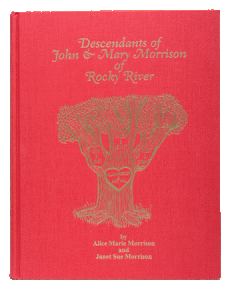
The sources I relied on for writing this blog post are as follows:  John Morrison’s Mecklenburg County estate papers on file at the State Archives of North Carolina in Raleigh, NC; What Did They Mean By That? – A Dictionary of Historical Terms for Genealogists, by Paul Drake, 1994; and Descendants of John & Mary Morrison of Rocky River, by Alice Marie Morrison and Janet Sue Morrison, 1996.

Red
The Descendants of John & Mary Morrison of Rocky River, by Alice Marie Morrison and Janet Sue Morrison

I regret that Marie and I did not know about the existence of John and Mary Morrison’s estate papers when we compiled and published Descendants of John & Mary Morrison of Rocky River in 1996.

Until my next blog post

I hope you have a good book to read. If you’re a writer, I hope you have productive writing time.

Janet