I write southern historical fiction, local history, and I've written a devotional book. The two novels I'm writing are set in Virginia and the Carolinas in the 1760s. My weekly blog started out to follow my journey as a writer and a reader, but in 2025 it has been greatly expanded to include current events and politics in the United States as I see our democracy under attack from within. The political science major in me cannot sit idly by and remain silent.
“J” is the featured letter on this the 10th day of the 2017 A to Z Blog Challenge. There were many options. Among them were jelly, jacket, jazz, jackpot, junk, justice, judge, jagged, jolly, jokes, jury, jiggle, and jalopy.
Blogging from A to Z Challenge Badge 2017
I was about to give up finding a “J” word that had something to do with writing, when I saw a word that intrigued me. At the risk of running off all my blog readers, I have chosen to write about the word “jot.” Pretty exciting stuff, eh?
Jot as a noun or a verb
To my surprise, when I checked for the official dictionary definition, I discovered that jot is not only a verb and a noun but it’s a noun in two ways.
Jot as a verb
One jots down a quick note. That is what comes to my mind when I hear the word. It is a word I don’t hear as much as I used to. I suppose in this day of texting, people don’t “jot” as much as they used to. Then, the phrase from the Bible, “one jot or one tittle” came to mind, and I realized it is also a noun.
Jot as two nouns
In fact, it has two meanings as a noun. Jot can mean (1) a slight but appreciable amount or (2) a note that is jotted down.
Jot as a small amount
The King James Version of the New Testament Book of Matthew, chapter five, verse 18 reads as follows: “For verily I say unto you, Till heaven and earth pass, one jot or one tittle shall in no wise pass from the law, till all be fulfilled.”
The King James Version of the Bible was the one in general use when I was a child, so “one jot and one tittle” was familiar to me from many years ago. I read more modern translations of the Bible now, so it has been a while since I’ve read those particular words.
What’s a tittle?
The archaic definition of the word “tittle,” in case you’re wondering, was a small printed stroke or dot. It was used to signify an omitted letter or letters in a word. I guess it’s what we call an apostrophe. The modern definition is essentially the same as the definition of a jot.
Jot as a note
I don’t recall ever hearing jot used to mean a note that is jotted down. If I jot down a note or list, I think of it as a note or a list. I’ve never thought about it as a jot. I’ve learned something.
Useless information?
When I told my sister that I was blogging about the word jot, she made some snide comment about this being useless information. Maybe it is, unless you are a wordsmith and have a great memory for definitions.
Until my next blog
I have 24 hours to come up with a word that starts with the letter “k” that has something to do with writing. I’m beginning to wonder why I committed to this blog challenge!
I hope you have a good book to read. (I’m reading Bittersweet, by Colleen McCullough and The Source, by James A. Michener.)
If you’re a writer, I hope you have productive writing time and that you aren’t as confused as I am about what to do with the novel I’ve worked on off and on for a decade.
For the ninth day of the A to Z Blog Challenge, I chose to write about the word, “irony.” I selected it because it was one of only a few i-words I could think of that has something to do with writing.
Irony can be thought of in several terms. Irony can mean a paradox. Irony can mean sarcasm or mockery. Dramatic irony is a technique used in literature through which the reader or audience knows something about the character that the character doesn’t know about himself. Dramatic irony has its roots in the Greek tragedies.
I had planned to write about dramatic irony today, but after what happened to me over the weekend I feel compelled to write about just plain irony. That’s ironic.
If you haven’t already done so, you might want to pause here and read my blog post from yesterday, “H is for Historical Fiction.” The irony of my situation yesterday was that I had thought a blog post about historical fiction would be easy to write, but it turned out to be difficult.
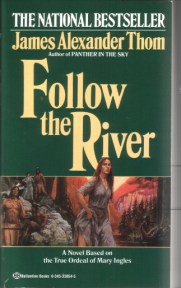
I mentioned author James Alexander Thom in yesterday’s blog post. Ironically, I found a comment by Mr. Thom about irony on his website (www.jamesalexanderthom.com) today. Six of his historical novels, including Follow the River, are available in electronic form.
I found the following statement and quote on the website:
“The author finds the news good, but ironic, musing, ‘I use every bit of my skill and imagination to take my readers hundreds of years into the past – and now they’ll visit those old days through the screen of an electronic gizmo.’”
That’s irony.
Until my next blog post
I hope you have a good book to read. If you’re an author, I hope you have quality writing time.
This is the eighth day of the 2017 A to Z Blog Challenge, so I am writing a blog post that has something to do with the letter, “H.” I chose a topic I enjoy and one about which I try to learn more every day.
One of my dreams is to write a historical novel. The historian in me struggles with the fiction in historical fiction. The writer in me wishes I could run fast and loose with the facts.
Over the weekend, I did a lot of reading on the subject in preparation for writing today’s blog post. In the process, I found some information that shed more light on the historical event that serves as the basis for the novel manuscript I’ve been working on for the last decade or so.
The combination of the new information I found about that event when paired with some of the reading I did yesterday about the craft of writing historical fiction made my head spin. The combination of the two, in fact, has convinced me that I must start over writing my novel. Yes, you read that correctly. I must start over.
When I mapped out my topics for this A to Z Blog Challenge two or three weeks ago, I thought “H” was a no-brainer. I could write about historical fiction. Today’s post would be one of the easier ones of the 26 letters of the alphabet. That’s laughable now, except I don’t feel much like laughing.
I won’t see The Spanish Coin in print. Not in its present form. Probably not in any form or with that title. I will, however, be able to use parts of it and characters from it.
None of my research has been in vain. Nor has any of my writing. Any time spent writing is beneficial. Writing is an exercise of “muscles” in the brain. Like any other muscles in the body, if not used they weaken and eventually cease to work.
The bad news is that I have to start over. The good news is that I get to start over. Today I get a fresh start.
I’m certainly not the first writer who never got her first novel published. There are numerous stories about first manuscripts being lost. Some succumbed to fire, while others were mistakenly left on a train and were never seen again. Many first manuscripts get rejected so many times by publishers that the writer eventually puts it away and moves on to another novel. Most writers have had to start over. That is what I will do, and I believe the end product will be better than The Spanish Coin manuscript.
Historians, as a rule, look at historical fiction with disdain. I want to be a historical novelist whose work is respected even by historians. Something I learned from historical fiction author Sharyn McCrumb and from author James Alexander Thom is that historical fiction can be just as — or even more — accurate than a history textbook.
History contains many errors because each person sees the same incident differently or remembers it differently. History textbooks contain errors and are biased depending on the agenda of the writer(s), the publisher, or the state school board or local school’s decision makers selecting the curriculum. History books are usually written by someone on the winning side of a war. The viewpoint of the losing side is rarely given or, if it is, it is what the winner thinks the loser thought or believed.
James Alexander Thom quotes author Lucia Robson in his book, The Art and Craft of Writing Historical Fiction as he wrote the following:
“Lucia Robson’s facts can be trusted if, say, you’re a teacher assigning her novels as supplemental reading in a history class. ‘Researching as meticulously as a historian is not an obligation but a necessity,’ she tells me. ‘But I research differently from most historians. I’m look for details of daily life of the period that might not be important to someone tightly focused on certain events and individuals. Novelists do take conscious liberties by depicting not only what people did but trying to explain why they did it.’”
Mr. Thom also wrote in that same book about writing historical fiction:
“To be really good historical novelists, though (and that’s what I want us to be), we have to take our obligation to historical truth just as seriously as the historians do theirs.”
He also wrote,
“But here’s the key: Whether your historical story is ancient or recent history, what you want to do is re-create it in full – live, colorful, smelly, noisy, savory, painful, repugnant, scary, all the ways it actually was – and then set the reader down smack in the midst of it.”
Many years ago, I read Follow the River, by James Alexander Thom. His writing was so good that I felt like I was in the story. I felt like I was Mary Ingles, the main character.
If I’m going to write historical fiction, this is my challenge: Get all the facts right, as far as research makes that possible, and flavor the story with believable dialogue and enough authentic background to make my reader feel like he or she is there.
The story I want to write takes place in the Carolina backcountry in 1771. In order to take my reader there, I must go there. I must be there.
Until my next blog post
Please hang in there with me. I’ve always thought of my blog as a way to take readers along on my journey as a writer. The road is not straight. It contains many curves, hill, and potholes. Yesterday I ran up on an unexpected detour.
As a traveler, I don’t like detours. I’m the type person who drives other people crazy. I map out the entire trip in advance. I have a daily itinerary planned. I leave little time for serendipity. That’s the way I plan vacations and yet, when I look back on the best trips of my life, it is the ones that weren’t so rigidly planned that I enjoyed the most.
Fasten your seatbelts, because this writer’s journey just got a lot more exciting and uncertain!
I’m going to do something on my writing blog today that I haven’t done before. Come to think of it, I’m doing two things I haven’t done before. (1) I’m blogging twice in one day, and (2) I’m going to share with you just a bit of the talent of music composer James Revels. (James doesn’t know I’m doing this!) We follow each other’s blogs although I try to write books and he writes music. I am never disappointed by the compositions he shares on his blog and on YouTube. His music is upbeat and fresh. When I’m checking in on the blogs I follow, it’s always nice to take a bring from reading and listen to James’ latest compositionn
Make sure the volume is turned on, click on the start button, close your eyes, and enjoy the music of James Revels.
Until my next blog on Monday (unless I stumble upon something else I want to share)
I hope you have a good book to read. (I’m reading Bittersweet, by Colleen McCullough and The Source, by James A. Michener.) If you’re a writer, I hope you have productive writing time.
This is the seventh day of the 2017 A to Z Blog Challenge, so I am featuring the letter “G” in today’s post.
I no longer remember how I found out about GOODREADS.COM, but it has become one of my favorite websites. I have a reader’s page and an author’s page on the site. Since I’ve only published one nonfiction book, my author page is not very extensive.
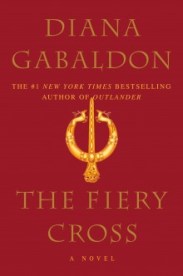
This is the sixth day of the 2017 A to Z Blog Challenge, so I am featuring the letter “F” in today’s post. Every month I blog about a favorite line from a novel. Today I shine a light on a FAVORITE line from the novel THEFIERY CROSS, by Diana Gabaldon.
It is the last line in the book, and it is spoken by the heart throb of Ms. Gabaldon’s Outlander Series, JAMIE FRASER.
“’When the day shall come, that we do part,’ he said softly, and turned to look at me, ‘if my last words are not ‘I love you’ – ye’ll ken it was because I didna have time.’”
Whew!
I wish I’d written that!
Until my next blog post tomorrow
I hope you have a good book to read. If you’re a writer, I hope you have productive writing time.
On the fifth day of the 2017 A to Z Blog Challenge I considered blogging about the dreaded editing process that strikes fear in the heart of the writer. (There should be sound effects here. Think “dadadadah dadadadahhhhh” from Beethoven’s 5th Symphony.)
However, I am so far from being an expert on editing that I concluded that I shouldn’t attempt to write about the process. That left me scrambling for another “E” word to blog about today.
As I bounced around on the internet looking for inspiration, I happened upon an interesting article about E-BOOKS. Written in 1998, this serious article comes across as humorous to the 2017 reader. If you don’t think the world of publishing has changed in 20 years, I direct your attention to “Electronic Books – A Bad Idea,” by Jakob Nielsen as published on July 26, 1998, on https://www.nngroup.com/articles/electronic-books-a-bad-idea/.
The title of the article alone gives the 2017 reader a chuckle. Before I start throwing rocks at this 1998 article, though, I thought I should do a little research on its author, Jakob Nielsen. The name meant nothing to me, since I’m not a computer nerd.
Who is Jakob Nielsen?
Jakob Nielsen is a Danish web usability consultant born in 1957. He holds a Ph.D. in human-computer interaction from the Technical University of Denmark in Copenhagen. I don’t even understand what that means except that Dr. Nielsen is far better qualified to write about electronic books than I will ever be. In 1998, I’m not sure I’d ever heard of electronic books.
According to https://www.nngroup.com/people/jakob-nielsen/, Dr. Nielsen is a principal of the Nielsen Norman Group. He co-founded the organization with Dr. Donald A. Norman, a former Vice President of Research at Apple Computer. His biographical information on the Nielsen Norman Group website states that Dr. Nielsen “holds 79 United States patents, mainly on ways of making the Internet easier to use.”
Dr. Nielsen’s accomplishments are far too numerous for me to include here. Suffice it to say, he knows what he’s talking about and he was a respected authority in 1998 as well. I cite his 1998 article today merely to illustrate how far we’ve come in the last two decades.
His article talks about his hope that “The Last Book” Project at the MIT Media Lab would produce a computer on which the reader could flip pages like one does when reading a printed book. Dr. Nielsen argued that “digital ink” needed to be invented that would give higher resolution, and hence, “gain the same reading speed as print.”
Dr. Nielsen stated the following two paragraphs in his 1998 article:
“Even when e-books gain the same reading speed as print, they will still be a bad idea. Electronic text should not mimic the old medium and its linear ways. Page turning remains a bad interface, even when it can be done more conveniently than by clicking the mouse on a ‘next page’ button. It is an insufficient goal to make computerized text as fast as print: we need to improve on the past, not simply match it.
”The basic problem is that the book is too strong a metaphor: it tends to lead designers and writers astray. Electronic text should be based on interaction, hypertext linking, navigation, search, and connections to online services and continuous updates. These new-media capabilities allow for much more powerful user experiences than a linear flow of text. Linear text may have ruled the world since the Egyptians learned to produce arbitrarily long scrolls of papyrus, but it’s time to end this tradition. Nobody has time to read long reports any more: information must be dynamic and under direct control of the reader, not the author.”
“When Peter James published his novel Host on two floppy disks in 1993, he was ill-prepared for the ‘venomous backlash’ that would follow. Journalists and fellow writers berated and condemned him; one reporter even dragged a PC and a generator out to the beach to demonstrate the ridiculousness of this new form of reading.”
Jump forward to 2017
We’re still debating in the public arena the fate of printed books. In the 1990s, Peter James predicted that electronic books would someday threaten print books with extinction. He was probably laughed at for saying that; however, that very issue is up for much debate today.
Print versus e-books
People seem to fall into two camps. There are people who have dug in their heels and refuse to read an e-book. At the other end of the spectrum are people who only read e-books. If they can’t get an electronic copy, they simply don’t read the book. I fall somewhere in the middle.
I like the ease of holding my Kindle Fire in my hand and having immediate access to hundreds of books. (If money were no object, I would have immediate access to thousands or possibly millions of books. That’s not my reality, though.)
I like being able to borrow e-books from the public library and change the font to better suit my aging eyes.
I like being able to pause when I come to a word I don’t know, highlight it with my finger, and instantaneously pull up the word’s definition. In fact, I have used that feature so much that occasionally while reading a print book I catch myself holding my finger on an unknown word and waiting for the definition to magically appear!
I also like the feel of a printed book. The smell of a new book. The clean, crisp pages of a new book.
I like the pliability of a well-worn old book – for instance, an old family Bible. I like the feel of my great-grandmother’s tiny leather-bound Psalter. I like holding a book in my hands that an ancestor held in her hands 150 years ago.
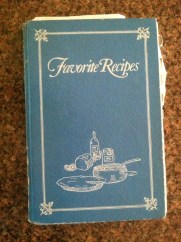
I like holding a cookbook that my mother hand wrote. There’s something comforting in reading her favorite recipes written in her own handwriting. As her death in 1993 becomes more distant, this book that she wrote just for me becomes more and more valuable to me. An electronic copy of my mother’s favorite recipes would also be valued, but it wouldn’t have the same effect on me as the paper pages bearing her handwriting.
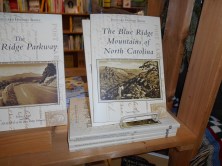
The day that the boxes of my paperback vintage postcard book, The Blue Ridge Mountains of North Carolina, arrived at my door was a day I’ll never forget. Although discovering my book in electronic form some weeks later was a thrill of a whole other kind, nothing equals the thrill I feel when I walk into a bookstore and see the paperback edition of my book on the shelf.
Janet’s book on display at Books Unlimited in Franklin, NC.
Destiny of printed books
Rachel Nuwer asked a question early in 2016 in her BBC article that is still waiting for an answer:
“Are printed books destined to eventually join the ranks of clay tablets, scrolls and typewritten pages, to be displayed in collectors’ glass cases with other curious items of the distant past?”
Then, she asked a follow up question: “And if all of this is so, should we be concerned?”
I ask, “Does it have to be either/or?”
The advent of e-books has revolutionized book publishing, but surveys indicate that most people still prefer print books. The advent of print-on-demand books and e-books struck fear in the hearts of writers, be they established, or newly-published, or the not-yet-published.
E-books – a two-sided coin.
On the one hand, e-books are less expensive to publish than print books, which prompted a fear that they would completely replace print books. As long as there is a demand for traditional print books, I believe they will continue to be printed. E-book technology has made it possible for anyone to publish a book. The other side of that coin, though, is that e-book technology has made it possible for anyone to publish a book.
You read that right. The good thing about e-books is the same as the bad thing about them. Do we want anyone publishing anything they want to? It used to be that having a novel published by a large publishing house gave the author credence. The way large publishing houses used to operate, an author was assigned an editor. The editor worked closely with the author to polish the novel before it was published. Budget crunches gradually squeezed in-house editors out of the equation. Now a person can self-publish an e-book without the aid of an editor. In fact, a person can self-publish an e-book without the benefit of even a self-edit.
My plan
It remains to be seen how or if I will get The Spanish Coin published. My original dream was that I would get a literary agent who would get me a contract with a large publishing house. That would still be fantastic and would stamp me as a legitimate writer; however, realistically, I know that I might have to self-publish a print-on-demand book or an e-book only. Doing so does not carry the stigma it did just a few years ago. The assumption used to be that a self-published novel was not professionally edited, but that is no longer necessarily the case. If I choose to self-publish The Spanish Coin, it will only be after it has been professionally-edited at my own expense, of course.
I hope within a year, I’ll know which path to publication The Spanish Coin is taking.
Until my next blog post tomorrow
I hope you have a good book to read. If you’re a writer, I hope you have productive writing time.
On this fourth day of the 2017 A to Z Blog Challenge, I’m supposed to write about something related to the letter “D.” Staying in my usual theme of writing, I chose the word, DIALECT.
18th century African slave dialect
Dialect is something I’ve had to address in my The Spanish Coin manuscript. One of the main characters and one of the minor characters are slaves in South Carolina in 1771. Another character is a free woman of color living in the community.
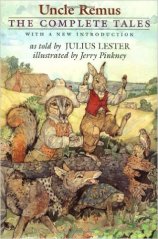
Dialect can be overdone. As a novice writer, that’s a fair assessment of where I was. I had those two slaves dropping the “g” at the end of every gerund. I gradually realized that they sounded like Uncle Remus or worse.
I grew up in the 1950s loving Uncle Remus stories, but writing a novel in the 21st century and assigning a speech pattern to that extreme is just wrong on so many levels.
Being a beginning writer, though, perhaps I had to go through many stages with the slaves’ dialect. I gradually changed dialectal words to today’s language – or to the standard language of the time and place. (The “find and replace” feature on the computer became my best friend.)
Beowulf
Even if it weren’t offensive to overuse dialect in a novel, it would be exhausting to the writer and the reader. It would be something akin to having to read Beowulf as it was originally written in Old English. I had to read Beowulf in high school, and I think I’d rather have a root canal than have to read it again. (My apologies to the late Mrs. Estelle Cline, my senior English teacher.)
Foreign accents
A consideration related to having a character speaking in dialect is having one speaking with a foreign accent. Since most of the characters in The Spanish Coin are Scottish or Irish immigrants, they use some words that we no longer use in America or they have ways of pronouncing words that differ from my 2017 pronunciation in North Carolina. For instance, the word “wee” is still very much used in Scotland and would have been used by Scottish immigrants and probably by one or two more generations, whereas today in America we use the word “little.” Having a character in The Spanish Coin say “wee” is a way I chose to remind the reader that a particular character is a native of Scotland.
Another character in The Spanish Coin is a French immigrant. There are a few French words he says when he cannot think of or doesn’t know the English word he needs to use. Perhaps I watch too many cooking shows on TV, but in my mind the Frenchman is my book sounds just like Jacques Pepin.
Until my next blog post tomorrow
I hope you have a good book to read. If you’re a writer, I hope you have productive writing time.
This is the third day of the 2017 A to Z Blog Challenge, so today’s post must have something to do with the letter “C.” Thinking in the realm of writing fiction, I settled on the word CHARACTERIZATION.
Characterization can be shown through narrative, dialogue, action, and reaction. All four should be used by a writer.
There are many things for a fiction writer to keep in mind in creating and fleshing out characters. My writing mentor from Queens University of Charlotte, Judy Simpson, said, “Don’t begin writing your story until you know all of the major characters.” I can’t remember if I followed that advice when I started writing The Spanish Coin manuscript 10 or more years ago. (There! I’ve said it! This has been a labor of love that I have worked on in spurts and fits, sometimes not touching it for more than a year at a time.) But I digress.
The famous mantra of writing instructors comes into play in characterization: Show, don’t tell. Don’t tell the reader about a character. Reveal character details through what they say, how they say it, and what they do or don’t do.
Even though the writer might have in her notes a driver’s license description of each character (e.g., black male, brown eyes, black hair, six feet tall, 180 pounds) that is usually not the best way to introduce a character to your reader. Let those details (or just the ones that are pertinent) come out gradually and in subtle ways.
Every character has strengths and weaknesses. A “goody-two-shoes” character is boring and, let’s face it, offensive and irritating. Likewise, even the most heinous villain probably has some redeeming value.
Characters unnecessary to the story should be omitted. Related to that, a writer should not include minor characters early on in a novel because the reader might be misled and lose interest.
There is also the matter of choosing names for all the characters. Writing instructors caution beginning writers not to give two characters in the same short story or novel names that are similar. For instance, you might not want a Phil and a Phyllis in the same book.
I have struggled over the name of a free woman of color in The Spanish Coin. She was Rachel for a long time because I think Rachel is a beautiful name and it conjures up an image of a strong and elegant woman in my mind. I changed her name to Clarissa in honor of a woman of color who made a great impression on me while I was writing local history articles for a newspaper a decade ago. It will be interesting to see what the character’s name turns out to be in the final product.
Another consideration that must be taken into account, especially when writing historical fiction, is that the writer must make sure to give characters names appropriate to the time and place. For instance, you won’t find a Tammy or a Kevin in The Spanish Coin because those names were not used in 1771 in the Carolina backcountry.
Each character should have at least one distinguishing characteristic in order to help set an image in the reader’s mind. A character could have a foreign accent, a disfiguring physical feature, a hearing problem, a lisp, a limp, an annoying laugh, a mental illness, or a word or phrase that no one else says.
Who knew there were so many things to think about when giving a fictitious character a name?
Until my next blog post tomorrow
I hope you have a good book to read. (I seem to always have too many on my bedside table! One night they’re going to topple over and give me a concussion.) If you’re a writer, I hope you have quality writing time.
On this second day of the 2017 A to Z Blog Challenge, my blog post is supposed to have something to do with the letter, “B.” I was tempted to write about blogging, but I’ve had that as my topic several times lately. I decided to write about BACKGROUND and what it means in fiction.
Foundations in Fiction
My first thought was to see what my fiction writing instructor in the Continuing Education Department at Queens University of Charlotte, Judith H. Simpson, had to say about background in her book, Foundations in Fiction.
Although background and setting are often used interchangeably, Judy chose to address them separately. Whereas setting is physical location, background is the story’s environment. Of background, Judy wrote in her book, “It is not the physical place but something more than that. It can be the hero’s job.”
Examples of background
Many popular authors use a background for their novels that becomes part of their brand. Janet Evanovich’s Stephanie Plum novels are set in New Jersey, but the background is bounty hunting — albeit of the bumbling variety. Tony Hillerman used Indian reservations for background in his Leaphorn and Chee series. Margaret Truman used iconic locations in Washington, DC in her murder mysteries, and Amy Clipston uses the Amish culture as the background in her fiction.
I enjoy reading and writing historical fiction. The historical fiction writer must create physical setting, create story background, and recreate a past culture, according to Judy Simpson. That last aspect — recreation of a past culture — is what gives historical fiction authenticity.
The writer of historical fiction must do extensive research in order to write believable characters. The novel manuscript I’m writing is set in the Carolina backcountry in 1771. People dressed and lived differently in 1771 than how we dress and live in that same geographical location in 2017. The culture, values, and accepted societal mores were different in 1771 than they are in 2017.
The writer of good historical fiction “must know the history of the period you are using; you must understand the social structure of this society; you must know how they lived, what they wore, what they ate, their monetary system, their transportation system, their social events, their daily lives,” according to Judy’s book. If you make an error, one or more readers will delight in bringing that mistake to your attention.
In writing my The Spanish Coin manuscript, I have done extensive research. The fear of making a mistake has paralyzed me sometimes. If I wait until my research is complete and my writing is perfect, though, my novel will never be published. At some point in the next 12 months, I need to conclude that it is as good as I can make it, push to get it published, and get back to writing the sequel.
The Flavor of Historical Fiction
Judy Simpson wrote the following in Foundations in Fiction and I try to keep her words in mind as I work on my book:
“Remember that what makes a historical novel different is the flavor, the sense of time and place of a long ago era. When the reader finishes the book, they should feel as if they were there, as if they really know what it would be like to live then. You have to capture the essence of that time and each period has its own flavor. Only you, the writer, can open the gate to that era for the reader.”
Until my next blog post tomorrow
I hope you have a good book to read. (As I was writing this last night, I was still reading The Heavens May Fall, by Allen Eskens.) If you’re a writer, I hope you have quality writing time.








 Janet's Writing Blog